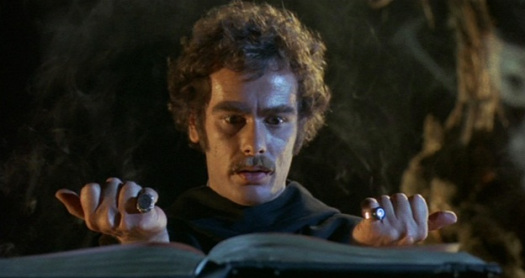
THE DUNWICH HORROR is another film I saw when it was first released, on a double bill with the Spaghetti Western GOD FORGIVES, I DON’T. Unfortunately, this one fails to stand the test of time, with it’s trippy special effects and a somnambulant performance by Dean Stockwell , who was pretty obviously stoned out of his gourd during the shooting.
Professor of the occult Henry Armitage is lecturing on the Necronomicon, a book said to hold the key to the gate to another dimension, where a race of monsters known as “the old ones” dwell. Creepy Wilbur Whateley, great grandson of occultist Oliver, shows an abonrmal interest in the book. In fact, Wilbur wants to possess the Necronomicon to bring “the old ones” back to rule the Earth once again. To achieve this, he pretty much kidnaps and drugs student Nancy Wagner, hoping to use her in a bizarre sex…
One thing that I instantly liked about Demon’s Tomb was the opening screen, which lists all of the special features that come with this game:
I appreciated that this game comes with a “pretend to be working” mode. Sometimes, when a game is uploaded into the Internet Archive, it loses some of its features. (For instance, do not even try to save a game if you are playing it in the archive.) While playing Demon’s Tomb, I decided to see if the pretend to be working mode still worked.
This was the game, before I pressed F2.
After I pressed F2.
After I pressed F2 again.
The game itself is an Infocom-style text adventure. You start the game as Edward Lytton, a British archeologist who is exploring a burial mound that has been uncovered on the moors. Do not get too attached to Edward. At the start of the game, he is trapped in the tomb and you are told that he only has a few turns left to live. Before Edward dies, you can hide some of his possessions around the tomb so that they can be found later.
This is important to do because, after Edward dies, the game becomes about his son, Richard. Richard arrives at the tomb to search for his father and he discovers that opening of the tomb has unleashed an ancient demon. In order to defeat the demon and escape from the burial mound himself, Richard is going to need to find the things that Edward has hidden in the tomb. If you did not hide those things while you were Edward, you will not be able to find them once you become Richard.
This is a challenging but rewarding game and the only real way to solve it is through trial and error. Try something and, if it doesn’t work, do the opposite the next time you play. Or you can just go on google and search for a walkthrough, like I shamefully did once I realized that I was never going to be able to figure this game out on my own.
Demon’s Tomb is largely text-based but it does give you the option to press F1 and see pictures of what is being described. For example:
And my favorite:
If you are looking for a retro adventure game, I highly recommend Demon’s Tomb. It’s a shame that they don’t make them like this anymore.
4 Shots From 4 Films is just what it says it is, 4 shots from 4 of our favorite films. As opposed to the reviews and recaps that we usually post, 4 Shots From 4 Films is all about letting the visuals do the talking.
This October, I am going to be using our 4 Shots From 4 Films feature to pay tribute to some of my favorite horror directors, in alphabetical order! That’s right, we’re going from Argento to Zombie in one month!
Today’s filmmaker: the legendarily prolific Jess Franco!
Ghost Stories was a U.S. pulp magazine that published 64 issues between 1926 and 1932. It was one of the earliest competitors to Weird Tales, the first magazine to specialize in the fantasy and occult fiction genre. It was a companion magazine to True Story and True Detective Stories, and focused almost entirely on stories about ghosts, many of which were written by staff writers but presented under pseudonyms as true confessions. These were often accompanied by faked photographs to make the stories appear more believable. Ghost Stories also ran original and reprinted contributions, including works by Robert E. Howard, Carl Jacobi, and Frank Belknap Long. Among the reprints were Agatha Christie’s “The Last Seance” (under the title “The Woman Who Stole a Ghost”), several stories by H.G. Wells, and Charles Dickens’ “The Signal-Man”. The magazine was initially successful, but began to lose readers, and in 1930 was sold to Harold Hersey. Hersey was unable to reverse the magazine’s decline, and Ghost Stories ceased publication at the start of 1932.
The covers below are all from Ghost Stories. Where possible, the artist has been credited:
For today’s horror on the lens, we have the low-budget, 2006 indie zombie film, My Dead Girlfriend.
The Late Night Movie Gang and I watched this move on Saturday night and it amused the Hell out of us. It’s about a guy (played by director Brett Kelly) who somehow manages to roll over his girlfriend while backing out his car. She’s dead but, fortunately, there’s some black magic books lying around so, before you know it, she’s alive again!
Except, of course, she’s kind of undead and hungry now. Amy, the formerly dead girl, is played by Caitlin Delaney and she has a blast trying to eat everything that she comes across. Eventually, Kelly decides to take her up to a cabin so that he can figure out what to do next. Unfortunately, a lot of their friends decide to come hang out at the cabin at the same time…
Anyway, this is a fun movie. I always like watching movies like this. For what they may lack in budget, they often make up for it in passion.
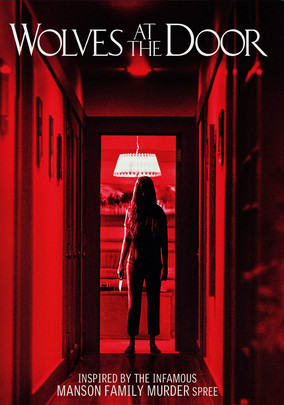
I’m really not sure what to make of Wolves at the Door.
I knew the film was inspired by the crimes of Charles Manson and his family before I watched the film. Not only was Wolves at the Door specifically advertised as being “Inspired by The Infamous Manson Family Murder Spree” but just check out the plot description that was provided by Warner Bros:
Four friends gather at an elegant home during the Summer of Love, 1969. Unbeknownst to them, deadly visitors are waiting outside. What begins as a simple farewell party turns to a night of primal terror as the intruders stalk and torment the four, who struggle for their lives against what appears to be a senseless attack.
The Manson Family have inspired a countless number of films, so that’s not really an issue. Almost all of those films either presented Manson and his followers as being the epitome of evil or they told stories that were heavily and obviously fictionalized.
Wolves at the Door, however, is different. Other than in some news footage that is shown during the end credits, Manson is not seen in the film. For that matter, the members of the Family don’t get much screen time either. Mostly, they’re just seen as shadows, creeping down hallways and sometimes materializing in a doorway before vanishing. There’s no mention of Helter Skelter or the Beatles. I’d have to rewatch the film to say for sure but I think it’s possible that we only hear them say one or two words over the course of the entire movie.
Instead, Wolves at the Door spends most of its running time with the victims of the Manson Family, following them as they are unknowingly stalked inside of a Los Angeles mansion. Usually, in a film like this, you would expect the names to be changed but, for some reason, that doesn’t happen in Wolves At The Door.
So, Katie Cassidy plays a pregnant actress who is named Sharon.
Elizabeth Henstridge plays a coffee heiress who is named Abigail.
Adam Campbell plays Abigail’s Polish boyfriend, who is named Wojciech.
Miles Fisher plays a hairdresser who is named Jay and who just happens to be Sharon’s ex-boyfriend.
And, finally, Lucas Adams plays a teenager stereo enthusiast named Steven, who just happens to be in the wrong place at the wrong time.
Speaking as someone who loves horror and who has defended some of the most critically derided films of all time, everything about Wolves at the Door just feels icky, tacky, and wrong. Many grindhouse horror films have been inspired by actual crimes but most of them at least changed the names of the victims. You really have to wonder just what exactly the filmmakers were thinking here.
(Then again, just two years ago, NBC greenlit a show called Aquarius, which could have just as easily been called “The Adventures of Young Charlie Manson.”)
It’s not just that Wolves at the Door is offensive. In fact some of the best movies of all time were specifically designed to be offensive. The problem with Wolves at the Door is that it’s also just a very shoddy film. (In fact, if the film had been well-made, it wouldn’t be quite as offensive.) Though the actors may be talented, they’re let down by a script that’s full of some of the clunkiest dialogue that I’ve ever heard. Though the soundtrack may feature some good songs, they’re still the same damn songs that show up in every movie set in 1969. (Judging from the movies, everyone in 1969 just listened to the same five songs over and over again.) Though the movie itself is only 73 minutes long, it is so abysmally paced that it feels much, much longer.
Sadly, this film was directed by John Leonetti, who did a pretty good job with Annabelle. Again, I’m not sure what exactly he or anyone else was thinking with Wolves at the Door, which I’m going to go ahead and declare to be the worst film of 2017. I know that the year isn’t over yet but I just can’t imagine anything as bad as this.
Tonight’s televised horror is another episode of the 2002 revival of The Twilight Zone.
In fact, it’s a sequel to a classic episode that aired during the show’s original run!
Remember that episode about the creepy little kid in Ohio who could read thoughts and mentally make just about anything happen? He wanted it to snow so it snowed and ruined the crops. He got mad at someone who drank too much so he turned the guy into a big jack-in-the-box. His aunt sang too much so he took away her mouth. That episode was called “It’s A Good Life.”
Well, It’s Still A Good Life catches up with that boy 41 years later. He’s still ruling that little town with an iron hand but now, he’s got a daughter. And she might have powers of her own…
Bill Mumy and Cloris Leachman both appeared in the original episode and they reprise their roles here.
1980’s The Funhouse opens with an almost shot-for-shot recreation of the famous shower scene from Psycho, with Amy (Elizabeth Berridge) getting attacked in the shower by a masked, knife-wielding maniac.
The only difference is that there’s no shrieking violins, there’s no blood, and the knife is quickly revealed to be a fake. It turns out that the “killer” is actually Amy’s younger brother, Joey (Shawn Carson). Joey loves horror movies. In fact, he’s pretty much the perfect stand-in for The Funhouse‘s intended audience. Joey was just playing a rather mean-spirited prank but now, as a result, Amy snaps that she’s not going to take him to the carnival.
Of course, Amy isn’t supposed to be going to the carnival either. Her parents have strictly forbidden it. Everyone knows that traveling carnivals are dangerous and, at the last town the carnival visited, two teenagers disappeared! There’s no proof that the carnival has anything to do with those disappearances, of course. But still…
Amy does exactly what I would have done in her situation. She tells her parents that she’s going over to a friend’s house and then she goes to the carnival anyway! Accompanying her is her boyfriend Buzz (Cooper Huckabee), who is so cool that he has a name like Buzz. Also along for the ride: Amy’s best friend, Liz (Largo Woodruff), and her boyfriend, Richie (Miles Chapin). Richie’s kind of a loser but that’s to be expected. Every group needs at least one idiot who can do something stupid that gets everyone else killed. We all know how that works.
The carnival turns out to be just as sleazy as Amy’s parents thought it would be. There’s a fake psychic (Sylvia Miles). There’s a magician who dresses like Dracula. There’s a barker (Kevin Conway), whose deep voice is constantly heard in the background. And, of course, there’s a funhouse! Still, everyone’s having a good time. Either that or they’re all just stoned.
For his part, Joey sneaks out of the house and goes to the carnival himself. He doesn’t have quite as much fun as Amy. In fact, his experience is pretty scary. Weird carnival people keep yelling at him. He keeps getting lost. Still, things could be worse. By the time his parents arrive to pick Joey up, Amy and her friends are all trapped in the funhouse. They’re being pursued by the barker and his deformed son (Wayne Doba). Needless to say, it’s all pretty much Richie’s fault.
Richie. What a dumbass.
With its teenage victims and its lengthy chase scenes, The Funhouse is often dismissed as just being another early 80s slasher film. However, The Funhouse is actually a fairly clever, entertaining, and occasionally even witty horror film. Much like director Tobe Hooper’s best-known film, The Texas Chainsaw Massacre, The Funhouse gets its scares by convincing audiences that they’re actually seeing more than they are. Hooper emphasizes atmosphere and performances over gore. While The Funhouse has its share of jump scares, it mostly succeeds by convincing us that anyone could die at any moment. It’s an intense film, with excellent performances from both Elizabeth Berridge and Kevin Conway.
After kickstaring the slasher genre with The Texas Chainsaw Massacre, Hooper used The Funhouse to poke a little fun at it. From the opening shower scene to the electrifying finale, Hooper plays with the genre-savvy expectations of the audiences. Our four victims even do the smart thing for once — they try to all stay together. Needless to say, that doesn’t work out too well.
The Funhouse is an entertaining thrill ride and, seen today, it’s more evidence that Tobe Hooper deserved better than he got from the film industry.