Tonight’s episode of The Twilight Zone might remind you of a previous episode entitled The Dummy. Once again, we have a story about a ventriloquist (Jackie Cooper) and a dummy who appears to have a mind of his own. (In fact, the same prop dummy was used in both episodes.) However, Caesar and Me is an even darker take on the conflict between puppet and puppeteer.
Seriously, don’t mess with Caesar.
This episode originally aired on April 10th, 1964.
Whenever it comes time to review a film like 1988’s Faceless, movie bloggers like me are faced with a very important question. Which name should we use for this film’s prolific director? The director was born Jesus Franco Manera and, for a very small handful of his 200+ film, he’s actually credited by his full name. However, for the majority of his films, he dropped the Manera. Sometimes, he is credited as Jesus Franco and then other times, the director’s credit reads Jesse Franco or just simply Jess Franco.
Myself, I usually prefer to go with “Jess Franco,” because it just seems to go with his “never give up” style of filmmaking. At the same time, it seems rather appropriate that Franco is known by more than one name because he was a director with a many different personas, occasionally a serious artist, occasionally a subversive prankster, and sometimes a director-for-hire. Franco was a lover of jazz and his films often had a similarly improvised feel. Sometimes, the results were, to put it lightly, not very memorable. But, for every Oasis of the Zombies, there was always a chance that Franco would give the world a film like Female Vampire. The imdb credits Franco with directing 203 films before his death in 2013 but it’s generally agreed that he probably directed a lot more. A lot of his films may not have worked but the ones that did are memorable enough to justify searching for them.
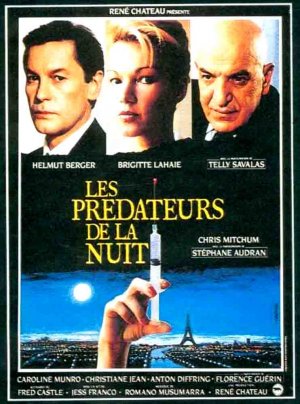
Faceless is Franco’s take on Eyes Without A Face, as well as being something of a descendant of his first film, The Awful Dr. Orloff. All three of these films deal with a doctor trying to repair a loved one’s disfigured face. In Faceless, the doctor is Dr. Flammad (Helmut Berger), a wealthy and decadent Paris-based plastic surgeon. One night, while out with his sister Ingird (Christiane Jean) and his nurse and lover Nathalie (Brigitte Lahaie, the former pornographic actress who appeared in several of Jean Rollin’s best films, including the brilliant Night of the Hunted), Dr. Flammad is confronted by a former patient. Flammad botched her operation so the patient tries to get back at him by tossing acid in his face. However, Ingrid shoves Flammad out of the way and ends up getting splashed by the acid instead.
Now disfigured, Ingrid spends her time hidden away in Flammad’s clinic and wearing a mask. Flammad and Nathalie start to kidnap models and actresses, searching for a perfect face. Flammad’s plan is to perform a face transplant, giving Ingrid a new and beautiful face.
Needless to say, a face transplant is not a simple thing to do. In order to get some advice, they go to the mysterious Dr. Orloff (Howard Vernon) and Orloff directs them to a Nazi war criminal named Dr. Moser (Anton Diffring). Now, if you’re not familiar with Franco’s work, the scene with Dr. Orloff will probably seem like pointless filler. However, if you are a Francophile, you will feel incredibly relieved to see Howard Vernon suddenly pop up. When it comes Franco’s films, a Howard Vernon cameo is usually a good sign.
Flammad’s search for the perfect face is complicated by the fact that his assistant, the moronic Gordon (Gerard Zalcberg), keeps accidentally killing and otherwise damaging all of the prospects. As the bodies continue to pile up, Nathalie even points out that there’s “too many dead bodies” in the clinic.
(Of course, Nathalie isn’t doing much to solve that problem. When the film got to the moment where Nathalie plunged a syringe into one troublesome patient’s eye, I ended up watching the movie between my fingers.)
Eventually, Nathalie kidnaps a coke-addicted model named Barbara (Caroline Munro). Flammad thinks that Barbara might finally be the perfect face that they’ve been looking for but there’s a problem. (Actually, two problems if you count Gordon…) Barbara’s father (Telly Savalas) is a wealthy industrialist and he wants his daughter back. He hires an American private investigator, Sam Morgan (Chris Mitchum, looking a lot like his father Robert), to track her down.
Actually, it’s not that much of a problem. It quickly turns out that Sam is kind of an idiot. Plus, since he’s American, nobody in Paris wants to help him. A Paris police inspector orders him to go home, yells at him for always chewing gum, and then adds, “You are not Bogart!”
And things only get stranger from there…
Faceless is one of Franco’s better films, a mix of over-the-top glamour (Faceless was filmed in Paris, after all) and grindhouse sleaze. Though there is a definite storyline, the film still feels like an extended improvisation, with characters and plot points coming out of nowhere and then disappearing just as quickly. If we’re going to be totally honest, the film is kind of a mess but it’s a glorious and stylish mess, one that is never less than watchable.
One of the great tragedies of American politics is that Chris Mitchum has twice been defeated when he ran for a seat in the U.S. House of Representatives (though he did come close to winning in 2014). Not only would it be great to have Robert Mitchum’s son as a member of Congress but it would be even better to know that our laws were being written, in part, by the star of Faceless. Unfortunately, Chris is sitting out the 2016 election. Hopefully, he’ll reconsider and file for at least one office.
“There are no crazy people, doctor. We’re all just on vacation.”
— Frank Hawkes in Alone In The Dark (1982)
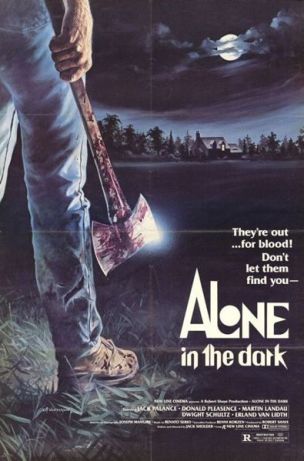
What is the difference between being crazy and being sane? Why are some forms of delusion considered to be socially acceptable while others are condemned? Who is the ultimate authority on what is normal and what is abnormal? These are just some of the issues that are raised by the gleefully subversive 1982 horror film, Alone In The Dark.
We know that there’s something off about Dr. Leo Bain (Donald Pleasence) from the minute we meet him. His smile is a little too nervous and his constant patter of positive words sound a little bit too rehearsed and convenient. When he greets another doctor, he insists on hugging him but it’s an awkward hug. Dr. Bain seems to be trying just a little bit too hard. (In many ways, Pleasence seems to be poking fun at his best-known role, Halloween‘s intense and dramatic Dr. Loomis.)
Dr. Bain is in charge of a psychiatric hospital. He doesn’t believe in conventional therapy. Instead, his hospital is perhaps the most oppressively positive place in the world, a place where every delusion is treated as being perfectly normal and where the patients are treated very leniently.
In fact, security is only present on the third floor of the hospital. That’s because the third floor is home to four inmates who are criminally insane. Frank Hawkes (Jack Palance) is a former POW who suffers from paranoia and gets mad whenever he hears anyone curse. Bryon “Preacher” Sutcliffe (Martin Landau) is a pyromaniac. Ronald Estler (Erland van Lidth) is a gigantic child molester. And finally, there’s The Bleeder, who always hides his face. The Bleeder is a serial killer who is called the Bleeder because, whenever he kills, his nose starts to bleed.
Dr. Bain scoffs at the idea that these four even need security but, as he explains it, the state requires it. However, one night, the power goes out and the four of them manage to escape. As they make their way into the nearby town, they rather easily blend into the mob of “normal” people who are using the blackout as an excuse to go looting.
However, these four patients are on a very specific mission. They had all grown to trust their psychiatrist, Dr. Merton. However, Dr. Merton was eventually hired away by another hospital. Frank is convinced — and has convinced the others — that Dr. Merton was murdered by their new psychiatrist, Dr. Dan Potter (Dwight Schultz). They’re goal now is to track down Dr. Potter and kill him and his family.
Meanwhile, Dr. Potter has issues of his own to deal with. He’s a nice guy but he’s also a bit too uptight and rational for his own good. (Early on in the film, he gets upset when his wife tries to get him to go see a band called the Sic Fucks.) His younger sister, Toni (Lee Taylor-Allan), is visiting while she recovers from a nervous breakdown of her own. She manages to get arrested while protesting a nuclear power plant and, when she gets out of jail, she insists on bringing another protester, Tom (Phillip Clark), home with her.
It all leads to one long night, during which the inmates lay siege to Dan’s house. And, all the while, Dr. Bain worries about whether or not they’re all mad at him…
Alone in the Dark may come disguised as a slasher movie but actually, it’s a pitch black comedy, with a lot of the humor coming from the contrast between Dan’s rationality, Bain’s nonstop optimism, and the fact that every one else in the film is literally batshit insane. The final siege is a masterpiece of suspense and Palance, van Lidth, and especially Martin Landau are memorably frightening in their menacing roles. The film’s final scene deserves to be iconic.
Alone in the Dark is one of those horror films that definitely deserves to be better known. Do NOT mistake it for the Uwe Boll film.
Little Shop…Little Shop of Horrors…Little Shop…Little Shop of Terrors…
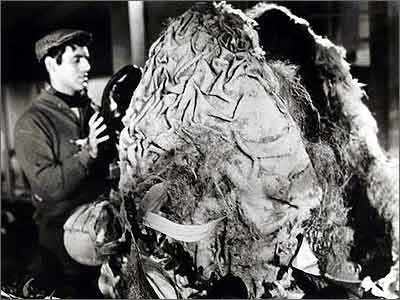
Hi! Good morning and Happy October the 25th! For today’s plunge into the world of public domain horror films, I’d like to present you with a true classic. From 1960, it’s the originalLittle Shop of Horrors!
When I was 19 years old, I was in a community theater production of the musical Little Shop of Horrors. Though I think I would have made the perfect Audrey, everybody always snickered whenever I sang so I ended up as a part of “the ensemble.” Being in the ensemble basically meant that I spent a lot of time dancing and showing off lots of cleavage. And you know what? The girl who did play Audrey was screechy, off-key, and annoying and after every show, all the old people in the audience always came back stage and ignored her and went straight over to me. So there.
Anyway, during rehearsals, our director thought it would be so funny if we all watched the original film. Now, I’m sorry to say, much like just about everyone else in the cast, this was my first exposure to the original and I even had to be told that the masochistic dentist patient was being played by Jack Nicholson. However, I’m also very proud to say that — out of that entire cast — I’m the only one who understood that the zero-budget film I was watching was actually better than the big spectacle we were attempting to perform on stage. Certainly, I understood the film better than that screechy little thing that was playing Audrey.
The first Little Shop of Horrors certainly isn’t scary and there’s nobody singing about somewhere that’s green (I always tear up when I hear that song, by the way). However, it is a very, very funny film with the just the right amount of a dark streak to make it perfect Halloween viewing.
So, if you have 72 minutes to kill, check out the original and the best Little Shop of Horrors…
On tonight’s episode of The Twilight Zone, Al Denton (Dan Duryea) used to be a notorious old west gunfighter. Now, haunted as the result of killing a teenage boy, Mr. Denton is just the town drunk. However, a salesman subtly named Henry J. Fate (Malcolm Atterbury) comes into town and gives Denton the chance to once again be great. Of course, it all comes with a price and a lesson.
Originally aired on October 16th, 1959, Mr. Denton on Doomsday is one of the earlier episodes of The Twilight Zone. Today, it’s perhaps most interesting for its message of anti-violence. Myself,I just like it because I went to college in Denton, Texas.
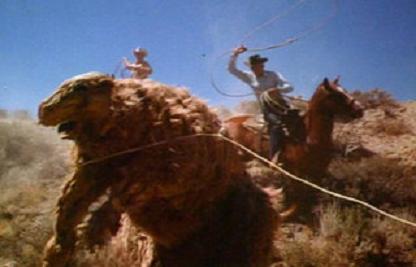
Occasionally, before the main movie starts, the Alamo Drafthouse will show a clip from an old movie. In this clip, a picnic is ruined by the sudden appearance of a giant mutant sheep. Everyone screams while the sheep stares at them with that passive sheep look. Whenever this clip is shown, the audience laughs. And it is pretty silly, especially when it’s seen devoid of any another context.
Myself, I have to admit that I’m always amused when that clip is shown because I know that I’m probably one of the few people in the audience who knows that the scene comes from a 1973 film called Godmonster of Indian Flats. Thanks to Something Weird Video, I have actually seen the entire film and I know that it’s probably the best movie ever made about a giant mutant sheep.
Of course, it’s also the only movie ever made about a giant mutant sheep.
Having sat through Godmonster a handful of times, I’m assuming that it was meant to be satirical. At least, I hope it was meant to be a satire.
While Godmonster may be best known as being a film about mutant sheep, the majority of the movie’s screen time is actually devoted to the culture of the town of Virginia City, Nevada. Virginia City is a tourist town, where everyone dresses like they belong in the old west and where tourists enjoy watching carefully staged gunfights and hanging out at the old-fashioned saloon/brothel. The mayor of the town is evil old Mayor Silverdale (exploitation vet Stuart Lancaster). Mayor Silverdale is determined to keep the town in the past and, as such, he is upset when a real estate agent named Barnstable (Christopher Brooks) shows up and starts trying to convince people to sell their land.
So, Mayor Silverdale and Sheriff Gordon (Robert Hirschfield, who has some truly impressive sideburns) decide to frame Barnstable for murder. It turns out that Gordon owns a dog who knows how to play dead. One day, when they see Barnstable engaged in target practice, Gordon shouts, “YOU SHOT MY DOG!” The dog rolls over and plays dead. Everyone in town believes that Barnstable murdered Gordon’s dog and it turns out that everyone in town loved that dog. They even have a funeral, with a tiny casket.
(Don’t worry, the casket’s empty. As Gordon explains to Silverdale, the dog is visiting relatives in the next town over.)
So, the entire town decides to practice some frontier justice on Barnstable. However, as the mob chases after Barnstable, they end up stumbling across a laboratory. And, inside the lab, is a mutant. 8-foot tall sheep. The sheep escapes the lab and one member of the lynching party is accidentally killed. The town blames the sheep but actually, the sheep is a gentle, well-meaning mutant. Meanwhile, Mayor Silverdale views the sheep as another way to make money…
It’s up to Prof. Clemens (E. Kerrigan Prescott) and his hippie assistant, Mariposa (Karen Ingenthron) to protect the sheep. But where did the sheep come from? Well, Clemens explains that it all has to do with toxic nerve gas and ecological destruction…
Anyway, I’m probably making Godmonster of Indian Flats sound more interesting than it actually is. It’s never as much fun as you would expect a movie about a giant sheep to be. But, even with that in mind, where else are you going to see a giant sheep wandering throughout the desert?
Seriously, this is one of those movies that you should see at least once. It may not be any good but it is one of a kind.
For whatever reason, I’ve lately found myself very much enjoying films about the end of the world. Who knows why. Maybe it’s because I’m dreading having to sit through another election year. Seriously, if the world just ended now, we could all be saved a lot of trouble.
Add to that, the weather’s been weird this year (and please do not take that statement to mean that I want to hear about climate change because seriously, that crap bores me to death). We got hit by snow earlier in the year. (I live in Texas, where snow is a big deal.) It rained more than usual during spring. Summer started late but when it did, it was hot and dry and there was not a rain cloud to be seen. Two days ago, out of nowhere, it started raining and right now, we are under a flash flood warning. Since I believe that existence is random chaos with no rhyme or meaning, I don’t necessarily think there’s any huge meaning behind the strange weather. But still…
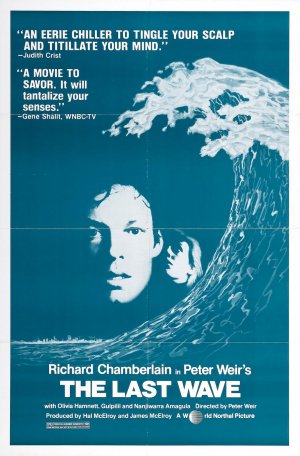
The 1977 film The Last Wave is all about strange weather and, in many ways, it’s the perfect film to watch while you’re stuck inside, waiting for the rain to stop. (Watch it with Take Shelter and have a watery apocalypse double feature.) The film opens in the Australian outback. The sky is blue and clear. And yet the children at a small schoolhouse hear thunder rumbling in the distance. When it suddenly starts to pour down rain, the kids are excited. Their soaked teacher manages to herd them back into the schoolhouse. As the teacher struggles to calm the children down, we suddenly hear something pounding down on the schoolhouse’s tin roof. Suddenly, the windows are shattering as huge chunks of ice crash through them. Looking outside, the teacher is confronted with the sight of torrential rain, gigantic hail, and a perfectly blue and cloudless sky.
Meanwhile, in Sydney, three Aborigines are accused of murdering a fourth outside of a bar. Assigned, by legal aid, to defend them is David Burton (Richard Chamberlain), a complacent upper middle class attorney. Since David usually deals with tax law, he doesn’t understand why he has been assigned the case. However, he take is because he feels a strange link to one of the accused men, Chris Lee (David Gulpilil).
Much like Michael Shannon in the previously mentioned Take Shelter, David has been visions and dreams in which he sees the world flooded. As he researches the case, he begins to suspect that he may be seeing visions of the future….
Well-acted and visually stunning, The Last Wave is a thought-provoking meditation on nature of reality, the end of the world, the “old ways” vs the “new ways,” and whether or not humanity is even worth saving. On top of all that, it features an absolutely brilliant final scene!
All in all, it’s not a bad way to pass the time on a rainy afternoon.
I knew that we’re all looking forward to seeing Benedict Cumberbatch play the title character in the 2016 MCU film, Doctor Strange. However, did you know that the Cumberbatch film will not be the first time that a movie has centered around the character of Dr. Stephen Strange?
It’s true! In 1978, there was a made-for-TV movie that featured the sorcerer Dr. Strange (played here by Peter Hooten) battling none other than Morgan Le Fay (Jessica Walter)! I watched it a few months ago with my friends in the Late Night Movie Gang and it was actually a lot of fun. I should admit that I have absolutely no idea whether or not it was true to the original comic book but still, it was enjoyable in a trippy 70s sort of way.
I shared this episode of The Twilight Zone two years ago for Halloween but the YouTube video has since been taken down. So, here it is again!
There’s a lot I could say about To Serve Man but really, all that needs to be acknowledged is that it’s a classic and features one of the best endings ever.
To Serve Man was written by Rod Serling and directed by Richard L. Bare. It originally aired on March 2nd, 1962.
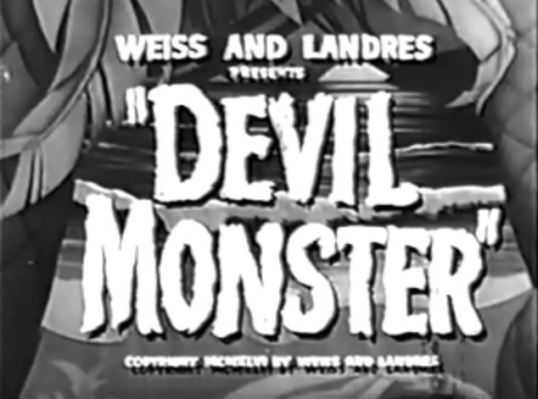
Number one, I came across the 1946 film Devil Monster in my 100 Horror Classic Movie Pack from Mill Creek. The main reason that I decided to watch and review it was because it only had a running time of 64 minutes. (On a good night, I have a 10-minute attention span.)
Number two, I guess it’s debatable whether or not Devil Monster really qualifies as horror movie. I mean, it is called Devil Monster. And there’s a big stingray that shows up during the final 10 minutes of the film and it rips off someone’s arm. I assume the stingray is meant to be the devil monster of the title. It’s not really scary but it’s supposed to be. What matters is that, from the title and some of the dialogue, it’s obvious that an attempt was made to sell this movie as being at least partially a horror film.
Finally, you may have noticed that I mentioned that Devil Monster was a 1946 film. Well, that’s actually debatable. Devil Monster was apparently released in 1946 but, according to Wikipedia and the imdb, it’s actually a re-edited version of a 1936 film called The Sea Fiend. Footage from The Sea Fiend was apparently mixed with stock footage and scenes lifted from other random films. (One scene, featuring a bunch of island natives dancing, was clearly lifted from a silent film.) The film was then dubbed over and a heavy-handed, nonstop narration was added in an attempt to link all of these random scenes together. So, even though Devil Monster was released in 1946, it was actually filmed, in pieces, much earlier.
And really, that’s the main thing that I liked about Devil Monster. It’s not that the film is in any way good or memorable. (Well, it is memorable but mostly in a WTF sort of way.) Instead, it’s a testament to the “never give up” attitude of the best B-filmmakers. The producers of Devil Monster took a bunch of random footage, crammed it all together, and created something that resembles a movie. Good for them.
As for the movie itself, it’s about a bunch of tuna fishermen who take the boat out and decide, in between searching for tuna, to stop by an island and pick up Jose (Jack Del Rio), who has been hiding out on the island ever since he was shipwrecked. The problem is that Jose doesn’t want to go home and, after he’s forcefully dragged onto the boat, he decided to sail the boat into a part of the ocean that is home to the Devil Monster. But then once the Devil Monster shows up, Jose changes his mind about killing everyone. He jumps overboard and gets into a fight with the Devil Monster and … well, you simply have to watch it to truly understand how ludicrous this fight truly is. Basically, footage of Jose throwing punches was superimposed over footage of a stingray in the ocean. As a result, the scene features Jose punching the stingray and the stingray not reacting at all. On top of all that, Jose is somewhat transparent. You can literally see the ocean through him. And, in the scenes where Jose is supposed to be swimming, you can see the hands of the crew holding him up in the air.
(Meanwhile, as we watch all this, we hear — but do not see — the tuna fishermen cheering Jose on. “Get that devil fish, Jose!” someone yells.)
Of course, before that exciting scene, we get to see a battle between an octopus and a moray eel. They are supposed to be at the bottom of the ocean but it’s obvious that they are actually in an aquarium. How obvious? Obvious enough that the studio lights are reflected in the glass and that the octopus tentacles gets stuck on the side of the aquarium in a few scenes.
And, before we watch the octopus/eel battle, the fisherman stop off at an island, where they meet a bunch of topless native girls. We don’t actually see the fisherman interact with the natives. Instead, we just hear the narrator tell us how much they enjoyed hanging out with the girls. The natives, of course, change ethnicity from scene-to-scene, depending on from which source the footage has been lifted.
One of my favorite parts of this film comes at the end. That’s where the boat captain’s son spots Jose and says, “There he is now.” We then see Jose walking, before cutting back to the exact same footage of the son saying, “There he is now,” followed by the exact same footage of Jose walking.
My other favorite part of the film comes about 40 minutes in. That’s when the screen goes black and we’re presented with a title card that reads, “One Moment Please, While We Change Reels.”
Of course, there’s also the scene where one of the fishermen suddenly yells, “TUNA! TUNA! TUNA!” He’s just sounds so excited.
Devil Monster is in the public domain and can be found on YouTube. Watch it at least once, just so you can say that you’ve seen it.

 Through the Shattered Lens