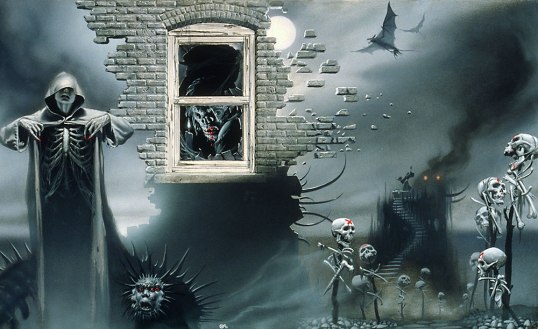
by Michael Whelan
by Michael Whelan
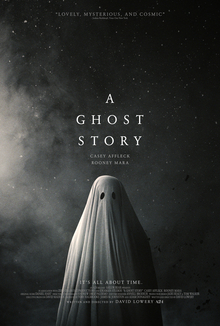
To quote Taking Back Sunday:
“What’s it feel like to be a ghost?”
That’s the question that is asked in the hauntingly beautiful film, A Ghost Story.
How to describe the plot of A Ghost Story? It’s not going to be easy because A Ghost Story is a film that defies easy description or categorization. It’s power comes less from the specifics of the story and more from the mood that it creates. A Ghost Story makes you think and it makes you feel and, to a certain extent, you’re just going to have to take my word on that. This is one of those film that, to truly understand, you simply must see.
Casey Affleck plays C and Rooney Mara plays M. They live in a small house, near Dallas. They’re like any couple, really. Sometimes, they appear to be in love. Sometimes, they appear to be on the verge of breaking up and never seeing each other again. Sometimes, they are happy. Sometimes, they are sad. The film starts with an almost random series of scenes, showing their life together.
Suddenly, we see a smashed car sitting in front of the house.
Just as abruptly, we’re in the hallway outside a sterile hospital room. We can see that, inside the room, M is staring down at a body on a slab. The body has been covered with a sheet. M leaves. Slowly, the sheet-covered body sits up. We watch as the sheet-covered ghost walks down the hallways of the hospital. Briefly, it pauses to look at what appears to be a portal to … somewhere else. The ghost does not enter the portal and the portal closes.
We spend the rest of the movie following that sheet-covered ghost as he wanders through our world. No one living sees it and the ghost never says a word. He watches as M mourns over his passing. Time passes. People enter and leave the house. Life goes on but the ghost is stuck forever where he is, powerless to do anything other than occasionally break a dish, play a piano, or open a book. Time passes. The ghost sees the future, the past, and the present. Why is the ghost still there? Does the ghost know? Is the ghost just waiting for someone who it has forgotten?
If I’m making A Ghost Story sound like a sad movie … well, it is. There are moments of humor, largely coming from the fact that the ghost is literally a sheet with some eye holes. For the most part, though, this film is a somber meditation on life, death, and what makes it all worth the trouble. It’s a film that makes you wonder whether you would have entered that portal or if you too would have returned to your old house so that you silently watch the world go on without you.
From the stillness of the morgue to the view of a futuristic cityscape that the ghost can see but probably no longer appreciate, director David Lowery gives some truly beautiful and haunting images while telling this story. (It’s not surprising to learn that the Dallas-based Lowery previously worked on Shane Carruth’s Upstream Color.) A Ghost Story came out earlier this year and really didn’t get the attention that it deserved. It’s a thought-provoking film and definitely one of the best of the year.
For my next adventure, I played Bitten By A Werewolf (2013).
Bitten By A Werewolf is a choose-your-own-adventure style Twine game. This is the first thing you see:

I don’t want to be too hard on Bitten By A Werewolf because, having played it, I get the feeling that it was written either by a kid or by someone still learning how to write in English. The game’s text regularly switches back from first to third person, sometimes in the same sentence.
The figure in the woods is a werewolf. You can run but don’t expect to avoid getting bitten. You can also stop long enough to try to help one of your friends climb out of a ravine but don’t expect it to go well.

The most interesting thing about Bitten By A Werewolf is discovering all the ways to die. Here are a few examples:



When it comes to getting bitten by a werewolf, the best advice is not to get bitten in the first place. Remember that the next time you’re in the woods and tempted to chase every strange figure you see.
For tonight’s televised horror, we have yet another classic episode of the Boris Karloff-hosted anthology series, Thriller!
In the Wig for Miss Devore, Sheila Devore (Patricia Barry) is an actress looking to make a comeback. She’s recently been cast in a film about a real-life witch who was executed centuries ago. Sheila’s so determined to make the part her own that she’s even willing to wear a wig that once belonged to the dead witch.
Needless to say, that proves to be a mistake for her.
However, it’s enjoyable for us!

Today is the 79th anniversary of Orson Welles’s infamous War of the Worlds broadcast.
In 1938, Orson Welles and the Mercury Theater of the Air performed a radio adaptation of H.G. Welles’s War of the World. Presented as a live news program, it was one of the first mockumentaries. It also caused a panic. How big the panic was is open for debate. Some say only a few people took it seriously. Other sources say that it was a nationwide crisis. But, regardless, Welles made history on that night. Not only did he illustrate the power of the media but he also scared the Hell out of a lot of people. All in all, a pretty good night…
Filmed in 1957 for a television program called Westinghouse Studio One, The Night America Trembled is a dramatization of that night. For legal reasons, Orson Welles is not portrayed nor is his name mentioned. Instead, the focus is mostly on the people listening to the broadcast and getting the wrong idea. That may sound like a comedy but The Night America Trembled takes itself fairly seriously. Even pompous old Edward R. Murrow shows up to narrate the film, in between taking drags off a cigarette. (I enjoyed the show but, whenever Murrow showed up, I was reminded of a grumpy old teacher complaining that none of his students cared about the Spanish-American War.)
Clocking in at a brisk 60 minutes, The Night America Trembled is an interesting recreation of that October 30th. Among the people panicking: a group of people in a bar who, before hearing the broadcast, were debating whether or not Hitler was as crazy as people said he was, a babysitter who goes absolutely crazy with fear, and a group of poker-playing college students. If, like me, you’re a frequent viewer of TCM, you may recognize some of the faces in the large cast: Ed Asner, James Coburn, John Astin, Warren Oates, and Warren Beatty all make early appearances.
As I said, it’s an interesting little historical document and you can watch it below!
Enjoy!
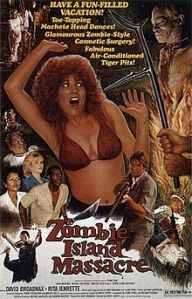 Zombie Island Massacre has got a massacre but it ain’t got no zombies.
Instead, it has a group of tourists who travel to Zombie Island so they can watch a voodoo ceremony. Afterward, their tour bus breaks down. The driver leaves to get help but never returns. There is a deserted villa nearby so the tourists decide to take shelter there for the night. Whenever anyone stumbles away from the main group, they are killed by someone wearing a costume made of leaves. There ain’t no zombies or surprises in the glacially paced movie. There might not even be an island. It might actually be a peninsula. I’m not sure.
The only reason that Zombie Island Massacre is remembered is because one of the tourists is played by Rita Jenrette. Rita was the wife of John Johnrette, a South Carolina congressman who was taken down as a part of Abscam. Rita got a divorce and wrote a book called My Capital Secrets, where she revealed that she and John had sex on the capital steps while the House was holding an all-night session. Rita was not a bad actress, though the material only required her to scream and take a shower.
The main problem with Zombie Island Massacre is obvious. There ain’t no zombies on that island.
For my next horrific adventure, I played My Evil Twin (2015, Carl Muckenhoupt).

This is a short and clever game about you and your evil twin. You have just pulled an all-nighter and you may want to sleep but you know you can’t. Your evil twin is out there, doing evil things. Not only did he mess up the neighbor’s lawn but he also set up a mind control device in the park. Can you figure out how to enter his secret lair and stop him?
My Evil Twin is based on the They Might Be Giants song. How easy the puzzles are to solve will depend on how much you know about the band’s history. I had to resort to Google to solve one puzzle because it required knowing a certain obscure piece of TMG trivia that was not hidden anywhere in the game. Other than that, I liked My Evil Twin. It was short, to the point, and I enjoyed reading about all the terrible things that my twin did whenever I was not around.
Today’s horror scene that I love comes from 2012’s The Cabin In The Woods.
How many references can you spot in that cellar?
For my next horrific adventure online, I played Don’t Go In The Old Green House (2015, Laura Knetzger).
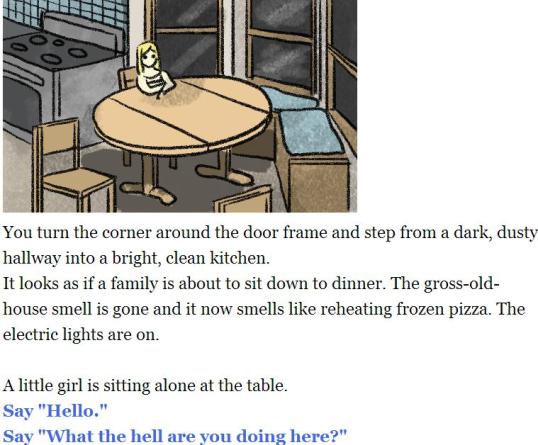
Don’t Go In The Old Greene House is another Twine Choose Your Own Adventure type of game. You have been dared to spend all of Halloween night in the old Greene House, which is said to be haunted. You agree because you know better than to turn down a dare. Exploring the house means running into mysterious spirits. Here’s something that I learned the hard way: Be nice to the little girl at the table. I know that one of the fun things about interactive fiction is that you get to do things that you would never do in real life but, no matter how tempted you may be, do not tell the girl at the table to stop crying and fuck off. Bad things will happen.
Twine games are always a mixed bag for me. I enjoy the simple format but, as opposed to games made with Inform or TADS, they can leave you feeling more like a reader than an active participant in the game. Don’t Go In the Greene House is an example of a good Twine game, well-written and with enough different outcomes that it is actually worth replaying.
Fantastic Adventures was an extremely successful and influential pulp magazine that was published from 1939 to 1953. They published a combination of fantasy, horror, and adventure, all distinguished by a more light-hearted approach than some of the other pulp magazines of the era.
Even better, Fantastic Adventures was one of the few pulp magazines to give proper credit to its cover artists:

by Harold W. McCauley

by Ed Valigursky

by Raymond Naylor

by Robert Gibson Jones

by Stockton Mulford

by Harold W. McCauley

by Robert Gibson Jones

by Rod Ruth

by Walter Parke

by Arnold Kohn
 Through the Shattered Lens