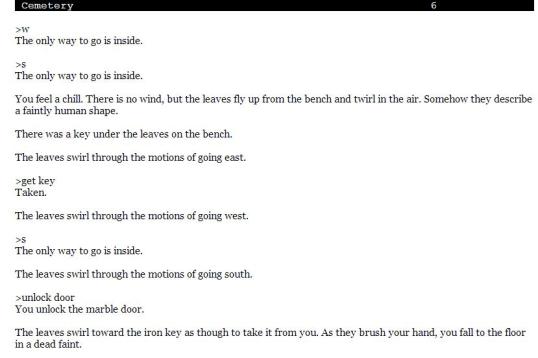
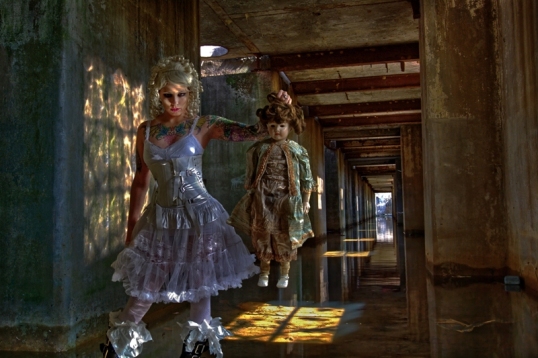
Faithful Companion is simply but difficult. You are at the cemetery, visiting the mausoleum. You want to get in the crypt. Opening the doors that lead into the crypt should be easy except you are being followed by a ghost. Any action you take will be duplicated by the ghost two turns later.
That may not sound like a big deal until you learn that, if the ghost touches you, you will pass out. If you take something and are still holding it two turns later, that means the ghost will take it from you. If you have to open a door by pushing three latches so that they open, the ghost will follow behind you, pushing the latches closed. The game’s challenge comes from fooling the ghost into helping you accomplish what you want to do.
I enjoyed this game. It is short, it is not impossibly hard, and it’s rewarding when you actually figure it all out.
4 Shots From 4 Films is just what it says it is, 4 shots from 4 of our favorite films. As opposed to the reviews and recaps that we usually post, 4 Shots From 4 Films is all about letting the visuals do the talking.
This October, I am going to be using our 4 Shots From 4 Films feature to pay tribute to some of my favorite horror directors, in alphabetical order! That’s right, we’re going from Argento to Zombie in one month!
Today’s director: the great Ed Wood!
4 Shots From 4 Films
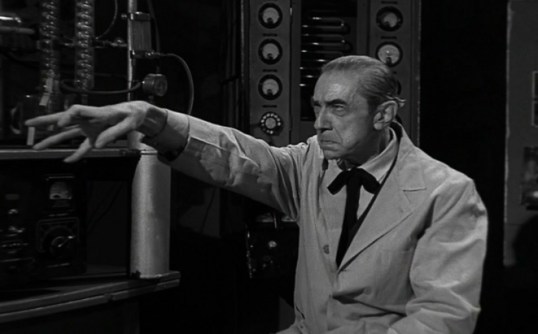
Bride of the Monster (1955, dir by Edward D. Wood, Jr.)
Plan 9 From Outer Space (1956, dir by Edward D. Wood, Jr)
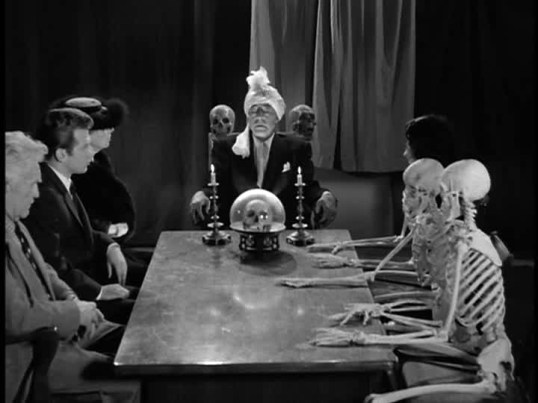
Night of the Ghouls (1958, dir by Edward D. Wood, Jr)
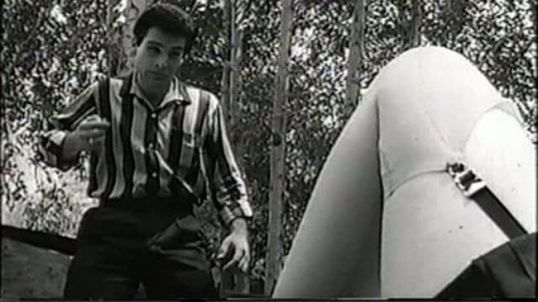
The Sinister Urge (1960, dir by Edward D. Wood, Jr.)
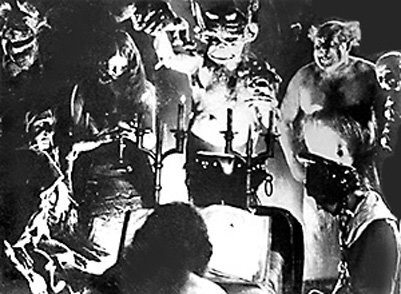
I previously shared Haxan back in October of 2013. A day later, YouTube removed the video and turned my post into a tease.
Well, the video has been uploaded again so I’m sharing Haxan again!
To quote what I wrote the last time that I shared this particular film:
Directed by the Danish director Benjamin Christensen, Haxan is a quasi-documentary that, over the course of four separate sections, documents the history of witchcraft and superstition in Europe. Along with making a potent case that religion and superstition are largely the same thing, Haxan is best known for dramatizing various old folk tales. Though the film was made in 1922, its images of lustful devils and dark magic remain powerful to this day.
I want to make one thing absolutely clear: I tried.
Seriously, I tried to get emotionally involved in this episode but there’s really only so much time that I can spend watching people shoot at each other before I get bored. It’s kinda funny, to be honest. I spent all last season complaining about Rick not doing anything. Then, this episode comes along and it’s basically 45 minutes of Rick and the members of his militia kicking Savior ass. Rick is finally doing something. This entire episode was all about Rick doing something. And I was bored out of my mind.
Basically, this episode followed several different groups as they all launched concurrent attacks on different Savior compounds. A few minor members of Rick’s militia died but the majority of the victims were Saviors. For all of their fearsome reputation, it’s pretty obvious that the only really strong savior is Negan. The rest of them are just bullies and sycophants. Unless Negan is physically there to tell them what to do, they’re easily defeated. Over the course of the episode, a few of the dead reanimated and started eating anyone they could get their hands on. That was good. The show is called The Walking Dead, afterall.
During the attack, we were allowed a glimpse into some of the group dynamics in this new alliance. Perhaps the most intriguing scenes were the ones that features Jesus (Tom Payne) and Tara (Alanna Masterson) debating whether or not to execute a man who claimed to just be a civilian. Tara’s approach was significantly more ruthless than Jesus’s. Even when Jesus had both the opportunity and the justification to kill a savior, he still decided to merely knock the man out. Jesus said that Maggie would back him up. Tara replied that Rick’s got her back.
Meanwhile, King Ezekiel, Carol, and the rest of Team Renaissance Faire wandered through the woods, with Ezekiel going on and on with his faux royal posturing.
As for Rick, he ran into a guy named Morales who is now a part of the Saviors. Apparently, Rick met Morales in Atlanta. Considering that there’s only a handful of people still alive in the world of The Walking Dead, it’s actually not too shocking that Morales and Rick would run into each other again. It’s a small world. If Rick had run into Shane’s brother or maybe Carl (who we saw running away last week), it would be exciting. But Morales? Who cares?
Finally, Morgan apparently now feels that he’s achieved some sort of immortality. I guess that means that Morgan will eventually turn out of the be this season’s surprise sacrifice.
We’ll see what happens. Maybe this episode will pay off in the future but for now, it’s just forgettable.
Some movies just force the viewer to ask, “What would you do?”
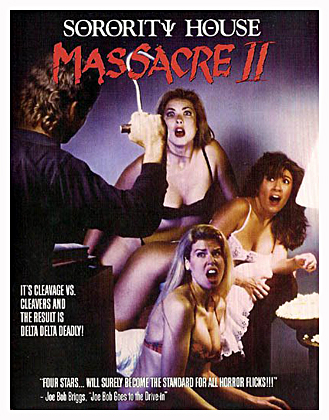
I mean, just consider what it would be like to be in the scenario that’s presented to us in the 1990 film, Sorority House Massacre II. You’re a college student. You’ve got your entire future ahead of you. The president of your sorority has just purchased a new sorority house and she wants you and three others to spend the weekend helping her fix the place up.
You arrive at the house and you discover that it’s literally on the verge of collapsing. There’s no electricity. There’s no telephone. (And remember, this is back when people just used landlines.) There’s no hot water. Soon after arriving, you’re informed that there’s two reasons why the house was being sold at such a cheap price.
First off, there’s the neighbor. He’s a creepy, kinda pervy-looking guy named Orville Ketchum. When Orville comes over to meet his new neighbors, he announces that he has the keys to the basement. He reaches into his pants to retrieve them. Ewwww!
Secondly, it turns out that the house isn’t just any deserted house. It’s the old Hockstadder Place! Years ago, Mr. Hockstadder killed his daughters before dying. Orville witnessed the whole thing. As he tells the story, you might notice that the flashbacks are lifted from a film called Slumber Party Massacre, despite the fact that you’re starring in Sorority House Massacre II.
Despite all of that, you still enter the house. A storm is rolling in and, whenever you look out the window, you see the same lightning stock footage that has appeared in a countless number of cheap horror movies.
When you and your friends decide to explore the basement, you find a Ouija board. You know that Ouija boards can be dangerous but everyone else wants to run upstairs and use it. Someone suggests that maybe the board can be used to contact the spirit of Hockstadder. After all, according to Orville, Hockstadder swore that his murderous spirit would never leave the house and would possess anyone who tried to move in.
At this point, you have two options.
Do you say, “Okay, obviously, it’s not a good idea to contact the spirit of a murderer — especially one that said he would possess anyone who tries to contact him — so I’m going to go ahead and leave now?”
or
Do you light some candles, strip down to your underwear in front of a bunch of open windows (despite the fact that weird old Orville is right across the street), sit on a filthy floor, and try to communicate with the spirit of a homicidal maniac?
The smart option would be the first one so, of course, the characters in Sorority House Massacre II do the exact opposite. Then again, nobody in Sorority House Massacre II appears to be that smart. For one thing, they’re all in their 30s and they have yet to graduate college. Trust me, I wish I could have stayed in college forever but, at some point, you really do have to either graduate or drop out. Tuition’s not cheap.
Anyway, Sorority House Massacre II is one of those movies that just amuses me to death. There’s absolutely nothing subtle about it. It’s such a blatant exploitation film that you can’t help but admire it for not pretending to be something that it isn’t. (At the same time, it’s rather tame when compared to the movies that we’re used to today. Whenever someone is killed, obviously fake blood is squirted on a wall.) This may be a stupid movie but it’s very sincere in its stupidity and there’s something to be said for that.
Add to that, Peter Spellos is memorably weird as Orville. The way he delivers his lines makes Orville into the neighbor that everyone would dread having next door. In the end, though, it’s a good thing that Orville was there.
Finally, there is one surprisingly effective moment. The movie starts with the “final girl” huddled in a dark room, begging the unseen killer to remember who they are. The movie then flashes back to that morning, with the girls standing in front of the house. The abrupt cut from darkness to the bright and sunny morning is surprisingly effective and feels almost dream-like. Though one gets the feeling it was probably unintentional, it’s still works far better than you’d expect.
For tonight’s televised horror, we have another classic episode of the Boris Karloff-hosted anthology series, Thriller!
In this creepy and atmospheric episode, a newlywed (Nancy Kelly) and her cat attempt to get through a stormy night in an isolated house. But are they really alone?
Nightmare of Ecstasy is an oral history of the life of Ed Wood, Jr., the man who has unfairly been declared the worst director of all time. Not only does it include interviews with people who knew and worked with Wood at all the stages of his life and career but it also includes plenty of details about what went on behind the scenes during the making of Wood’s most famous films.
And, make no mistake, a lot of it is fascinating and hilarious. Wood truly did surround himself with a collection of eccentrics and, fortunately for this book, several of them were very verbose eccentrics. (Sadly, since this was book was originally published way back in 1992, some of the most notable interviews are with people who have since passed away.) Wood was a storyteller so it’s perhaps not surprising that he was drawn to other storytellers.
Nightmare of Ecstasy is credited as being the basis for Tim Burton’s film, Ed Wood and it serves as a nice companion piece. Since Ed Wood was highly fictionalized, Nightmare of Ecstasy is a good resource for setting the record straight. Some of the more memorable moments in Ed Wood come across as being rather mundane in the book. Meanwhile, some of the book’s more flamboyant passages did not make it into the film. For instance, only by reading the book can you discover that one of Ed Wood’s frequent actors, Kenne Duncan, was nicknamed Horsecock.
At the same time, it’s a sad book because it follows Wood all the way to his final days. Wood is such a legendary figure that I think it’s sometimes forgotten that he was also a human being. Reading the book, you admire Wood for never giving up but, at the same time, you discover that he wasn’t the eternal optimist that Johnny Depp played in Burton’s film. At the end of his life, he was a rather sad man, an alcoholic who sometimes pawned his typewriter so he’d have enough money to buy a drink. He was reduced to working on the fringes of the adult film industry, even trying to convince his Plan 9From Outer Space co-star, Vampiram to appear in a hardcore film. At one point, Dudley Manlove (who played Eros in Plan 9) quotes a drunk and angry Wood as using a racial slur to describe his neighbors and it’s a shock because that’s just not the way that most of us like to think about Ed Wood.
Though the book may ultimately be rather sad, it’s also a valuable resource. At the end of the book is a list of all of the films and TV shows that Wood is believed to have worked on. (Wood has more credits than you might expect, though sadly some of them appear to be lost.) Even more importantly, there is a list of every “adult” novel that Wood wrote, along with a plot description and even a few excerpts. Longtime fans will be happy to learn that, just as in his films, Ed Wood the novelist always took the time to mention angora.
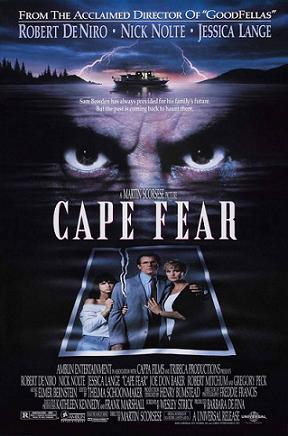
And I beheld as Scorsese remade a classic movie and, Lo, there was De Niro, decorated in india ink and speaking in tongues…
In 1991, Martin Scorsese remade the 1962 horror thriller, Cape Fear. Both versions deal with the same basic story but each tells it in a very different way. If the original Cape Fear was straightforward and to the point, Martin Scorsese’s version is so stylized that occasionally, it’s tempting to suspect that Scorsese might be parodying himself. Zoom shots, negative shots, sweeping camera movements, Scorsese’s Cape Fear is full of all of them. When a storm rolls in for the film’s operatic finale, the red clouds look as if their on fire. Hell is coming to North Carolina, the film appears to be announcing.
While the plot largely remains the same, there are a few significant changes to the characters involved:
In the first Cape Fear, Robert Mitchum’s Max Cady was an arrogant, swaggering brute. In the remake, Robert De Niro’s Cady is still an arrogant, swaggering brute but he’s now also an evangelical who is tattooed with bible verses and who speaks in tongues. Cape Fear‘s approach to Cady’s religion is so over-the-top that it almost makes Stephen King’s approach to religious characters seem subtle and nuanced. De Niro also speaks in a broad Southern accent. Occasionally, De Niro gets the accent right but most of the time, he sounds like he’s in a Vermont community theater production of Cat On A Hot Tin Roof.
In the first Cape Fear, Gregory Peck’s Sam Bowden was a lawyer who caught Max while Max was attacking a woman and who then testified against Max in court. That’s not the case with the remake’s version of Sam Bowden. Despite being played by Nick Nolte, the remake’s Sam Bowden is such a wimp that you can’t help but dislike him. His wife (Jessica Lange) doesn’t trust him. His teenage daughter (Juliette Lewis) resents him and his attempts to control her life. In this version, Sam didn’t testify against Max in court. Instead, Sam was Max’s lawyer and withheld evidence that could have secured Max’s acquittal. What Sam didn’t realize is that Max would spend his time in prison studying the law and that Max would eventually figure out what Sam did.
As in the original film, Max shows up in North Carolina and proceeds to stalk the Bowdens. Unlike Mitchum, who was all quiet menace, De Niro plays Max as being loud and obnoxious, the type who will sit in a theater, light a cigar, and intentionally laugh at the top of his lungs. Max knows enough about the law that he knows exactly what he can get away with. He poisons Sam’s dog. He rapes Sam’s associate, Lori (played, in a heart-breaking performance, by Ileana Douglas). In one of the film’s most unsettling scenes, he pretends to be the new drama teacher and toys with Sam’s daughter.
With the help of a private eye (Joe Don Baker), Sam tries to get Max out of his life. Eventually, Sam pretends to be out-of-town, all as part of a ruse to get Max to break into his house so that he can be shot in self-defense. It’s here that Nolte’s wimpy performance becomes an issue. It’s impossible not to laugh at the sight of Sam, all hunched down and desperately trying to run from room to room without being spotted through any of the windows.
To a certain extent, I suspect that were meant to see Sam as being a rather pathetic figure. Scorsese doesn’t really seem to have much sympathy for him or his dysfunctional family. If anything, the film seems to argue that Sam has been a bad lawyer, a bad husband, and a bad father and Max has been sent as a type of divine retribution. Only by defeating Max can Sam find forgiveness and hope to have the type of life that Gregory Peck enjoyed in the first movie.
Scorsese’s Cape Fear is an uneasy mishmash of styles. Is it an art film, a religious allegory, a horror film, or just a generic thriller? It doesn’t seem to be sure. Cape Fear‘s a Scorsese film so, of course, it’s always going to be worth watching. But there are times when the film definitely runs the risk of overdosing on style. Sometimes, Scorsese seems to be trying too hard to remind everyone that he’s a legitimately great director and ends up getting so invested in the film’s visuals that he runs the risk of losing the story. De Niro has some scenes in which he is genuinely chilling but then he has other scenes where he is basically just a live action cartoon character. The same can be said of the film itself. It’s always watchable. At times, it’s rather frightening. But other times, it’s just too cartoonish to be effective.
If anything, this remake proves that sometimes, it’s best to keep things simple.




 Through the Shattered Lens