Horror Film Review: The Vampire (dir by Paul Landres)


Headaches are a bitch!

And if you didn’t already know that, you will know it after watching the 1957 film, The Vampire.

Like many films of this kind, The Vampire starts with death.

Actually, I take that back.  Technically, it’s true but it’s also little bit too melodramatic.  And, to be honest, The Vampire starts with a 14 year-old boy, who is very much alive, riding his bicycle down the street of Anytown USA.  He has a box with him, one that has air holes.  On the back of his bike, a cardboard sign reads: “Bobs Pet Zoo!  If Its Alive We Got It!”  Apparently, the kid is smart enough to run his own zoo but not smart enough to know when to use an apostrophe.

Anyway, the kid comes up to a creepy old house, one that looks somewhat out of place in the otherwise pristine suburban neighborhood.  Originally, I thought that maybe Pennywise lived in the house but then I reminded myself that The Vampire was made decades before It.  Instead, the house belongs to Dr. Campbell, a scientist who is doing experiments with blood and who needs a never-ending supply of animal test subjects.  (Boooooo!  Animal testing!  Hiss!)  Apparently, the kid keeps Dr. Campbell supplied with animals.  When the kid enters the house, Dr. Campbell is nowhere to be seen.  It’s not until the kid enters the laboratory that he discovers Campbell, dead and slumped over his desk.

As news spreads of Campbell’s death, his friend, Dr. Paul Beecher (John Beal), searches through Campbell’s belongings and he comes across a mysterious bottle of pills, which he promptly takes home with him.  Dr. Beecher is kindly doctor, the type that we all wish we could deal with whenever we had to go in for a check up.  However, he suffers from terrible migraines.  That night, when he’s literally blinded with a headache, he asks his daughter to get him his pills.  She retrieves a bottle of pills but guess what?  They’re the wrong pills!  They’re not headache pills!  Instead, they’re Dr. Campbell’s vampirism pills!

The pills cause Beecher to blaxk out.  Whenever he comes to, he never has any memory of what he may or may not have done while he was out.  However, strange things are happening to his friends and his patients.  One of his longtime patients dies of fright when he comes by her house.  On her neck, he finds two puncture wounds…

So, it’s not a spoiler for me to tell you that Dr. Beecher has been transformed into a vampire.  And I know what you’re thinking.  Why doesn’t he just stop taking the pills?  The simplest answer is that the pills are addictive.  The more complex answer is that he doesn’t want to.  The pills have brought out his dark side and, now that it’s free, it’s not planning on going anywhere.

In a strange way, The Vampire reminded me of Nicholas Ray’s Bigger Than Life.  In Bigger Than Life, James Mason plays a gentle and good-hearted professor who, after taking steroids, turns into a monster who dreams of creating a master race.  Bigger Than Life was unsettling for the exact same reason that The Vampire is unsettling.  Both suggest that the pills didn’t turn their user into a monster.  Instead, the pills just allowed his true self to come out.

The Vampire was a low-budget film, a B-movie as many would probably call it.  The musical score is overly melodramatic and so are some of the actors.  But I would say that The Vampire is actually a bit of a subversive masterpiece.  This 1957 film suggests that behind the pristine facade of suburbia, there lurked monsters.  Even an outwardly successful and respected man like Dr. Beecher can turn into something totally different behind closed doors, this film is saying.  That’s a message that it as relevant today as it was when this film was first released.  In its own way, The Vampire is a brilliant and important movie.
6 Trailers For Halloween


Welcome the final October edition of Lisa Marie’s Grindhouse and Exploitation Film Trailers!

I’ve enjoyed reviving this feature for October.  I’m not totally sure if I’ll continue it because, as I said way back at the start of the month, there are only so many trailers on YouTube and I don’t want to spend too much time repeating myself.  We’ll see!

These are trailers for 6 of my favorite horror films:

  1. Lisa and the Devil (1973)

From the great director, Mario Bava.  This film is like a cinematic dream.  Plus, the main character is named Lisa!

2. Suspiria (1977)

This trailer is creepy, though it really doesn’t do the film justice.  Check out my review here!

3. The Shining (1980)

This is one of the few films that scares me no matter how many times I watch it.

4. Near Dark (1987)

Vampires in Texas!  Hell yeah!

5. Two Orphan Vampires (1997)

From the brilliant Jean Rollin.

6. The Cabin In The Woods (2011)

I don’t care how many hipster douchebags disagree.  This movie is absolutely brilliant.

Happy Halloween!

Jedadiah Leland’s Horrorfic Adventures In The Internet Archive #28: Stephen King’s The Mist (1985, Angelsoft, Inc)


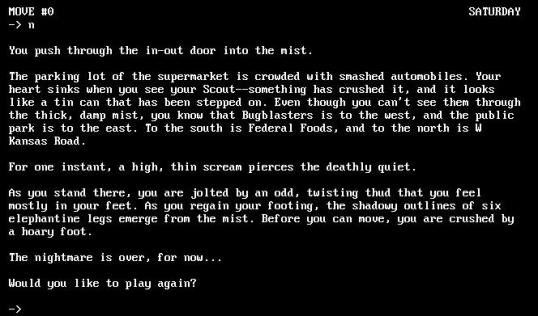
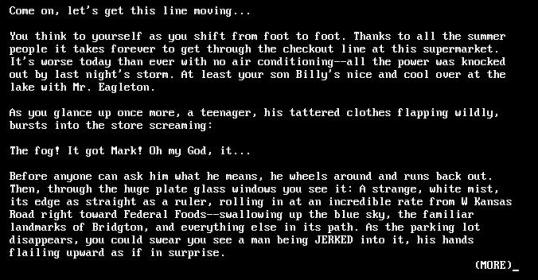
For my final horrific adventure of the month, I returned to the Internet Archive and I played Stephen King’s The Mist (1985, Angelsoft, Inc.)

The Mist is a text adventure based on Stephen King’s novella.  (The game came out before both the television series and Frank Darabont’s film version.)  You are at the supermarket, just trying to buy your groceries and get home, when suddenly a thick mist envelopes the entire town.  There are monsters in the mist and you soon discover that there are monsters in the store as well.  Can you survive the mist and make your way back to your home where, hopefully, your son is still alive and waiting for you to rescue him?

The Mist does a good job of turning King’s story into a work of interactive fiction.  Even if you have read the story or watched the movie, The Mist is still not an easy game.  This is a game where it is very easy to get killed and there’s one puzzle where, due to randomization, you can do everything right and still end up dying.  It is unfortunate that you cannot save games while playing them in the Internet Archive because The Mist is a game that can only be won through trial and error.

The best advice that I can give is don’t spend too much time in the supermarket, pick up everything that you can, and don’t shoot Mrs. Carmody, as much as you may want to.

Of course, you can just play the game with a walkthrough, like I did.


4 Shots From 4 Films: Special Rob Zombie Edition


4 Shots From 4 Films is just what it says it is, 4 shots from 4 of our favorite films. As opposed to the reviews and recaps that we usually post, 4 Shots From 4 Films is all about letting the visuals do the talking.

This October, I am going to be using our 4 Shots From 4 Films feature to pay tribute to some of my favorite horror directors, in alphabetical order!  That’s right, we’re going from Argento to Zombie in one month!

Our final director: Rob Zombie.

4 Shots From 4 Films

The Devil’s Rejects (2005, dir by Rob Zombie)

Halloween (2007, dir by Rob Zombie)

The Lords of Salem (2013, dir by Rob Zombie)

31 (2016, dir by Rob Zombie)

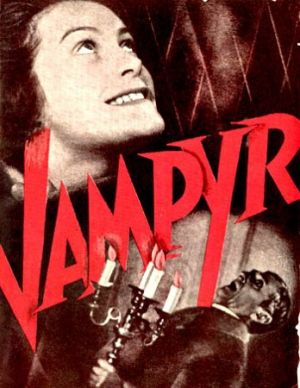
Horror Film Review: Vampyr (dir by Carl Thedor Dryer)


A dream of dark and disturbing things….

Allan Gray (Nicolas de Gunzburg, performing under the name Julian West) might be a student of the occult or he might just be a man having a dream within a dream.  He’s handsome with just enough of an aristocratic bearing to be intriguing.  His face is strangely blank.  Whenever we see him, we wonder if he’s awake or if he’s asleep.  We’re reminded of Werner Herzog’s film Heart of Glass, in which the entire cast recited their lines while hypnotized.

Allan’s come to a small village in France.  It’s a quaint little place, probably the type that most tourist would consider to be quite beautiful.  But from the minute that we see it, the entire landscape seems to be off.  The inhabitants of the village seem almost as blank-faced as Allan.  When we see the trees sway in the wind, we’re reminded of  Victor Sjöström’s The Wind and how the nonstop wind drove Lillian Gish mad.

Allan stays in an inn.  He goes to sleep.  When he wakes up, an old man stands in his room.  The old man gives him a package.  The package is not to be opened until the man’s death.  Allan goes outside.  The village is full of shadows.  He watches an old woman and the town’s doctor.  Allan meets with one of the old man’s daughters and learns that her sister is deathly ill.  She needs a blood transfusion.  When Allan reads a book about vampyres, he suspects that both the town and the sisters are being held prisoner.  At times, the events feel almost random but the film has such a hypnotic power that we automatically know that nothing happens by mere chance.

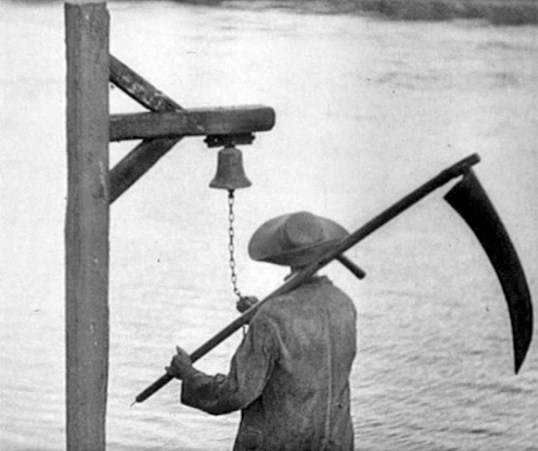
Directed by Carl Theodor Dryer, Vampyr was filmed in 1931 and released in 1932.  This was Dreyer’s first sound film but Vampyr almost seems like a silent film.  It certainly has more in common with Dreyer’s hallucinogenic silent masterpiece, The Passion of Joan of Arc, than it does with Universal’s version of Dracula.  Vampyr feels like a cinematic dream, full of surrealistic images and odd performances.  As a collection of images, Vampyr is one of the most intensely atmospheric film that I’ve ever seen.  Allan, who may be having a dream within a dream, discovers a coffin and is shocked to discover who is inside.  A character is buried alive in flour.  Fogs rolls across the river and a figure with a scythe brings to mind Charon, the ferryman who took the dead to the underworld.  Shadows dance across the screen.  Much like Lucio Fulci’s Beyond trilogy, Vampyr succeeds by creating its own cinematic world, one where reality is solely defined by the images on the screen.  The plot of Vampyr might not always make sense in the real world but it’s perfectly logical in the world created by the film.

Vampyr’s a surreal classic, one that reportedly came close to being a lost film.  Several of the video releases have been technically inferior, though the flickering picture and inconsistent soundtrack of those releases can actually add to the film’s dreamlike power.  It’s been released by the Criterion Collection and that is the ideal version to watch.


Horror on the Lens: Night of the Living Dead (dir by George Romero)


Happy Halloween everyone!

Well, as another horrorthon draws to a close, it’s time for another Shattered Lens tradition!  Every Halloween, we share one of the greatest and most iconic horror films ever made.  For your Halloween enjoyment, here is George Romero’s Night of the Living Dead!

(Be sure to read Arleigh’s equally iconic review!)

ENJOY!

AMV of the Day: This Is Halloween (Soul Eater)


It’s been a while since we’ve done an AMV of the Day here at the Shattered Lens.  This seems like the perfect day to rectify that!

Anime: Soul Eater

Song: Marilyn Manson — This Is Halloween

CreatorHagarenGao

Past AMVs of the Day