Minor Arcana is probably not the first game to center around Tarot cards but it is probably the first one to actually be written from the point of view of the cards themselves. You are the cards and, as you wait to reveal your next fortune, you think about your past and maybe your future. Who created you? Who gave you power and why? Are you going to help the people who seek your insight or are you going to destroy them? Are you a force of chaos or a force of peace? These are the decisions that you, as the player, can make as you point and click your way through the story.
Like a lot of works done with Twine, Minor Arcana is more of a short story than a game. While it’s true that you control several elements of the story and that your decisions will determine the type of story that’s told, it would be a mistake for anyone to play Minor Arcana thinking that it’s going to be a traditional IF game where you solve puzzles and examine rooms and decide whether to move north, west, or, if you’re really lucky, northeast. Instead, Modern Arcana is more of a well-written mood piece, designed to make the player meditate on issues of fate, fortune, and the future.
The 1993 YA novel, The Eternal Enemy, starts out with a typical Christopher Pike situation.
Rela is a teenager. Rela is adopted. Rela doesn’t know much about her past. Rela has a crush on my boy whom she’s too shy to ask out but luckily she has a confident best friend who is willing to do it for her. She also has another male admirer, who she just considers to be a friend. It’s all standard Pike.
However, the twist of this particularly novel is that Rela has a VCR and apparently, the VCR can tell the future! Whenever she tries to record an old horror movie, she instead ends up with a recording of a future news broadcast. At first, Rela uses this to her advantage. She makes money betting on a football game. She heads to Vegas to make even more money and then she goes to San Francisco and saves the lives of a bunch of window washers! Other than offering up a crisp picture, allowing viewers to easily skip around in a movie, and not eventually becoming an obsolete artifact of a past age, there’s absolutely nothing that this VCR can’t do.
However, even while Rela is having fun making money and saving lives, she’s also having disturbing dreams which seem to indicate that there are strange things hidden in her past. (Well, of course. It’s a Christopher Pike book.) A mysterious and creepy older man appears to be stalking her. Maybe she should stop messing with the VCR….
Then she sees a news report about her own death.
The Eternal Enemy is one of Pike’s more uneven books. It starts out nicely, with the promise of YA horror, but then it turns into this sort of Looper/Terminator sci-fi thing. As the story reveals more about the actual identities of Rela and the creepy old man, it gets bogged down trying to explain how everything works and, if you’re not already into science fiction, it becomes a bit of chore to read. It’s hard not to get annoyed that the book starts with an interesting premise and then kind of waves it all way by using the “It’s science!” excuse.
Probably the most interesting thing about The Eternal Enemy is that the entire narrative revolves around the mystical and complex powers of a VCR. If only Rela had been born a decade later, she wouldn’t have had to deal with any of this.
Few directors were as obsessed with memory as the great French filmmaker Jean Rollin and the 1975 cinematic memory poem, Lips of Blood, is one of his most personal works.
Frederic (played by Jean-Loup Philippe, a frequent Rollin collaborator) is at a reception for the launch of a new perfume. After discussing how certain fragrances can bring back subjective memories of the past, Frederic notices a poster hanging on the wall. The poster is a photograph of an old castle sitting on the beach. As Frederic stares at the poster, he has a vision of himself as a child, approaching the same castle and meeting a young woman named Jennifer (Annie Belle). Jennifer, who was apparently unable to go beyond the castle’s gates, allowed Frederic to get some sleep in the castle. When Frederic woke up, he left the castle but he promised Jennifer that he would return and that he would help her to leave the castle.
Years later, Frederic is haunted by the vision. He’s not sure if it’s dream or if it’s something that really happened. When he discusses it with his mother (Nathalie Perrey), she insists that it was just a dream and that Jennifer doesn’t exist. Even when Frederic says that he can’t remember anything about his childhood, his mother insists that he’s just imagining things.
But when Frederic starts to have visions of Jennifer beckoning him to come find her, is he imagining things or is she really trying to contact him? When she leads Frederic to a cemetery, is Frederic going mad or is Jennifer trying to tell him something? And, if this is all just in Frederic’s mind, why is he being followed by two mysterious girls who both have fangs and a taste for blood? Why are strangers trying to kill him? Even when Frederic is ruled to be mad and forcefully taken to an insane asylum, he remains obsessed with returning to the beach and finding that castle….
Lips of Blood has all the typical elements of a Rollin film. Yes, there are vampires. Yes, there is an old castle and yes, it’s on the same beach where it’s speculated that Rollin himself spent most of his childhood. (That beach makes an appearance in nearly every Rollin film.) Yes, the imagery is frequently sensual and erotically charged. And yes, the film plays out as its own dreamlike pace. Rollin is often described as being a director of vampire films but, at heart, Rollin was a surrealist and each one of his films creates its own unique world. The world that Rollin creates in Lips of Blood is a rather melancholy one, one tinged with love, regret, and existential angst. Frederic is wealthy and successful and leads what most people would consider to be a glamorous lifestyle. Yet, he’s empty. He’s haunted by the past and a promise that he failed to keep.
Indeed, throughout the film, there’s a palpable yearning for a simpler and more innocent world. It’s present in every frame of Lips of Blood. When Frederic visits the photographer who took the picture of the castle, the walls of her studio are decorated with vaguely political images, reminding us that the modern world can be a frightening and confusing place. The world is full of people who are not only threatened by what Frederic saw in the castle but also by Frederic’s refusal to share their fear. Frederic refuses to conform and therefore, society conspires to destroy not just him but also the glimpse he got into a world beyond our own. By the end of the film, as he and another talk about getting in a coffin and allowing themselves to be swept out to sea in the hope of finding an isolated island, it’s impossible not to hope that they make it.
Lips of Blood is one of Rollin’s best and most personal films. Never forget it.
4 Shots From 4 Films is just what it says it is, 4 shots from 4 of our favorite films. As opposed to the reviews and recaps that we usually post, 4 Shots From 4 Films lets the visuals do the talking!
This October, we’ve been using 4 Shots From 4 Films to pay tribute to some of our favorite horror directors! Today would have been the 77th birthday of Michael Reeves, the brilliant British director who died of an accidental drug overdose in 1969, when he was only 25 years old. It only makes sense that today, we honor Michael Reeves with….
4 Shots From 4 Films
Intrusion (1961, dir by Michael Reeves)
The She Beast (1966, dir by Michael Reeves)
The Sorcerers (1967, dir by Michael Reeves)
The Witchfinder General (1968, dir by Michael Reeves)
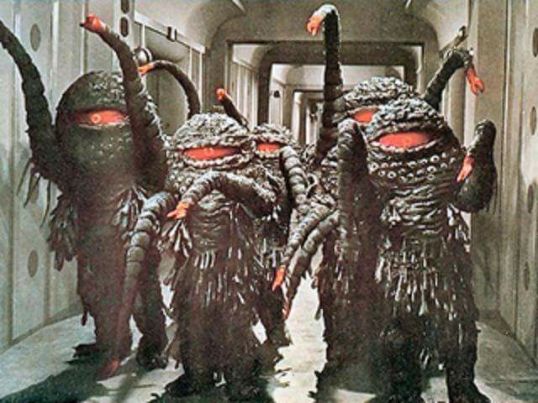
The 1968 film, The Green Slime, is meant to be a hybrid of a horror movie and a sci-fi film. One might even call it a forerunner to Alienif one wanted to run the risk of being ridiculed for the rest of one’s life. It’s about an alien life form that manages to sneak into a space station. Once it’s inside the space station, it starts to rapidly multiply and it turns out that everything that the humans do to try to stop it just causes more of the monsters to show up!
Seriously, that should be some major nightmare fuel but instead, the monsters are just too cute to believed.
Okay, maybe cute is the wrong word. When Jeff and I watched this movie, I asked him if he could come up with a better term to describe the monsters than “cute.” He suggested “cheap.” And yes, the monster do look rather cheap. It’s obvious that the monsters are made out of rubber and, half the time, their arms just seem to flail around at random. That’s actually one of the things that makes them so cute!
It’s also one of the things that makes The Green Slime memorable. Today, we tend to take it for granted that anything can be done via CGI so it’s interesting to see a film like this. The Green Slime was originally released 52 years ago, long before CGI. The special effects may look cheap but there’s an undeniable appeal to their quaintness. The special effects are a lot like the monsters themselves. They’re cheap. They’re not particularly convincing. But, in their own weird way, they’re definitely charming.
Of course, they’re not at all scary. That’s a bit unfortunate as far as the film is concerned. Remember how, in the Alien movies, you’re always scared to death that the alien is going to jump from out of nowhere because 1) the alien is absolutely terrifying to look at and 2) anyone caught by the alien is destined to die a terrible and agonizing death? Well, that’s not the case with The Green Slime. The Green Slime just kind of runs around and looks …. well, cute.
That said, The Green Slime cannot be allowed to make its way to Earth so the folks on the space station are going to have to figure out how to defeat it. That’s not going to be easy because the two rival commanders (payed by Robert Horton and Richard Jaeckel) are currently both in love with the same woman. Lisa Benson (Luciana Paluzzi) is the space station’s doctor and needless to say, she’s going to have her hands full. If you’re a Bond connoisseur, you might recognize Luciana Paluzzi from Thunderball. Myself, I was just happy that the doctor was a redhead named Lisa. I could automatically relate to her. Plus, there’s nothing more entertaining than hearing your name repeated over and over again.
The Green Slime was an American-Japanese co-production. The cast is a mix of American and European actors while the film’s crew was predominantly Japanese. Originally, The Green Slime was envisioned as being an American/Italian co-production and Antonio Margheriti was in talks to direct. When that plan fell through, MGM moved the production to Japan and teamed up with the Toei Company. One can only imagine what the film would have looked like if it had been directed by Marheriti. One imagines that the aliens would have been a bit less cute.
Fortunately, cute they are! The Green Slime fails as both a horror and sci-fi film because the aliens themselves never seem like a legitimate threat but I still like the film. If nothing else, it pays tribute to the name Lisa and that’s definitely something that I can get behind.
(It’s tradition here at the Lens that, every October, we watch the original Little Shop of Horrors. And always, I start things off by telling this story…)
Enter singing.
Little Shop…Little Shop of Horrors…Little Shop…Little Shop of Terrors…
Hi! Good morning and Happy October the 2nd! For today’s plunge into the world of public domain horror films, I’d like to present you with a true classic. From 1960, it’s the original Little Shop of Horrors!
When I was 19 years old, I was in a community theater production of the musical Little Shop of Horrors. Though I think I would have made the perfect Audrey, everybody always snickered whenever I sang so I ended up as a part of “the ensemble.” Being in the ensemble basically meant that I spent a lot of time dancing and showing off lots of cleavage. And you know what? The girl who did play Audrey was screechy, off-key, and annoying and after every show, all the old people in the audience always came back stage and ignored her and went straight over to me. So there.
Anyway, during rehearsals, our director thought it would be so funny if we all watched the original film. Now, I’m sorry to say, much like just about everyone else in the cast, this was my first exposure to the original and I even had to be told that the masochistic dentist patient was being played by Jack Nicholson. However, I’m also very proud to say that — out of that entire cast — I’m the only one who understood that the zero-budget film I was watching was actually better than the big spectacle we were attempting to perform on stage. Certainly, I understood the film better than that screechy little thing that was playing Audrey.
The first Little Shop of Horrors certainly isn’t scary and there’s nobody singing about somewhere that’s green (I always tear up when I hear that song, by the way). However, it is a very, very funny film with the just the right amount of a dark streak to make it perfect Halloween viewing.
So, if you have 72 minutes to kill, check out the original and the best Little Shop of Horrors…




 Through the Shattered Lens