Let’s start with a life lesson here that’s completely contradictory right on its face and therefore of absolutely no value whatsoever — sometimes the simplest ideas are great, and sometimes they’re really, really dumb.It all depends on the inherent intelligence level of the person who has them.
First case in point : a retrograde, racist, trigger-happy, self-appointed “neighborhood watch captain” decides it would be a good idea to follow around a kid in his gated suburban subdivision who’s minding his own business and eating Skittles. The cops tell him to back the fuck off and stay in his car, but our low-grade Charles Bronson-wannabe thinks he knows better : he pursues the young man on foot, removes his gun from its holster, loads some rounds in the chamber, unlatches the safety, and proceeds to generally and obviously tail him for three or four blocks. When the target of his harassment finally decides enough is enough and jumps him, a fight ensues. We’ll never definitely know who threw the first punch, but when “Mr. Tough Guy” was on the ground getting his nose bloodied by the kid’s fist, he decided he’d had enough and shot his “assailant” in the heart.
Dumb idea. I don’t care if a jury gave him a free pass for murdering the victim of his stalking or not, it’s still just not smart. Bargain-basement Bronson was reckless with his firearm, needlessly killed a kid who was, let’s face it, provoked into a confrontation, and now he has this bright, promising youngster’s blood on his conscience (assuming he has one, which is debatable) and has to sleep with one eye open for the rest of his life. Clearly, nothing good came from this guy’s very simple, and very stupid, idea.
Case in point number two : Wouldn’t it be seriously fucking cool if the Transformers fought Godzilla?
The answer to this question is as resounding as it is obvious : hell yes (as long as Michael Bay doesn’t direct it)! Thankfully, Guillermo del Toro is the guy who had this idea, and the result is Pacific Rim, easily the funnest thing to hit the silver screen this summer (even if I did just say the same thing about The Lone Ranger — this tops it, and by a wide margin).
Now, you can take exception to my admittedly over-simplified root description of this film all you want — hey, man, this is about a lot more than that : it’s about giant mentally-linked-to-human-host robots called Jaegers who battle inter-dimensional monsters from beneath the ocean floor known as Kaiju, there’s a nice little low-key love story that develops between out hero, Raleigh Beckett (Charlie Hunnam) and his co-pilot, Mako Mori (Rinko Kikuchi), it’s got Idris Elba as a stoic-but-compassionate military commander, and hey, Ron Perlman’s on board playing a mad scientist/black marketeer with the kind of relish that only he can bring to a role.
All these things are true, of course, but at the end of the day this is still a 12-year-old sci-fi geek’s wet dream realized on an enormous Hollywood budget. And that’s the best thing about it (besides maybe the awesome post-credits dedication to Ray Harryahusen and Ishiro Honda). This is del Toro letting loose his inner child for all of us to see, and that’s a pretty insipiring thing indeed, my friends.
Are there plot holes aplenty here? Sure, bigger than the monsters themselves (most notable among them being that if they know one of these nuclear Jaegers can seal up the dimenstional breach for good by blowing it to kingdom come, why did’t they try it years ago?), but never you mind that. Just sit back and allow yourself to be as thoroughly and completely wowed as is humanly possible by a movie. And when you feel a smile forming at the corners of your lips as the week goes on, don’t fight it — you really did have that much fun at the movies. It’s totally okay to feel like a giddy little kid again for awhile.
I’ll just say it outright and get it out of the way and say that Guillermo Del Toro is one of the few filmmakers whose body of work has earned him my admiration. The Mexican-born filmmaker has made some of the most fully-realized and visually-beautiful films of the last twenty years. It doesn’t matter whether its genre staples like Blade II and the two Hellboy films or arthouse fares like The Devil’s Backbone and Pan’s Labyrinth, Del Toro has a unique talent for making one believe in the world his films inhabit. This is probably the reason why Peter Jackson had tapped him to direct the film adaptation of J.R.R. Tolkien’s The Hobbit. The man just has an eye for every detail, no matter how big or small, that he believes will add to the overall experience of watching his films.
When delays and behind-the-scenes studio bickerings kept the production of The Hobbit from moving forward Del Toro was already two years into pre-production of the long-awaited new trilogy, but finally backed out. He would try to make one of his dream projects his next move with the film adaptation of H.P. Lovecraft’s classic At the Mountain of Madness. This was a film that looked to set the horror and genre scene by storm. It was a story that was right in Del Toro’s wheelhouse. The film would require him to create a believable world where cosmic Elder Gods and Old Ones existed and still make it terrifying and awe-inspiring. But once again his ideas would require a huge budget from the studios and his stance on making the film an R-rated one finally shelved it (though hopefully not for good).
With two major productions either cancelled or dropped out of, Guillermo Del Toro was now without a film to direct and it’s been years since his last (Hellboy II: The Golden Army). Maybe it was providence or just plain ol’ dumb luck, but in comes a screenplay from Travis Beacham which included such terms as “Jaegers” and “Kaiju” and Del Toro finally got a film that wasn’t an adaptation of someone elses work, but something he could build from the ground up and make his own. That film was and is Pacific Rim.
Pacific Rim finally arrives in cinemas around the world and it couldn’t come at a better time. The last couple years have seen summer blockbusters get bigger and bigger. Each new blockbuster tried to outdo the next with something more extravagant, louder and, to their detriment, more complex and convoluted in their storytelling. This is not the case for Pacific Rim which comes in with a simple premise that managed to stay together from start to finish: giant robots fighting giant monsters.
From that idea was born a film that lends itself well into Guillermo Del Toro’s visual and world-building talent. He had to find a way to make this film, that harkens back to the old kaiju films from Japan’s Toho studio and its mecha/giant robot anime genre, a believable world where adventure and spectacle ruled and not post-modern deconstruction and cynical characters and storytelling. It’s an endeavor that succeeds, though not perfectly, to do more than just entertain but also show that sometimes the old ways of telling a story does belong in this new world of hi-tech filmmaking.
The plot to Pacific Rim is simple enough and an extended opening prologue narrated by one of it’s lead character (Charlie Hunnam of Sons of Anarchy fame playing the role of Jaeger pilot Raleigh Becket). Sometime in the very near future an interdimensional rift (called The Breach) in the Pacific Ocean where two tectonic plates meet open up to allow gigantic creatures dubbed by people as “kaiju”. These kaiju wreak destruction and havoc on a massive scale to the world’s Pacific coastline cities like San Francisco, Manila, Cabo and Tokyo. When conventional military means take too long and and only nuclear options remain on the table the world’s governments band their resources and technical know-how to find a new weapon to combat these kaiju. In comes the “Jaeger Program” where two pilots control 25-story tall giant robots through a “dark science” called “The Drift” to finally fight the kaiju on even terms.
We see through this prologue how the “Jaegers” and their pilots have become rock stars in the eyes of the public as their successes stems and stops the tide that’s been destroying cities in the Pacific Rim for years. It’s also in this prologue that we get to the point of the film where this success has led to overconfidence and the beginning of the end of not just the “Jaeger Program” but that gradual slope that leads to humanity’s inevitable extinction.
The bulk of the film deals with the last few days of the war when the world’s government have stopped funding the Jaeger Program and instead have pooled all resources and manpower towards building massive anti-kaiju walls along city coastlines as a measure of defense. The Jaeger Programs leader, Marshal Stacker Pentecost (played by the ever-present Idris Elba who seem to live the role), believes that his Jaegers and the Rangers piloting them still can finish the war once and for all with a final strike on The Breach with the remaining four Jaegers left in his arsenal. When the politicians tell him no he resorts to dealing with the less than legitimate sector to fund this final strike. But for this last mission to succeed he needs one of his best pilots back from the brink of remorse and mourning to pilot an older, refurbished Jaeger by the name of Gipsy Danger.
From then on the film takes on the premise that Del Toro promised when he first took on the project. We finally get to see giant robots fighting giant monsters.
Pacific Rim lives on it’s simplicity. Whether the simplicity of it’s story, dialogue, characters and themes. The film works within those parameters and does it well. One never feels lost with in the film’s narrative. There’s nothing convoluted with this film’s story. Some have said this need to be simple is an inherent flaw. I would agree with this if someone with less talent took on the job. Del Toro understands that keeping the story simple doesn’t mean dumbing it down, but keeping the promise of what the audience expects from a genre film of giant robots fighting giant monsters needs to deliver. The film’s simplicity allows for the story to flow from it’s hi-octane action sequences to it’s more personal moments without having it seemed forced.
Even the characters themselves come off as the archetypes of past adventure films. Whether it’s the stern father figure leading the pack to the hot-shot hero looking to redeem himself for a past failure to the cocky rival whose hothead personality acts as a counter-balance to the hero’s. Even the mysterious newcomer whose past acts as one of the film’s central emotional anchors harkens back to an earlier era of storytelling that preceded the more realistic and gritty era of film narrative born during the late 60’s and 70’s.
These characters some would call one-dimensional or plain cardboard cutouts, but in the context of the film being seen they work. We get enough of what motivates each character to fully understand why their characters do what they do in the film. The motivations range from honor-bound duty to accomplishing the mission, to revenge, redemption and just plain old-school heroism. Yes, this film brings back heroism minus the recent trend to downplay such an archaic notion. The film treats heroism as something noble born out of the shared sacrifice and the need to do what’s right and to protect not just the person next to them but everyone else who cannot fight the monsters that are at their doors.
The characters of Raleigh Becket, Stacker Pentecost, Mako Mori (played by Oscar-nominatedted actress Rinko Kikuchi who channels her inner anime not just in her attitude but even her appearance) and even the dueling scientists Newton Geizler and Gottlieb (played with manic and eccentric enthusiasm by Charlie Day and Burn Gorman respectively) all come off as heroes who accepts the challenge and nobility inherent in the term. They don’t balk at the duty put on their shoulders, but go full-bore in making sure what they do doesn’t have any moments of self-doubt or cynicism. These are characters who don’t become heroes because they were forced into it. They’ve made their choice and thus have to realize that taking on the mantle of heroism would mean making the ultimate sacrifice.
Yet, for all the talk of themes and narrative styles the film will ultimately live or die on the film’s promise. Does the giant robot fighting giant monsters hold up?
I can honestly say that it does and goes beyond what the studios have been hyping it up to be.
The action sequences between the Jaegers and the kaiju have to be some of the best action sequences of the past decade if not even farther back. It’s a loving homage to the classic daikaiju and mecha of old from Japan that Westerners grew up watching on Saturday mornings on the local UHF channels. It’s mecha anime like Mazinger Z, Macross, Gundam, Neon Genesis Evangelion, Tetsujin-28, Tengen Toppa Gurren Lagann and many others seamlessly melded with the old-school monsters flicks from the Toho Studios with kaiju bearing the iconic names of Godzilla, Gamera, Rodan, Mothra, King Ghidorah and many more. Pacific Rim is a film aimed at the inner-child of men and women who grew up watching these films and shows, but also one that seeks to fire up the imagination of the current generation of children who have been fed on the latest trend of snarky and self-doubting heroes.
The fights between the the jaegers and kaiju also does one thing that most Hollywood filmmakers who make action films have been unable to pull off. I’m talking about action sequences that remains as kinetic and explosive as any we’ve seen in the past but also aware of it’s space and environment. Pacific Rim’s action sequences never come off as being confusing. There’s no hand-held, cinema verite stylistic choices when it came to filming these sequences. We know exactly which jaeger is doing to fighting and which kaiju is fighting back. Even while set mostly at night and in the rain (or in some cases in the water and underneath in ocean), these fights and the digital effects created by ILM (with some practical ones from Legacy Effects) come off just as clear as if they were done for daytime. In fact, having them set at night with the many differing kinds of light sources available in the scene sometimes gave the fight scenes an almost psychedelic look with Hong Kong’s neon-lit streets and cityscape to the reflected bio-luminescence of the kaiju to the utilitarian lights on the jaegers themselves.
Yet, it still all comes down on whether the promised throwndown delivers and yes it does. We’ve come to learn that even ILM can make the most awesome looking digital effect visuals but still having them end up being confusing because of the filmmaker involved. Some have called this the Michael Bay Effect. Even some of today’s most visually talented filmmakers have fallen prey to it, but not Del Toro who eschews rapid-fire editing and shaky-cam moves. He instead goes from strady shots both close-up and wide to show the battle progress from one move to the next as we see each counter-move develop into more counter-moves. These jaeger-kaiju fight scenes have an almost balletic grace to them despite the massive amount of destruction heaped not just on each other but their surrounding environment as well. They also have a sense of weight to both jaeger and kaiju. With each step, punch, crash and bodyslam there’s a sense of real actual weight being protrayed on the screen unlike films like the Transformers trilogy and, more recently, Man of Steel during some of it’s major action sequences.
Once again this boils down to the simplicity of the scenes and how this choice makes the fights more exciting and thrilling than anything we’ve seen this summer. Up-and-coming filmmakers looking to find out how to set, block and choreograph action scenes could find no better filmmaker than Guillermo Del Toro to learn from.
So, does this mean that Pacific Rim is a perfect film which has no flaws and can do no wrong. It’s a question that probably splits critics and those who talk endlessly about film, but the simple answer is that Pacific Rim is not a perfect film. It does have it’s faults that’s born out of it’s simple narrative and simple-drawn characters. Yet, these flaws also comes across as strengths depending on who ones asks. But as a piece of action-adventure filmmaking that promised the simple idea of giant robots fighting giant monsters the film was perfect.
Pacific Rim reminds us that Guillermo Del Toro is one of the few filmmakers who definitely earns the label of genius. It’s not hyperbole. It’s just fact. It takes a genius filmmaker to do the sort of varied films as he has done throughout his career both as director and producer and still have each and everyone of them feel original (whether they are or not), thought-provoking and just plain old fun. Pacific Rim may be Del Toro’s love letter to his childhood loves of mecha anime and daikaiju films from Toho and other such studios, but it’s really a rallying cry to audiences both young and old that blockbuster filmmaking doesn’t have to be gritty, journeys through psychological darkness to be successful. He’s brought the fun back in epic, grandiose filmmaking that hopefully becomes a trend and not a one-shot.
P.S.: Also, make sure to stay to watch the end title sequence that was created by Imaginary Forces to make a sequence similar to the awesome end titles for The Avengers last year. Plus, there’s a small scene mid-credits at the end that ends the film on the proper note.
If there’s one filmmaker alive today who probably deserves the label of genius it’s probably Mexican-born filmmaker Guillermo Del Toro. Yes, that’s probably hyperbolic high praise, but then with each new film he releases he shows audiences and critics something rarely seen before that gradually knocks down any doubts as to why he deserves the praise.
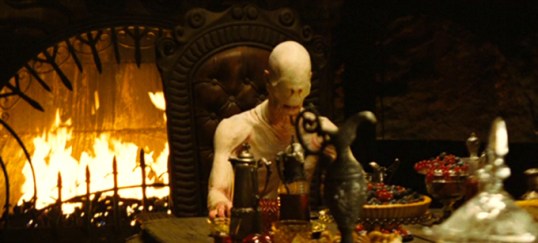
In 2006, Del Toro released the Spanish-language dark fantasy film Pan’s Labyrinth and people who had only known him as the guy who directed Blade II and Hellboy finally understood why critics both high and low were having such a major crush on the man’s work and talent. My favorite scene from this film was a major example why Guillermo Del Toro is such a genius. I’m talking about the scene with the “Pale Man” and Ofelia’s encounter with it during her second task given to her by the The Faun.
This sequence showed Del Toro not just juggling the dark fantasy aspect of the film, but also his talent for world-building and horror. This scene was the one which probably sold those still on the fence about the film as they watched it. It’s a scene which showed Del Toro’s love for monsters and he created one which has left an indelible mark on the film-going audience that still resonates to this day.
Ok, this is the final and most awesome trailer of Guillermo Del Toro’s upcoming giant mechs vs. kaiju (giant monster) blockbuster spectacle, Pacific Rim.
While it might look like so many trailers and teasers about this film will spoil the film for those still to see it I must say that it doesn’t. This latest and last trailer from Warner Bros. still uses scenes from previous teasers and trailers, but just extends each sequences a second or two longer. We get some new images of the jaegers and kaiju fighting, but just extended versions of what we’ve already seen. In the end, this latest trailer still doesn’t give a chronology of how these scenes fit in the film.
I know people probably have their pitchforks and hater-hats on to tear Pacific Rim apart for being too CG, all-action and no brains despite not having seen it. Or worst yet…Looks like Transformers.
I say to these people they should just stay home and go watch their indie, arthouse film that only ten other people have seen and let those of us who enjoy spectacle of this magnitude to enjoy (or not) what Del Toro seem to have cooked up in his mad scientist brain of his.
I don’t go into this film thinking it’ll be a new standard in high art in cinema. I just want to see a giant rocket punch smash into some interdimensional giant monster face.
Pacific Rim will punch fans and detractors a like in the face this July 12, 2013.
Behold, Through the Shattered Lens’ own Jaeger contribution to the fight: Ferrus Mannus.
July 12, 2013 will be the date that will go down in otaku history when anime and live-action finally come together to prove that dreams of a live-action versions of some of the most beloved anime titles can work outside the animator’s studio. Guillermo Del Toro may not admit it but this Wonder-Con exclusive trailer for his upcoming Pacific Rim is chock full of anime influences.
Giant mecha aka Giant robots piloted by humans: CHECK
Giant monsters alien or interdimensional in origin: CHECK
Humanity brought to the brink of extinction and living in fortified cities: CHECK
It sounds like the basic outlines for anime of the past 30 or so years. There’s a bit of Neon Genesis Evangelion. There’s definitely a healthy dosage of the Mazinger Z DNA in this film. We can’t forget the classic Voltron that introduced many young people in the West in the 80’s to the joy of ultra-violent anime. Outside of anime there’s the Ultraman versus kaiju live-action Saturday serials that continues to be popular in Japan to this day and was a staple of any growing boy’s entertainment agenda on Saturday mornings.
Whether this film lives up to the hype it’s been gaining since the first teaser was shown late last year is still an unanswered question, but for fans of action anime this film looks like a love-letter to us and everyone else should just hang on for the ride whether they want to or not.
Plus, for those not steeped in otaku culture it has something for you as well: Jax Teller, Luther, Clay Morrow and Charlie “Kitten Mittens” Kelly.
On July 12, 2013 will be the date to cancel the apocalypse.
It’s still just a little over 3 months before we get the premiere of Guillermo Del Toro’s return to the big-screen. It’s hard to believe that it’s almost 5 years since he last made a film (Hellboy 2: The Golden Army). His time wandering the world of Middle-Earth for three years and the last two developing his upcoming film and we now just have 3 months to wait for what could either be one of the biggest films of 2013 or a colossal failure.
Pacific Rim looks to introduce the well-worn and popular concept of the giant robot vs. kaiju from Japan to the rest of the world. Fans of this very Japanese pop-culture phenomena have been excited over this film since it was first brought up by Del Toro a couple years ago and more since then. Some have nitpicked that the trailers and teasers have made the film look like an offspring of the Michael Bay Transformers series, but then again all we’ve seen so far have been the robots. There’s still the surprise of how the kaiju will end up looking.
One thing I’ve learned about Guillermo Del Toro’s films have been that whether one likes them or not they’re never lazy affairs. He gives everything to the project and makes sure that his overall vision never get compromised by studio interference (one reason why he seems to back out of doing his dream project At the Mountain of Madness).
So, below are some of the latest promotional posters that show the five giant robots from five Pacific Rim nations who have volunteered to help fight the kaiju.
In 2008 a young Argentine filmmaker made a 3-minute short film that caught the eye of one Guillermo Del Toro. The short film was titled Mama and it’s simple premise of ghostly mother chasing after two young girls in a darkened home was so well-received by Del Toro that he decided to produce a feature-length adaptation of the short film. He could’ve easily put himself in the director’s chair for the adaptation, but liking the work done by the short film’s original director the Mexican filmmaker gave the job to the original director, Andres Muschietti, and allowed him the freedom to make Mama the way it was meant to be made.
The feature-length version of the film works off of the screenplay written by the filmmaker Andres Muschietti and his sister Barbara Muschietti (with some help from Neil Cross) and expands on the brief sequence from the short film. We get a backstory as to the origins of the titular character and how she came to be throughout the film. We even get a much more detailed work up of the two young sisters who have become the obsession of the ghostly “Mama” and how they had gotten involved with her.
Mama opens up with a disturbing sequence where a father has murdered his partners in his company and his wife then taking his two young daughters out into the country where his grief at what he’s done leads him in an attempt to complete the cycle of becoming a family annihilator through the killing of his children then his own suicide. It’s only through the intervention of a shadowy figure in the abandoned cabin they’ve come across in the forest that this father’s plan fails. It’s a truly disturbing scene to see a father comforting his 3-year old daughter and at the same time hold a gun to her head. It’s almost a wonder that the audience feels both a sense of relief and horror at seeing “Mama” protect the young girls by killing the father.
We skip five years later as we find out that the father has a twin brother named Lucas (played by Game of Thrones‘ Nikolaj Coster-Waldau) who has spent the intervening years using whatever money the dead brother had left in an attempt to find the two young girls. Victoria and Lilly do get found by the scouts sent out by Lucas in the very same cabin where their father had taken them earlier in the film, but what the scouts find look more like feral animals than children.
One would think that the film would be about “Mama” wreaking havoc on Lucas to try and get her young girls back, but this film is not about mother versus father but mother versus mother. We’ve already met “Mama” briefly in the start of the film. The other mama in this fight for the girls’ love and soul is Lucas’ rocker girlfriend whose attitude in the beginning doesn’t shout maternal at all. Annabelle (played by Jessica Chastain) doesn’t think it’s her job to have to raise the two girls. It’s her love for Lucas that keeps her from bolting and trying to find a common ground with the two young girls. As the film moves forward Annabelle begins to feel protective of the two young girls and begins to believe that “Mama” is real and that she has followed Victoria and Lilly back from the cabin.
To say that this film is a horror film would be understating things. While it does have some jump scare moments and some creepy and disturbing images the story itself plays out more like a dark fairy tale set in a modern setting. just like another Del Toro produced horror film from the last couple years in The Orphanage, this film uses a fairy tale template to tell the story of the maternal love mothers have for their children. It’s interesting to note that the two mothers vying for Victoria and Lilly are not their biological mother, but surrogates who have come to love and care for the two girls in their own way.
Mama doesn’t break new grounds in the field of horror. It’s liberal use of gothic horror cliches and tropes by the Andres and Barbara Muschietti detracts from some darkly beautiful visuals and imagery that the filmmaker seemed very adept in creating to build that very sense of the fairy tale. What could’ve been a “been there and done that” and “paint-by-the-numbers” ghost story gets elevated by the performances by Jessica Chastain and the two young girls (Megan Charpentier as the elder sister Victoria and Isabelle Nélisse as the younger Lilly). Chastain in particular shines in the role of Annabelle as we believe her growth from reluctant caretaker to loving mother figure to protective mama bear by the time film ends on a very un-Hollywood ending.
Mama will definitely lose some fans of the horror genre who expect gore (which the film doesn’t have a drop of) and tons of scary moments (the film has jump scares but not much). This film will attract audiences looking for something familiar but at the same time with the added visual flair of a young filmmaker who looks to have a future in the genre, if not the industry, as a new creative eye who can work with something unoriginal and give it his own spin.
While the film is not on the same creative and storytelling level as Juan Antonio Bayona’s The Orphanage it is much better than Troy Nixey’s remake of the 1973 horror film Don’t Be Afraid of the Dark. The film does continue Guillermo Del Toro’s streak of finding new and upcoming young filmmakers in the horror genre and giving them a chance to break into the industry with him mentoring them through the process. Mama might not be a perfect film but Andres Muschietti’s work as a director shows that he has repaid Del Toro’s faith in him. I, for one, can’t wait to see what this filmmaker has up next.
This weekend sees the release of the Guillermo Del Toro produced horror film Mama. It’s the full feature length film from a short film of the same name by Argentinean filmmaker Andres Muschietti who also directs the full film.
I’m pretty jaded when it comes to horror films purporting to scare the hell out of people, but after seeing this short I could easily believe why Guillermo Del Toro jumped at the chance to produce the feature length adaptation and put the short film’s director back in the chair to the the adaptation. It’s a short film that’s barely 3-minutes long and it’s a wonderful exercise in setting the appropriate mood and atmosphere before the money shot when we finally see the titular character of “Mama”.
Anyone who lives in a home with a second floor and stairs leading up it will definitely need to see this short film to get an idea of what to expect when they finally see Mama in the theaters.
I think Guillermo Del Toro’s upcoming giant robots vs giant monsters summer film will either fail to live up to the hype it’s been gathering since the very first teasers and images were released or the film will blow people’s minds away. This looks to be a film that will not brook any middle-of-the-road reaction. Some will either love it and some will absolutely hate it. Already there’s people who have been dismissing it as nothing but a jumped-up-Michael Bay rip (like that’s even possible) or dismissing it just because it’s a summer blockbuster, special-effects heavy film and not a barely-funded, arthouse, indie foreign film about the meaning of life, existence and the ennui that befalls all.
I, for one, am hyping this film up to beyond what’s safe to hype a film up for (yeah that doesn’t make sense but still deal with it). I’ve been a fan of Del Toro since I first caught his imaginative and inventive take on the vampire myth with Cronos. While he’s earned geek cred for his genre projects he is also once of the few filmmakers who have also gained the respect of the arthouse indie crowd with such films as The Devil’s Backbone and Pan’s Labyrinth.
Enough gushing over the man. It’s all about the new trailer which premiered at this year’s CES over in Las Vegas. One wouldn’t think of CES as a place to premiere new footage about a summe rblockbuster, but as one can spy in this newest trailer it looks like Qualcomm paid some cash to get itself named in the film even if it’s just in the background. Also, just to show just how awesome this film will be there are also the design blueprints of five of the giant Jaegers that we’ve caught glimpses of in the trailer.
It’s hard to believe that’s it’s been 11 years since Peter Jackson released The Lord of the Rings: The Fellowship of the Ring on the masses in 2001. There were much trepidation from Tolkien fans that Jackson (who had been known mostly for low-budget splatter horror-comedies) wouldn’t be able to handle the monumental task of adapting what many consider the greatest novel ever written in the 20th century. Tolkien’s epic fantasy became the standard by which fnatasy epics would be compared to for decades to come and still do. To say that Jackson succeeded in this epic task would be an understatement. TheLord of the Rings trilogy would hoard awards from 2001 to 2003 and also box-office receipts to make any dwarf-lord green with envy.
It’s now 2012 and we finally have the release of Jackson’s next trip into Middle-Earth as he adapts another of Tolkien’s beloved novels. This time he tackles The Hobbit which for some Tolkien fans remains their favorite of the author’s works. It’s a novel that might not have the epic scope and breadth of The Lord of the Rings, but what it lacks in that department it more than makes up in being a fun, adventure tale of a curious hobbit named Bilbo Baggins, a wizard named Gandalf the Grey and a fellowship of twelve dwarfs led by one Thorin Oakenshield of Erebor.
The Hobbit was originally written as a children’s book, but in later years Tolkien would retcon some parts of the novel to better fit with his magnum opus in The Lord of the Rings.It’s this revised version of that children’s story that Peter Jackson, Fran Walsh, Philippa Boyens and Guillermo Del Toro would adapt for the big-screen. Initially a two-film set that would tell the story of Bilbo and his merry band of adventurers, but it has since been expanded to become a trilogy as Jackson and his writers take a page out of Tolkien’s bag of tricks and try to tie-in this latest trilogy to the Lord of the Rings which precedes it by a over a decade.
The first film in this new trilogy is called The Hobbit: An Unexpected Journey and we begin by returning to sometime before the beginning of the first trilogy’s first film. We see the aged Bilbo reminiscing of his adventures 60 years hence and deciding to put it to pen and paper as a sort of memoir of that adventure to reclaim the lost dwarf-hold of Erebor. It’s in this opening that we get to see Frodo once more (played once again by Elijah Wood who doesn’t seem to have aged) prior to him taking up the One Ring.
Bilbo recounts to Frodo the realm of Erebor deep inside the Lonely Mountain east of the Shire to Frodo and how it’s wealth in silver, mithril, gold and precious gems became well-known throughout Middle-Earth. Yet, as Bilbo warns, it’s the very sickness of avarice by Erebor’s Thror the King which seals the dwarf-hold’s doom. We learn that hoards of wealth does more than light up the dwarf king’s eyes with greed but also brings the attention of one of the very last dragon’s in Middle-Earth. The arrival of Smaug to Erebor signals the death of not just that dwarf realm, but the surrounding human town of Dale. The surviving dwarfs of Erebor flee in a massive diaspora towards any safe haven willing to take them in. What was once a proud and powerful realm has now been sundered and it’s afterwards that we get to the meat of the film’s story.
Martin Freeman as a younger Bilbo Baggins was more than just great casting but one which the film needed if one was to believe that this young Bilbo would grow old to be the Ian Holm one fans of the first trilogy have come to know well. His performance as Bilbo Baggins of Bag End becomes the anchor from which the rest of the company would revolve around. When we first meet Freeman as Bilbo he’s not the adventurer that he would become, but a hobbit that’s respectable and one not for doing anything foolish like going on adventures. Yet, his lot in life changes as Gandalf maneuvers the situation so that he becomes embroiled in the quest by Thorin Oakenshield (played by Richard Armitage) to retake his ancestral lands of Erebor and it’s massive wealth from Smaug who has taken it for his lair.
While many would think that a film called The Hobbit would focus on Bilbo I thought the way the film unfolded that this story was all about the dwarfs with extra focus on the single-minded Thorin who comes off initially as both condescending, superior and dismissive of poor old Bilbo. The film never fails to show how much Thorin thinks so less of Bilbo yet throughout the film’s two and a half and more running time we see cracks in Thorin’s ice-cold demeanor towards the young hobbit. By film’s end we see just how wrong Thorin has been of Bilbo’s worth and it makes for one of the film’s more emotional scenes when Thorin realizes this as well.
The Hobbit: An Unexpected Journey is not just about a brooding dwarf prince and his motley band of dwarfs getting into one trouble after the next once they’ve left the Shire with Bilbo. The film also brings on a parallel storyline which tries to lay down the foundation that would tie this new trilogy with the first one. It’s the storyline of the Great Necromancer that Gandalf and a fellow wizard, Radagast the Brown, suspect might be the Great Enemy returned. We learn soon enough during the White Council in Rivendell (attended by Gandalf, Galadriel, Elrond and Saruman the White) that this so-called Necromancer might be Sauron looking to regain his former strength and gather an army to him.
It’s this second storyline that get’s sandwiched within the Thorin Oakenshield Fellowship quest that comes off a bit awkward in the film’s overall narrative flow. Where the film is all about fun adventuring and camaraderie when the dwarfs and Bilbo are on the screen, when they’re not and the film tries to tell us about Sauron’s eventual return the film slows down. These scenes are not uninteresting. On it’s own these sequences bring back the epic tone of the original trilogy and brings it into this film, but it’s that very grandiose theme that seems out of place in what is simply a “men on a mission” story.
Fortunately, we don’t spend too much time dwelling on this side-story. The final third of the film is all about Thorin and company needing to escape from one goblin lair and orc ambush to another. The last 45 minutes or so flies back swiftly after a very uneven first two hours that would make more than a few theater-goers look at their watch. The wait is worth it as we see that Jackson hasn’t forgotten how to choreograph and stage fantasy action scenes. While the use of CGI might be more evident this time around than the previous three films they’re still small compared to other blockbuster films of it’s type. It’s still all about WETA practical effects, make-up and costumes that combine to create a world that’s become familiar yet still have a sense of newness to them as we see new areas of Middle-Earth only mentioned in brief passing in the original trilogy.
The Hobbit: An Unexpected Journey is a wonderful return to the world of Middle-Earth. It is not without it’s missteps and flaws, but it also gets saved by some great performances from the ensemble cast which makes up the dwarfs. The aerial shots of the New Zealand’s eclectic geography shows just how much cinematographer Andrew Lesnie has become such a major component of making Middle-Earth come alive. Even the return of Howard Shore as the film’s composer was a welcome that brought more than a few smiles.
There’s no way of talking about The Hobbit without bringing up the stylistic gamble Peter Jackson has taken in filming this film and the rest of the trilogy in 48fps instead of the traditional 24fps (frames per second) that filmmakers have been using for almost a hundred years now. It’s an aesthetic choice that gives the film a overly realistic look akin to watching a stage production live. Everything looks too perfect and the High-Frame Rate (HFR) takes away some of the cinematic look which many have grown up seeing every time they watch a film. This new filming style works in certain areas like wide shots of the outdoor scenes. Whether it’s the emerald green rolling hills of the Shire to the snowcapped Alpine peaks of the Misty Mountains, these scenes in HFR came out beautiful. It’s when the film switches over to a much more enclosed and personal space within rooms and halls that we get the unusual “soap opera” look some have complained about. It takes a bit of getting used to, but some make the adjustment quickly enough while others may never make the adjustment.
Yet, it is when the film shows a CGI-created sequence that the HFR fails. While the doubling of the frame rate during filming has made the 3D in the film come off smoothly it did make some of the CG-effects come off as too video game-like. A sequence earlier in the film where we see a flashback of Thorin and the dwarfs of Erebor trying to retake another fallen dwarf hold in Moria (Khazadum in dwarfish) looks like a cinematic cutscene as a dwarf army charges and battles it out with an orc and goblin force which had taken Moria as it’s own.
All the scenes where HFR fails to come off as believable turn out better when The Hobbit was seen in traditional 24fps. I actually think that downscaling the film from it’s original HFR to a more traditional film frame speed of 24fps gave the film an even more magical look than the original trilogy. Jackson and his team of filmmakers have two more films to release and hopefully take some of the criticism this first film has received about HFR that they tweak and work on making the new style much more believable instead of taking the audience out of the film’s narrative.
The Hobbit: An Unexpected Journey doesn’t come off as grandiose as the original trilogy and for some that might come as a disappointment. Yet, as an adventure film it more than does it’s job to fully entertain it’s audience while, at the same, time reminding it’s audience how much this film and this trilogy will lead into The Lord of the Rings. I recommend that people just see the film and decide on their own whether it’s a worthy addition to the Middle-Earth saga as seen through the eyes of Peter Jackson. I, for one, think it is and with two more films left we shall see whether Jackson’s return to Middle-Earth has been a triumphant one or not.