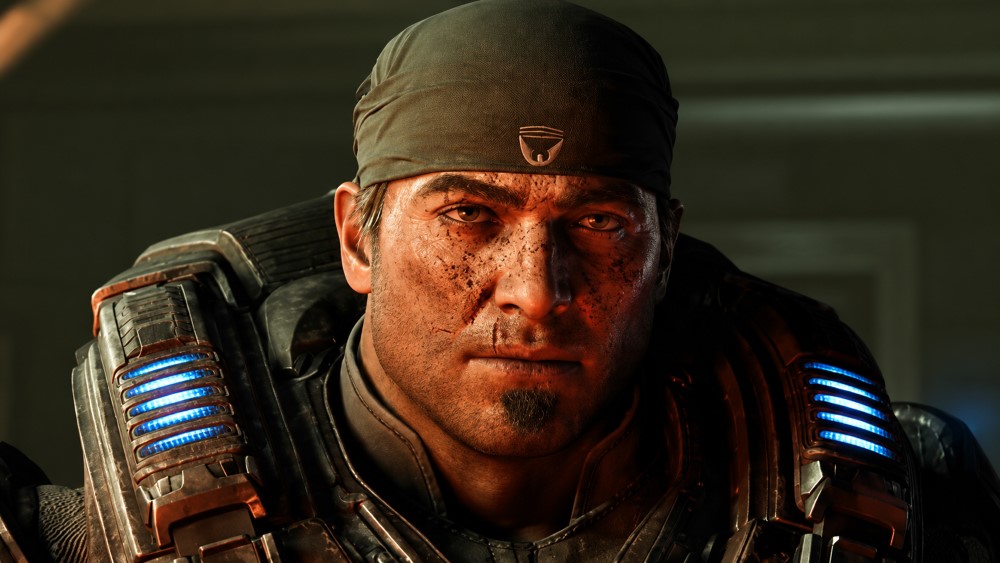
“With all due respect, fuck you, sir.” — Marcus Fenix
Few video game protagonists carry the weight of a dying world on their shoulders quite like Marcus Fenix, the granite-jawed soldier of Gears of War. At first glance, he seems deliberately unremarkable: a muscled, armor-plated space marine who speaks in growls and commands with grunts. Yet this surface-level stoicism is precisely what makes him so compelling. Marcus rejects the quippy, one-liner-spouting action hero archetype popularized by the early 2000s. Instead, he embodies a weary, bone-deep authenticity. He is a man who has lost everything—his father, his freedom, and his faith in authority—and his silence speaks louder than any monologue. That authenticity is the bedrock of his charisma; he does not perform heroism, he simply endures.
What elevates Marcus beyond a simple “tough guy” is his profound, unspoken loyalty. His defining act before the first game even begins—abandoning his post to rescue his father, which lands him in a military prison—immediately establishes his moral code: duty to family over duty to order. Throughout the trilogy, this loyalty extends to his squad, particularly his best friend, Dominic Santiago. The chemistry between Marcus and Dom is never overstated; it lives in shared glances, battlefield tactics, and the quiet understanding of two men who have bled together for over a decade. When Dom sacrifices himself in Gears of War 3, Marcus’s single, devastated howl is one of the most emotionally raw moments in gaming history. That grief is charismatic because it is earned—it shows that beneath the armor is a heart capable of being shattered.
Marcus also subverts the typical “chosen one” narrative. He is not a prophesied savior or a supernatural being; he is a skilled, broken soldier who keeps fighting because stopping means admitting that everyone who died did so for nothing. His charisma stems from his everyman fatalism, magnified by a world of grotesque monsters. While other heroes might inspire with rousing speeches, Marcus inspires by example. He is always the first through the breach, the last to retreat, and he never asks his men to do anything he wouldn’t do himself. This quiet, grindstone leadership is deeply appealing in an era saturated with narcissistic antiheroes. He earns respect not through charm, but through competence and sacrifice.
Moreover, the game’s design reinforces his character. The Lancer rifle with its chainsaw bayonet is an extension of Marcus’s personality: brutal, efficient, and unwilling to pretend war is clean. His heavy, lumbering movement in the early games conveys exhaustion, as if every step is a battle against despair. The “active reload” mechanic, which rewards precise timing, mirrors Marcus’s own discipline—a man who cannot afford to waste a single bullet or moment. Even his trademark bandana and scruff are practical, not stylish. Every element of his visual and mechanical design supports a man who has long abandoned vanity. This cohesion between gameplay and character makes his rare moments of dry humor—like his deadpan “Nice” after a brutal execution—feel like earned releases of tension rather than forced wit.
In the end, Marcus Fenix is charismatic because he respects the gravity of his world. He doesn’t crack jokes while Locusts tear his comrades apart; he doesn’t pause for dramatic monologues as cities fall. Instead, he offers something rarer: the quiet dignity of a man who keeps moving forward when hope is a luxury. In the later games, including Gears 5, we see him as an older, scarred father figure to JD Fenix, still struggling with the same burdens of command and love. That continuity of pain and perseverance is what solidifies him as an icon. Marcus Fenix reminds us that heroism is not about flash or wit—it is about being the rock others can hold onto when the world is flooding, even if that rock is too tired to speak.
Hero of the Day

