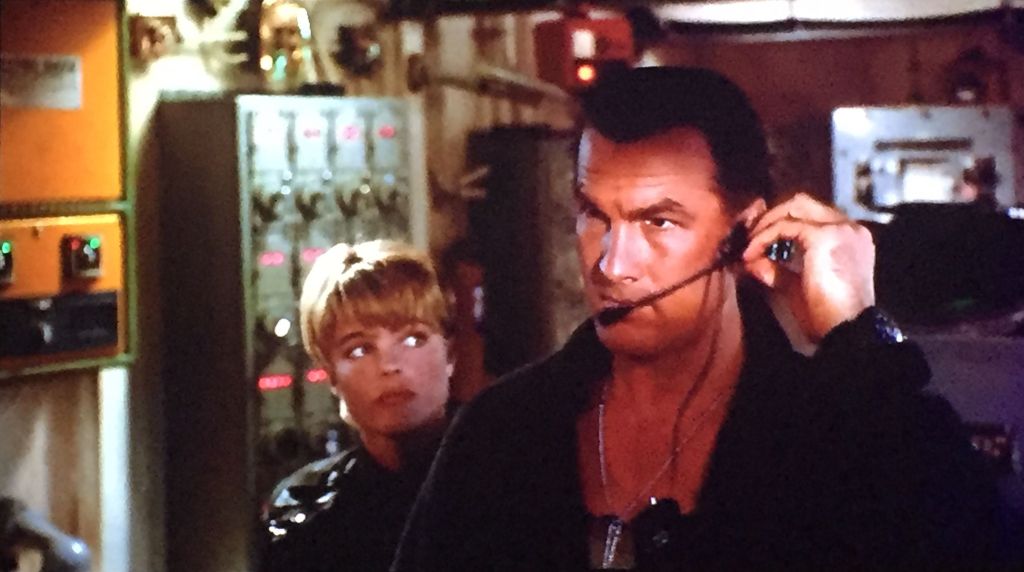
I’ve always liked UNDER SIEGE. After his sudden emergence with a series of brutal action films in the late 80’s and early 90’s, like ABOVE THE LAW and OUT FOR JUSTICE, Steven Seagal entered the world of high concept action filmmaking when he starred in this “Die Hard on a Battleship.” Seagal would not be the underdog cop taking on drug dealers, coked up mafia hitmen, or crooked cops here. Rather, he emerges as a full blown movie star in a big budget studio action film. Directed by Andrew Davis, whose credits include Chuck Norris’ best movie CODE OF SILENCE (1985), Seagal’s debut ABOVE THE LAW (1988) and the next year’s global smash THE FUGITIVE (1993), this is the movie where everything came together for Seagal. I watched UNDER SIEGE at the movie theater myself in 1992 and had a great time with it. I didn’t realize at the time that this would be his career peak, with a global box office of over $156 million. No other film would really even come close.
Casey Ryback (Seagal) is a “cook” aboard the USS Missouri, a battleship that is scheduled to be decommissioned. He’s also a former badass Navy SEAL who was demoted after punching out his commanding officer when a mission in Panama had gone wrong. When a group of mercenaries led by ex–CIA operative William Strannix (Tommy Lee Jones) seize control of the ship under the guise of a birthday celebration, they overlook Ryback. In classic John McClane style, Ryback goes on to become a fly in their ointment, a monkey in their wrench, and a big-time pain in their asses! Moving through the narrow corridors of the ship, and with the assistance of Playboy Playmate Jordan Tate (Erika Eleniak), Ryback begins taking out mercenaries one by one. But will he be able to stop Strannix and his partner Krill (Gary Busey) from stealing the ship’s nuclear Tomahawks and preserve the safety and security of the world? I’ll give you one guess!
First and foremost, UNDER SIEGE is a damn good action movie. It definitely helps that a director as talented as Andrew Davis is calling the shots. His film delivers on the entertainment front, with lots of well staged shootouts, violent scenes of close quarter, hand-to-hand combat, and a cake emergence sequence that still makes my head spin! I think the battleship makes for a great “movie” setting for this type of action. With its concoction of narrow hallways, engine rooms, and mess halls, there’s all kinds of interesting places for fighting and killing. Back in 2007, I was lucky enough to take a tour of the USS Alabama battleship, the primary filming location for UNDER SIEGE, which only enhances my appreciation for the work done here. On the heels of his confident and charismatic performance in the prior year’s OUT FOR JUSTICE, this is Steven Seagal at his most watchable. He’s in peak physical condition, so he can believably kick all the ass that’s necessary for this kind of film, and he’s also likable in his role as the underestimated “cook.” He will never be mistaken for Bruce Willis, but Seagal is good here.
Great action movies will usually have great villains, and UNDER SIEGE is especially blessed in this area. Tommy Lee Jones goes way over-the-top, chewing on scenery like he’s at a Golden Corral buffet, turning Strannix into the type of irrational lunatic that I love in my early 90’s action movies. And looking back now, Gary Busey seems to do what he does best. His traitorous Commander Krill comes off as goofy, disgusting, and unstable. In other words, he’s perfect. Even though Seagal does smile more in this film, Jones and Busey do bring an energy to the movie that balances out Seagal’s more stoic character, providing the type of spark not often found in the star’s movies.
At the end of the day, I rank UNDER SIEGE as my second favorite Steven Seagal film, slightly below my preference for the more down and dirty OUT FOR JUSTICE. What it lacks in grit is more than made up with entertainment value, strong performances, and action on a scale that the star’s future films would never rise to again. If I were put in a position where I could only recommend one Steven Seagal film to a person who’d never seen one of his movies before, I’d probably go with this one. It’s an excellent, mainstream 90’s action movie.
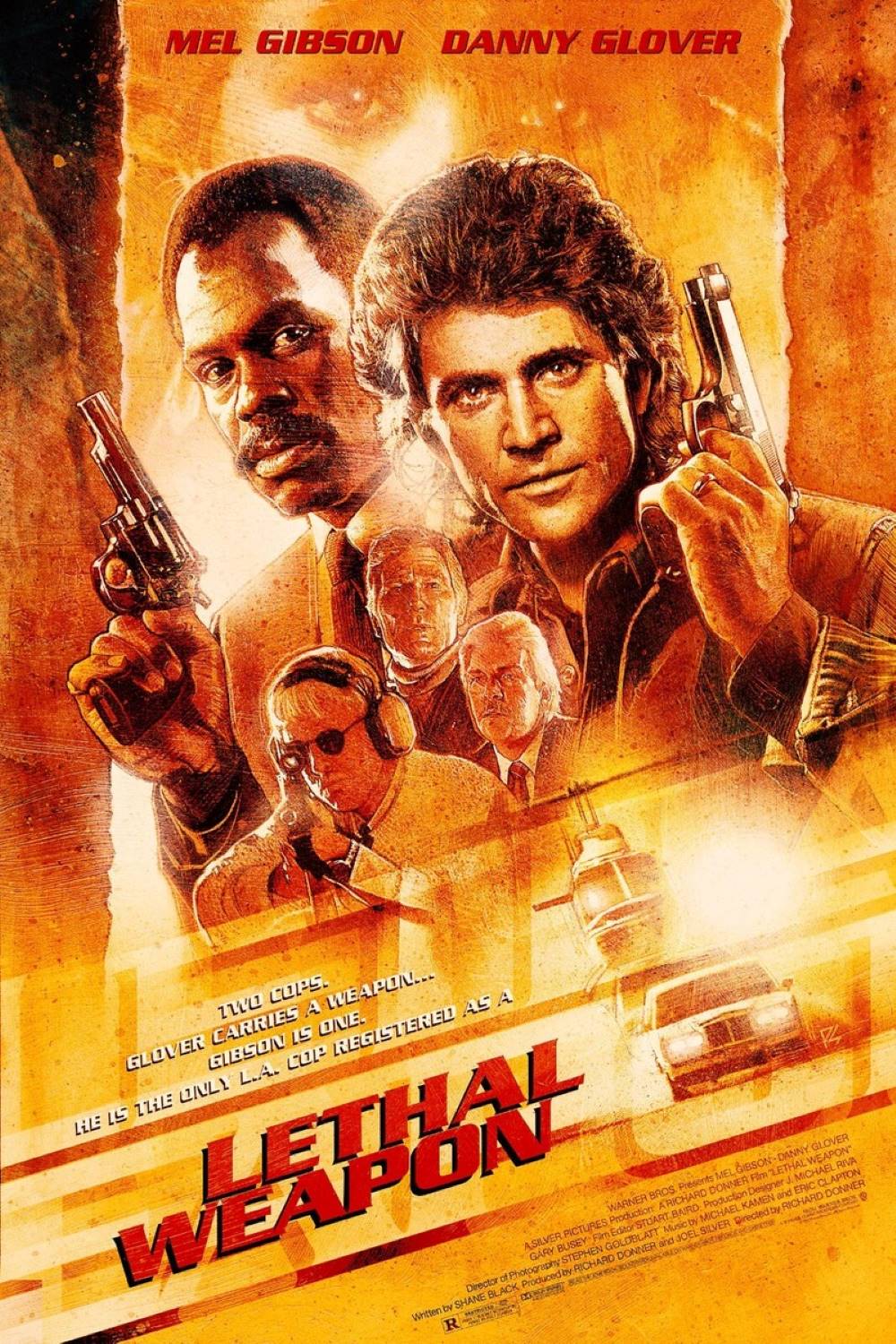
Lethal Weapon is one of those action movies that looks like pure genre formula on paper but somehow plays like lightning in a bottle on screen. From the opening moments, it feels like a film that knows exactly what kind of ride it wants to deliver and leans into that mission with confidence, attitude, and just enough heart to make the bullets and explosions actually matter.
The premise itself is as straightforward as they come, and that simplicity is part of the charm. Martin Riggs is the textbook “cop on the edge,” a former special forces sniper whose life has completely fallen apart after the death of his wife. He’s volatile, depressed, and teetering on the edge of suicidal, which gives everything he does an extra layer of danger. On the other side of the pairing is Roger Murtaugh, a seasoned detective staring down his 50th birthday, trying to balance a long career in homicide with the quiet, constant pull of his family at home. When these two are thrown together and assigned to a case involving drugs, dead bodies, and shady ex-military criminals, the story plays out across familiar beats: suspicious deaths, escalating confrontations, close calls, and a trail that leads them deeper into a dangerous operation. The crime plot is pulpy and direct rather than twisty, but the film uses it as a sturdy framework rather than the main point of interest, keeping the investigation moving while the characters come into focus. Much of that sharp setup and snappy progression comes from Shane Black’s script, which crackles with knowing genre savvy, pitch-perfect banter, and a keen eye for how personal pain fuels action-hero antics.
What really makes Lethal Weapon feel alive is how much time it spends letting Riggs and Murtaugh exist as people before they fully morph into the “classic duo” that pop culture remembers. The film doesn’t rush past the small stuff. Riggs is introduced living in a rundown trailer on the beach with his scruffy dog for company, drinking and stumbling through life with the casual recklessness of someone who genuinely doesn’t care if he sees tomorrow. Those early moments of him alone, flirting with self-destruction, give his later heroics a sense of tragic context: he’s not just fearless, he’s half-convinced he has nothing left to lose. Murtaugh’s introduction is a complete contrast: a crowded home, kids, a loving wife, and the kind of loud, chaotic domestic life that’s full of relatable irritation and warmth. Seeing him grumble through birthday milestones or awkwardly handle family situations does more for his character than any speech about his years on the force could. These slices of everyday life build a strong emotional foundation so that when the bullets start flying, there’s something at stake beyond catching bad guys. Black’s writing shines here, weaving those intimate details into the thriller beats without ever feeling forced or preachy.
The chemistry between Mel Gibson and Danny Glover is the film’s true secret weapon. Gibson plays Riggs as an unpredictable live wire, able to flip from goofy physical comedy to chilling seriousness in an instant. He sells the idea that this is a man barely keeping it together, yet still razor-sharp when it comes to the job. There’s a constant sense that his jokes and antics are a flimsy barrier over something very raw. Glover, by contrast, keeps Murtaugh grounded and human; his performance is packed with little sighs, muttered reactions, and weary facial expressions that speak volumes. He comes across as a guy who has seen too much, loves his family, and genuinely wants to do the right thing, but is exhausted by how hard that is in practice. Their initial friction hits the expected “mismatched partners” beats: Murtaugh thinks Riggs is unstable and dangerous, while Riggs treats Murtaugh like a fussy old man who doesn’t get it. Yet as they move through stakeouts, interrogations, and gunfights, their banter evolves from pure irritation into an easy rhythm filled with barbs, mutual respect, and eventually real affection. Shane Black’s dialogue is the glue for all of it—witty, profane, and laced with just enough vulnerability to make the laughs land harder and the tension feel real.
Richard Donner’s direction is a huge part of why all of this clicks as well as it does. He has a knack for blending big, commercial genre instincts with an eye for character detail, and Lethal Weapon is a textbook example of that balance. He stages action scenes with clear geography and rhythm, so even when things get loud and chaotic, you always know where you are and what everyone is trying to do. At the same time, he’s just as interested in the quiet beats: a pause on Riggs’ face after a joke lands flat, Murtaugh’s body language when he walks into his noisy home after a brutal day, the way a conversation in a car can shift from banter to confession in a couple of lines. Donner keeps the film moving at a brisk pace, but he knows when to let a shot linger or a silence hang long enough to tell you what the characters can’t quite say out loud. His tonal control—jumping from dark to funny to tense without completely losing the thread—is a big reason the movie doesn’t collapse under its own genre juggling, and it pairs beautifully with Black’s script that sets up those shifts so precisely.
Tonally, Lethal Weapon walks a tricky line, and that’s a big part of its identity. On one hand, this is a story with genuinely dark undercurrents. Riggs’ suicidal impulses are not a throwaway character quirk; the film gives time to scenes where he nearly acts on them and struggles in a very raw way with his grief and loneliness. The case they’re working breaks open into territory involving drugs, exploitation, and violence that’s sometimes nasty rather than cleanly heroic. On the other hand, the film is full of humor, ranging from quick one-liners to broad physical bits. The Murtaugh household provides a lot of that levity: awkward conversations with his kids, Riggs stumbling through family dynamics, and the contrast between domestic calm and the chaos of the streets. The movie often jumps from heavy emotional beats to comedic ones and back again, and while the transitions can be abrupt, that mixture is part of what keeps it from feeling like just another grim cop story. The laughter doesn’t erase the darker material, but it does give the movie a sense of momentum and charm that keeps it entertaining instead of oppressive. Black’s screenplay nails this push-pull, using humor as both release valve and revelation.
As an action film, Lethal Weapon delivers a steady run of sequences that are energetic, clear, and tactile. The action is built around physical stunts, dangerous-looking falls, and gunfights that feel chaotic without becoming incoherent. One memorable sequence has Riggs dealing with a jumper on a rooftop in a way that instantly tells you everything about his mentality and willingness to risk himself. Another set piece in a more open, exposed environment lets the film escalate tension step by step before violence finally erupts. Through it all, Donner keeps a strong sense of spatial clarity; you can track where the characters are, what they’re trying to do, and how each decision raises the stakes. The fights feel scrappy and painful rather than overly slick, and that slightly rough quality actually works in the movie’s favor, making each impact land harder. Riggs, especially, moves like a human weapon, hurling himself into situations with a recklessness that ties directly into his psychological state, all fueled by Black’s clever plotting that makes those risks feel personal.
Underneath the gunfire and explosions, there’s a surprisingly sturdy emotional core tying everything together. Riggs’ grief isn’t just window dressing; it’s the lens through which his every decision makes sense. The movie doesn’t lecture you about what he’s feeling, but it shows it—through quiet moments alone, through the anger that erupts at all the wrong times, and through the way he throws his body into danger almost as if daring the world to take him out. Murtaugh’s arc is more subtle but still strongly drawn. He’s at an age where he has to confront the reality that he can’t keep pace with younger, more reckless colleagues forever, and yet his sense of duty keeps pulling him into situations where his family might lose him. Throughout their investigation, Murtaugh’s protective instincts—toward his loved ones, toward Riggs, and toward innocent people caught in the crossfire—become as important as his skills as a detective.
The relationship that develops between Riggs and Murtaugh is the heart of the film and the main reason it sticks in the memory. At first, Murtaugh just wants to survive partnering with a man he genuinely believes might be unhinged, while Riggs seems to treat their pairing as just another chaotic twist in a life already off the rails. As they trade confessions, back each other up in tight spots, and slowly understand what the other is carrying, their bond shifts into something like brotherhood. Murtaugh becomes a kind of anchor for Riggs, offering not just backup in a fight but also a place at the table, both literally and figuratively. Riggs, in turn, forces Murtaugh out of his comfort zone, reminding him that he still has plenty of courage and fire left in him. The film doesn’t turn their connection into a sentimental soapbox, but it lets small moments—a shared laugh after a narrow escape, a quiet conversation after the chaos—do the emotional lifting, with Black’s words giving those scenes their understated power.
If there’s a clear weak spot, it’s that the villains are fairly thinly drawn, operating more as looming threats than fully realized characters. They are dangerous and organized, capable of serious brutality and clearly involved in serious criminal operations, but the movie doesn’t spend much time exploring their motivations or inner lives. They’re the kind of antagonists designed to be obstacles: formidable enough to make the heroes’ victories feel earned, but not so complex that they distract from the central duo. For a character-driven action film, that trade-off mostly works. When Lethal Weapon is firing on all cylinders, the tension doesn’t come from wondering what the bad guys will do next so much as from seeing how Riggs and Murtaugh will handle whatever gets thrown at them and what that reveals about who they are.
Structurally, the film keeps a tight pace, always nudging the story forward even when it pauses for character beats. Expository scenes rarely feel like dry info dumps; they’re often laced with jokes, personal jabs, or subtle shifts in how the two leads relate to each other. The downtime moments—a quiet drink, a shared meal, a conversation in a car between partners who would rather pretend they’re fine—are as important as the louder ones. By the time the case ramps up to its most intense passages, there’s been enough time with these characters to care less about the mechanics of the plot and more about whether these two damaged, stubborn men can come out the other side with something to hold onto.
What ultimately makes Lethal Weapon work so well is that it doesn’t settle for being just a checklist of genre requirements. Yes, it has gunfights, dark humor, car chases, and tough-guy posturing. But wrapped around all of that is a story about grief, aging, loyalty, and how unlikely partnerships can change the trajectory of a person’s life. Donner’s steady hand behind the camera, Shane Black’s razor-sharp script, and the powerhouse performances turn what could have been a forgettable cop thriller into something much more memorable. For anyone who enjoys action movies that care as much about the people pulling the triggers as the bullets they fire, Lethal Weapon stands out as a defining entry in the buddy-cop mold, powered by the messy, heartfelt dynamic at its center and the sure-footed craftsmanship that brings it all together.
Montessi (Kim Coates) and his men have taken over a water filtration plant, are holding hostages, and keep threatening to poison the water supply. Rogue cop David Chase (Jeff Fahey) and Melissa Wilkins (Carrie-Anne Moss) sneak around the plant and try to stop the terrorists. David Chase is set up to be a John McClane type but instead, he only kills one terrorists and then lets everyone else do most of the work. Of course, the whole water filtration hostage situation is just a distraction so Mr. Turner (Gary Busey) can steal a bunch of bonds. Busey sits behind a computer for most of the movie, lending his name but not much else.
A good cast is wasted in what is definitely one of the worst of the many DieHard rip-offs to come out in the 90s. There’s not enough action, with Jeff Fahey as a passive hero and even the great Kim Coates reduced to standing around and doing a lot of yelling for most of his time on screen. Gary Busey is the big star here but it’s obvious that he was only on the set for a few hours and his plan for stealing the bonds never makes sense. Whenever anyone questions his plans, he says that it involves computers. In the 90s, I guess that was enough.
Watching this last night, I realized that I had seen it on Cinemax back in the day. It didn’t make much sense back then either.
LETHAL WEAPON may be more of a Christmas movie, and today is the 4th of July, but today is also the 76th birthday of Ed O’Ross. Ed is an instantly recognizable character actor from movies like THE HIDDEN (1987) and RED HEAT (1989), but I always think of him first as Mendez, the guy who’s freaked out by The General (Mitchell Ryan) and Mr. Joshua (Gary Busey) at the beginning of LETHAL WEAPON!
While you’re enjoying the the 4th of July, take a few minutes to celebrate Ed O’Ross and one of the great buddy cop films of all time!
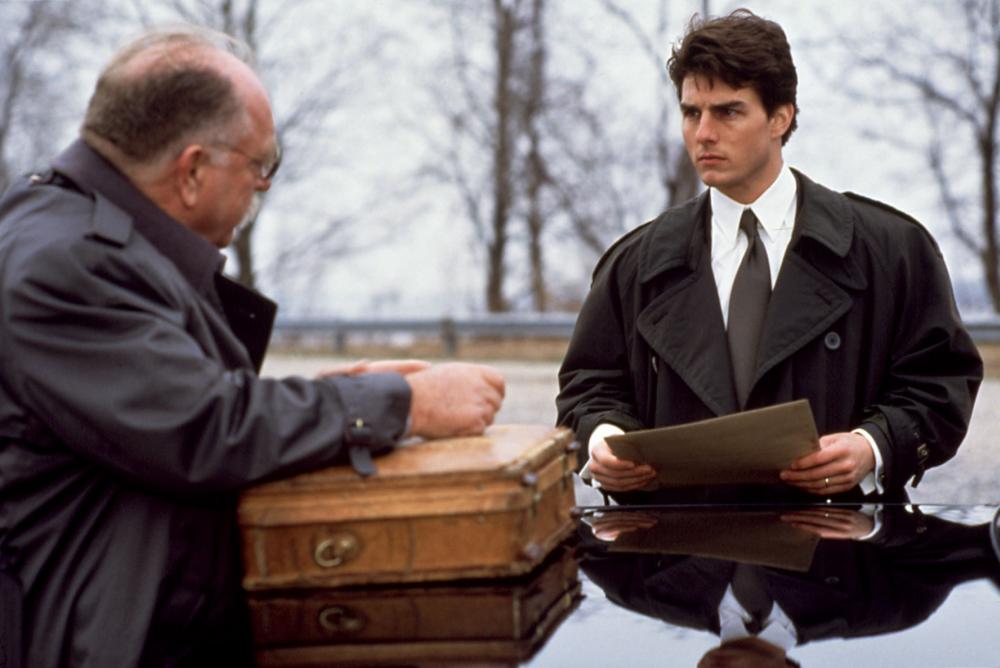
In honor of Tom Cruise’s 63rd birthday, I decided to watch THE FIRM, which is based on the 1991 novel from author John Grisham. Cruise stars as the brilliant Harvard law graduate Mitch McBride, who convinces his wife Abby (Jeanne Tripplehorn) to move to Memphis, TN, so he can join the prestigious Memphis law firm of Bendini, Lambert & Locke. With the help of his veteran mentor Avery Tolar (Gene Hackman), Mitch seems to be excelling at his job, and everything is just so perfect. Unfortunately, the good times don’t last as Mitch starts to notice some suspicious stuff going on with the firm, beginning with the mysterious deaths of two of his fellow attorneys. He’s soon approached by FBI agents, led by Wayne Tarrance (Ed Harris), who tell him that there are nefarious deeds taking place at the firm, including the laundering of money for the Chicago mob. When Mitch starts questioning the activities of the firm, he finds himself the subject of blackmail and intimidation from the firm’s security officer William Devasher (Wilford Brimley) because the firm will do anything to protect its secrets. Mitch is soon caught between betraying his corrupt employers, who are threatening to kill him, and the FBI, who is pressuring him to expose the firm’s criminal activities. Not wanting to lose his life, go to jail, or get disbarred, Mitch devises an extremely risky plan to outsmart the firm and the FBI, but is even he brilliant enough to pull this one off?!
Back in the early 90’s, it seemed that every other movie being released was adapted from a John Grisham novel, and the very first of those adaptations was THE FIRM in 1993. Extremely successful at the box office, THE FIRM grossed over $270 million worldwide, setting the stage for five new movies based on Grisham novels over the next five years. THE FIRM was not only financially successful, it’s also an extremely effective movie that showcases a 30-year-old Tom Cruise at his very best. Director Sydney Pollack crafted a creepy and paranoid thriller, using a slow-burn buildup that relies on Cruise’s ability to believably go from naïve and starstruck at the beginning, to scared and desperate during the middle portion of the film, and ultimately to resourceful and intelligent at the end, as he navigates the dangerous situations he finds himself in. It’s a dynamic, intense performance, and even with a huge supporting cast of excellent actors around him, Cruise dominates every frame of this film. Other performances that stand out to me are Jeanne Tripplehorn as Mitch’s wife Abby, Wilford Brimley as the firm’s enforcer, Gary Busey and Holly Hunter as a private investigator and his administrative assistant from Little Rock, and David Strathairn as Mitch’s jailbird brother in Arkansas. Gene Hackman is good in his role as Mitch’s corrupted mentor Avery Tolar, but his character is not one of my favorites from the legendary actor. His character has accepted his corruption and learned to cope with it over the years through alcohol and womanizing, just so he can keep making the money. He knows better and that’s the part that ultimately makes him the most pathetic. Ed Harris is also good in the film as the FBI Agent, but his character is kind of an asshole, and it’s fun to see Mitch outsmart him.
I also like the Memphis, Tennessee locations showcased in THE FIRM, locations that I’ve been to many times, such as Beale Street, Mud Island, and The Peabody Hotel. Early in the movie, Cruise’s character flips right along with the “Beale Street flippers,” popular Beale Street entertainers who perform nightly for tips. I’ve given them some of my cash over the years! And the chase sequence that starts at Mud Island and spills over into downtown Memphis is one of the most exciting parts of the movie. My home state of Arkansas even gets in on the action when Mitch meets FBI agent Wayne Tarrance at the Southland Greyhound Park located in West Memphis, Arkansas. The greyhound race track no longer exists at that location, as the final dog race was held on December 31, 2022. The site has now become the Southland Casino, one of three operating casinos in Arkansas, with the other two being the Oaklawn Casino in Hot Springs and The Saracen Casino in Pine Bluff. I also like the fact that the sleazy private investigator, played by Gary Busey, is from Little Rock, Arkansas. I commute to Little Rock daily to work at my accounting and tax firm, and it’s fun imagining that there could be an “Eddie Lomax” somewhere around here.
THE FIRM may not be a perfect film… some fat could have been trimmed out as it runs for over two and a half hours, a lot of time for a “thriller;” and while effective on paper, I also can’t help but wonder if the resolution would have worked quite as well in real life as it’s portrayed in the film. I still love the movie and consider it to be one of Tom Cruise’s best. I revisit it quite often, and I’m glad his birthday gave me another excuse to watch it again today!
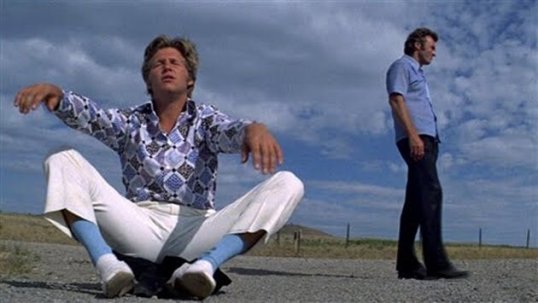
1974’s Thunderbolt and Lightfoot opens with two men, one young and one middle-aged, facing a moment of truth.
The younger of the two is Lightfoot (Jeff Bridges), a wild and hyperactive rich kid who is in his 20s and who steals a corvette right off of a used car lot. The other man is simply known by his nickname, Thunderbolt (Clint Eastwood). When we first see Thunderbolt, he’s giving a sermon in a small Montana church. When a gun-wielding man steps into the church and promptly starts firing at Thunderbolt, he takes off running. Pursued by his attacker, Thunderbolt runs through a field and just happens to jump onto Lightfoot’s speeding corvette. Lightfoot runs over the Thunderbolt’s pursuer. Thunderbolt slips into the car and Lightfoot drives on for a bit. Lightfoot is excited and talkative. Thunderbolt is more concerned with popping his shoulder back into its socket. A stop at a gas station leads to the men stealing someone else’s car.
And so it goes for a good deal of the movie. Thunderbolt and Lightfoot is a road movie, the majority of which is taken up with scenes of the two men just hanging out. Thunderbolt and Lightfoot take an instant liking to each other. When Lightfoot picks up a prostitute (Catherine Bach), he makes sure to ask that she bring along a friend for Thunderbolt. When a criminal punches Lightfoot, Thunderbolt is quick to punch back. “That’s for the kid,” Thunderbolt says. That’s the type of friendship that they have. Jeff Bridges is handsome and full of energy as Lightfoot and Clint Eastwood smiles more in this film than I think I’ve seen him smile in any other film. For once, Eastwood is not playing a perpetually grumpy stranger or a supercop. Instead, he’s just a blue collar guy who enjoys having a friend to travel with.
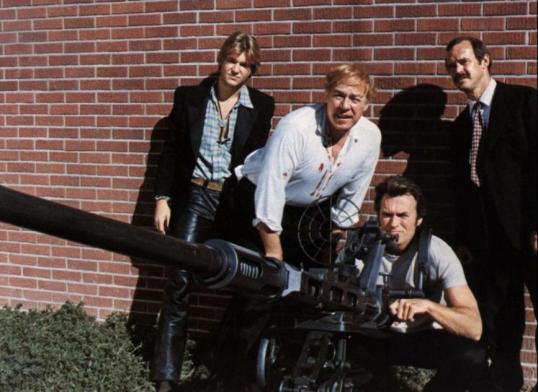
Eventually, Thunderbolt and Lightfoot meet up with two of Thunderbolt’s former associates. Red (George Kennedy) is a brutal brawler who, it is suggested, served with Thunderbolt in the Korean War. Goody (Geoffrey Lewis) is a gentle soul who takes orders from Red but still can’t bring himself to shoot anyone, no matter how much Red demands that he pull the trigger. Red and Goody have always assumed that Thunderbolt stole the loot from a bank robbery that they pulled off. Thunderbolt explains that he didn’t steal the money. He just got arrested after hiding it. Lightfoot suggests that maybe the four of them could pull off another bank heist….
Kennedy and Lewis are perfectly cast as the two criminals who end up working with Thunderbolt and Lightfoot. In many ways, the relationship between Red and Goody mirrors the relationship between our lead characters. The main difference is that Red is sadistic and quick to loose his temper, whereas Thunderbolt controls his emotions and tries not to hurt anyone while committing his crimes. Lightfoot looks up to Thunderbolt and Goody looks up to Red. Again, the difference is that Thunderbolt actually cares about Lightfoot, whereas Red is incapable of truly caring about anyone but himself. Eastwood, Bridges, Kennedy, and Lewis make quite a team and it’s hard not to worry about all four of them, especially when the film takes an unexpectedly dramatic turn during its third act.
I really wasn’t expecting Thunderbolt and Lightfoot to make me cry but the final thirty minutes of the film brought tears to my eyes as what started out as a buddy comedy turned into a tragedy. (I shouldn’t have been surprised. I’ve seen enough 70s movies that I really should have known better than to have expected a happy ending.) Thanks to the perceptive script by Michael Cimino (who would go on to make The Deer Hunter and Heaven’s Gate) and the performances of Eastwood and Bridges, the movie’s final moments carry quite a punch and they leave you wondering if Thunderbolt and Lightfoot’s road trip was worth the price that was ultimately paid. The film works as not only a tribute to friendship but also as a fatalistic portrait of life on the backroads of America.
Thunderbolt and Lightfoot was the first Eastwood film to receive an Oscar nomination, with Jeff Bridges competing for Best Supporting Actor. (He lost to Robert De Niro’s star turn in The Godfather, Part II.) Eastwood, reportedly, felt that he deserved a nomination for his performance as Thunderbolt and, considering that that Oscar itself was won by Art Carney for his pleasant but hardly revelatory work in Harry and Tonto, Eastwood was correct. Instead, Eastwood would have to wait for another 18 years before he finally received Academy recognition for starring in, producing, and directing Unforgiven.
2004’s Border Blues features Gary Busey as a wild-haired LAPD police chief who has psychic visions that enable him to track down a mad bomber.
Wow, that sounds great!
Well, believe it or not, that’s really only a minor subplot in this film. The majority of the film is about Andrei Samurov (Rodion Nahapetov), who was the greatest detective in Moscow before he immigrated to the United States. Now, he works in a restaurant and dreams of being the greatest detective in the LAPD. During a trip to Mexico, Andrei meets Larry (Eric Roberts), an American who now helps people sneak across the border. Larry is helping a Russian woman (Anna Nakhapetova) and her daughter make their way across the desert. Larry seems to take a special interest in the woman’s daughter. Perhaps it has something to do with the fact that Larry’s own daughter died under tragic circumstances.
Oh, and Erik Estrada’s in this too! He plays a Mexican cop named Morales and he yells a lot.
Gary Busey, Erik Estrada, and Eric Roberts!? How could this go wrong? Well, you could stick them all in a film that doesn’t make much sense and which has a plot that is next to impossible to follow. This is one of those movies where you get the feeling that the names were cast first and then a story was built around them. On the plus side, Eric Roberts actually gets a good deal of screentime and turns Larry into a rather interesting character. Larry is menacing but, there are times when he’s almost sympathetic. Roberts gives a good performance but, unfortunately, the majority of the film is focused on Rodion Nahapetov’s unconvincing turn as the greatest detective in the world. Nahapetov both directed and starred in this film and the end result is a vanity project that doesn’t seem to lead to anywhere in particular.
Previous Eric Roberts Films That We Have Reviewed:
Some films are so ludicrous and self-aware of their absurdity that you can’t help but love them and that’s certainly the case with 1991’s Point Break.
Consider what Point Break offers us:
First, you’ve got Keanu Reeves playing a former college football star who, after blowing out his knee, ended up joining the FBI. Keanu, who looks like he’s barely out of high school in this film, plays a character with the wonderful name of Johnny Utah. Keanu gives a relaxed performance. You can tell that he’s having fun in this movie and Johnny Utah’s enthusiasm is infectious. Personally, I prefer Johnny Utah to John Wick.
Secondly, you’ve got Patrick Swayze as Bodhi, the ruthless bank robber who is also a surfer. Much like Reeves, Swayze could occasionally be a stiff actor but in this film, you can tell he’s having fun and again, it’s hard not have fun watching him as he spouts his surfer philosophy, jumps out of planes, and dreams of dying while mastering a 50-foot wave. Swayze is so charismatic as Bodhi that you totally buy that Johnny Utah would like him despite all the times that Bodhi tries to kill him.
You’ve got Bodhi’s bank-robbing gang, who call themselves the Ex-Presidents. Bodhi wears a Ronald Reagan mask. Other members of the gang wear LBJ, Nixon, and Carter masks. “I am not a crook!” Nixon says. The wonderful thing about the Ex-Presidents is that they seem to truly enjoy robbing banks. Of course, they also enjoy surfing.
Gary Busey plays a character who is not Gary Busy. Instead, he’s Johnny’s partner. Everyone in the FBI laughs at him when he says the bank robbers are surfers but guess who knows what he’s talking about! Seriously, though, it’s always interesting to see Gary Busey in the years when he was still a somewhat serious actor.
John C. McGinley does the uptight boss thing. Lori Petty is the waitress who teaches Johnny Utah how to surf. The surf footage is beautifully shot. A soaked Johnny give the camera a thumbs-up. Director Kathryn Bigelow keeps the action moving quickly and, just as she did with Near Dark, uses the film’s genre trappings to explore the bond that holds together a group of outsiders.
It’s an over-the-top and cheerfully absurd film and it’s impossible not to love it. I haven’t felt the need to watch the remake. Why would I? The original has everything I need.
1998’s Soldier starts off with a brilliant seven-minute sequence. We watch as, over the course of 17 years, a child named Todd is raised and trained to be the ultimate soldier. From a young age, he’s learning how to fight. He’s learning discipline. He’s learning to follow orders without question. We follow him as he goes on to fight in conflict after conflict. The name of each conflict in which he fights is tattooed on his muscular arms. Finally, a title card appears that informs us that Todd (now played by Kurt Russell) is “Between wars.”
Captain Church (Gary Busey) insists that Todd and his fellow soldiers are the greatest fighting force in the galaxy. The autocratic Colonel Merkum (Jason Isaacs) disagrees, claiming that his genetically-engineered soldiers are superior and that Todd is now obsolete. After a savage training exercise that leaves Todd unconscious, Merkum orders that Todd be dumped on an abandoned planet.
Of course, it turns out that the planet in question is not actually abandoned. Instead, it’s home to a group of colonists who crash-landed on the planet years ago and who now live a life that is devoid of conflict. When Todd approaches the colony, he is cautiously welcomed. Todd, who rarely speaks, is extremely strong and quick and that pays off when he’s able to save Jimmy (Michael Chiklis) from being pulled into a thrasher. However, Todd is also haunted by PTSD and he’s been bred to fight and that leaves the other colonists cautious about him. Despite the efforts of Mace (Sean Pertwee) and his wife Sandra (Connie Nielsen), the other colonists vote to exile Todd from their colony.
Meanwhile, Merkum and his “superior” soldiers are heading towards the planet, eager to execute the colonists as a part of a training exercise. Todd will have to use all of his training to defeat Merkum’s super soldier, Caine 607 (Jason Scott Lee), and help the colonists reach their final destination.
One of the more interesting things about Soldier is that it apparently takes place in the same cinematic universe as Blade Runner. The wreckage of one of Blade Runner‘s flying cars is spotted on the planet and Todd is shown to have fought in some of the same battle that Roy Batty claimed to have witnessed in Ridley Scott’s classic film. For that matter, Ridley Scott himself has said that Blade Runner also takes place in the same cinematic universe as Alien and some people insist that Predator is a part of the universe as well. That’s a rich heritage for Soldier, which is essentially a dumb but entertaining B-movie.
I liked Soldier, almost despite myself. It’s a silly film and there are certain scenes, mostly dealing with day-to-day life in colony, that feel a bit draggy. But I enjoyed Kurt Russell’s performance as the ultimate super soldier. Russell has very little dialogue in the film and his character is bit stunted emotionally but it doesn’t matter. Ultimately, Russell’s natural charisma carries the day and his fight with Caine 607 is genuinely exciting. As usual, Jason Isaacs makes for a wonderfully hissable villain and even Gary Busey gives what is, for him, a rather restrained and ultimately credible performance. As is so often the case with the work of director Paul W.S. Anderson, the film is a cartoon but it’s an entertaining cartoon.
 Through the Shattered Lens