COWARD OF THE COUNTY – the boundary pushing country song turned into a TV movie


When I was a kid our family loved Kenny Rogers.  I remember listening to songs like “Lucille,” “The Gambler,” “Daytime Friends,” “She Believes in Me,” and “Lady” on my dad’s vinyl records. I would have been no older than second or third grade, and me and my siblings would really belt out “You picked a fine time to leave me, Lucille.” But the one Kenny Rogers song that affected me more than any of the others was the “Coward of the County.” If you know the lyrics of the song, then you know what I’m talking about.  As a kid of around 8 years old, the story about Tommy, Becky and the Gatlin Boys was a little more mature than what I was used to. I remember not even being sure what exactly happened to Becky, but I knew it was bad.  I also remember a TV movie based on the song starring Kenny Rogers, so you know our family watched it.

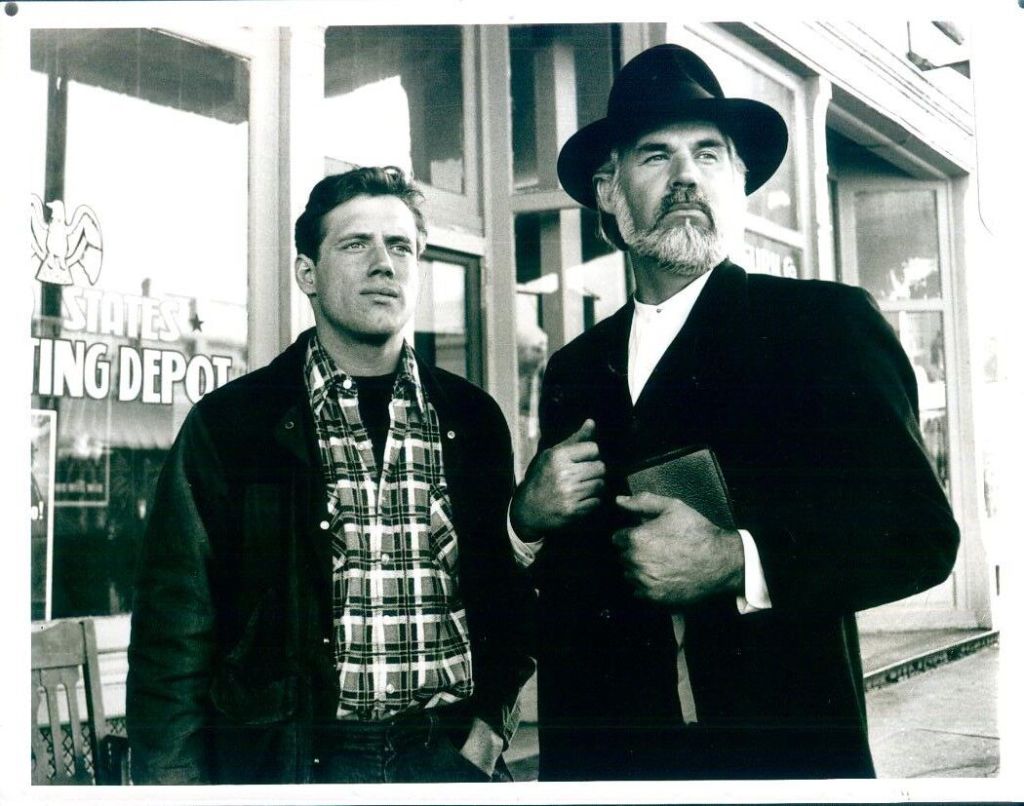
The TV movie premiered in 1981 and stars Kenny Rogers as Matt, a preacher who likes to drink, gamble, and cavort with the ladies. His nephew Tommy (Fredric Lehne) is a nice young man who already seems to have a bit of a reputation as someone you can push around. We learn this about Tommy at the town Christmas carnival when Jimmy Joe Gatlin wins a cake at a cake-walk (do y’all remember those things?) and proceeds to shove it in Tommy’s face. Tommy grabs Jimmy Joe by the arm to make him stop, but then he walks away without fighting back. It’s right after this confrontation between Tommy and Jimmy Joe that Matt makes an announcement to the crowd that the Japanese have just bombed Pearl Harbor, placing our story in 1941. Immediately the young men of the town, including Jimmy Joe Gatlin, start making their plans to join the military and head out for boot camp. And I tell you, this Jimmy Joe is a real jerk. Before he leaves, he tells the local beauty Becky that she’s “his” girl whether she likes it or not even though she’s telling him she’s not his girl. Jimmy Joe also stops to call Tommy a coward and ask him why he’s standing there with the men when he hasn’t even joined the military. We soon learn that Tommy has a very specific reason for not fighting. You see, his dad died in prison. He had to go to prison for killing another man in a fight, and before he passed he away, he asked his son to promise him that he would never fight. With the bully Jimmy Joe out of town, Tommy and Becky begin seeing each other and fall in love. That part of his life is happy, but everywhere Tommy goes he’s reminded that young men are fighting and dying for their country while he’s still at home. He really wants to keep his promise to his dad not to fight, but he feels he should fight for his country. After eight weeks, Jimmy Joe returns and tries to reclaim Becky as his girl. Becky tells him that she loves Tommy and they are getting married. Jimmy Joe doesn’t take the news well so he heads out and starts drinking. Full of drunken courage, he and his brothers head back to Becky’s house and he forces himself on her. When Tommy finds out what happened to Becky, he’s finally had enough and he confronts Jimmy Joe Gatlin and his brothers. He breaks his promise to his dad and beats the crap out of the Gatlin brothers. As the words of the song would say, “sometimes you have to fight to be a man.” Soon after, Tommy enlists in the service because with Becky he truly has something at home worth fighting for.

I’ll just start out by addressing the elephant in the room that Becky was raped by Jimmy Joe, and that’s what it took for Tommy to finally fight. I sure wish the cake to the face or the many times the Gatlin boys called him yellow would have been enough, but unfortunately it took something that horrible. I didn’t really understand all of this in 1981, and it’s pretty crazy that a mainstream country song told this story to be honest. Also, you might be surprised that Kenny Rogers is more of a peripheral character as the wandering preacher of the story. The main character, Tommy, is played by Fredric Lehne. He’s a likable actor who’s still very busy to this day on TV. I enjoyed seeing Lehne because he was very good in a movie that was filmed here in Arkansas called GREATER back in 2016. The movie tells the tragic, but inspirational story of Brandon Burlsworth, a former walk-on who became an All-American offensive lineman for the Razorbacks. Sadly, he died in a car accident in 1999 after being drafted to play professional football for the Indianapolis Colts. Lehne played an important role as a coach who helped get the very best out of Burlsworth. As a frequent attendee of Razorbacks home football games, I watched Burlsworth play many times in person and the whole state loved him. The news was devastating to our state, and the movie about his short, but very meaningful life is very special to me.

There were a couple of other things that I found interesting about COWARD OF THE COUNTY. First, I wondered if it was just a coincidence that the bad guys were the Gatlin Boys, especially considering that Larry Gatlin and his brothers were contemporary country music stars along with Kenny Rogers. According to the songwriters, they thought the Gatlin boys had a great ring to it and worked great for the song, better than anything else they could come up with. According to Larry Gatlin, he thinks they should have chosen a different name, but he was also a good friend with Kenny Rogers. Finally, the movie was partially filmed in Covington, GA, which has a very unique Courthouse with a large clock tower. Covington, which is about 35 miles east of Atlanta, is affectionately known as the “Hollywood of the South” due to the large number of movies and TV shows filmed there. To name just a few, THE CANNONBALL RUN, MY COUSIN VINNY, and the TV show THE VAMPIRE DIARIES were all filmed in Covington. My wife and I stayed the night in Covington on our way to Myrtle Beach in 2020 and visited the downtown area before we headed on. As soon as I saw that clock tower in COWARD OF THE COUNTY, I knew that it was filmed in Covington.

Guilty Pleasure No. 71: Submerged (dir by Fred Olen Ray)


THUNDERSTRIKE!

Listen, if you’re going to watch the 2000 film Submerged, you better be a  big fan of the term “Thunderstrike,” because it’s repeated so many times that one gets the feeling that the actors just loved saying it.

Thunderstrike is a satellite that was built by western businessman Buck Stevens (Dennis Weaver).  He and his daughter (Nicole Eggert) and her sort-of boyfriend (Hannes Jaenicke) are all flying to Hawaii so that they can conduct more tests on the Thunderstrike.  However, arms dealer Owen Cantrell (Tim Thomerson) wants the Thunderstrike for himself so he sends a mercenary named Jeff Cort (Coolio.  Yes, Coolio.) to steal the plans from the airplane.  The plan is to kill the pilot, substitute a new pilot, and then crash the plane into the ocean …. which is pretty much what happens, despite the best efforts of heroic CIA agent, Rex Manning (Maxwell Caulfield).

Actually, wait a minute.  Maxwell Caulfield’s character is named Jim Carpenter.  Well, I don’t care.  He’ll always be Rex Manning to me!

While Special Agent Mack Taylor (Brent Huff) tries to stop Cantrell from stealing the Thunderstrike, Captain Masters (Fred Williamson) tries to figure out a way to bring the plane to the surface.

If this sound familiar, it’s because Submerged has the same plot as Airport ’77.

If it looks familiar, it’s because Submerged lifts a lot of footage from Airport ’77, including the scene where the plane crashes, the scene where the plane settles on the ocean floor, and the scene where the plane is lifted off the ocean floor.  Even a scene of water pouring into plane is lifted from Airport ’77, which means that the plane in Submerged suddenly has a staircase that no one apparently noticed before.

Submerged was directed by the wonderful Fred Olen Ray and seriously, how can you not love it?  Between the cast and the fact that it features all of the best parts of Airport ’77, this is a film for which the term guilty Ppeasure was invented!  It helps that the cast, for whatever reason, appears to be taking the film rather seriously.  This film was Dennis Weaver’s final screen appearance and he seems to be having a ball playing a cheerful good old boy who can’t wait to put a dangerous satellite in the sky.

Plus, the film features Rex Manning!

Plus, Jack Deth!

Plus, Black Caesar!

Plus …. THUNDERSTRIKE!

Previous Guilty Pleasures

  1. Half-Baked
  2. Save The Last Dance
  3. Every Rose Has Its Thorns
  4. The Jeremy Kyle Show
  5. Invasion USA
  6. The Golden Child
  7. Final Destination 2
  8. Paparazzi
  9. The Principal
  10. The Substitute
  11. Terror In The Family
  12. Pandorum
  13. Lambada
  14. Fear
  15. Cocktail
  16. Keep Off The Grass
  17. Girls, Girls, Girls
  18. Class
  19. Tart
  20. King Kong vs. Godzilla
  21. Hawk the Slayer
  22. Battle Beyond the Stars
  23. Meridian
  24. Walk of Shame
  25. From Justin To Kelly
  26. Project Greenlight
  27. Sex Decoy: Love Stings
  28. Swimfan
  29. On the Line
  30. Wolfen
  31. Hail Caesar!
  32. It’s So Cold In The D
  33. In the Mix
  34. Healed By Grace
  35. Valley of the Dolls
  36. The Legend of Billie Jean
  37. Death Wish
  38. Shipping Wars
  39. Ghost Whisperer
  40. Parking Wars
  41. The Dead Are After Me
  42. Harper’s Island
  43. The Resurrection of Gavin Stone
  44. Paranormal State
  45. Utopia
  46. Bar Rescue
  47. The Powers of Matthew Star
  48. Spiker
  49. Heavenly Bodies
  50. Maid in Manhattan
  51. Rage and Honor
  52. Saved By The Bell 3. 21 “No Hope With Dope”
  53. Happy Gilmore
  54. Solarbabies
  55. The Dawn of Correction
  56. Once You Understand
  57. The Voyeurs 
  58. Robot Jox
  59. Teen Wolf
  60. The Running Man
  61. Double Dragon
  62. Backtrack
  63. Julie and Jack
  64. Karate Warrior
  65. Invaders From Mars
  66. Cloverfield
  67. Aerobicide 
  68. Blood Harvest
  69. Shocking Dark
  70. Face The Truth

Retro Television Reviews: The Seduction of Gina (dir by Jerrold Freedman)


Welcome to Retro Television Reviews, a feature where we review some of our favorite and least favorite shows of the past!  On Sundays, I will be reviewing the made-for-television movies that used to be a primetime mainstay.  Today’s film is 1984’s The Seduction of Gina.  It  can be viewed on Tubi!

Gina (played by Valerie Bertinelli) is bored.

She’s a 20 year-old newlywed who spends her days going to college and her nights sitting in a tiny apartment and waiting for her husband, David (Fredric Lehne), to come home.  David is an intern at a hospital.  He works the nightshift and, as a result, he’s usually exhausted and not particularly communicative.  Unlike her husband, Gina comes from a wealthy family and she’s due to inherit a good deal of money as soon as she turns 21.  However, David stubbornly refuses to use any of Gina’s money to make either of their lives better.  He gets angry when Gina even mentions the possibility.  He’s prepared to spend the next ten years living in a crummy apartment and working terrible hours.  Once he establishes himself as a doctor, he says that he and Gina can start to think about starting a family.  Are you getting the feeling that David has control issues?  Because that’s definitely the feeling that I got from him.

Bored and frustrated, Gina turns to gambling.  Who can blame her?  Not only is it a way to make some money and bring some excitement into her life but it’s also something that she’s really good at!  She starts out just putting bets on horse races.  (The owner of a nearby bodega is also a bookie.)  She uses the money to buy a new television set, which David totally freaks out about.  Soon, Gina is sneaking off to Lake Tahoe.  While David works at the hospital, Gina hits the blackjack table and spins the roulette wheel.  She even attracts the eye of Keith Sindell (Michael Brandon), a handsome lawyer who loans her money and obviously has an interest in her that goes beyond card games.  Every morning, she jumps in her car and rushes back to San Francisco, arriving at her apartment before David gets home and lying to David about what she’s been doing all night.

It starts out well but this wouldn’t be a TV movie if there wasn’t a bit of drama.  Unfortunately, Gina’s luck starts to change and she soon finds herself in debt.  The owner of that bodega is a lot less nice when he’s demanding his money.  And Keith might be willing to cheat on his wife with her but he still expects her to pay back the money that he’s given her.  The world of gambling turns out to be harsh and unforgiving.  Gina is forced to find ways to get the money.  If that means lying to her husband, her father (played by Ed Lauter), and her accountant, so be it.  She might even have to — gasp! — get a job as a cocktail waitress!

It’s obvious from the start that Gina is going to get into trouble, or at least it’s obvious to everyone but Gina.  And really, isn’t that the way life is sometimes?  Usually, the only person who can’t see the walls closing in is the person who is about to get crushed.  The Seduction of Gina is melodramatic and predictable but Valerie Bertinelli is likable in the role of Gina and the scenes in casino are enjoyably gaudy and a little bit sordid.  It’s an entertaining movie, a Lifetime film that came out before Lifetime.  The film’s message is not to gamble but The Seduction of Gina makes winning look like so much fun that it probably inspired more people to hit the casinos than to stay at home and balance the checkbook.  In the classic DeMille fashion, this film offers both sin and a hint of salvation but it understands that sin is more entertaining to watch.

TV Review: Dexter New Blood 1.1 “Cold Snap” (dir by Marcos Siega)


When last we saw erstwhile serial killer Dexter Morgan, he had faked his death, fled Miami, and was apparently working as a lumberjack in Oregon.

That was how Showtime’s Dexter originally ended, back in 2013.  It was not a popular ending and yet, I don’t think anyone was expecting to be satisfied by Dexter’s finale.  In retrospect, the highpoint of Dexter came during season 4, during the arc involving John Lithgow at the Trinity Killer.  The four seasons that came after the conclusion of that storyline could never quite escape the shadow of the battle of wills between Lithgow and Michael C. Hall.  Seasons 5, 6, and 7 all felt somewhat superfluous while season 8 seemed to go off the rails entirely.  As a result, I think everyone was mentally prepared to be let down by however the show ended but still, people were hoping for a little more than Dexter in Oregon.

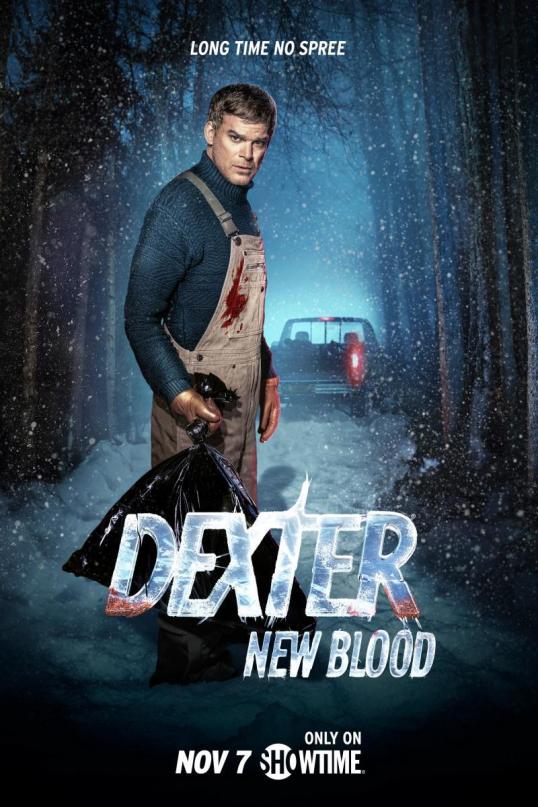
Fortunately, Dexter Morgan is back!  Dexter: New Blood, which premiered last Sunday on Sunday, picks up ten years after the conclusion of Dexter.  Dexter (played by Michael C. Hall, of course) is no longer living in Oregon.  In fact, in the first episode, Oregon was never even mentioned. Instead, Dexter is now living in upstate New York.  He’s using the name Jim Lindsay.  He works at a sporting goods store.  He’s dating the local chief of police, Angela Bishop (Julia Jones).  He’s a popular citizen.  Everyone like Jim.  Everyone thinks that they know Jim.  Of course, what they don’t know is that Jim is actually Dexter, a serial killer who once specialized in killing other murderers.  They also don’t know that Dexter spends a good deal of his spare time talking to the ghost of his dead stepsister, Deb (Jennifer Carpenter, taking on the mentor role that James Remar played in the original series).  Deb continually tells Dexter that he can’t get close to anyone.  Anyone to whom Dexter gets close dies.  Of course, even in death, Deb doesn’t seem to understand that Dexter isn’t capable of being genuinely close with anyone.

When Cold Snap, the first episode, begins, it’s been ten years since Dexter killed anyone, though it’s obvious that he still has the urge.  Dexter’s ten-year break comes to an end when he meets Matt Caldwell (Steve M. Robertson), a spoiled rich kid who, several years earlier, was involved in a boating accident that killed five people.  When Dexter learns that Matt intentionally smashed into the other boat and then when Matt later shoots a rare albino stag that Dexter had spent days tracking, Dexter’s Dark Passenger returns.  Interestingly enough, it turns out that, despite being inactive for ten years, Dexter still has a perfect murderer’s lair inside his cabin’s shed.  Before Dexter ritualistically kills Matt, Matt says that his father is going to kill Dexter.  Who is Matt’s father?  I’m sure we’ll find out soon.  A part of me suspects that it might be Edward Olsen (Fredric Lehne), a billionaire who is planning on doing business in the town.  I also suspect that Olsen is probably connected to the disappearances of several young women in the area.  Wealthy businessmen often turned out to be serial killers on Dexter.

Speaking of fathers, Dexter is also a father.  He abandoned his son, Harrison, in Miami ten years ago.  Now, the teenage Harrison (Jack Alcott) has tracked Dexter down.  At first, Dexter pretended not to know who Harrison was and he gave Harrison money to buy a ticket on the next bus out of town.  However, at the end of the episode, Dexter, fresh from murdering Matt, showed up at the bus station, sat down next to Harrison, and said, “I am Dexter Morgan.”

It was an interesting ending and a bit frightening considering everything that we know about Dexter.  Ghost Deb is right.  People who get close to Dexter do end up dying.  That said, we really don’t know much about Harrison.  In the books, Dexter was often concerned that Rita’s stepchildren, Cody and Astor, had their own dark passengers.  To the best of my memory, that wasn’t really explored on the television show with Harrison but what if Harrison does turn out to be a serial killer?  Even worse, what if Harrison turns out to be a serial killer who, like his father, only targets other serial killers?  Would Dexter have to kill Harrison or would Harrison have to kill Dexter?  But perhaps I’m getting ahead of myself.  As of the first episode, the only thing we know for sure is that Harrison managed to track his father down.

I was intrigued by the first episode of Dexter: New Blood, though I have to admit that most of that was due to the hints of what could happen in the future as opposed to what actually did happen in the episode.  As I said at the start of this review, the first four seasons of Dexter were brilliant.  The final four seasons were increasingly uneven.  Just as it’s hard for Dexter to run the risk of getting close to anyone, it’s also hard for us viewers to run the risk of fully embracing this revival because we’ve all seen first hand that there are limits to how far Dexter‘s concept can be taken without things falling apart.  It’s probably not surprising that the reviews for this episode were mixed.  Variety liked it.  The AV Club and Rolling Stone complained that it was too violent.  The generic online reviewer of today often seems more concerned with hitting the right talking points and satisfying the online mob than with actually giving thought to such quaint considerations at to whether or not a show is entertaining or if it actually holds your interest.  Dexter: New Blood held my interest and it was entertaining enough for me to set the DVR to record next week’s episode.  To me, that qualifies as a successful episode.

So far, Dexter: New Blood feels like it could be a return to the Dexter of those first four seasons.  Michael C. Hall remains a compelling presence.  I’m interested to see how things develop with Harrison.  I’m glad Dexter got the Hell out of Oregon.  I’ll be watching.

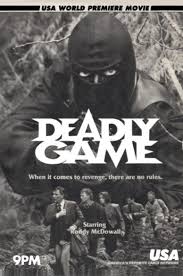
A Movie A Day #66: Deadly Game (1991, directed by Thomas J. Wright)


Seven strangers are invited to a remote island by a mysterious billionaire named Osiris.  There is a doctor, a dancer, an auto mechanic, a mercenary, a football player and his agent, and a member of the Yakuza.  The auto mechanic points out that, in Egyptian mythology, Osiris judged mankind’s sins.  For some reason, none of the seven think twice about going to the island but, once they arrive, they soon discover that they should have.  Osiris is willing to give them seven million dollars but to get it, they have to reach the other end of the island without being killed by Osiris or his men.

Of the many movie adaptations of The Most Dangerous Game, this is probably the worst.  The cast, which includes Michael Beck, Marc Singer, Jenny Seagrove, Mitch Ryan, John Pleshette, Soon-Tek Oh, and Roddy McDowall, isn’t bad but the script is terrible, full of overwrought dialogue and plot holes.  Across the island, Osiris has left clues that are designed to trigger flashbacks and lead to each member of the seven explaining what it is that they did in the past.  But for that to work, Osiris would have to know exactly what route the seven of them were going to use to cross the island and he would also have to know who would still be alive by the time that they came across each clue.  Also, whenever they come across the clue, everyone stands around and wastes valuable time arguing about it.  Considering that there are armed men trying to kill them, no one seems to be in that much of a hurry to make it to the other side of the island.  The flashbacks themselves are interesting in how clumsily they are put together.  40ish Marc Singer plays himself as a senior in high school.

Like Hitler’s Daughter, Deadly Game was originally made for the USA network.  The first time I saw it was in the UK where, for some reason, it seemed to air frequently during the mid-1990s.  (Possibly this was because it starred quintessential Hollywood Brit Roddy McDowall.  That’s the only reason I can think of.)  It’s now on YouTube, for anyone who wants to sit through it.

Embracing the Melodrama #32: Ordinary People (dir by Robert Redford)


ordinary_people_oc87rd_1

For the past seven days, I’ve been reviewing — in chronological order — fifty of the most memorable melodramas ever filmed.  We started with a silent film from 1916 and now, we have reached the 80s.  What better way to kick off the decade than by taking a look at the 1980 Best Picture winner, Ordinary People?

Directed by Robert Redford, Ordinary People tells the story of the upper middle class Jarrett family.  On the surface, the Jarretts appear to be the perfect family.  Calvin Jarrett (Donald Sutherland) has a successful career.  Beth (Mary Tyler Moore) keeps a perfect home and appears to be the ideal suburban matriarch.  However, one summer, their oldest son drowns in a sailing accident and their youngest son, sensitive Conrad (Timothy Hutton), attempts to commit suicide.  After spending four months in a psychiatric hospital, Conrad come back home and the family struggles to put their lives back together.  Even though he starts to see a therapist (Judd Hirsch) and starts dating his classmate Jeannine (Elizabeth McGovern), Conrad still struggles with his feelings of guilt over having survived.  Beth’s struggle to maintain a facade of normalcy leads to several fights between her and Conrad with Calvin trapped in the middle.

Among my fellow film bloggers, there’s always going to be a very vocal group that is going to hate Ordinary People because it won the Oscar for best picture over challenging black-and-white films directed by Martin Scorsese (Raging Bull) and David Lynch (The Elephant Man).  They always tend to complain that Ordinary People is a conventional film that tells a conventional story and that it was directed by a very conventional director.  More than once, I’ve seen an online film critic refer to Ordinary People as being a “big budget Lifetime movie.”

Well, you know what?

I love Lifetime.  Lifetime is the best network on television and to me, a big budget Lifetime movie would be the best Lifetime movie of all.  And, at the risk of alienating all of my film-loving friends, if I had to choose between watching Raging Bull and Ordinary People, I’m going to pick Ordinary People every time.  Raging Bull is visually stunning and features great performances but it’s also two hours spent watching an incredibly unlikable human being beating the crap out of anyone who is foolish enough to love him.  Ordinary People may essentially look like a TV show but it’s also about characters that you can understand and that, as the film progresses, you grow to truly care about.

Yes, I do wish that the character of Beth had been given more of a chance to talk about her feelings and it’s hard not to feel that Ordinary People places too much blame on the mother.  But, even so, the film still ends with vague — if unlikely — hope that Beth will eventually be able to move past her anger and reconnect with her family.  The film may be hard on Beth but it never gives up on her.  That’s what distinguishes Ordinary People for me.  In many ways, it’s a very sad film.  It’s a film that was specifically designed to make you cry and I certainly shed a few tears while I watched it.  But, even with its somewhat ambiguous ending, Ordinary People is also a very optimistic movie.  It’s a movie that says that, as much pain as we may have in our life,we can recover and life can go on and it’s okay to be sad and its also okay to be happy.

And that’s an important lesson to learn.

(That said, if I had been alive and an Academy voter in 1981, I would have voted for The Elephant Man.)

And, for all you Oscar lovers out there, here are clips of Timothy Hutton and Robert Redford winning Oscars for their work on Ordinary People.