What Lisa Watched Last Night #166: Daughter For Sale (dir by Farhad Mann)


Last night, I turned on Lifetime and I watched Daughter for Sale!

Why Was I Watching It?

Well, the main reason was because the film was on Lifetime and I always enjoy live tweeting Lifetime films.  There’s a strong community of Lifetime live tweeters.  We all appreciate Canadian location shooting and unapologetic melodrama.

Add to that, Daughter For Sale is a great title.  When you see that a movie is called Daughter for Sale, you really have no choice but to watch.

What Was It About?

Annalise O’Neil (Emily Rose) is a newly appointed judge.  We know this because 50% of her dialogue consists of her telling people, “I’m a judge.”  She also lives in a house that is almost totally made of glass.  Seriously, it’s all windows and there’s no privacy.

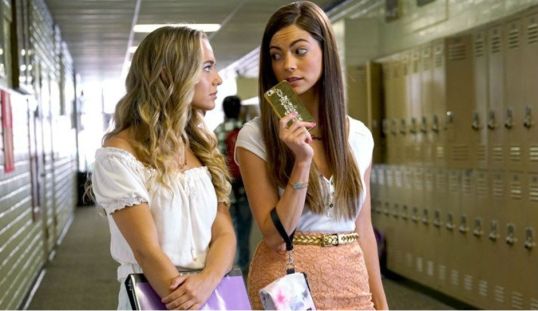
Anyway, when the movie starts, she’s celebrating being a judge by throwing a party at her glass house.  When she tells her teenage daughter, Carly (Emily Tennant), to put on a pink dress and come downstairs to the party, Carly responds by cutting the dress into pieces and then sneaking out of the house.  Somehow, nobody notices her running away, despite the fact that the house is almost all window.

Anyway, Carly wanders around Vancouver for a while and then ends up getting kidnapped by a human trafficking ring that is operated by a pretend do-gooder named John Gallant (Antonio Cupo).  Working with a whiny, leather jacket-wearing detective named Derek (Chris Kalhoon), Annalise searches for her missing daughter.  (Her search basically consists of approaching random people and saying, “I’m a judge.”)  Will Annalise and Whiny Detective Man be able to find Carly before she’s sold to the highest bidder?

What Worked?

Particularly for a Lifetime film, Daughter For Sale looked really good.  The shadowy cinematography created the perfect sense of menace.  The warehouse that Carly was kept in was pure nightmare fuel.  We tend to take production design for granted but the people responsible for the look of Daughter for Sale outdid themselves.

Emily Tennant did a pretty good job as Carly. (Remarkably, despite spending about a month in a dirty old warehouse, Carly’s hair and makeup remained perfect throughout the entire movie.)  Antonio Cupo was properly sleazy as the bad guy.  I enjoyed the way the film contrasted Gallant’s public image with the monstrous reality of who he truly was.

What Did Not Work?

“I’m a judge.”  Yes, we know, Analise!  You don’t have to mention it every two minutes!  You being a judge certainly isn’t going to get your daughter out of that warehouse…

This was one of those films where everyone continually switched from being super competent to being super stupid, depending on what was necessary for the scene.  Analise, in particular, was always either a genius or the most naive jurist in history.  Meanwhile, John Gallant was able to run a halfway house, a charity, and an international sex trafficking ring but he wasn’t smart enough to hide the incriminating evidence in his office.  If you’re going to send a thug to beat up a judge, it might be smart to not allow yourself to then be seen, in public, hanging out with the exact same thug.  Or, at least, that’s the way it would seem to me.

“Oh my God!  Just like me!” Moments

“I’m a judge!”

No, actually, I’m not.  But if I was, I would probably remind everyone every chance I got as well.

Lessons Learned

She’s a judge!

The Things You Find on Netflix: Christine (dir by Antonio Campos)


I really regret that I didn’t get a chance to see Christine when it played here last year.  I wanted to but the movie was only in theaters for a week and then it vanished.

I guess I shouldn’t be too surprised that Christine didn’t become a blockbuster.  I imagine that most potential viewers were turned off by the fact that 1) it wasn’t a remake of the movie about the killer car and 2) it was based on the true story of a reporter who, in 1974, committed suicide on live television.  I imagine that, to many people, the film sounded like it would be indescribably sad.  It certainly sounded that way to me.  That’s why, when the movie opened at the Dallas Angelika, I said, “I’ll see it next week.”  Of course, by the time “next week” rolled around, the movie was gone.

And that’s a shame.  I just watched Christine on Netflix and I discovered that it was one of the best films of 2016.  Yes, it is a sad film but it’s also a frequently fascinating one.  The movie may tell the story of a tragedy but it’s anchored and enlivened by a brilliant performance from Rebecca Hall.  People who love movies, of course, already know that Rebecca Hall is a brilliant actress but, unfortunately, she rarely gets the roles in the films that she deserves.  As of this writing, her most financially successful film was probably The Town and, in that film, she was pretty much wasted in a nothing role.  She is perfectly cast in Christine, perhaps as perfectly cast as any performer could ever hope to be.

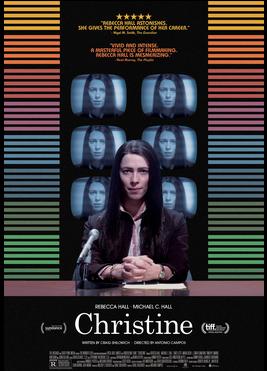
Rebecca Hall plays Christine Chubbuck, a reporter who was based in Sarasota, Florida.  In 1974, she started a newscast by announcing, “”In keeping with Channel 40’s policy of bringing you the latest in ‘blood and guts’, and in living color, you are going to see another first—attempted suicide.”  She then drew a gun from a shopping bag that was sitting behind the anchor desk.  As thousands watched, she shot herself in the back of the head.

Along with the gun, the shopping bag had contained the homemade puppets that Christine used whenever she volunteered at the local children’s hospital.  On the anchor desk, among her papers, was a news report that she had written the previous night, announcing that “Local news personality Christine Chubbuck” had shot herself on live television and had been taken to the hospital in critical condition.  Christine, who was reportedly frustrated both personally and professionally, was briefly the number one story in the nation.

One of the more interesting things about the suicide of Christine Chubbuck is that it happened in 1974, long before YouTube, Facebook Live, or Twitter.  Chubbuck’s suicide was only aired once and the footage has subsequently vanished.  If Christine Chubbuck, or anyone else, committed suicide on television today, it would immediately be all over the internet.  We would end up seeing, at the very least, clips of it on an almost daily basis.  Sadly, we would see it so much that we would probably become desensitized to it.  Since Christine Chubbuck’s death was recorded but remains unseen, both she and her suicide have achieved an almost mythical quality.  One can look at the details of Christine Chubbuck’s death and see almost anything that they want.

Christine follows the last few months of Chubbuck’s life.  As played by Rebecca Hall, Christine is confident enough that she can imagine interviewing Richard Nixon but insecure enough to obsess over whether she was nodding too much while the imaginary President gave his imaginary answer.  She lives with her mother (J. Smith-Cameron), a self-described hippie who keeps making references to a breakdown that Christine had in Boston.  When she complains about the pressure that she’s under to sensationalize the news, her boss dismisses her with “You’re a feminist!”  (He says it like an accusation.)  When she gives in and purchases a police scanner so that she can find the stories that the boss is demanding, she ends up spending most of her night listening to two cops brag about “how far” they got with their girlfriends the night before. When she goes to the doctor to complain about chronic stomach pain, she’s told that she has to have an ovary removed and she’ll probably never be able to conceive.  When she thinks that she finally has a date with the man who she’s been crushing on, she is instead dragged to an empty-headed encounter group.  Her group partner has a slick answer for every problem that Christine has until Christine says that she’s thirty and she’s still a virgin.

“Oh,” her partner replies, flummoxed.

In the film, Christine struggles with both depression and, in my opinion, bipolar disorder as well.  Unfortunately, for her mental well-being, she’s a woman in 1974.  The only thing that the world has to offer her are vapid self-affirmation (“I’m okay, you’re okay!  I’m okay, you’re okay!” one co-worker chants at a particularly dramatic moment) and sexist bosses who dismiss what is clearly a manic episode as either “being moody” or “being difficult.”  Speaking as someone who is very sensitive as to how mental health issues are portrayed onscreen, all I can say is that Christine gets it right.

I’m probably making this film sound like the most depressing movie ever made and it’s definitely not a happy film.  I had tears in my eyes by the end of it.  At the same time, it’s also a compulsively watchable character study.  Rebecca Hall gives such a good and brave performance as Christine that you can’t look away, even when you feel like you should.  Rebecca Hall is also ably supported by Michael C. Hall, Tracy Letts, Morgan Spector, Timothy Simons, and Maria Dizzia, who all play her sometimes sympathetic, sometimes annoyed co-workers.

Now, I do think that I should warn anyone from thinking that Christine is a 100% accurate look at Christine Chubbuck’s life and death.  The film left me so moved that I actually did some research and I came across this article from the Washington Post — Christine Chubbuck: 29, Good-Looking, Educated, A Television Personality. Dead. Live and in Color.  After reading the profile, it was easy to see that the film did take some dramatic license.  However, it was also easy to see that Christine gets the essence of the story right.

If, like me, you missed Christine in the theaters, you can now see it on Netflix.  And you should!

Film Review: Wonder Woman (dir by Patty Jenkins)


Wonder Woman is awesome!

I spent a while trying to think of the best way to begin this review.  There’s a lot to be said about Wonder Woman, as both a film and as a character.  Over the next few weeks, we’re going to be flooded with think pieces.  Is Wonder Woman too feminist or not feminist enough?  Does Wonder Woman herald a new direction for the DC Expanded Universe or is it destined to just be an anomaly among the ruins of crap like Man of Steel and Suicide Squad?  Does it announce the arrival of new star?  Is Wonder Woman pro-war or a plea for peace?  Does Wonder Woman live up to the rapturous early reviews or is it destined to suffer the same fate as the initially acclaimed, later-reviled Ghostbusters reboot?

Those are all legitimate questions.  They’re all worthy of debate and discussion.  And I look forward to reading everyone’s thoughts on blah blah blah blah….

Yes, Wonder Woman is empowering, both as a film and as a character.  It’s amazing to think that, with all the super hero adaptations that have come out over the past ten years, Wonder Woman is the first one to center around a female super hero.

Yes, Wonder Woman does finally prove that DC Expanded Universe can produce a good film, though I do have to say that two of the best things about Wonder Woman is that it had very little to do with any of the other DCEU films and it felt more like an MCU film.  With the period setting (the film takes place during World War I) and it’s weary view of the wars that men fight, Wonder Woman has far more in common with the first Captain America film than it does with Man of Steel.

Yes, Gal Gadot is going to be a huge star and her performance here suggests that she has range beyond action films and comic book melodramas.

Yes, Wonder Woman is a plea for peace but it’s a sincere and honest plea and one that does not ignore the realities of human nature.

And, finally, yes, Wonder Woman deserves those good reviews and I believe it will stand the test of time.

When all is said and done, what really matters is that Wonder Woman is freaking awesome!  The teaming of director Patty Jenkins and star Gal Gadot has resulted in one of the most entertaining and exciting comic book movies of recent times.  Usually, I resent it when an audience breaks into applause at the end of a movie, largely because it makes me feel as if I’m being pressured to make a snap judgment about a movie’s worth before I’ve had time to give it proper thought.  However, this time, when the applause broke out at the Alamo Drafthouse, I happily joined in.

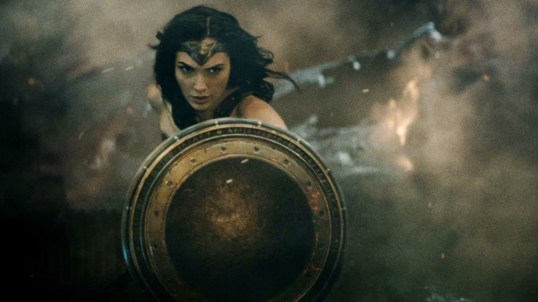
I could be wrong about this but I don’t think Wonder Woman is ever actually called “Wonder Woman” at any point during the film.  If she was, I missed it and I’m sure someone will correct me in the comments.  Instead, she is referred to by her proper name, Diana.  When the film opens (after the obligatory modern-day prologue), Diana is a child living on the island of Themyscira, the home of the legendary Amazons.  Diana is the only child among the Amazons.  The daughter of Queen Hippolyta (Connie Nielsen), Diana dreams of becoming a warrior but her mother refuses to allow it.  When Diana is trained, it’s in secret by her aunt, General Antiope (Robin Wright).  At one point, Antiope tells Diana that if she’s going to be warrior, she’s going to have to be prepared to fight for everything.  No victory, Antiope tells her, will ever come easily.  I nodded at that line and I’m sure every other woman in the audience did so as well.  We understood what Antiope was saying.

In 1918, for the first time in centuries, a man reaches the island.  His name is Steve Trevor (Chris Pine) and he’s an American spy.  No sooner does Steve’s plane crash on the beach then a boat full of Germans arrive.  After a genuinely exciting battle (perhaps the first exciting action scene to appear in any of the DCEU films), Steve reveals that the world is at war.  Suspecting that it is the influence of Ares, the god of war, that is causing people to kill one another, Diana defies her mother’s orders and leaves the island with Steve.  Steve’s goal is to keep the Germans from developing and deploying a lethal gas.  Diana, meanwhile, plans to track down and kill Ares.

While Steve is convinced that, as a result of human nature, wars are inevitable, Diana is resolute in her belief that all the evil in the world can be linked to Ares.  Their conflicting world views give Wonder Woman far more emotional depth and intellectual resonance than any of the other films that have, so far, been a part of the DC Expanded Universe.  By refusing to indulge in portentous hypermasculinity, it avoids becoming a pretentious slog like Man of Steel or Batman v Superman.  By refusing to treat war, death, and violence as a joke, it avoids falling into the soulless trap that imprisoned Suicide Squad.  When Diana runs and leaps into battle, she’s not just fighting for good against evil.  She’s fighting for the soul of humanity.

Some of the action scenes in Wonder Woman are nothing less than amazing.  The scene where Diana crosses the aptly named “No-Man’s Land” is destined to be remembered as a classic moment in comic book cinema.  I don’t want to spoil too much of the film but I will say that you’ll also never forget the way that Diana takes out a German sniper.  It’s an amazing moment, one that is matched by the film’s final battle.  Again, I don’t want to spoil anything so I’ll just say that the film’s finale brought tears to my eyes.

After providing Batman v Superman with its only good moments, Gal Gadot finally gets the film that she deserves and she gives an amazing performance.  As played by Gadot, Diana is confident but never arrogant, occasionally naive but never foolish.  She’s a fighter, one who refuses to surrender even when the rest of the world tells her to go home.  (There’s a rather interesting throw-away line, in which Steven’s secretary says that she’s looking forward to getting to vote in her first election.  Wonder Woman is saving a world that wouldn’t even allow her a voice in selecting the man who are constantly putting it in danger.)  Gal Gadot gives a charismatic and star-making performance.

Also giving a good performance — perhaps a career best if you take Hell or High Water out of the equation — is Chris Pine.  When Pine first appears, he seems to be doing a riff on his too-perfect Prince Charming performance in Into the Woods.  But, as the film progresses, Pine brings unexpected depth to this role.  Special mention should also be made of David Thewlis, who may not have a huge role but who makes the most of his limited screen time.

But, with all that in mind, the most important thing that I can tell you about Wonder Woman is that the film is an absolute blast, a fast-paced and exciting action film that is complimented by strong performances and an unexpectedly poignant subtext.

It’s empowering.

It’s entertaining.

It’s worthy of the applause that filled the Alamo Drafthouse.

In short, it’s absolutely awesome.

See it this weekend.

(Now, Marvel, where’s that Black Widow movie that y’all better be developing?)

Lisa Watches An Oscar Nominee: Separate Tables (dir by Delbert Mann)


As some of you may know, I have been on a mission for a while now.  My goal is to see and review every single film that has been nominated for best picture by the Academy of Motion Picture Arts and Sciences.  (Of course, with the 1928 nominee, The Patriot, being a lost film, that may seem like an impossible mission.  No matter!  For me, nothing is impossible.  What Lisa wants, Lisa gets.)  For that reason, I spent part of last night watching the 1958 best picture nominee, Separate Tables, on TCM.

Separate Tables is one of the more forgotten of the best picture nominees but then again, the 50s were not the greatest decade as far as the Academy was concerned.  Consider some of the other films released in 1958: Big Deal on Madonna Street, High School Confidential, Indiscreet, The Last Hurrah, Machine-Gun Kelly, The Fly, The Blob, The Horror of Dracula, The Revenge of Frankenstein, Some Came Running, Thunder Road, A Touch Of Evil, and Vertigo!  The thing they all have in common is that none of them were nominated for best picture but Separate Tables was.

That’s not to say that Separate Tables was, in any way, a bad film.  Actually, it’s a pretty good film and I’m glad that I watched it.  It’s not bad at all.  However, it is … what’s the right term to use here?  Stately perhaps?  Maybe stagey.  Separate Tables is based on two one-act plays and, though it’s obvious that some effort was made to open up the material, it still feels undeniably stage-bound.  Separate Tables was directed by Delbert Mann, who had previously won an Oscar for his lively direction of Marty.  With Separate Tables, his direction is far less lively.  Watching it, you get the feeling that he was not only straight-jacketed by the theatrical origins of the material but also by the fact that the film was clearly made to win Academy Awards.

So, ignore the direction and pay attention to the performances.  Separate Tables works best as a tribute to good acting.  The film follows the lives of several guests at an English seaside hotel.  Some people are just staying for a few days.  Some people live at the hotel.  John Malcolm (Burt Lancaster) is a moody writer, a recovering alcoholic who is planning on asking the hotel’s manager, the level-headed Pat Cooper (Wendy Hiller), to marry him.  Of course, then his ex-wife, Anne (Rita Hayworth), shows up.  As quickly becomes obvious, John and Anne may hate each other but they also love each other.  Neither one is particularly sympathetic but, in their scenes together, Lancaster and Hayworth do create a fascinating portrait of mutual self-destruction.  Ultimately, you’re left with the impression that both of them are so self-destructive that they belong together, if just to keep from drawing anyone else into their messed up orbit.

And then there’s Major Pollock (David Niven).  David Niven won the Oscar for Best Actor for his role as Major Pollock and he does give an excellent performance.  Major Pollock is one of those roles that often seems to attract comedic actors looking for a chance to prove their dramatic abilities.  When he first appears, he seems to be a bit of a joke but then, as the film progresses, we learn that he’s actually struggling with his own demons.  In the case of Major Pollock, those demons are more hinted at than defined.  As we learn at the start of the film, Pollock was convicted of “harassing” several “young women” at a movie theater.  Separate Tables does not make clear how young or, for that matter, the exact details of the harassment.  Some residents of the hotel want Major Pollock to be kicked out of the hotel.  Some residents say that it is none of their business and that everyone deserves a second chance.  John Malcolm is in the latter group, though he’s more concerned with his ex-wife than with the scandalous Major (who, to no one’s great surprise, isn’t actually a major and whose war stories have all largely been lies).  Also seeking to defend Major Pollock is the shy Sibyl (Deborah Kerr, playing against type).  Sibyl’s mother (Gladys Cooper) is among those most determined to exile Pollock.

And really, the only reason this plotline works is because of the performances of Niven and Kerr.  As written, it’s way too vague about the exact details of what it was that Pollock did.  We’re just told that he was caught “behaving immorally.”  (According to Wikipedia, Pollock was originally written as being gay but, apparently, that was considered to be too controversial for 1958, hence the mention that Pollock’s crime involved “young women.”)  But Niven gives such a soulful and wounded performance that, much like Sibyl, you want to believe the best about him.  You want to give him a second chance, even though you know he’s going to let you down.  As Major Pollock, David Niven uses his trademark charm to paint a portrait of a man who is painfully aware that he has little to offer beyond charm.

At the same time, I was surprised by how little screen time Niven actually had in Separate Tables.  The majority of the film is taken up with Lancaster and Hayworth.  Niven definitely deserved some consideration for best supporting actor but best actor?  Not in the year that saw Orson Welles in Touch of Evil and James Stewart in Vertigo.

Separate Tables is not a great film, at least not in the way that we might wish that a film nominated for best picture would be.  It’s way too stagey and vague.  But, with all that in mind, it’s still wonderfully acted and always watchable.  It may not be great but it is very, very good.

Separate Tables was nominated for best picture but lost to Gigi.

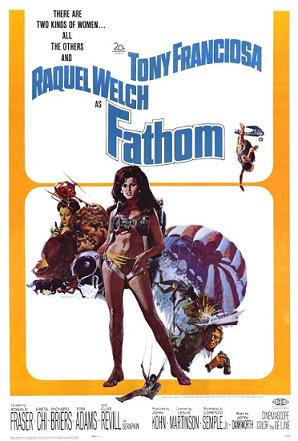
Lisa Cleans Out Her DVR: Fathom (dir by Leslie H. Martinson)


(Lisa is currently in the process of cleaning out her DVR!  It’s going to take her forever but, with the help of Dexedrine and energy drinks, she is determined to get it done!  She recorded 1967’s Fathom off of FXM on April 3rd of this year!)

Fathom is a spy spoof, one that was made the height of the initial James Bond craze.  It’s very much a late 60s film, in everything from the way the film looks to the overly complicated storyline to the film’s cultural attitudes.  This is one of those films that you know was probably considered to be “naughty” when it was released but, seen today, it’s all rather quaint.  There’s no nudity, there’s no cursing, and there’s very little violence.  However, it does feature in Raquel Welch in a lime green bikini and you just know that, when this film came out, there were probably people bemoaning it as the end of civilization.  “What happened to the movies that you could take the entire family too!?” they probably wailed.  That’s the way history works.  What was once daring now seems remarkably innocent.

I watched the film last night but I’d be lying if I said I could follow the plot.  I think that was intentional on the part of the filmmakers.  Fathom satirizes the spy films of the late 60s by taking all of their familiar elements to their logical extreme.  Spy thrillers feature unexpected twists and turns.  Fathom has a new twist every 10 minutes or so.  Spy thrillers feature sudden betrayal and double agents.  With the exception of Raquel Welch, literally no one in Fathom is who they initially claim to be.  It becomes exhausting to try to keep up.  In many ways, Fathom plays out like an old serial.  Every few minutes or so, there’s another cliffhanger.  Oh no, Raquel Welch is on an out-of-control motorboat!  Oh no, the bad guys have got Raquel Welch on an airplane!  Oh no, Raquel Welch is being chased by a bull and she’s wearing a red dress!  ¡Olé!

Raquel plays Fathom Harvill, who works as a dental hygienist except for when she’s touring Europe as a member of the U.S. parachute team.  She’s recruited by some spies to help track down a nuclear triggering mechanism, one that is being hidden somewhere in Spain.  The Scottish secret service just wants her to parachute into a villa owned by a mysterious American named Peter Meriweather (Anthony Franciosa) and plant a recording device.  Things don’t go quite as smoothly as they should and soon, Fathom’s going from one extreme situation to another.

(Even though Peter is supposed to be a suave, James Bond-type, Franciosa gives such an oddly intense performance that it feels like a dry run for his later work in Dario Argento’s Tenebrae.  Interestingly enough, in Argento’s film, Franciosa’s character is named Peter Neal.  Is it possible that Peter Meriweather changed his last name?)

But really, the entire plot is just an excuse to get Raquel into that lime green bikini and she totally owns the moment.  Raquel Welch is one of my favorite of the old film stars because she never apologized for who she was.  She had the body, she was sexy, she knew it, and she used it to her advantage.  Of course, when seen today, it’s disappointing that Fathom spends the entire movie being rescued by men but then again, I imagine that just the idea of a woman being a secret agent was revolutionary in 1967.  Actually allowing her to get out of situations on her own might have made heads explode.  If Fathom were made today, Fathom would at least get one scene where she gets to kick some ass, Angelina Jolie-style.

Anyway, Fathom is an enjoyably silly spy film.  Don’t worry about trying to follow the plot and, instead, just enjoy it as an over-the-top time capsule.  It doesn’t get more 1967 than Fathom.

Here’s What Won At Cannes!


Here’s what won at this year’s Cannes Film Festival!  As always, the list is full of intrigue and surprises.

Also, as always, it’s debatable whether any of this will actually effect that Oscar race.  To be honest, other than The Tree of Life, it’s hard to think of any recent Oscar nominee that was undeniably helped by a victory at Cannes.  During the Festival, both Robert Pattinson and Adam Sandler (yes, Adam Sandler) started to receive some Oscar buzz but neither of them — nor their films, Good Time or The Meyerowitz Stories — were honored.

(As enjoyably weird as it would be for Adam Sandler to become an Oscar nominee, I imagine The Meyerowitz Stories will be ignored come Oscar time because it’s a Netflix film.  If the Academy couldn’t even give one nomination to the previous Netflix contender — the powerful and important Beasts of No Nation — I doubt that they’re going to surrender their bias for a film starring Adam Sandler and Ben Stiller.)

That said, I am very, very happy to see that one of my favorite artists, Sofia Coppola, was honored!  I can’t wait to see The Beguiled!

Here’s the winners:

2017 Main Competition winners: 

Palme d’Or: The Square (Ruben Ostlund)
Gran Prix: “BPM (Beats Per Minute)” (Robin Campillo)
Jury Prize: “Loveless” (Andrey Zvyagintsev)
Best Director: Sofia Coppola — The Beguiled
Best Actor: Joaquin Phoenix — You Were Never Really Here
Best Actress: Diane Kruger — In The Fade
Best Screenplay: “The Killing of a Sacred Deer” (Yorgos Lanthimos, Efthimis Filippou) and “You Were Never Really Here” (Lynne Ramsay)

OTHER PRIZES

Camera d’Or: “Jeune femme” (Montparnasse-Bienvenüe) (Léonor Serraille)

Short Films Palme d’Or: “Xiao Cheng Er Yue” (Qiu Yang)

Short Films Special Mention: “Katto” (Teppo Airaksinen)

Golden Eye Documentary Prize: “Faces Places” (Visages Villages) (Agnès Varda, JR)

Ecumenical Jury Prize: “Radiance” (Naomi Kawase)

2017 Un Certain Regard winners: 

Un Certain Regard Prize: Mohammad Rasoulof – A Man of Integrity
Best Actress: 
Jasmine Trinca – Fortunata
Best Poetic Narrative:
 Mathieu Amalric – Barbara
Best Direction: 
Taylor Sheridan – Wind River
Jury Prize:
 Michel Franco – April’s Daughter

2017 International Critics Week winners:

Nespresso Grand Prize: Emmanuel Gras – Makala
France 4 Visionary Award: Fellipe Gamarano Barbosa – Gabriel and the Mountain
Leica Cine Discovery Prize for Short Film: Laura Ferrés – Los Desheredados
Gan Foundation Support for Distribution Award: Fellipe Gamarano Barbosa – Gabriel and the Mountain
SACD Award: Léa Mysius – Ava
Canal+ Award: Aleksandra Terpińska – The Best Fireworks

2017 Director’s Fortnight winners:

Art Cinema Award: Chloé Zhao – The Rider
SACD Award: Claire Denis – Let the Sunshine In, Philippe Garrel – Lover for a Day
Europa Cinemas Label Award: Jonas Carpignano – A Ciambra
Illy Prize for Short Film: Benoit Grimalt – Back to Genoa City

4 Shots From 4 Films: Special Twin Peaks Edition


Look, I’m just going to admit the truth.

I am obsessed.

Right now, I am totally obsessed with Twin Peaks.  Even as I spent the last few days watching movies off the DVR and writing the reviews that I posted on this site today, I still found my thoughts continually returning to Twin Peaks.

So, in honor of that obsession, here’s a special edition of 4 Shots From 4 Films.

It is happening again.

4 Shots From 4 Films

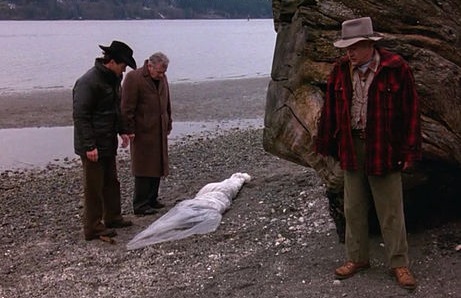
Twin Peaks 1.1 — The Pilot (dir by David Lynch)

Twin Peaks 2.22 “Beyond Life and Death” (dir by David Lynch)

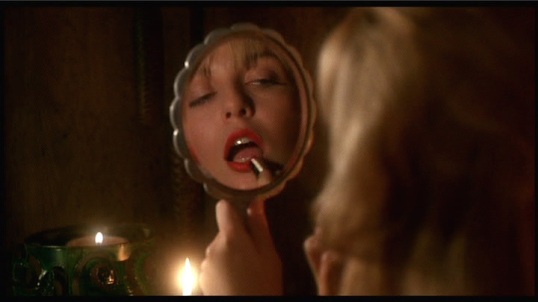
Twin Peaks: Fire Walk With Me (dir by David Lynch)

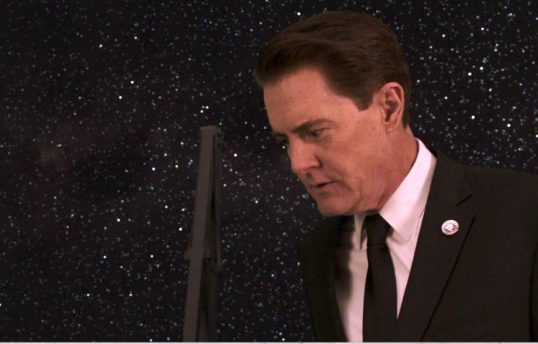
Twin Peaks: The Return Part 3 (dir by David Lynch)

Here’s The Trailer for Wind River!


Here’s the trailer for Wind River, a crime thriller that has gotten good reviews at both Sundance and Cannes.

Here are a few things to know about Wind River:

First off, a lot of people are pointing out that it stars two members of the MCU, Jeremy Renner and Elizabeth Olsen.  At this point, however, the MCU is so big — with the movies and Netflix and the tv shows — that it’s hard to think of a recent or upcomng film that doesn’t feature at least one actor from the MCU.  At this point, MCU actors running into each other in non-MCU movies is no longer as big a surprise as it may have once been.  It’s kind of unavoidable.

For me, the most intriguing thing about Wind River is that it is the directorial debut of Taylor Sheridan, who previously wrote the amazing screenplays for both Sicario and Hell or High Water.  I’ll be curious to see if Sheridan is as good and unpredictable a director as he is a writer.

Here’s the trailer!

Lisa Cleans Out Her DVR: The Rachels (dir by Michael Civille)


(Hi, everyone!  I’ve been cleaning out my DVR and reviewing the films that I’ve recorded.  Here’s my final review of the day.  I recorded The Rachels off of Lifetime on January 29th!)

I want to tell you about The Rachels but it’s not going to be easy because, at the same time, I don’t want to tell you too much.  The Rachels is a whip-smart and wonderfully snarky little satire and, because of the non-linear narrative style that the first half of the film employs, there’s very little I can tell you about the plot without spoiling the movie.

Don’t be put off by its origins as a Lifetime film.  Don’t judge the film just because the title was obviously inspired by Heathers.  How good is The Rachels?  It’s so good that I’m tempted to call it nifty.  That’s how good it is.

It tells the story of two teenage girls named Rachel.  They’ve been best friends forever.  They do the morning announcements together, always ending things by reminding the school, “We’re the Rachels.”  Rachel Nelson (Madison Iseman) is blonde and popular, a track star who is loved by everyone.  Rachel Richards (Caitlin Carver) is brunette and she’s slightly less popular than Rachel Nelson.  Rachel Richards is almost always in the shadow of Rachel Nelson.  While Rachel Nelson is praised by her track coach, Rachel Richards is consistently told that she could do better.  And then there’s Roxie (Daniela Bobadilla), a photographer who seems to be slightly obsessed with Rachel Nelson but is disliked by Rachel Richards.  Roxie claims that she was once one of the Rachels but she is continually told, by one of the Rachels (I can’t reveal which one), that she was never really a Rachel.

At a late night party, one of these three girls will fall off of the roof and plunge to her death, the result of an apparent suicide.  The film, in its non-linear fashion, holds off an immediately revealing which one of them fell from the roof and I will do the same.  What I can tell you is that the entire school soon becomes a shrine to the dead girl and the two survivors both use her death to their own advantage.  Both of them, by linking themselves to the now sainted dead girl, become very different types of celebrities.

It makes for a very sharp satire, one that perfectly skewers today’s culture of instant fame and internet grieving.  All three of the main actresses — Maidson Iseman, Caitlin Carver, and Daniela Bobadilla — are perfectly cast and give pitch perfect performances.  This is one of those films where no one turns out to be exactly who you thought they would be.  Well-written, well-directed, and wonderfully acted, The Rachels keeps you thinking and guessing.

That’s really all I can say about the movie without giving away too much.  Keep an eye out for it.

Film Review: Space Trucker Bruce (dir by Anton Doiron)


For most of today, I’ve been posting reviews of films that I watched off of my DVR.  Well, I’m going to take a brief break from that pattern to tell you about a film that I watched last weekend.  It was a low-budget sci-fi film, a real labor of love that the director posted on YouTube.  I watched this film with some of my friends from the Late Night Movie Gang: there was me, Kurt Zellner, Holly Wilson, Janeen Worrall, Phil Kaine, Michael McDow, and Jes Coolbaugh.  For the most part, we enjoyed this film.

The name of the movie was Space Trucker Bruce.  I’m trying to think of the best way to explain the plot and it’s not easy.  It’s a very episodic film and I think it could actually be argued that there really isn’t a plot per se.  Instead, there’s just a lot of stuff that happens. Some of it is connected and some of it isn’t but the randomness of it all is part of the film’s charm.

Space Trucker Bruce takes place in the far future.  The Earth has colonized the solar system.  Humans and human businesses have taken over space.  Bruce (Karl Sears) is a space trucker.  He’s currently in the process of hauling 20,000 tons of hog fat from Earth to a space station.  It’s a lonely job, to be honest.  At the start of the film, Bruce doesn’t have any human companionship.  He does have a robot, though it’s possible that the robot might actually just be a trash can.  You’ll have to watch the film to know for sure.  He has several books to read, including a few by the noted Catholic historian Garry Wills.  He also has movies, which apparently hardly anyone watches in the future.  (Bruce is one of the few people in existence to still know what Star Wars is.)  There’s also a tub of cream cheese that has apparently come to life and which keeps encouraging Bruce to do some really bad things.  Or at least, we assume that the cream cheese has come to life.  Could Bruce just be crazy?

During the journey, Bruce gets some human companionship when he picks up a hitchhiker named Max (played by the film’s director and writer, Anton Doiron).  Max is an affable if occasionally neurotic guy.  He has a hard time adjusting to Bruce’s laid back personality but, on the plus side, Max is willing to watch movies.

The rest of the film — well, I guess the simplest way to put it would be that Bruce and Max have various adventures while making their way to the space station.  Except, they’re not really adventures as much as they’re just stuff that happens.  Calling them adventures would suggest that Bruce and Max were really active participants.  For the most part, they both spend the majority of the film just relaxing in the ship and occasionally responding to stuff that happens.  I mean, if the ship is about to be destroyed then sure, Bruce and Max are going to try to stop that from occurring.  But, for the most part, Bruce and Max are just kind of hanging out.

And that really is the film’s charm.  This is a low-budget film that proudly embraces the fact that it’s a low-budget film.  The sets and the special effects manage to look cheap and effective at the same time.  There’s a real charm to the fact that the director wanted to make a space epic and he managed to do it, despite not having much money.  Even the amateurish acting become charming after a while.  To say that the actors were stiff would be an understatement.  But, at the same time, Karl Sears was perfectly cast as Bruce.  He just was Bruce in much the same way that Anton Doiron just was Max.  There are some films that you appreciate just because they actually managed to get made and seen.  Space Trucker Bruce is one of those films.

Space Trucker Bruce is available, for free, on YouTube.  It’s not a film for everyone but here’s the thing.  If it’s not for you, you’ll know after the first ten minutes.  However, if you’re still watching after those ten minutes then you’ll probably enjoy this odd little movie.

Here’s the trailer!

As for the film, it can be watched here: