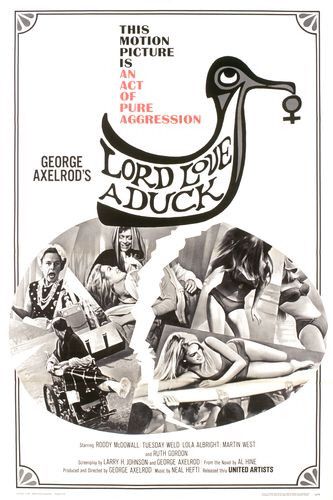
Back To School Part II #3: Lord Love A Duck (dir by George Axelrod)


Lordloveaduck

For my third Back to School review, I watched the 1966 satire, Lord Love A Duck!

Hey hey hey!

I have to admit that, because I’m writing this review in a hurry and because the D and the F key are located right next to each other, I keep accidentally calling this film Lord Love A Fuck.  Somehow, that seems appropriate because Lord Love A Duck is a very odd and subversive little movie that deals with people who are largely motivated by lust and I’m pretty sure that, at one point, Roddy McDowall is seen saying, “Fuck off!” but, of course, we don’t actually hear him say it.  But seriously, Lord Love A Duck is a weird movie.

Hey hey hey!

Roddy McDowall plays Alan Musgrave, a student at a “progressive” high school in California.  Roddy was about 37 years old when he played a high school senior and he doesn’t look like a teenager at all but somehow, it’s appropriate.  After all, Alan is no ordinary teenager!  He’s smarter than everyone else.  He’s wittier than everyone else.  He’s more clever than everyone else.  He’s also totally obsessive and willing to do just about anything to get what he wants.  And you can be sure of one thing: whenever Alan does something borderline insane, you’ll hear a group of singers harmonizing, “Hey hey hey!” in the background.

Hey hey hey!

See, it’s happening already.  It doesn’t matter what Alan’s doing.  He could be kicking a skateboard in the way of a romantic rival.  He could be interrupting the graduation ceremony with a tractor.  He could be going to prison for life.  No matter what it is, it will always be accompanied by:

Hey hey hey!

Anyway, Alan is in love with the innocent, sweet, and constantly flirtatious Barbara Anne Greene (Tuesday Weld).  In fact, almost everyone in the film is in love with (or, at the very least, turned on by) Barbara.  The only person who doesn’t seem to be in love with Barbara is her mother (Lola Albright), a former-beauty-turned-cocktail-waitress whose world-weary cynicism seems to offer a depressing hint of what’s in store for Barbara once she gets older.

Hey hey hey!

But everyone else loves Barbara.  Especially Alan!  In fact, Alan is so in love with her that he swears that he’s going to make sure that she gets everything that she wants.  When she needs 12 cashmere sweaters so that she can join an exclusive girl’s club, Alan helps her to convince her father (Max Showalter) to pay for them.  When Barbara needs a job after dropping out of school, Alan helps her get one as a secretary for the high school’s progressive principal (Harvey Korman).  When Barbara decides she wants to marry the boring but respectable Christian youth leader, Bob (Martin West), Alan keeps Bob’s mother (Ruth Gordon) so drunk that she doesn’t get a chance to reprimand her son for falling in love with a girl from a divorced family.  (As Bob’s mother explains it, she doesn’t believe in divorce.  “We don’t leave our husbands.  We bury them.”)  Eventually, a movie producer decides that he wants Barbara to star in his beach films but Bob says no.  No wife of his is going to be a movie star!  So, of course, Alan decides to murder Bob so that Barbara can again have what she wants…

Hey hey hey!

Lord Love A Duck is a manic comedy that satirizes everything that mainstream audiences in 1966 would have held sacred.  Teenagers, conservatives, liberals, love, hate, murder, justice, marriage, divorce, morality, sex, religion, television, movies — it’s all thoroughly ridiculed in this film.  (It’s not surprising that the film’s director also wrote the script for The Manchurian Candidate, a satire disguised as a thriller.)  To be honest, it’s probably a little bit too manic for its own good.  At times, the film run the risk of becoming exhausting.  But then there’s even more times when the film is absolutely brilliant.

Hey hey hey!

Speaking of absolutely brilliant, Lord Love A Duck makes brilliant use of Roddy McDowall’s eccentric screen presence but, even better, it features one of Tuesday Weld’s best performances.  Weld was a talented actress whose performances often revealed that a fragile soul is often the price that is payed for great beauty.  (There’s no greater insecurity than wondering whether people are responding to who you are or to how you look.  Would you still care if I was ugly is not a question we’re supposed to ask but it’s one that we’ve all wondered.)  It would have been far too easy to make Barbara either totally innocent or totally manipulative.  Wisely, the film does neither.  Barbara may occasionally be manipulative but she always means well.  It’s not her fault that everyone around her is either idiotic or insane.

Hey hey hey!

Though Lord Love A Duck is obviously a time capsule of the culture of mid-60s, it’s also a film that remains relevant even today.  Culturally, we’re still obsessed with fame, youth, and beauty.  In many ways, the satire of Lord Love A Duck still feels more extreme that anything that any contemporary filmmaker would dare to attempt.  I can only imagine what audiences in 1966 thought as they watched this subversive teen film.

Hey hey hey!

Back To School Part II #2: Vinyl (dir by Andy Warhol)


vinyl1

For my next back to school film, I watched the 1965 underground film, Vinyl!

Now, admittedly, Vinyl does not appear to take place in a high school.  Then again, maybe it does.  All of the action takes place in a cramped corner of a room and we’re never really told, for sure, where the room is located.  All we know is that various characters keep wandering in and out of the static frame while the film’s action unfolds.

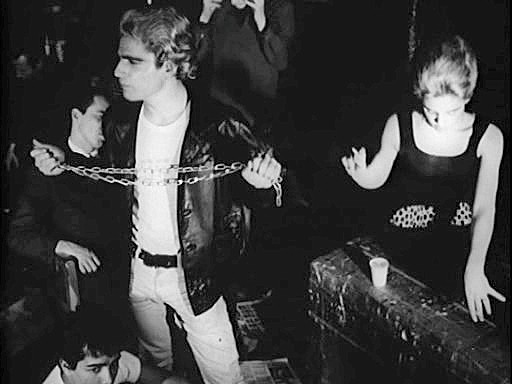
The center of the film is Victor (Gerald Malanga) who appears to be in his late 20s but who insists to us that he’s a “J.D,” which stands for juvenile delinquent.  He does what he wants, whether that means lifting weights or enthusiastically dancing.  Victor may be a murderous teenager with a bad attitude but he truly loves rock music.

While Victor dances and occasionally stumbles his way through a monologue about being a J.D, there’s an ever-present audience in the background of the scene.  Occasionally, they seem to be interested in what Victor is saying but, just as often, they seem to be bored with the whole thing.  Sitting off to Victor’s right and smoking through nearly the entire film is the iconic and tragic Edie Sedgwick.  Occasionally, she dances but, for the most part, she’s just observes with an enigmatic half-smile on her face.

Eventually, some men who we assume are the police get tired of Victor dancing and boasting about being a delinquent so they grab him, tie him to a chair, and force him to wear bondage gear while they beat him.  It’s a new, government-sanctioned rehabilitation technique and it’s guaranteed to turn Victor is a responsible member of society.  While they torture him, they play vinyl records in the background and Victor, possibly to his horror though, due to Malanga’s out-of-it performance, it’s often difficult to surmise what’s going on in Victor’s head, realizes that his beloved rock music is now being used to torture him.

All the while, Edie watches from the corner of the screen.  She smokes a cigarette.  She dances.  Sometimes, someone will refill her drink.  She holds a candle for a while.  As a viewer who is more than a little obsessed with the tragically short life of Edie Sedgwick and who relates to her on a personal level, it was occasionally difficult for me to watch because, even in a non-speaking role, Edie’s star power was obvious.

Edie!

Edie!

Of course, Edie isn’t the only person watching as Victor is tortured.  Many people wander in and out of the frame.  (Vinyl lasts 70 minutes and features exactly three shots.)  For the most part, the majority of them regard the torture happening in from with a studied detachment.  In fact, they’re very detachment and they’re very refusal to act in any sort of expected way becomes rather fascinating.  Vinyl goes so far out of it’s way to defy our expectations of what a movie should be that it becomes one of the most watchable unwatchable movies ever made.

Vinyl was directed by Andy Warhol.  Reportedly, it was filmed without any rehearsal and without multiple takes.  Hence, when Malanga stumbles over his lines or occasionally turns his back to camera, the moment is preserved.  When Edie Sedgwick breaks character and laughs, the film keeps on rolling.  When another actor accidentally drops his papers and has to spend half a minute picking them up and trying to get them back in order, it’s saved on camera.  And, because it’s in the final cut, Gerald Malanga forgetting his lines becomes as much a cinematic moment as Humphrey Bogart telling Ingrid Bergman to get on that plane or Clark Gable saying that he didn’t give a damn.   There is no editing and, as a result, there is no protection.  Instead, we just get a group of eccentric outsiders in their amateur glory.  Yes, it’s self-indulgent and deliberately alienating but it’s also undeniably fascinating.  (It helps that, while he may not have been a good actor, Gerald Malanga had an absolutely fascinating face.)  When one watches one of Warhol’s underground films, the question always arises as to whether he was a genius or a con artist.  Vinyl would seem to suggest that he was both.

(“What’s the point of all this?” some viewers may ask.  The point is that it was filmed and now you’re watching and, because he’s at the center of a static frame, Gerald Malanga is now a movie star.)

Though you might have a hard time realizing it from just watching the film, Vinyl was also the first cinematic adaptation of Anthony Burgess’s A Clockwork Orange.  Victor was a stand-in for Alex and Alex’s love of Beethoven is replaced by Victor’s love for Motown.  Six years later, Stanley Kubrick would release his better known adaptation of Burgess’s novel but Andy Warhol, Gerald Malange, and Edie Sedgwick all got there first.

ANDY-WARHOL-VINYL-3

Back to School Part II #1: Teenage Devil Dolls (dir by B. Lawrence Price, Jr.)


(a.k.a. Teenage Devil Doll)

(a.k.a. Teenage Devil Dolls)

Hi, everyone!

Well, down here in Richardson, Texas, today was the first day of school!  That’s right, all the kids are going to be back to school and movie theaters are about to become a lot more pleasant.  Now, you may remember that, two years ago, I observed the first day of school by launching a series of Back To School reviews!  I reviewed 80 films about being a teenager and high school life.  I had a lot of fun doing it and our readers seemed to enjoy it!

So, I figured — why not do it again!?

Now, as much as I’d like to, I’m not going to do 80 films this time.  Instead, I have decided to limit myself to reviewing 56 films over the next 14 days.  If I maintain a schedule of reviewing 4 Back to School films a day, it shouldn’t be a problem.

Can I do it?

Well, we’re about to find out!

I decided to start things off by reviewing a melodrama from 1955!  I have to admit that, when I decided to review Teenage Devil Dolls, I didn’t know anything about the film.  I just saw the title and I assumed that the whole film would basically be tight sweaters and juvenile delinquents.  I figured it would be good and campy fun, something along the lines of Ed Wood’s The Violent Years.

Well, it turned out that Teenage Devil Dolls does feature some juvenile delinquents and a few tight sweaters but otherwise, it really wasn’t what I was expecting.  For one thing, it turned out that the film didn’t have much to do with high school.  And though the main character was described as being 19, she was played by an actress who appeared to be in her 30s so it really didn’t matter.

It also turned out that Teenage Devil Dolls featured absolutely zero dialogue!  This is one of those films that was specifically made to be the second part of a double feature and, apparently, it was made without much of a budget.  On-set sound recording was apparently a luxury that could not be afforded and, as such, the entire movie is narrated by a hard-boiled cop.

The cop tells us the story of Cassandra Leigh (Barbara Marks), who was an innocent 17 year-old until she started hanging out with the wrong crowd.  We know that her new friends are the wrong crowd because they ride motorcycles and some of them wear leather jackets.  They also smoke weed (or “reefer cigarettes,” as the cop calls them).  At first, Cassandra turns down their persistent offers of marijuana but eventually, the peer pressure get to be too much.  Cassandra doesn’t want to be a big ol’ four-sided square so she starts smoking the weed and her life quickly falls apart.

Not only do her grades suffer to such an extent that she barely graduates high school and loses any chance she ever had to attend college but Cassandra also ends up frequently running away from home and getting hooked on heroin.  (If all this seems a little bit extreme, it should be remembered that Cassandra was previously seen smoking one of the biggest joints to ever appear in a movie.  Though, in all honesty, she didn’t appear to be inhaling.)  Cassandra marries a boring guy but the boring life is not for her!  Not when she can make so much more money by becoming a drug dealer…

You know, it’s easy to be dismissive of a film like Teenage Devil Dolls, what with the low-budget, the hard-boiled narration, and the alarmist portrayal of marijuana as literally being the root of all evil.  But honestly — whether intentional or not — there’s an intensity to Teenage Devil Dolls that makes it oddly hypnotic.  Perhaps because they were filmed without sound, almost all of the actors give the type of over-expressive performances that one would typical expect to see in a silent movie.  The contrast between the laconic narration and the theatrics on-screen creates a surrealistic and dream-like atmosphere.

Along with the narration, there’s also a few sound effects on the soundtrack but none of the effects really seem to sync up with the action on screen.  A dog shows up and opens its mouth but the barking sounds like it’s coming from somewhere else.  When a police car drives, the jarring siren doesn’t seem to fit the image.  Most hauntingly of all, a chilling ringing sound is heard whenever a junkie starts to go through withdraw.  At times, the film almost feels like a fever dream.

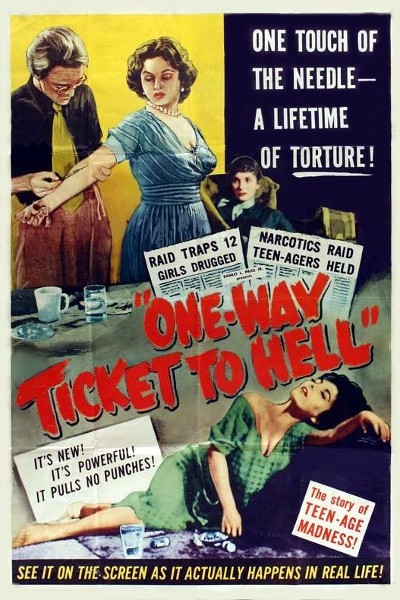
Teenage Devil Dolls (or One Way Ticket To Hell as it is also known) is an unexpectedly odd film.  And you watch it below!

The Things You Find On Netflix: 13 Cameras (dir by Victor Zarcoff)


camera2

If you go over to Netflix right now, you can watch a film called 13 Cameras.  13 Cameras had a brief VOD and theatrical run earlier this year and, in 2015, it got some attention on the festival circuit where it played under the title Slumlord.  It’s a film about a creepy landlord who rents out a house that is full of surveillance equipment and, what else can I say other than…AGCK!

I mean, this is a seriously creepy little movie and it’s even creepier if you actually have a landlord.  I’ll admit that I’ve been checking the house for hidden cameras ever since I watched 13 Cameras.

Now, admittedly, 13 Cameras moves at a very deliberate pace.  This film may be slightly less than 90 minutes long but it still requires a bit of patience.  When the movie started and I first met Ryan (PJ McCabe) and his pregnant wife, Claire (Brianne Moncrief), I have to admit that I had my doubts about 13 Cameras.  Both Ryan and Claire were such unlikable characters that I wasn’t sure that I wanted to spend any more time watching them.  Claire came across as being the epitome of the self-centered friend who you always dread getting a phone call from while Ryan … well, Ryan was just a huge jerk.  Because he was having a hard time adjusting to his wife’s pregnancy, he was cheating on her with his assistant, Hannah (Sarah Baldwin).

“Do you still love her?” Hannah asks him at one point.

“I don’t know,” Ryan shrugs.

Bleh!

(Interestingly enough, Hannah is probably the most sympathetic character in the film, despite the fact that she’s having an affair with a married man.  I don’t know if that was intentional or if it’s just a result of Sarah Baldwin being a more likable performer than either McCabe or Moncrief.)

But no matter!  In the end, the film really isn’t about Ryan, Claire, or Hannah.  The film is about their landlord, Gerald.  Gerald is totally frightening and he ends up doing some pretty bad things.  (In fact, some of the things that he does are so awful that it’s actually probably for the best that Claire and Ryan aren’t particularly likable.)  Gerald is played by an actor named Neville Archambault and, after I saw 13 Cameras, I immediately jumped over to his imdb page and I was both surprised and somewhat relieved to see pictures of him looking like a perfectly normal and pleasant human being.  Because, in the role of Gerald, Archambault gives perhaps the creepiest psycho performance since William Tokarsky played The Killer in Too Many Cooks.

From the minute that Gerald shows up on-screen, he inspires unease.  He’s a hunched over, heavy-set but muscular man who speaks only in grunts.  He shuffles around, keeping his head down and perpetually breathing through his mouth.  When he sits in his apartment and watches the footage from the 13 cameras that he’s set up around the house (including one located in the toilet — ewwwwwwwwwwww!), he sits there with his mouth open and literally never blinks.  When she first meets him, Claire complains that Gerald smells like “spoiled mayonnaise” and looking at him, you can imagine the odor almost seeping out of the screen.

What makes Gerald especially frightening is that he’s a believable psycho.  As I watched, I realized that I could easily imagine running into Gerald in real-life and then it dawned me that I actually have seen people like Gerald in real-life.  Gerald is the guy who, when you have to talk to him, spends the entire conversation answering in monosyllables and staring at your breasts.  Gerald is the disgusting, frightening psycho next door and the fact that you could easily imagine seeing Gerald walking down your own street is exactly what makes this film compelling.  Neville Archambault deserves a lot of credit for bringing a nightmare to life.

As for the film itself, it requires patience but it pays off in the end.  First-time director Victor Zarcoff does a good job, despite having to work with an obviously low-budget and only two locations.  The film ends with a perfectly morbid little twist.  While it’s not perfect, it’s definitely a promising debut.

Do I recommend watching 13 Cameras?  I do.  If for no other reason, see it for Neville Archambault’s wonderfully creepy performance!

Song of the Day: While My Guitar Gently Weeps (performed by Regina Spektor)


If you’ve seen Kubo and the Two Strings, you’ll understand why.

Though I won’t spoil the movie, I will say that, when this Regina Spektor cover of George Harrison’s classic song started to play, there was not a dry eye to be found in the Alamo Drafthouse.

If you haven’t already, be sure to see Kubo this weekend!  Let’s make it the number one film in the country!

Film Review: Kubo and the Two Strings (dir by Travis Knight)


Kubo_and_the_Two_Strings_poster

How is it that, this weekend, so much hype is being given to War Dogs and Ben-Hur — two films that you knew weren’t going to be any good from the minute you first saw their trailers — while one of the best films of the year is running the risk of being overlooked?

I just got back from seeing Kubo and The Two Strings and I am insisting that, if you haven’t already, you go out and see it right now.  If you’re busy today, I understand.  See it on Sunday.  You can even see it on Monday if you have to.  But the important thing is that you see it soon.  For the most part, 2016 in cinema has almost been as bad as 2016 in politics.  The year has been dominated by big spectacles, the majority of which do not even attempt to create any sort of emotional connection with the audience.  Don’t get me wrong — there have been some good films but not hardly enough.  Fortunately, Kubo and the Two Strings is the type of film that, if people actually go and see it, can help to redeem an entire year.

In short, I want to wake up on Monday and I want to read that Kubo and The Two Strings won the weekend.  Make it happen!

Kubo and The Two Strings is an animated film and yes, you need to see it in a theater and yes, you need to see it in 3D.  It’s one of the most visually stunning films that I’ve seen this year and, even better, it’s a film that actually has a heart.  When I watched Kubo and The Two Strings, I found myself both laughing and crying and feeling a renewed excitement about the potential of cinema.

Somewhat appropriately, this magical film is about magic, not just spell-casting magic but also the magic that we all have within our soul and locked away in our memories.  Taking place in ancient Japan, it tells the story of Kubo (voiced by Art Parkinson), a one-eyed child who lives in a cave with his sickly mother.  Most of the time, his mother is so out-of-it that she can only sit at the cave entrance and stare out at the distant ocean.  But occasionally, she is lucid enough that she remembers her past and she tells stories about how Kubo’s father was a mighty warrior who battled monsters and went on heroic quests.  She also remembers that Kubo’s grandfather is an evil demon, who is searching for his grandson and who hopes to take away his other eye.

Kubo supports his mother by going into a nearby village and, through the use of origami, magic, and music, telling stories to the townspeople.  His mother always warns Kubo not to say out after sunset.  Inevitably, however, Kubo does just that and soon, his demonic aunts appear in the village.  (The aunts, who are voiced by Rooney Mara, are truly scary.)  The village is destroyed and Kubo’s mother sacrifices her life to save him.

This, of course, all leads to Kubo going on a quest of his own.  He has to find his father’s armor so that he can defeat his grandfather.  Helping him in his quest is Monkey (Charlize Theron) and Beetle (Matthew McConaughey, providing comic relief to an occasionally grim film).  But really, the quest is less about finding the armor and more about Kubo both growing up and coming to terms with the loss of his parents.  Yes, Kubo and The Two Strings may be an animated film and it may be a fantasy and it may feature bits of comedy but it’s a film that inspires very real emotions.  It’s a film that made me cry and it earned every single tear.

(Seriously, I dare you to watch the final five minutes of Kubo and The Two Strings without tearing up.)

Visually, this is an amazing film.  The images are often beautiful, sometimes frightening, and occasionally awe-inspiring.  Kubo’s aunts are pure nightmare fuel and his confrontation with his grandfather (voice by Ralph Fiennes) is magical in more ways than one.  Even beyond that, Kubo and the Two Strings creates a world that feels as real as our own.  It not only visualizes and celebrates film magic but also real-life magic as well.

Kubo and the Two Strings is a great and magical film and it’s one of the best of the year so far.  If you haven’t seen it, go out and see it.  If you’ve already seen it, go see it again.  Don’t wait for it to come out on Blu-ray.  Don’t say, “I’ll see it on cable.”  Don’t wait for Netflix.  See it on a big screen and see it now.

Seriously, don’t miss your chance to experience this movie the way it was meant to be experienced!


Scenes that I Love: Edie Sedgwick and Gerald Malanga Dance in Andy Warhol’s Vinyl


Today’s scene that I love comes to use from an underground 1965 film called Vinyl!  Believe it or not, this adaptation of A Clockwork Orange was directed by Andy Warhol and predates the famous Kubrick film by 6 years!

This is a film that I hope to get a chance to review very soon but until then, check this out scene of Edie Sedgwick and Gerald Malanga dancing to Nowhere to Run by Martha and The Vandellas.

Watching her in this scene, it’s sad to think that, in just six years (and at the same time that Stanley Kubrick was releasing his version of A Clockwork Orange), Edie Sedgwick would die at the age of 28.  Like all of us, she deserved much better than what the world was willing to give her.

Edie Sedgwick (1943 -- 1971)

Edie Sedgwick (1943 — 1971)

Film Review: Isle of the Dead (dir by Nick Lyon)


isle-of-the-dead-poster

I just finished watching the premiere of the latest Asylum-produced SyFy film, Isle of the Dead!

Oddly, this film premiered on a Thursday night at 10:00 pm and, especially when compared to Sharknado 4 or 2 Lava 2 Lantula, it did so with relatively little fanfare.  Fortunately, I just happened to see the premiere mentioned on Facebook.  Otherwise, I probably would have missed it all together.

And that would have been a shame because, for a low-budget zombie film that was reportedly filmed in just 12 days, Isle of the Dead was actually a pretty effective little film.

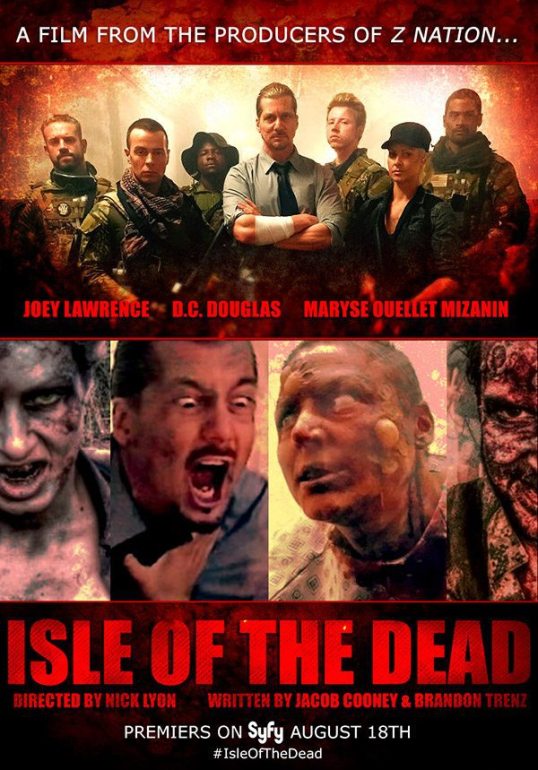
The film’s plot will probably sound familiar but there’s a reason for that.  The action starts at a secret Army research post that is located on an isolated tropic island.  While Dr. Wexler (D.C. Douglas) watches, a virus spreads through the lab, turning doctors and soldiers into ravenous zombies and leaving death and terror in its wake.  Jump forward ten years later.  A team of Navy Seals has disappeared on the island and a strike force has been sent to find out what happened to them.  Leading the strike force is the tough Lt. Gibson (Joey Lawrence).  Accompanying them is a CIA agent named Mikaela Usylvich (Maryse Mizanin).  Early on, Mikaela establishes a simple run: If you’re bitten by a zombie, you’re as good as dead.  A zombie bite means a bullet to the brain.

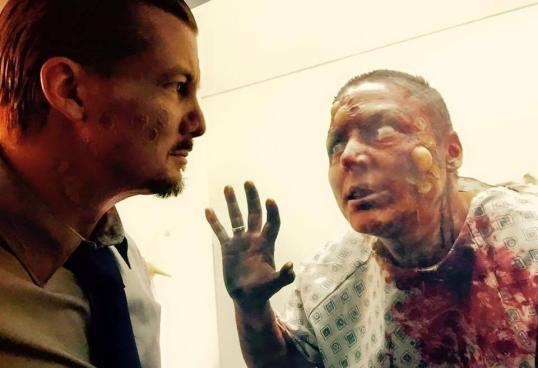
Eventually, the strike force makes their way to the old research post, where they discover a lot of zombies and one rather crazed Dr. Wexler.  Wexler, who turns out to have a personal connection to Mikaela, has spent the last ten years experimenting on zombies.  As a result, we now have zombies who can shoot guns as well as zombies who can talk and who can plot and plan…

If all of this is sounding familiar, it’s because Isle of the Dead is an homage to the Resident Evil games.  (Douglas may play Dr. Wexler here but he’s best known for voicing Albert Wesker in the games.)  As such, the film follows a pretty standard formula: we watch as the members of the strike force try to move from one area to another without getting ripped to pieces by zombies.  Admittedly, I’m not a huge expert on the Resident Evil games but I’ve been told by people who are that Isle of the Dead was full of references that were both subtle and occasionally obvious.

What I can tell you is that, taken on its own terms, Isle of the Dead was an effective, no-nonsense zombie film.  The zombies were relentless (and I personally like the idea of talking zombies), the gore was both credible and copious, and the entire film maintained a proper atmosphere of impending doom.  Douglas did a good job as crazy Dr. Wexler and Maryse Mizanin got to kick a lot of ass as Mikaela Usylvich.  If you’re into zombie films or you just enjoy the unique Asylum aesthetic, I suggest keeping an eye out for Isle of the Dead.

d.c.-douglas-and-taylor-jean-in-isle-of-the-dead-(2016)

Here’s The Latest Image of It’s Pennywise The Clown!


So, as you may know, there’s a new version Stephen King’s It coming out.  It’s scheduled to be released next year and it’ll star Bill Skarsgard as everyone’s favorite killer clown, Pennywise!

A new image of Pennywise’s costume appeared earlier today in Entertainment Weekly and here it is:

pennywise-ew-00054120

I have to admit that I’m not a huge fan of this look.  According to the EW article, the film’s costume designer decided to incorporate ideas from all eras of clowning, in order to show that Pennywise has been around for centuries.

But, to me, that kind of misses the point.  In the book, It appeared in many different forms, depending on who it was dealing with and it’s goal was at the time.  It used the form of Pennywise the Clown to both get the attention of and to scare the Hell out of children.  In the book, Pennywise kills Georgie Denbrough in 1957.  In the upcoming film, the timeline has been updated so that Georgie dies in 1989.  But, in both cases, why would Pennywise use the form of a Victorian-era clown to attack children in the 20th Century?  Wouldn’t Pennywise appear as a contemporary clown?

I may be overthinking this but, honestly, it’s difficult for me to look at this Pennywise without thinking about the time that Bobby Hill performed as Tartuffe the Spry Wonder Dog on King of the Hill.


Am I right?  Am I wrong?  What do you think of this new Pennywise?

Here’s The Full Trailer For Arrival!


Amy Adams and Jeremy Renner in a movie directed by  Denis Villeneuve?  Could Arrival be this year’s sci fi best picture nominee?  Or will it turn out to be more like Interstellar?

I’m hoping for the former!

(But then again, who isn’t?)

Check out the full trailer below!