(Lisa recently discovered that she only has about 8 hours of space left on her DVR! It turns out that she’s been recording movies from July and she just hasn’t gotten around to watching and reviewing them yet. So, once again, Lisa is cleaning out her DVR! She is going to try to watch and review 52 movies by the end of Tuesday, December 6th! Will she make it? Keep checking the site to find out!)
A Mother’s Escape aired on Lifetime Movie Network on July 21st, 2016.
Reportedly based on a true story, A Mother’s Escape tells a story that, on its surface, should be familiar to anyone who has ever watched a Lifetime film. After an argument with her abusive husband, Murel (Tara Buck) grabs her young son, Kipp (Spencer Mabrey), jumps in a car, and takes off in search of a better life. When we first meet them, they’re driving through Oklahoma. They stop at the house of Murel’s mother, Tess (Beth Grant).
From the minute that we first see Murel and Kipp, we feel like they know them. Both Tara Buck and Spencer Mabrey inhabit these roles so completely that it’s easy to forget that we’re watching actors performing from a script. Refreshingly, the film makes not attempt to idealize Murel. She’s frequently immature and occasionally self-centered but the ultimately, she’s defined by her love for her son. When she briefly talks to her husband on the phone, Murel is briefly tempted to return to him. Like so many victims of abuse, she fears that she might not deserve better. Fortunately, Tess is there to bluntly tell her that she does deserve better.
And so does Kipp.
Though her husband is not Kipp’s biological father, he did adopt him when he and Murel married. After Murel leaves, he accuses her of kidnapping her own son. Now, Murel must keep Kipp safe while also trying to avoid capture.
As I said, this might sound like a typical Lifetime film. However, it doesn’t feel like a typical Lifetime film. It moves at its own slow but steady pace, taking the time to allow us to get to know both Murel and Kipp. As Kipp, Spencer Mabrey is refreshingly non-cutesy while Tara Buck gives an almost heart-breakingly poignant performance as his imperfect but loving mom. As an added bonus, this film features some hauntingly beautiful shots of the Oklahoma landscape.
Though it may require some patience, A Mother’s Escape is one of the best Lifetime films that I’ve seen in a while.
(Lisa recently discovered that she only has about 8 hours of space left on her DVR! It turns out that she’s been recording movies from July and she just hasn’t gotten around to watching and reviewing them yet. So, once again, Lisa is cleaning out her DVR! She is going to try to watch and review 52 movies by the end of Tuesday, December 6th! Will she make it? Keep checking the site to find out!)
On November 5th, Lifetime aired a film about the murder of six year-old JonBenet Ramsey, Who Killed JonBenet? They followed this film with a documentary called JonBenet’s Mother: Victim or Killer? I did not watch the films when they originally aired, largely because, much like Girl In The Boxand Cleveland Abduction, the subject matter sounded way too disturbing to me. Instead, I just recorded them and, for a few weeks, both programs sat unwatched on my DVR.
Until earlier today, that is!
I watched both of them and then I quickly deleted both of them as well. And now I’m going to write a few words about them. In fact, I’m going to try to devote as little time as possible to these films.
Normally, I’m the first one to defend Lifetime and their movies. If you’re a regular reader of this site, you know how much I love Lifetime movies. I love them for the exact same reason that most people claim to disdain them. It’s rare that I ever see a Lifetime film that I can’t enjoy or, at the very least, defend.
But, seriously, Who Killed JonBenet? was such a misfire that I barely know where to begin. In many ways, it’s a typical true crime film. Suspects are identified. Detectives find themselves caring about the case … TOO MUCH! It ends on a note of surface ambiguity that’s deceptive because the film all but comes out and accuses Patsy Ramsey of murdering her daughter.
That thing that sets Who Killed JonBenet? apart is that the film is narrated by JonBenet Ramsey, who is apparently speaking to use beyond the grave. JonBenet tells us that she’ll always be six. And she tells us that one of the detectives is a nice lady. And it’s such an icky technique that it pretty much makes the entire film nearly unwatchable. Every time that we hear that cloying little voiceover, we’re reminded of two things: 1) this film is based on the real life rape and murder of a six year-old and 2) this movie was made specifically to exploit that event. In the end, you feel guilty for watching the damn movie in the first place.
Seeing as how Who Killed JonBenet? basically accuses Patsy Ramsey of murder, it’s interesting that it was immediately followed up by JonBenet’s Mother: Victim or Killer? JonBenet’s Mother explores Patsy’s life and pretty much comes to the conclusion that, while Patsy may have been a bit odd, she did not kill her daughter. If anything, the documentary shows that Patsy was largely the victim of a vicious media.
Like, to name just one example, Who Killed JonBenet?
Anyway, let us never speak of these two movies again. When I think of a Lifetime movie, I’d much rather think of Confessions of Go Go Girl.
(Lisa recently discovered that she only has about 8 hours of space left on her DVR! It turns out that she’s been recording movies from July and she just hasn’t gotten around to watching and reviewing them yet. So, once again, Lisa is cleaning out her DVR! She is going to try to watch and review 52 movies by the end of Tuesday, December 6th! Will she make it? Keep checking the site to find out!)
On November 13th, TCM Underground aired the 1976 Filipino women-in-prison film, The Muthers! And I recorded it!
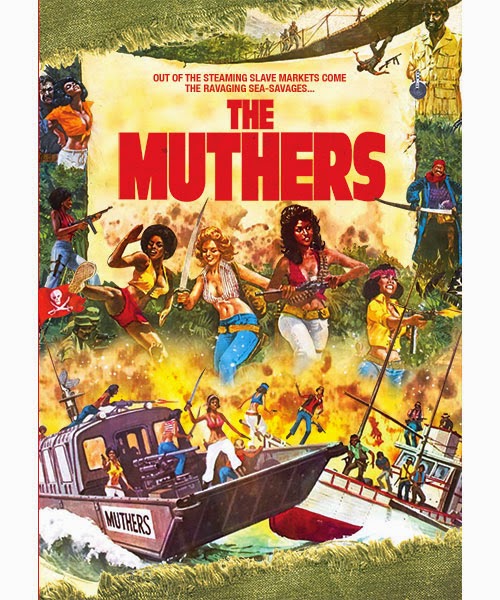
Before I say anything about the film itself, I want to acknowledge how much I love the poster above. I mean, that poster promises a film full of actions, thrills, and a healthy dose of girl power. You look at that poster and you think to yourself, “The Muthers must be one the greatest drive-in films ever made!”
You might also think that from reading about the film’s plot. The Muthers opens with Kelly (Jeannie Bell) and Anggie (Rosanne Keaton) sailing the high seas. It turns out that they’re pirates! They forcibly board yachts and rob decadent rich people. They’re good at their job and they have fun, too! Even better, they’re constantly fighting a rival pirate, a blowhard chauvinist named Turko (John Montomgery)! Turko only has one eye, that’s how much of a pirate he is!
If the film had just been Kelly and Anggie fighting Turko, The Muthers probably would be a classic. However, since this is a Filipino women-in-prison film, Kelly soon discovers that her sister has been imprisoned on Get Out If You Can Island. (Seriously, that’s what they call the island.) The island is run by the evil Montiero (played by Tony Carreon, a perennial villain in Filipino cinema) and, if they don’t rescue her, Montiero will sell her into prostitution.
Naturally, Kelly and Anggie go undercover and infiltrate the island. Sadly, the film gets kind of boring after Kelly and Anggie reach the prison. One reason why Filipino exploitation films are so respected and loved by aficionados of grindhouse cinema is because they frequently went totally and completely over the top. There was a shamelessness to the best of the Filipino grindhouse films and it makes them fascinating to watch. The Muthers starts out like a classic, with the pirates and Turko and all that, but once Kelly and Anggie reach the island, the film becomes oddly restrained. There’s little violence, little sex, only one notable use of slow motion, and the film even lacks the radical political subtext that runs through many women-in-prison films. One can’t help but wonder what the late Jess Franco would have done with the same material.
So, sadly, The Muthers failed to live up to the promise of that poster.
(Lisa recently discovered that she only has about 8 hours of space left on her DVR! It turns out that she’s been recording movies from July and she just hasn’t gotten around to watching and reviewing them yet. So, once again, Lisa is cleaning out her DVR! She is going to try to watch and review 52 movies by the end of Tuesday, December 6th! Will she make it? Keep checking the site to find out!)
On November 12th, I recorded 2016’s Marie Antoinette off of Starz.
Before I review Marie Antoinette, I think it’s important that you know that I am an unapologetic Sofia Coppola fan. I love every film that she’s made and I look forward to her upcoming remake of The Beguiled. At the same time, I can also understand why some people feel differently. Sofia Coppola’s films are not for everyone. For one thing, almost all of her films deal with rich people. The existential angst of the wealthy and/or famous is not a topic that’s going to fascinate everyone. When you watch a Sofia Coppola film, you never forget that you’re watching a film that’s been directed by someone who largely grew up in the spotlight and who knows what it’s like to have money. An ennui born out of having everything and yet still feeling empty permeates almost every scene that Sofia Coppola has ever directed. (If you have to ask what ennui is, you’ve never experienced it.) Many viewers look at Sofia Coppola’s filmography and they ask themselves, “Why should we care about all these materialistic people?”
However, while Sofia Coppola may not know what’s it’s like to be poor (or even middle class for that matter), she does understand what it’s like to feel lonely. Her filmography could just as easily be called “the cinema of isolation.” It doesn’t matter how much money you may have or how famous you may or may not be, loneliness is a universal condition. A typical Sofia Coppola protagonist is someone who has everything and yet still cannot connect with the rest of the world. More often that not, they turn to excessive consumption in order to fill the void in their life. To me, the ultimate Sofia Coppola image is not, regardless of how much I may love them, Bill Murray and Scarlett Johansson in Lost in Translation. Instead, it’s Stephen Dorff (playing a far less likable version of Bill Murray’s Translation character) standing alone in the desert at the end of Somewhere.
Marie Antoinette, which was Sofia’s follow-up to Lost in Translation, is technically a historical biopic, though it makes little effort to be historical or accurately biographical. Kirsten Dunst plays Marie Antoinette, the final queen of France before the French Revolution. It was Marie Antoinette was accused of dismissing starving French peasants by announcing, “Let them eat cake!” (For the record, it’s probable that Marie Antoinette never said that. It’s certainly never heard in Coppola’s film.)
Marie Antoinette opens with the title character arriving in France at the age of 14. She’s an Austrian princess who has been sent to marry the future king of France, Louis XVI (Jason Schwartzman). From the minute we meet her, Marie Antoinette is portrayed as being a pawn. Her mother arranges the marriage as a way to seal an alliance with France. The king of France (played by Rip Torn) expects Marie Antoinette to get produce an heir to the throne as quickly as possible. Meanwhile, her new husband is an infantile and immature fool who doesn’t even know how to make love. Marie Antoinette finds herself isolated in a strange country, expected to be all things to all people.
And so, Marie Antoinette does what I always do whenever I’m feeling unsure of myself. She hangs out with her girlfriends. She throws expensive parties. She gambles. She flirts. She shops. She has fun, regardless of whether it’s considered to be proper royal behavior or not. Occasionally, she is warned that she is losing popularity with the French people but she’s not concerned. Why should she be? She doesn’t know anything about the French people. All she knows about is the life that she was born into. She didn’t choose to be born in to wealth and power but, since she was, why shouldn’t she have a good time?
The French Revolution doesn’t occur until near the end of Marie Antoinette and when it does happen, it happens quickly. And yet, the shadow of the revolution hangs over the entire film. We watch the knowledge that neither Marie Antoinette nor her husband possess: eventually, they are both going to be executed. And knowing that, it’s hard not to cheer Marie Antionette on. She may be destined for a tragic end but at least she’s having a little fun before destiny catches up with her.
Kirsten Dunst makes no attempt to come across as being French or Austrian but then again, neither does anyone else in the film. After all, this is a movie where Rip Torn plays the King of France without once trying to disguise his famous Texas accent. Coppola isn’t necessarily going for historical accuracy. Instead, in this film, Marie Antoinette serves as a stand-in for countless modern celebrities. In the end, Marie Antoinette is portrayed as not being much different from Paris Hilton or Kardashian. Meanwhile, the people who eventually show up outside the palace, carrying torches and shouting threats, are the same as the viewers who loudly condemn reality television while obsessively watching every episode of it.
Coppola’s stylized direction results in a film that is both thought-provoking and gorgeous to look at and which is also features several deliberate anachronisms. (In many ways, Marie Antoinette blatantly ridicules the very idea that history can be accurately recreated.) Perhaps because it was following up the beloved Lost In Translation, Marie Antoinette has never got as much praise as it deserves but I think it’s a film that is totally deserving of a reevaluation.
(Sidenote: Fans of Italian horror should keep an eye out for Asia Argento, who has a small but very important supporting role.)
(Lisa recently discovered that she only has about 8 hours of space left on her DVR! It turns out that she’s been recording movies from July and she just hasn’t gotten around to watching and reviewing them yet. So, once again, Lisa is cleaning out her DVR! She is going to try to watch and review 52 movies by the end of Tuesday, December 6th! Will she make it? Keep checking the site to find out!)
On November 5th, I recorded the 1971 film Duel off of MeTV!
Duel tells the story of David Mann (played by Dennis Weaver). The name is probably not a coincidence. David is an “everyman,” if your idea of an everyman is a workaholic who is incapable of expressing his emotions. David is driving through the California desert. When he calls his wife (apparently, he left home in the morning without ever bothering to wake her), he tells her that he’s on a strict schedule and that he might lose an important sale if he’s delayed in any way. You get the feeling, however, that David’s trip is less about business and more about a desire to get away from his life. His conversation with his wife is strained and, when we watch him interact with a gas station attendant, we’re struck by how awkward David is.
Indeed, the only time that David seems to be really comfortable and relaxed is when he’s safely inside of his car. When we first see him, he’s listening to a radio talk show and occasionally commenting on what he’s hearing. David Mann has a better rapport with an unseen talk show host than he does with his own family.
Later, in the film, David is flagged down by a school bus that has stalled on the side of the road. The bus driver asks David to give him a push. For his part, David reacts with visible panic at the sight of several hyperactive children rushing towards his car. When they hop on his hood, David starts to frantically order them off. It makes sense really. The car is what he loves.
Of course, it’s not just bratty children that David has to deal with. There’s also a gigantic truck traveling up and down the highway. When David gets stuck behind the truck, he honks his horn. He yells at the unseen driver. He passes the truck at one point, just to have the truck promptly pass him so that it can continue to block him. When the driver finally does motion for David to pass him, David changes lanes just to discover another car coming straight at him.
The truck’s driver, it turns out, wants to kill David. Why does he want to kill David? We’re never quite sure. For that matter, we’re never quite sure what the truck is transporting, beyond the fact that it’s apparently flammable. But the brilliance of Duel is that it doesn’t matter why the truck’s driver is trying to kill David. All that matters is that he’s determined to do so.
And David — the man who can’t even figure out how to have a conversation with his wife — must now try to figure out how to defeat a seemingly unstoppable predator…
Today, Duel is probably best known for being Steven Spielberg’s first film. (It was a made-for-television production that got a theatrical release in Europe.) Watching Duel (and Jaws, for that matter) it’s easy to imagine an alternative universe where, instead of becoming America’s best known creator of mainstream entertainment, Spielberg instead became one of America’s best horror director. Duel is a suspense-filled thrill ride, one that’s scary because it remains rooted in reality. Seriously, who hasn’t gotten nervous when they’ve found themselves sharing the road with a gigantic truck?
(If anything, I’d argue that Duel is scarier than Jaws. I mean, I live in Dallas so it’s not like I have to worry about getting attacked by a shark. On the other hand, I drive my car nearly every day.)
Dennis Weaver plays the archetype of what would become the typical Steven Spielberg protagonist and he does an excellent job in the role. Weaver is on screen throughout the entire movie. We see the entire story unfold through his eyes and Weaver gives a harrowing performance as a man who is slowly but steadily pushed to the verge of a breakdown by an enemy that he cannot even begin to comprehend.
Okay, Oscar watchers, here’s another piece of the puzzle!
Earlier today, the 20 semi-finalists for the Best Visual Effects Oscar were announced! All of the films that you would expect are listed. And then there’s one that’s taking some people by surprise — Kubo and the Two Strings!
(It’s rare that animated films are ever nominated for Best Visual Effects. The last time it happened was back in 1993 when The Nightmare Before Christmas was nominated.)
(Lisa recently discovered that she only has about 8 hours of space left on her DVR! It turns out that she’s been recording movies from July and she just hasn’t gotten around to watching and reviewing them yet. So, once again, Lisa is cleaning out her DVR! She is going to try to watch and review 52 movies by the end of Sunday, December 4th! Will she make it? Keep checking the site to find out!)
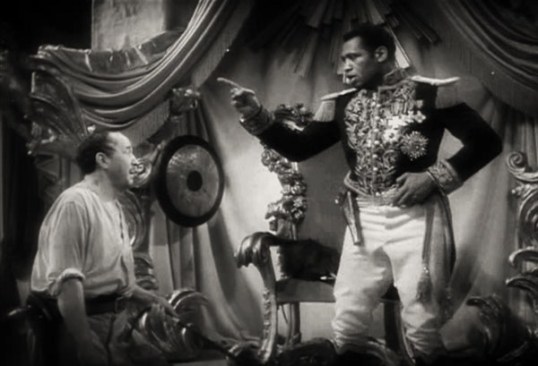
On November 8th, I recorded the 1933 film The Emperor Jones off of Retroplex.
Based on a play by Eugene O’Neill, The Emperor Jones tells the story of Brutus Jones (Paul Robeson). When we first meet Jones, he’s at a small Baptist church. He has recently gotten a job as a Pullman Porter and the church’s congregation has gathered for his send off. He shows off his uniform. He sings a spiritual. The congregation blesses him and Jones swears that he will make them proud. However, soon after he starts working for the railroad, he finds himself in the city. Though he’s a hard worker, he makes the wrong friends. He falls for the beautiful but cold-hearted Undine (Fredi Washington). A fight at a craps gang leads to Jones accidentally stabbing his friend, Jeff (Frank H. Wilson).
Jones is sentenced to hard labor and finds himself working on a chain gang, where he’s watched over by sadistic and racist guards. Jones attempts to serve his time but, eventually, he’s driven to violence by the sight of a white guard beating another prisoner. Jones attacks the guard and then flees. Eventually, he escapes on a steamer ship. Quickly growing tired of shoveling coal in the ship’s engine room, Jones jumps overboard and swims to a nearby island.
On the island, Jones meets Smithers (Dudley Digges). Smithers is an alcoholic merchant who also happens to be the only white man in the island. Working with Smithers, Jones convinces the natives that he has magical powers and overthrows the island’s previous dicttor. Now thoroughly corrupted, Jones declares himself to be the Emperor Jones…
Interestingly enough — and this was probably especially revolutionary in 1933 — almost all of Jones’s corruption is learned from dealing with the white world. It’s through dealing with the condescending and wealthy passengers on the train that Jones comes to understand that money equals power. It’s from dealing with the white guards on the chain gang that Jones learns how people can be controlled through fear and brutality. By the time Jones arrives on the island, he no longer has anything to learn from the white world. Hence, Smithers becomes his servant.
(One thing I found particularly interesting, as I did research for this review, was that The Emperor Jones was banned in cities in both the North and the South. In the North, the film was often banned for its frequent use of the n-word. In the South, it was largely banned because of a scene in which Jones orders Smithers to light his cigarette.)
Seen today, The Emperor Jones is something of an oddity. On the one hand, it’s a very stagey film. The film’s origin as a stage play is obvious in almost every scene. On the other hand, it’s also one of the few films from the 1930s to actually feature black characters as something other than comic relief. If just for that historical reason, The Emperor Jones is still worth watching today.
It’s also worth watching for Paul Robeson’s performance in the lead role. Robeson, whose career was derailed by both his political activism and his refusal to accept roles that he considered to be demeaning, gives a powerful and empathetic performance. Towards the end of the film, Robeson gives a 12-minute monologue as he runs through the jungle. For 12 minutes, it’s just the viewer and Robeson (and the menacing sound of drums in the distance). As Robeson delivers his final monologue, he takes us on a journey through the Emperor’s mind, alternative between periods of delusion and moments of sudden clarity. Even 83 years after it was first filmed, it remains a truly impressive performance.
Keep an eye out for this fascinating historical document.
(Lisa recently discovered that she only has about 8 hours of space left on her DVR! It turns out that she’s been recording movies from July and she just hasn’t gotten around to watching and reviewing them yet. So, once again, Lisa is cleaning out her DVR! She is going to try to watch and review 52 movies by the end of Sunday, December 4th! Will she make it? Keep checking the site to find out!)
A friend of mine recently posted this on Facebook: “Name your vagina by using the last movie you watched!” While everyone else was able to answer with “The Nightmare Before Christmas,” “Christmas Vacation,” and “Zombeavers,” I was forced to answer “Ride Along 2,” because I watched it last night. If only I had held off on watching Ride Along 2, I could have answered Moana.
Oh well…
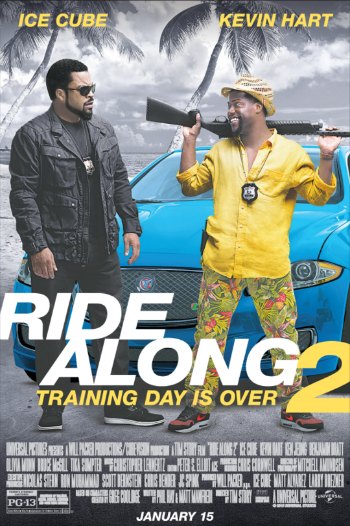
ANYWAY — I recorded Ride Along 2 off of HBO on November 11th. The main reason that I recorded it was because, at the time, I was panicking over the fact that the year is nearly over and there’s still a lot of 2016 releases that I haven’t seen. You know me. I’m a cinema completist and I like to see everything. As a result, I’ve been recording every single 2016 movie that I come across on cable, even if the film in question is one that I really didn’t have much interest in actually watching.
Like this one for instance…
Ride Along 2 is the latest entry in the ever-growing Ken Jeong Gets Kidnapped genre of action comedies. At some point in the future, film historians will wonder why Ken Jeong was always either getting abducted or arrested in violent comedies. I imagine that they’ll devote most of their time to studying The Hangover films and Community but they’ll still find some time to consider Ride Along 2.
In Ride Along 2, Ken Jeong is abducted by two Atlanta detectives who have come to Miami to investigate his boss, murderous drug lord Antonio Pope (Benjamin Bratt). The two detectives are James Payton (Ice Cube) and his future brother-in-law, Ben Barber (Kevin Hart). Of course, it’s really not important that one of them is named Payton or that the other one is named Ben. Ultimately, they are Ice Cube and Kevin Hart. Payton is tough and no-nonsense. Ben is short and outspoken and given to histrionics. Needless to say, the plot is mostly just an excuse for Kevin Hart to get on Ice Cube’s nerves.
And it’s all pretty predictable. There’s really nothing in Ride Along 2 that you haven’t already seen in a hundred other action comedies, including the first Ride Along. So, how much you enjoy this film is going to depend on how much you like Ice Cube, Kevin Hart, and Ken Jeong. (And I guess it might help if you’re a Benjamin Bratt fan as well. Are there Benjamin Bratt fans?) And, I will say this. Nobody glowers with quite the skill of Ice Cube. Ken Jeong may play the same role a hundred times but he knows what he’s doing. And Kevin Hart is actually a good actor, even if his films rarely give him a chance to show the full depth of his ability.
Ride Along 2 is predictable and kinda forgettable. It didn’t do much for me. But, at the same time, it’s thoroughly nonpretentious and totally inoffensive.






 Through the Shattered Lens