Who would have guessed that Tom Cruise would eventually become a more convincing secret agent than Daniel Craig?
Tag Archives: Film
Here’s The Super Bowl Teaser For Skyscraper!
Here’s the Super Bowl teaser for the latest film to star future President Dwayne Johnson, Skyscraper!
Why do people in movies always make the mistake of messing with Dwayne Johnson? Don’t they realize that he’s indestructible?
Here’s The Super Bowl Commercial for Solo!
Judging from the twitter reaction, a lot of people are more excited about than they were out The Last Jedi.
My favorite part of the Solo commercial? That glimpse of Donald Glover.
Here’s The Super Bowl Spot For Jurassic World: Fallen Kingdom!
“Blue!”
As long as Chris Pratt is back, I’m happy.
Oh My God! Here’s The Totally Frightening Super Bowl Commercial For A Quiet Place!
Seriously, this one freaked me out!
(There was some speculation that A Quiet Place may be part of the Cloverfield franchise but, judging from this commercial, I don’t think so. It looks really good, though.)
Here’s The Red Sparrow Super Bowl Spot!
It’s Super Bowl Sunday and you know what that means! Commercials, commercials, and more commercials.
(And, apparently, some football game.)
As I did last year, I’m going to do my best to post every movie teaser that airs during the Super Bowl. Things started off tonight with this intriguing teaser for Red Sparrow! Jennifer Lawrence plays a Russian agent in this movie, which has been rated R for torture, violence, sex, language, drugs, and everything else that can win a film an R-rating.
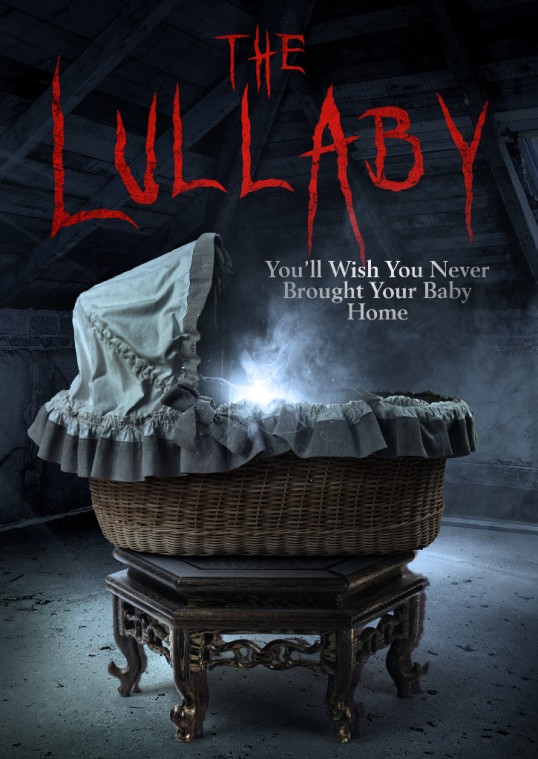
The Lullaby: Preview, Review and trailer
Remember that sweet song your Mother sang to you as a child?
Cast:
Reine Swart as Chloe van Heerdon
Brandon Aruret as Dr. Timothy Reed
Shayla-Rae McFarlane as young Chloe
Preview:
Chloe is overwhelmed by the birth of her first child. The incessant crying of her baby, the growing sense of guilt and paranoia sends her into depression. With a heightened urge to protect her son, Chloe sees danger in every situation. She starts to hear voices, the humming of a childhood lullaby and sees flashes of a strange entity around her child. Convinced that the entity is real, Chloe will do everything in her power to protect her son. Is she haunted by evil or is it just the baby blues?
Review:
 Oh, Child, we got so much to talk about! Your Mama is not crazy, you are! Or are you? Or was you just twisting my mind?

Or is your Mom really crazy!
 Or your Grandma?
That sweet little song you Mom sang to you as a child… you know… that comforting song that always puts you into dream land… yeah, this movie might make you sleep different tonight!
Credits:
Uncork’d Entertainment presents a Phoenix Film with Valhalla Productions Directed by Darrell James Roodt
Trailer:
Would I recommend this movie:
Yep, absolutely! One of the best horror/thriller movies I have seen this year!
Where can you see it?
The Lullaby is opening in theaters and on VOD March 2, 2018
Oh, BTW:
No Spoilers, but Chloe is back….

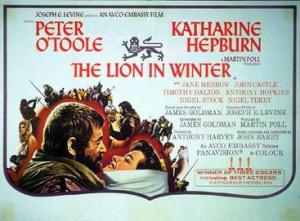
Lisa Reviews An Oscar Nominee: The Lion in Winter (dir by Anthony Harvey)
(With the Oscars scheduled to be awarded on March 4th, I have decided to review at least one Oscar-nominated film a day. These films could be nominees or they could be winners. They could be from this year’s Oscars or they could be a previous year’s nominee! We’ll see how things play out. Today, I take a look at the 1968 best picture nominee, The Lion in Winter!)
“I don’t much like our children.”
— Eleanor of Aquitaine (Katharine Hepburn)
“Oh God, but I do love being king.”
— King Henry II (Peter O’Toole)
“What family doesn’t have its up and down?”
— Eleanor of Aquitaine
To be honest, it’s tempting to just spend this entire review offering up quotes from this film. Based on a play by James Goldman and featuring a cast of actors who all specialized in delivering the most snarky of lines with style, The Lion In Winter is a film that is in love with the English language. As visually impressive as the film and its recreation of the 12th Century is, it’s tempting to close your eyes while watching The Lion In Winter and just listen to the dialogue.
The year is 1183. England has a king. His name is Henry II (Peter O’Toole) and he’s held power for a long time, through a combination of willpower and political manipulation. He’s married to Eleanor of Aquitaine (Katharine Hepburn), though he long since had her imprisoned. Before marrying Henry, Eleanor was the wife of Louis VII. Now, Henry’s mistress is Alais (Jane Merrow), the daughter of Louis and his second wife. In order to get Alais’s dowry, Henry has promised her half-brother, Philip II (Timothy Dalton), that she will be married to the next king of England. Philip, incidentally, is the son of Louis’s third wife. To be honest, it’s confusing as Hell to try to keep up with all of it but that’s medieval politics for you.
Of course, everyone knows that Henry II will not be king forever. He’s already 50 years old, which is quite an advanced age for 1183. Being king means that everyone, even his own family, is plotting against him. It also means living in a remarkably dirty and drafty castle. (If you’re looking for a film that celebrates the splendor of royalty, this is probably not the film to watch.) Henry has three sons, all of whom feel that he should be the rightful heir.
For instance, there’s Richard (a young Anthony Hopkins). Richard is Henry and Eleanor’s eldest son. He is a fierce, outspoken, and judgemental man. He describes himself as being a legend and a poet. He looks and acts like a future king. Of course, he’s also a bit of a pompous ass. Richard is Eleanor’s pick to be king, though Richard is always quick to equally condemn both of his parents.
And then there’s John (Nigel Terry). Early on, John is described as being “pimply and smelling of compost.” For some reason, John is Henry’s favorite. He’s also a sniveling weakling, the type who is never smart enough to know when his father is being honest or when his father is bluffing. Halfway through the film, he comes close to accidentally starting a civil war.
And finally, there’s Geoffrey (John Castle). Geoffrey is the smartest of the princes and the most manipulative. Of the three princes, he’s the only one who is as smart as both Henry and Eleanor. However, whereas Henry and Eleanor enjoy their complicated lives and manage to maintain a sense of (very dark) humor about it all, Geoffrey is bitter about his place as the middle child.
Christmas has arrived and Henry has temporarily released Eleanor from prison so that she can spend the holidays with him, his sons, and his mistress. Also coming over for the holiday is King Phillip II, eager to either take back his sister’s dowry or to attend her wedding to the next King of England. What follows is a holiday of politics, manipulation, and shouting. In fact, there’s lots and lots of shouting.
It’s a thoroughly enjoyable film, one that expertly mixes British history with domestic drama and dark comedy. Obviously, the film’s main appeal comes from watching two screen icons, Peter O’Toole and Katharine Hepburn, exchanging snappy dialogue. Hepburn deservedly won an Oscar for her performance as Eleanor. O’Toole should have won an Oscar as well but he lost to Cliff Robertson for Charly. In fact, O’Toole and Hepburn are so good that they occasionally overshadow the rest of the very talented cast. Anthony Hopkins and Nigel Terry both make indelible impressions as Richard and John but my favorite princely performance came from John Castle, who is a malicious wonder as Geoffrey. As easy as it is to dislike Geoffrey, it’s hard not to feel that he does have a point.
(Of course, in real life, both Richard and John would eventually serve as king while Geoffrey would die, under mysterious circumstances, in France. Reportedly, Philip II was so distraught over Geoffrey’s death that he attempted to jump on the coffin as it was being lowered into the ground.)
The Lion In Winter was nominated for seven Oscars and won three, for Best Actress (Katharine Hepburn), Best Adapted Screenplay (James Goldman), and Best Music Score (John Barry). It lost best picture to Oliver!
Lisa Reviews An Oscar Nominee: Grand Illusion (dir by Jean Renoir)
(With the Oscars scheduled to be awarded on March 4th, I have decided to review at least one Oscar-nominated film a day. These films could be nominees or they could be winners. They could be from this year’s Oscars or they could be a previous year’s nominee! We’ll see how things play out. Today, I take a look at the 1937 best picture nominee, Grand Illusion!)
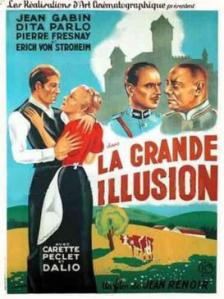
A few things to consider when watching Jean Renoir’s La Grande Illusion:
It is considered to be one of the greatest French films of all time and yet, at the outbreak of World War II, it was banned by France pour la durée des hostilités. It was also banned by Nazi Germany, with Joseph Goebbles declaring it to be “Cinematic Public Enemy No, 1.” Italy followed suit, banning the film as well.
It’s a pacifist film but all of the main characters are soldiers.
It’s a war film but we never see any battles. We hear about them, of course. Characters cheer when they hear that their country has taken another town. Towards the end of the film, when a gun finally is fired, it’s jarring because it’s the first gunshot that we’ve heard throughout the entire film.
It’s a film about change, specifically the change brought about by the First World War. Captain de Boeldieu (Pierre Fresnay) may be French and Major von Rauffenstein (Erich van Stroheim) may be German but they both share the bond of being aristocrats. (After Rauffenstein captures Boeldieu, the two of them have a friendly conversation about their shared acquaintances.) Both of them serve in the army, not for ideological reasons but because they consider themselves to be patriots and tradition holds that aristocrats go to war for their countries. At the start of the film, both Boeldieu and Rauffenstein seem to be above the fighting but, in the end, both realize that the old ways — their ways — will not survive in the new world that’s being created by the Great War.
(In another scene, a group of Russian soldiers are excited to receive a care package from “the Czarina,” just to open up the box and discover that, instead of Vodka, they’ve been sent used textbooks. The soldiers respond by setting the box on fire. For audiences in 1937, it would be impossible to watch this scene without reflecting on the fact that the Czarina herself would soon be dead, executed by revolutionaries.)
Grand Illusion tells the story of three French officers, prisoners of war who hope to somehow escape and make their way to neutral Switzerland. Unlike the aristocratic Boeldieu, Marechal (Jean Gabin) is a member of the working class, a mechanic. Lt. Rosnethal (Marcel Dalio) comes from a wealthy family but, as a Jew, he is still viewed as an outsider. (Reportedly, Renoir specifically made Grand Illusion‘s most sympathetic and generous character Jewish as a specific rebuke to Nazi Germany and their policies.) It’s Rosenthal who gives meaning to the film’s title when he says, regarding the belief that the great war will end all other wars, “That’s just an illusion.”
All three of them are moved from prison camp to prison camp, until they eventually find themselves at the camp commanded by the man who first captured both Boeldieu and Marechal, Major van Rauffenstein. Rauffenstein explains that he was given his new post after being seriously wounded in combat and his movements are sometimes so stiff that he almost resembles a marionette, suggesting that war has reduced this proud man to merely being a puppet for his government’s war machine.
Grand Illusion is a film about the forgotten people who get caught up in the madness of war. The French POWs may say they want to return to the front but, when they meet a woman who has lost her husband and three brothers to the war, they are reminded that even “victory” comes with a steep price. Rauffenstein and Boeldiue may share much in common but ultimately, the only thing that the world cares about is that one is French and one is German. Grand Illusion was Jean Renoir’s eloquent plea for peace, issued a mere two years before Europe plunged into World War II.
In 1938, Grand Illusion was the first foreign-language film to receive an Oscar nomination for best picture. However, it lost to Frank Capra’s You Can’t Take It With You.
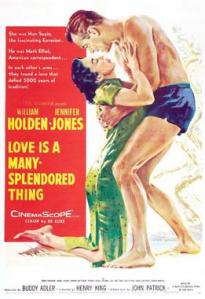
Lisa Reviews An Oscar Nominee: Love Is A Many-Splendored Thing (dir by Henry King)
(With the Oscars scheduled to be awarded on March 4th, I have decided to review at least one Oscar-nominated film a day. These films could be nominees or they could be winners. They could be from this year’s Oscars or they could be a previous year’s nominee! We’ll see how things play out. Today, I take a look at the 1955 best picture nominee, Love Is A Many-Splendored Thing!)
Before I talk about Love Is A Many-Splendored Thing, let’s play a little trivia game.
I’m going to list ten films. Your job is to guess what they all have in common:
- Bad Day At Black Rock
- Blackboard Jungle
- East of Eden
- Kiss Me Deadly
- The Night of The Hunter
- The Phenix City Story
- Rebel Without A Cause
- The Seven Year Itch
- Summertime
- To Catch a Thief
Did you guess? All ten of these films came out in 1955 and not a single one of them was nominated for best picture. That’s something that I found myself thinking about quite a bit as I watched Love Is A Many-Splendored Thing on TCM last night. Of course, at this point, everyone knows that deserving films are often ignored by the Academy and that what seems like a great film during one year can often seem to be rather forgettable in subsequent years.
So, you can probably guess that I wasn’t terribly impressed with Love Is A Many-Splendored Thing but, before I get too critical, I want to start things off on a positive note. William Holden was, without a doubt, one of the best actors to ever appear in the movies. He started his film career in the 1930s and worked regularly until his death in 1981. Just consider some of the films in which Holden appeared: Golden Boy, Our Town, Sunset Boulevard, Stalag 17, Sabrina, Picnic, Network, and so many others. Of course, not every film in which Holden appeared was a masterpiece. He made his share of films like Damien: Omen II and When Time Ran Out. But the thing is that, regardless of the film, Holden was always good.
That’s certainly the case with Love Is A Many-Splendored Thing. It’s not one of Holden’s better films but William Holden is his usual dependable self. He plays Mark Elliott, a rugged American correspondent who is living in Hong Kong in the 1940s. While the Chinese Civil War rages nearby, Mark deals with his failing marriage. His wife is back in the States. They’re separated but not quite divorced. Mark owns a really nice car and, since he’s played by William Holden, he delivers the most world-weary of lines with an undeniable panache. He also appears shirtless for a good deal of the film. Between this and Picnic, 1955 was the year of the shirtless Holden.
The problem with Love Is A Many-Splendored Thing is not with William Holden. Instead, the problem is with the miscasting of Jennifer Jones as Han Suyin, the woman with whom Mark Elliott falls in love. Han Suyin was a real-life person, a doctor who wrote the autobiographical novel on which Love Is A Many-Splendored Thing was based. Han Suyin was Eurasian. Jennifer Jones most definitely was not. Throughout the film, Han Suyin and Mark often discuss what it’s like to be Eurasian and to be in the middle of two very different cultures. There’s even a discussion about whether Han Suying should try to pass as European. It all has the potential to be very interesting except for the fact that Jennifer Jones, who was so good in so many films, is in no way convincing in her role. Whenever she mentions being Eurasian, which she does frequently, the film come to a halt as we all stare at Jennifer Jones, one of the first film stars to ever come out of Tulsa, Oklahoma.
It all leads to a rather strained movie, one that never really drew me into its cinematic world or story. (For the record, a lot of people on twitter disagreed with me on this point.) Ultimately, the main reason to watch it was for William Holden. According to the film’s Wikipedia entry (how’s that for in-depth research), Holden and Jones reportedly did not get along during filming, with Jones apparently chewing garlic before their love scenes and there was a definite lack of chemistry between them. Maybe I got spoiled by William Holden and Kim Novak dancing in Picnic but I never believed that Mark and Han Suyin were attracted to each other. Interestingly, Jones and Holden would later both appear in another best picture nominee, 1974’s The Towering Inferno. However, they didn’t share any scenes.
Love Is A Many-Splendored Thing was nominated for best picture but it lost to a far different love story, Marty. This was also the final film directed by Henry King to be nominated for best picture. Previous King films to be nominated included State Fair, In Old Chicago, Alexander’s Ragtime Band, The Song of Bernadette, Wilson, and Twelve O’Clock High.
 Through the Shattered Lens