Film Review: Charge Over You (dir by Regardt Steenekamp)


Charge Over You, an independent Australian film from 2010, tells the story of Sarah Goodall (Danya Cox).

Having spent almost her entire adolescence dreaming of becoming a doctor so that she could find a cure for the illness that was killing her mother, Sarah finds herself struggling after her mother dies.  Whereas she was once an honors student and seemed destined for greatness, she’s now haunted by a feeling that everything is pointless.  Her grades are slipping.  Her mentor is disappointed in her.  Her friends are all turning into bad influences.  Her father wants to marry some bimbo that Sarah doesn’t even know.  Sarah is even starting to wonder if she even wants to become a doctor.

It’s a dark time and, even worse, Sarah makes the mistake of playing with a Ouija board!  Well, technically, it was some of her friends who were playing with the Ouija board but Sarah was in the room at the time.  Sarah may say that she doesn’t believe in the power of the Ouija board but does the board believe in her?  That’s the question.

Suddenly, Sarah has a boyfriend!  She’s not sure how she met Dane (James E. Lee).  All she knows is that he’s suddenly in her life and that he has a habit of showing up whenever she’s feeling at her weakest.  When she steps into her dorm room, he’s there waiting for her.  When she tries to talk to other people, she’ll sometimes see him materialize behind them.  Dane is cold and cruel and doesn’t even pretend to be sympathetic when she tells him about the death of her mother.  Instead, Dane demands that she spend all of her time with him.  Even though Sarah doesn’t even like Dane, she finds it impossible to resist him.

Of course, Dane isn’t the only man who has suddenly materialized into Sarah’s life.  There’s also Mike, who appears to be a nice guy and who obviously likes Sarah.  (He’s visibly hurt when Sarah tells him that she already has a mysterious boyfriend who materialized out of nowhere.)  And then there’s Sam, who seems like he’s kind of dorky but who is constantly warning Sarah about guys like Dane.  Sam even warns Sarah about agreeing to have dinner with her father.  The dinner, of course, turns out to be a disaster and Sarah’s father reveals himself to be a disappointing human being.  Why, it’s almost as if Sam can see the future…..

Charge Over You is a strange film.  It starts out as a typical college horror film and then, suddenly, it swerves into overly religious territory as Sarah learns that she has both demons and angels competing for her soul.  And yet, it’s an undeniably entertaining little film.  Danya Cox gives a strong and sympathetic performance as Sarah and James E. Lee is magnetically evil as Dane.  Director Regardt Steenekamp does an excellent job of creating an ominous atmosphere and some the scenes where Dane materializes out of nowhere are genuinely creepy.  For a low-budget indie film that was reportedly filmed in just 12 days, Charge Over You is a surprisingly well-made and effective film.

It’s on Prime, so check it out during your lockdown and remember …. leave the Ouija boards in the closet!

The International Lens: Even Dwarfs Started Small and Fata Morgana (dir by Werner Herzog)


After making his feature film directorial debut with the well-made but somewhat predictable Signs of Life in 1968, Werner Herzog followed up with two of his most unconventional films to date, 1970’s Even Dwarfs Started Small and 1971’s Fata Morgana.

Even Dwarfs Started Small

I watched Even Dwarfs Started Small a few days ago and it was …. well, I’m not really sure what it was.  This is one of Herzog’s more enigmatic films.  It’s easy to imagine that the film has some incredibly deep meaning.  It’s also just as easy to imagine that the film was Herzog playing an elaborate practical joke on everyone who thought they were going to see another low-key film like Signs of Life.

The film takes place in an institution of some sort.  It’s implied that it’s a prison but it could just as easily be a mental hospital.  Everyone in the film is a little person.  The inmates are apparently rebelling against the warden.  While the warden sits in his office and waits for some sort of help to arrive, the inmates run around the grounds of the asylum and break things.  A van ends up driving in circles with no one at the wheel.  Chickens get into fights.  Piglets suckle on their dead mother.  (We don’t actually see the inmates kill any animals but there’s still a lot of very uncomfortable references to animal cruelty.)  Two blind inmates are taunted by the others.  We’re never really sure who anyone is or why they’re in the institution.  All we know is that their society appears to be crumbling and there’s no help on the way.

Even Dwarfs Started Small

It’s not a very pleasant movie to watch, though I do understand that it has its devoted fans.  (Director Harmony Korine has called it the greatest movie ever made because of course he would.)  You probably already guessed that my feelings about the film are mixed.  On the one hand, it was a very unpleasant viewing experience.  On the other hand, I do respect any artist who sticks to his vision, regardless of the risk of alienating his audience.  Herzog presents a portrait of Hell in Even Dwarfs Started Small and he doesn’t waver from it so I have to give him credit for that.

Incidentally, the smallest inmate is named Hombre.  He laughs nonstop through the entire film.  I have never more wanted to see a random asteroid just fall from the sky and crush one character.

Even Dwarfs Started Small was such an unpleasant experience that, after I watched it, I nearly gave up on watching any more films that night.  But, the fact of the matter is that I love movies and I like Werner Herzog so I decided to follow-up Dwarfs by watching Herzog’s third film, Fata Morgana.  And I’m glad I did!

Fata Morgana

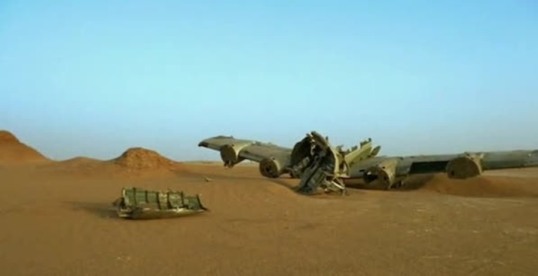
Admittedly, Fata Morgana has even less of a plot than Even Dwarfs Started Small.  For the most part, Fata Morgana is made up of long tracking shots of the Sahara Desert.  Herzog reportedly spent 13 months, off-and-on, shooting footage in Africa.  At the time, he didn’t have any plans for what he was going to do with the footage, beyond perhaps using it to tell a science fiction story about a dying planet.

Fata Morgana

Instead, Herzog edited the footage together in such a way that the viewers feel as if they’re being taken on a trip across the Sahara.  Though the early part of the film features a voice narrating the creation myth of the Mayan people, little context is provided for the starkly beautiful images that Herzog captured in Africa.  Instead, it’s left to the viewer to determine what it all means.

Fata Morgana

The end result is a fascinating film, one that leads you pondering life’s mysteries.  The combination of Herzog’s footage and the atmospheric musical score leaves you feeling less like a viewer and more like an explorer.  Fata Morgana is a film that makes you want to get out and explore every corner of the world for yourself.  It’s also a film that reminds us that, after we’re gone, all of our possessions and works will just be mysterious artifacts for future explorers, like an overturned car sitting in the middle of the desert.  It’s one of Herzog’s best.

Fata Morgana

After these two films, Herzog would direct one of the films for which he is best know, Aguirre, The Wrath of God, a masterpiece that was predicted by both the ominous beauty of Fata Morgana and the disturbing insanity of Even Dwarfs Started Small.  

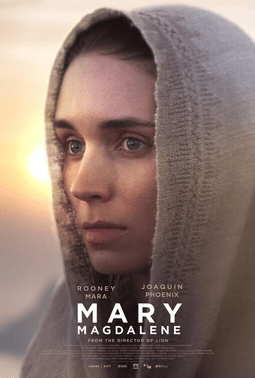
Film Review: Mary Magdalene (dir by Garth Davis)


“Dress more like the Virgin and less like the Magdalene.”

That’s something my grandmother always used to tell me and my sisters.  That’s because, Mary Magdalene — who is described in the Gospels as being a woman who traveled with and supported Jesus — is often mistaken for being the “sinful woman” who scandalized Simon the Leper by anointing Jesus’s feet.  As such, there’s a tradition that Mary Magdalene was either a former prostitute or, at the very least, a formerly promiscuous woman who repented and followed Jesus.  That said, there’s nothing in the canonical gospels that supports that tradition and, in all probability, the sinful woman was another Mary, Mary of Bethany.  In 1969, Pope Paul VI officially removed all reference to Mary Magdalene being the sinful woman but it’s still fairly common for Mary Magdalene to be portrayed as being a former prostitute.

Mary Magdalene, which was released briefly in theaters last year, attempts to set the record straight by imagining a different backstory for Mary Magdalene.  In fact, the whole theme of this movie seems to be, “See?  She wasn’t a prostitute!”  And that’s fine except, while watching the movie, I really had to wonder if it was somehow an improvement to instead portray her as being the most boring person in Judea.  Watching the film, one gets the feeling that the filmmakers were so proud of themselves for making Mary Magdalene a feminist that it didn’t occur to them that they might also want to make her an interesting character as well.

In this movie, Mary Magdalene (played by a dependably dull Rooney Mara) is a young Jewish woman who rebels against the wishes of her family and refuses to enter into an arranged marriage with Ephraim (Tzachi Halevy) and who instead decides to follow a preacher named Jesus (Joaquin Phoenix).  As portrayed in this movie, Jesus is charismatic but often moody, preaching a good message (though the film seems to interpret that message as mostly being vague Gnostic liberalism) while getting annoyed with almost everyone around him.  Jesus often seems to be exhausted by his followers, especially Judas (Tahar Rahim) who is way too eager for Jesus to lead an armed uprising against the forces of the Roman Empire.  Meanwhile, Jesus’s main disciple, Peter (Chiwetel Ejiofor), often finds himself growing jealous of Mary Magdalene and the trust that builds between her and Jesus.  While this film does not go the Jesus Christ Superstar route of portraying them as being a couple, it also leaves little doubt that Mary Magdalene, who is defying not just Rome but also the entire patriarchy, understands Jesus and his teachings in a way that the male disciples never will.

As a film, Mary Magalene takes itself and its story very seriously and it generally eshews the type of grandeur that one might expect from a biblical epic.  That low-key approach may be historically accurate but it’s not much fun to watch and, with a running time of 120 minutes, the action just kind of plods along.  Rooney Mara can give a good performance when she has the right material but here, she’s often just reduced to just wanly staring off into the distance.

As for Joaquin Phoenix as Jesus …. well, the casting actually works better than you might think.  Phoenix plays Jesus as being a passionate leader who is haunted by his destiny.  With his long hair and his scruffy beard, Phoenix is not a glamorous Jesus but he’s very much a credible one.  The film is probably at its best in the scene where Jesus witnesses the money changers in the temple.  Rather than playing Jesus as being simply enraged, Phoenix plays him as being deeply disappointed.  One gets the feeling that he’s looking at what is happening in his father’s house and he’s thinking, “These are the people I’m supposed to sacrifice my life to save?”

Mary Magdalene is one of those films that took forever to actually show up in theaters.  The Weinstein Company was originally set to release the film in early 2017 but the release was pushed back to 2018, for reasons that have never been particularly clear.  Eventually the Weinstein Company pulled out of distributing the film and, for that, I’m thankful.  The idea of any film about Jesus carrying the Harvey Weinstein name is just too terrible to think about.  The film was then picked up by IFC, who gave it a perfunctory release in 2019.

It’s a flawed film, even though it’s heart may be in the right place.  The approach that it takes is just too low-key to be consistently interesting.  Sometimes, bigger is better.

The International Lens: Signs of Life (dir by Werner Herzog)


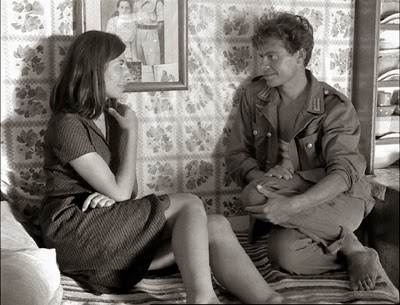
The 1968 German film, Signs of Life, is a deceptively simple film.

In fact, the story that it tells is so simple and so seemingly straight-forward that I’m sure some people would be surprised to discover that this was Werner Herzog’s first film.  When most people think of Herzog, they think of Klaus Kinski ranting against the Amazon and maybe Herzog himself talking about how he feels that chaos is the only governing principle of the universe.  Signs of Life, on the other hand, is a rather low-key and almost gentle film.  That said, the film does contain several of the themes that would show up in Herzog’s later film.  Even with his first feature film, Herzog already had a fairly good grasp on what he wanted to use cinema to express.

The film takes place in World War II and it deals with three German soldiers who have suffered from minor injuries in the war.  Deemed unfit for combat, they’ve been assigned to guard the munitions that are being stored at an ancient fortress on the Greek island of Kos.  It’s not demanding work.  The villagers are largely passive and, for the most part, seem to be just waiting out the war.  The leader of the soldiers, Stroszek (Peter Brogle), has recently married a Greek woman named Nora (Athina Zacharopoulou) and she is living with him at the fortress.

The film celebrates the beauty of Kos.  Herzog’s camera finds poetry in the simple sight of white linens hanging out to dry.  One of the soldiers explores the local cemetery and Herzog encourages us to ponder the long history of both the island and the people who live there.  In perhaps the film’s best known scene, Stroszek and Nora look down on a valley full of windmills and the beauty of it is a bit overwhelming.

As would often happen in later Herzog films, the soldiers never quite appreciate the beauty of the world around them.  While the audience is taking in scenes of breath-taking beauty, the soldiers are going a bit stir crazy.  Could it be that, as men of war, they’re incapable of appreciating the peaceful surrounding?  Perhaps but, then again, it could just be the fact that there’s not much to do on Kos other than ponder the mysteries of life and, in Herzog’s films, that often leads to insanity.  Stroszek ends up threatening to blow up the munitions dump but it must be said that, as far as Herzog lunatics are concerned, he’s no Klaus Kinski.

The plot of Signs of Life is largely secondary to the images that Herzog captures.  Watching Signs of Life, you get the feeling that Herzog simply fell in love with the island and that the film’s storyline is just something that he came up with so he’d have an excuse to share that love with the rest of the world.  Signs of Life is an exercise in pure cinema.  It’s not a perfect debut film but, at its best, it shows tantalizing hints of the great filmmaker that Werner Herzog would soon become.

Scenes That I Love: Gregory Peck and Audrey Hepburn at The Mouth of Truth in Roman Holiday


Given how much I love the 1953 film, Roman Holiday, I’ve probably shared this scene before but that’s okay.  It’s an incredibly charming scene and hey, it’s Gregory Peck’s birthday!

A Blast From The Past: Bette Davis Sells General Electric


Today is not only Roger Corman’s birthday!

And it’s not just Albert Broccoli’s birthday!

It’s also Bette Davis’s birthday and there’s absolutely no way that we here at the Shattered Lens, as lovers of both classic and modern films, could let the day pass without acknowledging it.

Here’s Bette Davis in a General Election commercial from 1933.  This commercial would have been shown in theaters, in between a double feature.

4 Shots From 4 Roger Corman Films: Not of this Earth, Masque of the Red Death, The Wild Angels, The Trip


4 Shots From 4 Films is just what it says it is, 4 shots from 4 of our favorite films. As opposed to the reviews and recaps that we usually post, 4 Shots From 4 Films lets the visuals do the talking!

Today, we wish a happy birthday to the one and only Roger Corman!  The godfather of indie cinema is 94 years old today.  It’s hard to know what’s left to be said about Roger Corman.  Corman was the producer who discovered some of the most important filmmakers in the history of American cinema.  He’s also the director who had the guts to tackle the important issues that the major Hollywood studios were afraid to acknowledge.  When all is said and done, Roger Corman is one of the most important figures in film history.  He’s also one of our favorite filmmakers, here at the Shattered Lens.

It’s impossible to do justice to this man’s career with just 4 shots from 4 films but it’s a start.

4 Shots From 4 Films

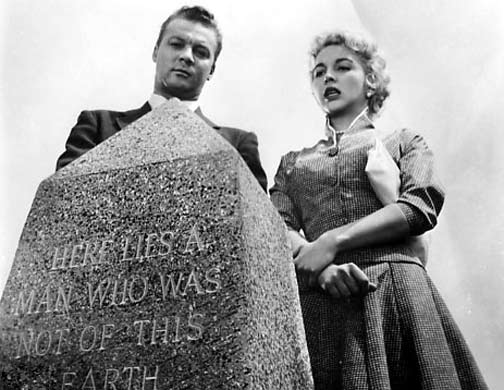
Not Of This Earth (1957, dir by Roger Corman)

The Masque of the Red Death (1964, dir by Roger Corman)

The Wild Angels (1966, dir by Roger Corman)

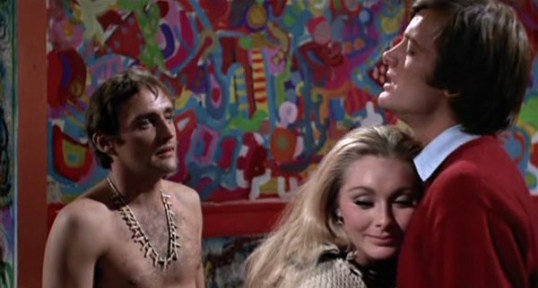
The Trip (1967, dir by Roger Corman)

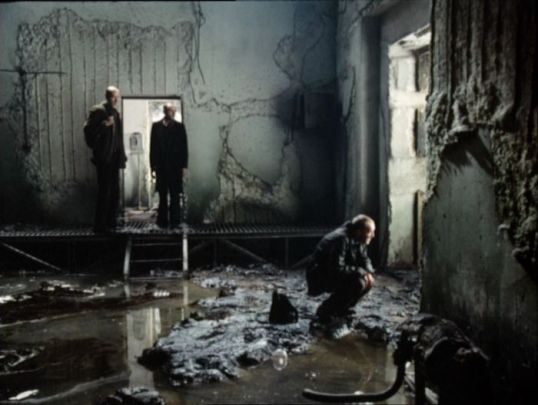
The International Lens: Stalker (dir by Andrei Tarkovsky)


The 1979 Russian film, Stalker, takes place in a world that might be our own.

In the middle of a wilderness that we assume, just because of the language that’s spoken in the film, to be in Russia, there is an area known as the Zone.  The Zone is a place where the normal laws of physics don’t seem to apply.  It’s not an easy place to enter and it’s almost impossible to exit but it’s rumored that there’s a very special room located in one of the Zone’s deserted buildings.  If you can find the Room, you’re innermost desires will be granted.  It’s said, for instance, that a semi-legendary man known as Porcupine found the Room and became wealthy as a result.  Of course, Porcupine also hung himself just a few days later.

Legally, no one is allowed to enter the Zone.  Soldiers patrol the perimeter and the gate that leads into the Zone is only opened to allow a train to make it’s way through.  However, there are outlaws who specialize in leading expeditions through the Zone.  They can get people in and, as long as everyone does as instructed, they can hopefully lead people out.  One of these outlaws is known as The Stalker (Alexander Kaidanovsky).  The Stalker, a former student of Porcupine, lives in a drab village where everything is filmed in Sepia.  (By contrast, the Zone is filmed in color.)  The Stalker is married to a woman (Alisa Freindlich) who continually begs him to stop leading expeditions into the Zone but who also says that she married the Stalker because his illegal activities bring a little bit of life to an otherwise drab existence.  They have a daughter (Natasha Abramova) who is described as being a “child of the zone.”  She may have a physical disability, though we’re never quite sure what the exact details of it may be.  The final enigmatic shot of the film belongs to her and it’s a shot that makes us wonder about everything that we’ve just previously seen.

The Stalker’s latest clients are the Writer (Anatoly Solonitsyn) and the Professor (Nikolai Grinko).  Both the Writer and the Professor have their own reasons for wanting to see the Zone.  The Writer is an alcoholic who has lost his inspiration and hopes to find it again.  The Professor says that he’s interest in the Zone is a scientific one, though it turns out that his actual intentions are a bit more complex.  The Stalker leads them into the Zone but it’s not an easy journey.  The Stalker grows annoyed as he comes to realize that the Writer does not share his nearly spiritual reverence for the powers and the mysteries of the Zone.  Meanwhile, the Professor obsesses over his backpack, even when the Stalker tells him to leave it behind.  There’s something in that backpack that the Professor definitely doesn’t want to lose.

Stalker is a science fiction film but it’s one that has no elaborate special effects.  There are hints that the Zone may have been visited by extraterrestrials but the film deliberately leave ambiguous the true origin of the Zone.  Director Andrei Tarkovsky instead emphasizes the barren landscape and the discussions between the three men, each one of whom is desperate in his own way.  Though the Zone may be filmed in vibrant color while the village is filmed in Sepia tones, both locations are equally desolate.

Watching this film today, it’s impossible not to compare the film’s Zone to the real-life forbidden zone surrounding Chernobyl.  However, Stalker was made 7 years before the disaster at Chernobyl.  The film’s Zone probably has more in common with the 1908 Tunguska event, which was when something (an asteroid, a comet, or maybe something else depending on how conspiracy-minded one is willing to be) either crashed into or exploded above Siberia.  The explosion was the equivalent of 30 megatons of TNT and, needless to say, you can find all sorts of fanciful stories about strange things happening in the area in the years after the explosion.  That said, it’s definitely not a coincidence that the modern-day guides who lead unauthorized tours of the Chernobyl area have taken to calling themselves stalkers.

The film itself is a fascinating one, though definitely not one for everyone.  As a director, Tarkovsky’s trademark was the long take and the camera often lingers over each scene, inviting the viewer to look for a deeper meaning that may or may not be there.  It’s a film that invites the viewer to think and to wonder who is right and who is wrong about the Zone.  It’s a film that asks a lot of questions but never claims to have all the answers.  The true meaning of it all is left the individual viewer to determine.  It really is a film that probably could have only been made by an artist trying to subtly rebel against a totalitarian society.  The Writer has lost his inspiration because society has become so drab and corrupt.  The intellectual Professor is forced to be deceptive about his true intentions.  And the Stalker looks for a deeper meaning that goes beyond what the State has to offer.  For that, he’s willing to risk everything.

Tragically, it’s possible that filming Stalker may have contributed to Tarkovsky’s death in 1986.  (Interestingly, he died just a few months after the Chernobyl disaster.)  Much of Stalker was filmed near a chemical plant and it’s felt that filming in such a toxic condition may have eventually led to the illnesses that not only killed Tarkovsky but several other members of the film’s cast and crew.  By the time of his death, Tarkovsky had escaped from Russia and was living in Paris.  Today, incidentally, is his birthday.  He would have been 88 years old.

The International Lens: Drunken Angel (dir by Akira Kurosawa)


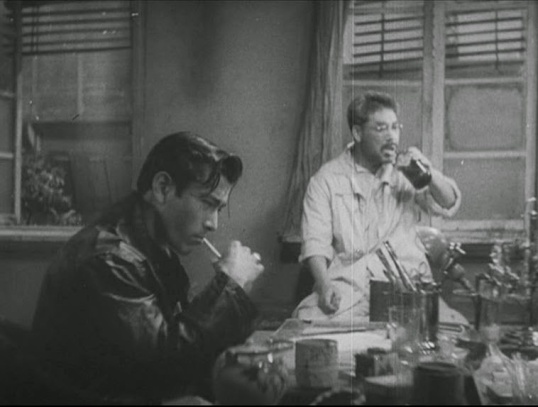
The 1948 Japanese film, Drunken Angel, tells the story of two seemingly different men living in a burned-out neighborhood in postwar Tokyo.

Sanada (Takashi Shimura) is an aging and world-weary doctor.  Though he may drink too much and he is occasionally too quick to snap at his patients, he truly cares about the people who live near his clinic.  He worries about the spread of tuberculosis, which was a very real concern in postwar Japan and which remains a concern to this day.  He continually tells his patients that they need to stop drinking and take better care of themselves, even though he does not seem to be capable of taking his own advice.

Matsunaga (Toshiro Mifune) is a young Japanese gangster, a member of the yakuza.  Matsunaga does everything with a swagger, one that he appears to have largely adapted from Hollywood gangster movies.  He not only dresses like an idealized version of an American gangster but he also smokes his cigarettes like one.  Everything about Matsunaga gives the impression that he’s desperate to prove that he’s something more than just a small-time hood living in a bombed-out neighborhood that’s centered around a poisonous bog.

One night, Matsunaga shows up at Sanada’s clinic.  He’s got a bloody hole in his hand.  Mastunaga claims that he walked into a door.  When Sanada responds with skepticism, Matsunaga adds that the door had a nail sticking out of it.  Sanada may not believe Matsunaga but he’s a doctor so he treats Matsunaga’s wound.  Sanada also diagnosis Matsunaga as suffering from tuberculosis and tells him that he has to stop drinking and womanizing.  Needless to say, Matsunaga is not pleased with this diagnosis.

Though they start out as antagonists, a weary friendship grows between the doctor and the gangster.  Matsunaga even starts to follow the doctor’s advice or, at least, he does until his boss, Okada (Reisaburo Yamamoto), is released from prison.  Under Okada’s influence, Matsunaga falls back into his own habits, drinking and going to nightclubs where the musicians perform Americanized music.  Okada is also the ex-boyfriend of Sanada’s nurse and, when he threatens to murder Sanada unless the doctor lead him to her, Matsunaga is finally forced to decide which of his two potential mentors will have his loyalty.

Taken on its own, Drunken Angel is an entertaining gangster film that features two memorable lead performances.  Takashi Shimura is likable as Sanada while Toshiro Mifune is dangerously charismatic as Matsunaga.  Director Akira Kurosawa originally planned for the film to focus solely on Sanada, with Matsunaga only playing a minor role.  Mifune, however, so impressed him that he ended up expanding Matsunaga’s role until Mifune was eventually the film’s co-lead.  (Following Drunken Angel, Kurosawa would go on to make 15 other films with Mifune.)  Kurosawa keeps the action moving at an exciting pace and he frames the story with haunting images of the dilapidated neighborhood that the two men call home.

However, Drunken Angel is even more fascinated with one consider that it was made at a time when Japan, having been defeated in World War II and still traumatized by the nuclear attacks on Nagasaki and Hiroshima, was still occupied by American forces.  The film was made at a time when it was still very much an open question as to what role Japan would play in a postwar world.  Would Japan become dominated by American culture (which, in this film, is represented by gangsters like Okada) or would it remain true to itself?  When Sanada warns Matsunaga that he is surrounded by toxic germs that are making him ill and threatening his future, he could very well have been talking about what Kurosawa perceived as being the threat of Americans transforming Japan into a westernized playground.

In the end, it’s a film that works on many levels, as a gangster film, as a portrait of a friendship, and as a metaphor for a people and a culture trying to find their place in a new and imperfect world.  If you haven’t seen it yet, now is the perfect time to do so.

4 Shots From 4 Lamberto Bava Films: Macabre, A Blade In The Dark, Demons 2, Delirium


4 Shots From 4 Films is just what it says it is, 4 shots from 4 of our favorite films. As opposed to the reviews and recaps that we usually post, 4 Shots From 4 Films lets the visuals do the talking!

Happy birthday to Lamberto Bava!

4 Shots From 4 Lamberto Bava Films

Macabre (1980, dir by Lamberto Bava)

A Blade In the Dark (1983, dir by Lamberto Bava)

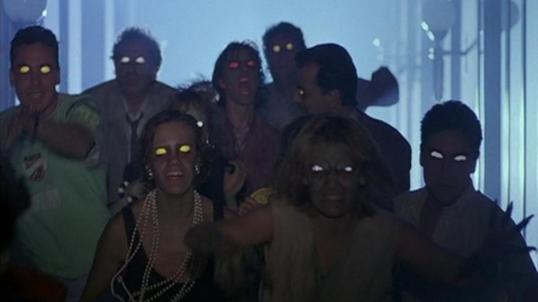
Demons 2 (1986, dir by Lamberto Bava)

Delirium (1987, dir by Lamberto Bava)