From 1986’s Deadly Friend, directed by Wes Craven:
Now, it should be noted that this scene was not in Craven’s initial cut of the film. Craven envisioned Deadly Friend as being a melancholy love story about a teenage boy who brings his dead girlfriend back to life. Elvira, the lady who loses her head, originally had a much less graphic death scene but Warner Bros. wants to take advantage of Craven’s reputation for being a horror director so they demanded a more extreme version and that’s what Craven delivered.
In my opinion, this scene is just ludicrous enough to work. The studio’s demands were a bit silly so Craven supplied them with perhaps the silliest death scene that he ever directed. That said, I do think Craven’s original version of Deadly Friend sounds like a nicer movie.
How one reacts to this film from Mexico will depend on what one prioritizes when it comes to watching movies. Do you watch movies for their plot or do you watch them for their style? Do you care about what the filmmaker has to say or do you just want to see how they say it?
Of course, this doesn’t have to be an either/or situation. Just because a film is heavy on style, that doesn’t mean that it’s thematically shallow. At the same time, just because a film has something to say, that doesn’t mean that it has to be dry and boring. It’s just that, in the case of Dark Forces, the film is almost all style and that seems to be by design.
The plot of Dark Forces is not always easy to follow and what can be followed is often pure nonsense. A former (or maybe current, it’s never really clear) criminal named Max (Mauricio Aspe) is searching for his sister, who is being held hostage by a gangster. Max checks into a hotel and searches for clues to where he sister is being held. There are a variety of eccentric people living in the hotel, some of whom appear to be supernatural in origin and some of whom are probably just sleazy hotel denizens. There’s a mysterious, femme fatale-style waitress. There’s an albino who is also a psychic because movies like this always seem to feature an albino psychic. And then there’s this mysterious man played by transgressive filmmaker Nick Zedd. Zedd’s character is named Demonio and he says that he can help Max for a price and can you guess what’s going on?
So, if you’re watching for a coherent plot, you’ll probably be disappointed. If you allow yourself to get in any way emotionally invested in Max’s quest, you’ll probably be disappointed. Narratively, Dark Forces somehow manages to be both totally incoherent and totally predictable at the same time. That’s such an accomplishment but I can’t help but think that it was somewhat intentional on the part of the filmmakers.
Where Dark Forces succeeds is as an exercise in pure style. Between the Argento-inspired lighting scheme, the combination of neon and shadows, the constantly skewed camera angles, and the dream-like mix of flashback and the present (or, at least, I assumed some of what I saw in the movie was meant to be a flashback), Dark Forces plays out like an extremely flamboyant dream. Visually, it’s enjoyable to take in and, at 81 minutes, it ends right before all of the stylistic excesses gets exhausting. Unfortunately, all of that style doesn’t make it any easier to follow the plot but at least there’s always something to look at.
Anyway, Dark Forces is a film that I obviously had mixed feelings about. The plot annoyed me but the film’s visual style held my attention. At its best, the film is vibrant pop art. At its worse, it’s an empty exercise in tilting the camera. As to whether or not you enjoy this film, it all depends on what matters the most to you, style or coherence.
4 Shots From 4 Films is just what it says it is, 4 shots from 4 of our favorite films. As opposed to the reviews and recaps that we usually post, 4 Shots From 4 Films lets the visuals do the talking!
This October, we’ve been using 4 Shots From 4 Films to pay tribute to some of our favorite horror directors! Today, we recognize the father and master of modern horror, Wes Craven!
4 Shots From 4 Films
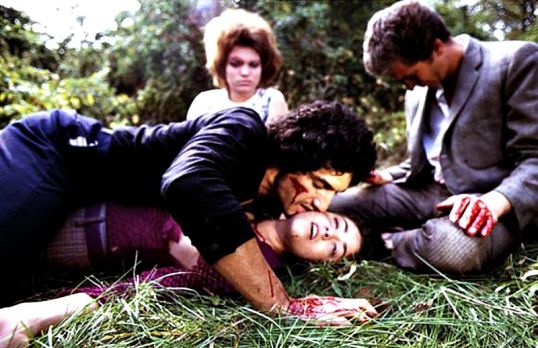
The Last House on the Left (1972, dir. by Wes Craven)
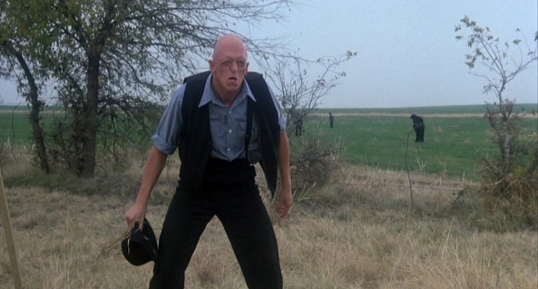
Deadly Blessing (1981, dir by Wes Craven)
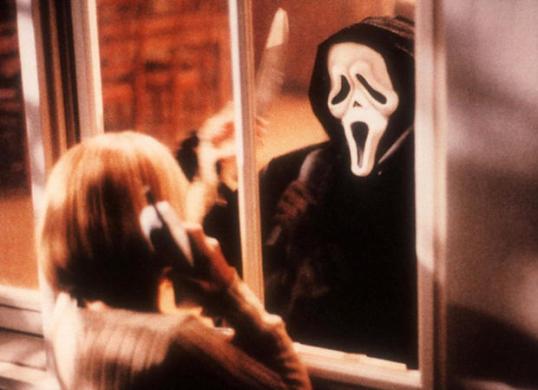
A Nightmare on Elm Street (1984, dir. by Wes Craven)
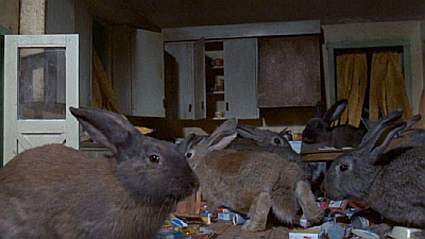
There’s really only one lesson to be learned from the 1972’s Night of the Lepus.
There is absolutely no way to make a rabbit look menacing.
Oh sure, you can film them in slow motion. And you can add a lot of weird sound effects and you can do a lot of extreme close-ups to make them look bigger than they actually are. You can do a lot of stuff as a part of your effort to make a rabbit into a scary monster but you’ll pretty much be wasting you time. Rabbits are simply not intimidating. There’s a reason why the idea of a killer rabbit was so funny in Monty Python and The Holy Grail.
Now, don’t get me wrong. I’m enough of country girl that I know the damage that wild rabbits can do. They eat crops. They eat bark. They chew on irrigations lines. If you’re a farmer or even just someone who wants to maintain a nice garden, you know that rabbits can be a nuisance.
However, that doesn’t change the fact that there’s nothing really menacing rabbits. Rabbits are cute and, for the most part, they’re fairly timid. They’re aware that, in the brutal world of nature, they’re designated prey and, as a result, they try to stay out of the way. Rabbits are shy and they hop around and there’s absolutely nothing frightening about them.
(We actually have quite a few rabbits in my neighborhood. It’s not unusual for me to see one hopping through the front yard. Whenever I go for a run in the early evening hours, it’s not unusual for me to see several rabbits hopping through a nearby park.)
Night of the Lepus is a strange film that attempts to make rabbits frightening. It takes place in the southwest and it features a bunch of mutated, giant rabbits who hop around the desert in slow motion and who savagely kill everyone that they meet. The plot makes it sound like a spoof but Night of the Lepus takes itself very seriously, which needless to say is a mistake. It even opens with documentary footage that’s designed to make sure that we understand that rabbits are actually very dangerous. It’s all very odd and you have to wonder why, out of all the wild animals in the southwest, the filmmakers decided to go with the least intimidating creature possible. I mean, there are coyotes and Gila monsters in the desert. Imagine having a giant coyote coming at you. That would be scary!
Instead, we get giant rabbits, attacking a cast of actors who definitely deserved better. Stuart Whitman, Janet Leigh, Rory Calhoun, DeForest Kelly, they’re all talented actors and, in this film, they’re reduced to fighting a bunch of giant rabbits. No one comes across particularly well, though just about everyone in the cast does manage to keep a straight face. Still, the problem is that the rabbits are just too damn cute. Even after they’ve killed half the cast, you still don’t want anything to happen to them. When Whitman and Calhoun opened fire on a group of rabbits and killed a few of them, I actually found myself getting mad at the humans. Leave the rabbits alone! I thought. You humans have had your chance! This the land of rabbits now!
Anyway, Night of the Lepus is silly but it’s kind of fun, just because the giant rabbits are cute. They’re kind of like the giant guinea pigs that attacked South Park a few seasons ago. They’re murderous but they’re adorable!
For today’s horror on the lens, we have a 1973 made-for-TV movie called Satan’s School For Girls.
After her sister turns up dead, Elizabeth (Pamela Franklin) refuses to accept that official conclusion that it was a suicide. Instead, Elizabeth is convinced that it was murder and that it has something to do with the exclusive school that her sister attended, the Salem Academy for Women.
Well, honestly, the Salem part is a dead giveaway. I think we can all agree on that.
Anyway, this movie features a Satanic cult, an old school clique, and plenty of early of 70s fashion choices. It may be silly but it’s also definitely entertaining.
4 Shots From 4 Films is just what it says it is, 4 shots from 4 of our favorite films. As opposed to the reviews and recaps that we usually post, 4 Shots From 4 Films lets the visuals do the talking!
This October, we’ve been using 4 Shots From 4 Films to pay tribute to some of our favorite horror directors! Today, in honor of Canadian Thanksgiving, we recognize the talents of the one and only David Cronenberg!
The Cabinet of Dr. Caligari is a film that I’ve shared four times previously on the Shattered Lens. The first time was in 2011 and then I shared it again in 2014, 2015, 2016, 2017, 2018, and 2019! Well, you know what? I’m sharing it again because it’s a classic, it’s Halloween, and everyone should see it! (And let’s face it — it’s entirely possible that some of the people reading this post right now didn’t even know this site existed in any of those previous years. Why should they be deprived of Caligari just because they only now arrived?)
Released in 1920, the German film The Cabinet of Dr. Caligari is one of those films that we’ve all heard about but far too few of us have actually seen. Like most silent films, it requires some patience and a willingess to adapt to the narrative convictions of an earlier time. However, for those of us who love horror cinema, The Cabinet of Dr. Caligari remains required viewing. Not only did it introduce the concept of the twist ending (M. Night Shyamalan owes his career to this film) but it also helped to introduce German expressionism to the cinematic world.
My initial reaction to The Cabinet of Dr. Caligari was that it simply wasn’t that scary. It was certainly interesting to watch and I was happy that I was finally experiencing this film that I had previously only read about. However, the film itself was obviously primitive and it was difficult for my mind (which takes CGI for granted) to adjust to watching a silent film. I didn’t regret watching the film but I’d be lying (much like a first-year film student) if I said that I truly appreciated it after my first viewing.
But you know what? Despite my dismissive initial reaction, the film stayed with me. Whereas most modern films fade from the memory about 30 minutes after the end credits,The Cabinet of Dr. Caligari has stuck with me and the night after I watched it, I even had a nightmare in which Dr. Caligari was trying to break into my apartment. Yes, Dr. Caligari looked a little bit silly staring through my bedroom window but it still caused me to wake up with my heart about to explode out of my chest.
In short, The Cabinet of Dr. Caligari passes the most important test that a horror film can pass. It sticks with you even after it’s over.
For the curious with an open mind to watch with, here is Robert Wiene’s The Cabinet of Dr. Caligari!
Man on the Prowl is a surprisingly intense film from 1957.
Doug Gerhardt (played by James Best) is an overly friendly young man with a pompadour and a quick smile. Doug works as a deliveryman for a car dealership and he seems like a nice enough person. He’s maybe a little bit goofy and, if you talked to him, you might think that he’s a little bit slow. Still, it’s hard not to get caught up in his endless enthusiasm. Doug is a very friendly man and he certainly does seem eager to help everyone that he meets.
Of course, Doug is also a sociopathic murderer. He’s just been released from a mental hospital and, as we see when he strangles his date during the first few minutes of the movie, he’s still got some issues. However, no one ever seems to really notice, just because he is so friendly and kind of dorky. Even though his own mother (Vivi Janiss) tries to warn people that Doug is not well, most people just think that he’s a little bit eccentric.
When Doug nearly runs over Marian Wood (Mala Powers) and her son, Marian is not very happy with him. Doug apologizes for driving too fast and he even insists on helping Marian carry in her groceries. Marian goes from hating Doug to being somewhat forgiving of his reckless driving. That’s the power of Doug’s charm. He can go from nearly killing someone to making a new friend in just a matter of minutes.
Marian is married to Woody (Jerry Paris), though it’s not a particularly happy marriage. Woody is always traveling on business, leaving Marian to take care of the house on her own. Seeing an opening, Doug starts to casually drop by so that he can do things like help Marian fix the washing machine. Of course, it’s hinted that Doug might be the one who broke the washing machine in the first place. Doug is determined to replace Woody in Marian’s life. When it turns out that Marian isn’t ready for husband to be replaced by a delivery boy (even if that delivery boy can fix a washing machine) …. well, Doug doesn’t take it well.
Man on the Prowl really took me by surprise. For a film made in 1957, the story didn’t feel particularly dated, beyond a few things that couldn’t be helped. (Doug’s pompadour comes to mind.) If anything the film feels refreshingly honest in its willingness to admit that not all marriages are happy and not all wives are content with the idea of just sitting at home and waiting for their husband to return. However, the thing that really took me by surprise was how Doug was portrayed. Considering that the term “serial killer” wouldn’t be coined until 23 years after this film was originally released, Man on the Prowl is a surprisingly realistic portrayal of a serial killer. Doug is someone who is empty on the inside but who keeps the world from noticing by deploying a charming smile and a friendly manner. He’s Ted Bundy, decades before Bundy became a household symbol of evil. As played by James Best, Doug is a very realistic and very frightening modern monster.
In many ways, Man on the Prowl is a prophetic film. In 1957, someone like Doug was probably seen as being an aberration, a once-in-a-lifetime example of the natural order of things getting screwed up. Now, however, we know that the world is full of Doug Gerhardts. And we all feel a little less safe as a result.
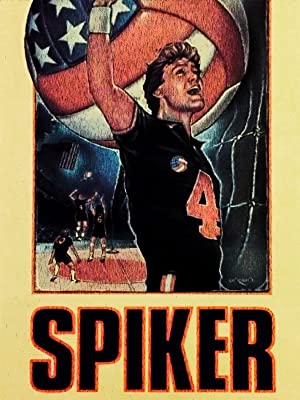
The 1985 film, Spiker, is an attempt to make an exciting movie out of the one of the most boring sports in the world, men’s volleyball. Not only does the film attempt to make volleyball look exciting but it attempts to do it on absolutely no budget. Anyone who doesn’t appreciate the combination of guts and foolishness necessary to even attempt this is not a real film fan.
Spiker follows a group of college volleyball players as they train to qualify for the Olympics. Or, at least, that’s what I think is supposed to be going on. The plot is really difficult to follow, not because it’s complex but just because it’s volleyball and who cares? We learn that the coach of the team (played by Michael Parks) is a tough taskmaster. We learn that one of the players needs to get his act together and be more mature. We learn that another member of the team has a wife who is jealous of all of his volleyball groupies. Eventually, the team competes in Japan and Poland. In Japan, the teammate who needs to get his act together gets drunk and wanders around with two prostitutes. Poland, meanwhile, is represented by a high school gym and four women doing the polka. One Polish woman asks a member of the team to smuggle out some letters. Which he does. Yay. Exciting.
As I said, there’s a lot of volleyball in Spiker but you’re never really sure if the American team is winning or not. Unless it’s being played on a beach and everyone’s wearing a skimpy bathing suit, volleyball is a thoroughly uncinematic sport. I mean, what do you think of when you think about volleyball in the movies? You think about Carrie White not hitting the ball and then burning down the school. What you don’t wonder is, “I wonder who was winning when Carrie missed that hit?”
What makes Spiker a pleasure is it’s determination. The film is truly convinced that it can somehow make volleyball exciting and you have to admire it for being so sure of itself. It’s kind of like those people who spend night after night in Marfa, waiting for the UFOs to arrive. They may be crazy but you can’t help but admire their dedication, even while you’re laughing at some of the absolutely atrocious dialogue.
The other thing that makes Spiker a guilty pleasure is the extremely intense and almost unhinged performance of Michael Parks at the volleyball coach. Parks plays the coach as being tough-as-nails and always in a bad mood. The film’s best scene features him throwing volleyball after volleyball at a player who has displeased him. Parks does so with a look of grim determination on his face, the sign of a dedicated method actor giving it his best even in a B-movie that he probably agreed to do because he needed to pay the rent. What makes Parks’s performance so memorable is that he never really seems angry. Instead, he just seems to be perpetually annoyed and that makes him all the scarier. Anger, after all, passes. Annoyance is forever.
Spiker is a bad film but it’s endlessly watchable precisely because it so misjudged. You can’t help but find both it and Michael Parks’s performance to be oddly fascinating.





 Through the Shattered Lens