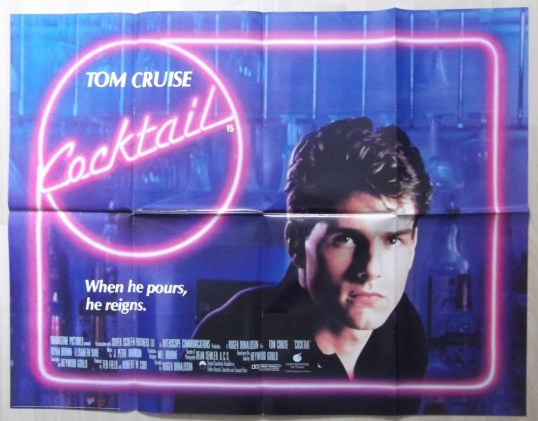
Guilty Pleasure No. 15: Cocktail (dir by Roger Donaldson)


cocktail-original-uk-quad-poster-tom-cruise-elisabeth-shue-88-1229-p

For the past two months or so, Cocktail, a 1988 film that stars Tom Cruise as a bartender with big dreams, has been on an almost daily cable rotation.  A few nights ago, my sister Megan and I sat down and watched the film from beginning to end and we laughed ourselves silly.

Seriously, if there’s ever been a film that deserves to be known as a guilty pleasure, it’s Cocktail.

Cocktail tells the story of Brian Flanagan (Tom Cruise), an apparent sociopath who, having just gotten out of the army, is now determined to become a millionaire.  During the day, he takes business classes but at night, he and his mentor Doug (Bryan Brown) are dancing bartenders.  While customers wait for drinks, Brian and Doug do the hippy hippy shake and toss bottles up in the air.  The crowd loves them and Doug educates Brian on how to be a cynical, opportunistic bastard.  (Myself, I didn’t think Brian needed any lessons but the film insists that he did.)

When Brian and Doug get into a fight over Gina Gershon, Brian ends up in Jamaica where he eventually meets both Jordan (Elisabeth Shue) and Bonnie (Lisa Banes) and has to choose between love and money.  (Guess which one he goes for…)  Gee, if only there was a way that Brian could get both love and money…

Why is Cocktail such a guilty pleasure?  Just consider the following:

1. Cocktail is an example of one of my favorite guilty pleasure genres.  It’s a film that attempts to give an almost religious significance to a profession or activity that, in the grand scheme of things, just isn’t that important.  Hence, Tom Cruise and Bryan Brown aren’t just bartenders.  No, instead, they are the linchpin that New York nightlight revolves around.  If not for the talents of Cruise and Brown, we’re told, thousands of people wouldn’t have a good night.  And then who knows what might happen.  They might go to a different bar and they might get served by less rhythmic bartenders.  Chaos and anarchy might be break out.  The living would envy the dead.  Fortunately, the super bartenders are there to save the day.  (Just consider the film’s tagline: “When he pours, he reigns!”  Really?)

2. In the pivotal role of Brian Flanagan, Tom Cruise gives a performance that seems to hint that the character might be a sociopath.  Whenever he speaks to anyone, he flashes the same dazzling but ultimately empty smile.  Whenever he feels that anyone is failing to treat him with the respect that he deserves, he responds with child-like violence.  When he drags Elisabeth Shue out of her apartment, he looks over at Shue’s father and snaps, “It didn’t have to be like this!”  It’s a line that makes next to no sense unless you consider that Brian is a pathological narcissist who is incapable of empathy.  “It didn’t have to be like this,” Brian is saying, “except you dared to question me so now I’m going to kidnap your daughter…”

3. In the role of Doug, Brian’s mentor, Bryan Brown gives perhaps one of the most openly cynical performances in film history.  While everyone else is earnestly reciting the script’s platitudes and trying their best to sound sincere, Brown delivers every line with a hint of resignation and an ironic twinkle in his eye.  It’s as if Brown is letting us know that, of the entire cast, he alone knows how bad this film is and he’s inviting us to share in his embarrassment.  But Bryan Brown need not worry!  The movie may be bad but it’s also a lot of fun.

4.  Brian and Doug become New York nightlife sensations by doing an elaborately choreographed dance as they mix their drinks.  The other people in the bar absolutely love this, despite the fact that it seems like all the dancing would mean that it would take forever for anyone to actually get a  drink.

5.  While bartending, Brian also takes a business class that is taught by one of those insanely elitist professors who always seem to show up in movies like this.  When he returns student papers, he doesn’t just pass them out.  Instead, he literally tosses them at the students while offering up a few pithy words of dismissal.  Seriously, this guy has to be the worst teacher ever.  No wonder Brian would rather be a bartender than a student!

6. After having a fight with Doug, Brian somehow ends up working as a bartender in Jamaica where he suddenly starts speaking with a very fake Irish accent.  The Jamaica scenes serve to remind us that — despite the fact his great-great-great grandfather did come from Dublin — Tom Cruise is one of the least convincing Irishmen in the history of film.

7. In Jamaica, Brian meets and falls in love with Jordan (Elisabeth Shue) but, because he’s a sociopath, Brian cheats on her with Bonnie (Lisa Banes), who is a wealthy TV executive.  Bonnie brings Brian back to New York with her but, unfortunately, it turns out that Bonnie and Brian don’t have much in common beyond Bonnie wanting a young lover, Brian being young, Brian wanting a rich woman to take care of him, and Bonnie being rich.  What’s particularly interesting about these scenes is that the film doesn’t seem to understand that Brian is essentially coming across like the world’s biggest asshole here.  I think we’re meant to feel sorry for him but all we can really think about is how Bonnie could do so much better.

8. Around this time, Bonnie drags Brian to a museum where Brian ends up getting into a physical altercation with a condescending artist.  It’s at this point that the audience is justified in wondering if Brian has ever met anyone who didn’t eventually end up taking a swing at.

9. But guess what!  It turns out that not only does Jordan live in New York but she’s actually rich as well!  And she’s willing to forgive Brian for being a sociopathic jerk.  Unfortunately, Jordan’s father objects to his daughter running off with a sociopathic bartender so Brian — as usual — reacts by beating up a doorman and then literally dragging Jordan out of her apartment.  One scene later and Brian and Jordan are suddenly married and Brian owns a bar of his own.  Where did Brian get the money to open up his own bar?  Who knows!?  At this point, all that’s important is that the movie is nearly over and, in order for there to be a happy ending, Brian must both be married and a bar owner.  That seems to be the film’s message: “Just stay alive for two hours and the film’s script will be obligated to give you a happy ending whether it makes sense or not.”

10.  Brian is not only a bartender, he’s a poet!  And, amazingly enough, bar patrons are willing to put aside their desire to get a drink so they can listen to their bartender recite poems like this:

” I am the last barman poet / I see America drinking the fabulous cocktails I make / Americans getting stinky on something I stir or shake / The sex on the beach / The schnapps made from peach / The velvet hammer / The Alabama slammer. / I make things with juice and froth / The pink squirrel / The three-toed sloth. / I make drinks so sweet and snazzy / The iced tea / The kamakazi / The orgasm / The death spasm / The Singapore sling / The dingaling. / America you’ve just been devoted to every flavor I got / But if you want to got loaded / Why don’t you just order a shot? / Bar is open.”

Seriously, how can you not enjoy a film like Cocktail?  It’s just so totally ludicrous and melodramatic and, best of all, it seems to have absolutely no idea just how over-the-top and silly it really is.  Both Tom Cruise and Elisabeth Shue seem to take their roles so seriously that you seriously have to wonder what film they thought they were making.

Cocktail is the epitome of a guilty pleasure.
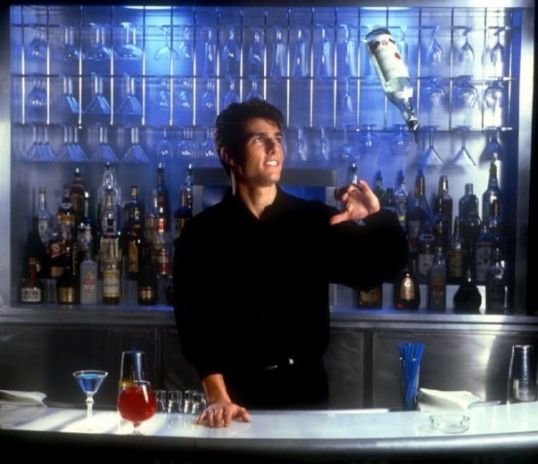
Tom Cruise In Cocktail

Previous Guilty Pleasures:

  1. Half-Baked
  2. Save The Last Dance
  3. Every Rose Has Its Thorns
  4. The Jeremy Kyle Show
  5. Invasion USA
  6. The Golden Child
  7. Final Destination 2
  8. Paparazzi
  9. The Principal
  10. The Substitute
  11. Terror In The Family
  12. Pandorum
  13. Lambada
  14. Fear


Dance Scenes That I Love: The Prom From She’s All That


I was shocked and saddened to learn, earlier tonight, about the tragic death of actor Paul Walker.  Though Paul is probably best known for appearing in The Fast and Furious Films, he also appeared in several other films, including 1999’s She’s All That.

Below, you’ll find my favorite scene from She’s All That.  And yes, it does involve dancing.  I was either 13 or 14 when I first saw She’s All That and I have to say that it gave me a lot of very unrealistic expectations about high school.  Imagine my disappointment when I went to my first prom and discovered that, despite the best efforts of both the DJ and myself, hardly anyone was actually interested in breaking out into a carefully choreographed dance routine!

But, I guess that’s why we have the movies…

44 Days of Paranoia #13: Quiz Show (dir by Robert Redford)


For today’s entry in the 44 Days of Paranoia, I want to take a look at a film that I recently caught on cable — 1994’s Quiz Show.

Directed by Robert Redford and based on a true story, Quiz Show was nominated for the Academy Award for best picture but lost to Forrest Gump.  Among those of us who obsess over Oscar history, Quiz Show is often overshadowed by not only Forrest Gump but two of the other nominees as well, Pulp Fiction and The Shawshank Redemption.  When compared to Pulp Fiction, Quiz Show certainly feels old-fashioned.  At the same time, it’s not quite as much of a sentimental crowd-pleaser as Gump or Shawshank.  Perhaps for those reasons, Quiz Show never gets quite as much attention as some other films that have been nominated for best picture.  However, taking all of that into consideration, Quiz Show is still one of the best films of the 90s.

Quiz Show takes us back to the 1950s.  The most popular show on television is 21, a game show in which two contestants answer questions, win money, and try to be the first to score 21 points.  The American public believes that all of the questions asked on 21 are locked away in a bank vault until it’s time for the show.  What they don’t know is that the show’s producers have instead been rigging the show, giving the answers to contestants who they feel will be good for ratings.

When Quiz Show begins, nerdy Herbie Stempel (John Turturro) has been the champion for several weeks.  However, both the show’s producers and sponsors feel that the untelegenic Herbie has peaked.  Hence, the handsome and charismatic Charles Van Doren (Ralph Fiennes) is brought on the show and Herbie is ordered to lose to him.  Reluctantly, Herbie does so.

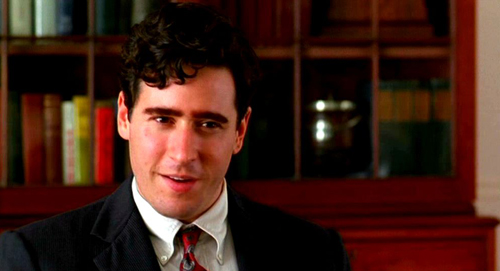
john_turturro_quiz_show

Charles is initially reluctant to cheat but, as he continues to win, he finds himself becoming addicted to the fame.  Charles is the son of the prominent academic Mark Van Doren (Paul Scofield) and his success on television finally gives him a chance to escape from his father’s shadow.  Indeed, the film’s subtle and nuanced portrait of Charles and Mark’s loving but competetive relationship is one of the film’s greatest strengths.

ralph_fiennes_quiz_show

Herbie, however, is bitter over having to lose and has subsequently gambled away all of his winnings.  When 21′s producer (David Paymer) refuses to help Herbie get on another TV show, Herbie reacts by going to the New York County district attorney and publicly charging 21 as being fixed.  Though the grand jury dismisses Herbie as being obviously mentally unbalanced, his charges come to the attention of a congressional investigator, Richard Goodwin (Rob Morrow).

rob_morrow_quiz_show1

Goodwin launches his own investigation into 21 and discovers that the show is fixed.  (As the ambitious Goodwin puts it, he wants to “put television on trial.”)  Along the way, he also meets and befriends Charles Van Doren and finds himself torn between his desire to expose the show and to protect Charles from the bad publicity.  Again, the film is to be applauded for the subtle way that it uses Goodwin’s investigation of both Charles and Herbie as a way to explore issues of both class resentment and class envy.  Goodwin may have come from the same ethnic background of Herbie but it quickly becomes obvious that Goodwin has more sympathy for the genteel (and very WASPy) world that produced Charles Van Doren.  When Goodwin tries to justify protecting Charles, his wife (played by Mira Sorvino) responds by calling him “the Uncle Tom of the Jews” and it’s hard not to feel that she has a point.

1quiz3

While I greatly enjoyed Quiz Show, I do have to say that, on one major point, the film fails.  Try as he might, director Redford never convinces us that a rigged game show is really as big of a crime as he seems to be believe it to be.  Perhaps in the 1950s, people were still innocent enough to be shocked at the idea of television reality being fake but for cynical contemporary viewers, it’s hard not to feel that the “scandal” was more about Richard Goodwin’s ambition and less about any sort of ethical or legal issue.  Towards the end of the film, one character suggests that television will never be truly honest unless the government steps in to regulate it.  “What?” I yelled back at the TV.

Seriously, it seemed like a bit of an overreaction.

As I watched Quiz Show, I found it hard not to think about the reality shows that I love.  For instance, I know that The Bachelor and The Bachelorette are largely staged.  I know that the previous season of Big Brother was largely set up so that Amanda could win.  (And, believe me, if Amanda hadn’t sabotaged her chances by turning out to be a mentally unstable racist bully, she would have won and she would probably would have been invited back for the next all-stars season.)  I know that shows like Storage Wars and Dance Moms are “unscripted” in name only.  I know that reality shows aren’t real but my attitude can basically be summed up in two words: “who cares?”  Perhaps I would be more outraged if I lived in the 50s which, to judge from both Quiz Show and a host of other movies, was apparently a much more innocent time.

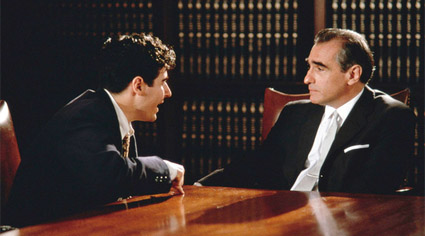
quiz-show-morrow-scorsese

That said, I really enjoyed Quiz Show.  A lot of that is because I’m a history nerd and, therefore, I have a weakness for obsessively detailed period pieces.  But even beyond that, Quiz Show is a well-made, entertaining film that features three excellent lead performances and several strong supporting turns.  If you love to watch great actors playing great roles then Quiz Show is the film for you.  Rob Morrow lays his Boston accent on a bit thick but otherwise, he does a good job of suggesting both Goodwin’s ambition and the insecurities that lead him to desire Charles’s friendship even as he tries to expose him as a fraud.  John Turturro brings an odd — if manic — dignity to Herbie Stempel while Johann Carlo is well-cast as his wife.  Best of all, Ralph Fiennes makes Charles Van Doren into a sad, frustrating, and ultimately sympathetic character while Paul Scofield is the epitome of both paternal disappointment and love as his father.  The film is full of great supporting turns as well, with David Paymer and Hank Azaria perfectly cast as the show’s producers and Christopher McDonald playing the show’s host with the same smarmy charm that he brought to a similar role in the far different Requiem For A Dream.  Perhaps best of all, Martin Scorsese shows up as the owner of Geritol and gets to bark, “Queens is not New York!”

Even if Robert Redford doesn’t quite convince us that the quiz show scandal was as big a deal as he obviously believes it to be, Quiz Show is still an uncommonly intelligent film and one that deserves to rediscovered.

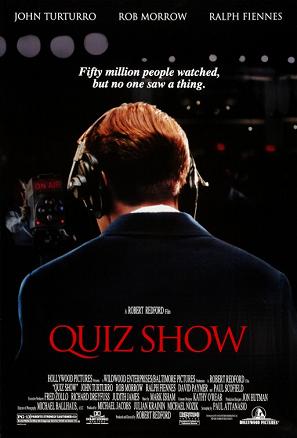
QuizShowPoster

Other entries in the 44 Days Of Paranoia:

  1. Clonus
  2. Executive Action
  3. Winter Kills
  4. Interview With The Assassin
  5. The Trial of Lee Harvey Oswald
  6. JFK
  7. Beyond The Doors
  8. Three Days of the Condor
  9. They Saved Hitler’s Brain
  10. The Intruder
  11. Police, Adjective
  12. Burn After Reading

44 Days of Paranoia #12: Burn After Reading (dir by Joel and Ethan Coen)


For today’s entry in the Days of Paranoia, let’s take a look at Joel and Ethan Coen’s wonderfully satiric look at espionage, greed, lust, and stupidity, 2008’s Burn After Reading.

Like most Coen Brothers films, Burn After Reading tells the dark story of a group of obsessives who all think that they’re far more clever than they actually are.  Osborne Cox (John Malkovich) is a CIA analyst who, because of his alcoholism and generally sour personality, is demoted.  Cox angrily quits his job and then starts working on his memoirs.  Meanwhile, Cox’s wife Katie (played by Tilda Swinton) is having an affair with the handsome but idiotic Mark (George Clooney).  On the advice of her divorce lawyer, Katie secretly downloads copies of all of Osborne’s records, including his memoirs.  Katie gives the disc to her lawyer’s secretary.  The secretary then proceeds to accidentally leave the disc at Hardbodies Gym.

This is where things, in typical Coen Brothers fashion, start to get complicated.  Two trainers at the gym — Linda (Frances McDormand) and her fitness obsessed friend Chad (a hilarious Brad Pitt) — find the disc and mistake Osborne’s very mundane files for national security secrets.  Linda, who is obsessed with raising enough money to get a boob job, convinces Chad that they should blackmail Osborne and demand that he pay them before they return his disc.  Osborne, who has no idea that Katie copied his records, refuses to pay so Linda takes the disc to the Russians.  This leads to a series of misunderstandings that eventually lead to several murders, all of which have to be covered up by the CIA, despite the fact that both the director of the CIA and his assistant agree that there’s no way to understand how any of this happened and that, in the end, neither one of them has learned anything from the experience.

Perhaps because it was released between the Oscar-winning No Country For Old Men and the Oscar-nominated A Serious Man, many critics tend to dismiss Burn After Reading as just being an enjoyable lark and nothing more.  While it’s true that there’s not a lot going on underneath the surface of Burn After Reading, the surface itself is so fun, vivid, and vibrant that it seems rather petty to complain.  Burn After Reading finds the Coen Brothers at their most playful and snarky.

The Coen Brothers have made films in several different genres and styles but all of their work has one thing in common.  The Coens tell stories about obsessive characters who aren’t anywhere close to being as smart as they think they are.  When critics complain that the Coens tend to view their characters with a rather condescending attitude, they’re usually talking about films like Burn After Reading.  Fortunately, in the case of Burn After Reading, the Coens assembled one of their strongest casts.  From the insanely focused Frances McDormand to the perpetually smiling Brad Pitt to cynical John Malkovich, everyone does such a great job that you can overlook the fact that they’re all essentially playing idiots.  Perhaps the film’s best performance comes from George Clooney who, in the role of Harry, proves himself to be a very good sport by satirizing both his own reputation as a womanizer and his career as an old school movie star.  In one of the film’s best moments, Harry, gun drawn, dramatically leaps and then rolls into an empty bedroom.  Like almost all of the characters in Burn After Reading, Harry is just a big kid playing action hero and Clooney’s performance here is perfect.

As for Burn After Reading, it may not be perfect but it’s certainly a lot of fun.

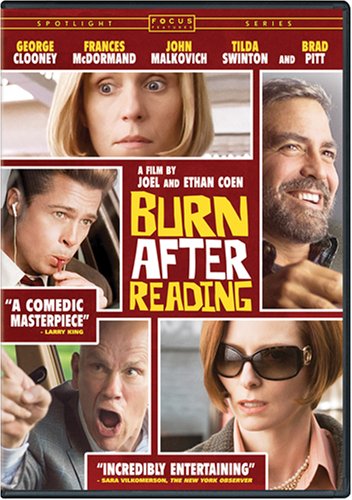
51CW76jX8fL

Other entries in the 44 Days Of Paranoia:

  1. Clonus
  2. Executive Action
  3. Winter Kills
  4. Interview With The Assassin
  5. The Trial of Lee Harvey Oswald
  6. JFK
  7. Beyond The Doors
  8. Three Days of the Condor
  9. They Saved Hitler’s Brain
  10. The Intruder
  11. Police, Adjective

Trailer: Gimme Shelter


PCAS

This film, which features Vanessa Hudgens in a change-of-pace role, looks good and life-affirming.  However, there are two reasons for concern.

First off, the movie is being released in January, which is traditionally the time of year that all of the really bad movies are released.

Secondly, the trailer features three quotes praising the film but they’re all from the same review.

Hopefully, Gimme Shelter will beat the odds.

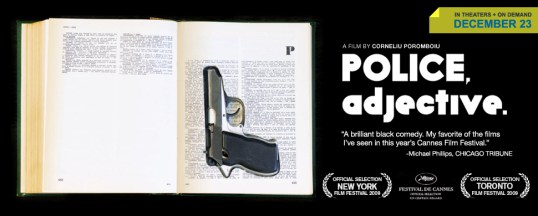
44 Days of Paranoia #11: Police, Adjective (dir by Corneliu Porumboiu)


For today’s entry in the 44 Days of Paranoia, I want to take a look at Police, Adjective, a Romanian film from 2009.

Alex (Alexandru Sabadac) is a teenager who has recently been accused of being a drug dealer by a police informant.  Burned-out detective Cristi (Dragos Bucur) is assigned to follow Alex and keep him under surveillance and, ultimately, gather enough evidence to send Alex to prison.

However, Cristi quickly realizes that Alex is just a bored kid who likes to smoke weed with his friends.  Cristi realizes that Alex isn’t a threat to anyone and, that by doing his job, Critsi will essentially be ruining Alex’s life.  As well, Cristi feels that the informant is a bigger threat than Alex but he’s told that the informant is the son of a powerful man and therefore, won’t be prosecuted.

After spending the majority of the film watching Alex and dealing with the drudgery of the never-ending police bureaucracy, Cristi has a meeting with his superior, Anglehache (played, with a subtle brilliance, by Vlad Ivanov).  Cristi argues that there’s no reason to arrest Alex and send him to prison for seven years.  Anglehache responds by opening a dictionary, forcing Cristi to read the definition of the word “police,” and then explaining why the law must be rigidly enforced regardless of logic.  It’s now up to Cristi to decide what’s more important, his conscience or the demands of the state.

I can still remember the Saturday afternoon that I spent watching Police, Adjective.  My reason for wanting to see the film was simple: I had never seen a Romanian film before and, living in Texas, there was a pretty good chance that Police, Adjective would be my only opportunity to do so.  I approached all of my friends and every member of my family and I said, “We have to see this movie!  It’s from Romania!”  I could tell by their reactions that they weren’t quite as enthusiastic as I was.  “Fine!” I declared, “I’ll see it by myself!”  And that’s exactly what I did.  Early in the morning,  I went down to the Dallas Angelika and I saw Police, Adjective.

When the film started, there were 7 other people sitting in theater.  The first two walked out after 15 minutes.  The next one left at the 30 minute mark.  As the rest of the film played out, I was aware of the other four viewers getting frustrated.  I could hear them impatiently rattling their popcorn bags.  I could hear a few of them demanding, under their breath, to know how The Dallas Morning News could have possibly given this film a good review.  I could hear them as, one-by-one, they stood up and walked out of the theater.  By then end of the movie, I was the only one left.

Now, you should understand that Police, Adjective features no violence, no profanity, no nudity, and no mention of religion.  In short, the audience didn’t leave because it was offended by anything it had seen.  Instead, they left because Police, Adjective is quite literally one of the slowest films ever made.  It’s a police film that features no action but instead emphasizes the drudgery of both the work and existence in general.  For 90 minutes, we watch as Cristi secretly follows and observes Alex.  During that time, Alex pretty much does nothing.  Then eventually, Cristi goes back to a depressingly shoddy-looking police station, questions whether the law is worth enforcing, and gets a lecture from a guy with a dictionary.

Exciting stuff, no?

Well, in its own way, it is.  Police, Adjective is a film about ideas and, despite what some filmmakers seem to believe, ideas can very exciting.  By emphasizing the drudgery of Cristi’s job and rejecting the clichés that audiences have been conditioned to expect when it comes to police films, Police, Adjective invites the viewer to consider their own attitude towards the law.  Why do we have laws and do we really need them?  Cristi is forced to consider whether his superior’s attitude — that the law must be obeyed just because of the fact that is the law — is correct or if it’s just another excuse to justify the power of the state at the expense of the rights of the individual.

Not only is it a good question but it’s a question that not many films have the courage to ask.

Fortunately, Police, Adjective does.

police-adjective_970x390

44 Days of Paranoia #10: The Intruder (dir by Roger Corman)


For today’s entry in the 44 Days of Paranoia, we take a look at one of the most underappreciated films of all time, Roger Corman’s 1962 look at race relations, The Intruder.

Despite the fact that he’s regularly cited as being one of the most important figures in the development of American cinema, Roger Corman remains an underrated director.  Many critics tend to focus more on the filmmakers that got their start working for Corman than on Corman himself.  When they talk about Roger Corman, they praise him for knowing how to exploit trends.  They praise him as a marketer but, at the same time, they tend to dismiss him as a director.

I would suggest that those critics see The Intruder before they presume to say another word about Roger Corman.

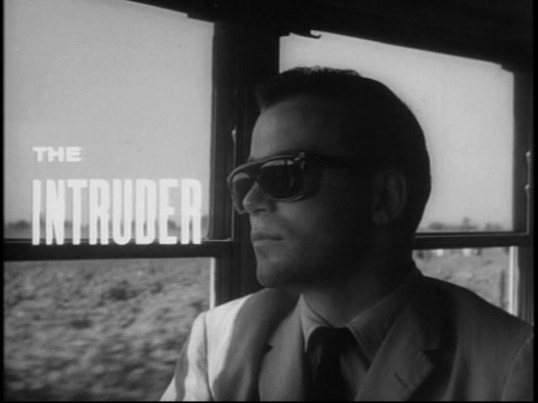
The Intruder opens with a young, handsome man named Adam Cramer sitting on a bus.  The first thing that we notice about Cramer is that he’s wearing an immaculate white suit.  The second thing we notice is that he’s being played by a very young (and, it must be said, rather fit) William Shatner.

I know that many people will probably be inclined to dismiss The Intruder from the minute they hear that it stars William Shatner.  Based simply on Shatner’s presence, they’ll assume that this film must be very campy, very Canadian, or both.  Well, they’re wrong.  Shatner gives an excellent performance in this film, bringing to life one of the most evil characters ever to appear on-screen.

Adam Cramer, you see, is a representative on a Northern organization known as the Patrick Henry Society and he’s riding the bus because he’s heading to a small Southern town.  The high school in that town has just recently been desegregated and Cramer’s goal is to make sure that no black students attend class.  As Cramer explains it, he’s a “social worker” and his goal is to help preserve Southern society.

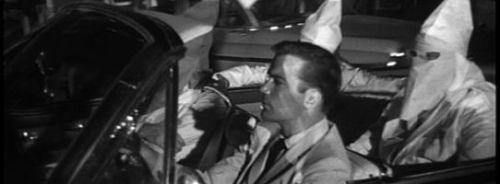
To achieve this goal, Cramer partners up with the richest man in town, Verne Shipman (who is played, rather chillingly, by Robert Emhardt).  With Verne’s sponsorship, Cramer gives an inflammatory speech in the town square and then later returns with a group of Klansmen.  As opposed to recent films like Django Unchained (which scored easy laughs by casting Jonah Hill as a Klansman and playing up the group’s ignorance), The Intruder presents the Klan as figures that have stepped straight out of a nightmare, making them into literal demons who appear at night and disappear during the day.  In a genuinely disturbing scene, the Klansmen set a huge cross on fire.  As the flames burn behind him, Cramer seduces the wife of a local salesman.

intruder-shatner-klan

After Cramer delivers his speech, the local black church is blown up and a clergyman is killed.  The editor of the town newspaper — who, before Cramer showed up, was opposed to desegregation — changes his mind and publishes an editorial strongly condemning Cramer.  Cramer’s mob reacts by nearly beating the editor to death.  Realizing that he’s losing the power to control the mob that he created, Cramer frames a black student for rape which leads the film to its powerful and disturbing conclusion.

Particularly when compared to other films that attempted to deal with race relations in 1962, The Intruder remains a powerful and searing indictment of intolerance and a portrait of how demagogues like Adam Cramer will always use fear, resentment, and ignorance to build their own power.  Corman filmed The Intruder on location in Missouri and used a lot of locals in the cast.  Judging from the disturbing authenticity of some of the performances that Corman got from some of these nonprofessionals, it’s not unreasonable to assume that quite a few of them agreed with everything that Adam Cramer was saying.

As opposed to most films made about the civil rights era in America, The Intruder doesn’t shy away from showing the ugliness of racism.  The Intruder casually tosses around the N word (and yes, it is shocking to not only hear Shatner use it but to see him smile as he does so) but, unlike a lot of contemporary films, it does so not just to shock but to show us just how naturally racism comes to the film’s characters.  The scene in which Verne repeatedly strikes a black teenager who failed to call him sir is also shocking, not just for the violence but because of how nobody seems to be particularly surprised by it.  As a result, The Intruder is not necessarily an easy film to watch but then again, that’s the point.  The hate on display in The Intruder should never be easy to watch.

The Intruder was written by Charles Beaumont, who also wrote several classic episodes of The Twilight Zone.  I think it can be argued that The Intruder represents the best work of Beaumont, Corman, and Shatner.  Unfortunately, but not surprisingly, The Intruder was the only film directed by Roger Corman to not be a box office success.

However, in a world where people are patting themselves on the back for sitting through The Butler, The Intruder is an important film that deserves to be seen now more than ever.

intruder (1962) title capture

44 Days of Paranoia #9: They Saved Hitler’s Brain (dir by David Bradley)


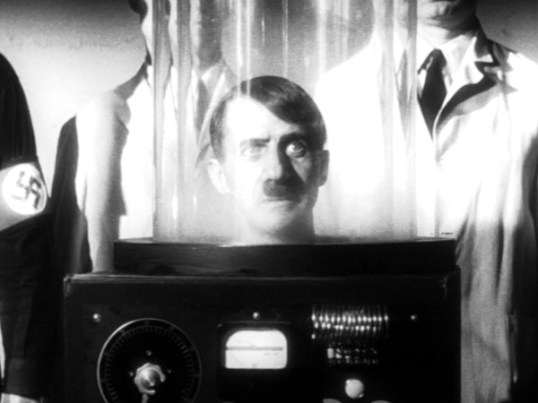
hitlerbrain6

When I started the 44 Days of Paranoia, I said that I was going to not only look at some of the best conspiracy-themed films but some of the worst as well.  With that promise in mind, today’s film is 1963’s They Saved Hitler’s Brain.

Beyond what’s obvious from the film’s title, what exactly is They Saved Hitler’s Brain about?

Your guess is as good as mine.

The film starts with a Mr. Van Pelt, who is a top official at the Central Intelligence Division.  It turns out that Mr. Van Pelt is also a part of a shadowy conspiracy that operates out of the South American country of Mandoras.  The conspiracy is developing a poison named as “G-gas” but a scientist named Dr. Bernard has developed an antidote to G-gas.  So Van Pelt orders his henchmen to blow up Dr. Bernard in his car.

Van Pelt then assigns two CID agents to investigate Dr. Bernard’s death.  Vic Gilbert is a real man’s man who is upset at having to work with a woman.  Toni Gordon wears an extremely short miniskirt, demands to be taken seriously as a CID agent, and — well, that’s about the extent of her characterization.  Anyway, Vic and Toni spend some time exchanging some cutesy dialogue and reading a lengthy dossier about Mandoras.  It turns out that Mandoras is full of Nazi war criminals which, of course, brings us back to the film’s title.

Also, it turns out that Dr. Bernard told his colleague, Dr. Coleman, about the antidote.  So, Van Pelt sends his henchmen to kidnap Coleman but fortunately, Toni just happens to be driving by at the same time that Coleman is kidnapped.  Toni follows the henchmen and Coleman to Van Pelt’s secret hideout.  The henchmen spot Toni and end up shooting her as she flees to a phone booth but not before Toni manages to call Vic.

Vic then shows up and discovers that Van Pelt is a traitor.  Fortunately, Toni isn’t quite dead yet so she manages to shoot Van Pelt before she expires but then Vic dies anyway, the result of driving his car into a power station.

And then, suddenly, an entirely new movie begins!

That’s right — They Saved Hitler’s Brain is one of those films that was essentially created by editing two unrelated movies together.  All of the Vic and Toni footage was apparently filmed in the late 60s by a bunch of students at UCLA who were hired by the film’s distributor to lengthen the original 1963 film so that it could be sold into television syndication.  Considering that the original film (which was titled Madmen of Mandoras) was a thorough mess, the addition of the equally confusing prologue serves to make They Saved Hitler’s Brain into one of the most completely incoherent films ever made.

Anyway, the “second” part of They Saved Hitler’s Brain deals with Coleman’s daughter and her boyfriend (who, we find out, is yet another CID agent) going down to Mandoras and searching for her father.  It turns out that the government of Mandoras has been secretly taken over by a bunch of Nazi war criminals who take their order from — wait for it — Hitler’s Brain!

It turns out that Hitler’s head has been preserved in a jar and, despite no longer having a body, he’s still capable of plotting, ordering people about, and dramatically rolling his eyes.  From his hiding place in Mandoras, he’s come up with Plan G, a scheme that will allow him to conquer the world.  Unless, of course, the CID can stop him…

(Were the filmmakers worried about getting sued by the CIA?  Seriously, CID just doesn’t have the same ring to it…)

Now, I have to admit that I have a soft spot for terrible films like They Saved Hitler’s Brain.  There are a lot of bad movies out there but there are only a few movies that are so bad that they’ve managed to become classics of ineptitude.  To the filmmakers behind movies like They Saved Hitler’s Brain, I would say that if you can’t take pride in making one of the best films ever made, why not take some pride in making one of the worst?

You can judge for yourself below.