Trailer: The Cobbler


Listen, I’m just going to put this out there:

Adam Sandler can be a good actor.

I know, I know.  You scoff and you have every reason to do so.  After all, Sandler is best known for appearing in Razzie-winning films like Jack and Jill and That’s My Boy.  Sandler’s film career has been so lowbrow that, when Amy Dunne mentioned the misery of being forced to watch Sandler movies, audiences watching Gone Girl knowingly nodded and thought to themselves, “She may be a crazy but she knows her movies…”

And yet, occasionally, mixed in with all of the crap, you’ll come across a film that actually requires Sandler to act and play a character and he usually does a pretty good job at it.  It’s the talent that you see in films like Punch-Drunk Love, Spanglish, Reign Over Me, and Funny People that makes it so frustrating that Sandler has devoted so much of his career to things like Grown-Ups 2.

When Sandler stops trying to make everyone laugh and actually lets his guard down, he has the ability to be a surprisingly good actor.  And, though it’s hard to believe now, a lot of film bloggers — like me — were convinced that 2014 would be the year that Sandler would prove that he was capable of more than just winning Razzies.

He had two films scheduled to come out and both of them were directed by “serious” filmmakers.  And Sandler got some good reviews for his performance in Jason Reitman’s Men, Women, & Children but the film itself was critically reviled.

As for Sandler’s other 2014 film, Thomas McCarthy’s The Cobbler opened to mixed reviews at the Toronto International Festival and, as a result, it probably will only get a very limited release in the early months of 2015.

However, I’m still looking forward to seeing The Cobbler.  Thomas McCarthy’s previous film — Win Win — was one of the best of 2011 and the film’s premise — a cobbler discovers that he can assume anyone’s physical appearance and life simply by putting on their shoes — sounds like it could be promising, especially is Sandler plays to his natural sadness as opposed to going for easy laughs.

Here’s the international trailer for The Cobbler.


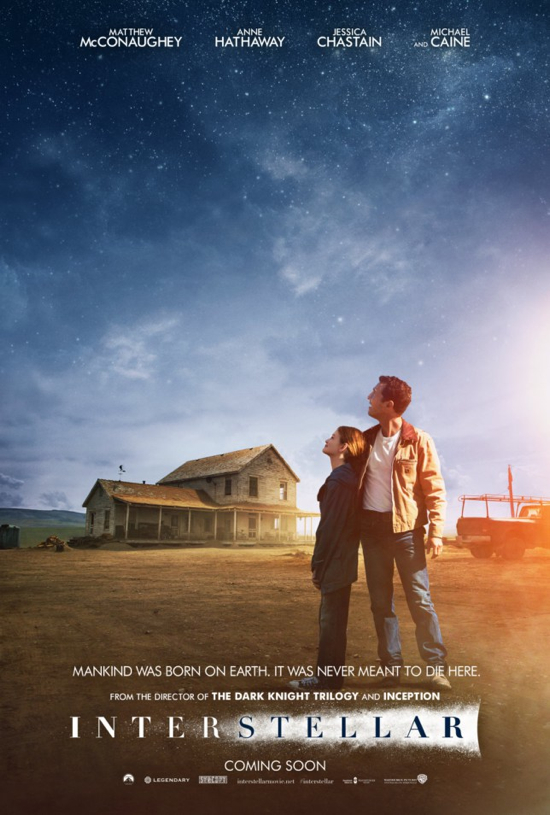
‘Interstellar’ Review (dir. Christopher Nolan)


interstellar2

It would be disingenuous of me to not start this review by saying that I went into ‘Interstellar’ with a clear and present bias. Not towards Nolan – though I think he is a wonderful director who has not yet made a truly bad film. But a bias towards the scientific theories and potential themes I expected – based on trailers and the concept of the film – that it would explore. I have always been very interested in astronomy and astrophysics – and have a soft spot for science fiction films with a strong emotional core (‘Close Encounters of the Third Kind’, ‘Contact’). So when I headed to the theater I knew I was walking a very fine line (one that many reviewers walk but won’t admit to). If the film met (even marginally) my high expectations then it would in no doubt lead to high praise that bordered on hyperbole – and if it didn’t – if it disappointed – then it would cause a reaction a lot more negative than it really needed to be.

Where did ‘Interstellar’ ultimately fall? Hyperbole…or disappointment? Well luckily for me it was the former…to a fairly strong degree. I’ll say it now – this is not just probably  my favorite film of the year so far, but like with ‘Gravity’ and ‘The Tree of Life’ (yes, more on that later) in recent years, this may  fall within my favorite films of all time. It is a dazzling, visually stunning, emotionally resonant and incredibly well made sci-fi space epic – one with the power to keep you on the edge of your seat one minute and in tears the next. It explores big ideas about the cosmos while also staying incredibly grounding with an intimate story about family, regret, sacrifice and love. Like I said…hyperbole.

coop2

The film takes place in a not so distant future in which the world is becoming unlivable. After population growth, climate shifts and diseases ravishing crops, the world is struggling to produce enough of what little food sources they have left – which means a heavy reliance on corn farms. It is very bleak future where dust from dust storms covers everything, and the only focus of mankind is struggling to survive with what they know and have. Innovation, free thinking and exploration are at a standstill – and unless schools deem you smart enough to go on to a university, your only career prospective is farming.

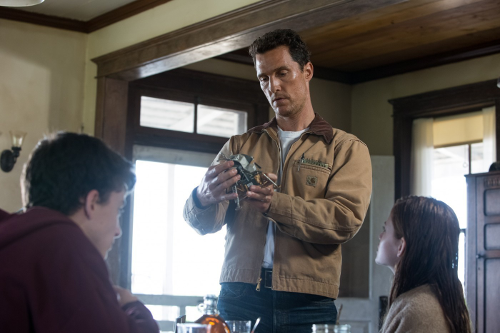
Matthew McConaughey stars as Cooper, a widower and former pilot who now owns a farm where he lives with his two young children. He does his best to provide for his family but clearly wants more for them than what the current world can provide. After finding a mysterious message in his daughter Murph’s room, Cooper finds himself being recruited by what is left of NASA. They are secretly putting together a mission to journey through a wormhole that has appeared near Saturn. They do not know how it got there but they do know that beyond it is a solar system with some potentially habitable planets. They want Cooper to pilot an expedition through the wormhole to explore these planets and see if one is suitable to set up a new human colony. Cooper reluctantly agrees, even though it means leaving his children behind. He knows that the journey could kill him or – due to the laws of relatively – that by the time he does return his children may be much older than he is or already dead. But the fate of the human race – including his son and daughter – relies on finding a new home. So he sets out with a team of astronauts – and one pretty funny robot – on a journey that will take them farther than any humans have ever gone. The decision devastates his young daughter Murph – who he had a close relationship with – and it sets her out on a journey of her own to save humanity in a way she believes her father couldn’t.

To go into much more detail of the plot would ruin much of the experience. But I will say it becomes a fast paced and exciting journey. It does sometimes fall back on the usual genre tropes but there is never a dull moment; and it all builds up to an emotional and rewarding conclusion.

murph

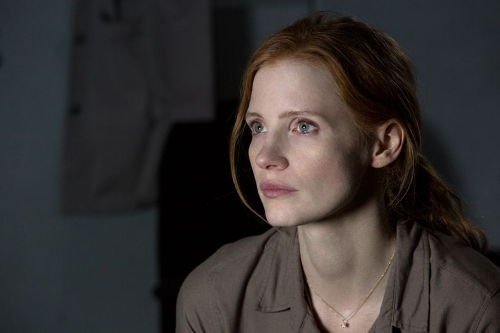
The performances are truly superb. For all his technical mastery, Nolan is also an actors’ director and he gets the most out of his casts. McConaughey is at his best here – which is saying a lot considering his work in recent years. The emotion he brings is on a whole different level than anything he has done before. Jessica Chastain, who plays the adult Murph, also has a strong presence. Both actors wear the burden of their decisions and regrets on their shoulders, and you can see it in every scene. They are the heart and soul of the film. Hathaway also did a wonderful job – as did Wes Bently, Michael Caine, and David Gyasi.

The score from Hans Zimmer is loud and heart pounding. He always manages to perfectly convey the intensity of some truly exciting set pieces – while also slowing down to capture the emotions of the more intimate moments, and this score is no different.

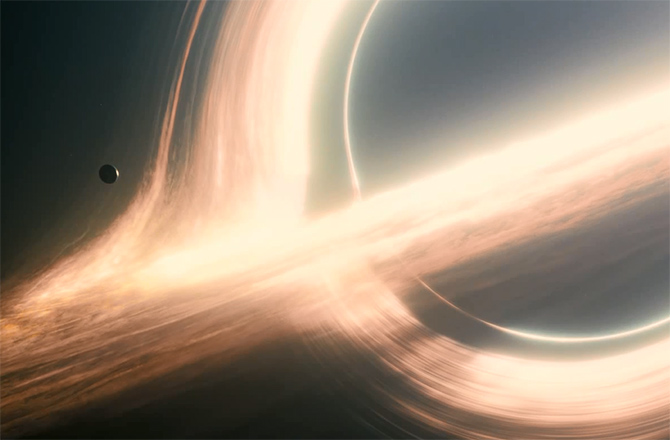
The visuals are absolutely stunning. The effects (most of them created through practical means) were influenced by physicist Kip Throne – who also oversaw a lot of the science in the film – and the result is dream-worthy space imagery. Interestingly, the depictions of the wormhole and black hole in ‘Interstellar’ are considered to be the most accurate ever created. The results are gorgeous, especially on a big screen – with one scene with Saturn making me all teary eyed.

tumblr_nel0c0Oncj1qd479ro1_1280

Below the spectacle and hard science is an emotionally resonant tale of exploration and human ambition that puts its faith not only in science but also the human soul.  Does it become heavy handed at times? Of course! This is a space opera – a science fiction epic – with a big budget, big ideas, big name actors, big visuals and so the emotions at times match that. The first 40 minutes or so do a fantastic job setting up the bond between Cooper and his daughter. It is a wonderful relationship – but a complex one filled with love, anger and regret. It is also the backbone of the story and Nolan builds the emotion from there.

Like with ‘The Tree of Life’ (I told you I was going here), the juxtaposition of dazzling space images and the exploration of the cosmos with this grounded and intimate family story about love and nature make for a challenging but truly rewarding experience. One that asks big questions about our relationship with each other and the universe we inhabit; and examines how the flow and clash of such things as love and instinct with nature can change and inspire us for better or worse. Nolan does seem to want to show how love has the ability to conquer and transcend even the harshest things nature and its laws can throw at us. It is almost fitting then that Chastain stars in each, and has a roll in both stories that could be almost viewed as similar – as the focal point of love that guides the main character and the audience. And like with ‘The Tree of Life’ I can totally understand why people would not like ‘Interstellar’. Neither are films for everyone. I believe most reviews I have seen are so mixed because ultimately ‘Interstellar’ relies so heavily on the emotions at the core of the story that it was inevitable that it wouldn’t connect with some people. You have to be open to some extreme sentimentalism, which just isn’t the case for everybody.

coop mur

I won’t go into much detail over the film’s final act, but I think it makes perfect sense within the logical and emotional progression of the story – though some critics disagree. They seem to think that Nolan’s often straight forward hard science approach is too stern and takes the wonder and ambiguity out of his stories and I found that to not be the case with ‘Interstellar’. Mainly because the ending does in fact have some level of ambiguity – but what it does explain adds a level of wonder and hope that would be lost had it been open ended. I will also say that I find it absolutely absurd that some critics who praise and accept the ending to’2001: A Space Odyssey’ have dismissed this one for being too convoluted or even nonsensical…as if those couldn’t also be said of the ending of Kubrick’s film.

But again maybe this is all just me. As I warned you, hyperbole was expected and I think this review lived up to that. I truly loved the film. It generated in me the same feeling of wonder, excitement and curiosity I got from the spectacle and emotions of ‘Close Encounters of the Third Kind’ and ‘Contact’ –the realism of ‘Gravity’ – and the complexity and mind bending theories of ‘2001: A Space Odyssey’. Throw in with that the connections I felt it had with such films as ‘The Tree of Life’ and there was no way I wasn’t going to love it. This is cinema at its finest. Whatever flaws it might have I can easily overlook due to not only how moving and entertaining of an experience it all is – but also because it is just so damn ambitious. Whether you see it on a large IMAX screen or not, you’ll be moved in one way or another.

tumblr_nejbrwgYQs1qanm80o3_500

Now, I don’t usually do this but I would like to end by quickly addressing the small group of people who have been crying sexism before the film even got its wide release. Apparently, because the lead is a scruffy male and the film is about the will power of mankind to journey off and explore the unknown, that it is somehow a male centric film that is about masculinity above all else. If the idea of human endeavor, innovation, the struggle to survive, and the pursuit of knowledge brings to your mind nothing but masculinity and male dominance then blame society – not the film – because it was clearly not its intentions  and really is just not even remotely the case here. You could easily replace McConaughey’s character with a female lead (like in ‘Contact’) and the narrative, emotional and thematic results would be EXACTLY the same. This all seems even more ridiculous given the fact that the female characters play a much more important role than any of the men. Their work, decisions and perspective essentially save the day. It isn’t until the men view the situations and universe through them that they are able to succeed.

I have also been thrown off by the complaints of Nolan’s reliance on “daddy issues” or the “dead wife/spouse” tropes, and fail to see how these (which I admit are often present in his films) should at all matter when they fit so well into the story and are so emotionally effective. Not to mention Cooper being a widower has nothing to do with any decision he makes; and the relationship Murph has with him is far more complex than simply being “daddy issues”. It is actually a wonderfully realized one, with Nolan drawing experience from the relationship he has with his own daughter.

But why are these even being brought up by people, so early and with such vigor? Do not get me wrong, I understand and appreciate the opinions of those who simply did not like it…but for the few who have criticized it for the aforementioned reasons I just cannot wrap my head around where they are coming from. Sexism is often an issue in cinema and film making as a whole and something that could clearly be worked on…but it just does not apply to ‘Interstellar’ in any way. And I say this as someone who isn’t a Nolan fan boy. Yes, I appreciate his work – he has made some truly great films – but I am not one of those who think he is the best director working right now. But it is hard to not be disappointed and confused by the fact that every time he releases a film there are tons of articles that pop up to critique what would otherwise be completely ignored in other films – or in some case they critique things they didn’t even care about in his other films. Maybe this is just the price a director like him faces. His work tends to be so popular that critics seem to try extra hard to make their voices heard – an attempt to quell the masses of fans excited to see it – by overreaching in their criticism. This is made all the more disheartening when you consider he is one of a very few filmmakers willing to take such big risks to make smart and ambitious films. But maybe I am wrong. Please, let me know your thoughts!

———

Twitter.

Lisa Reviews The Oscar Nominees: Nicholas and Alexandra (dir by Franklin J. Schaffner)


Nicholas_and_Alexandra-831476012-large

(Depending on how much you know about world history, the review below may contain spoilers.)

It was nearly four years ago that I decided that my goal in life was to watch and review every single film — no matter how obscure or potentially disappointing — that had ever been nominated for best picture.  Of course, that’s not my only goal.  If anything, I may have too many, often contradictory goals in my life.  But seeing all of the best picture nominees was definitely one of them and, all these years later, it’s a goal that I’m still trying to achieve.  With the help of TCM and their nonstop schedule of movies made long before I was born, it’s also a goal on which I am slowly but surely making progress.

Last night, as I scrolled through the guide, I noticed that TCM would be showing Nicholas and Alexandra, a three and a half hour film from 1971.  Now normally, I would be hesitant about watching a film that long, if just because I have ADHD and I doubt I’d be able to concentrate on it.  In a theater, watching the action unfold on a big screen, it wouldn’t be a big deal.  However, it’s totally different when you’re talking watching a movie on TV in a house that is full of potential distractions.  Add to that, Wednesday night is when I usually watch shows like Survivor, Hell’s Kitchen, and South Park.

But, here’s the thing.  The title Nicholas and Alexandra sounded familiar to me and not just because I’m an obsessive history nerd.  I did some checking and I discovered that, regardless of how obscure the film may be today, Nicholas and Alexandra was nominated for best picture.  It lost to The French Connection but it was nominated.

So, of course, I had to watch it.

And you know what?
NA

It’s not a terrible movie.  It’s certainly not great.  It has multiple flaws and it’s hard to imagine this film being nominated alongside films like The French Connection, Last Picture Show, and A Clockwork Orange.  Watching the movie, I got the feeling it was probably nominated because it was a big, expensive epic and not because it was one of the best of the year.  But, if you stick with the film (which, if we’re going to be honest here, is much easier said than done), it’s not quite as disappointing as you might expect it to be.

Nicholas and Alexandra tells the story of the last monarch of Russia, Tsar Nicholas II (Michael Jayston).  Struggling to escape the shadow of his father and incapable of understanding what life is like for those not born into royalty, Nicholas is portrayed as being well-meaning but autocratic and blind to the fact that the days of royalty are rapidly coming to an end.  His wife, Alexandra (Janet Susman) is also unpopular with both the Russian citizenry and the royal court on account of being German.

Alexandra spends most her time doting on her youngest son, Alexei, who suffers from hemophilia.  When a flamboyant Serbian monk named Rasputin (Tom Baker) claims that he has the power to heal Alexei, Alexandra immediately brings him into the court.  Soon, rumors are flying across Russia about Rasputin’s relationship with Alexandra.

Meanwhile, men with names like Lenin (Michael Bryant), Trotsky (Brian Cox), and Stalin (James Hazeldine) are plotting to lead a “worker’s revolution…”

If you know anything about history, it’s not really a spoiler to reveal what happens in the second half of Nicholas and Alexandra.  (And if you’re not into history, you probably would not have any interest in watching the movie in the first place.)   Archduke Franz Ferdinand is assassinated, plunging the entire world into war.  Russia declares war on Germany and the German-born Alexandra becomes even more unpopular than before.  The rest of the royal court, jealous over the mad monk’s influence, plots against Rasputin.  The Tsar is forced from the throne and Nicholas and his family spend their last days as captives of the people they once ruled.  Now a powerless prisoner, Nicholas finally starts to understand the world beyond his palace walls.  However, in the end, Nicholas, Alexandra, their children, and their loyal servants are taken into a small room and violently executed.  End of movie.

NA2

So, there are a lot of things wrong with Nicholas and Alexandra.  Not the least of the film’s problem is an unwieldy length and generally slow pace.  (The film was directed by Franklin J. Schaffner, who also directed the still-fun original Planet of the Apes.  Little of the flair he brought to Planet of the Apes is present here.)  This is one of those films that is full of incident with various characters popping up and discussing the intricacies of international politics with little concern as to whether or not any of this is the least bit cinematic or even compelling on a narrative level.  The film has a huge cast but very few memorable characters.

Even worse is that neither Nicholas nor Alexandra never come across as being all that interesting.  The film makes the case that Nicholas’s downfall was largely a result of him being unlucky enough to rule at a time when people across Europe and Asia were rejecting the old ways for the new ways of revolution and industrialization.  Nicholas is continually portrayed as being well-meaning but isolated and that has the potential to be interesting but, at times, the film feels almost as emotionally detached as its characters.

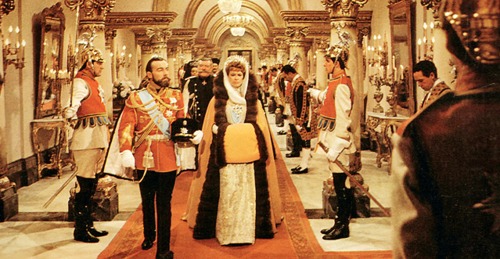
That said, Nicholas and Alexandra does work as a spectacle, as a showcase for beautiful clothing and ornate scenery.  As a character study, Nicholas and Alexandra largely fails but, as a fashion show, it’s actually a lot of fun.    Early on in the film, there’s a lengthy sequence in which Nicholas and Alexandra walk down the red-carpeted hallways of their palace.  It’s shot through Nicholas’s eyes and we see a collection of guards and noblemen and women standing to the side and bowing their heads as the Tsar and his wife walk past.  It’s a good scene and one that perfectly shows not only the life that Nicholas is used to but also why Nicholas doesn’t want to change that life.

baktna03

Perhaps not surprisingly, the first two hours of Nicholas and Alexandra work best when they focus on the flamboyant character of Rasputin.  Baker does a really go job as Rasputin, delivering all of his lines with a ferocious intensity while staring with obviously unhinged eyes.  When he’s with Alexandra, Rasputin is calculating and coldly conniving, providing just enough comfort to keep her under his control.  When he’s with Nicholas or any of the other male members of the court, he reveals himself to be an arrogant libertine, making profane jokes and bragging about his conquests.  It’s a really good performance but, as with so many other good performances in this film, it occasionally gets lost in the film’s dense production.

The best moments of Nicholas and Alexandra come towards the end, with the humbled Nicholas finally revealing his humanity and the Tsar’s family struggling to maintain their dignity even as their inevitable fate approaches.  At this point, the performers came to life.  The film suddenly had an emotional resonance.  It finally became about something!  For those final 20 or so minutes, Nicholas and Alexandra suddenly seemed worthy of being awarded.

In fact, based on those final 20 minutes, I would even be willing to see a sequel called Nicholas and Alexandra and Rasputin Makes Three.  

(Though I’m not sure how that sequel could ever be made.  As @Kev1Media pointed out when I suggested it on twitter, Adam Sandler would have to be somehow involved.)

As for Nicholas and Alexandra, it’s not a great film but if you’re into history or you’re an Oscar completist like me, the film has its occasional charms.  You just have to be willing to look for them.

Nicholas and Alexandra

What Lisa and the Late Night Movie Crew Watched Last Night #107: Prisoners of the Lost Universe (dir by Terry Marcel)


Last night, I gathered with about 17 friends over at SyFyDesigns and we watched an obscure little fantasy film from 1983, Prisoners of the Lost Universe.

P-0002_Prisoners_of_the_Lost_Universe_quad_movie_poster_l

Why Were We Watching It?

We were watching it because we are the late night movie crew and that’s what we do.  We watch movies and we watch them late at night and, since we are all intelligent and snarky people, we have a natural tendency to pick movies with titles like Prisoners of the Lost Universe.

(Add to that, since Prisoners of the Lost Universe is in the public domain, it has been included about a dozen different Mill Creek Box sets and it’s also on YouTube.  So, it was an easy film for everyone to watch.)

What Was It About?

News reporter Carrie (Kay Lenz) is interviewing Dr. Hartmann (Kenneth Hendel) when a sudden earthquake hits California.  Dr. Hartmann stumbles into an interdemensional transporter and disappears!  Then Dan (Richard Hatch) stops by Hartmann’s house and he stumbles into the transporter and disappears as well!  And then, after that, Carrie stumbles into the transporter and she vanishes!  Why is everyone in this movie so clumsy?

Anyway, Carrie is transported to the Lost Universe, which looks a lot like South Dakota.  (Actually, the movie was made in South Africa so apparently, South Africa also looks a lot like South Dakota.)  Carrie wanders around for a little while and spends a while talking to herself about how much she hates being in the Lost Universe.  Part of Carrie’s problem was that she was wearing high heels.  If you’re going to visit South Dakota, South Africa, or the Lost Universe, be sure to wear sensible shoes.

Eventually, Carrie is reunited with Dan and they meet a lot of other citizens of the Lost Universe.  They meet a green man.  They meet a gigantic cave man.  They meet a bearded thief.  They also meet a tribe of angry people who all have glowing red eyes.  When they’re climbing up a mountain, Dan offers a helping hand.  “Take your hand off my butt!” Carrie snaps back.  They’re not exactly Hepburn and Tracy.

Finally, Carrie is kidnapped by an evil warlord who happens to be played by John Saxon.  The warlord has a dueling pistol with him that he uses to enforce his will on everyone else in the Lost Universe.  He explains that it was built for him by a sorceror from another universe.  Any guess who that is going to turn out to be?

Anyway, it’s up to Dan to rescue Carrie and hopefully end the tyranny of John Saxon.

What Worked?

Prisoners of the Lost Universe is one of those otherwise forgettable films that suddenly becomes the most entertaining thing in the world if you’re watching it with the right people.  Last night, I watched it with the right people and our natural wit and snarkiness elevated the entire film.

Beyond the snarkiness, John Saxon made for a good and fun villain.  And I liked the Green Man.  He had an above-it-all attitude that was very entertaining.

What Did Not Work?

To be honest, it’s really a very bad movie.  If I hadn’t been watching this movie with 17 other snarky and talkative people, I imagine I would have been bored out of my mind.  If Prisoners of the Lost Universe had been produced by Crown International Pictures, it probably would have been a lot more fun.

“Oh my God!  Just like me!” Moments

I have a feeling that if I accidentally got transported to the Lost Universe, I’d probably be wearing high heels as well.  And I’d probably complain a lot.  Who wouldn’t?

Lessons Learned

Why go to the Lost Universe when you can just go to South Dakota?

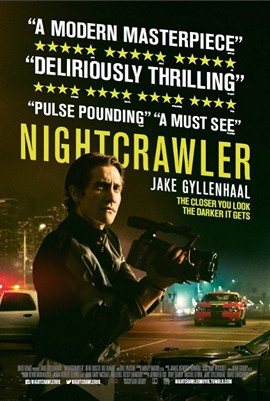
Film Review: Nightcrawler (dir by Dan Gilroy)


Nightcrawler


The new film Nightcrawler tells the story of a strange man named Lou Bloom (played, in the performance of his career, by Jake Gyllenhaal).  From the minute that we first see Lou, we can tell that there is something off about him.  He is a bit too quick to smile and his friendly manner is sharply contrasted with his sunken features.  He watches the world with shifty eyes that are surrounded by dark circles that make it appear as if he hasn’t slept for weeks.  (And it is interesting to note that, at no point during the film, do we actually see him sleep.  He’s always awake.)  When he speaks, it’s in an optimistic and ingratiating tone that can barely disguise the fact that everything he is saying is a cliché.  He speaks in the language of self-help books and inspirational speakers.  What’s interesting is that as empty as Lou’s constant patter may be, he always sounds as if he believes every single word of it.

Despite the fact that Lou is on screen during every minute of Nightcrawler, we learn very little about his background.  We don’t learn where he was born.  We don’t know how he eventually came to be the person that he is at the start of the film.  He has no family.  He has no friends.  He lives in a small apartment that is distinguished only by how anonymous it ultimately is.  The only thing we really know for sure about Lou is that he watches a lot of television.  In one of the few moments in the film where Lou actually lets down his guard, he tries to have a conversation with a reporter on a screen despite the fact that the reporter can not hear a word that he is saying.

Lou is first introduced stealing and selling scrap metal.  When he’s confronted by a security guard, Lou smiles and says a few friendly words before suddenly attacking the guard and throwing him to the ground.  Disturbingly, we never find out what exactly Lou did with that security guard but, when we next see Lou, he’s wearing the guard’s watch.

However, Lou has bigger plans than just being a common thief.  When he comes across a car accident, he sees a freelance video journalist (also known as a nightcrawler) filming the police.  When Lou finds out how much money he can make by simply filming human misery and then selling the footage to a local news station, Lou trades a stolen bicycle for a radio scanner and cheap camcorder.

After several nights of struggling to get some good footage and discovering that the police don’t like nightcrawlers, Lou manages to get some footage of a dying shooting victim.  He sells the footage to a local news station and meets Nina (an excellent Rene Russo), the station’s news director.  Nina is impressed with the footage and encourages Lou to find more.  She explains to him that she needs crime and disaster footage.  She needs footage that will both scare and intrigue her white middle-class audience — violence in the suburbs, families being threatened, and — most importantly — white people being victimized by minorities.  As she tells Lou,  “The perfect story is a screaming woman with her throat cut, running down a street in a good neighborhood.”

Soon, Lou is finding a lot of success as a nightcrawler, to the extent that he even gets an intern named Rick (Riz Ahmed) to serve as his assistant.  Rick is an interesting character and Riz Ahmed gives an excellent performance, one that is overshadowed by the more flamboyant performances of Gyllenhaal and Russo but which is just as important.  In many ways, RIck serves as the film’s conscience.  Alone among the film’s characters, Rick has a sense of morality but, unfortunately, he’s not observant enough to realize that he’s the only one.

Lou is a complete and total sociopath but Gyllenhaal gives such a compelling performance that you often forget until Lou gives you no choice but to remember.  As the film progresses, it becomes obvious that both Lou and Nina depend on bad news for their very existence and, in Lou’s case, he’s not above creating the news that he covers.

Marking the directorial debut of veteran screenwriter Dan Gilroy, Nightcrawler is a hyperkinetic portrait of society at its absolute worst.  As some reviewers have pointed out, Nightcrawler is often a bit heavy-handed when it comes to portraying the vacuousness of television news but then again, have you watched your local station recently?  Have you looked at any of the clickbait articles that are floating around the internet?  If Nightcrawler portrays television news as being shallow and hypocritical — well, why shouldn’t it?  The usual suspects will claim that Nightcrawler‘s portrayal of televised media is flawed but we all know the truth, don’t we?  Even if the film’s satire is heavy-handed, it still captures a larger and undeniable truth.

Not only is Nightcrawler a thought-provoking look at our paranoid society but it also features Jake Gyllenhaal’s best performance.  Gyllenhaal reportedly lost 20 pounds for the role and his commitment to the role pays off as he turns Lou into a truly fascinating monster,  making him the most compelling sociopath this side of Christian Bale’s Patrick Bateman.

Admittedly, the film does have a few flaws.  A scene in which Lou is seen cutting a van’s brake line almost inspired me to shout out, “Direct to video!” because it seriously felt as if it belonged in a lesser film.  (Every direct-to-video thriller features a scene of someone tampering with brakes.)  But, overall, Nightcralwer is one of the best films of the year so far.

Nightcrawlerfilm

Horror Film Review: The Visitor (dir by Giulio Paradisi)


The_Visitor_1979_film_poster

Do you want to see a strange horror film?

Just check out The Visitor, a 1979 Italian film that has recently been re-released by Drafthouse Films and occasionally shows up on TCM.  In many ways, The Visitor is a total and complete mess.  But, as is so often the case with Italian horror films, that very messiness — combined with some genuinely imaginative narrative and directorial choices — serves to make The Visitor into one of the most memorable films that you (possibly) have never heard of.

Like many of the Italian exploitation films released in the 70s and 80s, The Visitor is a rather blatant rip-off of a successful American film.  What makes The Visitor unique is the amount of different movies that it rips off.  The Visitor takes films that you would assume had no connection and mixes them together to create something wonderfully odd.

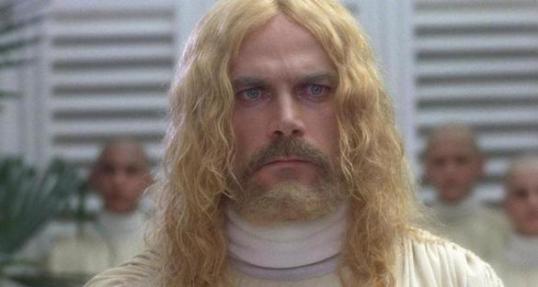
Franco Nero as Jesus in The Visitor

Franco Nero as Jesus in The Visitor

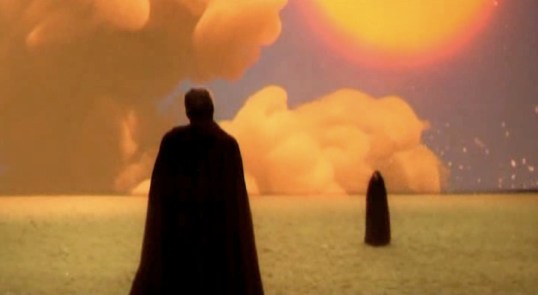
Much like Close Encounters of the Third Kind and 2001: A Space Odyssey, The Visitor opens with the idea that intergalactic beings have been visiting Earth for centuries and are subtly influencing the development of humanity.  The Visitor literally opens with Jesus Christ (played by Franco Nero!) sitting on a satellite and telling a version of the creation story to a bunch of bald children.  He explains that, long ago, he battled an evil intergalactic demon known as Sateen.  Sateen (who, the film implies, is better known on Earth as Satan) was eventually blown up but his genes were spread throughout humanity.  The bald children surrounding him are the descendants of Sateen.  Whenever one of them is born, Jesus sends an old man named Jerzy Colsowicz (played by director John Huston) to Earth so that Jerzy can bring the child to the satellite.  Of course, whenever Jerzy isn’t kidnapping kids for Jesus, he spends his time hanging out in a psychedelic dimension.

Yes, you did read that correctly.

This is where Jerzy lives.

This is where Jerzy lives.

Once you get past the intergalactic part of the story, The Visitor is a pretty obvious rip-off of both The Omen and Damien: Omen II, with the main difference being that the demon child here is not a cherubic little boy but instead is a rather bratty 8 year-old little girl named Katy (Paige Collins).  However, Katy is not the Antichrist.  Instead, her job is to mate with a male child who also has Sateen’s genes and then her baby will be the Antichrist.  In order to get this male child, Katy is pressuring her mother (Joanne Nail) to have sex with businessman Raymond Armstead (Lance Henriksen, who was also in Damien II: The Omen) so that Katy can have a half-brother to mate with.  (Ewwwwwwww!)  Raymond is a follower of Sateen and, adding to the film’s already odd feel, he also happens to own a basketball team.

(So, along with everything else going on, The Visitor also features a lot of basketball footage, which I guess would be exciting if I knew anything about basketball.)

Despite being a pretty powerful figure in the Sateenist hierarchy Raymond is not the head Sateenist.  No, the head Sateenist is played by Mel Ferrer, an actor who was once married to Audrey Hepburn and who will be familiar to anyone who has ever watched an Italian horror film.  (You can spot Ferrer in Zombie Holocaust, for example.)  Ferrer and the other Sateenists are all old, distinguished looking white men who spend all of their time meeting in an ornate corporate boardroom.

So, Jerzy comes down to Earth  to, with the help of a nanny played Shelley Winters, try to kidnap Katy but, for some reason, he doesn’t just do that.  Instead, he spends most of his time just watching Katy do destructive things.

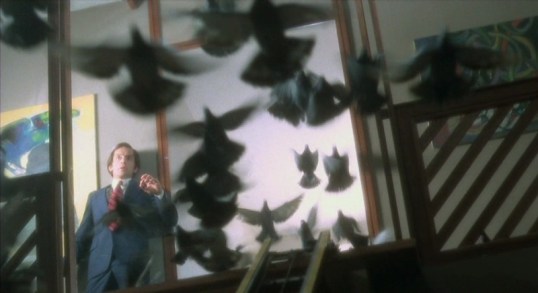
Much as in The Omen, anyone who gets too close to discovering the truth about Katy ends up dying an elaborate and bloody way.  Often times, their death involves black crows, who the film suggests might actually be all of those little bald kids in animal disguise. So is Jesus sending those crows to kill people?  Seriously, this movie is weird.

Beware the Crows

Beware the Crows

Meanwhile, Katy’s mom is having doubts about both Raymond and her daughter.  She even goes and talks to her ex-husband, an abortionist who is played by yet another film director, in this case Sam Peckinpah.  Katy gets annoyed with her mom and, after happening to come across a gun hidden away inside of a birthday presents, shoots her in the back and leaves her paralyzed.

And did I mention that Katy is telekinetic, much like Carrie?  That’s right!  During my favorite scene, Katy goes skating at the local mall’s ice rink and, after a group of boys bully her, she uses her powers to send those bullies flying all over the mall.  Oddly enough, nobody seems to notice this chaos.  Except, of course, for Jerzy who just stands off in the corner and watches without doing anything…

Seriously, I love The Visitor.  Along with being surprisingly well-acted and visually inventive, the film is just so weird!  In many ways, it epitomizes everything that I love about the old Italian exploitation films.  While it is rather shameless about ripping off other movies, the film still brings its own unique spin to everything.

Normally, I’d say that The Visitor is a good film for Halloween but you know what?  Anytime is a good time for an Italian horror film!

Welcome

Welcome


Horror on The Lens: Night of the Living Dead (dir by George Romero)


429px-Night_of_the_Living_Dead_affiche

Happy Halloween!

Here at the Shattered Lens, we’re all about tradition!  And what could be a better tradition than watching Night of the Living Dead on Halloween?

Watch it below and enjoy!  And then, after you’ve watched it, be sure to read Arleigh’s excellent review!

Horror On The Lens: Los Monstruos del Terror (dir by Tulio Demicheli, Hugo Fregonese and Eberhard Meichsner)


For today’s Horror on The Lens, we have a Spanish film that was originally made in 1969 and given an international release in 1970.  In the United States, it was released under several different names: Monsters of Terror, Assignment: Terror, and Dracula vs. Frankenstein.

Despite the title, this film really isn’t about Dracula fighting Frankenstein.  There is, of course, a Frankenstein monster in the film and there is a vampire who, in some versions of the film, is referred to as being Dracula and, in other versions, is referred to by a lot of other names.  (What’s he called in the version below?  You’ll have to watch to find out.)

What this film is about is Waldemar Danisky, a tragic werewolf who was played by Paul Naschy in a series of films.  In this, his third appearance, Waldemar and a host of other monsters are brought back to life by aliens who are looking to take over the Earth.  Fortunately, Waldermar is a werewolf with a conscience and battles not only the aliens but the other monsters as well.

Yes, it’s all a bit silly and really doesn’t make much sense but you really owe it to yourself to watch at least one Paul Naschy film before this October ends..


The Cutest Version of Gone Girl That You’ll Ever See!


Let’s take just a small break from horror and instead, let’s watch something that’s really cute.  And kinda horrific.  Here’s is the Pet Collective’s version of Gone Girl!

(And be sure to check out the Pet Collective’s version of Boyhood as well!)