Embracing the Melodrama Part II #107: No Country For Old Men (dir by the Coen Brothers)


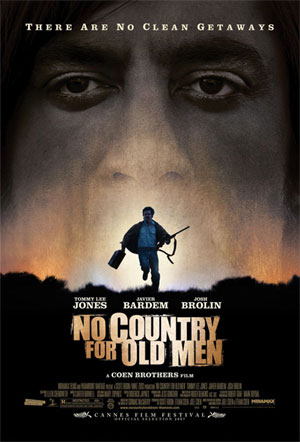
No_Country_for_Old_Men_posterI love my home state of Texas and I love movies. Therefore, it has always upset me that most movies set in Texas get the state totally wrong.  That’s not exactly shocking.  Unlike the rest of the states, there’s actually a lot of variety to Texas.  We’re a big state and we’re home to a lot of people.  Unlike some place like Vermont, Texas is a world all its own and it’s not surprising that most outsiders are incapable of getting their mind around that and instead find themselves embracing simple-minded clichés and stereotypes.  That’s perhaps why the best films about Texas tend to be ones that were actually made by Texans.  If you want to see the real Texas — flaws and all — than I suggest watching the films of Richard Linklater or perhaps Wes Anderson’s Rushmore.

And yet, it took two outsiders to write, produce, and direct one of the best films ever made about Texas.  The 2007 best picture winner No Country For Old Men was largely the work of two brothers from Minnesota, Joel and Ethan Coen.  It’s not only one of the best films about my home state but it’s also one of the best films of the past decade.

Based on a novel by Cormac McCarthy, No Country For Old Men tells the story of three determined men in South Texas whose lives are interconnected despite the fact that three of them spend almost the entire movie one step behind each other.  In fact, despite a few brief encounters where their paths meet, it can be argued that, at no point, do any of them truly interact with each other face-to-face.

Llewelyn Moss (Josh Brolin) is the type of person that anyone who has ever lived in Texas will have met.  He’s a hard-working, plain-spoken man, the type who drives a pickup, owns a gun, and likes to begin and end the day with a beer.  He lives in a trailer with his wife, Carla Jean (Kelly MacDonald, who may be Scottish but speaks here with an almost flawless Texas accent).  Llewelyn’s not a bad guy but he’s not as smart as he thinks and, like a lot of folks down here, he doesn’t like the idea of being told what to do.  In fact, he’d almost rather die for his trouble than admit to making a mistake.  When Llewleyn comes across the aftermath of a drug deal turned violent, he takes off with a suitcase that contains $2,000,000.  After barely escaping the remaining drug dealers (and the scene where Llewelyn is chased by a pit bull is a classic), Llewelyn sends Carla Jeans to stay with her sick mother and then he grabs the suitcase and heads over to the next county.  It quickly becomes apparent, to the viewers at least, that Llewelyn has absolutely no idea how to get out of the mess that he’s found himself in.

And it’s quite a mess because Anton Chigurh (Javier Bardem) has been hired to track down the money.  Perhaps one of the greatest movie villains of all time, Chigurh is an almost unstoppable force of death and destruction.  Chigurh pursues Llewelyn across Texas, killing almost everyone who he meets along the way.  Interestingly enough, just as Llewelyn continually makes excuses for his own greed, Chigurh also makes excuses for his murderous activities, seeming to obsess over the role of fate and chance.  Whereas Llewelyn refuses to give up the suitcase, even though it means that he’s putting his own wife in danger, because he insists that he can figure out a way to keep the money, Chigurh occasionally dodges responsibility for his own actions by flipping a coin and putting the blame on fate.

And finally, there’s Sheriff Ed Tom Bell (Tommy Lee Jones), who is both the most decent and the most ineffectual male character to be found in the film.  He’s an old-fashioned lawman, the type who, had this film been made in the 50s or the 60s, would have been played by Gary Cooper and would have both vanquished Chigurh and given Llewelyn and Carla Jean marriage advice as well.  In the world of No Country For Old Men, however, Ed is almost always one step behind both Chigurh and Llewelyn.  Instead of saving the day, Ed spends most of the movie shocked and saddened by the violence around him.  As the film draws to its conclusion, he’s left to wonder whether any one man can make a difference.  He’s left to literally wonder whether his area of South Texas has truly become no country for old men.

I recently rewatched No Country For Old Men on TCM and I was surprised to discover just how well this film holds up, even after repeat viewings.  If anything, the film actually improves on repeat viewings.  Once you know how the story is going to end (and, in a fashion typical of both the Coens and Cormac McCarthy, No Country For Old Men does not have a traditional ending), it’s easier to see all of the things that you may have been too overwhelmed to appreciate the first time, like Kelley McDonald’s performance as Carla Jean and Stephen Root’s cameo as Chigurh’s shady employer.

However, for me, the main reason that I appreciate No Country For Old Men is because it is one of the few films that actually manages to get South Texas right.  My mom was born and grew up in South Texas, in the town of Benavides to be exact.  I’ve spent a lot of time down there.  The portrait that No Country For Old Man paints of South Texas is not always flattering but it is largely accurate.  No County For Old Men captures both the region’s terrifying violence and its natural beauty.  It’s honest about the fact that there are men like Anton Chigurh but, at the same time, you occasionally meet an Ed Tom Bell as well.  And, of course, there’s a Llewelyn Moss in every town.  He’s the one who you meet and you hope — often against your better instincts — that he won’t get in over his head.

The Academy named No Country For Old Men the best film of 2007.  For once, the Academy was right.
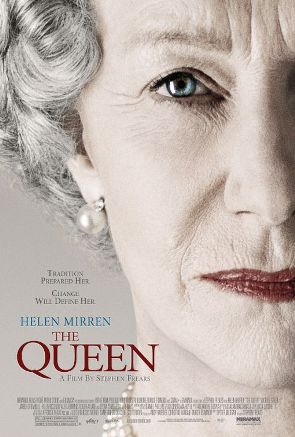
Embracing the Melodrama Part II #106: The Queen (dir by Stephen Frears)


The_Queen_movieIt recently occurred to me that, if you were so inclined, you could reconstruct the entire history of the British royal family by watching movies that have been nominated for best picture.

You would start, of course, by watching Becket.  Then you’d move on to The Lion In Winter.  After The Lion in Winter, you’ll enjoy a double feature of Ivanhoe and The Adventures of Robin Hood.  After that, it’s time to watch Henry V.   When it comes to Henry VIII, you’ve actually got three films to choose from: The Private Life of Henry VIII, A Man For All Seasons, or Anne of The Thousand Days.  I suggest that you go with the Private Life of Henry VIII and then follow it up with a double feature of Elizabeth and Shakespeare in Love.  After that, you’ll jump forward in time a bit.  You’ll watch The Madness of King George and Mrs. Brown because, even though neither was nominated for best picture, they both feature Oscar-nominated royal performances.  Finally, you’ll watch Chariots of Fire and The King’s Speech.  And, after all of that, you’ll end things by watching the 2006 Best Picture nominee The Queen.

And what a way to end!  The Queen is perhaps the best of the many Oscar-nominated films to be made about British royalty.  While the Queen is rightly known for being the film that finally won the great Helen Mirren an Oscar, it’s also a witty and frequently poignant look at how a group of entrenched people are forced to adapt to a changing world.  It’s a film that works not just because Helen Mirren gives a good performance in the role of Queen Elizabeth II but also because she humanizes Elizabeth, turning her into a character to whom viewers can relate.

The film opens with the death of Princess Diana in Paris.  As the world mourns, the British royal family struggles with how to deal with the tragedy.  Prince Charles (Alex Jennings) worries about the well-being of his sons.  Prince Philip (James Cromwell) is rather haughtily unconcerned with how the general public feels about Diana or the rest of the royal family.  The Queen Mother (Syliva Syms) continues to insist that the Royal Family is just as important as it has always been.  Only Queen Elizabeth (Helen Mirren) seems to truly understand that the Royal Family cannot continue to cut itself off from the rest of the world.  Even though Elizabeth understands that the world outside of Buckingham Palace has changed, she’s still unsure about what her place in this new world will be.

Of course, not only does Elizabeth have to adjust with the changing values of the British public but she also has to deal with a new prime minister.  Tony Blair (Michael Sheen) has been swept into office, pledging that he’s going to “modernize” British society.  While the politically savvy Blair is determined to treat Elizabeth with respect, some of his closest advisers do little to disguise the contempt with which they view the royal family.  This include Tony’s own wife, Cherie (Helen McCrory).

And so, while self-styled reformer Blair finds himself in the strange position of defending tradition, Elizabeth tries to figure whether those traditions still matter in changing times.

The Queen is a film that demands an intelligent audience, one that is capable of enjoying a film based solely on the basis of good acting and intelligent dialogue.  The Queen‘s triumph is that it humanizes an iconic figure and reminds us that even the biggest events are both historical and personal.  I have no idea whether the real Elizabeth is anything like the character played by Helen Mirren but I certainly hope she is.

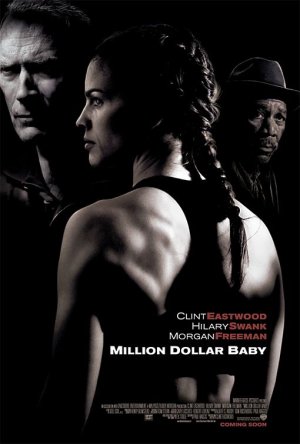
Embracing the Melodrama Part II #105: Million Dollar Baby (dir by Clint Eastwood)


Million_Dollar_Baby_poster

(This review and the Spanish trailer below are dedicated to mi madre, who saw Million Dollar Baby when it was first released and told me that, even though the film had been nominated for lots of Oscars, I shouldn’t watch it until I was in a better and more stable place emotionally.  She was right.)

Two months ago, I started Embracing the Melodrama Part II.  At the time, I announced that I would be reviewing 126 cinematic melodramas and I would get it all done in 3 weeks time!  Well, here we are 8 weeks into it and we are just now approaching the finish line.  That’s okay, though.  Even if it’s taken me longer than I thought it would, I’ve still been having fun writing and sharing these reviews.

I’ve been posting these reviews in chronological order.  Though it may be hard to remember, we started with a 1927 silent classic called Sunrise.  From Sunrise, we’ve worked our way through history and we’ve taken a look at films that are both famous and obscure.  And now, 104 reviews later, we finally reach the 2004 best picture winner, Million Dollar Baby.

When I first saw Million Dollar Baby, I had two reactions.  On the one hand, I thought it was a great film.  I thought it was a film that featured great performances and which gave me a chance to experience a world that I did not know much about.  I thought to myself, “This is a film that future directors will cite as an influence.  This is a film that proves that, even if he does sometimes make movies like Hereafter or Jersey Boys, Clint Eastwood still deserves to be known as a great American filmmaker.”  On the other hand, I thought to myself, “This film is so damn depressing that there’s no way I’m ever going to watch it again.”

And really, it is an amazingly sad film.  When the film starts, of course, you don’t think it’s going to be sad.  You think it’s going to be your standard sports film, the one where the underdog beats the odds and becomes a champion.  For one thing, the film is narrated by Morgan Freeman and Morgan’s got that voice that makes you believe that there is some justice to the universe.  Secondly, Hillary Swank is so appealing in the role of Maggie, a waitress who wants to become a boxer, that you just know she deserves a happy ending.  At first, veteran trainer Frankie (Clint Eastwood) refuses to work with her but her determination wins him over.  And soon, Frankie — who, in typical Clint movie fashion, has a strained relationship with his daughter — becomes a father figure for Maggie.

And as you watch Maggie find success as a boxer, you’re so happy for her.  I certainly was, despite the fact that I know next to nothing about boxing beyond the fact that it’s something that I would never want to do.  And when Clint starts to soften up to her, you’re not surprised.  After all, he’s craggly old Clint Eastwood.  He’s scary but we all know he has a heart of gold.  Add to that, Morgan Freeman’s still telling the story and surely the voice of God would not allow anything bad to happen…

And then … tragedy.  By the time that I finally saw Million Dollar Baby, I already knew the story’s big twist.  I knew that, as a result of a brutal fight, Maggie would be left paralyzed.  I knew that she would beg Frankie to euthanize her.  But seriously, imagine what a shock it must have been for audiences when this film first came out.

I mean, everything’s going perfectly and then suddenly, it’s not.

To a certain extent, I was jealous of those who got to see Million Dollar Baby without any advanced knowledge of the tragedy that defines the final third of the film.  When I watched the film, I found myself dreading the thought of enjoying any of Maggie’s triumphs because I knew what was going to happen.  Those who watched the film with know knowledge may have been shocked but at least they got to believe, for a few scenes, that Maggie could find that perfect sports film ending.

Then again, Million Dollar Baby is a great film because it refuses the temptation to give us the ending that we all want and expect.  Instead, it’s a movie that celebrates the people who will be there for you even when thing’s suddenly aren’t perfect.

That’s why Million Dollar Baby works as well as it does.  Unfortunately, it’s also why it’s a film that I could only watch once.

http://www.youtube.com/watch?v=Sva4p3E6p4o

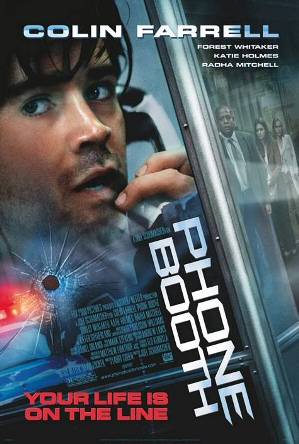
Embracing the Melodrama Part II #104: Phone Booth (dir by Joel Schumacher)


Phone_Booth_movie (1)

First released in 2003, Phone Booth is a good film.

Now, I know that you’re probably thinking, “Okay, that’s good, Lisa.  There were a lot of good films released in 2003.  I can’t think of any off the top of my head but let me go look on Wikipedia and I’m sure I can come back with a few dozen good films and…”

Well, before you go over to Wikipedia and do a search on 2003 in film (and I even included a direct link to make it easy for you because I like to be helpful), allow me to point something else out about Phone Booth.

Phone Booth is not only a good film but it’s a good film that was directed by Joel Schumacher!

That’s right!  There are several online film critics who will tell you that Joel Schumacher is one of the worst directors of all time and, to be honest, there’s actually a pretty good argument that can be made in support of that.  However, Schumacher did direct both The Lost Boys and Phone Booth.  So, he’s directed at least two good films and that’s two more than Uwe Boll.

In Phone Booth, Colin Farrell plays Stu, a slick publicist who has both a wife named Kelly (Radha Mitchell) and a girlfriend named Pam (Katie Holmes).  When Stu steps into the last remaining phone booth in New York City in order to call his girlfriend, he’s shocked when a pizza deliveryman shows up and attempts to give him a pizza.  No sooner has he gotten rid of the pizzaman (and, seriously, who turns down free pizza?), the phone rings.  Stu answers and is told by an unseen sniper (voice by Kiefer Sutherland) that, if he leaves the phone booth, he will be shot.  The sniper goes on to order Stu to tell the truth to both Kelly and Pam or to risk being shot as a consequence.

While all of this is going on, a group of prostitutes demand that Stu get out of the booth and let them use the phone.  When Stu refuses, their pimp approaches the booth and is promptly gunned down by the sniper.  Soon, under the assumption that Stu has a weapon, the police — led by Forest Whitaker — have surrounded the booth and are demanding that Stu step out.  The sniper, however, reminds Stu that he’ll be shot if he leaves the booth.

As a crowd of onlookers (including Pam and Kelly), police, and reporters surround the booth, Stu finds himself literally with no escape…

Telling the story in real time and keeping the film largely focused on Stu’s increasing desperation, Schumacher actually does a pretty good job with Phone Booth.  Colin Farrell gives a great performance, making Stu into a character who you like despite yourself.  While Kiefer Sutherland never appears onscreen, his sexy growl of a voice works wonders and he even manages to sell the point where his character starts to maniacally laugh.  Reportedly, screenwriter Larry Cohen came up with the idea for Phone Booth way back in the 1960s.  It took nearly 40 years for the film to be made but Schumacher, Farrell, and Sutherland made it more than worth the wait.

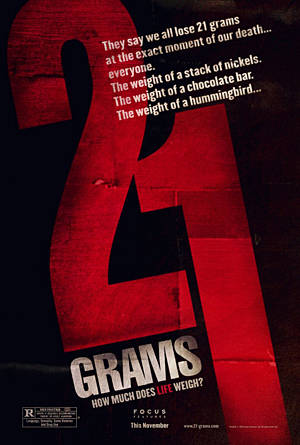
Embracing the Melodrama Part II #103: 21 Grams (dir by Alejandro Gonzalez Inarritu)


21_grams_movieRemember how shocked a lot of us were when we first saw Birdman?  Well, it wasn’t just because Birdman featured an underwear-clad Michael Keaton levitating in his dressing room.  And it also wasn’t just because Birdman was edited to make it appear as if it had been filmed in one continuous take (though, to be honest, I would argue that the whole “one continuous shot” thing added little to the film’s narrative and was more distracting than anything else.)  No, the main reason we were shocked was that Birdman was directed by Alejandro Gonzalez Inarritu and, when we thought of an Inarritu film, we thought of something like 2003’s 21 Grams.

It’s not easy to explain the plot of 21 Grams, despite the fact that 21 Grams does not tell a particularly complicated story.  In fact, if anything, the plot of 21 Grams feels like something that either Douglas Sirk or Nicholas Ray could have come up with in the 50s.  Indeed, the plot of 21 Grams is far less important than the way the Inarritu tells the story.  (In that, the dark and grim 21 Grams does have something in common with the arguably comedic Birdman.)

Inarritu tells his story out of chronological order.  That, in itself, is nothing spectacular.  Many directors use the same technique.  What distinguishes 21 Grams is the extreme to which Inarritu takes his non-chronological approach.  Scenes play out with deceptive randomness and it is left to the viewer to try to figure out how each individual scene fits into the film’s big picture.  As you watch 21 Grams, you find yourself thankful for little details like Sean Penn’s beard, the varying lengths of Naomi Watts’s hair, and the amount of sadness in Benicio Del Toro’s eyes because it’s only by paying attention to those little details can we piece together how once scene relates to another.

The film tells the story of three people whose lives are disrupted by the type of tragedies that the pre-Birdman Innaritu was best known for.

Sean Penn plays Paul Rivers, who is a sickly mathematician who desperately needs a new heart.  He’s married to a Mary (Charlotte Gainsbourg), who devotes all of her time to taking care of him and is frustrated by Paul’s fatalistic attitude towards his condition.  When Paul does finally get a new heart, he gets a new existence but is haunted by the fact that it has come at the expense of another man’s life.

Christina Peck (played by Naomi Watts) is a former drug addict who is now married with kids and who appears to have the perfect life.  That is until her husband and children are tragically killed and, in her grief, Christina falls back into her old lifestyle.  The formerly stable and happy Christina becomes obsessed with the idea of getting revenge for all that she has lost.  Naomi Watts was deservedly nominated for an Oscar for her work here.  Her vulnerable and emotionally raw performance holds your interest, even when you’re struggling to follow the film’s jumbled chronology.

And finally, there’s Jack Jordan (Benicio Del Toro).  Like Christina, Jack is a former drug addict.  Whereas Christina used the stability of family life to help her escape from her demons, Jack uses his new-found Christianity.  And just as Christina struggles after she loses her family, Jack struggles after tragedy causes him to lose his faith.  Like Paul, he struggles with why he’s been allowed to live while other have not.  Del Toro was nominated for an Oscar here and, like Watts, he more than deserved the nomination.

(While Sean Penn was not nominated for his performance in 21 Grams, he still won the Oscar for his role in Mystic River.)

21 Grams is a powerful and deeply sad film, one that will probably shock anyone who only knows Inarritu for his work on Birdman.  21 Grams is not always an easy film to watch.  Both emotionally and narratively, it’s challenging.  But everyone should accept the challenge.


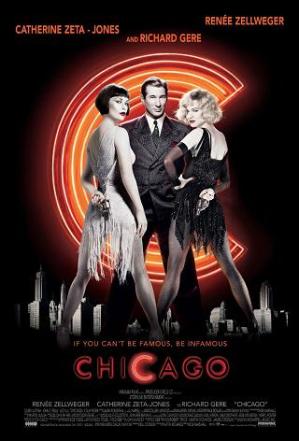
Embracing the Melodrama Part II #102: Chicago (dir by Rob Marshall)


ChicagopostercastIt’s strange to refer to a best picture winner as being underrated but that’s exactly the perfect description for the 2002 film Chicago.

When Chicago was named the best picture of 2002, it was the first musical to take the top prize since The Sound of Music won in 1965.  Until the box office success and Oscar triumph of Chicago, it was assumed by many that a musical had to be animated in order to be successful.  After Chicago won, the conventional wisdom was changed.  Dreamgirls, Nine, Rock of Ages, Hairspray, Jersey Boys,  Into the Woods, Les Miserables, none of these films would have been produced if not for the success of Chicago.  It’s also due to Chicago that television networks are willing to take chances on shows like Glee and Smash.  And while I think a very valid argument could be made that we would all be better off without Glee, Smash, and Rock of Ages, you still can not deny that Chicago both challenged and changed the conventional wisdom.

https://twitter.com/Delanynder/status/606251356136042496

And yet, despite its success and its continuing influence, Chicago is one of those best picture winners that often seems to get dismissed online.  Some of that’s because, by winning best picture, Chicago defeated not only The Two Towers (which is arguably the best installment in Peter Jackson’s Lord of the Rings trilogy) but also Roman Polanski’s searing masterpiece, The Pianist.  Critics often point out that The Pianist won for best adapted screenplay, best actor, and best director but Chicago somehow managed to win best picture.  They suggest that the Academy was either worried about the implications of giving best picture to a film directed by Roman Polanski or else they were blinded by Chicago‘s razzle dazzle.  They argue that Chicago was merely an adaptation of an iconic stage production, whereas The Pianist and The Two Towers were both the result of visionary directors.

Well, to be honest, I think those critics do have a point.  The Pianist is one of the most emotionally devastating films that I have ever seen.  The Two Towers is the perfect mix of spectacle and emotion.  And yet, with all that in mind, I still love Chicago.

And it’s not just because of scenes like this:

Or this:

Or even this scene of Richard Gere tap dancing:

If you’ve been reading this site for a while then you know my bias.  You know that I grew up dancing.  You know that I love to dance.  And you know that I automatically love any film that features a dance number.  And, since you know my bias, you may be thinking to yourself, “Well, of course Lisa likes this….”  And you’re right.

But you know what?  Even if nobody danced a step in this film, I would still enjoy it.  (Though it would be odd to see a musical with absolutely no dancing.)  Chicago is not just about spectacle.  Instead, it tells a very interesting story, one that is probably even more relevant today than when the film was first released.

Set in 1924, Chicago tells the story of Roxie Hart (Renee Zellweger).  Married to the decent but boring Amos (John C. Reilly), Roxie wants to be a star.  She has an affair with slrazy Fred Casely (Dominic West), believing that he has showbiz connections.  When Fred finally admits to her that he lied in order to sleep with her, Roxie reacts by murdering him.  Because Roxie is pretty and blonde and claims to have been corrupted by the big, bad, decadent city, she becomes a celebrity even while she sits in jail and awaits trial.

Also in the jail is Velma Kelly (Catherine Zeta-Jones), a nightclub singer who killed her husband and sister.  Roxie idolizes Velma but, after Velma snubs her, a rivalry forms between the two.  Roxie hires Velma’s lawyer, the slick Billy Flynn (Richard Gere).  During the trial, Roxie becomes even more popular, Velma grows jealous, and the only innocent women on death row — a Hungarian who can’t speak English — is ignored and executed because she doesn’t make for a good news story.

Chicago is a cynical and acerbic look at both the mad pursuit of celebrity and the pitfalls of the American justice system.  In its way, it’s the film that predicted the Kardashians.  (If Roxie had been born several decades later, it’s not difficult to imagine that she’d build her career off of a sex tape as opposed to murder.)  Renee Zellweger and Catherine Zeta-Jones are both sociopathic marvels in their respective roles.  Even Richard Gere, who, in other films, can come across as being oddly empty, is perfectly cast and surprisingly witty in the role of Billy.

Director Rob Marshall does a great job of making this stage adaptation feel truly cinematic.  At no point does Chicago feel stagey.  Perhaps Marshall’s smartest decision was to tell the entire film through Roxie’s eyes.  Every musical lives and dies based on whether it can convince the audience that it would perfectly natural for everyone onscreen to suddenly break out into song.  Chicago is convincing because, of course, Roxie would view her life as being a musical.

And did I mention that the film features a lot of great dancing?

Because it so seriously does….

So, yes, it can be argued that Chicago beat out some worthier films for the title of best picture of the year.  But, regardless, it’s still a good and memorable film.

Embracing the Melodrama Part II #101: Harvard Man (dir by James Toback)


https://twitter.com/hrmonie/status/358515665419763713

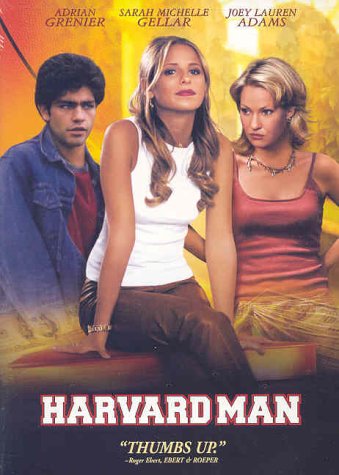
Oh please, Harvard Man sucks.

I watched this 2002 film for one reason and one reason only.  It stars Sarah Michelle Gellar and I used love Buffy the Vampire Slayer.  In fact, now that I think about it, my love for Buffy the Vampire Slayer has led to me watching a lot of really bad movies.  Seriously, somebody give Nichols Brendon a role in a good movie and do it now!  I’m tired of reading about him getting arrested at conventions.

But anyway, in Harvard Man, Sarah plays Cindy Bandolini, a student at Harvard.  Her father is a gangster and he’s played Gianni Russo, who is best known for playing Carlo Rizzi in The Godfather.  Cindy is also dating the star of Harvard’s basketball team, Alan Jenson (Adrian Grenier).  Cindy knows that Alan’s parents have just lost their farm to a tornado.  She tells Alan that if he’ll throw an upcoming basketball game, her father will pay him $100,000.  However, Mr. Bandolini isn’t really in on the deal.  Instead, Cindy has set it up herself with the help of two of her father’s associates, Teddy (Eric Stoltz) and Teddy’s girlfriend, Kelly (Rebecca Gayheart).

But what Cindy doesn’t know is that both Teddy and Kelly work for the FBI.  She also doesn’t know that Teddy and Kelly are engaging in threesomes with a philosophy professor, Chesney Cort (Joey Lauren Adams) and that Chesney is also having an affair with Alan.

Got all that?

Good.  Of course, it doesn’t really make that much of a difference because Alan is such a passive character that you get the feeling that he really doesn’t care what happens one way or another.  About halfway through the film, he takes a massive dose of LSD and he spends the rest of the film tripping while all of the various characters chase him across Boston.

And then Al Franken shows up, playing himself.  As Alan wanders across campus, Al Franken walks up to him and says, “Hi, I’m Al Franken.”  It turns out that the future senator is showing his daughter around Harvard and wants to ask Alan what the campus is like nowadays.  As future President Franken speaks in his nasal tones, we get all sorts of fun distortion effects so, if you’ve ever wanted to see Al Franken with a big googly face, Harvard Man is the film for you.  Al Franken’s scenes are, however, partially redeemed by the way that the actress playing his daughter rolls her eyes at her desperately uncool dad.

And, of course, while this is going on, we get random scenes of Joey Lauren Adams giving an endless lecture about ethics.  Why, exactly?  I imagine it has something to do with fooling critics like me and making us mistake Harvard Man for a movie with a brain.

Harvard Man is a pretentious mess of a film but it’s a fascinating example of what happens when every single role in a movie is miscast.  Eric Stoltz and Rebecca Gayheart are the least believable FBI agents ever.  You don’t believe for a second that short and scrawny Adrian Grenier could be a basketball star.  Joey Lauren Adams comes across like she’d be lucky to teach at Greendale Community College, much less Harvard.  Al Franken makes for a remarkably unconvincing Al Franken.  And, as much as I loved her in Buffy, Cruel Intentions, and Ringer, I do have to say Sarah Michelle Geller is one of the least convincing Italians that I have ever seen on-screen.

Harvard Man is an incredibly bad film but at least you get to see Al Franken with a googly face,

HARVARDMAN

Embracing the Melodrama Part II #100: Pearl Harbor (dir by Michael Bay)


Pearl_harbor_movie_poster

“And then all this happened…”

Nurse Evelyn Johnson (Kate Beckinsale) in Pearl Harbor (2001)

The “this” that Evelyn Johnson is referring to is the Japanese attack on Pearl Harbor.  You know, the date will live in infamy.  The attack that caused the United States to enter World War II and, as a result, eventually led to collapse of the Axis Powers.  The attack that left over 2,000 men died and 1,178 wounded.  That attack.

In the 2001 film Pearl Harbor, that attack is just one of the many complications in the romance between Danny (Ben Affleck), his best friend Rafe (Josh Hartnett), and Evelyn (Kate Beckinsale).  The other complications include Danny briefly being listed as dead, Danny being dyslexic before anyone knew what dyslexia was (and yet, later, he’s still seen reading and writing letters with absolutely no trouble, almost as if the filmmakers forgot they had made such a big deal about him not being able to do so), and the fact that Rafe really, really likes Evelyn.  Of course, the main complication to their romance is that this is a Michael Bay film and he won’t stop moving the camera long enough for anyone to have a genuine emotion.

I imagine that Pearl Harbor was an attempt to duplicate the success of Titanic, by setting an extremely predictable love story against the backdrop of a real-life historical tragedy.  Say what you will about Titanic (and there are certain lines in that film that, when I rehear them today, make me cringe), Leonardo DiCaprio and Kate Winslet had genuine chemistry.  None of that chemistry is present in Pearl Harbor.  You don’t believe, for a second, that Ben Affleck and Josh Hartnett are lifelong friends.  You don’t believe that Kate Beckinsale is torn between the two of them.  Instead, you just feel like you’re watching three actors who are struggling to give a performance when they’re being directed by a director who is more interested in blowing people up than in getting to know them.

Continuing the Titanic comparison, Pearl Harbor‘s script absolutely sucks.  Along with that line about “all this” happening, there’s also a scene where Franklin D. Roosevelt (Jon Voight) reacts to his cabinet’s skepticism by rising to his feet and announcing that if he, a man famously crippled by polio and confined to a wheelchair, can stand up, then America can win a war.

I’ve actually been to Pearl Harbor in Hawaii.  I have gone to the USS Arizona Memorial.  I have stood and stared down at the remains of the ship resting below the surface of the ocean.  It’s an awe-inspiring and humbling site, one that leaves you very aware that over a thousand men lost their lives when the Arizona sank.

I have also seen the wall which lists the name of everyone who was killed during the attack on Pearl Harbor and until you’ve actually been there and you’ve seen it with your own eyes, you really can’t understand just how overwhelming it all is.  The picture below was taken by my sister, Erin.

Pearl Harbor 2003If you want to pay tribute to those who lost their lives at Pearl Harbor, going to the Arizona Memorial is a good start.  But avoid Michael Bay’s Pearl Harbor at all costs.

Embracing the Melodrama Part II #99: Pay It Forward (dir by Mimi Leder)


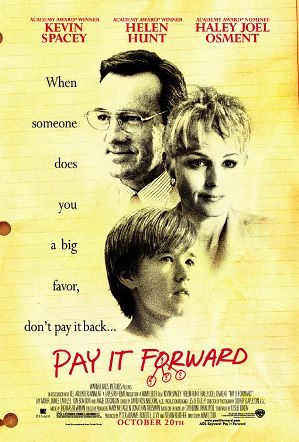
Pay_it_forward_ver1Speaking of crappy films…

Listen, I’m not going to say too much about the 2000 film Pay It Forward because it’s such a terrible movie that I feel like writing too much about it would be like the equivalent of having sex in It Follows.  Seriously, you talk too much about Pay It Forward and you’ll end up with some sort of shape-shifting demon following you around, doing you favors and demanding that you do three more favors for three other people and then those people have to do three more favors and pretty soon, everyone in the world is doing favors for everyone and…

AGCK!

Okay, okay — I know that probably doesn’t sound too bad to some people.  “People being nice to each other!?  What could be wrong about that?”  Well, watch the damn film and find out.

In Pay it Forward, Haley Joel Osment plays a creepy little kid who basically “saves” the world.  At the end of the film, he’s violently murdered and the entire population of Las Vegas gathers outside of his house with candles.  His mother Helen Hunt is truly touched that everyone was so moved by Haley’s mission.  That said, if Haley had never decided that everyone should pay it forward, he probably wouldn’t be dead.  I mean, let’s just be honest here.

Before he died, Haley was challenged by his social studies teacher, Kevin Spacey.  Mr. Spacey challenged an entire class of 7th graders to come up with an idea that will change the world.  (Honestly, don’t 7th graders already have enough to deal with?)  Haley’s idea is that he’ll do a favor for three random people and then those three people will do three nice things for three people and then…

BLEH!  God, I hate this movie!

Anyway, Haley gives money to a homeless man and then that homeless man keeps a woman from committing suicide and then that woman does something nice for Angie Dickinson and then somehow, this all eventually leads to some rich guy giving Jay Mohr a car and telling him to “pay it foward.”

And Jay’s a reporter!

So, naturally, he starts to work his way backwards on the chain of good deeds.  Along the way, he meets a prison inmate who has been converted to Pay It Forwardism.  “This is going to change the world!” he tells Jay.  “I’m even getting the brothers in here in on it!”

By the way, there’s exactly one person of color in Pay It Forward and he’s a prison inmate who thinks that other inmates will want to do random favors for each other.

Oh, but Haley has to do two other favors!  So, he sets Helen Hunt up with Kevin Spacey and when he catches his teacher coming out his mom’s bedroom, Haley gets really, really excited and … well, it’s pretty creepy.

At first, Helen thinks that Kevin thinks that she’s not smart enough to date him.  When Helen asks him point blank if he thinks that she’s dumb, he responds by giving a really long monologue about the time that his father set him on fire.  Kevin does not mention what his father was attempting to pay forward…

And then Jay shows up in town and interviews Haley and oh my God, Haley’s going to change the world!  Yay!  But then Haley spends his third favor trying to protect a kid (played by Degrassi‘s Marc Donato) from some bullies and ends up getting stabbed to death.

But fear not!  Along with that candlelight vigil, we also hear an anchorwoman breathlessly reporting that there have been reports of “Pay it Forwardism” across the country.

Now, there’s a lot of negative things that I could say about Pay It Forward but … well, I kinda already did.  Pay It Forward pops up on TV a lot and there’s a lot of idiots who always get excited about it.

https://twitter.com/_sierraalynn/status/606195871949156353

https://twitter.com/TreyClark56/status/605372272690356225

https://twitter.com/KelliOtto_/status/605370371248951296

Here’s my fear concerning the whole Pay It Forward idea.  It seems like anybody can just do anything and then go, “Pay it forward,” and suddenly, you are obligated to go do three favors.  You may be running late.  You may have other things you need to do.  But no, you’ve been told to pay it forward and now, you have to!  Because of one creepy little kid who wanted his social studies teacher to have sex with his mom, you have now been inconvenienced.

There doesn’t seem to be any rule about how big of a favor anyone actually has to do before they can smugly order you to “Pay it forward.”  Think about this.  You’re trying to get a Coke from a vending machine but all of your dollars are all crumbled up and the machine won’t accept them.  You’re about to give up and go home when suddenly, a stranger walks up and deposits three quarters in the machine and punches a button.

He tosses you a grape drink.  You wanted a Coke but, because you’re nice and you think he was selflessly trying to help you out, you smile and say, “Thank you.”

“Pay it forward,” he replies before walking away.

Well, now, you’re screwed, aren’t you?

Now, suddenly, you have to go find three people who need a favor.  You didn’t want grape.  You wanted a Coke and, even if you had never gotten that Coke, it would not have been the end of the world.  But, because you were polite and said thank you, you are now obligated.

As you look for people to help, it occurs to you that stranger really didn’t care about whether you wanted a Coke.  What he cared about was completing his third favor so he could actually get on with his life.  So, no, he wasn’t trying to help you or trying to make the world a better place.  Instead, he was just trying to free himself of a nagging obligation.

So, after a long search, you’ve finally found your three strangers and you’ve done your three favors and you’re finally free of your obligation.  And then suddenly, another stranger runs up and tosses you the keys to one of those stupid looking Smart cars and yells, “Pay it forward!”

SERIOUSLY, IT NEVER ENDS!

Don’t tell me about paying it forward.

Just leave me alone and let me drink my damn Coke.

Embracing the Melodrama Part II #98: American Beauty (dir by Sam Mendes)


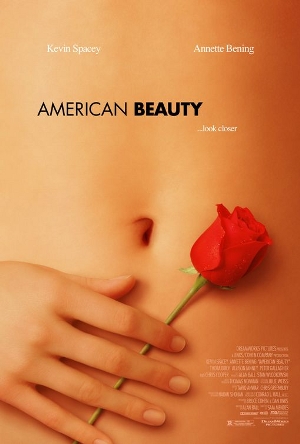
American_Beauty_posterWhat crap!

I know, I know.  “American Beauty is an incisive satire that looks at the stifling conformity of American suburbia with Kevin Spacey giving the definitive portrait of the male midlife crisis and blah blah blah blah blah blah.”  Listen, American Beauty is a terrible film.  I don’t care if it won a lot of Oscars, including the 1999 award for best picture.  American Beauty is a shallow film that, at its worst, is deeply misogynistic.

American Beauty tells the story of two people.  They’re married.  They live in the suburbs.  They have a teenage daughter who is a cheerleader.  They pretend to have the perfect life but actually, everyone’s extremely unhappy.

WOW!  OH MY GOD!  PEOPLE ARE SECRETLY UNHAPPY IN THE SUBURBS!?  MY MIND IS BLOWN!  WOW, NO ONE’S EVER HAD THAT THOUGHT BEFORE!  OH.  MY.  GOD!

Anyway, the husband is named Lester (Kevin Spacey).  Lester’s a loser.  He narrates the film and he’s played by Kevin Spacey so you’re supposed to think that he’s really this great guy who deserves better but honestly, Lester’s a whiny little jerk.  He’s upset because, now that he’s an adult, he misses being a teenager.  Life hasn’t turned out the way that he wanted it to.  Boo hoo.  As I said, Lester is kind of whiny but the film treats him like he’s an enlightened truth seeker.  In order to keep the audience from realizing that Lester is a loser, the film surrounds him with one-dimensional stereotypes.

And really, Lester is the ultimate male fantasy.  Everything that he says and thinks is wise.  His every thought and feeling matters.  To its discredit, the world has failed to recognize that Lester’s vapid thoughts are worthwhile.  Lester quits his job and finds employment working in fast food.  Lester fantasizes about fucking his daughter’s best friend (Mena Suvari).  Lester starts to smoke weed with his teenage neighbor (Wes Bentley).  In real life, Lester would just be another pathetic guy having a midlife crisis but, in the world of American Beauty, he’s a seeker of truth,

Anyway, eventually, Lester gets shot in the back of the head and dies but that doesn’t keep him from still narrating the film.  You just can’t shut him up.

Meanwhile, Lester’s wife is Carolyn (Annette Bening) and wow, is she evil!  Get this — she actually tries to keep the house clean, is obsessive about her job, and wants her family to eat dinner together.  Oh my God, so evil!  She ends up having an affair with Buddy Kane (Peter Gallagher) and, when they have sex, we’re supposed to laugh at them because they’re so cartoonishly loud.  And when Lester catches them, the audience is expected to applaud and say, “Way to go, Lester!”  The film ridicules Carolyn’s affair but it idealizes Lester’s sexual fantasies.  Lester’s determination to be independent and do what he wants is presented as being heroic.  Carolyn’s determination to have a life that does not revolve around her pathetic husband is presented as being villainous.

And why is that?

Basically, it comes down to the fact that Lester has a penis whereas Carolyn has a vagina.

American Beauty is probably one of the most misogynistic films that I have ever seen, one in which men are exclusively victims of all those unreasonable and untrustworthy women.  Whiny loser Lester is presented as being a hero.  Ricky, the next door neighbor played by Wes Bentley, spends his time going on and on about the beauty of an empty bag and we’re supposed to see some sort of higher truth in his pretentious blathering.  Meanwhile, Carolyn is portrayed as being a shrew.  Lester’s teenager daughter (Thora Birch) is a spoiled brat.  Lester’s sexual obsession, the cheerleader played by Mena Suvari, is presented as being a suburban seductress but, in the film’s eyes, she’s partially redeemed when she suddenly admits to being a virgin.

(The film seems to think that the revelation that teenagers lie about sex is truly shocking.  This is one of those films that makes you wonder if the filmmakers have ever hung out with anyone outside of their own small circle of friends.)

One huge subplot deals with Ricky’s father, a military guy played by Chris Cooper, mistakenly believing that Lester is gay.  And, honestly, American Beauty would have been a better film if Lester had been a gay man and if, instead of buying a new car and getting a crappy job, Lester had dealt with his identity crisis by coming out of the closet.  Certainly, a lot of Lester’s anger would have made a lot more sense if he was a man struggling to come to terms with his sexuality as opposed to being a man who just doesn’t like his job and is upset that his wife no longer has the body of a 17 year-old.

(We are, of course, supposed to be shocked when Cooper suddenly reveals that he himself is gay.  But, honestly, the film’s plans for Cooper are obvious from the minute he first appears on-screen and dramatically squints his eyes in disgust at the sight of two men jogging together.  Cooper is a good actor but he’s terrible in American Beauty.)

It would have taken guts to make Lester gay and, at heart, American Beauty is a very cowardly film.  It attacks easy targets and it resolutely refuses to play fair.  So desperate is it to make Lester into a conventional hero that it refuses to let anyone around him be human.  As a result, a talented cast is stuck playing a collection of one-note stereotypes.  No wonder a lot of people love this film — it makes you feel smart without requiring that you actually think.

American Beauty was written by Alan Ball and directed by Sam Mendes.  Both Ball and Mendes have subsequently done far better work, which is good because American Beauty is a terrible movie.  The script is a pretentious mess and Mendes never seems to be quite sure what exactly he’s trying to say from scene-to-scene.

American Beauty did win best picture but who cares?

It’s a crappy film.