“Fight fire with fire.” — Kanji Murakami
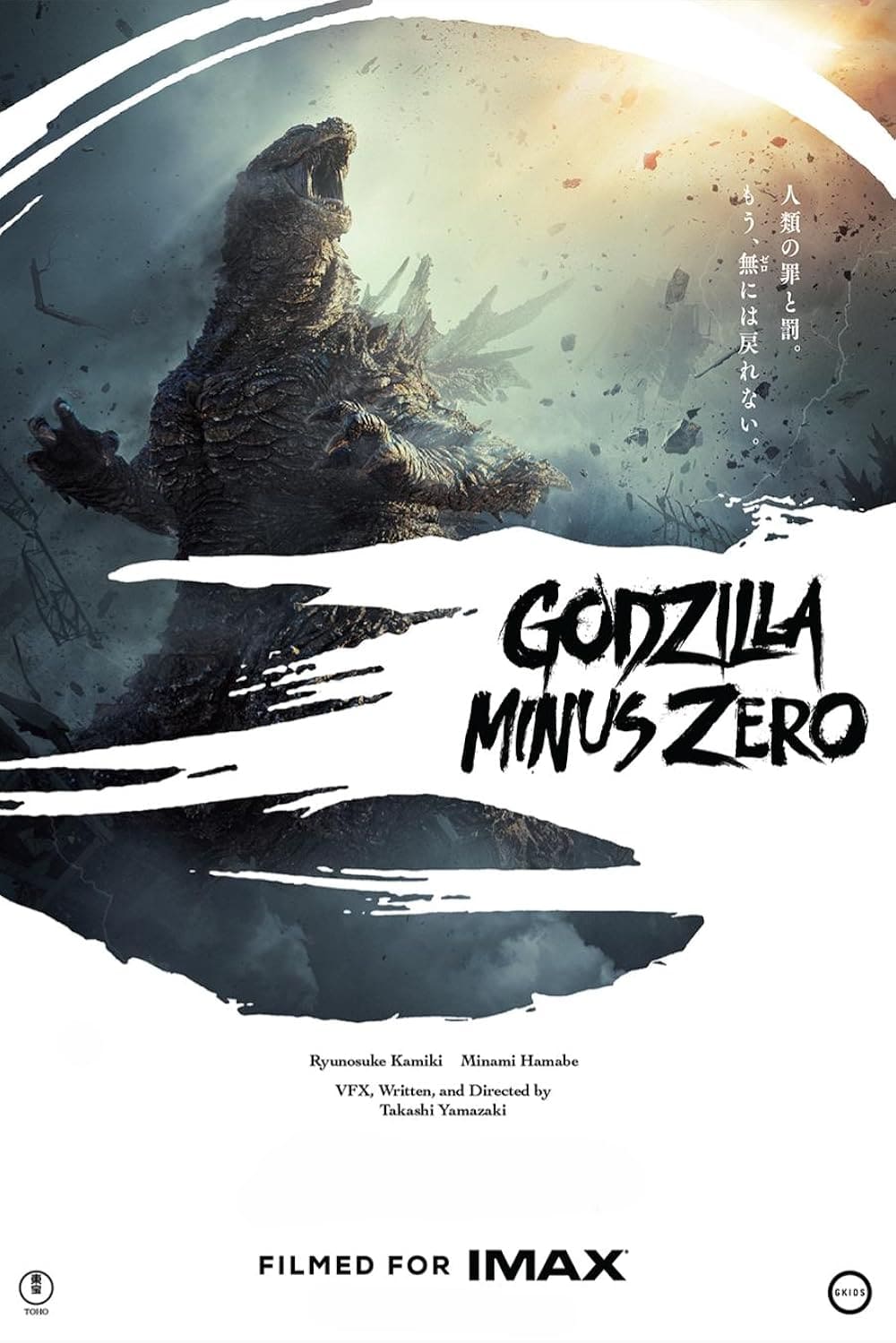
Godzilla Minus Zero understands that surviving the apocalypse is only the beginning of the problem. Eventually, somebody has to rebuild the house, raise the kids, and figure out whether the next rumble outside is ordinary bad weather or another civilization-ending nightmare. Takashi Yamazaki’s follow-up to Godzilla Minus One takes that fragile recovery and puts it under spectacular pressure. Set in 1949, two years after its predecessor’s devastation, the film brings back Kōichi Shikishima, Noriko, and their adopted daughter Akiko, then drops another monster into their hard-earned domestic stability. It’s a bigger premise, but the most interesting stakes remain painfully small: can this family actually keep its future?
That continuity gives the sequel something more valuable than simple audience familiarity. Kōichi and Noriko aren’t just returning characters waiting for another round of destruction; their household represents the ordinary life that catastrophe keeps interrupting. Ryunosuke Kamiki and Minami Hamabe return to roles built around the difficult business of carrying on, while Akiko makes the question of survival extend beyond the adults’ unresolved wartime experiences. The setup creates an effective emotional contradiction. We want these people to have an uneventful life, even though an uneventful life would make for a very different kind of Godzilla movie. Their happiness matters precisely because it seems so vulnerable to forces they can neither predict nor control.
Still, Godzilla Minus Zero isn’t quite as emotionally grounded as Godzilla Minus One. The first film had a beautifully direct connection between one man’s survivor’s guilt and a country’s struggle to recover. Its enormous scale never obscured the intimate story holding everything together. The sequel has a wider field of interests, and its attention moves between family drama, occupation politics, scientific problem-solving, and escalating kaiju conflict. That expansion sometimes makes the emotional material feel less concentrated. There’s more happening, but not every development has the same room to settle. The difference isn’t that the sequel stops caring about people; it’s that more things are competing for our attention.
What keeps that shift from becoming a serious problem is the emotional foundation Yamazaki has already established. Kōichi, Noriko, and Akiko don’t need to start from scratch to make us care. We understand what their home means and what another catastrophe could take away. Returning characters like Kenji Noda extend that sense of connection, while newcomer Makoto Aoyama brings another human perspective to the effort to survive. The emotional stakes remain high even when the storytelling gets busier. These people aren’t simply trying to escape a monster’s path. They’re trying to preserve relationships, reclaim a sense of security, and believe that rebuilding wasn’t just an exercise in postponing the next loss.
That’s especially important as Yamazaki increases the kaiju action. More destruction can easily make a sequel feel less consequential: after enough collapsing buildings, the damage starts looking like scenery. Here, the returning characters give that spectacle a point of reference. We know there are lives beyond the immediate emergency, and that surviving an attack doesn’t mean walking away untouched. The film’s emotional pull may be broader and less piercing than its predecessor’s, but it remains strong enough to keep the monster action from becoming detached from the people experiencing it. Bigger fights don’t automatically mean smaller feelings, even if the balance occasionally wobbles.
Writer-director Yamazaki also once again makes a Godzilla film look beautiful through the way he integrates its visual effects. His background in effects work—and his triple duty here as visual effects supervisor—helps explain why the imagery feels like part of the filmmaking rather than something layered over it. He understands how the technology can push and support the story, not just provide an opportunity to showcase the latest technical achievement. The creatures’ scale, the destruction around them, and the vulnerability of the people below all belong to the same dramatic picture. The spectacle communicates fear and awe while reminding us how precarious everything the characters have rebuilt really is.
That distinction matters in a sequel with this much more monster action. There’s plenty to admire as a technical accomplishment, but Yamazaki doesn’t seem interested in treating the human drama as an obligatory pause between effects sequences. His strongest images connect those two sides of the movie: the enormous force occupying the frame and the ordinary lives threatened by it. Even when the action gets extravagant, there’s a sense of weight behind it. The effects aren’t simply asking us to appreciate what the team can create. They help us feel what it means to live beneath something that powerful, keeping the film’s visual ambition connected to its emotional stakes.
Yamazaki’s smartest narrative expansion is to make the surrounding country feel as unsettled as the family. This is a Japan rebuilding under American occupation, where recovery doesn’t necessarily mean independence or even control over the next emergency. The occupation hangs over the story as another source of pressure, complicating the usual business of scientists, soldiers, and civilians deciding how to confront a monster. Godzilla’s return and the arrival of a new kaiju are immediate dangers, but they unfold within a political situation that already limits Japan’s freedom to respond. The country is threatened from outside while still struggling to determine its own direction.
That makes the American military presence function as a secondary antagonist. Not because occupying forces are interchangeable with a radioactive creature, but because their authority adds another obstacle between vulnerable people and meaningful security. The tension is more interesting than a straightforward humans-versus-monsters arrangement: assistance and domination can occupy uncomfortably similar territory when the people offering protection also hold power over you. The occupation isn’t merely period decoration. It sharpens the film’s anxiety about who gets to make decisions, whose suffering counts, and whether a devastated nation can protect itself without becoming dependent on another destructive force. There’s a bitter irony in being promised stability while having so little say in what that stability looks like.
Then there’s Ghidorah, whose arrival changes the equation from “How do we survive Godzilla?” to the considerably less comforting “Do we actually need Godzilla?” The new creature brings an extraterrestrial dimension to the crisis, while its manipulation of the elements gives the threat a different character from the devastation Japan already knows. Yamazaki isn’t simply replacing one enormous problem with another. He’s creating circumstances in which yesterday’s nightmare starts looking like today’s best available option. That’s a wonderfully nasty foundation for a sequel, because it makes the audience’s anticipation of Godzilla’s return feel morally uneasy rather than automatically triumphant.
The monster-versus-monster premise also gives Godzilla’s changing role a useful dramatic foundation. He doesn’t have to become harmless, friendly, or conveniently misunderstood for people to hope he wins. He just has to be the only force capable of stopping something worse. That distinction matters. A protector who can flatten your city remains a terrifying protector, and dependence on him isn’t the same thing as safety. The film’s movement toward Godzilla as Japan’s defender therefore carries an uncomfortable bargain: survival may require inviting back the very power that made survival so difficult in the first place. You can cheer his arrival without forgetting why everyone should still be afraid.
This is where the film’s concern with weapons of mass destruction becomes more interesting than a familiar nuclear warning. The issue isn’t only that humanity has built weapons capable of annihilating cities. It’s that, confronted with another source of overwhelming destruction, people immediately begin imagining how to direct it. Murakami’s scheme to control Godzilla through the “Resonance Wave,” including his desire to attack New York in revenge for his family’s deaths in Hiroshima, turns the monster into a potential delivery system for human grievance. The kaiju aren’t merely consequences of catastrophe anymore. They’re candidates for the next arsenal.
That possibility makes the proliferation theme especially bleak. A weapon doesn’t stop being a weapon because it breathes, regenerates, or refuses to fit inside a missile silo. Once a creature can be controlled—or someone believes it can—the same arguments about deterrence, retaliation, and national survival become available. Murakami embodies the danger of letting justified grief harden into permission for another mass killing. His history makes the impulse understandable without making its intended consequences defensible. The disturbing question isn’t simply whether humanity can defeat these monsters. It’s whether humanity can resist reproducing its own worst habits through them.
The occupation storyline and the possibility of weaponized kaiju also reinforce each other. Both raise questions about the difference between having protection and possessing power. If another country controls your security, your choices are already constrained. But acquiring an overwhelming destructive force of your own doesn’t necessarily resolve that imbalance in a humane way. It may just give you the means to impose a similar terror on somebody else. The film is most interesting when it sits with that contradiction rather than treating access to greater firepower as an uncomplicated victory. Being vulnerable doesn’t automatically make every response to vulnerability a good one.
Fortunately, the human response isn’t limited to revenge. Noda’s return as the head of the Large-Scale Disaster Response Bureau, alongside meteorologist Aoyama, preserves an appealing counterweight to the film’s destructive imagination: knowledge can serve collective survival rather than domination. Their involvement gives the scientific problem-solving more than a mechanical function. It offers another way of responding to helplessness, one based on cooperation rather than possession of the biggest weapon. Aoyama also helps the sequel’s expanded cast feel like more than a reunion. The future belongs not only to the people who survived the previous disaster, but to those now joining the effort to prevent another.
The bigger mythology does bring a trade-off. Compared with the direct emotional hook of Godzilla Minus One, this sequel has considerably more machinery to keep running. Some viewers will understandably miss the first film’s tighter focus, and the increased action can’t entirely replace that particular emotional intensity. But the expansion isn’t empty escalation. The family story, the occupation, the new monster, and the temptation to weaponize Godzilla all circle the same problem: everyone wants security, and the real conflict lies in what they’re prepared to sacrifice, unleash, or excuse to obtain it.
Godzilla Minus Zero doesn’t quite recapture the emotional precision of Godzilla Minus One, but it finds a worthwhile direction of its own: bigger, stranger, and more uneasy about what survival might demand. Yamazaki delivers the kaiju spectacle without letting the people underneath it become an afterthought, using his command of visual effects to support both the action and its human cost. What lingers isn’t just the thrill of watching enormous creatures collide. It’s the discomfort of watching people look at something capable of destroying their world and wonder how they might use it. The monsters may have changed the balance of power, but the temptation to turn destruction into security remains all too human.

