Welcome to Retro Television Reviews, a feature where we review some of our favorite and least favorite shows of the past! On Fridays, I will be reviewing St. Elsewhere, a medical show which ran on NBC from 1982 to 1988. The show can be found on Daily Motion.
This week, a famous doctor comes to St. Eligius.
Episode 3.13 “Dr. Wyler, I Presume”
(Dir by Mark Tinker, originally aired on December 19th, 1984)
This week’s episode opens in the hospital gift shop. Dr. Craig is excited because a Nobel Prize-winning surgeon, Dr. George Wyler (David Wayne), is traveling from Africa to St. Eligius. Wyler is bring along a man who needs a kidney transplant. They are hoping to find a donor in Boston.
Dr. Auschlander, who is an old friend of Wyler’s, is a bit more nervous. Craig tells him not to worry so much and then grabs a carnation that he puts on Auschlander’s lapel.
As Auschlander starts to leave the gift shop, Craig says, “Don’t forget to pay for that.”
It’s a brilliant opening for a pretty good episode of St. Elsewhere. It’s always interesting to see the usually arrogant Dr. Craig in fanboy mode and one gets the feeling that, if he’s impressed by Dr. Wyler, than Wyler really must be as brilliant as everyone says.
And maybe he is! It’s hard to say for sure. When Wyler arrives at the hospital, he’s avuncular and obviously intelligent but we really don’t learn much about him, beyond the fact that he’s an old friend of Auschlander’s. The rest of Wyler’s scenes feature him and Auschlander sitting around and talking about how they’re both getting older. It’s not boring, largely due to the performances of Norman Lloyd and David Wayne. But, after all of the build-up, it’s a bit anti-climatic. That said, according to the imdb, Dr. Wyler appeared in a total of three episodes so I imagine things will develop.
While this is going on, Nurse Rosenthal is having a mid-life crisis. Her 45th birthday is coming up and she doesn’t want to celebrate it. She’s not amused when the nurses get her a stripper. Usually, I would have sympathy for a character who hates the idea of getting older but I’m a little bit tired of Nurse Rosenthal and her poor-me attitude. I get that she’s upset that her adulterous affair hasn’t been going well but maybe she should take that as a sign to stop sleeping with married men.
Meanwhile, Mrs. Hufnagle, the patient that no one likes, continues to get on everyone’s nerves. She’s even managed to alienate Elliott! I actually feel bad for Mrs. Hufnagle. Yes, she complains a lot but being in a hospital is a scary thing. I get the feeling that the doctors and nurses getting annoyed with her is probably the most realistic part of the series. Dr. Morrison is now Hufnagle’s doctor and that worries me. Morrison’s stories always end in the most depressing way possible.
At the tv station, Victor is told that his medical segments are not popular with viewers and that he needs to make being sick sound more pleasant than it is. Victor records an upbeat segment about how wonderful it is to go the hospital.
At the hospital, Victor assists Dr. Craig in removing an live exploding bullet from a woman who was shot in a robbery. Victor worries that the bullet could explode as he removes it and end his medical career. Fortunately, the operation is successful but Craig still tells Ehrlich that he’s a disgrace.
Ouch!
Hey, this was a really good episode. It was well-acted. It wasn’t too depressing. Dr. Craig got to snap at a lot of people. The best episodes always feature Dr. Craig going off on someone. St. Eligius may not be the best hospital but, this week, it was the most entertaining.
Welcome to Retro Television Reviews, a feature where we review some of our favorite and least favorite shows of the past! On Fridays, I will be reviewing St. Elsewhere, a medical show which ran on NBC from 1982 to 1988. The show can be found on Daily Motion.
This week, the heartbreak continues!
Episode 3.11 “Homecoming”
(Dir by David Anspaugh, originally aired on December 5th, 1984)
What a depressing episode!
Actually, it’s not totally depressing. Dr. Elliot Axelrod (Stephen Furst) survives his first night as the attending-on-duty and he even convinces cranky old Mrs. Hufnagle (Florence Halop) to go back to her room. He also handles things when a patient collapses in the hallway. One can be sure that Elliot will be given absolutely no praise for his good work because he never is. But at least, he was there and he proved himself to be more competent than anyone gives him credit for being.
Now, for the depressing stuff:
Nurse Rosenthal is continuing her affair with Richard Clarendon. This wasn’t depressing because of anything that happened in this episode. Instead, it’s just depressing that any time was devoted to these two boring characters.
After her apartment is broken into while she’s in the shower, Clancy (Helen Hunt) moves in with Jack. Jack and Clancy make for a cute couple but, watching this episode, it’s easy to see that their relationship is doomed. Clancy is young and enthusiastic. Jack is young but he moves like an old man and he’s already been through a lifetime’s worth of tragedy. Sadly, Clancy living with Jack does not last longer than one night. Clancy says that Jack acts like he’s offended by having her stuff in his apartment and she’s right. Jack is still mourning his wife and not ready to live with anyone.
Lois Wegener (Mimi Kennedy) comes home from being out of town and discovers that her husband, Andrew (John Schuck) is becoming progressively weaker from the experimental bone marrow treatment that he’s going through in an attempt to save the life of their daughter (Brandy Gold). Everyone at the hospital is impressed with Andrew’s courage but it’s obvious to me that this is not going to have a happy ending.
Kathy Martin is still in the psych ward. During this episode, she gives Fiscus the note that Shirley Daniels gave her after Shirley shot and killed Peter White.
And finally, it wouldn’t be a depressing episode without a Westphall storyline. Westphall’s daughter, Lizzie (Dana Short), comes home from college for the weekend and, without asking Westphall ahead of time, she brings along her new boyfriend, Rick (Casey Seimaszko). Lizzie assumes that Rick will be sleeping with her in her room. Westphall is not thrilled to hear about that. (It doesn’t help that Rick isn’t wearing a shirt when he and Westphall first meet.) Lizzie gets angry. Westphall points out that his dead wife would not have approved. Lizzie argues that she is now an adult and can do whatever she wants.
And you know what? I am totally on Westphall’s side here. It’s his house! Lizzie isn’t the one paying the bills. If Westphall doesn’t want Rick sleeping in her room (and, I might add, there are other rooms in the house where Rick could sleep), then Rick doesn’t sleep in her room. When I was younger, I probably would have been on Lizzie’s side but now that I’ve gotten older, I see Westphall’s point and Lizzie comes across as being a spoiled brat. I mean, if she wants to stay in the same room as Rick, they can get a motel room. How expensive could one be in 1984? This episode ends with Lizzie telling her father that she’s leaving. “Lizzie!” Westphall says but she’s already gone.
See what I mean? This was a depressing episode, even by St. Elsewhere standards. That said, it was also a good episode. Ed Flanders, David Morse, Helen Hunt, Stephen Furst, Mimi Kennedy, they all gave wonderfully empathetic performances. Your heart may hurt for them but you can’t wait to see what happens next. Sometimes, life is depressing but, like the characters on this show, you have to moving forward.
Welcome to Retro Television Reviews, a feature where we review some of our favorite and least favorite shows of the past! On Fridays, I will be reviewing St. Elsewhere, a medical show which ran on NBC from 1982 to 1988. The show can be found on Daily Motion.
This episode proves that Dr. Cavanero is the worst.
Episode 3.10 “Girls Just Want To Have Fun”
(Dir by Bruce Paltrow, originally aired on November 28th, 1984)
The struggle is real.
Seriously, I am thankful that someone uploaded St. Elsewhere to Daily Motion. With the show no longer on Hulu and Prime only having the first season available, Daily Motion is pretty much the only place where I can stream the show. That said, the sound quality is not great. The sound quality wasn’t particularly good when the show was on Hulu either but at least then I could turn on the captions. The Daily Motion uploads don’t have that option. I had to strain to hear the dialogue and, as a result, this review is not going to be as in-depth as it could be.
What I can tell you is that Dr. Cavanero is now one of the least sympathetic characters that I have ever seen on a television show. Last week, Dr. Christine Holz (Caroline McWilliams) told Cavanero that she was a lesbian. This week, Cavanero blabbed that information around the hospital, leading to a lot of homophobic comments from certain members of the stuff. (Not surprisingly, Victor Ehrlich was there to say something stupid.) Cavenero admitted to Christine that she found Christine’s lifestyle to be “unnatural.” Christine smiled sadly and left Cavanero’s apartment and left the show. Keep in mind, Dr. Holz was portrayed as being a brilliant surgeon and bone marrow expert. It probably would have been good to keep her around the hospital for a little while but nope. Sorry. Dr. Cavanero — who really hasn’t done anything of note since the first season — felt uncomfortable.
(Originally, Christine and Cavanero were supposed to have a romantic relationship but Cynthia Sikes, the actress playing Cavavero, objected to the storyline. As a result, the story was rewritten and perhaps it’s not a coincidence that Cavanero comes across as being a bit of a homophobe.)
Meanwhile, Dr. Chandler was concerned when he discovered that a neighborhood woman (Beah Richards) was practicing medicine out of her apartment. This storyline at least gave Denzel Washington more to do than usual, which was good. St. Elsewhere, at least so far, has often tended to underuse both Chandler as a character and Washington as an actor.
Jack’s friend (John Schuck) insisted on doing an experimental kidney procedure to try to save the life of his daughter (Brandy Gold) and Dr. Auschlander finally gave his approval for it to be done. I would say that was a good thing except for the fact that Jack’s storylines hardly ever have a happy ending. There’s a reason why Morrison is the most depressed resident in the hospital.
Nurse Rosenthal continued her affair with Richard Clarendon, even though Richard’s wife (Beverly Sanders) is now working at the hospital. Wow, that’s going to be awkward. In fact, I hope it’s really awkward. I’m tired of Nurse Rosenthal and her holier-than-thou attitude.
Dr. Craig testified at a city council hearing. The poor sound quality kept me from fully understanding what the hearing was about but at Dr. Craig told everyone off. It’s always fun to watch William Daniels tell people off.
Here’s hoping the sound will be a bit less muddy next week!
Welcome to Retro Television Reviews, a feature where we review some of our favorite and least favorite shows of the past! On Fridays, I will be reviewing St. Elsewhere, a medical show which ran on NBC from 1982 to 1988. The show can be found on Daily Motion.
This week, an arrest is made.
Episode 3.9 “Up On The Roof”
(Dir by Eric Laneuville, originally aired on November 21st, 1984)
It’s another busy day at St. Eligius.
The last of the firemen (Stephen Elliott) is finally sent home. At first, he’s bitter about all of the skin grafts and all the other work that Dr. Caldwell did on him. But then his grandkids come in the hospital and room and shout, “Grandpa!” And then he steps outside and is greeted by all the other firemen. He leaves in a fire truck and Dr. Caldwell — the only angst-free doctor at St. Eligius — smiles and waves. Finally, someone on this show gets a happy ending.
Ms. Hufnagel continues to get on everyone’s nerves with her constant complaints. Dr. Fiscus dumps her on Dr. Axelrod. While the show seems to want us to be as annoyed with Ms. Hufnagel as everyone else, I have to admit that I feel sorry for her. Does she complain a lot? Yes, she does. But being in a hospital can really be scary. I complained a lot whenever I was rushed to the ER because of my asthma. I complained a lot when my mom was in the hospital. I complained a lot when my dad was in the hospital. I complained a lot when my aunt was in the hospital. Sometimes, complaining is the only comfort you have.
Dr. Morrison is upset when a friend (John Schuck) is told that his daughter cannot be treated with an experimental dialysis machine.
Nurse Rosenthal continues to have an affair with Richard Clarendon, the labor negotiator.
Dr. Christine Holz (Caroline McWilliams) comes to the hospital to perform a bone marrow transplant. Dr. Annie Cavanero invites Dr. Holz to come to her place for dinner. Cavanero is shocked when Dr. Holz reveals that she’s a lesbian and the viewer is once again reminded that this show aired in the mid-80s.
According to what I’ve read online, the original plan was for Dr. Holz to become Cavanero’s romantic partner but Cynthia Sikes refused to kiss another woman onscreen. This led to the storyline being hastily rewritten and it apparently also led to Sikes being fired from the show at the end of the third season.
Kathy Martin is still in the psych ward. When Detective Alex MacGallen (Charles Lanyer) attempts to question her about where she was when Peter White was shot, he is informed by Kathy’s doctor that Kathy has an alibi. Later, Shirley comes to the psych ward and slips Kathy a letter.
Shirley has been hiding the gun that she used to shoot Peter all over the hospital. However, when the detective finally confronts her and reveals that he knows that she killed Peter, Shirley pulls the gun on him and then run up to the rooftop.
On the roof, Dr. Westphall and Jack take their turns trying to convince Shirley to surrender to the police. After Shirley confesses and then demands to know why Jack didn’t make more of an effort to stop Peter, Shirley drops her gun and is taken into custody.
This was a depressing episode, even by the standards of St. Elsewhere. Shirley has always been one of my favorite characters and I hate the idea that she’s now going to go to prison for killing Dr. White. From a narrative point of view, someone had to shoot Peter. That was really the only way his story could end. Personally, I think it would have made more sense for Dr. Cavanero to be the shooter that Shirley. I mean, if Cavanero was going to be written off the show anyway, killing Dr. White would have given her a decent exit.
Next week, I’m sure something else depressing will happen. We’ll see!
Welcome to Retro Television Reviews, a feature where we review some of our favorite and least favorite shows of the past! On Fridays, I will be reviewing St. Elsewhere, a medical show which ran on NBC from 1982 to 1988. The show can be found on Daily Motion.
I miss when this show on Hulu and available to rent on Prime. The Daily Motion uploads are not the best (especially where sound quality is concerned) but, for now at least, that’s what I’m having to go with.
Episode 3.8 “Sweet Dreams”
(Dir by Mark Tinker, originally aired on November 14th, 1984)
This week’s episode was all about sleep and the dreams that might come with sleep.
Westphall, as usual, gets the most depressing storyline. He can’t sleep. He has insomnia. Of course, he does. Anything depressing that doesn’t happen to Dr. Morrison will inevitably happen to Dr. Westphall instead.
Dr. Craig tries to figure out why one of his patients died in his sleep with a terrified look on his face. Can a nightmare cause someone to have a heart attack?
Dr. Cavanero diagnoses a man with sleep apnea.
Meanwhile, we get a peek at the dreams of three members of the St. Elsewhere staff.
Luther dreams of being kicked out of the hospital by two security guards. Fortunately, ZZ Top is standing outside of the hospital and they order three women to kidnap Luther in a big red car and turn him into a sharp-dressed man. Luther and his new friends invade the hospital, toss out the security guards, and invite Warren Coolidge to come hang out with them. ZZ Top performs Legs, which seems odd since the song is about a woman who has legs and knows how to use them but Luther is the one getting the makeover. Well, whatever. It’s a cute dream and a nice break from Dr. Westphall looking depressed.
Both Victor and Jack agree to take part in a sleep study. Victor is yanked out of the study by Dr. Craig but, before that happens, we do get to see Victor’s dream of washing up on an island that is ruled by Amazons.
As for Jack Morrison’s recurring dream, it’s just about as dark as you would expect when it comes to the only character who has suffered more heartache than Dr. Westphall. In Morrison’s dream, he finds himself wandering around the deserted hospital. He hears someone playing Led Zeppelin in the morgue. He goes down there and discovers Peter White waiting for him.
Morrison and White speak. Even in death, White is whiny and defensive. Morrison repeatedly asks whether or not White was the ski mask rapist and, every time, White refuses to give a direct answer. However, when Morrison is about to leave the morgue, White is suddenly wearing a blue ski mask. Morrison wakes up from each dream with a jolt, terrified to face the truth about the man who he defended against his better judgment.
(I have to admit that, if I was a nurse or a doctor at St. Eligius, I would have mixed feelings about Morrison. Yes, he seems to be well-meaning and he’s suffered his share of tragedy. But the fact that he continued to be a friend — albeit with a certain ambivalence — to Dr. White would make me very uncomfortable. I know that Morrison would probably point out that Dr. White was acquitted but everyone at the hospital knew he was guilty. Everyone but Morrison, apparently.)
This was a good episode and a bit of a reset after all the drama of the Peter White storyline. Well-directed, well-acted, and very atmospheric, this was St. Elsewhere at its best.
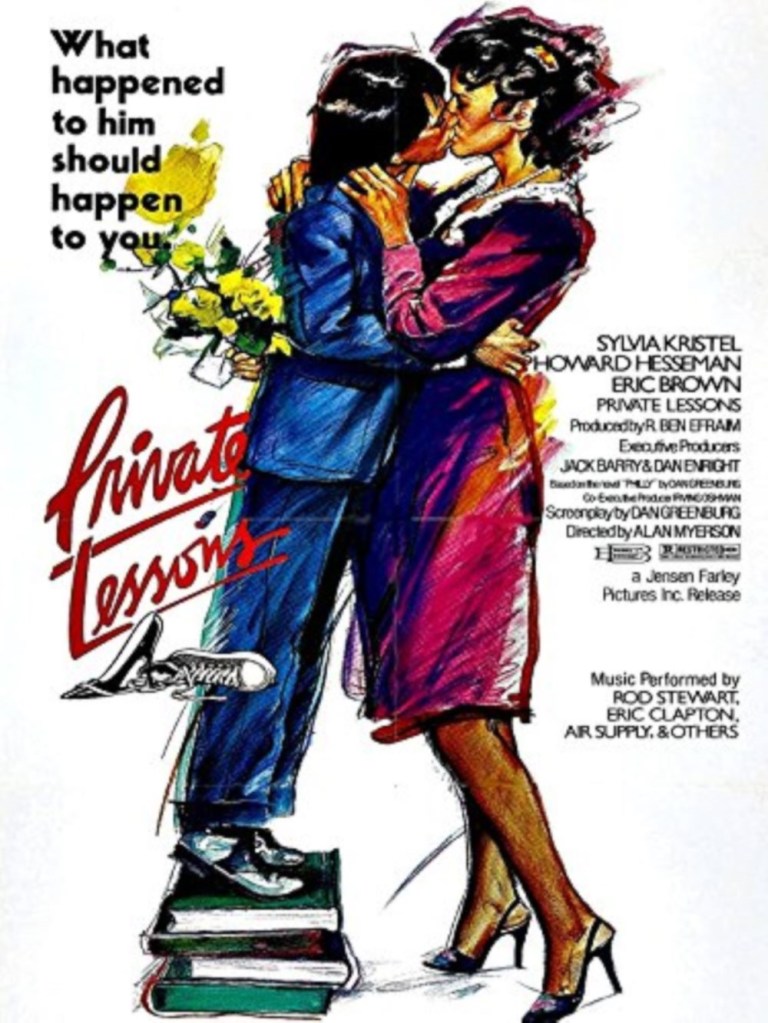
Private Lessons is that kind of early ’80s sex comedy that feels like a time capsule from when movies could get away with stuff that would never fly today. It’s got this awkward charm mixed with some seriously questionable choices, centering on a horny teenager named Philly who gets schooled in the ways of love by his family’s sultry French housekeeper. The film tries to play it all for laughs and titillation, but it lands somewhere between guilty pleasure and uncomfortable relic.
Philly, played by Eric Brown, is your classic 15-year-old rich kid left home alone for the summer in a sprawling Albuquerque mansion while his dad jets off on business. Dad hires Nicole, this alluring European housekeeper portrayed by Sylvia Kristel—yeah, the Emmanuelle star herself—to keep an eye on things, along with the sleazy chauffeur Lester, brought to life by Howard Hesseman in full sleazeball mode. From the jump, Philly’s got a massive crush on Nicole; he’s peeping through keyholes and fumbling over his words whenever she’s around. It’s all very American Pie before American Pie existed, but with a Euro-sex vibe courtesy of Kristel’s effortless sensuality. She catches him spying one night, strips down without a care, and invites him to touch—Philly bolts like his pants are on fire. You can’t help but chuckle at his panic; Brown’s wide-eyed innocence sells it without overplaying the hand.
The setup builds slowly, which is both a strength and a drag. Philly spills the beans to his buddy Sherman, played with manic energy by Patrick Piccininni, who turns every conversation into a roast session about Philly’s virginity. Their banter is some of the film’s highlights—raw, boyish ribbing that feels authentic to awkward teen friendships. Nicole keeps pushing the envelope: a steamy makeout in a dark movie theater, a goodnight kiss that nearly melts the screen, and finally, a fancy French dinner date where they seal the deal back home. Kristel owns these scenes; her Nicole isn’t just a seductress, she’s got this playful confidence that makes the slow seduction believable. The sex scene itself is tame by today’s standards—soft-focus, lots of sighs—but it’s handled with a wink, pretending to be shocking while delivering the era’s softcore goods.
But here’s where Private Lessons swerves into darker territory and kinda loses its footing. Midway through their romp, Nicole fakes a heart attack and “dies” right on top of Philly. Freaked out, he confesses to Lester, who smells opportunity. Turns out, the chauffeur’s been blackmailing Nicole over her immigration status and hatches a scheme to pin her “murder” on Philly, forcing the kid to cough up a chunk of his trust fund to cover it up. They bury a dummy in the desert, and Lester plays the concerned adult while pocketing the cash. It’s a twist that amps up the stakes, but it also shifts the tone from fluffy comedy to something creepier, leaning hard into moral panic territory. Hesseman chews the scenery as Lester, all smarmy grins and side-eye; he’s the perfect villain you love to hate, but the plot machinations feel forced, like the writers ran out of seduction gags and needed conflict.
Nicole, developing real feelings for Philly amid the con, has a change of heart and spills the truth. Together, they rope in Philly’s tennis coach—Ed Begley Jr. in a quick but fun bit—to impersonate a cop and scare Lester straight. The bad guy panics, gets nabbed trying to flee with the money, and everyone agrees to a truce: no one rats anyone out. Nicole’s “child molestation” (the film’s own loaded term for her role in seducing a minor) and immigration issues stay buried, Lester technically keeps his job, and Nicole splits before Dad returns. It’s a tidy wrap-up that dodges real consequences, which fits the film’s escapist fantasy but leaves a sour taste ethically. The romance fizzles without much payoff; you half-expect a heartfelt goodbye, but it’s more pragmatic than emotional.
Tonally, Private Lessons is all over the map. The first half thrives on its lighthearted horniness—Philly’s fumbling advances, Nicole’s teasing allure, and a very of-its-time soundtrack that pumps up the montages. It’s got that innocent raunchiness of films like Porky’s, where sex is the big mystery and everyone’s in on the joke. Brown holds his own as the lead; at 15, he’s convincingly flustered yet game, making Philly relatable rather than cartoonish. Kristel brings actual star power, turning what could be a one-note vixen into someone with hints of depth—her chemistry with Brown sparks genuine warmth amid the sleaze. Hesseman leans into Lester’s slimeball energy, turning every scene with him into a mix of funny and gross.
That said, the film’s not without flaws, and they’re glaring by modern eyes. The premise is straight-up predatory: a grown woman systematically grooming an underage boy, played for comedy without much self-awareness. It’s the male version of Lolita, but without any critique—instead of examining the situation, it just sort of grins and shrugs. The blackmail plot tries to add intrigue but mostly undermines the fun, turning Nicole from free spirit to reluctant crook. Pacing drags in spots; the relatively short runtime still feels stretched when the seduction stalls so the script can set up the con. And the ending? It papers over everything with a shrug, letting all parties walk free like it’s no big deal. The whole thing feels very much like a product of a moment when taboo could be turned into box-office bait without much pushback.
Visually, it’s a product of its time: glossy ’80s cinematography, plenty of skin but no hardcore edge, and that mansion setting screaming wealth fantasy. Director Alan Myerson keeps it breezy, never letting the comedy get too mean-spirited until Lester’s scheme really kicks in. The score and song choices nail the vibe—upbeat for the flirtations, a bit more tense for the con, always keeping things light even when the story goes to shadier places. It very much feels like something that would play late at night on cable and stick in your memory more as a vibe than as a fully coherent film.
Does it hold up? Kind of, if you’re in a nostalgic mood or digging for ’80s cheese. It’s honest about teen lust without being judgmental, and the performances carry the silly plot. But the power imbalance and the underage angle make it tough to fully endorse—watch with that lens, and it’s more cringe than chuckle. Still, for what it is—a raunchy romp with a surprisingly soft center—Private Lessons delivers just enough to warrant a spin on a bored night. Eric Brown and Sylvia Kristel do a lot of heavy lifting; without their chemistry, this would be forgettable smut instead of a strangely endearing, if deeply problematic, relic. If you’re into retro sex comedies like My Tutor or Zapped!, this one sits comfortably in that same dusty corner of the genre, flaws and all, as a snapshot of looser times that’s best taken with a big grain of salt.
1977’s Record City opens with a montage of rear-focused close-ups of women wearing short shorts and that pretty much tells you all that you really need to know about the film. It’s crass, shameless, and very much a product of its time.
The film takes place over the course of one day at a California vinyl record shop. It’s tempting to compare the film to something like Empire Records but, unlike Empire Records, Record City suggests that working in a record store is perhaps the worst thing that could ever happen to anyone. The store is dirty and grimy. The customers are rude and played by vaguely familiar comedy actors, all of whom seem to have been bitten by the overacting bug before stepping in front of the camera. The employees all seem to hate each other. Marty (Tim Thomerson) keeps getting slapped and kicked by Vivian (Deborah White). Vivian keeps getting groped by almost every customer and employee who walks by her. The only thing that Vivian hates more than men is other women. The store’s owner (Jack Carter) is in trouble with the mob. The store’s manager (Michael Callan) is lech who wears gold chains, keeps his shirt unbuttoned, and who expects the new cashier, Lorraine (Wendy Schaal), to sleep with him because, after all, he did hire her. Danny (Dennis Bowen) is the shy guy with a crush on Lorraine. Rupert (Stuart Goetz) is the nerdy virgin who goes from wearing a bowtie to dressing like a swinger but he still can’t get laid. Both the customers and the employees are paranoid about “fairies” coming into Record City. Pokey (Ed Begley, Jr.) wants to hold the place up and who can blame him? Really, the only likable employee is a black man known only as The Wiz and that’s just because he’s played by Ted Lange. (Yes, Isaac the Bartender from The Love Boat.) Lange gets to perform a song at the end of the film.
When the film isn’t focused on the antics inside Record City, it’s all about the talent show that’s taking place in a nearby parking lot. The talent show is hosted by radio DJ Gordon Kong (Rick Dees) and it gives the film an excuse to trot out a bunch of cameos, some of whom are more recognizable than others. For instance, Gallagher — the comedian with the sledgehammer — shows up. Kinky Friedman also shows up, playing himself and looking for records at Record City. When he spots a woman with a blonde bowl cut and glasses, he accuses her of being John Denver and then grabs her breasts. And to think — less than 30 years later, Kinky Friedman would run for governor of my homestate.
Anyway, this is a terrible and rather boring movie but I did find it interesting for one reason. It’s the reason why I find so many grindhouse films to be interesting. Shot on location and for no other reason than to make money, Record City is a true product of its time. There’s no attempt to try to make the 70s look nicer than they were. There’s no attempt to try to make the record store look like anything more than a tacky establishment. There’s an honesty to how low-rent the whole thing is. Watching the movie is like stepping into a time machine and getting a chance to experience the past firsthand. I was born long after the 70s but, after watching this film, I now feel like I’ve been there.
In 1979’s The Concorde …. Airport ’79, Joe Patroni (George Kennedy) finally gets to fly the plane.
The plane is question is a Concorde, a supersonic airliner that can travel faster than the speed of sound. When we first see the Concorde, it’s narrowly avoiding a bunch of dumbass hippies in a hot air balloon as it lands in Washington, D.C. The recently widowed Joe Patroni joins a flight crew that includes neurotic Peter O’Neill (David Warner), who says that he has dreams in which he’s eaten by a banana, and suave co-pilot Paul Metrand (Alain Delon). Because this is an Airport film, Mertrand is dating the head flight attendant, Isabelle (Syliva Kristel). “You pilots are such men,” Isabelle says. “It ain’t called a cockpit for nothing, honey,” Patroni replies.
(One thing that is not explained is just how exactly Joe Patroni has gone from being a chief technician in the first film to an airline executive in the second to a “liaison” in the third and finally to a pilot in the fourth.)
The Concorde is flying to Moscow with a stop-over in Paris. There’s the usual collection of passengers, all of whom have their own barely-explored dramas. Cicely Tyson plays a woman who is transporting a heart for a transplant. She gets maybe four or five lines. Eddie Albert is the owner of the airline and he’s traveling with his fourth wife. (Of course, he’s old friends with Patroni.) John Davidson is an American reporter who is in love with a Russian gymnast (Andrea Marcovicci). Avery Schrieber is traveling with his deaf daughter. Monica Lewis plays a former jazz great who will be performing at the Moscow Jazz Festival. Jimmie Walker is her weed-smoking saxophonist. Charo shows up as herself and gets kicked off the plane before it takes off.
The most important of the passengers is Maggie Whelan (Susan Blakely), a journalist who has evidence that her boyfriend, Kevin Harrison (Robert Wagner), is an arms trafficker. Harrison is determined to prevent that evidence from being released so he programs a surface-to-air missile to chase the Concorde. Patroni is able to do some swift maneuvers in order to avoid the missile, which means that we get multiple shots of passengers being tossed forward, backwards, and occasionally hanging upside down as Patroni flips over the plane. Oddly no one really gets upset at Patroni about any of this and no one seems to be terribly worried about the fact that someone is obviously trying blow up their plane. Even after the stop-over in Paris, everyone gets back on the Concorde! That includes Maggie, who could have saved everyone a lot of trouble by just holding a press conference as soon as the plane landed in Paris.
A year after The Concorde came out, Airplane! pretty much ended the disaster genre. However, even if Airplane! had never been released, I imagine The Concorde would have still been the final Airport film. Everything about the film feels like the end of the line, from the terrible special effects to the nonsensical script to the Charo cameo and Martha Raye’s performance as a passenger with a weak bladder. The first Airport film was an old-fashioned studio film standing defiant against the “New Hollywood.” The second Airport film was a camp spectacular. The third Airport film was an example of changing times. The fourth Airport film is just silly.
And, really, that’s the main pleasure to be found in The Concorde. It’s such an overwhelmingly silly film that it’s hard to look away from it. For all of its weaknesses, The Concorde will always be remembered as the film that featured George Kennedy opening the cockpit window — while in flight — and shooting a flare gun at another plane. As crazy as that scene is, just wait for the follow-up where Kennedy accidentally fires a second flare in the cockpit. “Put that out,” Alain Delon says while David Warner grabs a fire extinguisher. It’s a silly moment that it also, in its way, a great moment.
The Concorde brings the Airport franchise to a close. At least George Kennedy finally got to fly a plane.
Welcome to Retro Television Reviews, a feature where we review some of our favorite and least favorite shows of the past! On Fridays, I will be reviewing St. Elsewhere, a medical show which ran on NBC from 1982 to 1988. The show can be found on Daily Motion.
This week, the nurses go on strike. Fire all of them!, I say.
Episode 3.3 “Two Balls and a Strike”
(Dir by David Anspaugh, originally aired on October 3rd, 1984)
It’s another depressing few days at St. Eligius.
When negotiations break down, all of the nurses — except for Shirley Daniels — go on strike. Led by Nurse Rosenthal, they march out of the hospital and join a picket line in the rain. Triumphant music plays on the soundtrack Rosenthal gets on her bullhorn and announces that anyone making deliveries to the hospital will be crossing the picket line and not showing solidarity with the union. Honestly, though? Screw the union. It’s a hospital! It needs supplies. There are people dying inside of that building and they’re not even going to have the dignity of clean linen because of Nurse Rosenthal and her stupid union. And another thing …. Rosenthal is the head of union at St. Eligius. So, why isn’t she marching in the rain and carrying a sign? Why does she get to stand in the doorway and shout at people? Get out there and suffer for your union, you British commie!
Obviously, the show wanted me to be inspired by Rosenthal and the union. Whenever it switched over to the picket line, triumphant music started playing. I’m with Nurse Daniels on this one, though. Daniels didn’t vote the union so why should she have to suffer in the rain? She stays on the job. “Good luck,” Rosenthal tells her, “you’ll need it.” And all I can say to that is that at least Shirley Daniels isn’t deserting the hospital’s patients.
While the nurses are on strike, Dr. Canavero is attacked by a hulking man wearing a ski mask. Canavero is able to fight him off. Westphall and everyone else at the hospital immediately assumes that the man was Peter White but Peter has an alibi. He was in radiology when Canavero was attacked. So, is there a new ski mask rapist haunting the hospital? The first ski mask rapist storyline was pretty disturbing, especially since Peter got away with it. I’m not sure I want to go through a second one.
Dr. Craig and Ellen went to couples therapy. As usual, Dr. Craig got annoyed with the whole thing. There’s really nothing more fun than watching Dr. Craig get annoyed. No one gets annoyed better than William Daniels. Still, it seemed to do Dr. Craig and Ellen some good, with Ellen making plans to go to Hawaii and Dr. Craig acknowledging that he’s not always the easiest person to deal with.
As for Dr. Westphall …. he spent most of this episode depressed. Westphall is always depressed.
This is my final St. Elsewhere review for 2025. Retro Television Review is taking a break for the holidays, so I can focus on Awards Season and Christmas movies! St. Elsewhere will return on January 9th.
Welcome to Retro Television Reviews, a feature where we review some of our favorite and least favorite shows of the past! On Fridays, I will be reviewing St. Elsewhere, a medical show which ran on NBC from 1982 to 1988. The show can be found on Daily Motion.
This week, the hospital is a depressing place.
Episode 3.2 “Playing God: Part Two”
(Dir by Bruce Paltrow, originally aired on September 26th, 1984)
There was a lot going on in this episode.
Sister Domenica demanded that Sister Theresa be taken off of life support and she threatened to sue the hospital if it didn’t happen. This led to Dr. Westphall telling another long and depressing story about his dead wife. I don’t mean to be flippant about anyone’s tragedies but it’s hard not to notice that almost everything seems to lead to Westphall telling a depressing story. Westphall is one of the most saddest television characters that I’ve ever come across.
The nurses are closer to striking. A labor negotiator named Richard Clarendon (Herb Edelman) is brought in by the nurses and it’s hard not to notice that he looks a lot like Helen Rosenthal’s ex-husband. I think I can already guess where this is heading.
A sick child was brought in by a woman (Tammy Grimes) who claimed to be his fairy godmother. This gave Fiscus an excuse to get a consultation from Kathy Martin, who has abandoned the morgue for psychiatry and who is no longer dressing exclusively in black.
At home, Dr. Craig struggled with impotence. At the hospital, Dr. Ehrlich gave an awkward lecture about whether or not one can have sex after heart surgery.
The firefighters are still recovering from their burns.
Clancy got an abortion, despite Morrison’s objections.
And yet, all that drama was overshadowed by the fact that the Dr. Peter White — the drug-addicted rapist who nearly killed more than a few patients due to his own incompetence — is once again walking the halls of St. Eligius. White won his lawsuit. I’m not really sure that I understand what the basis of his lawsuit was. St. Eligius could only ask a select number of residents to return and, even if you overlook the fact that White was accused of rape, it’s not as if Dr. White was ever an especially competent doctor. It would seem that just his struggle with drug addiction would be enough to justify not asking him to return. And yet, somehow, Dr. Peter White is once again a resident at St. Eligius. (The ruling was probably handed down by a Carter judge.)
“You just can’t admit that you were wrong about me!” White snaps at Westphall.
Westphall replies that White is a terrible human being and not worthy of being a doctor and that he will not be allowed to work with any patients at the hospital. And, for once, I wanted to cheer Dr. Westphall. He may be depressing but he understands exactly who and what Peter White is.
Whatever the future may hold for the hospital, I have a feeling that it’s not going to be happy. Two episodes in and the third season has already settled into a pit of melancholy. That said, melancholy is perhaps the right mood for a medical show. When it comes to hospitals, there aren’t many happy endings.
 Through the Shattered Lens