Val’s Movie Roundup #12: Hallmark Edition


finding-a-family.7565

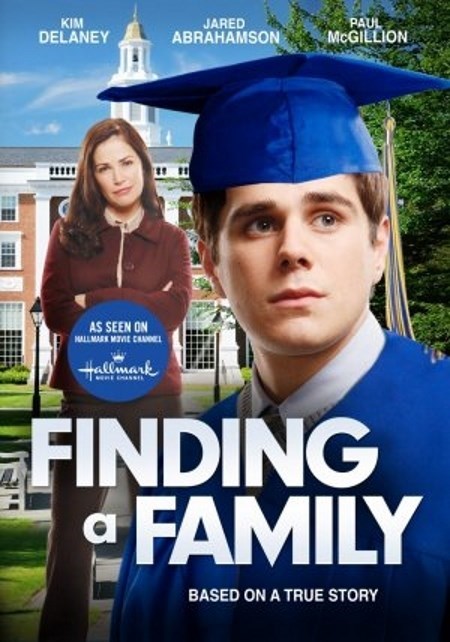
Finding A Family (2011) – This movie is about a kid named Alex (Jared Abrahamson) whose mother has serious mental problems. She has a great degree, but her mental problems absolutely cripple her. As you can guess, they create major issues for her son who has to live with her day after day. Ultimately, Alex has himself emancipated. He wants to go to Harvard and works hard in school to make this work while not forgetting his mother. Then he decides that he really does want a family and starts writing to people asking them to take him in. It’s a nice story that really only had one issue and a minor personal complaint.

The issue is that I have some experience in this area and the depth to which his mother’s mental problems should affect him, don’t. Don’t get me wrong, it’s not like The Blind Side (2009) where they gutted and flattened two amazing people, but it’s noticeable. The other thing is a minor complaint. In the old days you did receive a letter from colleges you applied to telling you whether you were accepted or not. However, I applied in 2006 and we was never sent a letter. You checked their website to find out whether you were accepted or not. This film was made in 2011. I know it’s more dramatic and familiar to go with the letter thing, but it’s time to move on.

You’ve seen it all before, but if you want to see again, then check this one out.
banner_gengap

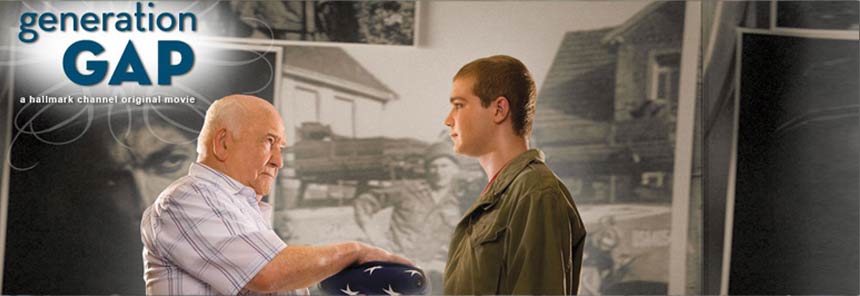
Generation Gap (2008) – There really isn’t much to talk about here. You’ve seen this plot a million times before. We meet Dylan (Alex Black) who is just too much for his mother because of a few scenes of rebellion. His Mom, played by Catherine Mary Stewart, calls up her father played by Ed Asner and dumps Dylan on him. After a few scenes of Asner acting like a dick, which he seems to think he is entitled to do because he’s old, both him and the kid calm down. The film does three things: 1. Asner and the kid come to realize that despite being different ages, they both occupy the same time and place on Earth, 2. Asner hooks up with Rue McClanahan who sounds weird without her Southern accent, 3. The kid also gains a romantic interest.

The only other noteworthy things are that they age Asner by about 10 years to have his character able to have been in WWII. The other is that the kid walks in on Asner and three other guys playing Halo. Pretty funny. Remember that scene in The Wizard (1989) where Beau Bridges is supposedly playing Teenage Mutant Ninja Turtles, but we now know thanks to AVGN that he was probably playing Winter Games for the NES? Well, they actually show that Halo is what is being played and I wouldn’t be surprised if Asner and the others were actually playing.

This one is cliched, but okay.
MV5BMTgyODAzNjUzOV5BMl5BanBnXkFtZTcwMDY3MzgxMw@@._V1_SY317_CR3,0,214,317_AL_

Expecting A Miracle (2009) – This is a weird movie. It seems to be nice and have it’s heart in the right place, but there are some odd bits. It introduces us to a couple played by Jason Priestley and Teri Polo who have been trying to get pregnant. It seems that the couple has tried IVF several times, but there doesn’t seem to be any mention of sex whatsoever. Did they try that?

To try and calm down, they take a vacation and wind up in a small Mexican town that seems to consist only of a courtyard. Cheech Marin is here along with some other characters who conveniently speak English. There is a kid who has something wrong with his leg and is convinced that a special ceremony is going to fix it. This is the kind of place populated with people who are like the magic negro/eccentric characters that turn your life around simply by coming into contact with them.

Polo is told a line that basically says God decides whether you will have kids or not. Okay, but does that mean God also controls the adoption process which is brought up numerous times during this film. Maybe it’s the film’s way of saying that God sometimes is trying to tell you that it’s not necessary to pass on your genetic material, but instead to save a poor kid who needs a family and people who will love them.

The rest is harmless and kind of nice, but then comes the ending. The kid in the village is miraculously cured of a condition with his leg during a ceremony. The couple talk about adopting him. At the very end, they are at home working through the adoption process, talking about how much paperwork there is to adopt a kid. The wife goes to the bathroom and takes a pregnancy test. She’s pregnant! Then there are the credits. Did they have sex? Was it IVF again? Did they still follow through and adopt the kid? No answers.

It’s nice and everything, but I can’t honestly recommend it. Just a little too weird and relies on people’s assumptions about the nobility and happiness about simple rural communities.

Murder101_IfWishesWereHorses_0001.jpg

Murder 101: If Wishes Were Horses (2007) – Another Hallmark murder mystery, but just like Murder 101, this was good. As always, I’m terrible about following the plots of these movies. It all begins when a horse is kidnapped. Once again, Dick Van Dyke is brought in to help with the case. Barry Van Dyke is back again as well, but this time Shane Van Dyke joins in on the fun. This is your standard murder mystery movie in the vein of Diagnosis Murder, Murder, She Wrote, and Mystery Woman as opposed to recent movies like Wedding Planner Mystery and Garage Sale Mystery. This one’s fine.
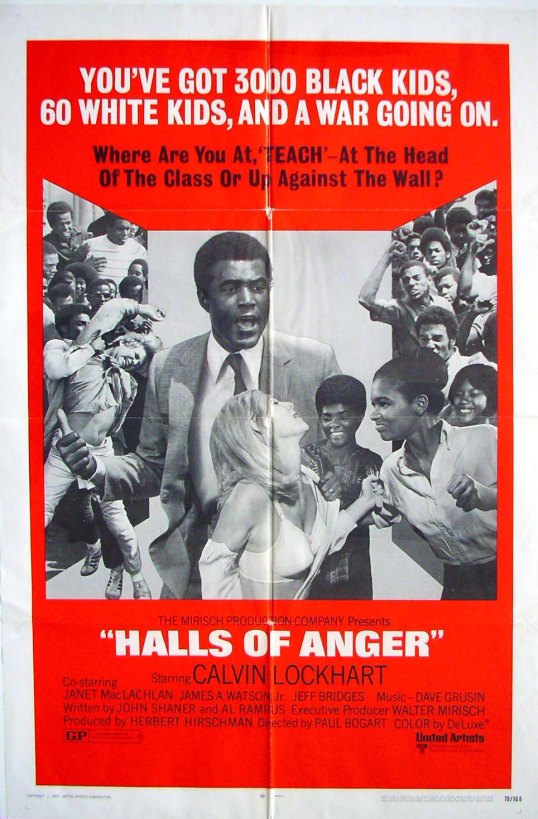
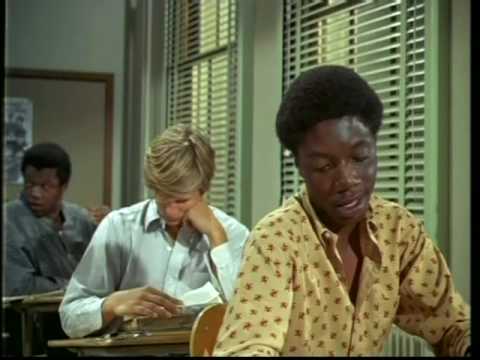
Back to School #8: Halls of Anger (dir by Paul Bogart)


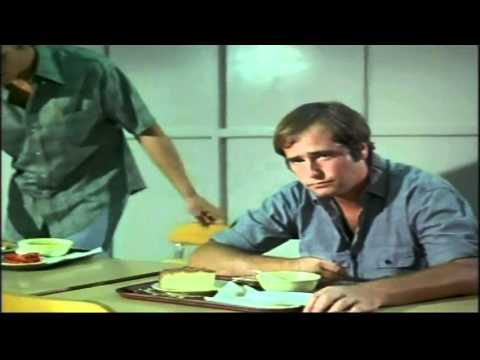
Halls Of Anger

Everybody loves Jeff Bridges.

Last month, the Democratic senator from Montana, John Walsh, announced that he wouldn’t be running for reelection because, much like Lianne Spiderbaby, he had been caught plagiarizing.  (Incidentally, I was one of the many bloggers caught up in Lianne’s web of thievery.  If you have ever read Lianne’s review of Mario Bava’s Black Sabbath, you were essentially reading my review of Black Sabbath.)  Unfortunately, for the Montana Democratic Party, Walsh had already won the Democratic primary.  So, the Montana Democrats held an emergency meeting to select a new nominee.

Governors, ranchers, former congressmen — nearly every prominent Democrat in Montana announced that he didn’t want the nomination.  It looked like all hope was lost but then a petition appeared online, asking the Democrats to nominate Jeff Bridges for the U.S. Senate!  This petition made national headlines and, in just a few hours, it had received thousands of signatures.  For a few brief days, everyone was truly excited about the prospect of U.S. Sen. Jeff Bridges.  I even signed the petition myself, despite the fact that 1) I don’t live in Montana and 2) I’m not even a Democrat!

(I’m a member of the Personal Choice Party.  PCP in 2016!)

Ultimately, he announced that he had no interesting running and wasn’t even sure if he was registered to vote but, until that happened, why were so many of us excited about Jeff Bridges running for the Senate?

Because, in this time of division and conflict, everybody loves Jeff Bridges!

He’s just an incredibly likable actor.  Even when he’s playing a villain, like in Iron Man, he still comes across like someone you would want to live next door to.  He’s everyone’s perfect hippie uncle, the guy that even people who don’t smoke weed want to get stoned with.  If you ever watch any of his early films — and Bridges has been making movies for nearly 50 years now — you’ll discover that this unique and likable charm is something that Jeff Bridges has always possessed.

It’s certainly present in 1970’s Halls of Anger.  This was Jeff Bridges’s film debut, made at a time when he could still pass for a high school student.  He was 20 when he made this film and I have to say that for those of us who best know him as the Dude, Rooster Cogburn, and whoever he was playing in Crazy Heart, it’s always interesting to see just how handsome Jeff Bridges was when he was young.

Jeff Bridges, hiding his face in Halls of Anger

Jeff Bridges, hiding his face in Halls of Anger

In Halls of Anger, he plays Doug, one of 60 white kids who have been transferred to a majority black inner city high school in an attempt to integrate it.  Of all the new white students, Doug is probably the most confident and the most open-minded.  He’s also the most friendly.  His attempt to join the high school basketball team upsets the other students but — even after getting beaten up — Doug sticks with it.  You knew that he would because, after all, he’s played by Jeff Bridges.

Of course, Doug’s story is just one of the many stories told in Halls of Anger.  Another one of the transfers — a weak-willed and balding racist named Leaky (played by future director Rob Reiner!) — tries to provoke a fight with a black student, hoping that he’ll be sent back to his old school for his own protection.  White Sherry (Patricia Stich) dates a black classmate and is savagely assaulted as a result.  Newly assigned vice principal Quincy Davis (Calvin Lockhart) tries to both keep the peace and teach a group of functionally illiterate students how to read.  Militant J.T. Walsh (James Edwards) wanders the hallways and speaks of revolution…

Rob Reiner in Halls of Anger

Rob Reiner in Halls of Anger

Actually, I’m probably making Halls of Anger sound a lot more interesting than it actually is.  For the most part, it’s pretty much your standard 1970 social problem film, in that it’s full of good intentions but those good intentions don’t always add up to compelling drama.  Paul Bogart’s direction is often flat (the scene where Davis teaches his students how to read seems to drag on for hours) and the characters don’t so much talk to each other as they make narratively convenient speeches.

That said, Halls of Anger is worth watching just to see Calvin Lockhart’s authoritative performance, Rob Reiner’s hilariously bad performance, and Jeff Bridges’s charismatic debut performance.  He may never be a member of the U.S. Senate but everybody will always love Jeff Bridges.

You can watch Halls of Anger below!

44 Days of Paranoia #6: JFK (dir by Oliver Stone)


JFK-John-F-Kennedy-DVD-Yon-OLIVER-STONE__76044126_0When I first decided to do this series of reviews of conspiracy-themed films, I knew that I would eventually have to review the 1991 Oliver Stone film JFK.

JFK is one of those films that continues to divide audiences.  Those who think that John F. Kennedy was killed by a conspiracy tend to love this film and are given to describing JFK as being “one of the most important films ever made.”  Those who believe that Lee Harvey Oswald was the lone assassin dismiss Stone’s film as being left-wing propaganda.  Just check out  the message board at the imdb if you need evidence of just how worked up people get over this film and its subject matter.

It seems that very few of the people who criticize or praise JFK ever review it as a work of cinema.  Instead, they focus on the film’s politics.  If I criticize the film for wasting the talents of Sissy Spacek or featuring one of Kevin Costner’s least interesting performances then I’m running the risk of having to deal with angry conspiracy theorists telling me that I need to open my eyes to the reality of American history.  On the other hand, if I praise Tommy Lee Jones’s wonderfully decadent turn as one of the film’s conspirators, chances are that someone is going to accuse me of being a naive leftist.

Then again, perhaps that reaction is to be expected.  Oliver Stone is one of our most political and least subtle filmmakers.  His movies are specifically designed to challenge the status quo.  For that reason, it’s not surprising to discover that Stone considers JFK to be the best of all of his films.

JFK is based (rather loosely, some claim) on the true story of New Orleans District Attorney Jim Garrison (played by Kevin Costner) and how, in 1967, he charged businessman Clay Shaw (played by Tommy Lee Jones) with being a part of a conspiracy to kill John F. Kennedy.  Shaw was eventually acquitted and both Jim Garrison and his investigation remain controversial to this day.

JFK courts controversy immediately with its portrayal of Jim Garrison.  I’ve read several accounts of the Garrison investigation and the one thing that they all seem to agree on is that Jim Garrison was a flamboyant, bigger-than-life figure who enjoyed publicity.  Even among those who believe that Garrison uncovered some valuable evidence as a result of his investigation, there is a good deal of ambiguity about Garrison’s motives.  However, in Stone’s film, Jim Garrison is played by Kevin Costner and is portrayed as being an incorruptible, all-American idealist.  It’s not that Costner gives a bad performance.  Instead, it’s just a rather uninteresting one, especially when one compares Costner’s Garrison to some of the stories about the real-life Garrison.

However, as the film unfolds, it becomes obvious that Stone is using Costner’s blandness to the film’s advantage.  Over the course of three hours, JFK slowly peels back layers of secrecy and cover-ups and reveals the shadow world that, according to Stone, lurks underneath everyday reality.  Costner’s Garrison might not be interesting but he is a stable presence.  He anchors the film, giving us someone to relate to while the film itself grows more and more bizarre.

While Costner’s might give the least interesting performance of his career in this film, the same cannot be said of the rest of the cast.  JFK is full of familiar faces, many of whom are only on-screen for a few minutes but all of which play an important role in creating Stone’s shadow universe.  Kevin Bacon, Gary Oldman, Joe Pesci, Michael Rooker, Donald Sutherland, and Tommy Lee Jones; they all have small roles but every single one of them makes an undeniable impression.  Whether you agree with the film’s conclusions are not, it’s impossible not to enjoy JFK for the chance to spot a bunch of familiar faces giving memorably bizarre performances.

But ultimately, its impossible to review JFK without considering the film’s conclusions.  JFK makes the case that John F. Kennedy was killed as the result of a massive right-wing conspiracy that involved the military, business interests, the CIA, the FBI, anti-Castro Cubans, and the mafia.  By the end of the film, the question becomes less who killed JFK and more who didn’t kill JFK.

Myself, I’m not going to claim to be enough of an expert on the Kennedy assassination to argue whether JFK is accurate or if it’s just propaganda.  However, as a film reviewer, I can say that it’s a very well-made and powerful film but it’s also one of those films that works better the first time you see it than the second time.

The first time you see it, the film overwhelms you.  It leaves you convinced that yes, there was a conspiracy and yes, everyone was involved and yes, Jim Garrison was right!  It convinces you so thoroughly that you end up using exclamation points, just to make sure everyone knows how convinced you are.

However, with each subsequent time that you view JFK, you became a bit more aware of just how manipulative and one-sided it truly is.  You become a bit more aware of the technique underneath the outrage and, if you’re a smart film watcher, you remember that JFK is a recreation as opposed to being a historical document.  You become more and more aware that Stone approached the material with a destination in mind and, like any good director, he has specifically shaped the material to make sure that you reach that destination at the end of the journey.

That was certainly my experience with JFK.  I first saw it in high school and it convinced me that JFK was the victim of a conspiracy.  Then, when I was in college, I watched it for a second time and, though I still believed the film’s conclusions, I also found myself much more aware of how the film’s length and Stone’s direction were designed to beat the audience into submission.  When I saw the film a third time, I found myself resenting the film’s manipulative nature and, as a result, I found it a lot more difficult to accept Stone’s conclusions.

However, when I rewatched the film last night for this review, I was surprised to discover that JFK actually holds up pretty well.  It’s still way too long (and, unlike a lot of other reviewers, I am not impressed by the droning speech that Costner delivers at the end of film) and Stone’s lack of subtlety does backfire on a few occasions.  However, perhaps because I was finally watching the film as entertainment as opposed to judging the film on its political or historical merits, I discovered that JFK is a watchable and entertaining film, one that does a pretty good job of making Stone’s case.  If nothing else, it’s worth watching just for the chance to see the wonderfully snarky performances of Tommy Lee Jones, Kevin Bacon, and Gary Oldman.

Perhaps the best thing that I can say about JFK is that its the type of film that will inspire smart people to do their own research and come to their own conclusions, which may or may not be the same conclusions that Oliver Stone reaches.

And, honestly, isn’t that the most that we can ask of any film?

JFK

Scenes I Love: Up


The passing of Steve Jobs has brought out condolences and praise for one of the most innovative and creative forces in technology, entertainment and how the world interacted in the digital age. One of the many things he has created and fostered was the animation studio we’ve grown to love and call Pixar. It’s difficult to fathom of anyone who doesn’t have at least one fond memory from watching a Pixar film. I have my favorite from several Pixar releases, but one that I really have enjoyed reliving over and over (sometimes with my brother who also loves the film) is the film Up from 2009. It’s from this cg animated film that I’ve chosen the latest “Scenes I Love” in honor of Steve Job.

I’m sure there’s many scenes other people love from this film. Whether it’s the great opening sequence that will bring the most cynical person to tears or scenes between crotchety, old Mr. Fredrickson and Wildlife Explorer Russell. I’m also sure that many would choose scenes involving their talking furry companion Dug. It’s the scene where Dug first meets up with Russell and Mr. Fredrickson which I love the best.

I would try and describe why I love this scene but I think watching it would be the best explanation why I love it so. The one below is a bonus and just shows why Dug is a favorite.