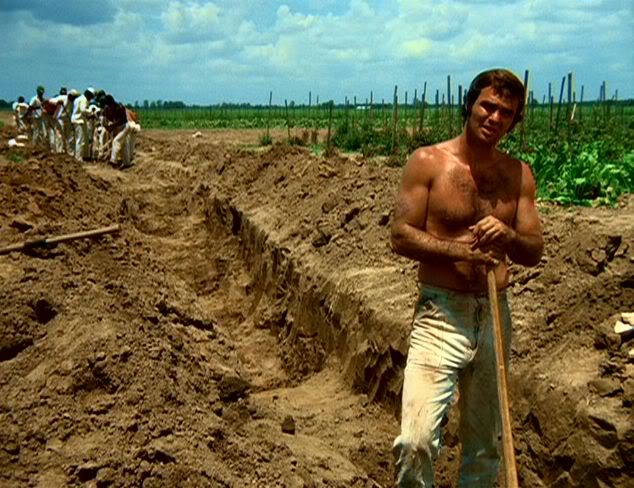
Burt Reynolds labored for years in the Hollywood mines, starring in some ill-fated TV series (his biggest success on the small screen was a three-year run in a supporting role on GUNSMOKE) and movies (nonsense like SHARK! and SKULLDUGGERY) before hitting it big in John Boorman’s DELIVERANCE. Suddenly, the journeyman actor was a hot property (posing butt-naked as a centerfold for COSMOPOLITAN didn’t hurt, either!), and studios were scurrying to sign him on to their projects. WHITE LIGHTNING was geared to the Southern drive-in crowd, but Reynolds’ new-found popularity, along with the film’s anti-authority stance, made it a success across the nation.
WHITE LIGHTNING takes place in rural Arkansas, and Gator McKluskey (Burt) is doing a stretch in Federal prison for running moonshine. His cousin visits and tells Gator his younger brother Donnie was murdered by Sheriff J.C. Connors, the crooked boss of Bogan County. A raging Gator tries to escape, but is immediately caught, so he…
A year after co-starring in Deliverance, Burt Reynolds and Ned Beatty reunited for another movie about life in the backwoods, White Lightning.
White Lightning starts with two hippies, bound and gagged and floating in a canoe. While a banjo plays in the background, two rednecks use a shotgun to blow the canoe into pieces. They watch as the hippies drown in the swamp. It turns out that one of those hippies was the brother of legendary moonshiner and expert driver, Gator McCluskey (Reynolds). Gator is doing time but when he hears that his brother has been murdered, he immediately realizes that he was probably killed on the orders of corrupt Sheriff J. C. Connors (Ned Beatty). The Feds arrange for Gator to be released from prison, on the condition that he work undercover and bring them enough evidence that they can take Connors down.
Back home, Gator works with a fellow informant, Dude Watson (Matt Clark), teams up with local moonshiner, Roy Boone (Bo Hopkins), and has an affair with Roy’s girl, Lou (Jennifer Billingsley). Connors and his main henchman, Big Bear (R.G. Armstrong) both suspect that Gator and Dude are working for the government. Since this is a Burt Reynolds movie, it all ends with a car chase.
A classic of its kind and a huge box office success, White Lightning set the template for almost every other film that Burt Reynolds made in the 1970s and 80s. There is not much to the movie beyond Burt’s good old boy charm and Ned Beatty’s blustering villainy but if you’re in the mood for car chases and Southern scenery, White Lightning might be the movie for you. Joseph Sargent also directed the New York crime classic, The Taking of Pelham One Two Three, and he gives White Lightning an edginess that would be lacking from many of Burt Reynolds’s later movies.
For tomorrow’s movie a day, it’s the sequel to White Lightning (and Burt Reynolds’s directorial debut), Gator.
Today was the first day of a new year so, of course, I had to go down to the Alamo Drafthouse and see a movie. What was the title of the first movie that I saw in a theater in 2016?
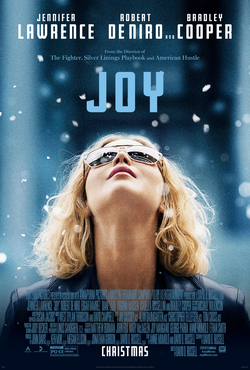
Joy.
Despite the fact that Joy has gotten some seriously mixed reviews, I had high hopes when I sat down in the Alamo. After all, Joy represents the third collaboration between director David O. Russell and one of my favorite actresses, Jennifer Lawrence. (Their previous collaborations — Silver Linings Playbook and American Hustle — happen to be two of my favorite films of the past 5 years.) Add to that, Joy has been advertised as being a tribute to a real-life, strong-willed woman and I figured that, at the very least, it would provide a nice alternative to the testosterone-crazed movies that I’ve recently sat through. And finally, Joy had a great trailer!
Sure, there were a few less than positive signs about Joy. As I mentioned before, the majority of the reviews had been mixed and the word of mouth was even worse. (My friend, the sportswriter Jason Tarwater, used one word to describe the film to me: “Meh.”) But what truly worried me was that Sasha Stone of AwardsDaily absolutely raved about the film on her site and that’s usually a bad sign. Let’s not forget that this is the same Sasha Stone who claimed that Maps To The Stars was one of the best films ever made about Hollywood.
And, to be honest, I had much the same reaction to Joy that I had to Map To The Stars. I really wanted to love Joy and, occasionally, there would be a clever bit of dialogue or an unexpected directorial choice and I would briefly perk up in my seat and think to myself, “Okay, this is the film that I wanted to see!” But, for the most part, Joy is a disappointment. It’s not so much that it’s bad as it’s just not particularly great. For the most part, it’s just meh.
But let’s talk about what worked. Overall, this may be one of Jennifer Lawrence’s lesser films but she gives a great performance, one that reminds us that she truly is one of the best actresses working today. I’ve read some complaints that Lawrence was too young for the title role and, to be absolutely honest, she probably is. She looks like she could easily go undercover at a high school and help Jonah Hill and Channing Tatum bust drug dealers. But, at the same time, she projects the inner weariness of a survivor. For lack of a better term, she has an old soul and it comes across in her films.
In Joy, she plays Joy Mangano, a divorced mother of two who lives in upstate New York. Her mother (Virginia Madsen) lives with Joy and spends all of her time watching soap operas. Joy ex-husband, a lounge singer named Tony (Edgar Ramirez), lives in the basement. Meanwhile, her grandmother (Diane Ladd, who narrates the film) is always hovering in the background, offering Joy encouragement and optimism. At the start of the film, Joy’s cantankerous father (Robert De Niro) has also moved into the house. Joy, who was the valedictorian of her high school, has got a demeaning job working as a flight booker at the airport.
(“What’s your name?” one rude customer asks, “Joy? You don’t seem very joyful to me…”)
How stressful is Joy’s life? It’s so stressful that she has a reoccurring nightmare in which she’s trapped in her mother’s favorite soap opera and Susan Lucci (cleverly playing herself) tells her that she should just give up.
However, as difficult as life may get, Joy refuses to take Susan Lucci’s advise. She invents a miraculous mop known as the miracle mop and eventually becomes a highly successful businesswoman. Along the way, she makes her television debut on QVC and becomes a minor celebrity herself…
The film’s best scenes are the ones that deal with Joy and QVC. These scenes, in which the inexperienced Joy proves herself to be a natural saleswoman, are the best in the film. These scenes are filled with the spark that I was hoping would be present throughout the entire film. Of course, it helps that these scenes also feature Bradley Cooper as a sympathetic television executive. This is the third time that Bradley Cooper and Jennifer Lawrence have acted opposite each other and there’s an immediate chemistry between them. In this case, it’s not a romantic chemistry (and one of the things that I did appreciate about Joy was that it didn’t try to force a predictable romance on the title character). Instead, it’s the type of mutual respect that you rarely see between male and female characters in the movies. It’s a lot of fun to watch, precisely because it is so real and unexpected.
But sadly, the QVC scenes only make up a relatively small part of Joy. The rest of the film is something of a mess, with David O. Russell never settling on a consistent tone. At times, Joy feels like a disorganized collection of themes from his previous films. Just as in The Fighter and Silver Linings Playbook, we get the quirky and dysfunctional family. Just as in American Hustle, we get the period detail, the Scorsese-lite soundtrack, and the moments of cynical humor. There’s a lot going on in Joy and, at time, it doesn’t seem that Russell really knows what to do with all the theme and characters that he’s mixed into the movie. I found myself wondering if he truly understood the story that he was trying to tell.
Finally, at the end of the film, Joy visits a business rival in Dallas, Texas. Let’s just say that the film’s version of Dallas looks nothing like the city that I know. (The minute that the scene cut from her ex-husband discovering that Joy had left to a close-up of a Bar-B-Q sign, I let out an exasperated, “Oh, come on!”) I suppose I should be happy that Russell didn’t have huge mountains in the background of the Dallas scenes but seriously, would it have killed anyone to do a little research or maybe hop on a plane and spend a day or two filming on location?
(After all, if Richard Linklater or Wes Anderson decided to set a movie in David O. Russell’s home state of Massachusetts, I doubt that they would film the Boston scenes in El Paso….)
Joy features great work from Jennifer Lawrence and Bradley Cooper and it tells a story that has the potential to be very empowering. But, when it comes to the overall film … meh.
However, it might be nice if they had been. It would certainly put a lot less pressure on me. Here we are — it’s September and the Oscar race is still largely up in the air. Hopefully, the picture will start to become a bit more clear over the next few weeks. For instance, Beasts of No Nation was just acclaimed at the Venice Film Festival and, as I write this, we are just a few days into the Toronto Film Festival.
But for now, it still looks like it is anyone’s race to win!
Below are my predictions for September! If you want to see just how confused I’ve been (and how random my predictions have occasionally been) for the majority of the year, be sure to check out my predictions for January, February, March, April, May, June, July, and August!
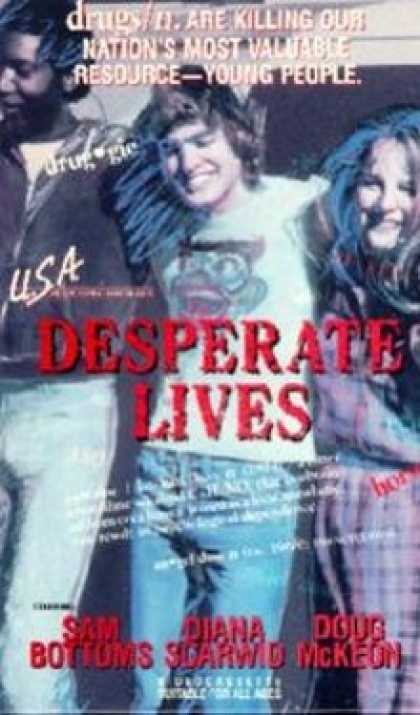
For the longest time, the 1982 anti-drug melodrama Desperate Lives has been available for viewing on YouTube. I first watched it two years ago, after I read an online article about a scene in which a teenage Helen Hunt takes PCP and jumps through a window. And, when I watched it, I was stunned. I knew that the film was going to be over-the-top and silly, largely because it’s hard to imagine how a film featuring a teenage Helen Hunt taking PCP could be anything other than that. But, even with my experience of watching over the top message movies, nothing could have quite prepared me for Desperate Lives.
So, I figured, for this review, that I’d say a few snarky words about Desperate Lives and then I’d just add something like, “And you can watch it below!” And then I would embed the entire movie and all of y’all could just click on play and watch a movie on the Lens.
Unfortunately, Desperate Lives has been taken off of YouTube. I assume the upload violated some sort of copyright thing. And really, it’s kinda stupid because seriously, Desperate Lives is one of those films that really deserves to be seen for free on YouTube.
Oh well. You can still watch a video of Helen Hunt jumping through that window. The video below also features some additional elements from Desperate Lives.
For instance, you get to see Diana Scarwid playing the angriest high school guidance counselor in the world. Scarwid knows that students like Helen Hunt are using drugs and that her fellow faculty members are turning a blind eye to everything’s that’s happening. From the minute she first appears on screen, Scarwid is shouting at someone and she doesn’t stop screaming until the film ends.
And you also get to see Doug McKeon, playing Helen Hunt’s brother. McKeon goes for a drive with his girlfriend, who has just taken PCP herself. As their car goes flying off a mountain, she says, “Wheeee!”
In the video below, you also get to see that the only reason Helen Hunt used drugs was because her boyfriend begged her to. That’s a scenario that seems to show up in a lot of high school drug films and it’s strange because it’s something that I’ve never actually seen happen or heard about happening in real life. In fact, in real life, most users of hard drugs are actually very happy to not share their supply.
Unfortunately, the video below does not feature any scenes of Sam Bottoms as the world’s most charming drug dealer and that’s a shame because he gives the only good performance in the entire film (sorry, Helen!).
Even worse, the video doesn’t include any scenes from the film’s memorably insane conclusion, in which Scarwid searches every single locker in the school and then interrupts a pep rally so she can set everyone’s stash on fire in the middle of the gym. Making it even better is that all the students are so moved by Scarwid’s final speech that they start tossing all of the drugs that they have on them into the fire.
Which means that the film essentially ends with the entire school getting high off of a huge marijuana bonfire.
No, that scene cannot be found in the video below. But you can find Helen Hunt jumping through a window so enjoy.
I recently saw the 1970 film WUSA on Movies TV. After I watched it, I looked Joanne Woodward up on Wikipedia specifically to see where she was born. I was surprised to discover that she was born and raised in Georgia and that she attended college in Louisiana.
Why was I so shocked? Because WUSA was set in New Orleans and it featured Joanne Woodward speaking in one of the most worst Southern accents that I had ever heard. A little over an hour into the film, Woodward’s character says, “What’s all the rhubarb?” And while “What’s all the rhu…” sounds properly Southern, the “…barb” was pronounced with the type of harshly unpleasant overemphasis on “ar” that has given away many Northern actors trying to sound Southern. Hence, I was shocked to discover that Joanne Woodward actually was Southern.
That said, her pronunciation of the word rhubarb pretty much summed up every problem that I had with WUSA. Actually, the real problem was that she said “rhubarb” in the first place. It came across as being the type of thing that a Northerner who has never actually been down South would think was regularly uttered down here. And I will admit that WUSA was made 16 years before I was born and so, it’s entirely possible that maybe — way back then — people down South regularly did use the word rhubarb. But, for some reason, I doubt it. I know plenty of old Southern people and I’ve never heard a single one of them say anything about rhubarb.
As for WUSA, it’s a long and slow film. A drifter named Reinhardt (Paul Newman) drifts into New Orleans and, with the help of an old friend who is now pretending to be a priest (Laurence Harvey), Reinhardt gets a job as an announcer at a right-wing radio station. He reads extremist editorials that he doesn’t agree with and whenever anyone challenges him, he explains that he’s just doing his job and nothing matters anyway.
Reinhardt also gets himself an apartment and spends most of his time smoking weed with long-haired musician types, the exact same people that WUSA regularly denounces as being a threat to the American way. Living in the same complex is Geraldine (Joanne Woodward), a former prostitute who has a scar on her face and who says stuff like, “What’s all the rhubarb?” She falls in love with Reinhardt but finds it difficult to ignore what he does for a living.
Meanwhile, Geraldine has another admirer. Rainey (Anthony Perkins) is an idealistic and neurotic social worker who is regularly frustrated by his efforts to do good in the world. Reinhardt makes fun of him. The local crime boss (Moses Gunn) manipulates him. And WUSA infuriates him. When Rainey realizes that WUSA is a part of a plot to elect an extremist governor, Rainey dresses up like a priest and starts carrying around a rifle.
Meanwhile, Reinhardt has been assigned to serve as emcee at a huge patriotic rally. With Geraldine watching from the audience and Rainey wandering around the rafters with his rifle, Reinhardt is finally forced to take a stand about the people that he works for.
Or maybe he isn’t.
To be honest, WUSA is such a mess of a film that, even after the end credits roll, it’s difficult to figure out whether Reinhardt took a stand or not.
Anyway, WUSA is not a lost masterpiece and I really wouldn’t recommend it to anyone. The film’s too long, there’s too many scenes of characters repeating the same thing over and over again, and neither Newman nor Woodward are particularly memorable. (You know a movie is boring when even Paul Newman seems like a dullard.) On the plus side, Anthony Perkins gives such a good performance that I didn’t once think about the Psycho shower scene while watching him.
As boring as WUSA is, I have to admit that I’m a little bit surprised that it hasn’t been rediscovered. Considering that it’s about a right-wing radio station, I’m surprised that there haven’t been hundreds of pretentious think pieces trying to make the connection between WUSA and Fox News. But, honestly, even if those think pieces were out there, it probably wouldn’t do much for WUSA‘s repuation. According to the film’s Wikipedia page, Paul Newman called it, “the most significant film I’ve ever made and the best.” Paul Newman’s opinion aside, WUSA is pretty dire.
Jack Stanton (John Travolta) is the charismatic governor of an unnamed Southern state. After spending his entire life in politics, Jack is finally ready to run for President. Even more ready is his equally ambitious wife, Susan (Emma Thompson). Jack proves himself to be a strong candidate, a good speaker who understands the voters and who has the ability to project empathy for almost anyone’s situation. He’s managed to recruit a talented and dedicated campaign staff, including the flamboyant Richard Jemmons (Billy Bob Thornton), Daisy Green (Maura Tierney), and journalist Henry Burton (Adrian Lester). Henry is the son of a civil rights leader and, as soon as they meet, Jack talks about the first time that he ever heard Henry’s father speak. Within minutes of first meeting him, Henry believes in Jack.
The problem, however, is that there are constant hints that Jack may not be worthy of his admiration. There’s the fact that he’s a compulsive womanizer who is given to displays of temper and immaturity. When one of Jack’s old friends reveals that Jack may have impregnated his daughter, Jack and Susan respond with a pragmatic ruthlessness that takes Henry by surprise.
When one of Jack’s mistresses threatens to go public, Henry is partnered up with Libby (Kathy Bates) and sent to dig up dirt on her and her sponsors. When the former governor of Florida, Freddie Picker (Larry Hagman), emerges as a threat to derail Jack’s quest for the nomination, Henry and Libby are again assigned to research Picker’s background. Libby is perhaps the film’s most interesting character. Recovering from a mental breakdown, Libby has no trouble threatening to shoot one political opponent but she’s still vulnerable and idealistic enough that it truly hurts her when Jack and Susan repeatedly fail to live up to her ideals. As an out lesbian, Libby is perhaps the only character who has no trouble revealing her true self and, because of her honesty, she is the one who suffers the most.
First released in 1998 and based on a novel by Joe Klein, Primary Colors is an entertaining and ultimately rather bittersweet dramedy about the American way of politics. John Travolta and Emma Thompson may be playing Jack and Susan Stanton but it’s obvious from the start that they’re meant to be Bill and Hillary Clinton. And while it takes a few minutes to get used to Travolta’s attempt to sound Southern, this is ultimately one of his best performances. As played by Travolta, Jack Stanton is charming, compassionate, self-centered, and ultimately, incredibly frustrating. One reason why Primary Colors works is because we, as an audience, come to believe in Jack just as much as Henry does and then we come to be just as disillusioned as Libby. Emma Thompson’s performance is a little less obviously based on Hillary. Unlike Travolta, she doesn’t attempt to imitate Hillary’s voice or mannerisms. But she perfectly captures the steely determination.
Primary Colors captures both the thrill of believing and the inevitability of disillusionment. It’s definitely a film that I will rewatch in the days leading up to 2016.
Our latest entry into the 44 Days of Paranoia is a dark masterpiece. Based on a script by Robert Towne, directed by Roman Polanski, and starring Jack Nicholson, 1974’s Chinatown is one of the greatest films ever made.
Chinatown takes place in 1940s Los Angeles. Private Investigator Jake Gittes (Jack Nicholson) is hired by a woman (Diane Ladd) who claims that her name is Evelyn Mulwray. She wants Gittes to follow her husband, Hollis, and discover whether he’s having an affair. Gittes gets some pictures of Hollis with a young woman (Belinda Palmer) and hands them over to Evelyn.
The next day, the pictures are published on the front page of the newspaper and Gittes is confronted by another woman (Faye Dunaway) who explains that she — and not the woman who hired him — is the actual Evelyn Mulwray. Gittes then learns that Hollis has turned up dead, drowned in a reservoir.
Gittes suspects that Hollis was murdered and launches his own investigation. This eventually leads Jake to Hollis’s former business partner, Noah Cross (John Huston). Noah also happens to be the father of Evelyn and he offers double Gittes’s fee if Gittes will track down Hollis’s younger girlfriend.
As his investigation continues, Gittes discovers that Hollis’s murder was connected to both the continued growth of Los Angeles as a city and a truly unspeakable act that occurred several years in the past. Nobody, it turns out, is what he or she originally appears to be. To say anything else about the plot would be unfair to anyone who hasn’t seen Chinatown before.
Since I first started reviewing films for this site, one of the things that I’ve discovered is that it’s actually easier to review a bad film than a good film. It’s easier to be snarky and cynical about the latest film from Michael Bay or Roland Emmerich than it is to explain why a film works. There’s a famous saying about pornography: “I don’t know what it is but I know it when I see it,” and sometimes that’s the way I feel whenever it comes time to try to review a great film.
Consider Chinatown. At its heart, Chinatown is an homage to the old film noirs of the 40s and 50s. Now, I have to admit that I’ve lost track of how many noir homages I’ve seen. It seems like every director has to make at least one hard-boiled, morally ambiguous detective film. Chinatown has all of the familiar elements — the hero is a private investigator, Evelyn Mulwray initially appears to be a classic femme fatale, the dialogue is appropriately cynical, and the plot is full of twist and turns. Even the film’s theme of political conspiracy serves to remind us that most noirs used their detective stories as a way to explore the hidden underbelly of American society.
And yet, with Chinatown, Polanski, Nicholson, Towne, and producer Robert Evans took all of those familiar elements and used them to create one of the greatest films ever made.
Why is Chinatown such a great film?
Some of the credit has to go to Jack Nicholson who, in the role of Jake Gittes, gives perhaps his best performance. As I mentioned above, Gittes is, in many ways, a stock character but Nicholson brings so much nuance and depth to the role that it doesn’t matter. Nicholson’s trademark cynicism and sarcasm are both to be found here but he also brings a cocky recklessness to the role. Gittes is such a charismatic and likable hero and so confident in himself that it makes the film’s ending all the more shocking.
As good as Nicholson is, he’s matched at every turn by John Huston’s Noah Cross. Noah Cross is one of the most vile characters to ever appear on-screen, which is why Huston’s rather courtly performance is all the more disturbing. When Gittes confronts Noah about the worst of his many crimes, Cross simply responds that a man is never sure what he’s capable of until he does it. Huston delivery of the lines leave us with little doubt that Noah believes every word of what he’s just said.
In the end, though, most of the credit has to go to Roman Polanski’s direction and Robert Towne’s script. Towne’s script provides a genuinely challenging and thought-provoking mystery, while Polanski’s stylish direction keeps the view continually off-balance and unsure of who is telling the truth. Reportedly, Polanski and Towne had a contentious relationship, with Polanski changing the ending of Towne’s script to make the film much more downbeat. In the end, Polanski made the right choice. The film ends the only way that it possibly could.
“Starring Academy Award nominee Jack Nicholson…” Actually, this film features at least 3 Academy Award nominated performers — Nicholson, Bruce Dern, and Diane Ladd.
2) Cry Baby Killer (1958)
Speaking of Jack Nicholson, here’s proof that even the most iconic stars had to start somewhere. This was Nicholson’s film debut.
3) The Delinquents (1957)
This juvenile delinquent film was directed by Robert Altman, who would later direct films like M*A*SH, Nashville, The Player, Short Cuts, Gosford Park, and The Company.
4) The Cool and the Crazy (1958)
The 50s were a wild time to be a teenager, apparently.
5) The Narcotics Story (1958)
“It’s a story of the young and innocent…” They’re young and innocent only be the standards of the decadent 50s!
6) The Pusher (1960)
And, of course, you can’t have the narcotics story without …. The Pusher!









 Through the Shattered Lens