
“Get a life, punk!”
— Albert Rosenfield (Miguel Ferrer) in Twin Peaks 2.15 “Slaves and Masters”
Well, it had to happen some time.
We have reached the “Slave and Masters” episode of Twin Peaks. Judging from what I’ve read online, most fans seem feel that this episoode was the worst in the show’s history. Myself, I don’t know whether it is or isn’t. I’m writing this introduction before watching the episode. I guess I’ll know soon enough.
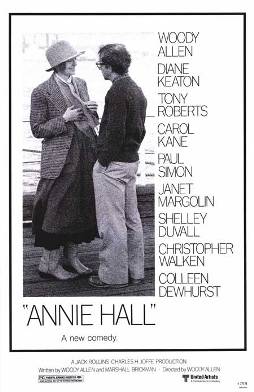
Interestingly enough, this episode was directed by actress Diane Keaton. When I first saw Keaton’s name listed as director, I assumes that she must have been a fan of the show and that she lobbied for the chance to direct an episode. However, according to Relections: An Oral History of Twin Peaks by Brad Dukes, the opposite was true. While the cast all liked and respected Keaton as a director, there was also a feeling that she didn’t seem to actually know much about the show. Considering that the show had suffered a severe ratings decline during the 2nd season, it seems probable that Keaton was hired to direct in an attempt to generate some new interest in the once hot show.
If that was the plan, it didn’t work. Apparently, the ratings for this episode were so low that Twin Peaks was put on hiatus a week after it aired. It was only due to a letter-writing campaign that ABC decided to air the last six episodes of the season. In short, it can be argued that this episode was truly the beginning of the end for Twin Peaks‘s original network run.
So, with all that in mind, let’s take a look at the 23rd episode of Twin Peaks, “Slaves and Masters.”
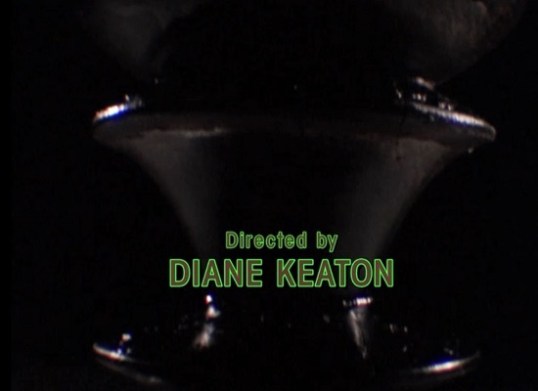
As always, we begin with the haunting opening credits and Angelo Badalamenti’s lushly romantic (yet ominously threatening) score. The mood has been set. We have returned to the world of Twin Peaks.
After the credits, we immediately cut to a close-up of a chess board. In slow motion, the camera glides over all of the pieces. The Queen, The pawns, the King, the Bishop, the little horsey guy. (I don’t know much about chess, sorry.)
Suddenly, we’re no longer looking at chess pieces. Instead, the camera is panning up the legs of Evelyn Marsh (Annette McCarthy), who is dressed in black and even wearing a black veil and — OH MY GOD, HAS THIS STORYLINE NOT BEEN RESOLVED YET!? Seriously, when people talk about Season 2 not being as inspired as Season 1, they’re talking about this half-assed film noir rip-off that James (James Marshall) rode into after he hopped on his motorcycle and left Twin Peaks. From the minute that Evelyn first showed up, I knew exactly what was going to happen with her, James, and her husband. Much like the whole Audrey kidnapping subplot, the Evelyn Marsh subplot should not have lasted any longer than an episode and a half. Instead, it’s still going on!
Anyway, the cops are talking to Evelyn and Malcolm (Nicholas Love) about how someone might have killed her husband. Malcolm is quick to blame James but Evelyn seems a little bit more conflicted about it. There is a funny moment when Malcolm says that James was hired to fix the Jaguar and the cop can’t figure out how to spell Jaguar. That made me laugh but, otherwise, this whole scene felt predictable and unnecessary.
Meanwhile, at Wallie’s Bar, a dozen cops are sitting at the bar, smoking cigars and listening to opera music. (Weird image is weird but it’s just weirdness for the sake of weirdness.) James and Donna (Lara Flynn Boyle) are in a corner of the bar. Donna says that they need to get help but James is all like, “I don’t need nobody!” He says that Malcolm framed him and that he just needs to talk to Evelyn.
Donna goes to call Ed but ends up having to talk to Nadine instead. Though we only hear Donna’s side of the conversation, it sounds like Nadine is talking about her new boyfriend. If her new boyfriend is Mike (Gary Hershberger) than that means that Nadine is now dating Donna’s ex and yet, Donna seems to be remarkably okay with that.
Back at the Sheriff’s station, Harry (Michael Ontkean) and Cooper (Kyle MacLachlan) are interrogating Bobby (Dana Ashbrook) and Shelly (Madchen Amick). Bobby wants to know why Harry and Cooper aren’t making more of an effort to track down Leo. Cooper asks Bobby about the night that the mill burned down. Bobby lies and says that Hank Jennings shot Leo.
Harry says that he’ll have some deputies watch the house. Bobby claims that he’s all the protection that Shelly needs. (For some reason, Bobby is acting like a methhead in this scene.) When Bobby and Shelly leave, they pass Albert Rosenfield (Miguel Ferrer), who takes one look at Bobby and shouts, “Get a life, punk!”
(We love you, Albert!)

After giving Harry an out-of-character bear hug (but that’s okay because I like it when dudes hug it out), Albert explains that he’s been sent to Twin Peaks by Gordon Cole. He has brought with him a picture of Windom Earle, in which Windom looks like an extra in a 1930s gangster movie. He also brings the news that Windom has been mailing different pieces of clothing to police agencies across the country.
Windom has mailed:
1. A white veil
2. A garter
3. A pair of white slippers
4. A peal necklace
5. A wedding dress
Oh my God, I said as Albert listed the items, Windom Earle is marrying Pippa Middleton!
Cooper says that the clothing belonged to Windom’s dead wife (and Cooper’s ex-lover), Caroline. Albert says that Windom is definitely making his move and then says that Cooper looks good in the muted earth tones of a flannel shirt. That was nice of Albert.
Meanwhile, in his cabin, Windom Earle (Kenneth Welsh) plays a flute while Leo (Eric Da Re) lies on the floor. (I have to be honest that these cabin scenes between Windom and Leo made me think about Peter Boyle burning down Gene Hackman’s hut in Young Frankenstein.) Once Leo wakes up, Windom — who was previously described as having a mind like a diamond, cold and precise — starts acting like a Satanic little wood sprite. He jumps around the cabin. He says a lot of evil quips. He beats Leo with a flute and then reveals that he’s placed a collar around Leo’s neck. Windom can electrocute Leo whenever he feels like it. Windom forces Leo to eat gruel while Windom pretends to be a kitty cat. “Purrrr,” he says.
(Windom’s a genius so why is he acting like a sadistic towel manager?)
We cut to Ed (Everett McGill) laying in bed with Norma (Peggy Lipton) and talking about how it’s been twenty years since they first fell in love. They agree that it’s sucked not being together. Suddenly, they hear Nadine (Wendy Robie) arriving home. Norma starts to leave but Ed says, “No, no. We may as well talk to her now.” Sure, Ed — have this conversation with Nadine while you and Norma are laying in bed in your underwear. That’ll really avoid any hurt feelings.
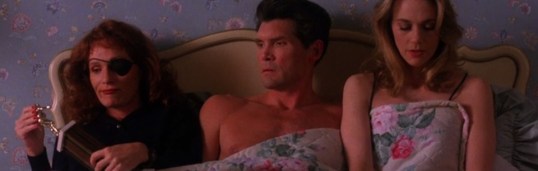
Suddenly, Nadine rips the bedroom door off of its hinges. She comes into the room, carrying a wrestling trophy, and then jumps into bed with Ed and Norma. Nadine apologizes for beating up Hank and then says that she knows about the two of them. Nadine says it’s okay because she’s in love with Mike now.
Cut to the Martell house, where Harry and Cooper are talking to Josie (Joan Chen) about what happened to her in Seattle. Josie says she doesn’t know who killed Jonathan. Harry begs Josie to tell him the truth. Out of nowhere, a surprisingly cheerful Cooper announces, “I think I’ll get another cup of Joe!”
(Somewhere, Joe Biden looks up and says, “Oh my God, they’re talking about me in an old episode of Twin Peaks!” No, Joe, they’re not. Sorry. Maybe later.)
While Cooper’s getting more coffee, Pete (Jack Nance) stumbles in. He has picked up the dry cleaning and can barely see above all of the clothes that he’s holding. He and Cooper do that thing where, instead of being smart and putting the clothes somewhere first, they stand around and attempt to have a conversation, despite the fact that Pete is about fall over backwards. When the phone rings, Pete gives the clothes to Cooper and now its Cooper’s turn to struggle to remain standing. Eventually, Cooper puts the clothes on a chair (was that so hard!?) and then picks one thread off of a jacket.
Speaking of Josie, the phone call was for her. It turns out that the call is from Thomas Eckhardt (David Warner) and he is wondering if he and Josie could get together. Thomas reveals that he is responsible for Jonathan’s death.
After hanging up the phone, Thomas and his assistant, Jones (Brenda Strong), stare at a black trunk.
Meanwhile, Ben Horne (Richard Beymer) is apparently still convinced that he’s a Civil War general because he’s talking to Dr. Jacoby (Russ Tamblyn) about Stonewall Jackson. Much like all that stuff with Evelyn Marsh, this is a plotline that should have been resolved after an episode and a half. Instead, it’s been dragged out way past the point of being amusing. The Ben-Goes-Crazy storyline is the epitome of how Season 2 abandoned surrealism in favor of just being weird for the sake of being weird.
It turns out that Ben and Jacoby have an audience. Audrey (Sherilyn Fenn) and Jerry (David Patrick Kelly) are listening. Johnny Horne (Robert Bauer) is rocking back and forth while wearing a Native American headdress. And there’s a few members of the Hotel Staff, who have been transformed into some sort of marching band.

While Ben rants in his really crummy Southern accent, Jerry and Audrey leave the office. Audrey is worried about her father but Jerry seems to be fairly indifferent. (Needless to say, this goes against everything that we’ve previously seen about Jerry and his relationship with Ben.) Audrey points out that, conveniently enough, she is set to inherit the entire Horne business empire if anything happens to Ben and that Jerry better do what she says or she’ll cut him off.
Audrey returns to Ben’s office, where Dr. Jacoby looks perplexed. Audrey walks up to him and says she wants her father to turn back to normal. Jacoby says that he’s got it all taken care of. Bobby shows up, dressed like a Confederate soldier. Ben sings Dixie. Can this storyline just end, please!?
Meanwhile, at Walli’s, Evelyn is still dressed in black. Though the bar appears to be closed (there are chairs on the tables and everything), Evelyn is drinking. Suddenly, Donna walks up to her. Why is Donna still there? How much school can you miss in Twin Peaks? Why are Evelyn and Donna both hanging out in a bar that appears to be closed?
Suddenly, the bartender wanders by, lingering just long enough for Evelyn to order Donna a drink, “one that has a little umbrella in it.” Okay, is this bar closed or open? If it’s open, why are the tables covered in chairs? This stuff is confusing, especially for a non-drinker like me.
Anyway, Donna gets mad when Evelyn says that she won’t help James. Evelyn explains that life is crap. (Her words.) Suddenly, Malcolm (Nicholas Love) shows up and tells Evelyn to go home. He then threatens Donna and Donna reacts by yelling and then crying.
Back at the station, Albert reveals that the thread that Cooper found was from the carpet outside of Cooper’s hotel room. Apparently, this proves that it was Josie who shot Cooper at the end of Season 1. Bad Josie!
After swearing Albert to secrecy, Cooper heads to Harry’s office, where Harry is playing darts. Harry tells Cooper that the dead vagrant has been identified as being Eric Powell, a former member of the Merchant Marines.
“Powell was Caroline’s maiden name!” Cooper says.
Cooper says that this is all a big chess game to Windom. Harry says that, if Cooper needs a chess expert, they have one of the best right in town. And his name is Pete Martell!
At the diner, Pete shows of his mad chess skills by playing and winning four games at once. Cooper is impressed and invites Pete to help him play Windom’s chess game. Pete better be good because, every time that Cooper loses a piece, Windom is going to kill an innocent person.
Shelly walks into the diner and asks Norma if she needs any help. Norma hires her back. Then Harry shows up and says that he needs to talk to Norma. They slip into the kitchen where Harry explains that Hank is going away for a long time. Norma’s okay with that but I’m not. Hank may be a sociopath but he’s hella charming.
That night, Thomas shows up at the Martell house, where he is greeted by Catherine (Piper Laurie). Thomas appears to be slightly surprised by the sight of Josie in her maid’s uniform. Thomas and Catherine drink wine, eat dinner, and discuss art and killing. It quickly becomes apparent that Thomas has shown up to take Josie and that Catherine is more than willing to allow him to do that, for a price.
Meanwhile, at the Marsh house, Evelyn is stunned when James shows up in the living room and demands to know why Evelyn killed her husband and attempted to frame him. James says that it was hella lame to manipulate him with everything that he’s been going through. Evelyn confesses to everything. She says that she set James up. She says she did it for the money and also just because she felt like doing it.
Suddenly, Malcolm barges into the room and knocks James out. Malcolm says that they can now kill James and claim that it was self-defense. And you know what? He has a point. Bye, James.
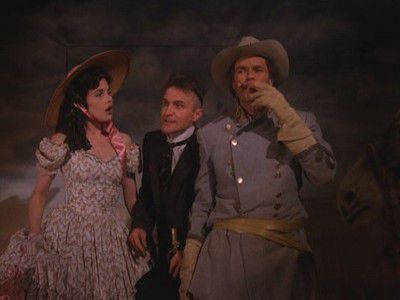
Meanwhile, Ben and the gang recreate another Civil War battle. This whole Civil War subplot is so freaking stupid that I don’t even feel like talking about it anymore. While pretending to be General U.S. Grant, Dr. Jacoby announces that he’s surrendering. Having won the Civil War, Ben proceeds to faint. When he wakes up, Ben says that he had the strangest dream about being a general during the Civil War. He even does the whole “And you were there …. and you … and you!” thing. Anyway, Ben appears to be back to normal.
At the cabin, Windom is putting on a disguise. He continues to torment Leo with the electroshock collar.
At the Marsh mansion, James is still unconscious on the floor while Malcolm and Evelyn look down on him. Donna watches from outside the window. When Malcolm repeats that they can kill James and make it look like self-defense, Donna runs into the living room and screams, “NO!”
As Evelyn watches Donna cry over a motionless James, she stands up. Uh-oh, she’s got a gun. Evelyn shoots Malcolm and then says that she’ll frame Malcolm for her husband’s death though I don’t think it’ll be that difficult a frame-up because Malcolm is actually guilty.
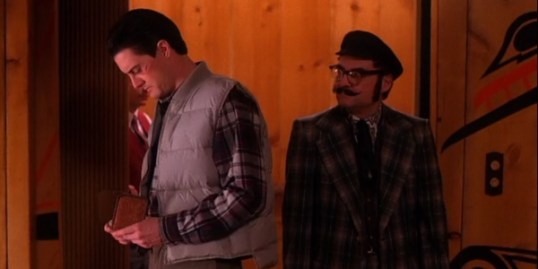
At the Great Northern, Cooper walks down a hallway and stops in front of an elevator. He looks at a picture of Caroline that he has in his wallet. As he does this, a poorly disguised Windom Earle steps off the elevator. Windom goes to the front desk an drops off a note for Audrey. (Oh, goddamnit, is this going to be the start of yet another Audrey-gets-kidnapped storyline?) He also notices several postcards that all feature owls. “Owls,” he says.
Cooper arrives back at his room. He finds a white mask on his bed. Windom Earle has been there and he’s left a taunting message. The episode ends with Windom’s line: “It’s your move.”
Agck!
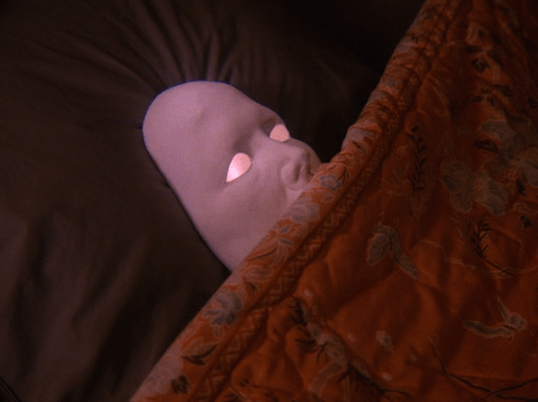
As for this episode, it definitely felt a bit off. The main problem is that it focused on two largely uninteresting subplots — Evelyn Marsh and the Civil War — and portrayed Windom Earle as so cartoonishly evil that it’s hard to believe that he could also be the villainous mastermind that Cooper’s spent the last few episodes describing. It was a weak episode but at least it finished off the whole Evelyn Marsh thing.
Always look on the bright side of life.
Previous Entries in The TSL’s Look At Twin Peaks:
- Twin Peaks: In the Beginning by Jedadiah Leland
- TV Review: Twin Peaks 1.1 — The Pilot (dir by David Lynch) by Lisa Marie Bowman
- TV Review: Twin Peaks 1.2 — Traces To Nowhere (directed by Duwayne Dunham) by Jedadiah Leland
- TV Review: Twin Peaks 1.3 — Zen, or the Skill To Catch A Killer (dir by David Lynch) by Lisa Marie Bowman
- TV Review: Twin Peaks 1.4 “Rest in Pain” (dir by Tina Rathbone) by Leonard Wilson
- TV Review: Twin Peaks 1.5 “The One-Armed Man” (directed by Tim Hunter) by Jedadiah Leland
- TV Review: Twin Peaks 1.6 “Cooper’s Dreams” (directed by Lesli Linka Glatter) by Lisa Marie Bowman
- TV Review: Twin Peaks 1.7 “Realization Time” (directed by Caleb Deschanel) by Lisa Marie Bowman
- TV Review: Twin Peaks 1.8 “The Last Evening” (directed by Mark Frost) by Leonard Wilson
- TV Review: Twin Peaks 2.1 “May the Giant Be With You” (dir by David Lynch) by Leonard Wilson
- TV Review: Twin Peaks 2.2 “Coma” (directed by David Lynch) by Jedadiah Leland
- TV Review: Twin Peaks 2.3 “The Man Behind The Glass” (directed by Lesli Linka Glatter) by Jedadiah Leland
- TV Review: Twin Peaks 2.4 “Laura’s Secret Diary” (dir by Todd Holland) by Lisa Marie Bowman
- TV Review: Twin Peaks 2.5 “The Orchid’s Curse” (dir by Graeme Clifford) by Lisa Marie Bowman
- TV Review: Twin Peaks 2.6 “Demons” (dir by Lesli Linka Glatter) by Leonard Wilson
- TV Review: Twin Peaks 2.7 “Lonely Souls” (directed by David Lynch) by Jedadiah Leland
- TV Review: Twin Peaks 2.8 “Drive With A Dead Girl” (dir by Caleb Deschanel) by Lisa Marie Bowman
- TV Review: Twin Peaks 2.9 “Arbitrary Law” (dir by Tim Hunter) by Lisa Marie Bowman
- TV Review: Twin Peaks 2.10 “Dispute Between Brothers” (directed by Tina Rathbone) by Jedadiah Leland
- TV Review: Twin Peaks 2.11 “Masked Ball” (directed by Duwayne Dunham) by Leonard Wilson
- TV Review: Twin Peaks 2.12 “The Black Widow” (directed by Caleb Deschanel) by Leonard Wilson
- TV Review: Twin Peaks 2.13 “Checkmate” (directed by Todd Holland) by Jedadiah Leland
- TV Review: Twin Peaks 2.14 “Double Play” (directed by Uli Edel) by Jedadiah Leland





 Through the Shattered Lens