Winner: Casey Affleck, MANCHESTER BY THE SEA Runners-up: Denzel Washington, FENCES; Joel Edgerton, LOVING; Ryan Gosling, LA LA LAND; Tom Hanks, SULLY
BEST ACTRESS
Winner: Natalie Portman, JACKIE Runners-up: Emma Stone, LA LA LAND; Ruth Negga, LOVING; Amy Adams, ARRIVAL; Annette Bening, 20TH CENTURY WOMEN
BEST SUPPORTING ACTOR
Winner: Mahershala Ali, MOONLIGHT Runners-up: Jeff Bridges, HELL OR HIGH WATER; Michael Shannon, NOCTURNAL ANIMALS; Lucas Hedges, MANCHESTER BY THE SEA; Ben Foster, HELL OR HIGH WATER
BEST SUPPORTING ACTRESS
Winner: Viola Davis, FENCES Runners-up: Naomie Harris, MOONLIGHT; Michelle Williams, MANCHESTER BY THE SEA; Greta Gerwig, 20TH CENTURY WOMEN; Judy Davis, THE DRESSMAKER
Today’s horror on the lens is Mark of the Witch, a little oddity that was filmed in 1969 and released in 1970. It’s a film about what happens when the spirit of an executed witch possesses a college student.
This is an admittedly low-budget and, some would say, amateurish production but certain scenes have a nice dream-like feel and, in the role of the witch, Marie Santell doesn’t leave a bit of scenery unchewed. I especially enjoy her speech at the start of the film.
Plus, Mark of the Witch was filmed in my hometown of Dallas, Texas!
(James was actually in Dallas filming last month but I was on vacation so I missed him.)
It’s just unfortunate that James is going to be appearing in yet another rehash of the Kennedy assassination. Allow me to turn on my sarcasm as I say that this film will probably be a totally fair and even-handed portrait of my home city and that everyone in the cast will actually try to get the local accents right (as opposed to sound like a bunch of yankees with peanut butter in their mouth).
But, ultimately, all that really matters to me is that 11.22.63 stars James Franco! It’ll be available on Hulu starting on February 15th, 2016.
And finally, one last group of critics announced their picks for the best of the year today. The DFW Film Critics, who represent my hometown but have somehow failed to offer me membership (and what’s going on with that!?), today announced that — in their opinion —
Birdman is the best film of 2014!
(I know that some people will probably be surprised that the DFW Film Critics did not pick Boyhood — a film that was made in, based in, and basically about Texas — for best picture. Personally, I suspect that if Boyhood had been set in North Texas — as opposed to the Houston area and Austin — it probably would have won.)
Check out the winners below!
Best Film: Birdman
Best Actor: Michael Keaton for Birdman
Best Actress: Reese Witherspoon for Wild
Best Supporting Actor: J.K. Simmons for Whiplash
Best Supporting Actress: Patricia Arquette for Boyhood
Today has been a strange day to live and work in Dallas, Texas. It is, of course, the 50th anniversary of the day that President John F. Kennedy was assassinated in my hometown.
As I mentioned in my review of Executive Action, those of us who live in Dallas are still expected to live in the shadow of something that happened before a lot of us were even born. Today, the city of Dallas did everything that it could to embrace that shadow. Despite the fact that it was cold and rainy today, a lot of people attended the memorial ceremony at Dealey Plaza. (Despite the weather, nobody was allowed to open an umbrella during the ceremony. Having been raised Catholic, I appreciate a little self-punishment as much as the next girl but considering how bad the weather was, it all seems a bit much to me.) One of the local talk radio stations spent today rebroadcasting all of its programming from November 22nd, 1963. I guess the idea was to give people a chance to experience a terrible day in real time. That seems a bit creepy to me but it does illustrate just how much the Kennedy assassination continues to overshadow life here in Dallas.
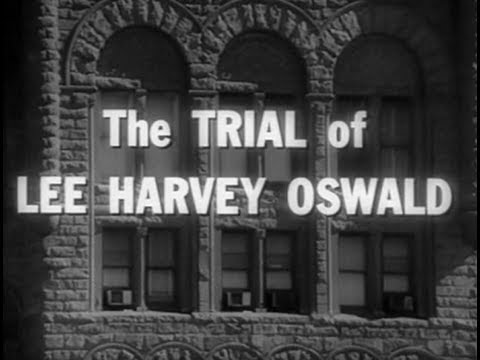
Considering just how much my city is identified with it, it’s perhaps appropriate that the very first film ever made about the Kennedy assassination was made by a Dallas filmmaker, the infamous Larry Buchanan. As a filmmaker, Buchanan specialized in exploitation films that claimed to either be ripped-from-the-headlines or were presented as being lurid dramatizations of real-life events. Hence, it’s not surprising that, in 1964, Buchanan gathered together a group of local (and obscure) Dallas actors and filmed The Trial of Lee Harvey Oswald.
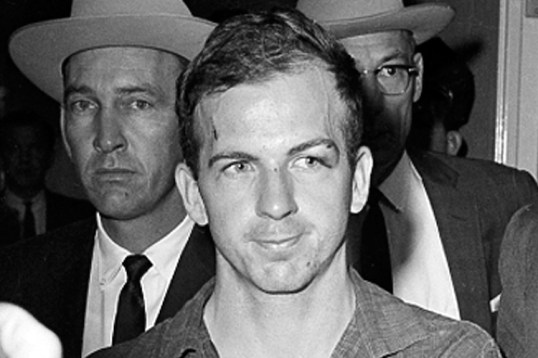
The eyes of a killer?
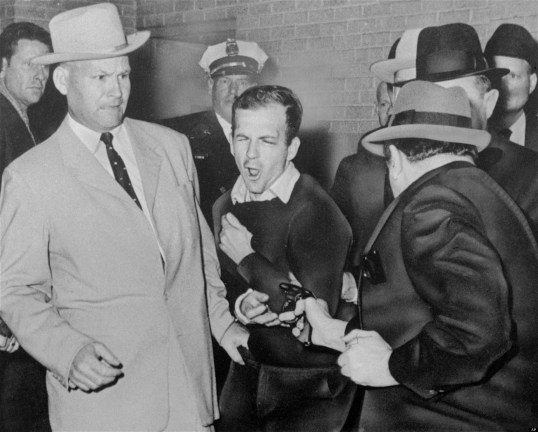
The Trial of Lee Harvey Oswald takes place in an alternative reality in which Lee Harvey Oswald was not murdered by Jack Ruby and, instead, actually stood trial for the assassination of John F. Kennedy. The prosecution pretty much presents the case that was made by the infamous Warren Commission. The defense argues that the evidence against Oswald is circumstantial and that, even if Oswald did fire the fatal shots, he should still be found “not guilty for reason of existing insanity.” The film’s audience is meant to serve as the trial’s jury.
As I watched this film, two things stood out for me. One is the fact that Buchanan never allows us to get a good view of the defendant. Instead, we simply see his eyes. While this was probably due to the fact that actor Charles Mazyrack didn’t bear a strong resemblance to the real-life Oswald, it’s still an occasionally striking effect that allows the character to remain a troubling enigma.
Secondly, and this surprised me as a contemporary viewer, next to no accusations of conspiracy are made during the trial. There’s no talk of the grassy knoll or the military-industrial complex or any of the other things that one naturally expects when it comes to a film about the Kennedy assassination. Instead, The Trial of Lee Harvey Oswald is based solely on the information that was available to the general public in 1964. As such, it remains an interesting historical document, a chance to get a genuine look at what people actually knew and thought in the days immediately following the Kennedy assassination.
(Interestingly enough, Buchanan’s later films would often feature shadowy government conspiracies.)
When Larry Buchanan died in 2004, The New York Times summarized his career as follows: “One quality united Mr. Buchanan’s diverse output: It was not so much that his films were bad; they were deeply, dazzlingly, unrepentantly bad.” For the majority of Buchanan’s films, that’s true but it’s not exactly true for The Trial of Lee Harvey Oswald. Considering that Buchanan is best remembered for directing a film called Mars Needs Women, The Trial of Lee Harvey Oswald feels almost respectable.
In fact, the film is a bit too respectable. The dialogue and direction are often rather dry and the mostly amateur cast alternates between overacting and not acting at all. If there was ever a film that could have benefited from some ludicrous melodrama, it’s this one.
That said, I enjoyed The Trial of Lee Harvey Oswald because I’m a history nerd and, if nothing else, this film remains an interesting historical curio. As well, it was filmed on location in Dallas and I can’t complain about any film that features a close-up of my favorite downtown building, the old red courthouse.
Even though it happened 22 years before I was born, I sometimes feel as if it was only yesterday that President John F. Kennedy was assassinated.
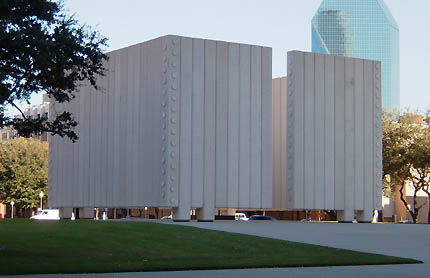
A lot of that is because I’m from Dallas. When I was born, my family lived in Oak Cliff, a few blocks away from where the accused assassin Lee Harvey Oswald once lived. I drive by the Kennedy Memorial several times a week. I’ve gone to the Sixth Floor Museum. I’ve made out on the Grassy Knoll. On a daily basis, I see tourists who have come down here from up north with their preconceived prejudices, their unwieldy copies of Stephen King’s 11/22/63, and their overactive sweat glands. (“How do you handle the heat!?” they ask when the temperature is barely above 90.) With the 50th anniversary of the assassination approaching, the Dallas Morning News has been running daily stories examining every detail of that terrible event.
The rest of the nation, of course, will never let us forget that JFK was assassinated in Dallas. Just last week, there was an idiotic and bitter opinion piece in The New York Times, written by James McAuley, in which he claimed that Dallas was a “city of hate” that should feel more guilt over the JFK assassination. As McAuley (who is studying history at Oxford and is not a resident of that city that he apparently feels qualified to judge) put it, “For 50 years, Dallas has done its best to avoid coming to terms with the one event that made it famous: the assassination of John F. Kennedy on Nov. 22, 1963.”
This, of course, is bullshit.
There are two competing schools of thought about the assassination of John F. Kennedy. One says that Lee Harvey Oswald was solely responsible. The other is that Kennedy was killed as the result of a complex conspiracy.
Let’s say, for the sake of argument, that Lee Harvey Oswald acted alone. Well, Oswald was born in New Orleans but he was raised up north in New York City. He was also a communist with a history of mental instability. Hence, if you accept that Oswald was the lone assassin than you also have to be willing to accept that Oswald would have tried to kill Kennedy regardless of what city he was living in.
Things get a bit more complicated if you believe that Kennedy was killed as the result of a conspiracy. But let’s consider the usual suspects that come up whenever people start talking about the possibility of conspiracy. The Mafia was based in the north. The CIA was based in Washington, D.C. The anti-Castroites were based in Miami. Again, all of these conspirators would have killed Kennedy regardless of what city he went to in November.
It’s easy for the rest of the country, in a fit of jealousy, anger, and delusion, to blame Dallas and Texas for the assassination of John F. Kennedy but, regardless of whether you believe in the lone assassin or a larger conspiracy, the truth is far more complex.
Over the next few days, as part of the 44 Days of Paranoia, I’ll be taking a look at some of the many films that were inspired by this assassination. Let’s start things off with one of the lesser known entries in the JFK genre, 1973’s Executive Action.
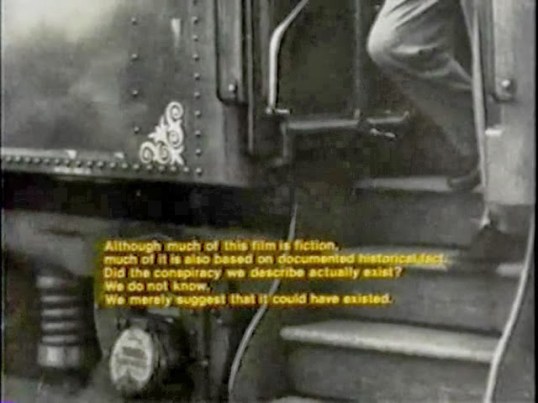
Executive Action opens with a series of grainy, black-and-white photographs of both America in the 1960s and the men who, over the course of the film, will be portrayed as having plotted and carried out the assassination of President Kennedy while a mournful piano plays in the background. It’s a low-key but eerily effective opening and it also lets the viewers know exactly what type of film they are about to see. As opposed to Oliver Stone’s far better known JFK, Executive Action is a low-key, almost deliberately undramatic film. Despite the fact that there are some familiar faces in the cast (or, at the very least, familiar faces to those of us who watch TCM), Executive Action almost feels as if it could have been a documentary.
As the film opens in 1963, we see a group of very rich men talking about the future of America. Ferguson (Will Geer) and Foster (Robert Ryan) are concerned that President Kennedy’s policies are going to destroy America. Foster is worried that Kennedy is planning on cutting back on military spending. Ferguson is upset by Kennedy’s support of the Civil Rights movement. (In one memorable scene, we see Martin Luther King delivering his Dream speech on TV before the camera pulls back to reveal Ferguson watching in disgust.) Their associate, the shadowy Farrington (Burt Lancaster), argues that the only way to stop Kennedy is to assassinate him and put the blame on a lone gunman.
With the support of Ferguson and Foster, Farrington recruits a group of gunmen (led by Ed Lauter and including Roger Corman regular Dick Miller) and works to set up the perfect patsy. A man (James MacColl) goes around Dallas, acting obnoxious and telling anyone who will listen that his name is Lee Oswald. At Ferguson’s insistence, a picture is doctored to make it appear as if Lee Harvey Oswald is posing in his backyard with a rifle. As all of this goes on, the date of November 22nd steadily approaches…
As I stated before, Executive Action is an almost obsessively low-key film. That, however, works to the film’s advantage. Ferguson, Foster, Farrington, and the other conspirators are chillingly believable because they are presented almost as being anonymous. Instead of being portrayed as being super villains, they are instead men who approach assassination as just another part of doing business. The impression one gets is that Kennedy isn’t the first leader they’ve had killed and he probably wasn’t the last. Director David Miller seamlessly mixes historical footage with film reenactments and the end result is a disturbingly plausible film.
Unfortunately, Executive Action is less well-known than some of the other films that have argued that a conspiracy was responsible for the assassination for John F. Kennedy. However, it may very well be the best.
A little while back, a little studio called Overkill put a game on Steam called Payday: The Heist. The release completely passed me by. In fact, I was totally ignorant even of the existence of the title until a group of my friends all bought it and decided to start robbing banks together. They were so taken with it that they demanded that I join them, and I couldn’t have been happier with the purchase. We passed many nights (and into the early mornings, sometimes!) trying to grind our way through harder difficulties, and try to learn more advanced ways to stealth through the various ‘heists’, which included stuff ranging from your standard-issue bank job through a Left 4 Dead inspired hospital mission called, fittingly, No Mercy, where a shadowy anonymous buy was willing to pay bank in exchange for a sample of infected blood.
The game was marked by a number of good ideas. It includes minor RPG elements in that your account ‘levels up’ as you play more heists, granting access to useful abilities. In the original game, most of these bonuses were tied directly to weapons and armor and your ability to last in combat against the inevitable waves of police and SWAT forces that would attempt to keep you from escaping with your ill-gotten gains. Being stealthy at the start of a heist by using silenced weapons and preventing any civilian hostages in the area from escaping to summon help could pay significant dividends as you waited for your large thermal drill to bore its way into this vault or that one. A variety of weapons and gadgets rounded out your heisting arsenal, modeled off of real-life weapons augmented by just a bit of fancy. The game included multiple difficulty levels for every heist which would affect the number and types of enemies that spawn, and add other random factors that could make heists substantially more challenging. Indeed, that random AI Director feature of the game also helped its replayability dramatically, as heists could play out very differently if things went right – or very much wrong.
Payday 2 improves noticeably upon almost all of this. The heists are now more elaborate, including multi-day criminal enterprises (such as a ‘Watchdog’ mission where you must first secure a shipment of cocaine against an FBI operation, then in ‘day 2’ load the coke onto a drug boat at the docks, all while under police assault), and a wider variety of possible objectives – your crew are no longer strictly robbers, but rather highly skilled specialists for higher, men of limited principles and significant hardware.
The skill trees (Mastermind, Enforcer, Technician and Ghost, respectively) now include a wider variety of abilities, many of which can be directly employed for greater speed or stealth in the missions. Now, being a high level player with access to the best gadgets can make the simpler heists significantly easier, allowing the players to focus on the greater challenges of high difficulty level multi-day jobs. I personally find it very rewarding to try and work through missions in a stealthy way. Not only can some rewards become greater when you don’t have to battle you way through police lines, but the heists can also (often) be done cleaner and more quickly with the application of stealth. Returning is the oft-failing thermal drill which is the centerpiece of a number of missions where you try to gain access to a safe or other place you shouldn’t be, but this can now be circumvented if your technician is skilled enough to deploy shaped charges to blow off hinges, or if your ghost has an ECM Jammer that can bypass electronic security. The Mastermind can talk down inquisitive guards on the other end of the phone, easily intimidate and control civilians, and provide a slew of buffs to the group, and the Enforcer can (among so many other things) bring a powerful rotary saw to slice open less-imposing lockboxes, ATM machines, and encroaching enemies who draw too close.
Also notable in Payday 2 is a more credible electronic opponent. In the original game, the challenge was typically increased by sending more powerful units earlier in the mission, legions of ‘special’ units, and an unending stream of SWAT goons and their guns. To an extent, this is still completely true. However, the enemy now employs lesser raw numbers in favour of better tactics, and more threatening enemy units. Of course, stealth your way through the missions, and you may never have to suffer their wrath…
Payday 2 is not by any means a perfect game, however. The mission select is now done through an interface called Crime.net, which is a black and white overhead map of a city on which missions appear as ‘pings’ (as if the job just became available, complete with a timer before the job eventually disappears). Because of this system, if your crew is in favour of running a particular heist, it quite literally might take as long as half an hour of ‘browsing’ Crime.net for it to appear (or perhaps even longer!). In the most recent update, Overkill added some very basic filters to the Crime.net interface, allowing you to opt out of missions below a certain difficulty level… but this seems woefully inadequate. Though the game contains 10 heists, they re-use a couple of maps between them, and some of them are completely basic – there’s almost nothing to them. These are offset by some very complex heists higher up in pay scale, but some of them start to feel less replayable after a couple of solid nights with the group. This happened in the first game too, of course, but it’s much more annoying now with the obstacle of Crime.net possibly throwing you copy after copy of an undesirable heist that you are totally burned out on… instead of something you’d really like to do. I frankly do not understand the creative choice behind not offering better filters for this system.
While it is true that the police do not attack in such great numbers as before, they do still leave a lot of artifacts around the map, with corpses, piles of ammo, and miscellaneous gear (such as riot shields) strewn about, and I have seen the game start to chug on systems that are powerful enough to run many other contemporary games without issue. By its nature, this is probably something that’s hard for this game to overcome, but it’s a frustrating problem to have when the key resource that you need to enjoy this game to its fullest is friends who can also play it with you.
Yes, Payday 2 has in-game voice chat, and yes, you can jump into public games with strangers anytime you want. Some people might really enjoy doing so, in fact, and I don’t really mind it…. but I would much rather gather a group of 3 friends to roll with and work in tandem to complete heists. The AI team-mate can be valuable in combat because of their accuracy (though sometimes the team AI seems bewildered in a way the police AI rarely is… failing to respond even in a dire emergency) but is also frustratingly useless as they cannot transport filthy lucre, or drugs, or whatever, cannot advance mission objectives, and will occasionally blunder into unwinnable firefights against a legion of police in the middle of the street… where they can’t even be reached for a quick revive. As a result, you really want a full party, regardless of how you have to get it.
One thing to admire entirely about Payday 2 is its price point. At $29.99 on Steam (it’s also available on Xbox 360 and Playstation 3, the physical media involved means your price point will be $39.99 instead), this game has real value, though I can’t necessarily recommend it if you don’t have at least one friend who would be willing to buy the game as well and commit to playing it with you. Your mileage may vary with teaming up with strangers (I’ve had a mixed bag of results, myself) but I wouldn’t have purchased the game without friends I knew for certain would play, so I certainly won’t tell you to do it!
It’s Oscar season and we’ve finally reached the moment that you all know you’ve been waiting for. That’s right — my hometown has finally made its voice heard!
The DFW Film Critics Association is made up of film critics who work for media outlets in the Dallas/Ft. Worth metroplex and throughout North Texas. Every December, they announce their picks for the best in cinema.
Here are their picks for 2012. There’s a few pleasant surprises (like the fact that Life of Pi, Skyfall, and the Master all made their top ten) and a few annoying shocks (because seriously, if Texas critics can’t appreciate Bernie, who can?) but, for the most part, the winners are pretty much what you would expect. I think some of this might be because I’m not a member of the DFW Critics Association. Fortunately, I’ll be announcing my own picks for the best in 2012 during the first week of January.
Best Picture:
1) Lincoln
2) Argo
3) Zero Dark Thirty
4) Life of Pi
5) Les Miserables
6) Moonrise Kingdom
7) Silver Linings Playbook
8) Skyfall
9) The Master
10) Beasts of the Southern Wild
Best Actor:
1) Daniel Day-Lewis in Lincoln
2) Joaquin Phoenix in The Master
3) John Hawkes in The Sessions
4) Hugh Jackman in Les Miserables
5) Denzel Washington in Flight
Best Actress:
1) Jessica Chastain in Zero Dark Thirty
2) Jennifer Lawrence in Silver Linings Playbook
3) Helen Mirren in Hitchock
4) Emmanuelle Riva in Amour
5) (tie) Quvenzhane Wallis in Beasts of the Southern Wild and Naomi Watts in The Impossible
As some of our more regular readers may know, I was born, raised, and still live in the part of the country known as Tornado Alley. Yesterday afternoon, we had about a thousand tornadoes all on the ground at once. Well, maybe not a thousand. More like six. But still, it was scary! I was at work in downtown Dallas when the storm began and I spent almost the entire afternoon in my boss’s office, watching the tornadoes on his TV while the building trembled with each crash of thunder. As soon as it was reported that one tornado had finally gone away, another one would suddenly be reported on the other side of town. As the hours passed, I heard about and saw footage of tornadoes ripping through towns like Arlington, Forney, Lancaster, and Mesquite and I found myself wondering how long it would be before they found my home in Richardson.
Fortunately, despite the six tornadoes, none of them hit downtown Dallas and, though they came way too close, they also missed us in Richardson. I did panic a bit when I first got home and I couldn’t find our cat Doc but eventually, he turned up hiding underneath Erin’s bed. He gets scared of thunder. My sister Melissa actually saw the tornado that hit Arlington but, thank goodness, it didn’t hit her house.
Anyway, this may stretch the definition of entertainment, but here’s a few Texas tornado videos that I’ve found on YouTube.
The video comes from outside of Forney, which is the town that was hit the hardest yesterday.
Here’s another one from outside Forney.
When the tornadoes first hit Forney, I was at work in downtown Dallas. My boss and I were in his office, watching the footage that is featured in this video. Essentially, a storm tracker named Jason was on the phone with our favorite local weatherman Larry Mowery and Jason suddenly starts going, “Oh my God, it’s hit the high school! OH MY GOD! OH MY GOODNESS! THE HUMANITY!” It was a bit like that famous audio of that reporter watching the Hindenburg explode. Anyway, a few minutes later, as can be seen in the video below, Jason calmed down (a little, at least) and let us all know that actually the tornado did not hit the high school.
This next video was shot by a guy named Vincent Tang who was apparently sitting on the roof of his home in Lancaster, Texas and filming the whole thing while it went on and, unfortunately, providing his own running commentary. I know that some people online love this guy’s commentary (mostly because he kind of prays at one point and pandering to God is always the easiest way to get lots of fans online — well, that and thong pics.) but I find it to be kind of annoying which is why I always mute it before I watch.
And seriously, why would you get on your roof in the middle of a tornado?
Finally, here’s the footage that everyone’s been talking about: one of the tornadoes hits a truck stop and sends a bunch of semi flying through the air. As scary as this footage might look right now, just imagine watching it while you’re sitting in a fourth floor office with warning sirens going off all around you. Agck!
Fortunately, we all survived and the sky is nice and clear today. As for me, I’m working on a new script: The Towering Tornado. I’m thinking either Jennifer Lawrence or maybe Aubrey O’Day can play me. It’ll be great!
So, last week, I asked for everyone to vote for which film I should watch on Sunday. 864 votes were cast and the winner was Michael Anderson’s 1976 cult classic, Logan’s Run. So, last night, I sat down with my sister Erin and we watched Logan’s Run. I have to admit that we both giggled a lot but we still enjoyed watching it. (I should also note that Logan’s Run was filmed in Dallas and Ft. Worth and, even 35 years later, both of us recognized a lot of familiar landmarks. The end of the film was shot at the Ft. Worth Water Gardens and we squealed with delight as we watched it and said, “We’ve been there!”)
Like most sci-fi films released before Star Wars, Logan’s Run takes place on a post-apocalyptic Earth. It’s the 23rd Century and what’s left of humanity lives in an underground city where they’re governed by a gently condescending computer. Civilization is now based around the pursuit of pleasure. Everyone appears to live in the world’s biggest mall (probably because the “City” scenes were actually filmed in a shopping mall located in my hometown of Dallas). It’s a city that’s essentially made up of slow-motion orgies, hot tubs, and crazy plastic surgeons. Everyone dresses in these sheer tunics and it quickly becomes obvious that the world’s knowledge underwear was apparently lost during the move underground. (Then again, this could have been because the film was made in the 70s. Seriously, did nobody own a bra in the 70s?)
Future civilization appears to have only one law and that’s that anyone who reaches the age of 30 has to go to Carrousel. At Carrousel, everyone has reached their time limit levitate in the air, floats around in a circle, and then blows up. Their fellow citizens assume that those being blown up are actually being “renewed” but actually, they’re just blowing up. (In many ways, Michael Anderson’s direction of Logan’s Run is pretty pedestrian but the Carrousel sequence is actually quite visually stunning.)
Now, some citizens don’t want to get blown up. These citizens are called runners and they greet their 30th birthday by attempting to flee the City and escape to the Outside and to a mysterious place they call “Sanctuary.” Some of them end up getting caught and frozen by a bizarre little robot called Box (played, in a really odd performance, by Roscoe Lee Browne). Those that don’t get caught by Box usually end up getting gunned down by the Sandmen. The Sandmen are a group of nylon-clad fascists who are never happier than when they’re gunning down runners.
At this point, you may have noticed that it actually takes more time to explain the film’s backstory than its actual story. Logan’s Run has a fascinating concept behind it and the plot has a lot of potential. Sadly, the film itself doesn’t quite live up to that potential but the story is still intriguing enough to carry the viewer through some of the film’s more uneven moments.
Michael York is Logan
The Logan of the title is a Sandman played by Michael York (who, when he first appears in this movie, projects just the right sense of unthinking entitlement). Logan is assigned (by the condescending computer) to infiltrate the runners and find sanctuary. In short, he’s ordered to run. However, as it quickly becomes obvious that nobody’s actually being renewed, Logan decides to run for real. Along with a runner named Jessica (played by Jenny Agutter), Logan tries to escape the city. Pursued by his best friend and fellow Sandman Francis (Richard Jordan), Logan and Jessica most deal with a psychotic plastic surgeon (well-played by the director’s son, Michael Anderson, Jr.) and his glam nurse (Farrah Fawcett!) as well as a tribe of feral children and a bunch of sex-crazed, naked people who move in slow motion. (It’s a neat visual, to be honest).
Logan, Jessica, and Farrah
When Logan and Jessica finally do reach the Outside, it turns out to not quite be all it was cracked up to be. (Or as Jessica puts it, in one of my favorite lines, “I hate outside!”) They come across the ruins of Washington, D.C. which turns out to be inhabited by a thousand cats and an old man played by Peter Ustinov. However, little do they know, Francis has followed them outside and, back at the City, the computer is still demanding to know the location of Sanctuary.
I enjoyed Logan’s Run but I’d be lying if I said it was a great film. It’s basically a big, silly, entertaining film that makes sense as long as you don’t think about it too much. I have a feeling that if I had seen this film in a theater, trapped in the same seat for 2 hours straight, I would probably be a lot harder on it. However, Logan’s Run is the perfect film to watch in the privacy of your own home with a friend or two (or, in my case, a big sister). The story is just good enough to hold your interest, you can openly giggle at the film’s more campy moments, and — once the action starts to drag — you’re free to move around and find something else to do until things get interesting again.
Ultimately, Logan’s Run shares the flaw that afflicts most sci-fi films that are about people trying to escape a decadent, dystopian society. That is, the movie is a lot more fun when everyone’s being decadent and evil than when everyone’s searching for a higher truth. When Jessica yelled that she hated the outside, I had to agree with her because the inside — even with everyone getting blown up at the age of 30 — was so much more fun. Inside the city, they had slow-motion orgies, hot tubs, and really pretty clothes. Meanwhile, the only thing that outside had to offer was Peter Ustinov reading a decayed copy of the Declaration of Independence. Don’t get me wrong — I was jealous that Ustinov got to live with all of those cute kitties but it just couldn’t compare with the psychotic plastic surgeons of the City. If that’s Outside, I can understand why everybody went inside.
(Personally, I call this the Matrix Rule. Everyone talks about how great Zion is but, seriously, what type of toadsucker would actually want to live in that tedious, ugly little Socialistic state?)
Still, despite this, Logan’s Run is a watchable and entertaining artifact of 70s “event” filmmaking. This film doesn’t have any scenes set in a disco but it really should.
Among the actors, both Michael York and Peter Ustinov are a lot of fun to watch as they both found their moments to go over the top and made the most of them. Perhaps my favorite over the top York moment came towards the end of the film when he shouted, “YOU CAN LIVE! LIIIIIIIIIIIIIIIIIIIIIIIIVE!” When I first announced, on twitter, that I would be reviewing this film, I got a lot of replies from men who apparently had fond memories of Jenny Agutter in this film and her performance here is sexy and confident. Plus, she gets to deliver one of my favorite lines of all time, “I hate outside!” Still, if you want to talk about sexy and confidence, then you have to talk about Richard Jordan’s performance as the cocky Sandman, Francis. Seriously, Francis is a Sandman who could bring me a dream any night of the week…
Sexy, Dangerous Francis
So, in the end, Logan’s Run is silly but fun, uneven but definitely watchable. Thank you to everyone who voted for me to see this film. And until next time, remember — “Theeeeerrrrreeee Issssssssssss Noooooooo Saaaaaaaanctuuuuuuuary….”
Earlier today, I did a google search and I discovered that Logan's Run was apparently spun off into a television show. Apparently, this is the cast of that show. They certainly look a lot more cheerful than their film counterparts.






 Through the Shattered Lens