DC has always had the Batman franchise as it’s standard bearer when it came to its many properties adapted to the big-screen. In the past one could add the Superman franchise as well, but a return (no pun intended) to that franchise a couple years ago didn’t pan out too well.
Marvel Studios (film division of Marvel Comics) has had a better track record in the past decade in adapting its own franchise characters, both top tier and supporting, to the big-screen. Some of these adaptation have been through other studios like Sony, 20th Century Fox, Paramount and Universal who licensed the characters for film. In the last 3-4 year Marvel has made the decision to adapt their characters themselves to better rake in the profits. This has led to successes and a subsequent purchase of the company as a whole by giant entertainment conglomerate Disney. With Disney’s Scrooge McDuck money bin to help finance further Marvel properties to the big-screen DC and it’s parent company Time-Warner had to respond with something other than Nolan’s Batman franchise.
What DC has decided to answer with first is the live-action adaptation of the iconic DC character Hal Jordan and his Green Lantern persona. The film has veteran action filmmaker Martin Campbell behind the director’s chair with Ryan Reynolds in the title role. The film has finally released it’s first official trailer and the film is set for a Summer 2011 release. A summer that’s becoming more and more crowded with superhero tentpole films not to mention the 800-lb gorilla waiting in the wings to beat everyone senseless: Warner Brother’s final Harry Potter film.
The trailer for Green Lantern just gives enough of a taste about what the film is about but despite some intergalactic scenes was still quite bare in terms of what the story will be about beyond it being an origin tale. Here’s to hoping the next trailer gives a bit more with a much more refined and polished fx work.
A little over five years ago Warner Brothers made the decision to reboot the Batman film franchise. Several names of filmmakers were mentioned as candidates to helm this reboot. One of them was director Darren Aronofsky. He has made a name for himself helming very dark (and for some very depressing) films about very damaged personalities and their struggles. The Batman/Bruce Wayne duality was perfect for Aronofsky and he had begun to do early treatments to adapt Frank Miller’s classic Batman origin tale, Batman: Year One. In the end, this Aronofsky project fell through and the reboot ended up being handled by Christopher Nolan (not a slouch of a filmmaker himself).
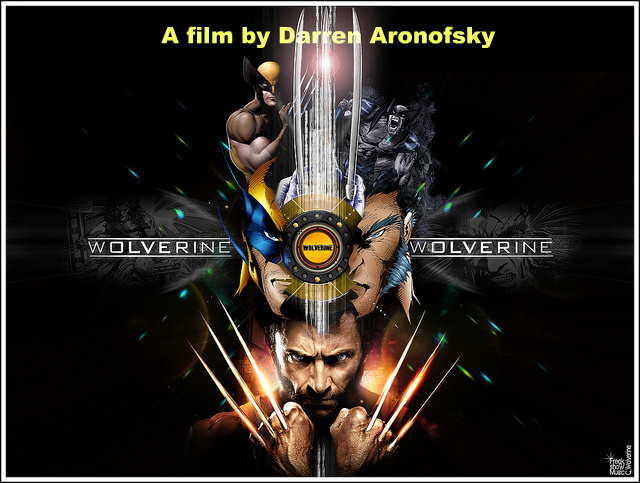
Aronofsky has made a couple of original and very personal films since then (The Fountain, The Wrestler, Black Swan), but with 20th Century Fox scrambling to put another one of their Marvel-licensed properties into production in order to keep the rights to them, they’ve decided to give the reins of the next Wolverine film to Aronofsky. Rumors of Aronofsky close to signing the deal to helm this Logan sequel was finally confirmed by none other than Hugh Jackman himself aka Wolverine in an interview for Vulture.
The first film in this character’s franchise was lackluster at best and horrible to most. The fact that a sequel has been greenlit even after the less-than-stellar box office returns of the first film was headscratching to many. Will Aronofsky’s involvement in this sequel actually erase the bad taste that Wolverine: Origins left in fans’ mouths. If there was anyone who can actually get a handle in the troubled and damaged psyche of one of Marvel’s most iconic characters it would be Darren Aronofsky.
There’s still little details as to what sort of storyline this Aronofsky sequel will take or will he just decide to reboot the franchise and start fresh. The reaction I’ve been reading has been mostly tepid with some guarded excitement from those who thinks Aronofsky will end up working his dark magic on this character on the big-screen. We’ll learn more once filming starts in early 2011.
Here’s to hoping that Aronofsky can do for Wolverine what Nolan was able to do for Batman.
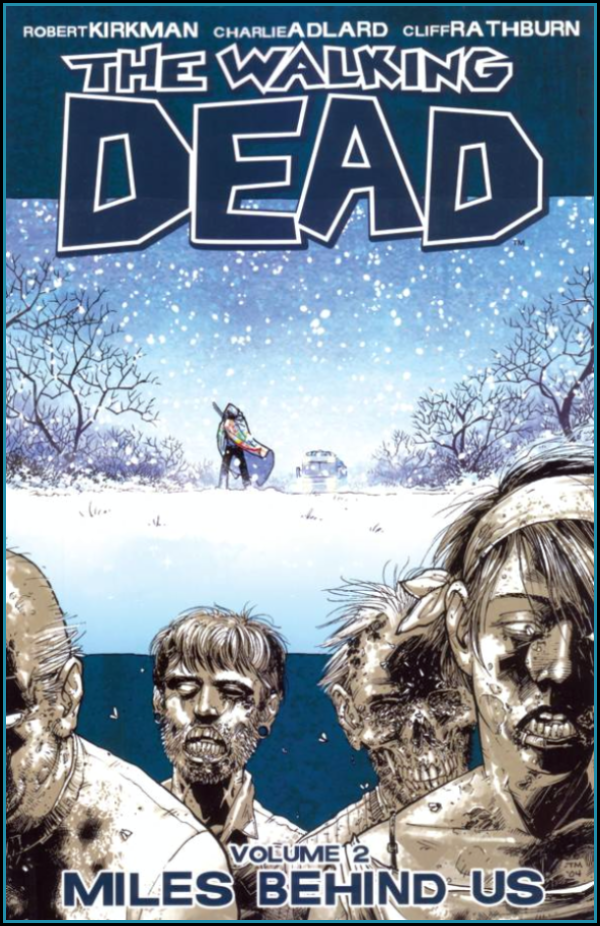
Robert Kirkman’s The Walking Dead Vol.2 – Miles Behind Us puts together issues 7 through 12 into one collection. The first six issues introduce the reader to the main character of Rick Grimes and his discovery of a world turned upside-down and inside-out as the legions of undead walk and prowl the streets, fields and by-ways. The rest of that first volume reunites Rick with his wife and son and a ragtag bunch of other survivors just looking for a safe place to stay. I loved how Kirkman used the backdrop on a world of the undead to tell a story of survival and how extreme situations can have surprising and lasting effects on those left behind.
In Miles Behind Us, Robert Kirkman’s story has a new artist in Charlie Adlard. Adlard’s style has a different look to that of previous artist Tony Moore. Where Moore’s pages and panels had a smoother and more cinematic feel to them, Adlard’s rougher, sketchy style actually fits the mood and feel of the story Kirkman is writing. I love Moore’s work and the gory detail he put in the first issues, but Adlard’s just seems to resonate a bit more with the subject matter of survival and doing what it takes to survive. There’s certain scenes in Miles Behind Us where its hard to tell the difference between the survivors and the zombies. I like this technique in how it shows that the zombies and the survivors may have alot more in common after all in relation to the title of the story.
Kirkman introduces in this volume quite a bit of new characters to the group Rick is leading as they leave the campground at the outskirts of Atlanta. They’ve lost three of their numbers in the previous volume. Two of them to the predations of the undead who stumbled into their campground and another to the stress and jealousy that weighed on the mind of one of their own.
Miles Behind Us brings in two groups of survivors. One is a father, his daughter and the girl’s boyfriend. Tyrese is an interesting character right from the get-go and hints of problems with the daughter and boyfriend are gradually doled out to help bring in new conflicts to the group dynamic. The other group is a farmer and his children and some neighbors from down the road. The introduction of Herschel and his family helps in showing how not everyone reacted the same way to the undead crisis. To say that Herschel’s reaction and temporary solution to how to handle the undead crisis was a bad idea all-around was an understatement. Hershel’s actions helps lead to the biggest sequence event in this volume and how far-reaching its ramifications are. While new characters are introduced some of the people in Rick’s group fall by the wayside as their search for a safe place to stay in becomes more and more dangerous and people are lost and/or nearly lost along the way.
I agree with the assertion that The Walking Dead is really not all about the zombies and the gore (it helps that it has them in abundance), but that its about the effects of extreme events and situations on the personality, psyche and behavior of those left behind trying to survive. From the Dale (the oldest) all the way down to Carl (one of the youngest), the survivors are affected right down to their bones with all that has happened to them. Sometimes the result makes each individual stronger and at times it just leads to conflicts and brings out the baser nature of man as an individual.
Miles Behind Us continued to impress me in how well Kirkman has taken the zombie apocalypse theme and ran with it. It’s a testament to his storytelling and imagination that I consider The Walking Dead series as equal to anything Romero has done. I think from fans of zombie and apocalyptic stories that’s high praise indeed.
One of the geek properties that had been building a major hype and buzz at this year’s San Diego Comic-Con was Image Comics and Robert Kirkman’s long-running and critically-acclaimed zombie series, The Walking Dead. It’s time at the Con didn’t just push the title to a new batch of fans, but also made a major showing at it’s very own panel with the cast and crew of AMC’s tv series adaptation of the comic book. It would be an understatement to say that by the time The Con was over the series (both comic book and the upcoming tv series) walked away a clear winner and put the property into hype/buzz overdrive.
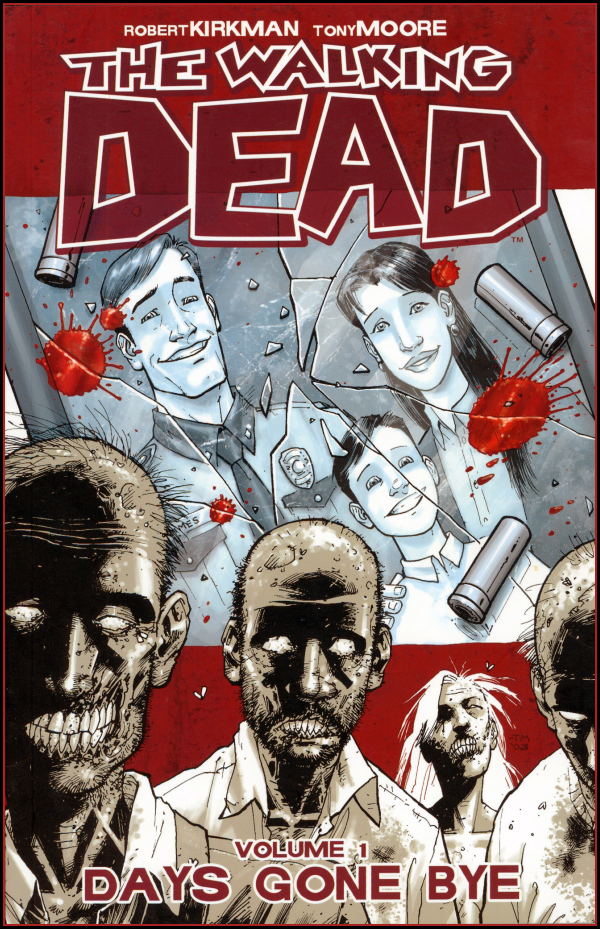
With the series set to premiere on AMC this coming October 2010 I thought it was high-time that I went back to my reviews of the collected trade paperbacks of the series. Each trade paperback collection were 6-issues long and usually started a current story-arc or finished an on-going one. This comic book series is one of the few in the market currently running which could was able to keep releasing its trades in 6-issue collected formats and not lose any impact that particular arc had when read as single-issues. It was by finding the first trade that I was initially introduced to Kirkman’s zombie opus.
It was 2005 and I was what one might call a lapsed comic book fan. I had burned myself out on the neverending flood of superhero titles even as independent ones quickly got cancelled, died out or just outright didn’t end but left its readers hanging. But it took a passing glance of The Walking Dead‘s first trade volume to get my interest in comic books rekindled. Kirkman’s foray into creating the zombie film that never ends made comic books fun for me again. The fact that Kirkman didn’t jump onto the fast-zombie bandwagon that became the rage of the mid-2000’s was a major plus in my eyes.
Using the same slow, shambling zombies that George A. Romero first made popular with Night of the Living Dead and its subsequent sequels, Kirkman continued the zombie story where Romero usually ended his films. All those times people have wondered what happened to those who survived in zombie films need not imagine anymore. Kirkman has created a believable world where the dead have risen to feast on the living, but has concentrated more on the human dynamic of survival in the face of approaching extinction.
I won’t say that the story-arc collected in this first volume has little or no zombies seen, but they’ve taken on more as an apocalyptic prop. One can almost substitute some other type of doom in place of zombies and still get a similar effect (as was done in Brian K Vaughn’s equally great series, Y: The Last Man). What Kirkman has done was show how humanity’s last survivors were now constantly, desperately trying to adapt to a familiar world through unfamiliar circumstances. Characters from the start make the sort of mistakes regular people would make when they don’t know exactly everything that was happening around them. Instead of chiding these people as one reads their story, we sympathize and hope for their continued survival.
The artwork by Tony Moore is another reason why people should check out this first volume. While it is only in this volume (the first 6-issues of the series which is now deep into the 70’s) Tony Moore’s art puts the horrific in the story Kirkman has written. His zombies and their look were quite detailed and for fans of the series his departure after issue 6 and staying to just make the covers to each single-issue has rubbed them the wrong way. While I subscribe to the opposite viewpoint that Moore’s work was a nice bonus to bring in the readers in the end his artwork was gravy to what was already a fulfilling story that would’ve been as effective if the artwork was mediocre at best. It’s a good thing that follow-up and series regular artist Charlie Adlard more than holds his own in drawing the rest of the series.
This first volume was a great beginning which should automatically pull in the hardcore zombie fans (pretty much any of those types should’ve been reading the books for years now) while giving newbie fans to the zombie genre a reason not to dismiss it as just another gorefest lacking in drama and great storytelling. Already Kirkman has done more to realizing the universe Romero created than a lot of the hack filmmakers who have taken Romero’s idea and cannibalized it for their own profit. I consider The Walking Dead as a must-read for anyone looking to find something different from all the costumed superhero titles. It is also a great starting point for those awaiting the start of the tv series, but have never read the original comic book source.
With Comic-Con over the hype surrounding the tv adaptation of Robert Kirkman’s zombie apocalypse comic book series has reached stratosphere status. The 6-episode first season was already one of the most anticipated new shows of the upcoming fall season from just the fans and geek community talking about it nonstop in the internet, but with it’s unveiling at this year’s San Diego Comic-Con the mainstream press has latched itself onto the series. The common reaction to the series at the panel in Hall H seemed to be a unanimous positive one.
Character photos, Drew Struzan posters and new trailers have added to the hype. The comic book series has hit it’s milestone 75th issue. Sales of the comic and it’s collected softcover and hardback graphic novels have seen a spike in sales. AMC has added to the series’ website a taste of the the comics for people to get an idea of what to expect from the series. This motion comic of the first issue of The Walking Dead really captures the horror and hopelessness of the world Kirkman has created and Daabont plans to show up on the TV screen.
In 2008 Marvel Comics released it’s very first in-house financed film through it’s Marvel Studios. That film was called Iron Man. It was a film that definitely was given buzz and hype by the comic book crowd, but wasn’t highly-anticipated by the general public. Even the prospect of Robert Downey, Jr. as the character of Tony Stark was received by the fanboys with trepidation and by the rest of the film-going public with apathy. When the film finally came out the reaction wasn’t what industry experts had expected. The film became a bonafide hit and it was all due to one man. That man happened to be the very person people thought was wrong for the part: Robert Downey, Jr. His performance as Tony Stark and as Iron Man was one of those which makes a franchise. Robert Downey, Jr. was born to play Tony Stark and it showed on the screen. The film was a major success not just for RDJ but for the fledgling Marvel Studios.
It is now 2010 and the follow-up to Iron Man has finally come out. The road to this second film wasn’t as difficult and mired in trepidation as the first, but now people wondered whether the first film was just a fluke and would lightning be caught once again in the proverbial bottle. The complaints this time around prior to the film’s release was that there were too many new characters both villains and allies being introduced. Would the action scenes be as average and all-too-brief as they were in the first film? Would Robert Downey, Jr. be able to handle the pressure of being the foundation of a world Marvel Studios was building with not just the Iron Man franchise but the other films coming down the pipeline like Thor and Captain America then the big boy in the room: The Avengers. These were all credible worries, but in the end this sequel made a great leap forward into calming down these fears. Iron Man 2 definitely lives up to the first film and improves on certain weaknesses of the first film, but not all which just keeps this sequel from being on the same level as past Marvel superhero sequels like Spider-Man 2 and X2.
The film opens up literally just as the first film ends as we see a Russian TV rebroadcasting Tony Stark declaring himself as Iron Man in front of a crowd of reporters. It’s who is watching this broadcast that moves the story along from start to finish. We meet Ivan Vanko (played with inherent menace by Mickey Rourke) who finds out from his dying father that Tony stark and Iron Man was to blame for their family’s hardship and lost legacy. That very theme of patriarchal and familial legacy becomes a running theme throughout the film. This opening intro sequence shows the audience that Tony Stark wasn’t the only one capable of creating the very power source keeping him alive and powering up the Iron Man suit. The extended intro also does a good job of introducing a main character right from the start and giving us his background, motivations and skill set and why he makes a credible opponent for a one-man army which Iron Man truly has become. But Ivan Vanko, or Whiplash as the credits have dubbed him, won’t be the only problem Tony Stark has to face throughout the film. All the problems he’s having to deal with since becoming Iron Man and publicly declaring himself as such comes from that very declaration.
The U.S. government now sees Iron Man as a problem, despite having stabilized the world by his very existence, and has been trying to force Tony Stark to relinquish the suit and the technology necessary to operate and replicate the Iron Man suit/weapon. Whether it’s his self-inflated and fame-fed ego or his new-found ideals to rewrite his family’s warmongering and war-profiteering past, Tony Stark refuses to give up the suit and even embarrasses the senator (played by Garry Shandling) heading up the subcommittee trying to get Stark to relinquish the suit. The other more immediate and personal problem Stark now has to find a solution for happens to be the very thing keeping him alive. The minituarized ARC Reactor in his chest is gradually poisoning him due to it’s palladium core. While the poison levels slowly builds as he continue to wear the reactor it jumps up in levels whenever he uses the suit. Without a suitable replacement to the toxic palladium all the good work Tony Stark thinks he has done will be for naught as death was something he couldn’t fight against.
Right in the middle of both Vanko and the US government sits one Justin Hammer of Hammer Industries. Hammer (played with weasly and loser aplomb by Sam Rockwell) runs a competing arms manufacturer to Stark Industries. A company who took the opportunity of Stark ending all arms manufacturing and sales to become the government’s newest primary defense contractor. Hammer also looks to replicate the Iron Man suit and arc reactor technology either in-house or through less reputable means. Hammer is instrumental in giving Vanko and the government the resources needed to take on Tony Stark. Most of the comedic aspect of the film involves Hammer trying to help out these two competing antagonists with hilarious and, in the end, lethal results.
Not everything about the film centers on Stark’s problems. The film also works in further building up and rounding out the cast of characters supporting Tony Stark. Pepper Potts has now turned from being Tony’s personal aide and secretary to actually becoming Chairman and CEO of his company by his choice. His military liaison and best friend Lt. Col. James Rhodes (Don Cheadle replacing Terence Howard for this sequel in the role) returns with conflicted agendas as he’s caught between his friendship to Stark and his commitment as an Air Force officer to the military and this to the U.S. government. We get more screentime with S.H.I.E.L.D.’s Nick Fury as he appears in the middle and very end of the film. Another ally to join this core group is Natasha Romanoff as the Black Widow (played by Scarlett Johannson). These people try their best to keep Tony Stark grounded and focused throughout the film.
Iron Man 2 pretty much equals what the first film did in providing the audience with some very good performances from all the actors. Great performances despite another script which definitely needed some help in tightening up the story and it’s many converging subplots. While the screenplay done up by screenwriter Justin Theroux is not bad it does fail to capitalize on the very good origin story of the first. The dialogue was pretty average with some lines bordering on uninspired. The adage of great actors making even the worst script sound great definitely stands with the one for this film.
Robert Downey, Jr. returns to elevate the script and dialogue with his very presence and personality. RDJ is Tony Stark and once again proves that he was born for to play the character and personify it on-screen. Every screentime he has with the rest of the film’s actors pop and sizzle especially those with the two female support of Gwyneth Paltrow as Pepper Potts and Scarlett Johannson as the Black Widow. The chemistry between RDJ and Paltrow has improved even though it was already one of the strongest positives of the first film. We see their relationship evolve beyond the mutual attraction from the first film to something much stronger this second time around. Paltrow’s performance was more defined as she goes from being just Stark’s gal Friday to one in a position of power. She becomes the everyman/woman who bears witness to the fantastic going-ons of a world suddenly becoming full of superheroes and the subsequent villains and enemies.
While the two leads in RDJ and Paltrow continue to do a great job in their roles, and the rest of those returning and even the newest faces keeping up with their own performances, the one actor who almost steals the film has to be Sam Rockwell as Justin Hammer. Some have called his performance as being too campy and over-the-top. I think his work as Justin Hammer was actually one of the best in the whole film. It’s right up there with RDJ’s work as Tony Stark. Where people saw a character that seemed over-the-top was actually an actor playing the role exactly how it should be played. Hammer was a character always in the shadow of the more popular, charismatic and confident Tony Stark. Hammer thought himself equal to Stark in every way when in truth his mannerisms and affectations only made him seem more the loser each and every time he was on-screen.
One thing which the film improved on over the first was the staging of it’s action sequences and the length with which they lasted. In the first film, the action was quite minimum to say the least as the film really focused on Iron Man’s origin. While the action in the first film wasn’t bad in any way the fact that they didn’t last long was a sore point for even the ardest fan of that film. This time around the action had better staging and a much improved choreography. The visual effects work by Legacy Effects Studio (formerly known as Stan Winston Studios) improved on the original with the different Marks of Iron Man suits looking distinct whether it was the newest Mark VI worn by Stark in the climactic battle or the “pimped-out” War Machine worn by Rhodes.
One thing which should excite comic book fans, and especially those who fanatically follow the Marvel line of titles, is the many little references to future Marvel Studios titles. While the script itself could be seen as average with some above-average moments it still was coherent enough that all the little easter eggs about Thor, Captain America and The Avengers didn’t seem out of place. This sequel played less like a sequel to a stand-alone franchise, but more like another piece to the world Marvel was building and adding to with each new film. It is for this very reason that I’m more than willing to give some of the deficiencies in the story and dearth of new characters a break.
I think it would be difficult to look at any Marvel Studio film as a stand-alone or even for a franchise to be self-contained. Both Iron Man films belong in a world where other characters with their own films will inhabit and interact with each other. Thus we get all these little references even though it may bloat up the particular film they appear in. The final judgement will come once all the films planned have been released and the overall effect and payoff has been met or not.
In the end, Iron Man 2 was a sequel which more than matched it’s predecessor but still had problems in its screenplay work to keep it from being great. The performances were excellent from everyone involved with some even elevating their roles to higher levels. The action was better than the original with some great work from the visual effects studios whose task was to keep the action coherent and easy to follow (unlike Michael Bay’s action work). For those who follow the comics this film should definitely be a must-see and shouldn’t disappoint. For the casual viewer the film should be a fun and action-filled two-hours that also happens to have some very great actors doing good to great work. I must also recommend that people not leave the theater once the end credits begin to roll. Like the previous film in the franchise there is a suprise scene at the very end of the credits which should be seen as it hints at a future Marvel superhero film and one that will tie in with this particular franchise.
It looks like Andrew Lincoln’s character of Rick Grimes for AMC’s upcoming horror tv series, The Walking Dead, has finally found it’s wife. According to Michael Ausiello of Entertainment Weekly the role of Lori Grimes has finally been cast with Sarah Wayne Callies (previously seen in the now-cancelled Prison Break). She joins Andrew Lincoln to form the husband-and-wife in the tv series adaptation of Robert Kirkman’s popular and critically-acclaimed zombie apocalypse comic book series.
I like this choice in casting not just because Sarah Wayne Callies actually looks like the character, but her previous role in Prison Break looks to have been the perfect practice role for the part of Lori Grimes. Rick Grimes’ wife Lori could only be described as very troubled and keeping secrets of her own during her time away from Rick at the beginning of the series. While I wouldn’t call the character as hysterical she does pose some instability in the group dynamics which Rick has to carefully navigate if he has any chance of keeping his small group of survivors from dying out.
As more and more names get announced as becoming part of the show’s cast it looks like the series (6-episodes ordered for the moment) continues to move towards it’s early summer production start date. The Walking Dead looks to be one of the 2010 fall schedule’s most-anticipated new shows and here’s to hoping Darabont and crew’s initial 6-episodes hit it out of the park and earn the show more ordered episodes.
There’s something to be said about DC’s attempt to try and take some of the thunder away from Marvel as the two battle it out over the hearts and wallets of the film-going public. With the exception of Christopher Nolan’s Batman Begins and The Dark Knight DC’s properties has lagged behind that of Marvel when it comes to being adapted to the big-screen. Some would say that this is a good thing in that DC hasn’t flooded the market with too many comic book titles adapted to film. Marvel’s track record has been very good but they’ve also had some very awful comic book-to-film titles which at times almost derails this Golden Age of comic book films. But even with the misses Marvel has released they’ve done a good job of keeping their name brand in the film public’s eye. DC hasn’t been very good at this but this may be changing soon.
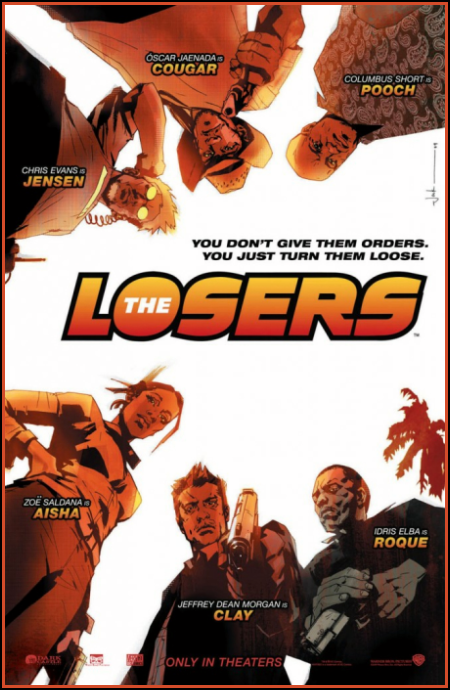
While not part of the DC Universe proper the Vertigo line of titles do belong under the DC umbrella. Vertigo has always been the more mature-oriented publishing arm of DC with well-known and critically-acclaimed writers such as Grant Morrison, Garth Ennis, Warren Ellis and Alan Moore being the top names releasing titles under that aegis. There’s already been several films based-off of the Vertigo line with Constantine and League of Extraordinary Gentlemen being two. Two examples which haven’t gone over well with comic book fans and film-goers. We now have another title from DC/Vertigo which hopes to break that cycle of mediocrity. The Losers (written by Andy Diggle) as directed by Sylvain White (Stomp the Yard) is a funny and exciting action-comedy which definitely had a chance to be one of the great comic book films if it actually had a coherent storyline.
The Losers is pretty much the name of the special-ops covert team the audience gets to know from start to finish. The basic premise to this film is actually straight out of late 80’s and early 90’s action films. A team of badass operatives gets betrayed during a covert mission by unknown parties who may or may not be working for the very organization the team has worked loyally for. For this particular reiteration of that action flick staple the team literally calls themselves the Losers and their betrayal occurs while in a secret mission inside Bolivia to take out a narco-terrorist. While their mission to take out this bad man does happen it does so with some new wrinkles such as first saving 25 innocent Bolivian children before the airstrike called in by them happens within 8 minutes. This eventual betrayal now forces the Losers’ commander, a military colonel called Clay (played by Jeffrey Dean Morgan), to take his 5-man team deep under while convincing their CIA masters that they died during the operation.
The rest of the film revolves around the Losers being discovered by a third-party as still being alive and given a choice. The choice being to remain under the Agency’s radar, stay dead and in Bolivia or take on this third-party’s mission to take out the very man who betrayed them, get back their good name and return to their families or, for some, their old lives. Heading up this mysterious benefactor is the one and lovely Zoe Saldana (fresh-off a little flick called Avatar). She’s pretty much the only female of note in the whole film. One would think she’s the token female, but she’s more than capable of holding her own in a testosterone-fueled action-comedy.
What would an action-comedy about betrayed badass special-ops guys (and gal) without a bad guy to match. In The Losers we get the betrayer of the team in Max (played with an almost James Bond villainish flair by Jason Patric). He’s the one who gave them the team their last official mission in Bolivia and the same one to frame them for the a heinous crime they didn’t commit. To say that Max is over-the-top in terms of on-screen villainy would be an understatement. While the character doesn’t prance or growls his way through the film he does have a certain je ne sais quois about him that doesn’t pigeonhole him as your typical uber-bad guy.
One would think that with such a simple enough revenge and wronged team-on-a-mission set-up it would be quite an easy story to create and film around. I would have to say that the screenplay adapting the first two volumes of the original source material had left much to be desired. While it wasn’t a total waste there wasn’t enough of a story beyond creating set-pieces for the characters to either shoot at and blow stuff and people up, Max to show the audience how evil he really is, or show Saldana’s and Morgan’s character together either fighting or getting it on. The whole script used almost seemed like it was culled from a much bigger one.
What we do see on the screen was exciting and funny enough that it helps cover up enough of that major flaw of a non-existent story. In fact, I would say that the film behaved almost like an extended, well-shot and well-casted pilot for a new tv action series. It’s almost what I would expect USA Network’s excellent spy-comedy Burn Notice to look like if shot on 35mm, given a multi-million dollar budget and shot on exotic locations. The film definitely would’ve benefited from an additional 20-30 more minutes to help add muscle to the story. The fact of the matter is that the story actually was able to flesh out the main characters enough that they were all quite distinct in personalities without ever becoming cardboard copy caricatures.
It’s the chemistry between the ensemble cast which shines in The Losers. While Jeffrey Dean Morgan (Watchmen), Zoe Saldana and Jason Patric were the three main leads (with each of them pushing their own agenda over the other two) the rest of the players were very good in their roles. Idris Elba (The Wire) as Clay’s second-in-command Roque does a very good job of balancing out the cool-headed team leader. his name may not be spelled like it but he definitely was the rogue factor in the whole film. While the team itself wasn’t an amoral team of killers and expert covert ops operators it was the character Roque who came closest and Elba played him with enough menace that one might’ve wondered why he was actually still with the team instead of going off on his own. Columbus Short as driver extraordinaire and Óscar Jaenada as Cougar (got a hilarious reaction from Saldana’s character upon hearing of the name) the expert marksman who never seems to miss are good in their roles as well, but the one who stole every scene he was in was Chris Evans as Jensen who filled the role of team tech and communications expert.
Chris Evans is definitely not a novice when it comes to being part of a comic book film. He’s already done two portraying the wise-ass brother in the Fantastic Four franchise and already tapped to play one of Marvel Comics’ most iconic characters in Captain America. His character portrayal of the Losers’ Jensen is more akin to his work as Johnny Storm in the FF franchise. He was the funniest thing and most lively character in The Losers. He pretty much got the best dialogue and his comedic timing was on point. He definitely kept the film from leaning towards the too-serious side of the equation. His singing of Journey’s classic motivational song, “Don’t Stop Believing”, was one of the funniest moments in the film and the song itself ended up being the closing credits musical choices which I thought was quite appropriate.
Sylvain White’s work in this film I would say would constitute as being good and, at times, bordering on being very good. There were a few stylistic choices by White which elevated the action sequences into comic book territory such as sudden pauses in the action to capture a good kill or scene like one would see in a panel of a comic book page. Even some of the camera angles mimicked those angles used by comic book artists to create a more dynamic and stylized point of view of the scene. I thought his use of the slo-mo shots of the team walking towards the screen was done overmuch. It was good to show the team together for the first time with something exploding in the background, but just once would’ve been enough. His background as a music video director showed too much in The Losers that at times it became too distracting. Fortunately, it didn’t detract from the fun everyone seemed to be having on-screen. There’s talent in White as a filmmaker if he would just trust in his growing sense as a feature filmmaker and not fall back on his music video directing days. I did like the choice of using the original comic book art to highlight the starting and ending credits of the film. Artist Jock’s artwork was great to see on the screen.
Overall, I enjoyed my time with The Losers. I enjoyed the film despite a glaring flaw in the story (which was really nowhere to be seen). The film took the comic book film staple of “origin story” a bit too far and made the whole production look like a glorified and high-budgeted tv pilot for an action series. In fact, if DC and Warner Brothers wanted to make a series out of The Losers they already have said pilot in the can and just continue things from there. What really saves this film from becoming a huge disappointment was the cast and how much fun they had on-screen. The action scenes were not great but they had life in them and when propped up by some of the comedic stylings of one Chris Evans made the sequences enjoyable. While The Losers will not be anything to scare Marvel Studio into cranking out something similar it does help bring attention to some of the more non-superhero properties DC has in its Vertigo line. The film definitely has more excitement in it despite its major flaw than either Constantine and League of Extraordinary Gentlemen. I do hope it does well enough that a sequel gets greenlit and helps build more of a story in the follow-up now that introducing the characters and the world are now out of the way.
Comic books which have been adapted for the big-screen have had an uneven track record. For every excellent film-incarnations like Spider-Man 2, X-Men 2, The Dark Knight and Iron-Man we get dregs like Elektra, Ghost Rider and Daredevil. The last couple years filmmakers have gravitated towards the deconstruction side of comic book superheroes. Christopher Nolan’s The Dark Knight was as much an action-thriller as it was a meditation on the superhero psyche and mythmaking. Then there was 2009’s Watchmen which tried admirably (though failed in the end) to adapt Alan Moore’s epic deconstruction of the superhero archetypes.
It’s now 2010 and we get the first comic book film of the year. The film is an adaptation of Mark Millar (writer) and John Romita, Jr.’s (artist) ultraviolent comic book title from Marvel’s Icon Comics (their creator-owned publishing line). Kick-Ass was optioned and adapted by British-director Matthew Vaughn and screenwriter Jane Goldman. Unlike most comic book films of the past decade, Vaughn’s Kick-Ass was independently-financed (with help from Brad Pitt and his Plan B Studio) and made which was the best thing that could’ve happened to this project. With a free rein to make the film he wanted without corporate studio meddling, Matthew Vaughn was able to craft a fun and violent romp of a film mashup that collides superhero archetypes and conventions with “real world” grounding.
The story and premise for Kick-Ass is actually quite simple enough to follow. We have high-schooler and avid comic book fan Dave Lizewski asking his best friends and fellow comic book fans why no one has actually tried to be a superhero. The answer he gets from his like-minded friends doesn’t instill hope in his dream. While they are huge fans of superheroes and comic books they stop at actually trying to be one in real-life. Dave, on the other hand, knows that it’s possible for one to try and be a superhero even without powers. He believes that determination, conviction and the need to help those in need would be all that someone requires to become a superhero. With these criteria in mind he sets off to do the very thing he had asked his friends about. He accomplishes this by ordering (for the amount of $99.99) a green and yellow wet-suit and head cover plus a pair of batons and a taser gun. His first attempt at superherodom fails spectacularly as he’s stabbed and violently run over in the street. This near-fatal introduction to the world of superheroes doesn’t deter Dave when deep down even he knows that he’ll get killed if he continues on his quest to become the next Spider-Man.
The story moves on to Dave finally getting his superhero fame by stopping a beatdown of a stranger and having this event caught on a bystander’s camera phone and uploaded said video on Youtube. With this amateur video on Youtube getting millions of hits and views, plus Dave’s own creation of a MySpace page for his alter-ego the world finally gets it’s real-life superhero in the form of Kick-Ass. A name that spurs not just tens of thousands of fans on Kick-Ass’ MySpace page but also a boom in sudden Kick-Ass merchandise in Dave’s local comic book shop. Through it all Dave revels in the attention his alter-ego has been getting even the unexpected attention of the girl of his dreams, Katie Deauxma (played by the lovely Lyndsy Fonseca). An attention born out of a misunderstanding where Katie believes Dave to be gay because of circumstances revolving around his near-death experience of his very first attempt at crimefighting.
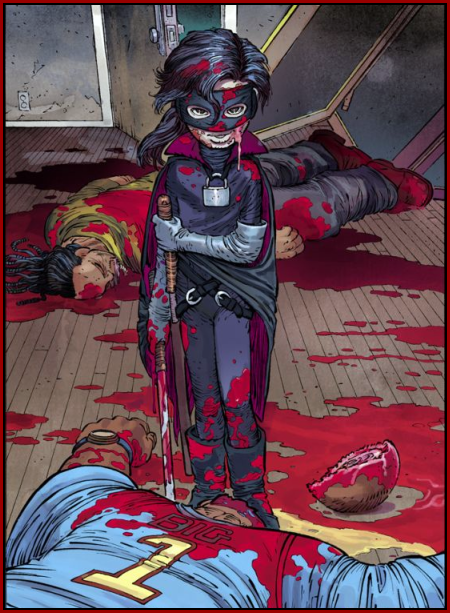
On the sidelines of all this we get introduced to the film’s real “superheroes” in the form of Big Daddy (played by Nicolas Cage) and his sidekick and 11-year old daughter, Hit-Girl (Chloe Moretz). We see early on that both Big Daddy and Hit-Girl are the real thing though calling them superheroes would be a stretch since they seem to be more vigilantes who happen to wear costumes and with no compunction at all about killing the criminals. These two are definitely not Batman and Robin (one of many easter egg-like references to comic book characters and storylines). Their story parallels that of Kick-Ass’ but where Dave seems to enjoy just playing at being a superhero and the adoration such role-playing gives him both Big Daddy and Hit-Girl actually have a focus and mission in their own attempts. These are two individuals who believe in the superhero roles they’ve taken on themselves and have prepared and trained themselves well for the violent consequences and ramifications of their mission.
The rest of the film takes the audience on a peculiar coming-of-age journey for one Kick-Ass. As stated earlier he’s pretty much all talk with a rose-tinted view of a superhero’s life. What he has read in his comic books doesn’t prepare him for the reality of actually trying to act and become a true superhero. While writer Mark Millar takes a dim and cynical view of what Kick-Ass is trying to figure out and accomplish (most of the comic’s morality ends up being that bad things happen to good people with the best of intentions), director Matthew Vaughn and screenwriter Jane Goldman take a more hero’s journey approach (sprinkled liberally with foul language and bloody violence). While Dave Lizewski’s attempts to live up to his hero persona of Kick-Ass range from succeeding through luck to failing miserably and at times fatally, by the end of the film circumstances (which have spiralled out of his own control) forces him to finally face up to the fact that if he really wanted to be a superhero he needed to finally do more than just talk and pretend to be one and actually act and perform like one.
This is in contrast to Hit-Girl’s own journey which doesn’t start her off as clumsy and unsure of herself. Instead we see in Hit-Girl the type of individual Kick-Ass wants to be but is unable to through most of the film. Where Kick-Ass suddenly realizes that he’s way over his head once the bodies start dropping in bloody ways, Hit-Girl doesn’t lack in confidence but is in control of every situation she’s confronted with. Whether it’s rescuing Kick-Ass from death (more than once) or finally launching the climactic assault on her and Big Daddy’s focus and reason for being. Hit-Girl is the true superhero with Big Daddy really her sidekick. Everyone else, from Kick-Ass to Red Mist (Christopher Mintz-Plasse), just pretend and play at being costumed superheroes. Hit-Girl is the personification of the female antihero of the recent comics, but unlike most female characters in comic books she’s not the fringe character or the one in need to help. She’s the one who rescues everyone and willing to sacrifice her very life to live up to the ideals (however twisted they may be to the audience) she has set for herself.
Kick-Ass may have been an post-modern exercise in trying to deconstruct and then acknowledge the superhero archetype and themes, but first and foremost it is a very fun and exhilarating rollercoaster ride of an action film. Vaughn and Goldman were able to capture the exciting and fun side of the original comic despite leaving behind some of the meanspiritedness of Millar’s writing. Goldman definitely has an ear for inserting comedy beats into the film to keep the story from becoming too serious and thus slowing down the film. In fact, I would say that Kick-Ass was a very fast-paced two-hour film that would alternate between comedy and action with a tender moment spliced in at the last third of the film. Much of the comedy in Kick-Ass come at the expense of Kick-Ass himself as he stumbles his way through most of the film either out of his league or just pantshitting scared of what he’s gotten himself into. Nicolas Cage’s characterization of Big Daddy also drew some major laughs as he alternated from a twisted version of Mr. Rogers as Damon MacReady to channeling Adam West’s “Batman” when dressed up as Big Daddy.
One thing which Matthew Vaughn has shown with is third feature-length film was the ability to create and shoot some very good action sequences. He even made an interesting stylistic choice to film his action sequences differently depending on whether it was Kick-Ass who was the focal point in the fight or whether it was Hit-Girl or Big Daddy doing the mayhem. Vaughn chose to shoot Kick-Ass’ fight sequences with comedy in mind as the character clumsily fought his way through his opponents. Even when he finally finds his inner superhero in the final fight with his newly discovered nemesis Kick-Ass still fought more on instinct and blindly swinging away instead of actually fighting like an expert. The same couldn’t be said about when Hit-Girl or Big Daddy were the main focus in the action scenes. These two characters were trained killers pure and simple. Their fight choreography was the exact opposite of Kick-Ass’. Hit-Girl’s was especially well-choreographed to show just how honed a fighter and killer Big Daddy’s 11-year old daughter really was even when confronted by over a dozen heavily-armed gangsters and drug dealers. It’s the Hit-Girl action scenes which drew the biggest positive reactions from the audience and rightfully so. Chloe Moretz truly sold the idea of an 11-year old costumed vigilante killer and the film was better for it.
Chloe Moretz star-making performance brings us to the overall performances of the film’s cast. While pretty much everyone who sees this film will agree that Chloe Moretz as Hit-Girl pretty much steals every scene she’s in Aaron Johnson as Dave Lizewski/Kick-Ass also does a very good job in his performance. He anchors the film as the everyman, or everyboy for this film, the audience will gravitate towards. He’s believable as the stumbling and naive teen whose dream of becoming a superhero turns his life upside-down and rightside-up. We can sympathize with his teen need to be accepted and, ultimately, find his identity. It just happens that he find it in the midst of playing at being his dream girl’s fake gay BFF and then as the superhero he finally became in the end. Nicolas Cage, Clark Duke and Lyndsy Fonseca were good at their “sidekick” roles. On the other side of the superhero spectrum we have Mark Strong as mob boss Frank Dimico doing a wonderful job. Christopher Mintz-Plasse as Chris Dimico/Red mist makes for a great counterpoint and mirror to Dave Lizewski/Kick-Ass. But where Dave finally learns to be a hero and take the role seriously, Mintz-Plasse’s Chris never learns the true meaning of what a hero is and just continues to be the wannabe that Dave started off as but finally shed in the end.
Kick-Ass does a better job at deconstructing the superhero world of comic books than Zack Snyder’s Watchmen of 2009. While the comic book version of Kick-Ass will never be in the same league and level as Alan Moore’s Watchmen the film version flip-flop and shows that sometime the simpler story makes for a better film. Vaughn and Goldman did a great job in adapting the darker and more nihilistic writing of Millar. But while changes were made to allow the story to be more accesible to the general public, the film still manages to keep the spirit of the original source material intact but minus the cuckolding the story’s intrepid hero gets hit with twice to end the story.
Even with the controversy over the Hit-Girl character and of Chloe Moretz protrayal of this blood-soaked and foul-mouthed killer it shouldn’t diminish the fact that Kick-Ass set out to be both thought-provoking, fun and entertaining and succeeds in accomplishing all three. While the film has flaws they’re not so glaring or even distracting that they take away from one’s enjoyment of the film. Even for an “origins” tale Kick-Ass manages to escape being too overly reliant on dialogue to explain everything that’s going on to the audience. The fact that a sequel was already being talked about even before the film’s release shows confidence in both Millar and Vaughn that there’s further adventures and stories to show and tell about Kick-Ass and Hit-Girl. I, for one, will be there to see what they will be up to next.
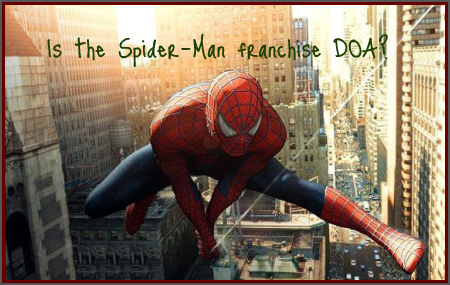
It looks like the one major comic book film franchise of the last decade has started to fall apart.
The past couple weeks have seen news of the disagreements between the Spider-Man franchise’s only director (Sam Raimi) and it’s studio (Sony Pictures) ranging from script ideas to who should be the main villain of the fourth installment in the series. Raimi’s been very insistent in using the classic Spider-Man villains such as Green Goblin, Doctor Octopus and, in the third film, Sandman. The studio wants the newer villains such as Venom and Carnage (two villains I thought were given too much press by comic book fans of the younger generation).
With the fourth film’s start date for filming having been delayed the targeted release date for the film on May 2011 wouldn’t be met. Visual-effects teams and houses have been told not to start work. It is these production teams who need the most time to do their work and the fact that they’ve been told not to even start pre-prod work means the delay will most likely affect not just the targeted date of 2011, but probably it’s new release date of 2012 (FX quality could suffer if rushed for the latter which Sony may just take a chance on).
All these delays and postponements have just cost the franchise it’s two most visible frontmen. Director Sam Raimi and Tobey Maguire (the only actor to play Peter Parker in all three films) are not out of the fourth film. Sony looks to reboot the franchise with a new director and a new lead actor as they move forward to try and make a 2012 release.
Will taking in a new director and a new lead mean a fourth film in the franchise that will have less of a budget to work with (the three films averaged between 150-250 million budget per)? Is Sony trying to rush this fourth film and giving up on the franchise’s only director and lead actor to try and keep their licensing rights to the franchise? Will Marvel (now a subsidiary of Disney Corp.) play hardball with Sony and the other studios which hold the licensing rights to Marvel characters?
While the third Spider-Man film wasn’t on the same level in terms of quality as the first two it still made a ton of money. One would think that a studio such as Sony would listen to the director who actually made the franchise become a juggernaut when summertime comes around. As a company Sony has made many missteps in their consumer and entertainment divisions. The struggle between studio and filmmaker may just have started the death-knell to the franchise which ushered in the Golden Age of comic book-based films.
Only time will tell, but unless Sony is able to get a director who can bring in the sort of inventive and imaginative vision to the franchise and a lead actor who can easily step into Maguire’s shoes and make audiences forget about the change, then I see this franchise heading down a fast slope into B-movie territory. A development which would further cement Marvel’s desire to take back all it’s properties under it’s fold.





 Through the Shattered Lens