The 1987 film, Tough Guys Don’t Dance, opens with Tim Madden (Ryan O’Neal) talking to his father, tough Dougy (Lawrence Tierney). Dougy has stopped by Tim’s New England home to let Tim know that he has decided stop chemotherapy and accept his eventual death from cancer because, as Dougy puts it, “Tough guys don’t dance.” The tone of Dougy’s voice is all we need to hear to know that, in his opinion, his son has spent way too much time dancing.
Tim is an ex-convict turned writer and, when we first see him, he’s obviously had a few rough nights. He explains to Dougy that he woke up after a bender with his ex-girlfriend’s name tattooed on his arm, blood all over his jeep, and two heads dumped in his marijuana stash. Tim says that he’s hopeful that he’s not the murderer but he can’t be sure. He’s been drinking and doping too much. He suffers from blackouts. He’s not sure what happened.
The majority of the film is made up of flashbacks, detailing Tim’s affairs with a number of women and also his odd relationship with the town’s police chief, Luther Regency (Wings Hauser). Luther is married to Tim’s ex-girlfriend, Madeleine (Isabella Rossellini), who long ago accompanied Tim on a trip to North Carolina where they hooked up with a fundamentalist preacher (Penn Jillette) and his then-wife, Patty Lariene (Debra Sundland). (Tim found their personal ad while casually skimming the latest issue of Screw, as one does I suppose.) Patty Lariene eventually ended up married to Tim, though she has recently left him. As for Madeleine, she has never forgiven him for a car accident that they were involved in. Is Tim capable of loving anyone? Well, he does say, “Oh God, oh man,” repeatedly when he discovers that his wife has been having an affair.
Tim tries to solve the murders himself, finding that they involve not only him and Luther but also Tim’s old prep school friend, Wardley Meeks III (John Bedford Lloyd) and also some rather stupid drug dealers that Tim hangs out with. The plot is almost ludicrously convoluted and it’s tempting to assume that the film is meant to be a parody of the noir genre but then you remember that the film is not only based on a Norman Mailer movie but that it was directed by Mailer himself. Mailer, who was the type of public intellectual who we really don’t have anymore, was blessed with a brilliant mind and cursed with a lack of self-awareness. There’s little doubt that we are meant to take this entire mess of a film very seriously.
And the film’s theme isn’t hard to pick up on. By investigating the murders, Tim faces his own troubled past and finally comes to understand why tough guys, like his father, don’t hesitate to take action. Tough guys don’t dance around what they want or need. That’s a pretty common theme when it comes to Mailer. Tim Madden is not quite an autobiographical character but he is, by the end of the story, meant to represent the type of hard-living intellectual that Mailer always presented himself as being. Unfortunately, Ryan O’Neal wasn’t exactly an actor who projected a good deal of intelligence. And, despite his lengthy criminal record off-screen, O’Neal’s screen presence was somewhat docile. That served him well in films like Love Story and Barry Lyndon. It serves him less well in a film like this. It’s easy to imagine O’Neal’s Tim getting manipulated and, in those scenes where he’s supposed to be a chump, O’Neal is credible enough in the role. It’s far more difficult to buy the idea of Tim actually doing something about it.
Indeed, it’s hard not to feel that co-star Wings Hauser would have been far more credible in the lead role. But then, who would play Luther Regency? Hauser gives such a wonderfully unhinged and out-there performance as Luther that it’s impossible to imagine anyone else in the role. Maybe Hauser could have played both Tim and Luther. Now that would have made for a classic film!
Tough Guys Don’t Dance is weird enough to be watchable. The dialogue is both raunchy and thoroughly humorless, which makes it interesting to listen to, if nothing else. The moments that are meant to be funny are so obvious (like casting noted atheist Penn Jillette as a fundamentalist) that it’s obvious that the moment that feel like clever satire were actually all a happy accident. As far as Norman Mailer films go, this one is not as boring as Wild 90 but it also can’t match the unhinged lunacy of a frustrated Rip Torn spontaneously attacking Mailer with a hammer at the end of the unscripted Maidstone. It’s a success d’estime. Mailer flew too close to the sun but the crash into the ocean was oddly entertaining.
In 1987’s The Last Innocent Man, Ed Harris plays Harry Nash.
Harry is a criminal defense attorney, one who specializes in defending people who have been charged with committing murder. He’s good at his job but he’s not sure that he’s happy with his life. He went into the law to save people from Death Row but years of getting acquittals for guilty people have taken their toll on Harry’s psyche. His most recent client was Jonathan Gault (David Suchet), a man accused of having killed his wife. The verdict was “not guilty” but Harry suspects that Gault may have been guilty of both what he was charged with and also countless crimes for which he hasn’t been charged. It doesn’t help that Gault confronts Harry in a parking lot and says he wants Harry to co-write a book about how he got Gault acquitted. Gault proceeds to tell Harry that he did kill his wife, before suddenly laughing and saying that he’s only joking.
Despite all of the money and the fame, Harry needs a break from dealing with guilty people. He tells his shocked partner that he will be temporarily stepping back from their practice. Along with being burned out, Harry is also interested in pursuing a romantic relationship with Jenny Stafford (Roxanne Hart). Jenny is married but she assures Harry that she is in the process of getting a divorce from her husband, Philip (Darrell Larson).
However, when Philip is arrested and accused of murdering a policewoman who was working undercover as a prostitute, Harry finds himself defending Philip in court. Philip swears that he’s innocent of the crime and that he’s never even been with a prostitute. He claims that, when the murdered occurred, he was at home with his wife. Jenny is willing to collaborate Philip’s alibi, even though Harry suspects that she’s lying.
As you can probably guess, there are plenty of twists and turns to the plot of The Last Innocent Man. Unfortunately, they’re not exactly shocking twists and turns. The Last Innocent Man is a courtroom drama and it pretty much sticks to the rules of the genre, which means a lot of snarky comments between Harry and the prosecutor and also plenty of scenes of various lawyers snapping “Objection!” and demanding a recess. This is the type of film where people fall apart on the witness stand and the audience in the courtroom murmurs whenever something shocking happens. The Judge can’t pound that gavel hard enough to make The Last Innocent Man anything more than a standard courtroom drama.
That said, director Roger Spottiswoode keeps the action moving at a quick-enough pace and Ed Harris is ideally cast in the role of the morally conflicted Harry Nash. As well, there’s an entertaining supporting performance from Clarence Williams III, cast here as a cocky pimp, and David Suchet is chillingly evil as the worst of Harry’s clients. The Last Innocent Man doesn’t quite reach the Hitchcockian heights that it was reaching for but, still, fans of courtroom dramas will enjoy it or, at the very least, show a little leniency in their judgment.
Welcome to Retro Television Reviews, a feature where we review some of our favorite and least favorite shows of the past! On Mondays, I will be reviewing Miami Vice, which ran on NBC from 1984 to 1989. The entire show can be purchased on Prime!
This week, things get weird.
Episode 2.8 “Tale of the Goat”
(Dir by Michael O’Herlihy, originally aired on November 15th, 1985)
It’s hard to know where to begin with this one.
Legba (Clarence Williams III) is a drug lord that Sonny has been trying to take down for three years. While hiding out in Haiti, Legba reportedly dies. When his body is flown back to Miami, Crockett and Tubbs are waiting in the airport so that Crockett can snap a picture of Legba in his casket. Legba does indeed appear to be dead. But, at his voodoo-themed funeral, a man on a motorcycle riddles the casket with bullets. When Crockett and Tubbs (who were staking out the ceremony) open up the casket, they discover only a dead goat.
“Zombie!” a priest exclaims.
Legba has come back, though not as a member of the undead. Instead, while in Haiti, he ingested a toxin that put him in a 48-hour coma. Unlike a lot of people who take the toxin, Legba survives. However, when he is revived, he has suffered brain damage and is now walking and talking slowly. That doesn’t stop Legba from getting his old gang back together (including a dwarf who carries a pickaxe) and going after everyone who he feels has betrayed him. This includes his former lieutenant (Mykelti Williamson) and an obnoxious money launderer (Ray Sharkey) who owns a used car lot.
Tubbs doesn’t believe in voodoo, despite Crockett warning him of the dangers. Tubbs is more interested in Marie (Denise Thompson), Legba’s ex-girlfriend. Looking to keep Marie safe from Legba, Tubbs attempts to infiltrate a voodoo ceremony. You might think this would give Tubbs the perfect excuse to trot out the fake Caribbean accent that he occasionally used during the first season but instead, Tubbs is captured before he can even utter a word. He’s injected with the toxin and spends 48 hours in a coma, haunted by visions of Legba staring at him!
Eventually, Tubbs does come out of his coma and, amazingly, it takes him about five minutes to fully recover. The episode ends with another raid on a yacht. This time, Tubbs manages to kill the villain, shooting him in the back! In Tubbs’s defense, he was still having visions and he thought Legba was facing him. Legba dies and Marie is found in a coma but alive.
This was a weird episode, one that had enough plot for a two-parter. As it is, the story felt rather rushed. No sooner had Mykleti Williamson and Ray Sharkey made their appearances as criminals then Legba was doing away with them. No sooner had Marie stepped onto Crockett’s boat then she was being kidnapped by Legba’s men. No sooner had Tubbs decided to infiltrate Legba’s cult then he was getting injected with the voodoo toxin. And no sooner had Tubbs woken up from his coma then he was preparing to raid the yacht. Add to that, Clarence Williams III gave a performance that was without a hint of subtlety, speaking in accent that was impossible to describe. This wasn’t really a good episode but it was so weird that it was undeniably entertaining.
Next week, Dean Stockwell appears as an old friend of Castillo’s! Hopefully, he won’t be a voodoo priest.
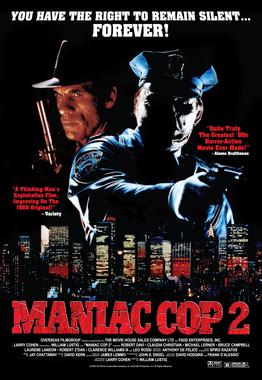
Maniac Cop 2 picks up where the first Maniac Cop ended.
The NYPD thinks that the undead maniac cop Matt Cordell (Robert Z’Dar) has been destroyed but he is actually still alive and killing civilians and cops in New York. He has even teamed up with a serial killer named Steven Turkell (Leo Rossi, ranting and raving like a pro). Jack Forrest (Bruce Campbell) and Theresa Malloy (Laurene Landon) both return from the first film but both of them are killed by Cordell before the movie is even halfway over. Maniac Cop 2 is not playing around.
With Jack and Theresa gone, it falls to Detective Sean McKinney (Robert Davi) and Officer Susan Riley (Claudia Christian) to discover what the rest of the audience already knows, that Cordell is seeking revenge against the system that abandoned him in prison. The new police commissioner, Ed Doyle (Michael Lerner), is determined to cover up what happened but Cordell is even more determined to have his vengeance. Working with Turkell, Cordell heads to the prison where he was unjustly incarcerated and murdered.
Maniac Cop 2 is a marked improvement on the first film. Cordell is no longer a lumbering and slow monster. He is now a ruthless, Terminator-style executioner who, in the film’s best-known scene, wipes out an entire police precinct in a matter of minutes. Cordell is so ruthless that he won’t even stop when he’s on fire. His partnership with Turkell adds a new twist to the Maniac Cop saga. Turkell views Cordell as his partner-in-crime but Cordell is only interested in getting his revenge. (Turkell was originally meant to be Frank Zito, the main character from Lustig’s Maniac. When Maniac star Joe Spinell died before shooting began, the role was changed to Leo Rossi’s Steven Turkell.)
Stepping into the shoes of the main investigation, Robert Davi gives one of his best performances. As opposed to the boring heroes of the first film (sorry, Bruce!), Davi’s Sean McKinney is just as obsessive and ruthless as Cordell. Cordell sets fire and McKinney uses those fires to light his cigarettes.
William Lustig has described Maniac Cop 2 as being his best film and he’s probably right. It is definitely the best of the Maniac Cop films and the only one to fully take advantage of its premise.
That was my main reaction to watching the 1984 film, Purple Rain, a few nights ago. Over the years, there have been a lot of music stars who have attempted to make the transition to acting. Some have been more successful than others. While some have stuck to playing versions of themselves, others have attempted to become actual character actors and the end results have often been mixed. Being a strong stage performer does not neccesarily mean that person is automatically going to be a convincing film actor and the history of the movies is full of famous singers whose personality seemed to evaporate as soon as they had to act for the cameras and try to sound convincing while reciting dialogue. Taylor Swift has built up a strong and incredibly loyal fanbase but you wouldn’t necessarily believe that she was one of the world’s biggest stars if you only knew her from her wan and bland performances in Cats and Amsterdam. Indeed, while watching her in Amsterdam, it’s kind of hard not to be thankful when that car drives up and brings her performance to an end.
Prince, on the other hand, could truly act.
In Purple Rain, he plays The Kid. The Kid is an enigmatic musician living in Minneapolis, Minnesota. He’s the front man of a band called The Revolution and he sings songs that are, at times, almost disturbingly personal. The Kid rides a purple motorcycle and he’s one of those musicians who is driven to record almost every sound that he hears. (At one point, The Kid listens to a recording of an unidentified woman sobbing. Who exactly the woman was or why she was crying are questions that are never answered, though I think it’s possible it was supposed to be the Kid’s mother.) He performs to escape from the scars of his upbringing. His father (Clarence Williams III), a failed musician, regularly beats his mother (Olga Karlatos, who memorably lost an eye in Lucio Fulci’s Zombi 2). No one can deny The Kid’s talent but he’s also known for being a bit of a control freak and the other members of the Revolution sometimes feel that he’s not willing to give them the credit and opportunities that they deserve and….
Okay, obviously there are some similarities between The Kid and the man playing him. Purple Rain was Prince’s first film and his first acting role and it makes sense that he would want to play a character in a situation that he was familiar with. But that still doesn’t change the fact that Prince gives an excellent and charismatic performance in the lead role. Unlike so many other singers-turned-actors, he doesn’t lose his spark when he has to remember his lines. His presence doesn’t evaporate when the camera is turned on him. Instead, if anything, Price feels even more natural off-stage than on. Whether the Kid is being playful or serious, driven or defeated, Prince is never less than convincing. Yes, the audience never forgets that they’re watching Prince. But, at the same time, the Kid comes to life as an individual character with his own life and problems and personality separate of the actor who is playing him.
As for the film’s plot, it’s a fairly simple one. The Revolution is one of three bands that hold down the house band slot at the First Avenue nightclub. The Kid’s rival, Morris Day (played by Morris Day), plots to replace the Revolution by putting together an all-girl group called Apollonia Six. Apollonia Six is led by Apollonia (Apollonia Kotero), who is the Kid’s girlfriend. As Morris explains it, the Kid is too wrapped up in himself to help out Apollonia or the Revolution’s Wendy and Lisa.
And Morris Day has a point. As soon as Apollonia tells the Kid that she’s going to be working with Morris, the Kid responds by striking her. It’s a shocking scene but, as the film shows, it’s all the Kid learned at the hands of his father. It’s only after a personal tragedy that the Kid starts to realize that he does not have to be just like his father. That said, let us hope that the Kid invested in some therapy and some anger management courses after the end credits rolled.
As a character, the Kid would be unbearable if not for the strength and charm of Prince’s performance. Prince is amazing when he performs on stage and the film’s soundtrack still holds up but what makes the film work are the moments when Prince shows us the Kid’s vulnerable side. Self-loathing is not an easy feeling to play and it’s an even more difficult feeling to make sympathetic but Prince does both. The Kid knows that he’s self-destructive and immature but he’s also sincere in his desire to be better than his past. The film leaves you to wonder if he’ll succeed.
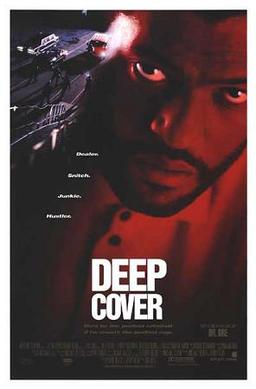
When Russell Stevens was 10 years old, he saw his father get gunned down while holding up a liquor store. Now, 20 years later, Russell (Laurence Fishburne) is a cop who is so straight that he doesn’t even drink. But because of his father’s background, a psychological profile that indicates Russell is unique suited to understand how the criminal mind works, and the fact that he has no loved ones at home, he is recruited to work undercover. His weaselly handler, Carver (Charles Martin Smith), explains that going undercover means that Russell is going to have to become a criminal 24/7. He can’t just do his job for 8 hours a day and then go back to his normal life at night.
With the government’s money, Russell sets himself up as a dealer, buying and selling the drugs that are destroying his community. It does not take long before Russell meets David Jason (Jeff Goldblum), a lawyer and aspiring drug kingpin. At first, David makes Russell as being an undercover cop but, after Russell is arrested by the righteous but clueless Detective Taft (Clarence Williams III), David changes his mind and brings Russell into the operation. The line between being a cop and a criminal starts to blur, especially after David and Russell start to bond over their mutual dislike of their boss, Felix (Gregory Sierra). It doesn’t take long for Russell to get in over his head.
There have been a lot of films made about undercover cops losing themselves in their new criminal identity but few take the story to its logical conclusion like Deep Cover does. Russell may start out as a straight arrow but, by the end of the movie, he’s killed a dealer in cold blood and broken his own personal pledge to never do cocaine himself. He also discovers that David is often a more trustworthy partner than his own colleagues in law enforcement. Fishburne and Goldblum both give excellent, spot-on performances as Russell and David and they’re supported by an able cast of weasels and tough guys. I especially liked Charles Martin Smith’s performance as Carver. (When Russell asks Carver if he’s ever killed a man, Carver laughs and says that he went to Princeton “just to avoid that shit.”) Gregory Sierra is also great in the role of Felix and I loved that, of all people, Sidney Lassick played one of Felix’s henchmen. That’s like seeing John Fiedler play the Godfather.
One of the best crime thrillers of the 90s, Deep Cover is not only a detective film but it’s also a politically-charged look at why America’s war on drugs was doomed to failure. No sooner does Russell get into position to catch the man behind Felix’s operation than he’s told to drop the case because the State Department thinks that the drug lord could be politically helpful to them in South America. As Russell discovers, the War on Drugs is more interested in taking out the soldiers on the streets than the generals in charge. While men like Carver sit in their offices and move people around like pieces on a chess board, people like Russell are left to clean up the mess afterward.
Harry Mitchell (Roy Scheider) is a businessman who has money, a beautiful wife named Barbara (Ann-Margaret), a sexy mistress named Cini (Kelly Preston), and a shitload of trouble. He is approached by Alan Raimey (John Glover) and informed that there is a sex tape of him and his mistress. Alan demands $105,000 to destroy the tape. When Harry refuses to pay, Alan and his partners (Clarence Williams III and Robert Trebor) show up with a new tape, this one framing Harry for the murder of Cini. They also make a new demand: $105,000 a year or else they will release the tape. Can Harry beat Alan at his own game without harming his wife’s political ambitions?
Based on a novel by the great Elmore Leonard and directed by John Frankenheimer, 52 Pick-Up is one of the best films to ever come out of the Cannon Film Group. Though it may not be as well-known as some of his other films (like The Manchurian Candidate, Seconds, Black Sunday, and Ronin), 52 Pick-Up shows why Frankenheimer was considered to be one of the masters of the thriller genre. 52 Pick-Up is a stylish, fast-paced, and violent thriller. John Glover is memorably sleazy as the repellent Alan and the often underrated Roy Scheider does an excellent job of portraying Harry as a man who starts out smugly complacent and then becomes increasingly desperate as the story play out.
One final note: This movie was actually Cannon’s second attempt to turn Elmore Leonard’s novel to the big screen. The first attempt was The Ambassador, which ultimately had little to do with Leonard’s original story. Avoid The Ambassador but see 52 Pick-Up.
1930s. New York City. For years, Stephanie St. Clair (Cicely Tyson) has been the benevolent queen of the Harlem underworld, running a successful numbers game and protecting her community from outsiders. However, psychotic crime boss Dutch Schultz (Tim Roth) is determined to move into Harlem and take over the rackets for himself. With the weary support of Lucky Luciano (Andy Garcia), Schultz thinks that he is unstoppable but he did not count on the intervention of Bumpy Johnson (Laurence Fishburne). Just paroled from Sing Sing, Bumpy is determined to do whatever has to be done to keep Schultz out of Harlem.
When I reviewed The Cotton Club yesterday, I knew that I would have to do Hoodlum today. Hoodlum and The Cotton Club are based on the same historic events and both of them feature Laurence Fishburne in the role of Bumpy Johnson. Of the two, Hoodlum is the more straightforward film, without any of the operatic flourishes that Coppola brought to The Cotton Club. Fisburne is surprisingly dull as Bumpy Johnson but Tim Roth goes all in as Dutch Schultz and Andy Garcia is memorably oily as the Machiavellian Luciano. Hoodlum is about forty minutes too long but the gangster action scenes are staged well. Bumpy Johnson lived a fascinating life and it is unfortunate that no film has yet to really do him justice, though Clarence Williams III came close with his brief cameo in American Gangster. (Interestingly enough, Williams is also in Hoodlum, playing one of Shultz’s lieutenants.)
One final note: Hoodlum features William Atherton in the role of District Attorney Thomas E. Dewey. Atherton plays Dewey as being a corrupt and sleazy politician on Luciano’s payroll. In real life, Dewey was known for being so honest that Dutch Schultz actually put a contract out on his life after he discovered that Dewey could not be bribed. I am not sure why Hoodlum decided to slander the subject of one of America’s most famous headlines but it seems unnecessary.
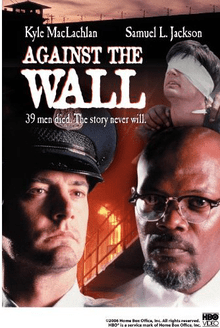
The year is 1971 and Malcolm Smith (Kyle MacLachlan) has just started working as a prison guard at Attica Correctional Facility. Even though his father (Harry Dean Stanton) was a prison guard, Malcolm does not fit in with the other guards at Attica. Malcolm is younger than them and is disgusted by the inhumane treatment of the prisoners. If not for his wife (Anne Heche) and the child that they are expecting, Malcolm would just quit but he needs the money. He fears that he is going to eventually turn into just another sadistic guard.
When a prison riot breaks out, Malcolm is one of the guards taken hostage. While the psychotic Chaka (Clarence Williams III) wants to kill all of the guards, Jamaal X (Samuel L. Jackson) realizes that killing the hostages will sacrifice what little leverage that prisoners have. If the guards are killed, Jamaal X reasons, the state police will have no reason not to storm the prison and violently restore order. Over the course of the four-day riot, Jamaal and Malcolm become unlikely friends and allies but it turns out that, even with the guards being held hostage, the government has no interest in negotiating with the prisoners.
This moving, thought-provoking, and well-acted docudrama originally aired on HBO and it won John Frankenheimer a well-deserved Emmy. Samuel L. Jackson is powerful as Jamaal X and this is one of the few times that Kyle MacLachlan got to play a thoroughly normal person with no dark secrets or weird quirks. Malcolm Smith is just a regular everyman who finds himself in the middle of a history-making event.
For fans of Twin Peaks, Against the Wall features three alumni of the show. Kyle MacLachlan, of course, starred as Dale Cooper while Clarence Williams III appeared in one episode as Roger Hardy. Finally, Harry Dean Stanton, a longtime favorite of David Lynch, appeared in Twin Peaks: Fire Walk With Me.
This is where Twin Peaks starts to go into uncharted territory.
“Masked Ball”, directed by Duwayne Dunham, marks the first full episode after the closure of the Palmer case. We begin in the best way possible – a long motorcycle ride out of Twin Peaks with James Hurley (James Marshall). He’s moving on, and the audience is brought along for the ride.
At the precinct, Sheriff Truman (Michael Ontkean) and Special Agent Dale Cooper (Kyle McLachlan) speak with Betty Briggs (Charlotte Stewart) over the disappearance of Major Briggs (Don Davis). Apparently, Betty seems to be aware of the Major’s disappearances, and goes on to state that it happens from time to time. It’s a strange angle to this new story arc. When Betty leaves, Cooper whispers to Truman that the light he saw was a powerful force in the woods. Strange things are always at work at Twin Peaks, it seems.
Hawk (Michael Horse) and Andy (Harry Goaz) come in with a package with a gift from Dougie Milford (Tony Jay, Shere Khan from Disney’s Animated version of The Jungle Book). Dougie is getting married, something that happens as often as the return of the salmon, according to Hawk. A wedding seems an interesting change of pace, considering we’ve had two funerals over the course of the show so far.
A call comes in from Gordon Cole (David Lynch) to offer his support to Cooper. Due to his actions across the border at One Eyed Jacks, he’s now under investigation by the FBI. Gordon asks if everything Cooper is accused of is true, to which Cooper denies it. To help investigate the drug angle with the Renaults in Twin Peaks, Cole states they’re sending in Dennis Bryson (David Duchovny, just a few years before The X-Files).
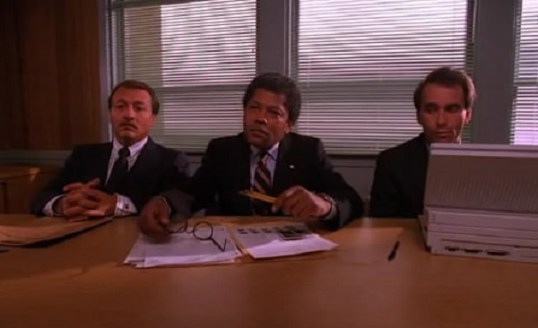
Cooper meets with Roger Hardy (Clarence Williams III, The General’s Daughter). and two other personnel. Talk about time travel. On the table is one of the first Apple laptops ever made in 1989, weighing in at about 16 pounds. When asked about what he wants to bring to the defense, Cooper admits he has no defense. Yes, he did travel outside of his jurisdiction to One Eyed Jacks, but overall, he’s “innocent of any wrongdoings”. This statement causes Hardy to go “off the record” and have the computer shut down.
“Dale, there’s a right way and a wrong way to do this.” Hardy starts, asserting that an individual of the Bureau should be able to stand up for themselves. Cooper speaks of the magic of Twin Peaks. The life in the trees and animals, and the elements that have amazed him so far. Unfortunately, this doesn’t really help his case. Hardy keeps the suspension in effect and it’ll be up to the D.E.A. And the Canadians to decide his fate. Cooper rises and takes one last look at his badge and pistol before leaving as Citizen Cooper. I liked that they ended with the badge and pistol. The audience has to wonder what he’s looking at for a moment before revealing it.
The next scene has us in High School, with Nadine (Wendy Robie) bounding down the stairs and running into Donna (Lara Flynn Boyle). On greeting Donna, Donna asks if she’s seen James. Nadine states she hasn’t. I suppose James didn’t tell anyone he was leaving. She asks Donna if she happens to still be going out with Mike Nelson (Gary Hershberger). Nadine feels that she and Mike have some great chemistry going on, though Mike doesn’t seem quite in on this knowledge, given the cold shoulder he gives her in the hallway.
“What about Ed?”Donna asks. If she’s with Ed (Everett McGill), how should she be with Mike? Nadine has a plan. Ed’s at home, Mike’s at school, she’ll find a way to manage it, and Ed’s old enough to be her father, she adds. I enjoyed that scene. Any comedic scene with Wendy Robie in this show, I’m for it.
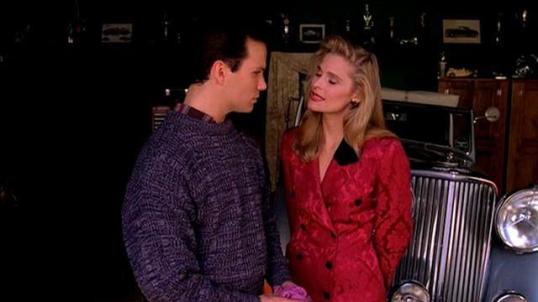
Meanwhile, James makes a pit stop at a local bar, where he finds a young blonde dressed in red. Over beers, she mentions she has a Jaguar that needs fixing. James has just the skill set for that sort of thing. She introduces herself as Evelyn Marsh, and he plays the jukebox, perhaps wondering what he’s getting himself into. First Laura, then Donna, then Maddy, then Donna, now this? Goodness.
Back at the precinct, Dick Tremayne (Ian Buchanan, Panic Room, One Life to Live) brings little Nicky by. Dick explains to Andy that they’re going out for a malted and wanted to bring Lucy (Kimmy Robertson) along. Since both men are vying for Lucy’s affections, treating Nicky well seemed like it would work out in either man’s favor. Andy states that Lucy is at the Great Northern, helping with the Milford wedding, which reminds Dick that Dougie’s getting married again. It’s like an annual event, this wedding. When Dick moves to change their plans, Nicky becomes upset. Andy chimes in, saying that he’d love to come along for the malted. Reluctantly, Dick has him come along.
Here comes one of my favorite scenes, back to back. In Truman’s office, Truman asks Cooper what they should do if they can’t clear him. Cooper’s answer to this is that the Giant told him that the path is formed by laying one stone at a time, meaning they’d have to cross that bridge when they get to it. Cooper asks both men of the White Lodge that Briggs spoke of. Hawk, who’s also in the room, states that the White Lodge is another world. The White Lodge is where the spirits reside, and that there’s also a Black Lodge. The Black Lodge carries the shadow selves of each person, and everyone has to pass through that at some point in their lives. They refer this as The Dweller on the Threshold, and if you fail to pass through, your soul will be annihilated. Sounds pleasant, no?
The intercom rings, letting everyone in the room know that Agent Dennis Bryson has arrived. As one of the finest minds in the D.E.A., he should be able to get right to the bottom of the drug issues in Twin Peaks.
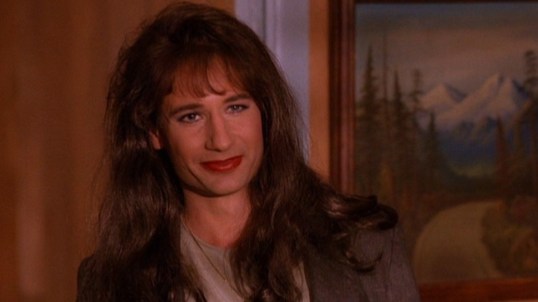
So, in walks Dennis, who is a woman now. Duchovny, along with Wendy Robie later on, pretty much steal this episode from everyone else.
“It’s a long story…” she starts, “but I prefer Denise if you don’t mind.” The magic of this scene is that it takes just a finger snap for both Cooper and Truman to adjust to this. Hawk might need a little time, but after that heartbeat, everyone’s accepting and is down to business. Denise says she’ll look into things and will get back to everyone, since both she and Cooper are staying at the Great Northern.
We’re at the High School weight room. It’s leg day, and Mike is on the leg press. Nadine sits at an adjacent leg press machine, but not before putting the pin in the maximum weight allowed. She holds his gaze as she pushes the set with ease. Mike asks her what she wants, but she suggests that he’s a little forward. The wrestling coach (Ron Taylor) catches sight of the weight and offers Nadine a position on the wrestling team, much to Mike’s surprise.
Truman is home, and Josie is in bed. It’s morning. Holding each other, Truman asks her to tell the truth about what she’s been keeping secret. She reveals that she worked for a man in Hong Kong named Thomas Eckhardt, who took her off the streets and taught her about business. After that, she met her husband Andrew. When Truman inquires about Mr. Lee, she explains that Lee worked for Eckhardt, who still feels he has a claim to Josie. Josie believes that Eckhardt is who killed her husband, but I’m wondering if she’s not being truthful. Wasn’t it brought to light that Hank Jennings (Chris Mulkey) was involved in Andrew’s murder. Truman accepts this and all is well, for now. I don’t normally enjoy the Josie / Truman scenes, but I’ll admit that this was nice.
At the RR diner, Roger Hardy is having some of the pie there, of which he’s heard great things. Hank and Ernie Niles (James Booth) steps into the room. With great pleasure, Norma (Peggy Lipton) informs Ernie that her mom has left him, which he doesn’t take too well. Hank reassures him that it will allow him to concentrate more on the work at hand.
Meanwhile, Nicky is given his malted, with Andy and Dick at his side. Nicky blows the whipped cream into Dick’s face, and spins Andy’s chair, causing him to fall to the floor. Neither man is faring well with Little Nicky, and by the end of the scene, I’m shocked they haven’t held him down and checked his scalp for triple 6’s.
At Evelyn Marsh’s garage, James is doing the repair work on the Jaguar. She states that her husband, Jeffrey, loves the car and that he’s currently away on business. Jeffrey has to have the most beautiful toys, according to Evelyn. This causes James to have a mini speech about his motorcycle and how it’s more important about where it can take him. As a rider, I can easily relate to nighttime rides to nowhere. It’s a great feeling. Evelyn offers a room for him while he’s fixing the car, leaving him to wonder where all of this is going.
I should also note that the actress who plays Evelyn, Annette McCarthy, bears a wild resemblance to Priscilla Barnes from Three’s Company (an old show from the late 70’s). It’s rather odd.
Back at the Great Northern, Ben Horne (Richard Beymer) is watching old videos of the establishment when Hank walks in. Ben is haggard, scruffy looking and is upset that Catherine Martell (Piper Laurie) has gotten over on him. Ben talks about rearranging the furniture in such a way where it’s aesthetically pleasing to the owner – basically Feng Shui. Hank informs Ben that he’s no longer working for him and that ownership of One Eyed Jack’s has changed. Ben deduces that it’s now Jean Renault (Michael Parks) who owns the establishment. Ben goes back to watching his videos, making finger puppets for his amusement.
In his room, Cooper receives a tape from Windom Earle. On the tape, Windom goes on to say that he and Cooper will cross paths, and eventually, “the King must die.”
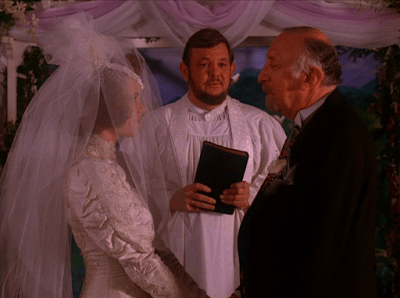
We’re at Dougie’s wedding. When the priest asks if there’s anyone who objects, Mayor Dwayne Milford (Dougie’s Brother) chimes in. “She after his money.” He barks, but Truman pulls him to the side. Dougie comforts his bride to be (Robyn Lively) and they continue on.
In his room, Cooper receives a call from Denise, who asks to meet him at the wedding. Cooper takes a brief moment to make a tape for Diane to tell her about what happened Denise.
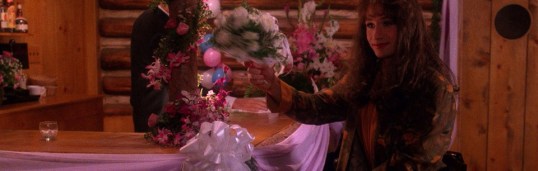
Cooper finds Denise comfortably sitting at the bar, waving the bridal bouquet. “Unfair advantage”, she says, smiling. “How many of those girls were Varsity wide receivers.” Denise explains that cocaine was found in Cooper’s car, but it does appear to be a frame up. Dwayne watches on as the bride and groom share a piece of cake, and states that his brother’s pretty much a “trout on a hook” when it comes to women. Pete takes the comment in stride, which has me wondering if he was thinking of Catherine at that moment.
Cooper asks Denise what happened to her. Denise explains she was working on a bust where the drug dealer in question “would only sell to transvestites”, so she played the part, found it relaxing, and just kept with it. “It’s not something you exactly plan on.”, She adds.
Dale meets the bride and groom, and Truman chuckles over it. According to him, Dwayne and Dougie have had this wedding fight every year. More partying continues and Cooper shares a dance with Audrey (Sherilyn Fenn), while Andy & Denise are also enjoying themselves on the dance floor. Overall, it was a fun scene, peppering some comedy throughout.
Josie and Catherine come to an agreement that has Josie working for Catherine hand and foot. When Josie leaves the room, Andrew (Dan O’Herlihy, Halloween III: Season of the Witch) steps in and says that everything’s going according to plan. What’s he doing among the living?!
Overall, for a post Palmer Case episode, I thought it did well.Both Duchovny, Robie and the wedding scenes were standouts here. Where it’s all going, I’m not sure I can say. I’m on deck for tomorrow’s episode. We’ll find out then.


 Harry Mitchell (Roy Scheider) is a businessman who has money, a beautiful wife named Barbara (Ann-Margaret), a sexy mistress named Cini (Kelly Preston), and a shitload of trouble. He is approached by Alan Raimey (John Glover) and informed that there is a sex tape of him and his mistress. Alan demands $105,000 to destroy the tape. When Harry refuses to pay, Alan and his partners (Clarence Williams III and Robert Trebor) show up with a new tape, this one framing Harry for the murder of Cini. They also make a new demand: $105,000 a year or else they will release the tape. Can Harry beat Alan at his own game without harming his wife’s political ambitions?
 1930s. New York City. For years, Stephanie St. Clair (Cicely Tyson) has been the benevolent queen of the Harlem underworld, running a successful numbers game and protecting her community from outsiders. However, psychotic crime boss Dutch Schultz (Tim Roth) is determined to move into Harlem and take over the rackets for himself. With the weary support of Lucky Luciano (Andy Garcia), Schultz thinks that he is unstoppable but he did not count on the intervention of Bumpy Johnson (Laurence Fishburne). Just paroled from Sing Sing, Bumpy is determined to do whatever has to be done to keep Schultz out of Harlem.
 The year is 1971 and Malcolm Smith (Kyle MacLachlan) has just started working as a prison guard at Attica Correctional Facility. Even though his father (Harry Dean Stanton) was a prison guard, Malcolm does not fit in with the other guards at Attica. Malcolm is younger than them and is disgusted by the inhumane treatment of the prisoners. If not for his wife (Anne Heche) and the child that they are expecting, Malcolm would just quit but he needs the money. He fears that he is going to eventually turn into just another sadistic guard.


 Through the Shattered Lens