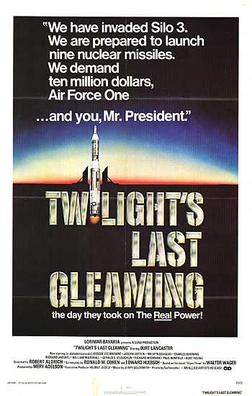
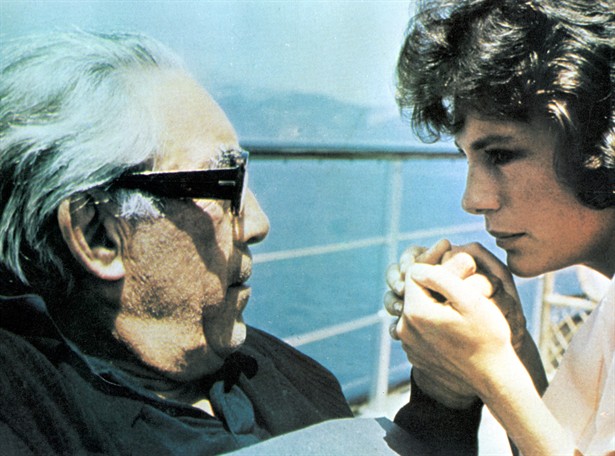
A Movie A Day #235: Twilight’s Last Gleaming (1977, directed by Robert Aldrich)


In Montana, four men have infiltrated and taken over a top-secret ICBM complex.  Three of the men, Hoxey (William Smith), Garvas (Burt Young), and Powell (Paul Winfield) are considered to be common criminals but their leader is something much different.  Until he was court-martialed and sentenced to a military prison, Lawrence Dell (Burt Lancaster) was a respected Air Force general.  He even designed the complex that he has now taken over.  Dell calls the White House and makes his demands known: he wants ten million dollars and for the President (Charles Durning) to go on television and read the contents of top secret dossier, one that reveals the real reason behind the war in Vietnam.  Dell also demands that the President surrender himself so that he can be used as a human shield while Dell and his men make their escape.
Until Dell made his demands known, the President did not even know of the dossier’s existence.  His cabinet (made up of distinguished and venerable character actors like Joseph Cotten and Melvyn Douglas) did and some of them are willing to sacrifice the President to keep that information from getting out.

Robert Aldrich specialized in insightful genre films and Twilight’s Last Gleaming is a typical example: aggressive, violent, sometimes crass, and unexpectedly intelligent.  At two hours and 30 minutes, Twilight’s Last Gleaming is overlong and Aldrich’s frequent use of split screens is sometimes distracting but Twilight’s Last Gleaming is still a thought-provoking film.  The large cast does a good job, with Lancaster and Durning as clear stand-outs.  I also liked Richard Widmark as a general with his own agenda and, of course, any movie that features Joseph Cotten is good in my book!  Best of all, Twilight’s Last Gleaming‘s theory about the reason why America stayed in Vietnam is entirely credible.

The Vietnam angle may be one of the reasons why Twilight’s Last Gleaming was one of the biggest flops of Aldrich’s career.  In 1977, audiences had a choice of thrilling to Star Wars, falling in love with Annie Hall, or watching a two and a half hour history lesson about Vietnam.  Not surprisingly, a nation that yearned for escape did just that and Twilight’s Last Gleaming flopped in America but found success in Europe.  Box office success or not, Twilight’s Last Gleaming is an intelligent political thriller that is ripe for rediscovery.

A Movie A Day #167: Stick (1985, directed by Burt Reynolds)


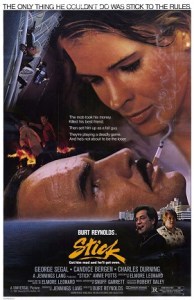
Stick (Burt Reynolds) is a veteran car thief who has just gotten out of prison.  No sooner has Stick arrived home in Florida then he accompanies his friend, Rainy (Jose Perez), on a drug deal that goes bad.  When Rainy is killed, Stick goes into hiding.  He manages to get a stable job, working as a chauffeur for an eccentric millionaire (George Segal).  He gets a new girlfriend (Candice Bergen) and starts to bond with his teenage daughter (Tricia Leigh Fisher).  Stick wants to go straight but, before he can, he knows that he has to confront the men who murdered Rainy.

Stick starts out strong.  The first half of the film finds Burt, who was often as underrated as a director as he was as an actor, in pure Sharky’s Machine mode, mixing the steamy Florida atmosphere with quirky character comedy and hardboiled action.  Adapting his own novel, Elmore Leonard wrote the screenplay and Stick seems like a classic Leonard hero, a criminal with his own moral code.  

But then Stick falls apart during the second half and it becomes obvious why both Reynolds and Leonard often cited this film as being one of the biggest disappointments of their careers.  Universal Studios disliked Burt’s first cut of the film and brought in a second screenwriter, who beefed up the action scenes and added the subplot with Stick’s teenage daughter.  Reynolds reshot the second half of the movie, no longer playing Stick as a tough criminal but instead as another variation on the Bandit.  The end result is a very disjointed movie, with Burt looking bored.

It does not help that the movie’s main villain is played by Charles Durning, who wears an orange fright wig and several Hawaiian shirts.  Durning was an actor who gave many great performances but never was he as miscast as when he played a drug dealer in Stick.

A Movie A Day #141: Breakheart Pass (1975, directed by Tom Gries)


California.  The 1870s.  Sheriff Pearce (Ben Johnson) boards a train with his prisoner, an alleged outlaw named John Deakin (Charles Bronson).  The train is mostly full of soldiers, under the command of Major Claremont (Ed Lauter), who are on their way to Fort Humboldt.  The fort has suffered a diphtheria epidemic and the soldiers are supposedly transporting medical supplies.

However, it’s not just soldiers on the train.  There’s also Gov. Fairchild (Richard Crenna) of Nevada, his fiancée (Jill Ireland), the Reverend Peabody (Bill McKinney), and a conductor named O’Brien (Charles Durning).  As the train continues on its journey, it becomes obvious that all is not as it seems.  People start to disappear.  A man is thrown from the train.  Two cars full of soldiers are separated from the train and plunge over a cliff.  There is also more to Deakin than anyone first realized and soon, he is the only person who can bring the murderers to justice.

In both real life and the movies, Charles Bronson was the epitome of a tough guy, so it’s always interesting to see him playing a more cerebral character than usual.  There are some exciting and surprisingly brutal action scenes, including a scene where Bronson fights a cook (played by former professional boxer Archie Moore) on top of the speeding train, but Breakheart Pass is more of a murder mystery than a typical action film.  If Louis L’Amour and Agatha Christie had collaborated on a story, the end result would be much like Breakheart Pass.  Bronson spends as much time investigating as he does swinging his fists or shooting a gun.  It’s not a typical Bronson role but he does a good job, showing that he could think as convincingly as he could kill.  Acting opposite some of the best character actors around in the 70s, Bronson more than holds his own.

Apparently, back in 1975, audiences were not interesting in watching Bronson think so Breakheart Pass was a disappointment at the box office and it is still not as well known as Bronson’s other films.  However, even if you’re not already a fan of the great Bronson, Breakheart Pass is worth discovering.

Film Review: The Hindenburg (dir by Robert Wise)


80 years ago, on May 6th, 1937, the Hindenburg, a German airship, exploded in the air over New Jersey.  The disaster was not only covered live by radio reporter Herbert Morrison (whose cry of “Oh the humanity!” continues to be parodied to this day) but it was also one of the first disasters to be recorded on film.  Looking at the footage of the Hindenburg exploding into flame and sinking to the ground, a mere skeleton of what it once was, it’s hard to believe that only 36 people died in the disaster.  The majority of those who died were crew members, most of whom lost their lives while helping passengers off of the airship.  (Fortunately, the Hindenburg was close enough to the ground that many of the passengers were able to escape by simply jumping.)

Not surprisingly, there was a lot of speculation about what led to the Hindenburg (which has successfully completed 63 flights before the disaster) exploding.  The most commonly accepted explanation was that it was simply an act of God, the result of either lightning or improperly stored helium.  Apparently, there was no official evidence found to suggest that sabotage was involved but, even back in 1937, people loved conspiracy theories.

And really, it’s not totally implausible to think that the Hindenburg was sabotaged.  The Hindenburg was making its first trans-Atlantic flight and it was viewed as being a symbol of Nazi Germany.  One of the ship’s passengers, Captain Ernest Lehman, was coming to the U.S. in order to lobby Congress to give Germany helium for their airships.  With Hitler regularly bragging about the superiority of German industry, the theory was that an anti-Nazi crewman or passengers planted a bomb on the Hindenburg.  Since no individual or group ever stepped forward to claim responsibility, the theory continues that the saboteur must have perished in the disaster.

At the very least, that’s the theory put forward by a film that I watched earlier today, the 1975 disaster movie, The Hindenburg.

A mix of historical speculation and disaster film melodrama, The Hindenburg stars George C. Scott as Col. Franz Ritter, a veteran of the German air force who is assigned to travel on the Hindenburg and protect it from saboteurs.  Ritter is a Nazi but, the film argues, he’s a reluctant and disillusioned Nazi.  Just a few weeks before the launch of the airship, his teenage son was killed while vandalizing a synagogue.  Ritter is a patriot who no longer recognizes his country and George C. Scott actually does a pretty good job portraying him.  (You do have to wonder why a seasoned veteran of the German air force would have a gruff, slightly mid-Atlantic accent but oh well.  It’s a 70s disaster film.  These things happen.)

Ritter is assigned to work with Martin Vogel (Roy Thinnes), a member of the Gestapo who is working undercover as the Hindenburg’s photographer.  Tt soon becomes obvious that he is as much a fanatic as Ritter is reluctant.  Vogel is a sadist, convinced that every Jewish passenger is secretly a saboteur.  Thinnes is chilling in the role.  What makes him especially frightening is not just his prejudice but his casual assumption that everyone feels the same way that he does.

And yet, as good as Scott and Thinnes are, the rest of the cast is rather disappointing.  The Hindenburg features a large ensemble of actors, all playing characters who are dealing with their own privates dramas while hoping not to burn to death during the final 15 minutes of the film.  Unfortunately, even by the standards of a typical 70s disaster film, the passengers are thinly drawn.  I liked Burgess Meredith and Rene Auberjonois as two con artists but that was mostly because Meredith and Auberjonois are so charming that they’re fun to watch even if they don’t have anything to do.  Anne Bancroft has one or two good scenes as a German baroness and Robert Clary does well as a vaudeville performer who comes under suspicion because of his anti-Nazi leanings.  Otherwise, the passengers are forgettable.  Whether they die in the inferno and manage to make it to the ground, your main reaction will probably be to look at them and say, “Who was that again?”

Anyway, despite all of Ritter and Vogel’s sleuthing, it’s not much of mystery because it’s pretty easy to figure out that the saboteur is a crewman named Boerth (William Atherton).  Having seen Real GeniusDie Hard and the original Ghostbusters, I found it odd to see William Atherton playing a sympathetic character.  Atherton did okay in the role but his attempt at a German accent mostly served to remind me that absolutely no one else in the film was trying to sound German.

Anyway, the main problem with The Hindenburg is that it takes forever for the airship to actually explode.  The film tries to create some suspense over whether Ritter will keep the bomb from exploding but we already know that he’s not going to.  (Let’s be honest.  If you didn’t already know about the Hindenburg disaster, you probably wouldn’t be watching the movie in the first place.)  The film probably would have worked better if it had started with the Hindenburg exploding and then had an investigator working backwards, trying to figure out who the saboteur was.

However, the scenes of the explosion almost make up for everything that came before.  When that bomb goes off, the entire film suddenly switches to black-and-white.  That may sound like a cheap or even sensationalistic trick but it actually works quite well.  It also allows the scenes of passengers and crewmen trying to escape to be seamlessly integrated with actual footage of the Hindenburg bursting into flame and crashing to the ground.  The real-life footage is still shocking, especially if you’re scared of fire.  Watching the real-life inferno, I was again shocked to realize that only 36 people died in the disaster.

In the end, The Hindenburg is flawed but watchable.  George C. Scott was always at his most watchable when playing a character disappointed with humanity and the real-life footage of the Hindenburg disaster is morbidly fascinating.

Oh, the humanity indeed!

A Movie A Day #7: Sharky’s Machine (1981, directed by Burt Reynolds)


220px-sharkys_machine_ver3After a drug bust goes wrong, Atlanta police detective Tom Sharky (Burt Reynolds, who also directed) is transferred from narcotics to the vice squad, the least desirable assignment in the Atlanta police department.  Despite all of his honors and commendations, Sharky finds himself reduced to busting hookers with Papa (Brian Keith) and Arch (Bernie Casey).  But then Sharky discovers evidence of a prostitution ring being run by Victor D’Anton (Vittorio Gassman), one that services the wealthiest and most powerful men in Georgia.

Working with Papa, Arch, and a burned-out bugging expert named Nosh (Richard Libertini), Sharky begins a surveillance of Domino (Rachel Ward), one of Victor’s girls.  As the days turns into weeks, Sharky falls in love with Domino, who doesn’t even know that she’s being watched.  Sharky also discovers that Domino is sleeping with Hotckins (Earl Holliman), who is about to be elected governor of Georgia.  At the same time, a heroin-addicted assassin named Billy Score (Henry Silva) is assassinating anyone who could reveal Victor’s crimes.

There are two great sequences in Sharky’s Machine.  One is the opening credits scene, in which a bearded Burt Reynolds walks through the roughest parts of Atlanta while Randy Crawford sings Street Life.  This scene lets everyone know from the start that this is not another Burt Reynolds good ol’ boy comedy.  The other is a cat-and-mouse chase through an Atlanta skyscraper, as Sharky and his partners try to track down Billy Score, who is so doped up on painkillers that he barely flinches whenever he’s shot.  Billy Score is one of the most frightening movie villains of all time, seemingly indestructible and capable of moving like a ghost.

henry-silvaWith the exception of maybe Deliverance, Sharky’s Machine is Burt Reynolds’s darkest movie.  There are moments of humor and appearances by the usual members of the Burt Reynolds stock company, like John Fiedler and Charles Durning.  But overall, this is one dark movie.   Likable characters die.  Sharky cries and loses two fingers when they are graphically chopped off by the bad guys.  A woman’s face is literally blown off.  Even when Sharky starts to talk about his childhood, a sentimental moment the occurred in almost every Burt Reynolds film, Domino tells him that she doesn’t care.

In other words, this ain’t The Cannonball Run.

Burt Reynolds’s first cut of Sharky’s Machine reportedly ran for 140 minutes.  Twenty minutes were cut before it was released into theaters and, as a result, Sharky’s Machine sometimes seems to be rough around the edges.  (One important supporting character is killed off-screen and if you don’t pay close attention to the dialogue, you might never know what happened to him.)  Still, this violent film noir, which Reynolds once called “Dirty Harry in Atlanta,” is one of Burt’s best.

sharky-machine

When McQueen Met Ibsen: An Enemy of The People (1978, directed by George Schaefer)


What happened when famed action star Steve McQueen met playwright Henrik Ibsen?

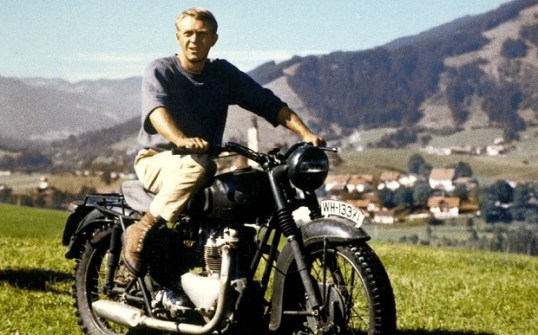
Here’s Steve McQueen in The Great Escape:

Steve McQueen In The Great Escape

This is Steve McQueen in Bullitt:

Steve McQueen in Bullitt

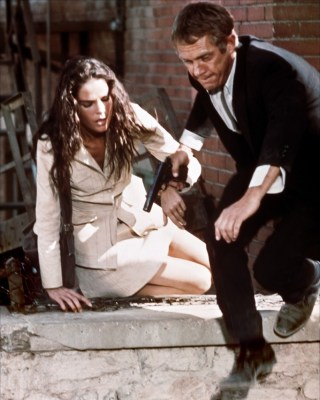
Here’s Steve McQueen with his future wife, Ali MacGraw, in The Getaway:

Steve McQueen in The Getaway

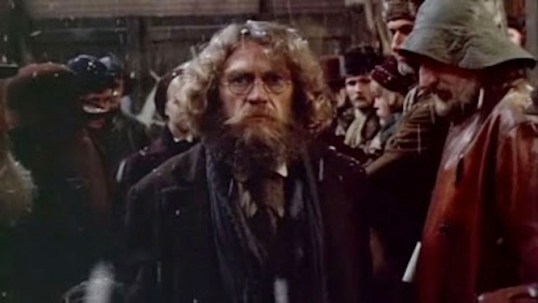
And finally, here’s Steve McQueen starring in An Enemy of the People:

Steve McQueen in Enemy of the People

In the four years between appearing in the Oscar-nominated The Towering Inferno and starring in An Enemy of the People, McQueen notoriously turned down several high-profile projects.  He turned down the lead role in Sorcerer because director William Friedkin would not write a role for MacGraw.  He turned down the lead role in Steven Spielberg’s Close Encounters of The Third Kind because he felt that he would not be able to cry on cue.  (When Spielberg offered to take out the crying scene, McQueen replied that it was the best scene in the script.)  Francis Ford Coppola could not afford his salary and McQueen missed out on the chance to play Capt. Willard in Apocalypse Now, a role he would have been perfect for.

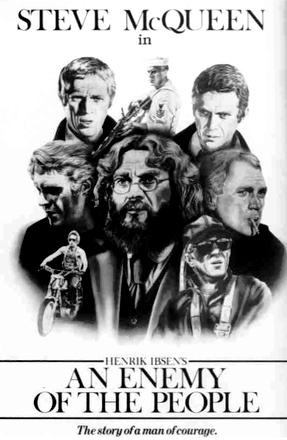
AnEnemyOfThePeople_posterInstead, after a four years absence, McQueen returned to the screen in one of the least expected films of his career.  Based on Arthur Miller’s adaptation of Henrik Ibsen’s original play, An Enemy of the People featured McQueen playing Dr. Thomas Stockmann, a scientist who discovers that his town’s local spring has been polluted by a tannery.  When Stockmann reveals his findings, the town turns against him and his family.  Stockmann has to decide whether to give into pressure from the town or to stay true to his principles.
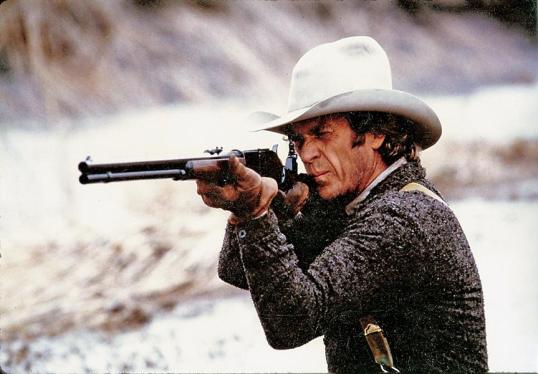
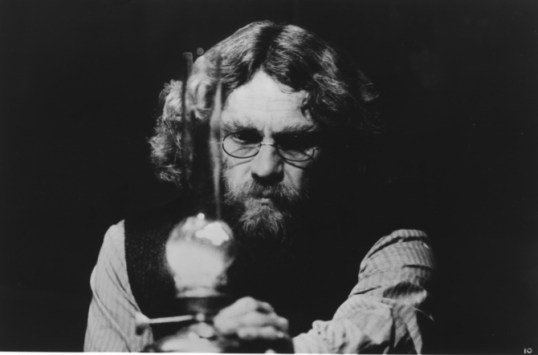
As a star who was best known for playing stoic men of action, Steve McQueen was the last actor that anyone expected to appear in a film based on an Ibsen play.  McQueen also insisted on playing the role with a heavy beard and a stocky build, making him virtually unrecognizable on-screen.  Warner Bros. had no idea how to advertise An Enemy of The People so they didn’t.  After a year of sitting on the shelf, An Enemy of the People was given a limited run in a few college towns.  Many critics assumed that McQueen deliberately made an uncommercial movie just to get out of his contract with Warner Bros but, according to both Ali MacGraw and Marshall Terrill’s Steve McQueen: An American Rebel, McQueen was actually very enthusiastic about making An Enemy of the People and extremely disappointed when it was not a success.  After the film failed to find an audience, Steve McQueen returned to appearing in action films and westerns.

Steve McQueen in Tom Horn (1980)

Steve McQueen in Tom Horn (1980)

I recently saw An Enemy of the People on TCM and I thought it was slow and didactic.  (It did not help that An Enemy of the People is Ibsen’s weakest play.)  Especially in the beginning, there are a few scenes where McQueen struggles to hold his ground against co-stars Charles Durning and Richard Dysart, both of whom had far more theatrical experience.  But McQueen gets better as the film goes on and proves that his deceptively casual approach can still be effective even when he is playing an intellectual who chooses to make his point with his words instead of his fists.  He does a good job handling Ibsen’s notoriously wordy speeches.  By the end of the movie, the idea of Steve McQueen in an Ibsen play no longer seems strange at all.

After An Enemy of the People, McQueen would only make two more movies before dying of cancer at the age of 50.  Based on his performance as Dr. Stockmann, I believe that if McQueen had not died, he would have aged into being a great actor, in much the same way as Clint Eastwood.  It’s unfortunate that McQueen never got that chance.

bfi-00o-4ni

Lisa Reviews an Oscar Winner: The Sting (dir by George Roy Hill)


Earlier tonight, as a part of their 31 Days of Oscar, TCM aired The Sting, the film that the Academy selected as being the best of 1973.  I just finished watching it and what can I say?  Based on what I’ve seen of the competition (and there were a lot of great films released in 1973), I would not necessarily have picked The Sting for best picture.  However, the movie is still fantastic fun.

The Sting reunited the director (George Roy Hill) and the stars (Robert Redford and Paul Newman) of Butch Cassidy and the Sundance Kid and told yet another story of likable criminals living in the past.  However, whereas Butch Cassidy largely satirized the conventions of the traditional Hollywood western, The Sting is feels like a loving homage to the films of 1930s, a combination of a gritty, low-budget gangster film and a big budget musical extravaganza.  The musical comparison may sound strange at first, especially considering that nobody in The Sting randomly breaks out into song.  However, the musical score (which is famously dominated by Scott Joplin’s The Entertainer) is ultimately as much of a character as the roles played by Redford, Newman, and Robert Shaw.  And, for that matter, the film’s “let-pull-off-a-con” plot feels like an illegal version of “let’s-put-on-a-show.”

The film takes place in the 1936 of the cultural imagination, a world dominated by flashy criminals and snappy dialogue.  When con artists Johnny Hooker (Robert Redford) and Luther Coleman (Robert Earl Jones) inadvertently steal money from a gangster named Lonnegan (Robert Shaw), Lonnegan has Luther murdered.  Fleeing for his life, Hooker goes to Chicago where he teams up with Luther’s former partner, veteran con man Henry Gondorff (Paul Newman).  Gondorff used to be one of the great con artists but he is now living in self-imposed obscurity, spending most of his time drinking and trying to avoid the FBI.  Hooker wants to get revenge on Lonnegan by pulling an elaborate con on him.  When Gondorff asks Hooker why, Hooker explains that he can either con Lonnegan or he can kill him and he doesn’t know enough about killing.

The rest of the film deals with Hooker and Gondorff’s plan to con Lonnegan out of a half million dollars.  It’s all very elaborate and complicated and a bit confusing if you don’t pay close enough attention and if you’re ADHD like me.  But it’s also a lot of fun and terrifically entertaining and that’s the important thing.  The Sting is one of those films that shows just how much you can accomplish through the smart use of movie star charisma.  Redford and Newman have such great chemistry and are so much fun to watch that it really doesn’t matter whether or not you always understand what they’re actually doing.

It also helps that, in the great 70s tradition, they’re taking down stuffy establishment types.  Lonnegan may be a gangster but he’s also a highly respected and very wealthy gangster.  When Newman interrupts a poker game, Lonnegan glares at him and tells him that he’ll have to put on a tie before he’s allowed to play.  Lonnegan may operate outside the law but, in many ways, he is the establishment and who doesn’t enjoy seeing the establishment taken down a notch?

As entertaining as The Sting may be and as influential as it undoubtedly is (Steven Soderbergh’s Ocean films may be a lot more pretentious — which makes sense considering that Soderbergh is one of the most pretentious directors in film history — but they all owe a clear debt to The Sting), it still feels like an unlikely best picture winner.  Consider, for instance, that The Sting not only defeated American Graffiti and The Exorcist but Ingmar Bergman’s Cries and Whispers as well.  On top of that, when you consider some of the films that were released in 1973 and not nominated — Mean Streets, Badlands, The Candy Snatchers, Day of the Jackal, Don’t Look Now, Jesus Christ Superstar, and The Long Goodbye — it’s debatable whether The Sting should have been nominated at all.  That’s not a criticism of The Sting as much as it’s an acknowledgement that 1973 was a very good year in film.

So, maybe The Sting didn’t deserve its Oscar.  But it’s still a wonderfully entertaining film.  And just try to get that music out of your head!

Embracing the Melodrama #30: The Greek Tycoon (dir by J. Lee Thompson)


Theo and Liz: A Love Story

Theo and Liz: A Love Story

“The characters in this film are fictitious and any resemblance to persons living or dead is purely coincidental”. — Completely And Totally False Disclaimer From The Greek Tycoon (1978)

In order to appreciate a film like 1978’s The Greek Tycoon, it helps to be a history nerd like me.

If you are, then you probably know that, 5 years after her husband was assassinated in Dallas, former first lady Jacqueline Kennedy remarried.  Her new husband was Aristotle Onassis, a Greek shipping magnate who was 23 years older than her and who had an unsavory reputation.  Onassis was one of the world’s richest men and was known for both his extravagant life style and for being a ruthless operator.  Depending on which books you read, Onassis is portrayed as either being either one of the world’s greatest villains (and, in fact, there’s a whole school of conspiracy theorists who believed that Onassis was somehow involved in John Kennedy’s assassination) or just a casually amoral rich man who treated his new wife like his latest trophy.  Either way, he was not the sort of person who Americans expected to become the second husband of a widowed first lady.

Of course, the Greek Tycoon is not about Aristotle and Jackie Onassis.  It’s about another Greek shipping magnate with a ruthless reputation who shocks the world by marrying the widow of a martyred President.  And, if you stick with the film all the way through the end credits, you’ll even see a disclaimer to prove it!

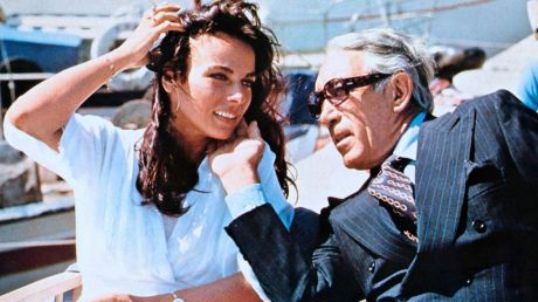
Anthony Quinn plays Theo Tomasis.  When we first meet him, he’s content to spend his time making crooked business deals and attending parties on a seemingly endless collection of white yachts.  He is grooming his son (Edward Albert) to take over the family business.  He loves both his wife Simi (Camilla Sparv) and his mistress (Marilu Tolo).  In fact, the only problem he has in his life is his business rival, Spyros (Raf Vallone, who played another Greek tycoon in The Other Side of Midnight).  Spyros happens to be Theo’s brother.  But other than that, Theo is content to spend all of his time dancing and breaking plates because, as the film reminds us every chance that it gets, he’s Greek.

However, things change for Theo when he meets Liz Cassidy (Jacqueline Bisset), the wife of young and charismatic Senator James Cassidy (James Franciscus).  Within minutes of meeting her, Theo is hitting on her but Liz loves her husband.  However, Sen. Cassidy soon becomes President Cassidy and this, of course, leads to Cassidy being assassinated while he and Liz are strolling down the beach.

Liz is soon married to the freshly divorced Theo and proving herself to be far more strong-willed than anyone realized.  Despite the anger and efforts of both Theo’s son and the dead President’s brother (Robin Clarke), Liz and Theo’s love endures and soon, they are such a glamorous and famous couple that its surprising that nobody ever suggests making a movie about them.

The Greek Tycoon is a big mess of a movie but it’s enjoyable if you know what inspired it.  (Of course, if you’re not into history and you don’t know anything about Aristotle and Jackie then you’ll probably find The Greek Tycoon to be one of the most boring movies ever made.)  To be honest, the story is never important in a film like this.  Instead, you watch for the clothes and the sets and they’re all properly glamorous in a 1970s sort of way.  Finally, you can watch this movie for Anthony Qunn’s unapologetically over-the-top performance as Theo.  I don’t know if you could necessarily say that Quinn gave a good performance here but, watching the film, it certainly does look like he was having fun.

The_Greek_Tycoon_36374_Medium

44 Days of Paranoia #39: The Fury (dir by Brian DePalma)


For our latest entry in the 44 Days of Paranoia, let’s take a look at one of the silliest films ever made, Brian DePalma’s 1978 horror/thriller hybrid The Fury.

The Fury opens on a beach in Israel.  CIA veteran Peter (Kirk Douglas, who grimaces up a storm) is hanging out with his teenage son Robin (Andrew Stevens) and his friend and colleague Ben Childress (John Cassavetes).  Two things quickly become apparent.

First off, Robin has psychic powers.  We know this because Peter is obsessed with protecting him from being captured by a shadowy government agency that wants to use his power as a weapon.

And secondly, Ben is evil.  We know that Ben’s evil because he’s played by John Cassavetes.  As one of the first truly independent filmmakers, Cassavetes would often raise the money to make his fiercely individualistic films by playing villains in bad B-movies, like this one.

Ben, in fact, is so evil that he’s arranged for terrorists to attack the beach.  After Peter is apparently killed in a ludicrously violent gunfight, Ben takes off with Robin.

However, Peter is not dead!  Somehow, despite the fact that both the beach and the ocean were pretty much blown up with him on it, Peter survived and now, he’s looking for his son.  Peter makes his way to Chicago where he calls up his girlfriend, Hester (Carrie Snodgress), and says things like, “I want your body, baby.”

Hester, meanwhile, works at the Paragon Clinic, which is run by Dr. James McKeever (Charles Durning) who, himself, is secretly working for Ben.  The Paragon Clinic is a front to try to discover other teenage psychics and to turn them into weapons as well.  The newest patient is Gillian (Amy Irving), a teenage girl who might be able to help Peter track down his son.

Of course, what Peter doesn’t take into account is that, in his absence, Robin has turned into a power-mad sociopath who spends his time doing things like killing tourists at amusing parks…

Wow, that’s a lot of plot, isn’t it?  And, with all of that, I haven’t even gotten into what happens during the second half of the film!

The Fury is an enjoyably silly film, an awkward attempt to combine DePalma’s previous film, Carrie, with a paranoia-fueled political thriller.  There’s a certain charm to a film that takes itself so seriously and yet, at the same time, manages to be totally over-the-top and ludicrous.

For example, just consider the performances of the high-powered cast and the fact that none of the actors appear to be acting in the same film.  Playing a character who is a bit of a hero by default (because, seriously, how stupid did he have to be to not realize that Ben was evil to begin with), Kirk Douglas grimaces so manfully that Peter’s stupidity almost starts to feel like a satiric comment on hyper-masculinity.  John Cassavetes, on the other hand, is so disdainful of the film that he actually rolls his eyes while delivering some of his more melodramatic lines.  Meanwhile, Carrie Snodgress is forced to say things like, “Here comes the Pony Express!” and Charles Durning brings the full weight of his talent to deliver lines like, “If you’re having your monthlies, I don’t want you near the patient.”

And finally, there’s Amy Irving.  In DePalma’s Carrie, Irving played Sue Snell, the sole survivor of a psychic rampage.  In The Fury, Irving gets to play the psychic and she gives such a dramatic and emotional performance that you almost get the idea that she was trying to challenge Sissy Spacek.  “This is how you play a psychic, Sissy!” she seems to be shouting.  Of course, the big difference is that Carrie was actually a good film whereas The Fury is a bad film that happens to be watchable.

Finally, no review of The Fury is complete without talking about Brian DePalma’s direction.  To put it lightly, Brian DePalma directs the Hell out of The Fury and the effect is something like what an episode of Agents of SHIELD would look like if directed by Martin Scorsese.  The entire film is a collection of tracking shots, zoom lenses, and sweeping overhead shots with the camera only stopping long enough to linger over scenes of violence and spilled blood.  In perhaps the film’s most ludicrous scene, Amy Irving runs away from the clinic in slow motion while the orchestral score plays out on the soundtrack.  We get close-ups of Irving’s face and close-ups of the faces of her pursuers.  One character gets shot multiple times but we don’t hear the gunshots.  Instead, we only hear the music and watch as the character overacts and dies in slow motion.  It’s almost as if DePalma was trying to win a bet by achieving the most counter-productive use of slow motion in film history.

Ultimately, The Fury is so thoroughly silly and over-the-top that it simply has to be seen.

Other Entries In The 44 Days of Paranoia 

  1. Clonus
  2. Executive Action
  3. Winter Kills
  4. Interview With The Assassin
  5. The Trial of Lee Harvey Oswald
  6. JFK
  7. Beyond The Doors
  8. Three Days of the Condor
  9. They Saved Hitler’s Brain
  10. The Intruder
  11. Police, Adjective
  12. Burn After Reading
  13. Quiz Show
  14. Flying Blind
  15. God Told Me To
  16. Wag the Dog
  17. Cheaters
  18. Scream and Scream Again
  19. Capricorn One
  20. Seven Days In May
  21. Broken City
  22. Suddenly
  23. Pickup on South Street
  24. The Informer
  25. Chinatown
  26. Compliance
  27. The Lives of Others
  28. The Departed
  29. A Face In The Crowd
  30. Nixon
  31. The Hunger Games: Catching Fire
  32. The Purge
  33. The Stepford Wives
  34. Saboteur
  35. A Dark Truth
  36. The Fugitive
  37. The Day of Jackal
  38. Z

Film Review: Dog Day Afternoon (dir. by Sidney Lumet)


Last night, as part of my continuing mission to see every film ever nominated for best picture, I watched Sidney Lumet’s Dog Day AfternoonDog Day Afternoon was released in 1975.  Though nominated for best picture, it lost to One Flew Over the Cuckoo’s Nest.

In Dog Day Afternoon, Al Pacino plays Sonny, a nervous Viet Nam vet who, along with the dim-witted and possibly crazy Sal (John Cazale), attempts to rob a bank.  Unfortunately for him, Sonny doesn’t really know what he’s doing and literally within minutes of him first drawing his gun, the bank is surrounded by cops.  The robbery quickly descends into a hostage situation.  As Pacino negotiates with a NYC police detective (Charles Durning), a crowd of onlookers gathers around the bank and starts to cheer with every defiant word that comes out of Sonny’s mouth.  Sonny discovers he likes his new-found fame.  In the film’s most famous scene, he stands outside the bank and leads the crowd in a chant of “Attica!  Attica!”   Eventually, Durning learns that Pacino’s motive for robbing the bank was to steal enough money for his suicidal lover (Chris Sarandon) to get a sex change operation.  However, now that the robbery has failed, Pacino has a new plan.  He demands a flight out of the country.  Meanwhile, the hostages inside the bank start to form their own odd kinship with the two bank robbers and Durning finds himself being challenged by the F.B.I., who have a much more drastic plan for how to end the situation.

Dog Day Afternoon is a remarkable film, a dark comedy of desperation and human nature that, by the final scene, reaches a certain tragic grandeur.  Sidney Lumet (who made his directorial debut in 1957 with 12 Angry Men and whose most recent film, Before the Devil Knows Your Dead, was released 51 years later) was one of the most important (if underrated) filmmakers of the 1970s and he proves it here.  From the opening montage of New York City looking so wonderfully sordid at the height of the grindhouse era to Pacino’s bumbling initial attempt to rob the bank to the film’s violent and abrupt conclusion, Lumet captures your attention and, much like Al Pacino in this movie, he holds it hostage until the movie ends. 

Dog Day Afternoon is probably one of the best acted films that I’ve ever seen.  This is one of those films where every role — regardless of how large or how small — fills like an actual human being.  By the end of the film, you feel as if you know the bank managers and the tellers almost as well as you know Pacino, Durning, Sarandon, and Cazale.  Pacino is simply amazing here, giving a nervous, jittery performance as a character who manages to be both selfish and selfless at the same time.  Durning, meanwhile, is hilarious as the frazzled detective who finds himself steadily overwhelmed by the circus around him.  Much as you can’t help but root for Pacino no matter how self-absorbed he might act, you can’t help but sympathize with During, even if he is a member of the establishment.  As Pacino’s transsexual lover, Sarandon plays his role with a fragile dignity that prevents the role from becoming a stereotype.  However, for me, the film truly belongs to John Cazale who is both scary and oddly child-like as Sal.  As seen below, Cazale improvised one of the best lines in the movie when he replies to Pacino’s question regarding to which country Cazale wants to make his escape.

Now, this is going to be difficult for me to admit but, as thrilling as it was to watch Pacino shout, “Attica!  Attica!,” I honestly had no idea why that phrase was the one he chose to use to work up the crowd.  In fact, if I had written this review right after seeing (or while watching) the film last night, I probably would have doubled embarrassed myself by claiming that Pacino was shouting “Ateka.”  However, for once, I decided to be a responsible reviewer and I actually did some research as opposed to just going with my first conclusion.  So, as a result of this film, I can now say that I know about the Attica Prison Riots of 1971.

But what’s truly significant about that “Attica” chant is that it’s the only part of this film (beyond a few fashion choices) that feels dated.  As I watched the movie, it was easy for me to imagine myself jumping on twitter and seeing “#Attica” as a trending topic.  We’ve all seen the famous “Attica!” scene in countless compilations but what’s often forgotten is how that sequence ends.  When Pacino, obviously a bit star struck by all the attention, goes outside and start chanting a second time, he is suddenly tackled from behind by one of the bystanders who has decided to play hero.  And as Pacino goes down to the ground, the same crowd that was previously cheering him now cheers for the new object of their affection.  If nothing else, Dog Day Afternoon showed why sometimes we all need to escape to Wyoming.