My weekend was full of sleep, coughing and just vegetating in front of my bedroom tv as I tried to get better from my bout of the cold and flu. For some reason or another AMC channel decided to hold a mini-marathon of David Fincher’s classic neo-noir thriller, Seven, and I must say that I probably saw all three straight showings before sleep finally took over. It surely made for some very unusual, drug-induced dreams.
I’ve always seen Seven as Fincher at his most exploitative best. If there was ever a modern grindhouse exploitation film of the past twenty years I would have to consider Seven as one of them. From start to finish the film just felt grimy and made one feel dirty just for having seen it. Take away all the gloss and veneer afforded Fincher due to modern film technology and techniques this film was grindhouse to its core. No better scene exemplifies and solidifies Seven as a grindhouse exploitation film than it’s shocking, nihilistic ending which bucked traditional Hollywood happy ending (or at least and ambiguous one).
It’s been made famous due to the powerful performances from the three leads who dominate the scene. It is almost played off like a stage play with some gorgeous camera work from cinematographer Darius Khondji switching from Morgan Freeman to Kevin Spacey to Brad Pitt with mathematical precision as the scene unfolds through very strong dialogue by screenwriter Andrew Kevin Walker.
The performances shown by Spacey is both chilling and otherworldly as the sociopathic John Doe urging Pitt’s Det. Mills to become wrath and punish him for his sin of envy. Looking helpless and desperate is Freeman’s Det. Somerset trying to talk some sense and decency to the rapidly unraveling Mills who has just learned that what is inside the box he’s been screaming for is his wife’s head.
The fact that the unfolded and ended the way it did honors the grindhouse sensibilities of past exploitation films where the good guys never always win and even when they do it’s at a very heavy cost to the victor. This climactic ending to Seven is so nihilistic that when the film was first shown in 1995 many walked out grumbling at such a dark and heavy ending. Where was the Hollywood happy ending everyone was so used to. There was no cavalry charging last second to save the day. No deus ex machina intervening to show that Mill’s wife was still alive. No, Fincher and crew knew they had something special in their hands and went full tilt to see it through.
It’s no wonder I still consider Seven to be David Fincher’s best film to date.
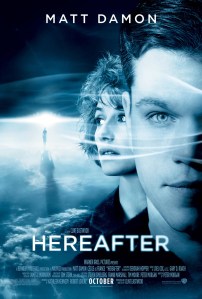
Hereafter is a very serious film about a very serious topic, death. Following three separate but ultimately connected stories, the film attempts to explore death and the question of what happens after death from three different angles — intellectually, emotionally, and spiritually. I really wanted Hereafter to be a great film. So did the film’s makers, which is precisely why Hereafter fails.
The intellectual consideration of death is represented by the character of Marie (Cecile De France), a French journalist who, at the start of the film, drowns in a tsunami and is, for a few minutes, clinically dead. Before she is eventually revived, she has a classic near-death experience: the bright light, the people waiting to greet her, the whole deal. After this experience, Marie is compelled to investigate whether or not there truly is such a thing as an afterlife. As she does so, Marie finds herself shunned by her resolutely secular friends and grows increasingly distant from her skeptical (and rather condescending) boyfriend.
The emotional response to death is represented in the story of twin brothers, Marcus and Jason (played by Frankie and George McLaren). The two boys live in London with their drug-addicted mother and share a strong (and, to be honest, kinda creepy) bond. Jason, while simply trying to return home with some drugs for his detoxing mother, is roughed up by some bullies and ends up running out into the middle of the street. Naturally, since this is a movie, Jason is hit by a truck as soon as he steps off the curb. Jason is killed and Marcus is taken away by social services and put into a foster home. Marcus continues to carry Jason’s cap with him and soon starts tracking down local English psychics in an attempt to talk to his brother again.
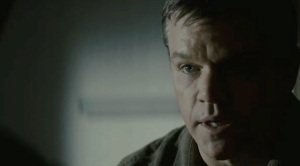
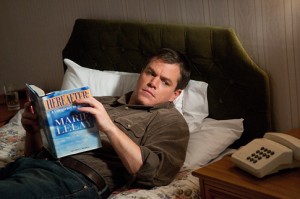
Finally, the spiritual aspect is detailed in the film’s most interesting story. This story features Matt Damon as George Lonegan, a psychic who can speak with the dead. After years of being a minor celebrity, George burned out and went into a self-imposed exile. He now works at a factory while his brother (Jay Mohr, who looks incredibly puffy in this movie) keeps trying to find ways to convince George to get back into the business of talking to dead for fun and profit. After George reluctantly gives a reading to Richard Kind, he finds himself being dragged back into his old life.
A lot of viewers and critics have compared Hereafter to Alejandro González Iñárritu’s 2006 masterpiece, Babel. Both films follow three separate but connecting stories and both films are concerned with the theme of death and how it connects us all. As well, Babel featured Brad Pitt in a serious role and Hereafter features Matt Damon. The main difference, however, is that Babel was a great film but Hereafter is basically an uneven mess.
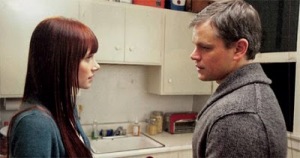
Whereas Babel featured three strong stories, Hereafter features 1 compelling story (that would be Damon’s) which is compelling solely because Matt Damon is a talented enough actor that he can apparently perform miracles. He’s probably about as likable as he’s ever been in the role of George but he also wisely plays the role as being just a little bit off. Even though the film makes the mistake of never really going into the details of just what exactly caused George to give up being a psychic, Damon is so good in the role that you’re willing to take him at his word that he had a good reason. Probably the highlight of the film (and one of the few sections to really inspire any sort of real emotional response) is an extended sequence where Damon befriends and the manages to alienate an insecure, single woman played by Bryce Dallas Howard. Damon and Howard have a scene that involves eating while blind-folded that manages to be both powerfully erotic and wonderfully romantic at the same time. If the entire film had been about them, Hereafter would have been a much better movie.
Unfortunately, we’ve got to slog through two other stories.
Cecile La France gives an excellent performance as Marie and the opening tsunami scene is truly terrifying. For someone like me, who cannot swim and risks having a panic attack if she even stands near the deep end of a swimming pool, the tsunami scene was almost impossible to watch. I had to put my hands in front of my eyes and watch the scene through my fingers. However, once she drowns, Marie sees a vision of the afterlife that — as a harbinger of things to come — is rather dull. I mean, with everything that can supposedly be done in movies today, the best that Hereafter can give us is a bland white light. Once Marie returns to Paris and starts her investigation, La France remains a sympathetic presence and the film actually does a pretty good job of showing just how condescending most supposedly “liberal” men are whenever a woman starts to stray from the established orthodoxy. But, unfortunately, her story is just never that interesting. Marie decides to write a book about the afterlife. As a writer myself, I have to say that there is nothing more boring than watching someone else write.
As for Marcus, I was shocked just how little I cared about him or his attempts to contact his brother. I come from a very close family and I have a very strong bond with all three of my sisters and, among them, I am notorious for crying at any movie that deals with that sort of sibling bonding. Yet I sat through the saga of Marcus and Jason without shedding a tear and I felt terrible about it. I really wanted to cry. I really wanted to have some sort of emotional response to the story but I just never believed it. I hate to say this but honestly, a lot of this was due to the fact that the McLaren twins are such bad actors. Director Clint Eastwood has said that he specifically cast them because they weren’t professional actors and therefore, they wouldn’t introduce any false “sentimentality” into the mix. But dammit, it was a sentimental story. Sentiment is not necessarily a bad thing and just because something is sentimental, that doesn’t make it false.
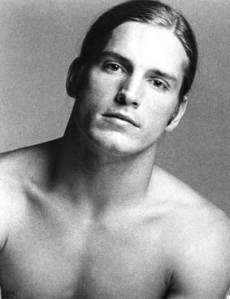
So, what exactly went wrong with Hereafter? The film opens strongly with a terrifying tsunami and the final 30 minutes are also undeniably touching (if also a bit contrived). It’s everything that happens in between those two points that ruins Hereafter. Director Eastwood, obviously looking to avoid that dreaded curse of being sentimental, keeps the whole film very low-key and realistic. Other than the opening tsunami, there are no big wow moments but to be honest, isn’t that what movies are for? If you’re going to make a movie that specifically shuns the wow moment, you better have something compelling (a perfect script or an entire cast giving a compelling performance as opposed to just a handful of them) to take its place. Hereafter doesn’t and, as a result, the movie drags. This, honestly, has got to be one of the slowest, most boring movies I’ve ever seen. If director Eastwood’s westerns and actions films can all be seen as homages to Sergio Leone and Don Siegel, I think Hereafter must be an homage to some of Andy Warhol’s intentionally dull films. Whereas Warhol, at the very least, gave us Joe Dallesandro to look at, Eastwood gives us Jay Mohr. It’s not a fair trade.
I don’t know how much of Hereafter should be blamed on Eastwood and how much should be blamed on the script written by Peter Morgan. Here’s a quote from Morgan that appeared in The Hollywood Reporter:
“It’s quite spiritual material, and quite romantic, too. It’s the sort of piece that’s not easy to describe and in the hands of different filmmakers could end up as wildly different films. Quite unlike some of my other material, which I think there were only certain ways that you could shoot it. It’s really not just another boring Hollywood movie with the same old boring Hollywood actors, although I see the point that the public and sick of paying $10.00 to see a movie with same old faces and the same gramma of story telling.”
And to that, all I can say is “Shut up, Peter Morgan!”
This is not spiritual material as much as it’s just a bunch of vaguely New Age platitudes being delivered by a mainstream screenwriter who apparently doesn’t have the guts to come down either firmly for or against an afterlife. This is the type of feel-good BS that leads to thousands of people every year giving up their life savings to some fraud who claims he can deliver messages from beyond. Morgan’s script goes out of its way not to actually define the afterlife. Is it heaven or is it Hell? Is there a God? Do the worthy go to Heaven? Are souls saved? Or are they just ghosts who are waiting for us to be willing to let them go? These are all questions that would have been considered by a good film but Hereafter doesn’t consider them. Oh, don’t get me wrong. It pretends to bring them up but only so the movie can shrug and go, “I guess nobody knows.” And to that I say, either take a position or don’t expect everyone else to pay money just to listen to you duck the question because you’re too scared of alienating mainstream critics or audiences.
(Myself, I do believe that those who love us are always with us in some way even if I don’t believe in a literal afterlife. And while I know that answer might seem vague, you should also consider that I’m not the one spending millions of dollars to make a movie celebrating that vagueness.)
Morgan’s script also make its a point to incorporate real-life events into his contrived narrative. As a result, the London Subway bombings and the Thailand Tsunami are both used as convenient plot points in much the same way that The Curious Case of Benjamin Button used Hurricane Katrina. I felt it was ghoulish when Button did it and, the more I think about it, it’s equally ghoulish in Hereafter. It’s hard not to feel that the film’s saying, “Too bad all those real people died but what’s important is how these events impacted the lives of a bunch of fictional characters.”
Hereafter’s main problem is that it simply tries too hard to be great. You get the feeling that every scene and line has been calculated to make you go, “Wow, what genius!” As a result, even the scenes that work still somehow feel very dishonest. The end result is a very insincere film about some very sincere concerns.
Have I mentioned how much I loved The Girl With The Dragon Tattoo? Have I suggested that the late Stieg Larsson, in the Millenium Trilogy, did for Europe what James Ellroy did for America with the American Tabloid trilogy? Have I gone into the fact I think Noomi Rapace’s performance as Lisbeth in both the original film and its sequels will probably be remembered as one of the greatest film performances of all time? Have I explained that I think, even beyond Rapace’s performance, Lisbeth herself is one of the best characters in the history of film? For that matter, have I talked about the hours that I’ve spent standing with my back to a mirror and looking over my shoulder and debating on which shoulder-blade a dragon would look most appropriate? Personally, I think my left shoulder-blade is a bit nicer than my right but last night, my friend Jeff was telling me that…
Sorry, I’m losing focus here. Okay, getting the ADD under control. Anyway, the point of the matter is that I love The Girl With The Dragon Tattoo.
That’s why I feel a lot of caution about the upcoming, David Fincher-helmed remake. First off, quite frankly, I really don’t see what can be improved on the original films. It’s not as if the original film version of the Girl With The Dragon Tattoo failed to do justice to the book (if anything, the book fails to do justice to the film that eventually made from it). I suppose a remake would give people who can’t handle subtitles the chance to see the story but honestly, who cares about those losers? Speaking of the story, the rumors I hear seem to indicate that this remake is going to be an “Americanized” version of The Girl With The Dragon Tattoo, which I’m not really sure can be done as the entire book is basically meant to act as a metaphor for Swedish society. Of course, it is possible that the remake is going to be set in Sweden as well but if that’s the case, what’s the point of the remake?
I know the usual argument to these concerns is that, as a director, Fincher will not allow the film to be Hollywoodized. At one point that may have been true but, judging from The Curious Case of Benjamin Button, Fincher’s got more Hollywood in him than most people want to admit. The fact that he’s also teamed up with Aaron Sorkin (an establishment figure if there ever was one) to direct a movie about Facebook doesn’t exactly fill me with confidence but I’ll hold off on judging until the Social Network actually shows up in theaters.
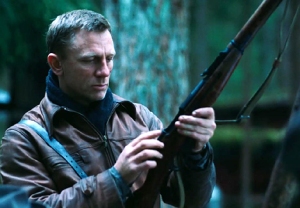
However, I am encouraged by the news (announced yesterday) that Fincher has cast Daniel Craig as the male lead, Mikael Blomkvist (or whatever his name is going to be in the Hollywood version). Craig’s name had been mentioned for the role ever since the remake was first announced but there were also reports that the role would go to Brad Pitt (who, of course, has already made 3 films with Fincher). Nothing against Brad Pitt (who I think is a truly underrated actor) but it’s hard to think of a worst choice for the role of Mikael. Mikael’s defining characteristic is just how ineffectual he is. He’s the ultimate well-meaning intellectual, the type of guy who wants to fight injustice but is to insulated from the harsh realities of life to effectively do so. (That’s why he needs Lisbeth, she represents everything he wishes he could do but can’t.) In short, Mikael is a hero by default and casting an actor like Brad Pitt would throw the entire movie off-balance.
Mikael is not a role for a star. Mikael is a role for a character actor and, James Bond aside, that’s exactly what Daniel Craig is. (That’s one reason why Craig’s Bond is dull, regardless of how good a performance Craig gives in the role.) Not only is Craig the right age, he projects just the right amount of idealistic weariness for the role. Admittedly, it helps that Craig bears a passable physical resemblance to the original Mikael, Michael Nyqvist which, if nothing else, will make it easier for fans of the original film — like me — to accept him.
(For the record, my personal choice for Mikael would have been Tim Roth.)
Of course, the question now is who will win the role of Lisbeth and why would they want it? For me, Noomi Rapace is Lisbeth. She is the girl with dragon tattoo. It’s hard to think of single mainstream actress in her 20s or early 30s who could hope to match Rapace’s performance. (Perhaps a young Angelina Jolie could have though physically, Jolie is all wrong for the part.) However, even beyond what Rapace did with the character, Lisbeth is one of the most vivid and memorable characters in recent literary history. Even without having to worry about the shadow of Rapace’s previous performance, the role is not an easy one.
Originally, rumor had it that Kristen Stewart was a lock for the role. At the risk of being burned at the stake as a heretic, I’m going to say that I think Stewart could have been an adequate (though not a great) Lisbeth except for the fact that she’s about ten years too young. (While Lisbeth is described as looking like a teenager, she also projects a worldliness of someone much older. Physical appearance can be faked but life experience can not.) Carey Mulligan, star of An Education (the best film of 2009, by the way), was another actress who was frequently mentioned.
Well, according to Entertainment Weekly, neither Stewart nor Mulligan will play Lisbeth Salander. Neither will Natalie Portman who, according to EW, was offered the role but turned it down. The offer to Portman makes sense as she’s physcially right for the role and she’s an undeniably talented actress. However, much as Pitt could never have been convincing as Mikael, Portman would have been miscast as Lisbeth. Portman may be a talented actress but she’s also a rather passive one. Even in her previous “action” roles (Leon, V For Vendetta), Portman essentially played a lost, damaged character (much like Lisbeth) who needed an older male figure to serve as her mentor (which, needless to say, is nothing like Lisbeth).
Again, according to EW, the role of Lisbeth has been narrowed down to four actresses: Rooney Mara, Lea Seydoux, Sarah Snook, and Sophie Lowe. It’s probably a good sign that none of these actresses are household names exactly. Competing with the shadow of Noomi Rapace’s Lisbeth is going to be difficult enough without also having to deal with the shadow of their own previous performances. (For instance, even if Stewart gave a brilliant performance as Lisbeth, it would still be impossible for me to get through the remake without making at least one Twilight joke.)
For me, the real question is not who is going to be cast as Libseth but if Fincher and his producers are going to give us the real Lisbeth — this would be the unapologetically lesbian Lisbeth who can only befriend Mikael once she’s sure that she doesn’t any sort of sexual attraction towards him — or if we’re going to get a more mainstream, Hollywood version of Lisbeth. Are we going to get the real Lisbeth who needs no one or are we going to get another version of what Hollywood claims to be a strong woman, one who can fight up until the final 30 minutes of the film at which point she’s suddenly rendered helpless by the demands of Mainstream Filmmaking 101.
More than anything, that will be the test that Fincher’s Girl With The Dragon Tattoo will have to pass if it wants to be anything more than an unneeded imitation of the original.
(Incidentally, the perfect Lisebth Salander would be Jena Malone. End of story.)