
“What I want and what I need are two different things, Audrey”
— Dale Cooper (Kyle MacLachlan) in Twin Peaks 1.7 “Realization Time)
In anticipation of the Showtime revival in May, Leonard, Jeff, and I have been reviewing every single episode of the original Twin Peaks! Today, I will be taking a look at the 7th episode of season 1, “Realization Time.”
Now, I have to admit that I was not originally assigned to review this episode. Much as I did with Zen, or the Skill To Catch A Killer, I literally got down on my knees and begged for the chance to review this episode. Once again, as I explained why I felt that I was predestined to write this review, I shed many tears and threatened to utilize the power of excessive whining unless I allowed to do so. Eventually, it paid off.
Why did I want to review this episode? Well, first off, it’s a strong Audrey episode and, as I discovered while writing my previous Twin Peaks review, Audrey Horne is who I would be if I was a character on Twin Peaks. She is the character to whom I most relate.
(Audrey was such a popular character during the initial run of Twin Peaks that, apparently, Mulholland Drive was originally conceived as being a spin-off in which Audrey would have gone to Hollywood and solved crimes. In other words, no Audrey, no Mulholland Drive, no polls declaring Mulholland Drive to be the best film, so far, of the 21st century.)
Secondly, this was the final episode to feature Waldo the Myna Bird and I just happen to love the way that whenever Harry Goaz, in the role of Deputy Andy, said the name “Waldo,” he would drag out each syllable so that the bird’s name became “Walllll DOE.”
Anyway, with all that in mind, let’s take a look at Realization Time!
We start with those beautiful opening credits, that mix of machinery and nature that reminds us that Twin Peaks is a David Lynch production, even if this particular episode was directed by noted cinematographer Caleb Deschanel.
(Deschanel’s wife, Mary Jo, also played Ben Horne’s unhappy wife. Interestingly enough, in the 1983 best picture nominee The Right Suff , for which Caleb Deschanel received an Oscar nomination, Mary Jo played the wife of John Glenn.)
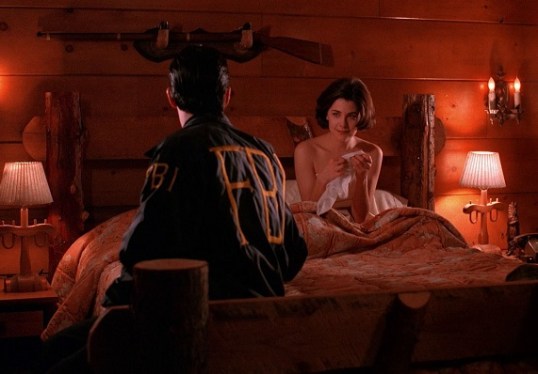
This episode opens where the last one left off. Audrey (Sherilyn Fenn) is naked in Dale Cooper’s (Kyle MacLachlan) bed and Dale is explaining that he is an agent of the FBI and, as such, he has taken an oath to uphold certain principles. He tells Audrey that she needs a friend and he says he is going to get them two malts and that she is going to tell him all of her troubles.
This is one of those scenes — and there’s a lot of them to be found in the first season of Twin Peaks — that really shouldn’t work and yet it does. Everything about it, from Cooper’s corny sincerity to the promise of two malts, serves to remind us that Twin Peaks often has more in common with an idealized 1950s than with any recognizable modern era. I think that only Kyle MacLachlan could have made Cooper’s lines come across as being sincere as opposed to condescending. Being rejected by an older man who has just found you naked in his bed is not as pleasant experience as this episode makes it appear to be. And yet, Fenn and MacLachlan both do a great job at selling this scene.
And yet, there’s one key line in this scene that I think is often overlooked. When Audrey says that she can’t tell Cooper all of her secrets, she then asks him, “Do you have any secrets?” Cooper says, “No.” However, we know that’s a lie. We know because we saw the way that Cooper smiled when Laura kissed him in his dream. We know that Cooper is not the asexual puritan that he pretends to be. When Cooper says that there’s a difference between what he wants and what he needs, we perhaps understand his meaning more than he does.
We learn one of Cooper’s secrets the next morning when he shows up at the police station and discovers Harry (Michael Ontkean) and Doc Hayward (Warren Frost) looking in on Waldo the Myna Bird. Doc Hayward explains that myna bird’s have an amazing ability to mimic the human voice but they only do it when they’re feeling playful and Waldo is definitely not in the mood. He asks Cooper if he wants to give Waldo some food. Cooper replies, “I don’t like birds,” and steps back in such a dramatic fashion that you’re left wondering what terrible bird-related misfortune befell Cooper during his youth.
(Personally, I suspect this was meant to be yet another one of the first season’s many Hitchcock references. There’s a few more in this episode, which we’ll be getting too shortly.)
Don’t feel to bad for Waldo, though. While Dale, Hayward, and Harry are watching the bird, Deputy Hawk (Michael Horse) enters with the forensic report on Jacques Renault’s cabin. There was only one exposed negative on the roll of film and it’s a picture of Waldo biting Laura Palmer’s shoulder. BAD WALDO!
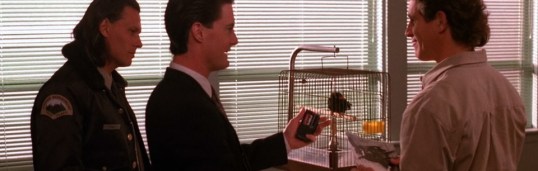
Realizing that, regardless of how much he may hate birds, Waldo is the only witness they have, Dale leaves a voice-activated tape recorder at the base of Waldo’s cage. When Waldo speaks, they’ll have it on tape. Dale also suggests heading up to Canada and investigating One-Eyed Jacks. When Harry points out that he has no legal authority in Canada, Dale says, “That’s why I was thinking it would be a good job for the Bookhouse Boys.” Yay! Vigilante justice!
Last episode, Shelly (Madchen Amick) shot Leo Johnson (Eric Da Re) and we all cheered. Well, it turns out that Leo survived. He’s hanging out in the woods, watching his house through a pair of binoculars. That’s how he sees Bobby showing up at his house and Shelly greeting him with a kiss. It’s interesting to note that, when Shelly was talking about Leo in The One-Armed Man, she lamented that she only married him because of his red corvette. However, Bobby — who seems to be destined to grow up to be another Leo — drives a black corvette. Shelly needs to stop picking her men based on their car.
While Leo sits outside with a sniper rifle, a sobbing Shelly confessed to Bobby that she shot Leo. Shelly may be upset but Bobby thinks that all this sounds like a good thing. “Leo Johnson is history!” he declares. No, Bobby, Leo is sitting outside with a sniper rifle. Fortunately, for Bobby, Leo has a police scanner with him and he hears Lucy (Kimmy Robertson) announcing that Waldo has been talking. Leo gets into his pickup truck and drives off.
At the Hayward House, Donna (Lara Flynn Boyle), James (James Marshall), and Maddy (Sheryl Lee) listen to the tape that Maddy found in Laura’s room. It turns out to be one of several tapes that Laura recorded for Dr. Jacoby (Russ Tamblyn.) On the tape, Laura wonders why it’s so easy for her to get men to like her and, for a few minutes, I was worried that we’d have to deal with another “James-Gets-Weepy” scene. Fortunately, Maddy distracts him by pointing out that there’s one empty case in Laura’s collection of tapes. The missing tape was recorded the night that Laura was killed. James deduces that Jacoby must have it and that Jacoby might also be Laura’s killer. He comes up with a plan to get Jacoby out of his office so that he and Donna can search for the tape. What if Jacoby gets a call from Laura? Everyone looks over at Maddy.
At Horne’s Department Store, Audrey attempts to convince a customer to buy a perfume that will make her smell like a forest. Since most forests smell like death, the customer really isn’t interested. She wants a perfume that makes a statement. Audrey suggests hanging the perfume around her neck. “It’s a perfume. It’s a fashion accessory. Two statements for the price of one?” “I don’t appreciate your attitude,” the customer says. If only I had a dime for every time that I’ve heard that…

Anyway, Audrey isn’t really all that concerned about making sales. She’s got an investigation to conduct! This means hiding in the manager’s office and listening while he recruits one of Audrey’s co-workers to go work at One-Eyed Jack’s as a “hospitality girl.” The manager says that the co-worker’s positive and money-hungrey attitude will take her far in life. (It’s all about attitude at Horne’s Department Store.) Later, Audrey deftly manipulates that co-worker into giving her the number to One-Eyed Jacks. Audrey’s the best.
Meanwhile, at the Double R, Hank (Chris Mulkey) is working at his new job and boring Shelly with inspiring stories about his time in jail. Little does Shelly know that, before she shot Leo, Hank beat him up. They have something in common and personally, I think they’d make a cute couple. I mean, Hank may be sleazy but he’s so damn likable.
Of course, Harry doesn’t like Hank but that’s probably just because of all the drug dealing and other assorted crimes that Hank has committed. When Cooper and Harry stop by the diner, Harry tells Hank that if he misses one meeting with his parole officer, he’ll be sent back to jail. Harry tells Cooper that people never change but Cooper is too busy appreciating a cup of black coffee to worry about Hank Jennings. Cooper tells Harry that the secret of happy living is to give yourself a random present, like a good cup of coffee.
(It’s played for laughs but again, the important word to remember is secret. Twin Peaks is all about to secrets.)

At the Hurley House, Nadine (Wendy Robie) watches the latest episode of Invitation to Love. When Big Ed (Everett McGill) enters the room, Nadine announces that she’s eating bon bons because a patent attorney rejected her silent drape runners. Ed assures her, in one of my favorite lines ever, “Nadine, there’s plenty of patent attorneys. We’re just going to have to keep looking until we find one that understands drape runners.” McGill delivers that line with just the right amount of gravitas too. If I ever lose an eye and become obsessed with drapes, I hope my man will be as understanding as Big Ed Hurley.
At the Packard Mill, Pete Martell (Jack Nance) laments to Harry that a fish he recently caught was bigger before he sent it to the taxidermist. “Once they take all the innards out,” he explains, the fish loses something, a reminder that everything that makes existence interesting (in both Twin Peaks and life itself), lies directly under the surface.
Harry’s come to see Josie (Joan Chen). He knows that she was at the Timber Falls Motel on Tuesday but he doesn’t know why. (She was spying on Ben and Catherine.) At first, Josie lies and says she was at the mill on Tuesday but eventually, she reveals her secret. She also tells Harry that she heard Catherine talking about burning down the mill. Harry swears that he won’t let that happen.
Later, that night, Cooper, looking incredibly dashing in a tuxedo, is preparing to go to One-Eyed Jacks with Harry, Hawk, and Ed. Cooper has $10,000 of the FBI’s money for them to use in the casino. “Whenever I gamble with the bureau’s money, I like a 10 to 15% return,” he says. Cooper’s a gambler? Who would have guessed, especially since Cooper claimed to have no secrets?
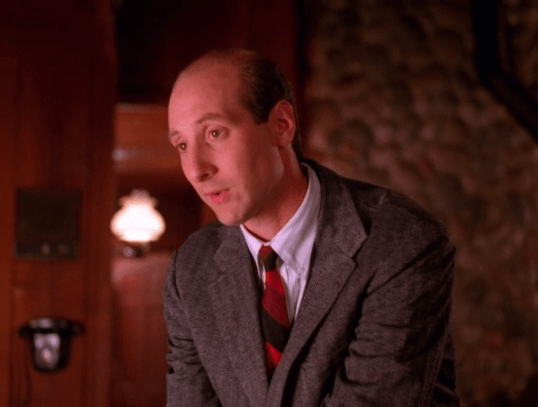
Walter Neff
Twin Peaks, like most of David Lynch’s films, borrowed a lot from classic film noir and nowhere is that more obvious than in the next scene. An insurance agent (Mark Lowenthal) had dropped in on Catherine Martell (Piper Laurie). The agent’s name is Mr. Neff, as in Walter Neff from Double Indemnity. He’s visiting because a life insurance policy has been taken out on Catherine by … Josie Packard! And, as Mr. Neff goes on to explain, it appears that Ben Horne (Richard Beymer) originally said that he would make sure that Catherine signed the papers! Apparently, thinking it was strange that Catherine would be “too busy” to appear in person to sign the policy, Mr. Neff held off on giving Josie and Ben the last page that needed to be signed. Catherine, realizing that she’s been set up, coolly says that she’ll have to look over the policy with her lawyer before signing anything. It’s a fascinating scene because both Catherine and Neff realize what’s happening but neither comes right out and says it. Apparently, this was Neff’s only appearance and that’s shame because Mark Lowenthal gives a fun, scene-stealing performance in the role.
Meanwhile, at the police station, Waldo the Myna Bird is feeling well enough to say, “Laura … Laura…” Suddenly, there’s a gunshot. Hawk, Dale, and Ed — who were busy trying on disguises in the next room — run into the conference room. Someone — and we know that had to be Leo because he was the one with the sniper rifle — has killed Waldo!
And I have to admit that I felt really bad about Waldo. The shot of Waldo’s blood dripping down on the uneaten conference room donuts is far more horrifying than you would think, based on the description. In just one and a half episodes, I had grown rather attached to Waldo. The fact that we know he was talking because he was finally feeling playful again makes his death all the more tragic. Andy, with tears in his eyes, reaffirms why he’s one of my favorite minor characters when he says, “Poor Wall-DOE!”
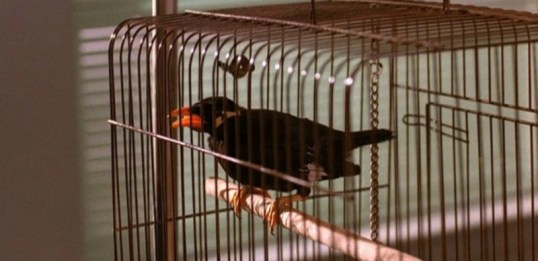
Rest in Peace, Waldo
Dale listens to the tape. As Angelo Badalamenti’s somber music plays in the background, we hear Waldo say, “Laura! Laura! Don’t go there! Hurting me! Hurting me! Stop it! Stop it! Leo, no!” As the camera cuts between Dale and Harry listening to Waldo mimicking Laura’s death, I stopped to once again marvel at the genius of Twin Peaks. This scene should have been ludicrous. Instead, I’m getting teary-eyed just writing about it.
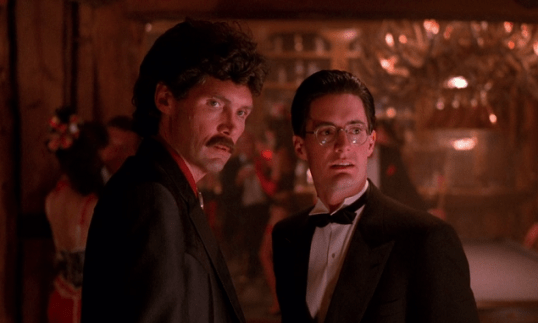
Leaving behind the unfortunate Waldo, we go to One-Eyed Jacks. Cooper and a bewigged Big Ed show up. (Cooper’s wearing a pair of glasses that look unbelievably adorable on him.) Blackie (Victoria Catlin) approaches them, which gives us a chance to witness flirtatious Cooper. On the one hand, flirtatious Cooper is specifically written to be kind of dorky. That’s just who Dale Cooper is. But, on the other hand, nothing he says is as dorky as the way Jerry and Ben Horne behaved when they visited One-Eyed Jacks in Zen, or the Skill To Catch A Killer. Cooper, at least, has the excuse of being undercover.
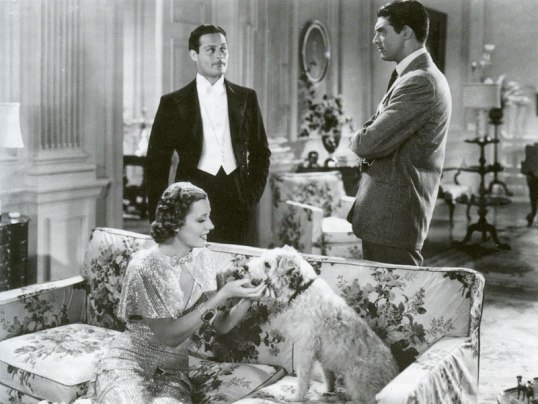
Blackie takes one look at Big Ed and announces, “You look like a cop.” Cooper smiles and says, “I’m the cop,” which leads to Blackie says that Dale looks like Cary Grant. Ironically, MacLachlan would play Cary Grant in the 2004 film, Touch of Pink.
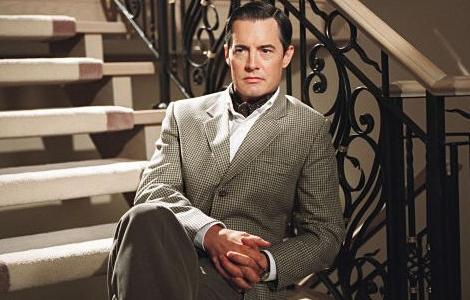
Kyle MacLachlan as Cary Grant in Touch of Pink
Meanwhile, Maddy sneaks out of the Palmer House, barely noticed by Leland (Ray Wise), who is sitting in the shadows. It’s time for Operation Freak Out Jacoby and here’s where we get this episode’s other big Hitchock reference. In order to fool Jacoby, Maddy has not only taken off her oversized glasses but she’s also put on Laura’s clothes and is now wearing a blonde wig. Now is as good a time as any to point out that Madeleine Ferguson’s name comes from Hitchcock’s Vertigo, a film that starred Kim Novak as Madeleine and Jimmy Stewart as Scottie Ferguson. In Vertigo, of course, Novak played two roles, just as Sheryl Lee does here. In Vertigo, Novak was used to trick Jimmy Stewart into believing the woman he loved was still alive. Essentially, that’s the same thing that James and Donna are planning to use Maddy to do to Jacoby.
Back at the Great Northern, Jerry (David Patrick Kelly) and Ben (Richard Beymer) are partying with the Icelandic businesspeople. (Iceland appears to be full of a lot of fun people.) Jerry is enraptured with the Icelandic people but Ben is more concerned about getting the contracts signed. It turns out that the Icelanders only want to sign the contracts if they can do it at One-Eyed Jacks. Ben agrees and then sends Jerry out of the office so that he can call Josie. Apparently, the plan is to kill Catherine in the fire that Ben hired Leo to set.

It turns out that Ben and Jerry are not the only Hornes heading to One-Eyed Jacks, Audrey has already arrived and is meeting with Blackie. As soon as Audrey enters Blackie’s office, we immediately notice all of the red curtains. That’s never a good sign. Audrey hands Blackie her resume. “Hester Prynne,” Blackie says, as she looks the resume over, “Pretty name.”
Audrey has made the mistake of claiming to have worked extensively in Canada. When Blackie started to quiz Audrey about where specifically she had worked, I yelled, “Degrassi! Say Degrassi!” (Later I realized that was foolish on my part, as Twin Peaks predates Degrassi by over a decade,) Instead, Audrey makes the mistake of mentioning an obviously fake “dude ranch,” (which I guess is where they grow dudes because I’ve never quite understood that term) and answers a question that Blackie asks about someone named Big Amos.
Big mistake. It turns out that Big Amos is a dog and Blackie read The Scarlet Letter in Canadian high school.
(That said, borrowing the name of a Nathaniel Hawthorne heroine is such an Audrey thing to do that it automatically becomes the greatest thing ever.)
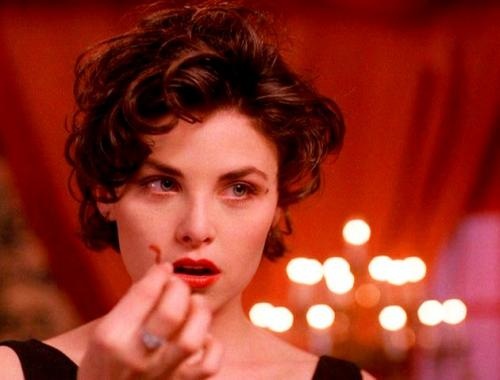
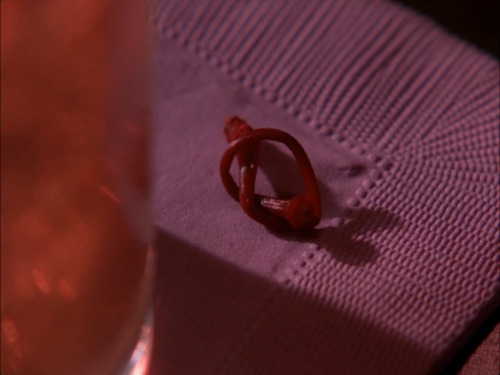
Blackie asks Audrey for one good reason not to kick her out. Fortunately, there’s a cheery nearby so that Audrey can take it, eat it, and then use her tongue to tie the stem in a knot. (Before anyone asks, despite having a very flexible tongue, I cannot do that. However, neither can Sherilyn Fenn. Apparent, she already had a pre-tied stem in her mouth when they shot the scene.) Audrey has the job, which — considering how much her father and uncle love visiting One-Eyed Jacks — has the potential to be all sorts of creepy.

Inside the casino, Dale is playing blackjack, His original Jamaican dealer goes on break and is replaced by … JACQUES RENAULT (Walter Olkewicz).
At Jacoby’s office, the good doctor (Russ Tamblyn) is watching Invitation to Love because, apparently, that’s the only show that plays on Twin Peaks television. When the phone rings, the Hawaii-obsessed Jacoby answers with a somewhat perfunctory, “Aloha.” (In my experiences, a true Hawaiian can make even the most somber “Aloha” sound like an invitation to the greatest party ever.) On the other end, Maddy pretends to be Laura. She tells Jacoby to go to his door. “There’s something waiting for you.”
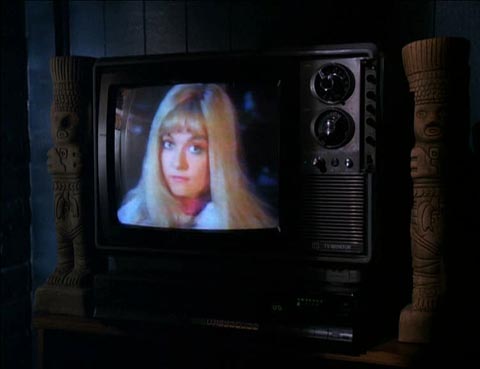
And indeed there is! A VHS tape has been left outside Jacoby’s office. The tape features Maddy (as Laura) holding that day’s newspaper. From the payphone, Maddy tells Jacoby to “Meet me at Sparkwood and 21 in ten minutes.”
(Everything in the town of Twin Peaks revolves around wood, both figuratively and literally.)
What James, Maddy, and Donna don’t realize is that they’re being followed by Bobby, who is just as shocked as Jacoby to see “Laura” apparently alive. (Now is as good a time as any to, once again, point out that Laura was named after the title character from Otto Preminger’s Laura, a film noir about a woman who is incorrectly believed to be dead.)
When Jacoby runs off to find “Laura,” James and Donna sneak into his office. Meanwhile, Bobby plants cocaine in James’s motorcycle. As for Maddy, she hangs out around the gazebo, little realizing that someone is watching her from behind the trees…
What a great episode! Tomorrow, Leonard looks at the finale of season 1!
By the way, if you want even more Lynch, be sure to check out Gary’s review of three of Lynch’s short films and Val’s look at a music video that was made for one of Lynch’s songs.
Previous Entries in The TSL’s Look At Twin Peaks:
- Twin Peaks: In the Beginning by Jedadiah Leland
- TV Review: Twin Peaks 1.1 — The Pilot (dir by David Lynch) by Lisa Marie Bowman
- TV Review: Twin Peaks 1.2 — Traces To Nowhere (directed by Duwayne Dunham) by Jedadiah Leland
- TV Review: Twin Peaks 1.3 — Zen, or the Skill To Catch A Killer (dir by David Lynch) by Lisa Marie Bowman
- TV Review: Twin Peaks 1.4 “Rest in Pain” (dir by Tina Rathbone) by Leonard Wilson
- TV Review: Twin Peaks 1.5 “The One-Armed Man” (directed by Tim Hunter) by Jedadiah Leland
- TV Review: Twin Peaks 1.6 “Cooper’s Dreams” (directed by Lesli Linka Glatter) by Lisa Marie Bowman







 Through the Shattered Lens