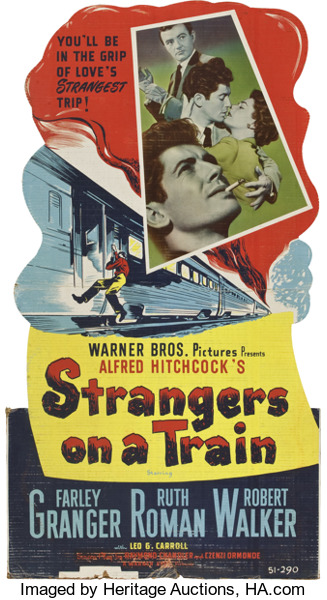
The Yin & Yang of Alfred Hitchcock’s STRANGERS ON A TRAIN (Warner Brothers 1951)


gary loggins's avatarcracked rear viewer

Alfred Hitchcock , like many great artists before and since, was in a bit of a career slump. The Master of Suspense’s previous four films (THE PARADINE CASE, ROPE, UNDER CAPRICORN, STAGE FRIGHT) were not hits with either critics or audiences, and did poorly at the box office. Then came 1951’s STRANGERS ON A TRAIN and Hitch was back on top with this devilish mélange of murder, suspense, romance, and humor, featuring a stunning star turn by Robert Walker, cast against type as a charming sociopath.

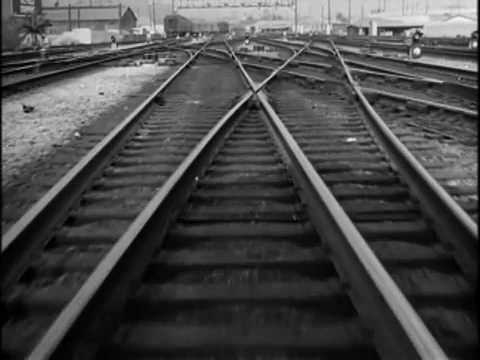
Our story opens with two pairs of shoes (one two-toned, one staid brown loafers) emerging from two separate cabs, walking separately to catch a train and their date with destiny, as we cut to two separate train tracks merging together. Hitchcock’s playing with one of his classic themes: “the double”, or more importantly, duality. Even Dimitri Tiomkin’s score highlights the differences, as a jaunty…

View original post 815 more words

Games People Play: Alfred Hitchcock’s DIAL M FOR MURDER (Warner Brothers 1954)


gary loggins's avatarcracked rear viewer

Alfred Hitchcock  wasn’t afraid to take chances. When the 3-D craze hit in the 1950’s, the innovative director jumped on the new technology to make DIAL M FOR MURDER, based on Frederick Knott’s hit play. The film is full of suspense, and contains many of The Master’s signature touches, but on the whole I consider it to be lesser Hitchcock… which is certainly better than most working in the genre, but still not up to par for Hitch.

Knott adapted his play for the screen, and keeps the tension mounting throughout. The story is set in London, and revolves around ex-tennis pro Tony Wendice, whose wife Margot is having an affair with American mystery writer Mark Halliday. Tony comes up with an elaborate plot to have her murdered by stealing a love letter Mark has written and blackmailing her, then setting up his old school acquaintance C.A. Swann, a man…

View original post 403 more words

The Covers of Alfred Hitchcock Presents


From 1955 to 1965, Alfred Hitchcock hosted a very successful television program called Alfred Hitchcock Presents.  In order to capitalize on the popularity of the show, a series of Alfred Hitchcock Presents literary anthologies were also issued.  The covers all featured Hitchcock in some sort of potentially ghastly situation.  Below are just a few of the covers from Alfred Hitchcock Presents.

(I tried to pick a favorite but I couldn’t decide between Death Can Be Beautiful and Once Upon A Dreadful Time!)

20 Shots from 20 Alfred Hitchcock Films


Happy National Hitchcock Day!

20 Shots From 20 Films

The Pleasure Garden (1925)

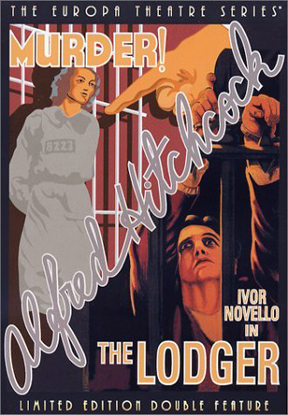
The Lodger (1927)

Blackmail (1929)

The Man Who Knew Too Much (1934)

The 39 Steps (1935)

The Lady Vanishes (1938)

Rebecca (1940)

Shadow of a Doubt (1943)

Lifeboat (1944)

Notorious (1946)

Strangers on a Train (1951)

Rear Window (1954)

The Wrong Man (1956)

Vertigo (1958)

North by Northwest (1959)

Psycho (1960)

The Birds (1963)

Topaz (1969)

Frenzy (1972)

Family Plot (1976)


Music Video of the Day: Hitchock Blonde by Laeticia de Valer (2015, dir by J. Antonio)


According to TimeandDate.com, today is Alfred Hitchcock Day!

I’m not sure why March 12th would be considered Alfred Hitchcock Day, seeing as how Alfred Hitchcock was born in August of 1899 and passed away in April of 1980.  But no matter!  It’s always a good day for Hitchcock!

So, in honor of Alfred Hitchcock Day, today’s music video of the day is Laeticia de Valer’s Hitchcock Blonde!

Enjoy!

Spy in the House of Love: Alfred Hitchcock’s NOTORIOUS (RKO 1946) — cracked rear viewer


You won’t find a more glamorous pair of spies than Cary Grant and Ingrid Bergman in Alfred Hitchcock’s NOTORIOUS… except maybe in other films that feature Cary Grant as a spy! The Master of Suspense once again goes full speed ahead in bringing this exciting espionage caper to the screen loaded with the usual “Hitchcock Touches”, and […]

via Spy in the House of Love: Alfred Hitchcock’s NOTORIOUS (RKO 1946) — cracked rear viewer

Halloween Havoc!: Alfred Hitchcock’s THE BIRDS (Universal 1963)


gary loggins's avatarcracked rear viewer

Many years ago, back in the 80’s I believe, I spent a week on Martha’s Vineyard. It was early in the morning on a gorgeous summer day, and as my friend was still crashed from the previous evening’s debauchery, I decided to walk down to the beach and catch some rays. I strolled past a particularly marshy stretch when, out of nowhere, a seagull buzzed by my head. Then another. And another. And soon there were about ten of the nasty flying rats swooping down at me, screeching and dive-bombing toward my long-haired dome (this was back when I actually had hair!). I ducked and dodged, yelling and snapping my beach towel at the airborne devils, and ran as fast as I could away from the area, scared to death one of these buzzards was going to peck my eyeballs out! It was like something straight out of Alfred Hitchcock’s 

View original post 926 more words

4 Shots From 4 Films: Special Alfred Hitchcock Edition


4 Shots From 4 Films is just what it says it is, 4 shots from 4 of our favorite films. As opposed to the reviews and recaps that we usually post, 4 Shots From 4 Films is all about letting the visuals do the talking.

This October, I am going to be using our 4 Shots From 4 Films feature to pay tribute to some of my favorite horror directors, in alphabetical order!  That’s right, we’re going from Argento to Zombie in one month!

Today’s director: the master of suspense, Alfred Hitchcock!

4 Shots From 4 Films

The Lodger (1926, dir by Alfred Hitchcock)

Psycho (1960, dir by Alfred Hitchcock)

The Birds (1963, dir by Alfred Hitchcock)

Frenzy (1972, dir by Alfred Hitchcock)

Horror Book Review: Alfred Hitchcock and The Making of Psycho by Stephen Rebello


57 years after it was first released, Alfred Hitchcock’s Psycho remains one of the most influential films ever made.

Certainly, every horror film ever released since 1960 owes a debt to Psycho.  The infamous shower scene has been duplicated so many times that I’ve lost count.  Whenever a big-name actor is unexpectedly killed during the first half of a movie, it’s because of what happened to Janet Leigh in that shower.  If not for Psycho, Drew Barrymore would have survived Scream and that shark would never have eaten Samuel L. Jackson in Deep Blue Sea.  Every giallo film that has ended with someone explaining the overly complex psychological reasons that led to the killer putting on black gloves and picking up a scalpel owes a debt to Simon Oakland’s monologue at the end of Psycho.  Psycho is so influential and popular that, decades later, A&E could broadcast a show called Bates Motel and have an instant hit.

What goes into making a classic?  That is question that is both asked and answered by Stephen Rebello’s Alfred Hitchcock and The Making of Psycho.  Starting with the real-life crimes of Ed Gein, Rebello’s book goes on to examine the writing of Robert Bloch’s famous novel and then the struggle to adapt that novel for the screen.

This book is a dream for trivia lovers.  Ever wanted to know who else was considered for the role of Marion Crane or Sam Loomis or even Norman Bates?  This is the book to look to.  Read this book and then imagine an alternate world where Psycho starred Dean Stockwell, Eva Marie Saint, and Leslie Neilsen?

(That’s right.  Leslie Neilsen was considered for the role of Sam Loomis.)

The book also confronts the controversy over who deserves credit for the shower scene, Alfred Hitchcock or Saul Bass.  And, of course, it also provides all the glorious details of how Hitchcock handled the film’s pre-release publicity.  Ignore the fact that this book was cited as being the inspiration for the rather forgettable Anthony Hopkins/Helen Mirren film, Hitchcock.  This is a fascinating read about a fascinating movie and a fascinating director.

First published in 1990 and still very much in print, Alfred Hitchcock and The Making of Psycho is a must-read for fans of film, horror, true crime, history, Alfred Hitchcock, Anthony Perkins, Janet Leigh, and Psycho.

Sweet Land of Liberty: Alfred Hitchcock’s SABOTEUR (Universal 1942)


gary loggins's avatarcracked rear viewer

The Master of Suspense puts the pedal to the metal once again in SABOTEUR, another “double chase” spy thriller that doesn’t get the attention some of Alfred Hitchcock’s other films do, but should. I’ve always enjoyed the performance of Robert Cummings as the “ordinary man caught in an extraordinary situation”; his naturally laid-back, easygoing charm makes him perfect playing Barry Kane, accused of sabotaging a wartime aircraft plant and killing his best friend in the process, who winds up on a cross-country chase alongside reluctant heroine Priscilla Lane . SABOTEUR is certainly an  important film in Hitchcock’s body of work for one important reason: it’s the director’s first film for Universal Pictures, a studio he’d have a long and profitable association with, and where he’d later create some of his finest movies.

SABOTEUR is in many respects a loose remake of Hitchcock’s THE 39 STEPS , transplanted to America and…

View original post 701 more words