Icarus File No. 24: Express to Terror (dir by Dan Curtis)


The year was 1979 and Fred Silverman, the president of NBC, had an idea.

How about a television series in which each week’s episode would depict a different group of passengers going on a trip?  The passengers would all be dealing with their own stories, some of which would be dramatic and some of which would be humorous.  With any luck, some of them might even fall in love over the course of their journey!

To keep the audience interested, the show would also feature a cast of regular characters, the crew.  Edward Andrews would play the captain, a sensible and by-the-book type.  Robert Alda played Doc, the doctor who was also a bon vivant.  Patrick Collins was the goofy purser.  Nita Talbot played Rose, the perky director of entertainment.  Michael DeLano was the bartender who always had the best advice for the passengers….

Does this sound familiar?

If you think that it sounds like Fred Silverman just ripped off The Love Boat …. well, you’re wrong.  The Love Boat took place on a boat.  Supertrain took place on a train.

At the time that Supertrain went into production, it was the most expensive television production of all time.  Before the pilot film was even shot, NBC had spent ten million dollars on the Supertrain sets.  Not only was a fake train built but two models were also constructed for the shots of the train moving through the countryside.  At the time, the assumption was that the costs would be easily covered by the money that NBC stood to make from broadcasting the 1980 Summer Olympics.  Unfortunately, Jimmy Carter decided that the U.S. would be boycotting the Olympics as a way to protest Russia’s invasion of Afghanistan.  The only thing that kept NBC from going bankrupt was that the BBC was apparently run by someone even more incompetent than Fred Silverman.  The BBC paid $25,oo per episode for the rights to air Supertrain in the UK.  Supertrain proved to be such a disaster that the BBC never actually aired the episodes that they had purchased.

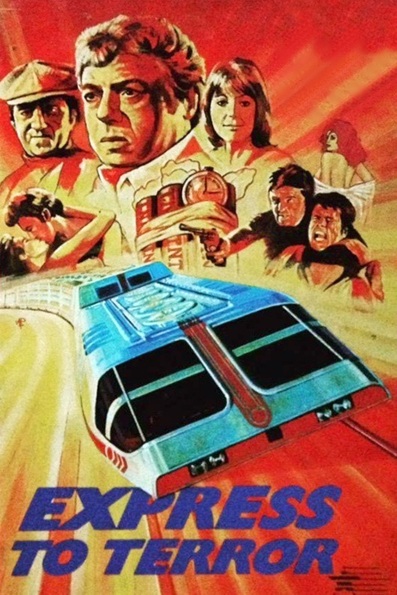
1979’s Express to Terror was the pilot to Supertrain.  (It was later released in some territories as a stand-alone film.)  Directed by horror impresario Dan Curtis (who was also brought in to produce the series), Express to Terror opens with an apparently drunk Keenan Wynn playing the role of railway baron Winfield Root.   Winfield loudly announces to a group of nervous investors that he has created ” an atom-powered steam turbine machine capable of crossing this country in 36 hours!”  A few months later, Supertrain sets off from New York to Los Angeles.

The main thing that one notices about the train is that it’s incredibly tacky.  For all the money that Winfield Root (not to mention NBC) poured into the thing, it looks awful.  The cabins are bland and also seem to be constantly shaking as the train rumbles over its tracks.  Whereas The Love Boat featured glorious shots of passengers enjoying themselves on an open-air deck, Express to Terror features a lot of shots of passengers trying to squeeze their way through narrow and crowded hallways.  There’s a disco car, which sounds like fun but actually looks like a prom being held in a locker room.  There’s a swimming pool but you can’t really lay out by it because it’s on a train.  Winfield is among the passengers and he continually refers to the train as being “Supertrain” in conversation, which just sounds dumb.  “The next person who stops Supertrain,” he announces “will be walking to L.A!”

The main drama features Steve Lawrence as Mike Post, a Hollywood agent with a gambling problem who thinks that someone on the train is trying to kill him.  Actually, the assassin is after a different Mike Post (Don Stroud) but that Mike Post is a criminal who, after entering the witness protection program, changed his name to Jack Fisk.  The criminal Post is hoping that the agent Post will be killed by mistake.  The criminal Mike Post has a girlfriend named Cindy (Char Fontane) who falls in love with the agent Mike Post.  Fred Williamson appears as a football player-turned-assassin.  George Hamilton plays a Hollywood executive.  Don Meredith is the alcoholic best friend of the agent Mike Post.  Stella Stevens is on the train as a diva.  So is Vicki Lawrence, playing a naive innocent.

Express to Terror tries to mix comedy and drama but it doesn’t really work because the “Good” Mike Post doesn’t really seem to be worth all the trouble.  Steve Lawrence gives a mind-numbingly bad performance in the role and, as a result, “Good” Mike Post really isn’t any more sympathetic than “Bad” Mike Post.  The main problem is that “Good” Mike Post comes across as being a coward and there’s only so much time that you can watch a coward act cowardly before you lose sympathy for him.  Being scared is one thing.  Being so dumb that accidentally gets your fingerprints on a knife that’s just been used to kill a man is another thing.

As for the members of the crew — the captain, the doctor, the bartender, and such, they take a back seat to the drama of the two Mike Posts.  It’s a bit odd because no one on the train — not even Winfield Root — seems to be that upset by the fact that one of their passengers is murdered while the train is going through a tunnel.  You would think that everyone would be worried about the future of Supertrain at that point.  A murder is not good for publicity but Winfield Root is oddly unconcerned about it.  I swear, light rail people are almost as heartless as bicyclists!

Of course, the worst thing about Express to Terror is that it promises terror but it doesn’t deliver.  When I see a the word “terror” in a film directed by Dan Curtis, I expect a little terror!  Other than Steve Lawrence’s overacting, there really wasn’t anything particularly terrifying about Express to Terror.

As for Supertrain, it ran for nine episodes and was promptly canceled.  Fred Silverman left NBC and spent the rest of his career as an independent producer.  Supertrain’s tracks got too close to the sun and they nearly took down a network.

Previous Icarus Files:

  1. Cloud Atlas
  2. Maximum Overdrive
  3. Glass
  4. Captive State
  5. Mother!
  6. The Man Who Killed Don Quixote
  7. Last Days
  8. Plan 9 From Outer Space
  9. The Last Movie
  10. 88
  11. The Bonfire of the Vanities
  12. Birdemic
  13. Birdemic 2: The Resurrection 
  14. Last Exit To Brooklyn
  15. Glen or Glenda
  16. The Assassination of Trotsky
  17. Che!
  18. Brewster McCloud
  19. American Traitor: The Trial of Axis Sally
  20. Tough Guys Don’t Dance
  21. Reach Me
  22. Revolution
  23. The Last Tycoon

Icarus File No. 23: The Last Tycoon (dir by Elia Kazan)


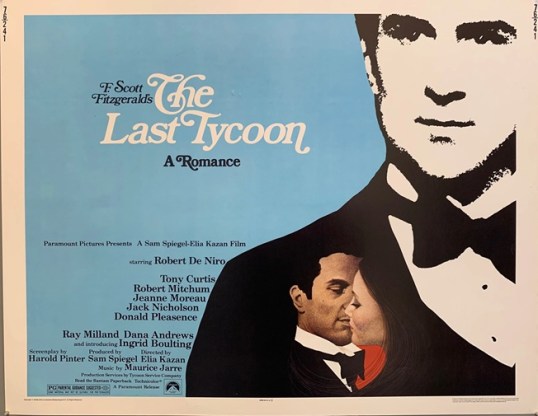
Based on the final (and unfinished) novel by F. Scott Fitzgerald, 1976’s The Last Tycoon tells the story of Monroe Stahr (Robert De Niro).

Monroe Stahr is the head of production at a film studio during the early days of Hollywood.  Stahr is an unemotional and seemingly repressed man who only shows enthusiasm when he’s talking about movies.  He may not be able to deal with real people but he instinctively knows what they want to see on the big screen.  Stahr is a genius but he’s working himself to death, ignoring his health concerns while trying to create the perfect world through film.  He’s haunted by a lost love and when he meets Kathleen Moore (Ingrid Boulting, giving a remarkably dull performance), he tries to find love with her but, naturally, he doesn’t succeed.  Meanwhile, he has to deal with his boss (Robert Mitchum), his boss’s daughter (Theresa Russell), a neurotic screenwriter (Donald Pleasence), an impotent actor (Tony Curtis), and a lowdown dirty communist labor organizer (Jack Nicholson)!  Sadly, for Stahr, McCarthyism is still a few decades away.

There’s a lot of talented people in The Last Tycoon and it’s undeniably interesting to see old school stars — like Mitchum, Curtis, Dana Andrews, Ray Milland — acting opposite a Method-driven, 30-something Robert De Niro.  This is one of those films where even the minor roles are filled with name actors.  John Carradine plays a tour guide.  Jeff Corey plays a doctor.  This is a film about Golden Age Hollywood that is full of Golden Age survivors.  It’s a shame that most of them don’t get much to do.  The Last Tycoon is a very episodic film as Stahr goes from one crisis to another.  Characters show up and then just kind of disappear and we’re never quite sure how Stahr feels about any of them or how their existence really shapes Stahr’s worldview.  Robert De Niro may be a great actor but, as portrayed in this film, Monroe Stahr is a boring character and De Niro’s trademark tight-lipped intensity just makes Stahr seem like someone who doesn’t have much to offer beyond employment.  This is one of De Niro’s least interesting performances, mostly because he’s playing a not-particularly interesting person.  Mitchum, Pleasence, and the old guard all make an impression because they’re willing to coast by on their bigger-than-life personalities.  De Niro is trapped by the Method and a total lack of chemistry with co-star Ingrid Boulting.

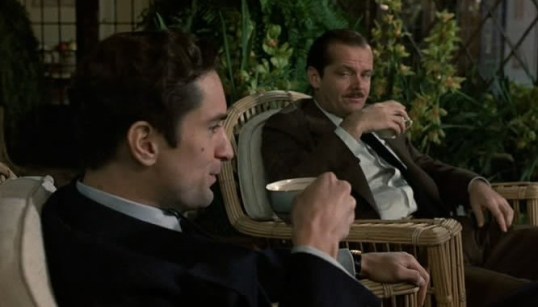
Still, this is the only film to feature both De Niro and Jack Nicholson.  (The Departed was originally conceived as a chance to bring De Niro and Nicholson together, with De Niro being the original choice for the role eventually played by Martin Sheen.)  Nicholson’s role is small and he doesn’t show up until the film is nearly over.  He and De Niro have an intense table tennis match.  Nicholson doesn’t really dig deep into Brimmer’s character.  Instead, he flashes his grin and let’s the natural sarcasm of his voice carry the scene.  It’s nowhere close to being as emotionally satisfying as the De Niro/Pacino meeting in Heat.  That said, Jack Nicholson at least appears to be enjoying himself.  His natural charisma makes his role seem bigger than it actually is.

Why was The Last Tycoon such a disappointment?  Though unfinished, the book still featured some of Fitzgerald’s best work and there’s a huge amount of talent involved in this film.  The blame mostly falls on Elia Kazan, who came out of retirement to direct the film after original director Mike Nichols left the project.  (Nichols reportedly objected to casting De Niro as Stahr.  While it’s tempting to think that Nichols realized that De Niro’s intense style wouldn’t be right for the role, it actually appears that Nichols and De Niro sincerely disliked each other as Nichols also abandoned the next film he was hired to direct when he was told that De Niro wanted the lead role.  Nichols choice for Monroe Stahr was Dustin Hoffman, which actually would have worked.  If nothing else, it would have provided a Graduate reunion.)  Kazan later said that he did the film solely for the money and it’s obvious that he didn’t really care much about the film’s story.  The film has some good scenes but, overall, it feels disjointed and uneven.  Kazan doesn’t really seem to care about Monroe Stahr and, as a result, the entire film falls flat.

Previous Icarus Files:

  1. Cloud Atlas
  2. Maximum Overdrive
  3. Glass
  4. Captive State
  5. Mother!
  6. The Man Who Killed Don Quixote
  7. Last Days
  8. Plan 9 From Outer Space
  9. The Last Movie
  10. 88
  11. The Bonfire of the Vanities
  12. Birdemic
  13. Birdemic 2: The Resurrection 
  14. Last Exit To Brooklyn
  15. Glen or Glenda
  16. The Assassination of Trotsky
  17. Che!
  18. Brewster McCloud
  19. American Traitor: The Trial of Axis Sally
  20. Tough Guys Don’t Dance
  21. Reach Me
  22. Revolution

Icarus File No. 22: Revolution (dir by Hugh Hudson)


1985’s Revolution opens on July 4th, 1776.  The Declaration of Independence has just been published.  The streets are full of people celebrating.  A statue of King George is pulled down.  In her carriage, the wealthy Mrs. McConnahay (Joan Plowright) turns up her nose to the enthusiastic rebels, including the fanatical Liberty Woman (Annie Lennox).  Mrs. McConnahay’s daughter, Daisy (Nastassja Kinski) is intrigued by this idea of freedom and equality.

Fur trader Tom Dobbs sails his boat into Hudson Harbor.  Tom is Scottish, illiterate, and very much a man of the 18th Century.  However, he’s played by Al Pacino, who was none of those things.  After Revolution was released to desultory reviews, Pacino took four years off from the movies and watching this film, one can see why.  Pacino is miscast as Dobbs and, as a result, he gives the type of truly bad performance that can only be given by a great actor.  Unable to disguise the fact that he had the accent of a modern-day New Yorker, Pacino resorts to mumbling the majority of his lines.  Tasked with playing a character who has no idea how to deal with the history-making events in which he finds himself, Pacino alternates between a blank look and with bulging his eyes like a madman, proving that it’s far more difficult to play an uneducated character than an educated one.  Why cast Pacino, who can be one of our most exciting actors, as a character who can barely speak and who has neither the intensity of Michael Corleone or the subversive wit of Tony Montana?  Due to Pacino and Kinski having zero chemistry, the scenes where Tom falls in love with Daisy are almost painful to watch.

The film follows Tom as he and his son, Ned (Simon Owen when the film begins, Dexter Fletcher by the time the action moves to Valley Forge), as they find themselves conscripted into the Revolutionary Army.  Eventually, Ned is abducted into the British army and serves as a drummer boy under the sadistic watch of Sgt. Major Peasy (Donald Sutherland).  The idea behind the film isn’t a bad one.  It attempts to portray the American Revolution through the eyes of the average citizen.  Instead of focusing on the Founding Fathers, Revolution tries to tell the story of the everyday people who found themselves in the middle of the war.  Tom loses his boat and (temporarily) he loses his son.  Fortunately, this is one of those films where people are constantly running into each other by chance, regardless of whether it makes any sense or not.  Daisy goes from seeing Tom in New York to randomly coming across him in a field to eventually finding him in Valley Forge.  It’s not because she’s specifically looking for him.  Instead, he just happens to be there.

Why does Revolution fail?  A lot of it comes down to Pacino’s performance, though Pacino certainly isn’t the only talented actor to give a not-quite good performance in Revolution.  (Donald Sutherland has never been more wasted in a film.)  The script is full of dialogue like, “My mouth belongs where I place it.”  (Pacino gets stuck with that one.)  Hugh Hudson directs in a leaden manner.  Towards the end of the film, there is one brilliant sequence where Tom wanders through the streets of New York and, for a few minutes, the film comes to like with a spontaneity that was previously lacking.  Unfortunately, it’s just one sequence in a very long movie,

To be honest, we could use some good films about the American Revolution and I’m not talking about elitist nonsense like Hamilton.  No taxation without representation.  It’s still a good message for us all.

Previous Icarus Files:

  1. Cloud Atlas
  2. Maximum Overdrive
  3. Glass
  4. Captive State
  5. Mother!
  6. The Man Who Killed Don Quixote
  7. Last Days
  8. Plan 9 From Outer Space
  9. The Last Movie
  10. 88
  11. The Bonfire of the Vanities
  12. Birdemic
  13. Birdemic 2: The Resurrection 
  14. Last Exit To Brooklyn
  15. Glen or Glenda
  16. The Assassination of Trotsky
  17. Che!
  18. Brewster McCloud
  19. American Traitor: The Trial of Axis Sally
  20. Tough Guys Don’t Dance
  21. Reach Me

Icarus File No. 21: Reach Me (dir by John Herzfeld)


The 2011 film, Reach Me, opens with a rapper named E-Ruption (Nelly) appearing on a morning show and talking about how, while he was serving a prison sentence, he read a self-help book called Reach Me.  It asked him to consider whether or not his childhood self would be happy with his adult self.  The book was written by a mysterious man named Teddy Raymond.  No one knows who this Teddy Raymond is.  He’s never appeared in public.  People film themselves reading the book online and then upload to YouTube as a way of sharing Teddy’s wisdom.  I honestly can think of nothing more annoying and boring than watching someone else read a self-help book but whatever.  I live in Texas.  The movie takes place in California.

Tabloid editor Gerald (Sylvester Stallone) takes a break from action painting to order one of his reporters, Roger King (Kevin Connolly), to track down Teddy Raymond.  Roger wants to write the great American novel.  He doesn’t care about self-help.  He meets Teddy’s associates, Wilson (Terry Crews) and Kate (Lauren Cohan) and Wilson talks about how Teddy magically cured Kate’s stutter.  Roger then wanders around the beach, asking random people, “Teddy Raymond?  Are you Teddy Raymond?”  Oh look!  There’s a guy named Teddy (Tom Berenger) who reluctantly cures Roger of his smoking addiction by ordering Roger to yell at the ocean …. over and over and over again.

Collette (Kyra Segdwick) has just been released from prison.  Reading Teddy’s book has inspired her to try to become a fashion designer.  Collette’s daughter, Eve (Elizabeth Henstridge), is an aspiring actress who was earlier groped by a sleazy star named Keating (Cary Elwes).  Collette and Eve literally crash their car into a car being driven by Wolfie (Thomas Jane), a sociopathic undercover cop who enjoys killing people and who goes to confession after every shooting.  (At the start of the movie, he guns down Danny Trejo.)  The alcoholic priest, Father Paul (Danny Aiello), refuses to hear any more of his confessions.

Meanwhile, wannabe mob boss Frank (Tom Sizemore) is upset because another mob boss, Aldo (Kelsey Grammer), doesn’t treat him with any respect.  Frank sends two of his hitmen, Thumper (David O’Hara) and Dominic (Omari Hardwick), to kill a man who owes him money and to also shoot the man’s dog.  Thumper has been reading Teddy Raymond’s book and doesn’t want to shoot the dog.  Dominic realizes that his heart isn’t into the mob life so, taking the book’s message to heart, he calls Frank and says, “My heart’s not in it.”

(Don’t try that with any real mobsters.)

Eventually, all of the characters do come together.  They don’t exactly come together in a plausible manner but they do all end up at the same location so let’s give the film credit for that.  Let’s also give this film credit for leaving me seriously confused.  I have no idea whether this film was meant to a parody or a celebration of the self-help industry.  At first, I suspected that it meant to be a parody because all of Teddy Raymond’s advice was painfully shallow and the type of basic crap that anyone could come up with.  I actually found myself losing respect for the people who claimed that Teddy had changed their lives.  But at the movie progressed, I realized that I was supposed to take Teddy and his advice seriously.  This was a film that I guess was meant to have something to say but who knows what exactly that was.

That said — hey, everyone’s in this movie!  Director John Herzfeld was a former college roommate of Sylvester Stallone’s and, once Stallone agreed to appear, that apparently convinced a lot of other “name” actors to take the risk as well.  There’s a lot of talent in this film but little of it is used correctly.  Kelsey Grammer as an Italian mobster instead of the editor?  Sylvester Stallone as the editor instead of the Italian mobster?  Thomas Jane as a sociopath who has a girlfriend by the end of the movie, one who smiles and tells him, “Try not to shoot anyone?”  Kyra Sedgwick as an ex-con?  These are all good actors but just about everyone, with the exception of the much-missed Danny Aiello, is miscast.

It’s a true Icarus File.  It was a just a little more self-aware, this would have been a Guilty Pleasure.  But, in the end, self-help cannot help itself.

Previous Icarus Files:

  1. Cloud Atlas
  2. Maximum Overdrive
  3. Glass
  4. Captive State
  5. Mother!
  6. The Man Who Killed Don Quixote
  7. Last Days
  8. Plan 9 From Outer Space
  9. The Last Movie
  10. 88
  11. The Bonfire of the Vanities
  12. Birdemic
  13. Birdemic 2: The Resurrection 
  14. Last Exit To Brooklyn
  15. Glen or Glenda
  16. The Assassination of Trotsky
  17. Che!
  18. Brewster McCloud
  19. American Traitor: The Trial of Axis Sally
  20. Tough Guys Don’t Dance

Icarus File No. 20: Tough Guys Don’t Dance (dir by Norman Mailer)


The 1987 film, Tough Guys Don’t Dance, opens with Tim Madden (Ryan O’Neal) talking to his father, tough Dougy (Lawrence Tierney).  Dougy has stopped by Tim’s New England home to let Tim know that he has decided stop chemotherapy and accept his eventual death from cancer because, as Dougy puts it, “Tough guys don’t dance.”  The tone of Dougy’s voice is all we need to hear to know that, in his opinion, his son has spent way too much time dancing.

Tim is an ex-convict turned writer and, when we first see him, he’s obviously had a few rough nights.  He explains to Dougy that he woke up after a bender with his ex-girlfriend’s name tattooed on his arm, blood all over his jeep, and two heads dumped in his marijuana stash.  Tim says that he’s hopeful that he’s not the murderer but he can’t be sure.  He’s been drinking and doping too much.  He suffers from blackouts.  He’s not sure what happened.

The majority of the film is made up of flashbacks, detailing Tim’s affairs with a number of women and also his odd relationship with the town’s police chief, Luther Regency (Wings Hauser).  Luther is married to Tim’s ex-girlfriend, Madeleine (Isabella Rossellini), who long ago accompanied Tim on a trip to North Carolina where they hooked up with a fundamentalist preacher (Penn Jillette) and his then-wife, Patty Lariene (Debra Sundland).  (Tim found their personal ad while casually skimming the latest issue of Screw, as one does I suppose.)  Patty Lariene eventually ended up married to Tim, though she has recently left him.  As for Madeleine, she has never forgiven him for a car accident that they were involved in.  Is Tim capable of loving anyone?  Well, he does say, “Oh God, oh man,” repeatedly when he discovers that his wife has been having an affair.

Tim tries to solve the murders himself, finding that they involve not only him and Luther but also Tim’s old prep school friend, Wardley Meeks III (John Bedford Lloyd) and also some rather stupid drug dealers that Tim hangs out with.  The plot is almost ludicrously convoluted and it’s tempting to assume that the film is meant to be a parody of the noir genre but then you remember that the film is not only based on a Norman Mailer movie but that it was directed by Mailer himself.  Mailer, who was the type of public intellectual who we really don’t have anymore, was blessed with a brilliant mind and cursed with a lack of self-awareness.  There’s little doubt that we are meant to take this entire mess of a film very seriously.

And the film’s theme isn’t hard to pick up on.  By investigating the murders, Tim faces his own troubled past and finally comes to understand why tough guys, like his father, don’t hesitate to take action.  Tough guys don’t dance around what they want or need.  That’s a pretty common theme when it comes to Mailer.  Tim Madden is not quite an autobiographical character but he is, by the end of the story, meant to represent the type of hard-living intellectual that Mailer always presented himself as being.  Unfortunately, Ryan O’Neal wasn’t exactly an actor who projected a good deal of intelligence.  And, despite his lengthy criminal record off-screen, O’Neal’s screen presence was somewhat docile.  That served him well in films like Love Story and Barry Lyndon.  It serves him less well in a film like this.  It’s easy to imagine O’Neal’s Tim getting manipulated and, in those scenes where he’s supposed to be a chump, O’Neal is credible enough in the role.  It’s far more difficult to buy the idea of Tim actually doing something about it.

Indeed, it’s hard not to feel that co-star Wings Hauser would have been far more credible in the lead role.  But then, who would play Luther Regency?  Hauser gives such a wonderfully unhinged and out-there performance as Luther that it’s impossible to imagine anyone else in the role.  Maybe Hauser could have played both Tim and Luther.  Now that would have made for a classic film!

Tough Guys Don’t Dance is weird enough to be watchable.  The dialogue is both raunchy and thoroughly humorless, which makes it interesting to listen to, if nothing else.  The moments that are meant to be funny are so obvious (like casting noted atheist Penn Jillette as a fundamentalist) that it’s obvious that the moment that feel like clever satire were actually all a happy accident.  As far as Norman Mailer films go, this one is not as boring as Wild 90 but it also can’t match the unhinged lunacy of a frustrated Rip Torn spontaneously attacking Mailer with a hammer at the end of the unscripted Maidstone.  It’s a success d’estime.  Mailer flew too close to the sun but the crash into the ocean was oddly entertaining.

Previous Icarus Files:

  1. Cloud Atlas
  2. Maximum Overdrive
  3. Glass
  4. Captive State
  5. Mother!
  6. The Man Who Killed Don Quixote
  7. Last Days
  8. Plan 9 From Outer Space
  9. The Last Movie
  10. 88
  11. The Bonfire of the Vanities
  12. Birdemic
  13. Birdemic 2: The Resurrection 
  14. Last Exit To Brooklyn
  15. Glen or Glenda
  16. The Assassination of Trotsky
  17. Che!
  18. Brewster McCloud
  19. American Traitor: The Trial of Axis Sally

Icarus File No. 19: American Traitor: The Trial of Axis Sally (dir by Michael Polish)


First released in 2021, American Traitor: The Trial of Axis Sally tells the story of Mildred Gillars, an American women who worked as propagandists for The Third Reich.  Gillars would broadcast on German-radio, her show mixing music with propaganda messages that were meant to be heard by American and British soldiers in Europe.  Gillars would talk about how wonderfully the war was going for Germany.  She would tell the Americans that their mothers, sisters, and sweethearts were waiting for them back in the United States.  She was one of the many female Nazi propagandists to be nicknamed “Axis Sally.”

(Interestingly enough, her broadcasts did gather a bit of cult following amongst U.S. personnel in Europe.  Even though she was a propagandist, she played music and she also occasionally let slip the location of the German army.  As the war progressed, her programs took on a “so bad it’s good” quality as she continued to insist that the Germans were still winning when they clearly weren’t.)

Mildred was arrested after the war ended and charged with treason against the United States.  The prosecution claimed that Mildred was a committed Nazi who turned against her home country.  Mildred and her defense attorneys claimed that Mildred only stayed in Germany because her boyfriend was there and that Mildred was largely apolitical.  They also argued that Mildred would have been sent to a concentration camp if she had refused to do the broadcasts.  Mildred Gillars became the first American woman to be convicted of treason.  She lost her American citizenship, received a hefty fine, and spent 13 years in prison.  Reportedly, she never showed much in the way of regret over being a Nazi propagandist.

It’s an interesting story but you wouldn’t know that from American Traitor, which is largely a vanity project.  Meadow Williams not only plays Mildred Gillars but she also served as a producer on the film.  Williams is the widow of vitamin tycoon Gerald Kessler.  When Kessler died, he left his $800 million dollar fortune to Williams and, reportedly, a bit of that inheritance was used to fund this film.  That perhaps explains why a name actor like Al Pacino shows up in the role of Gillars’s defense attorney.  Pacino barks his lines with authority and manages to give a credible performance, even though he’s stuck wearing a ridiculous wig.  There is absolutely nothing about Williams’s performance that suggests the type of charisma that Mildred Gillars would have needed to become an effective propagandist.  She gives a blank-faced and blank-voiced performance, one that might be meant to seem enigmatic but which is instead just boring.

And really, that’s the best way to describe the film.  It’s dull.  The dialogue is dull.  The performances, other than Al Pacino, are dull.  Even the film’s visuals are dull.  The film has little to say about propaganda, war, guilt, or innocence.  It’s a vanity project turned Icarus file.

Previous Icarus Files:

  1. Cloud Atlas
  2. Maximum Overdrive
  3. Glass
  4. Captive State
  5. Mother!
  6. The Man Who Killed Don Quixote
  7. Last Days
  8. Plan 9 From Outer Space
  9. The Last Movie
  10. 88
  11. The Bonfire of the Vanities
  12. Birdemic
  13. Birdemic 2: The Resurrection 
  14. Last Exit To Brooklyn
  15. Glen or Glenda
  16. The Assassination of Trotsky
  17. Che!
  18. Brewster McCloud

Icarus File No. 18: Brewster McCloud (dir by Robert Altman)


First released in 1970, Brewster McCloud takes place in Houston.

A series of murders have occurred in the city.  The victims have all been older authority figures, like decrepit landlord Abraham Wright (Stacy Keach, under a ton of old age makeup) or demanding society matron Daphne Heap (Margaret Hamilton, who decades earlier had played The Wicked Witch in The Wizard Of Oz).  The victims all appear to have been killed by strangulation and all of them are covered in bird droppings.  Perplexed, the Houston authorities call in Detective Frank Shaft (Michael Murphy) from San Francisco.  Shaft only wears turtlenecks and he has piercing blue eyes.  He looks like the type of guy you would call to solve a mystery like this one.  It’s only later in the film that we discover his blue eyes are due to the contact lenses that he’s wearing.  Frank Shaft is someone who very much understands the importance of appearance.  As one detective puts it, when it comes to Shaft’s reputation, “The Santa Barbara Strangler turned himself in to him.  He must have really trusted him.”

Perhaps the murders are connected to Brewster McCloud (Bud Cort), who lives in a bunker underneath the Astrodome and who seems to be fascinated with birds.  Brewster dreams of being able to fly just like a bird and he’s spent quite some time building himself a set of artificial wings.  A mysterious woman (Sally Kellerman) who wears only a trenchcoat and who has scars on her shoulder blades that would seem to indicate that she once had wings continually visits Brewster and encourages him to pursue his dream.  However, she warns him that he will only be able to fly as long as he remains a virgin.  If he ever has sex, he will crash to the ground.

Brewster thinks that he can handle that.  Then he meets a tour guide named Suzanne Davis (Shelley Duvall, in her film debut) and things start to change….

Brewster McCloud is a curious film.  The story is regularly interrupted by a disheveled lecturer (Rene Auberjonois) who is very much into birds and who, over the course of the film, starts to more and more resemble a bird himself.  The film is full of bird-related puns and there are moments when the characters seem to understand that they’re in a movie.  Frank Shaft dresses like Steve McQueen in Bullitt and his blue contact lenses feel like his attempt to conform to the typical image of a movie hero.  (A lengthy car chase also feels like a parody of Bullitt’s famous chase scene.)  When the old woman played by Margaret Hamilton dies, the camera reveals that she’s wearing ruby slippers and a snippet of Somewhere Over The Rainbow is heard.  As played by Bud Cort, Brewster is the perfect stand-in for the lost youth of middle class America.  He knows that he’s rebelling against something but he doesn’t seem to be quite sure what.  Brewster, like many idealists, is eventually distracted by his own desires and his once earnest plans come cashing down.  Brewster becomes an Icarus figure in perhaps the most literal way possible, even if he doesn’t come anywhere close to reaching the sun.  As with many of Altman’s films, Brewster McCloud is occasionally a bit too esoteric for its own good but it’s always watchable and it always engages with the mind of the viewer.  One gets the feeling that many of the film’s mysteries are not necessarily meant to be solved.  (Altman often said his best films were based on dreams and, as such, used dream logic.)  With its mix of plain-spoken establishmentarians and quirky misfits, Brewster McCloud is not only a classic counterculture film but it’s also a portrait of Texas on the crossroads between the cultures of the past and the future.

Though it baffled critics when it was released, Brewster McCloud has gone on to become a cult film.  It’s a bit of a like-it-or-hate-it type of film.  I like it, even if I find it to be a bit too self-indulgent to truly love.  Quentin Tarantino, for his part, hates it.  Brewster McCloud was released in 1970, the same year as Altman’s Oscar-nominated M*A*S*H.  (Both films have quite a few cast members in common.)  Needless to say, the cheerfully and almost defiantly odd Brewster McCloud was pretty much ignored by the Academy.

Previous Icarus Files:

  1. Cloud Atlas
  2. Maximum Overdrive
  3. Glass
  4. Captive State
  5. Mother!
  6. The Man Who Killed Don Quixote
  7. Last Days
  8. Plan 9 From Outer Space
  9. The Last Movie
  10. 88
  11. The Bonfire of the Vanities
  12. Birdemic
  13. Birdemic 2: The Resurrection 
  14. Last Exit To Brooklyn
  15. Glen or Glenda
  16. The Assassination of Trotsky
  17. Che!

Icarus File No. 17: Che! (dir by Richard Fleischer)


Che Guevara!

By most accounts, Che Guevara epitomized the excesses and the hypocrisies of the extreme Left.  He spoke of the class struggle while remaining an elitist himself.  He oversaw thousands of executions and advocated for authoritarian rule.  In his writings, he frequently revealed himself to be a racist and a misogynist.  By arguing that the Russians should be allowed to bring nuclear missiles to Cuba, he brought the world to the brink of destruction.  However, he also died relatively young and he looked good on a t-shirt.  Decades after he was executed by the Bolivian Army in 1967 (or was it the CIA?), he remains an icon for college students and champagne socialists everywhere.

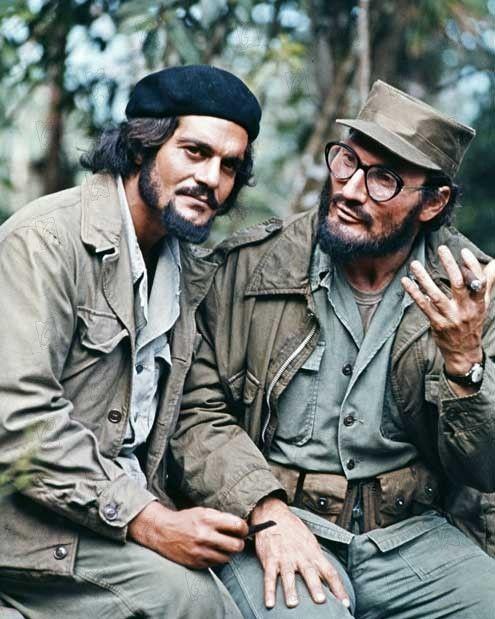
The film about Che! was released in 1969, two years after his death.  Starring the Egyptian actor Omar Sharif as Che Guevara, Che! opens with Guevara already a martyr and then quickly gives way to flashbacks.  Various actors pretending to be Cuban appear and speak directly to the audience, debating Che Guevara’s legacy.  Some describe him as being a violent thug who killed anyone who displeased him.  Others describe him as a visionary doctor who sacrificed his comfortable existence for the people.  It’s a rather conventional opening and one that hints that Che! is going to try to have it both ways as far as Che’s legacy is concerned.  But it’s still effective enough.  A montage of soldiers and rebels creates the proper feeling of a society on the verge of collapse.

And then Jack Palance shows up.

Palance first appears creeping his way through the Cuban jungle with a group of soldiers behind him.  Palance is chomping on a cigar and he wears the intense look of a man on a mission.  My initial reaction was that Palance was playing one of the CIA agents who sent to Cuba to try to assassinate Fidel Castro or to set up the Bay of Pigs invasion.  I kept waiting for him to look at the camera and launch into a monologue about why, for the safety of America, he had been dispatched the topple Cuba’s communist government.  Imagine my shock when Omar Sharif called Palance, “Fidel.”

Yes, that’s right.  Jack Palance plays Fidel Castro!  As miscast as the suave Omar Sharif is as Che Guevara, nothing can prepare one for seeing Jack Palance playing Fidel Castro.  Needless to say, there is nothing remotely Cuban or even Spanish about Jack Palance.  He delivers his lines in his trademark terse Jack Palance voice, without even bothering to try any sort of accent.  (And, needless to say, both he and Sharif speak English through the entire film.)  Anyone who has ever seen a picture of a young Fidel Castro knows that, while he shared a family resemblance with Justin Trudeau, he looked nothing like Jack Palance.  Eventually, Palance puts on a fake beard that makes him look even less like Castro.  When one of our narrators mentions that Castro was a great speaker, the film cuts to a scene of Palance spitting out communist slogans with a noted lack of enthusiasm.  When Castro takes control of Cuba, Palance looks slightly amused with himself.  When Che accused Castro of selling out the revolution, Palance looks bored.  It’s a remarkably bad piece of casting.  Seeing Palance as Castro feels like seeing John Wayne as Genghis Khan.  Thank goodness Hollywood never tried anything that silly, right?  Anyway….

As for the rest of the film, it hits all the expected notes.  The film was made in the very political year of 1969, a time when the New Left was ascendant and many considered Che Guevara to be a hero.  However, since this was a studio production, Che! tries to appeal to both college radicals and their parents by taking a “both sides” approach to Che Guevara.  Here’s Che teaching an illiterate farmer how to read.  Here’s Che overseeing a bunch of dissidents being executed.  Here’s Che getting angry at Castro for not being properly enthusiastic about housing Russian nuclear missiles.  Here’s Che talking about a moral revolution.  Here’s Che trying to start an unwanted war in Bolivia.  Here’s Che talking to Sid Haig — hey, Sid Haig’s in this film!

Like so many mainstream political films of the 60s and today, Che! tries to be political without actually taking any firm positions.  One is tempted to say that is the film’s downfall.  Of course, the film’s real downfall is casting Jack Palance as Fidel Castro.

There’s no way to recover from that.

Icarus File No. 16: The Assassination of Trotsky (dir by Joseph Losey)


If you study the history of the International Left in the years immediately following the death of Lenin, it quickly becomes apparent that the era was defined by the rivalry between Joseph Stalin and Leon Trotsky.

Trotsky, the self-styled intellectual who was credited with forming the Red Army and who many felt was Lenin’s favorite, believed that he should succeed Lenin as the leader of Communist Russia.  Stalin, the ruthless nationalist who made up in brutality what he lacked in intelligence, disagreed.  Stalin outmaneuvered Trotsky, succeeding Lenin as the leader of the USSR and eventually kicking Trotsky out of the country. Trotsky would spend the rests of his life in exile, a hero to some and a pariah to others.  While Stalin starved his people and signed non-aggression pacts with Hitler, Trotsky called for worldwide revolution.  To Stalin, Trotsky was a nuisance whose continued existence ran the risk of making Stalin look weak.  When Trotsky was assassinated in Mexico in 1940, there was little doubt who had given the order.  After Totsky’s death, the American Communist Party, which had already been weakened by the signing of the non-aggression pact between Hitler and Stalin, was further divided into Stalinist and Trotskyite factions.

Ideologically, was there a huge difference between Stalin and Trotsky?  Many historians have suggested that Trotsky probably would have taken many of the same actions that Stalin took had Trotsky succeeded Lenin.  Indeed, the idea that Trotsky was somehow a force of benevolence has more to do with the circumstances of his assassination than anything that Trotsky either said or did.  In the end, the main difference between Stalin and Trotsky seemed to be Trotsky was a good deal more charismatic than Stalin.  Unlike Trotsky, Stalin couldn’t tell a joke.  However, Stalin could order his enemies killed whenever he felt like it and some people definitely found that type of power to be appealing.  Trotsky could write essays.  Stalin could kill Trotsky.

First released in 1972, The Assassination of Trotsky is a cinematic recreation of the events leading to the death of Leon Trotsky in Mexico.  French actor Alain Delon plays Frank Jacson, the Spanish communist who was tasked with infiltrating Trotsky’s inner circle and assassinating him with a pickaxe.  Welsh actor Richard Burton plays the Russian Trotsky, giving long-winded monologues about world revolution.  Italian Valentina Cortese also plays a Russian, in this case Trotsky’s wife, Natalia.  And finally, French actress Romy Schneider plays Gita Samuels, who is based on Jacson’s American girlfriend.  This international cast was directed by Joseph Losey, an American director who joined the Communist Party in 1946 and who moved to Europe during the McCarthy era.

Losey was an interesting director.  Though his first American feature film was the anti-war The Boy With Green Hair, the majority of his American films were on the pulpy side.  Not surprisingly, his European films were far more open in their politics.  Losey directed his share of undeniable masterpieces, like The Servant, Accident, and The Go-Between.  At the same time, he also directed his share of misfires, the majority of which were bad in the way that only a bad film directed by a good director can be.  The same director who gave the world The Go-Between was also responsible for Boom!

And then there’s The Assassination of Trotsky.  It’s a bit of an odd and rather uneven film.  Alain Delon’s performance as the neurotic assassin holds up well and some of his scenes of Romy Schneider have a true erotic charge to them.  The scenes of Delon wandering around Mexico with his eyes hidden behind his dark glasses may not add up too much but they do serve as a reminder that Delon was an actor who could make almost any scene feel stylish.

But then we have Richard Burton, looking like Colonel Sanders and not even bothering to disguise his Welsh accent while playing one of the most prominent Russians of the early 20th Century.  The film features many lengthy monologues from Trotsky, all of which Burton delivers in a style that is very theatrical but also devoid of any real meaning.  As played by Burton, Trotsky comes across as being a pompous phony, a man who loudly calls for world revolution while hiding out in his secure Mexican villa.  Now, for all I know, Trotsky could have been a pompous phony.  He certainly would not have been the first or last communist to demand the proletariat fight while he remained secure in a gated community.  The problem is that the film wants us to admire Trotsky and to feel that the world was robbed of a great man when Jacson drove that pickaxe into his head.  That’s not the impression that one gets from watching Burton’s performance.  If anything, Burton’s overacting during the assassination scene will likely inspire more laughs than tears.

The Assassination of Trotsky is one of those films that regularly appears on lists of the worst ever made.  I feel that’s a bit extreme.  The film doesn’t work but Alain Delon was always an intriguing screen presence.  (Interestingly enough, Delon himself was very much not a supporter of communism or the Left in general.)  The film fails as a tribute to Trotsky but it does make one appreciate Alain Delon.

Previous Icarus Files:

  1. Cloud Atlas
  2. Maximum Overdrive
  3. Glass
  4. Captive State
  5. Mother!
  6. The Man Who Killed Don Quixote
  7. Last Days
  8. Plan 9 From Outer Space
  9. The Last Movie
  10. 88
  11. The Bonfire of the Vanities
  12. Birdemic
  13. Birdemic 2: The Resurrection 
  14. Last Exit To Brooklyn
  15. Glen or Glenda

Icarus File No. 15: Glen or Glenda (dir by Edward D. Wood, Jr.)


Today is the 100th birthday of Edward D. Wood, Jr., the director who is often referred to as being “the worst director of all time.”  Personally, I’ve never really agreed with that title.  Ed Wood had a long career in Hollywood and yes, he may have worked exclusively in B-movies and yes, he eventually turned to softcore and then hardcore porn to pay the bills and yes, his life ended under rather tragic circumstances.  But, unlike most truly bad directors, his films are still being watched today and, again unlike most bad directors, his style is immediately recognizable.  You don’t need to see his name in the credits to know when a film was directed by Ed Wood.  You just have to keep an eye out for stock footage, a few familiar actors, and a lot of angora.

If anything, Ed Wood was a director whose ambitions far outweighed the money that he could usually raise for his films.  On the one hand, Plan 9 From Outer Space was a film where the strings holding the flying saucers were clearly visible and where a shower curtain was used to represent the door into an airplane’s cockpit.  On the other hand, it was also a very sincere plea for world peace and a lament that humans would rather blow themselves up with Solarnite than work out their differences.

Or you take a film like 1953‘s Glen or Glenda.  Ed Wood, who identified as a heterosexual and who was considered, by his friends, to be quite a womanizer (and it should be noted that young Ed Wood was strikingly handsome, though he was subsequently very badly aged by alcoholism and homelessness), also preferred to wear clothing designed for women and was open about it at a time when American culture was even more conformist-minded than usual.  In Glen or Glenda, Wood plays the autobiographical role of Glen, who struggles to tell his fiancée (played by Wood’s real-life girlfriend, Delores Fuller) that he dreams of being able to wear her angora sweater.  Glen’s story is told by a psychiatrist (Timothy Farrell) who is talking to a cop (veteran Hollywood character actor Lyle Talbot) who is investigating the death of a transvestite.  Among other things, Glen or Glenda is known for its bad acting, stiffly delivered dialogue, and its occasional digressions about why men go bald while women do not.  (It’s the tight-fitting hats, which cut-off blood flow to the head and not only cause men to lose their hair but also develop the Solarnite bomb.)  But, at the same time, it’s a film in which Wood attempts to handle, with sensitivity and empathy, a subject that most films in the 50s would have either ridiculed or portrayed as being a threat to the American way of life.  All of Wood’s films are sympathetic to those who are considered to be outsiders by conventional society.  This is especially true of Glen or Glenda.

Of course, Glen or Glenda is also known for Bela Lugosi randomly appearing in a laboratory and shouting things like, “Pull ze string!  Pull ze string!”  As far as I can tell, Lugosi is supposed to be playing the creator, who is not portrayed as being a stereotypical God but instead as being a mad scientist who rants and raves in his library and his laboratory.  And while it’s obvious that Bela was probably added to the film at the last minute and, more or less, allowed to do whatever the Hell he wanted, his presence adds a wonderfully bizarre touch to film’s dry style.  (I would compare him to the mysterious burned man who appears at the start of David Lynch’s Eraserhead.)  Whenever the film starts to get a bit too much like an educational film, Lugosi pops up and starts to literally shout at the audiences, frantically issuing a bunch of commands and nursery school rhymes that don’t really made any sense.  It reminds one of H.P. Lovecraft’s insistence that the universe was created by a blind idiot God who had no idea that he was actually creating anything.  The presence of Lugosi and a lengthy and increasingly surreal dream sequence in which Glen imagines himself being tormented by both his fiancée and the devil all suggest that, under different circumstances, Ed Wood could have been the American Buñuel.

Sadly, it was not to be.  Ed Wood died in alcoholic poverty and was reportedly pretty miserable during the final years of his life.  There was nothing pleasant about the end of Wood’s life.  But, on his birthday, I think the least we can do is remove the title of “worst director” from his legacy.  He was nothing of the sort.

Previous Icarus Files:

  1. Cloud Atlas
  2. Maximum Overdrive
  3. Glass
  4. Captive State
  5. Mother!
  6. The Man Who Killed Don Quixote
  7. Last Days
  8. Plan 9 From Outer Space
  9. The Last Movie
  10. 88
  11. The Bonfire of the Vanities
  12. Birdemic
  13. Birdemic 2: The Resurrection 
  14. Last Exit To Brooklyn