I really don’t have much to say about this teaser, beyond the fact that it looks really good. With Ethan Coen reportedly taking a break from cinema to focus on theater, this will be Joel Coen’s first film as a solo director. Shakespeare, though, seems like a good collaborator. Both Denzel Washington and Frances McDormand are already being spoken of as very likely Oscar nominees as a result of their work in this film.
The Tragedy of MacBeth will be released in theaters in Christmas and will be available on AppleTV+ in January. For the record, this film is the one reason why I currently subscribe to AppleTV+.
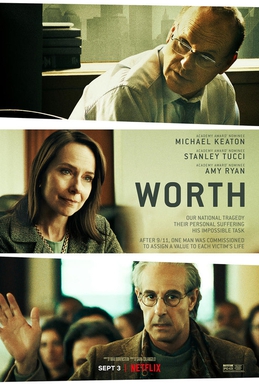
That’s the question that is asked in a film that’s appropriately titled Worth.
Based on a true story, Worth centers around Kenneth D. Feinberg. Played by Michael Keaton, Fienberg was the Washington lawyer who, in the days after 9/11, was appointed the Special Master of the September 11th Victims Compensation Fund. In that role, Feinberg was in charge of determining how much money should be given to the families who lost someone in the 9/11 attacks. At first, Feinberg tries to reduce his job to just numbers. He resists the efforts of his law partner, Camille Biros (Amy Ryan), to convince him to meet with any of the families one-on-one. Instead, he tries to make it all about how much the victims would have earned if they had lived. When Camille tries to get him to listen to a recording of the final phone call of a man trapped in the Pentagon, Feinberg refuses to do it.
Not surprisingly, Feinberg gets a reputation for being insensitive and many of the families signal that, rather than accepting the government’s compensation, they would rather sue the airlines and the city of New York, a move that we’re told could crash the U.S. economy or bankrupt the families or both. It’s only after the workaholic Feinberg makes the mistake of staying in the office after everyone else has left that he actually meets one of the families. With the help of activist Charles Wolf (Stanley Tucci), Feinberg finally starts to care about the people behind the numbers.
Worth is a bit of an old-fashioned film, a throw-back to the type of well-meaning, competently produced films that used to come out every December so that they could compete for the Academy Awards. Even the film’s rather stolid, middle-of-the road liberalism feels like an artifact of another age. (I had to laugh a little when the film assured us that, despite sometimes coming across like a jackass, Feinberg was a good guy because he had been a senior aide to Ted Kennedy, the senator who left a woman to drown in a car while he went back to his hotel and got some sleep.) At a time when Adam McKay is being treated as a serious thought leader and Aaron Sorkin has somehow been recast as a sensible moderate, Worth’s fairly even-handed and nonjudgmental approach feels like almost an act of rebellion. That said, Worth’s approach works for the story that it’s telling. 9/11 was such a huge tragedy that it doesn’t need to be talked to death, as it would be in a Sorkin film. Nor do we need the heavy hand of Adam McKay to tell us that there’s something inherently disturbing about reducing the value of someone’s life to a mere number. Unlike the films of McKay, Sorkin, or Jay Roach (Hell, why not throw him in there, too?), Worth trusts the audience to be able to figure out certain truths on its own. After a decade of heavy-handed political agitprop, Worth’s nonshowy approach is actually a bit refreshing.
As a character, Kenneth Feinberg is not always easy to like. That’s especially true during the first half of the film, when Feinberg seems to be more interested in the challenge of running the compensation fund as opposed to the people that he’s supposed to be helping. When the film begins, Feinberg is the epitome of the technocrat who can figure out the numbers but who has no idea how to actually deal with human beings. Fortunately, Feinberg is also played by Michael Keaton, who is one of the few actors to be capable of projecting the natural authority necessary to make Feinberg compelling without also resorting to begging us to like the character. Keaton does a good job portraying both Feinberg’s quick mind but also his social awkwardness. When we first meet him, he’s someone who has been an insider for so long that he can’t even imagine that an outside exists. Keaton plays him as a man who does not mean to be callous but who is so work-obsessed that he doesn’t understand how his job comes across to other people. Even more importantly, though, Keaton does a good job of portraying Feinberg’s transformation from being a detached bureaucrat to being someone who actually cares about the people who will effected by his decisions. A lesser actor would have overplayed these scenes and the film would have felt mawkish. Keaton underplays and it saves the film.
As I said before, Worth is an old-fashioned film. Visually, it sometimes resembles the type of movie that HBO used to win Emmys with in the mid-aughts. Keaton so dominates the film that, only afterwards, do you realize that the talented supporting cast was often underused. Worth is not a perfect film but it is a good film and a thought-provoking one. It’s currently showing on Netflix.
Here’s the latest trailer for Steven Spielberg’s remake of West Side Story!
I still don’t know how I feel about this. This is either going to be brilliant or it’s going to be an act of extreme hubris. I don’t see it as being a disaster because Spielberg usually does okay the bigger the project is. (It’s usually only when he attempts to do something low-key or personal that he loses his touch.) But is he going to bring anything new to the material, anything that wasn’t present in the first film? Every Spielberg film arrives with high expectations. Will West Side Story live up to them or will this be another film like The Post or Lincoln, two films that were nominated for Best Picture but which no one would consider to be classic Spielberg?
I guess we’ll find out when the film is finally released in December!
Here’s the first teaser for one of the most anticipated movies of the year, Nightmare Alley!
Guillermo del Toro’s previous film, Shape of the Water, won the Oscar for Best Picture. Could Nightmare Alley pull off the same feat? I have no idea but the trailer looks good and I’ll watch Bradley Cooper, Willem DaFoe, and Cate Blanchett in anything. Nightmare Alley is scheduled to be released on December 17th.
Incidentally, Nightmare Alley is based on a novel, which was previously adapted into a film way back in 1947. That version, which is considered to be a noir classic, was directed by Edmund Goulding and starred Tyrone Power, Jr in the lead role.
When is an Andy Sidaris film not an Andy Sidaris film?
When it’s directed by Cirio H. Santiago, of course!
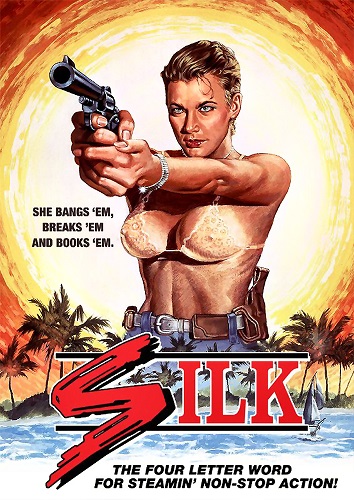
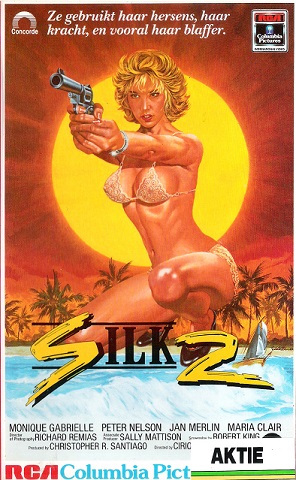
Santiago, the Roger Corman of the Phillippines, is credited with directing 100 films over the course of his 60-year career and the 1986 film Silk is definitely one of them! And the sequel, 1989’s Silk 2, is definitely another one. That may sound like faint phrase and I guess it is. Let’s just face it — not everyone is going to be a Cirio H. Santiago fan. Some people are going to want movies that make sense and maintain some sort of continuity from scene to scene. To those people, I will say that Silk and Silk 2 are probably not for you. However, if you just enjoy watching people fire guns and blow things up, the Silk films might be for you.
In the first film, Cec Verrell plays Jenny Sleighton, also known as Silk. Silk is the toughest cop in what we’re told is Honolulu but which is obviously Manila in real life. Early on Jenny informs us that she’s known as Silk because, “I’m so fucking smooth.” Silk may be smooth but she’s also deadly. The film establishes early on that Silk will basically shoot anyone. Normally, that might be a problem but, fortunately, Silk only seems to meet criminals. Over the course of the film, Silk investigates a smuggling operation. She starts out busting heroin dealers and then eventually comes across an identity theft ring …. at least, I think that’s what happens. Trying to follow the plot isn’t always easy but then again, why would you want to follow the plot of a film like Silk? The plot’s not the point. The action is the point and Cec Verrell is such a convincing action star that I’m surprised that she didn’t have a bigger career. Seriously, Cec Verell kicks ass!
Unfortuantely, Cec Verell did not return for Silk 2. In Silk 2, Monique Gabrielle steps into the lead role. Technically, Gabrielle is better at convincingly delivering her dialogue that Verell was but Gabrielle is never believable as an action star. As opposed to the first Silk, which emphasized action, Silk 2 emphasizes nudity and it even features a strangely blurred sex scene. (It’s like soft focus times twenty.) The plot of Silk 2, however, is a bit more fun than the plot of the first film, as it deals with the search for some ancient scrolls and it features Silk’s partner continually getting captured and tortured by the bad guys. After a while, you start to wonder if maybe Silk should stop rescuing him every time that he kidnaps because, seriously, the guy needs to learn to make more of an effort not to kidnapped every time he leaves his house. Eventually, Silk teams up with an ancient scroll expert, who looks like a reject from the brat pack. He and Silk fall for each other, of course. As with the first film, it’s not always easy to follow what’s going on but it’s a short movie and it’s quickly paced, making it ideal for when you want to watch a movie but you don’t necessarily want to have to pay too much attention to it.
Technically, neither Silk nor Silk 2 are that good but they’re both entertaining when taken on their own admittedly special terms. For all of his flaws as a filmmaker, it’s hard not to appreciate the fact that Cirio H. Santiago, like Andy Sidaris and Roger Corman, never let a lack of budget or ability stand in his way. Between 1955 and 2014, Cirio H, Santiago directed 100 films and every single one of them is uniquely his. There’s something to be said for that.
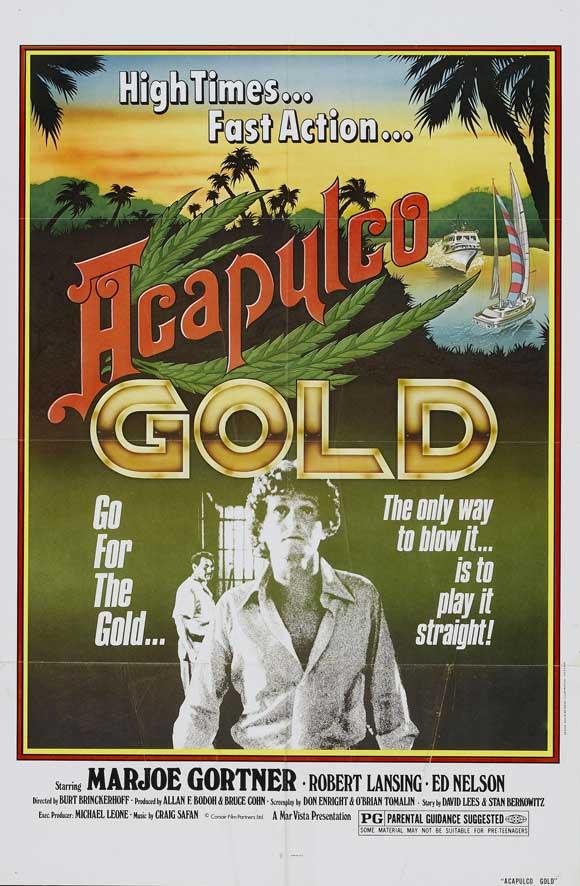
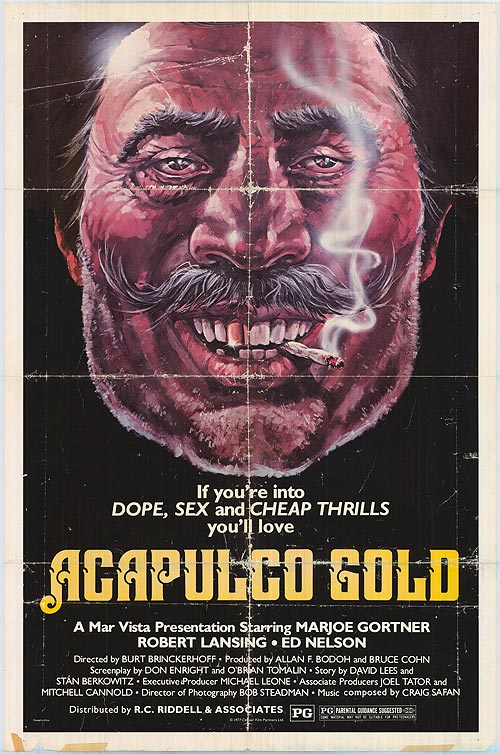
I just finished watching Acapulco Gold, a rather goofy 1976 film about …. well, who knows?
The film starts with some well-shot footage of marijuana farmers checking out their crop but then it abruptly abandons all of that to follow an American insurance salesman named Ralph Hollio (Marjoe Gortner). Ralph is at an airport in Acapulco, waiting to board a flight back to America. He’s approached by a nun who asks him to carry a piñata for her. Ralph says sure but — oh no! — that piñata is actually full of heroin! Ralph’s an unwitting drug mule and not a very good one because it doesn’t take long for him to get himself arrested and sentenced to 40 years in a Mexican prison.
Despite this run of bad luck, Ralph remains surprisingly cheerful. One is tempted to almost describe him as being a Candide-like figure but that would probably be giving this film too much credit. In prison, he meets another prisoner, a boat captain named Carl Solberg (Robert Lansing). Carl is sprung from jail by local businessman, Morgan Frye (John Harkins). Frye wants Carl to sail a boat from Mexico to Hawaii. Carl agrees but he insists that Morgan also pull some strings so that Ralph can serve as his first mate. Morgan, of course, agrees.
The film’s “action” shifts to Hawaii, where it turns out that Ralph and Carl are being used as a part of a much bigger plot. Or something. To be honest, it’s a bit difficult to figure out just what exactly is going on. Acapulco Gold has a make-it-up as you go along feel to it. Occasionally, it’s amusing. Often, it’s frustrating. As soon as you start to get in any way interested in one storyline, it gets abandoned. The film doesn’t have a plot as much as it has a bunch of scenes that we’re left to assume are meant to be somehow connected.
For instance, there’s an elderly couple who keep showing up at inopportune times, providing what I guess is meant to be comedic relief. At one point, it appears that the couple is surely doomed but, several scenes later, they show up at a golf course and they look none the worse for wear. There are lengthy sailing scenes, mixed in with lengthy helicopter scenes. None of them add much to the plot but the Hawaiian scenery is frequently nice to look at. Ralph falls for Morgan’s girlfriend (Randi Oakes) while a Congressman and a corrupt DEA agent use huge, oversized walkie-talkies to communicate with two people who we occasionally see wandering around in the jungle. There’s a golf cart chase, which ends with a labored joke about a two-strike penalty. And, since this is a low-budget 70s film, there’s a day-for-night sequence that is so ineptly lit that we can barely see anyone for several minutes of the movie. (Though his face may not be visible, one can always spot Marjoe Gortner by his hair. 70s Marjoe had a lot of hair.)
At its best, Acapulco Gold is a charmingly incoherent time capsule, a chance to hop in a time machine and go back to 1976. At its worse, it’s a total mess. That said, it’s short enough that it’s never exactly boring and the randomness of it all occasionally lends the film a dream-like atmosphere (albeit one of those dreams that you forget about after you’ve been awake for 87 minutes). As I previously stated the Hawaiian scenery is lovely and some members of the cast — Robert Lansing and Ed Nelson, in particular — do the best that they can with their inconsistently written characters. The whole thing is such a slapdash affair that it becomes oddly fascinating to watch.
As for the film’s star, Marjoe Gortner was a former child evangelist whose claim to fame was being the subject of Marjoe, a documentary in which he admitted that he didn’t believe in anything that he preached and that he was just scamming people out of their money. Perhaps not surprisingly, Gortner was usually best-cast as villains or unpredictable rogues. (His best performance was as a morally ambiguous space pirate in Starcrash.) In Acapulco Gold, Gortner is playing a normal, ordinary guy who finds himself caught up in the drug underworld. Gortner is miscast as a naive innocent and, instead of projecting any sort of shock over anything tht he experiences, Gortner’s laid back performance suggests that there were multiple reasons why this film was called Acapulco Gold.
Acapulco Gold is currently viewable on Prime. It’s not a particularly good film but Hawaii has always looked great.
Adam McKay has a new movie coming out. It’s called Don’t Look Up and the cast is packed with stars. It’s apparently a comedy about two astronomers who discover that a comet is about to collide with Earth, potentially ending all life as we know it.
Here’s the teaser:
I’m not really a big Adam McKay fan. In fact, I think the last Adam McKay film that I really liked was Anchorman. The Big Short was overrated and smug. Vice was an attempt to destroy Dick Cheney that, instead, rehabilitated the former vice president’s image in the eyes of many. (I mean, seriously, it takes a certain amount of effort to screw up a film that’s only reason for existing was to portray Dick Cheney as being a sinister figure.) Both Vice and The Big Short were victims of McKay’s tendency to try too hard to prove that he’s capable of more than just Anchorman. (Let’s be honest, though. If you had to pick between Anchorman and either of McKay’s Oscar-nominated films, which one are you going for?)
McKay is not a particularly good or clever political satirist but there are people who love his work, largely because they already agree with him. His films are like the progressive, secular version of God’s Not Dead, heavy-handed, predictable, and beloved by people who exist in a very specific social and cultural bubble. Of course, both The Big Short and Vice received several Oscar nominations but that due more to Hollywood agreeing with the film’s politics than the films themselves.
Anyway, the teaser features Leonardo DiCaprio, Jonah Hill, Meryl Streep, and Jennifer Lawrence, all acting up a storm. (These are four talented actors, all of whom really need a director who is willing to say, “Okay, let’s dial it back a little.” Subtlety, of course, is not really a McKay specialty.) I’m not looking forward to this film but I’ll still watch it when it shows up on Netflix. Who knows? Maybe it’ll feel more like Anchorman than Vice. One can only hope!
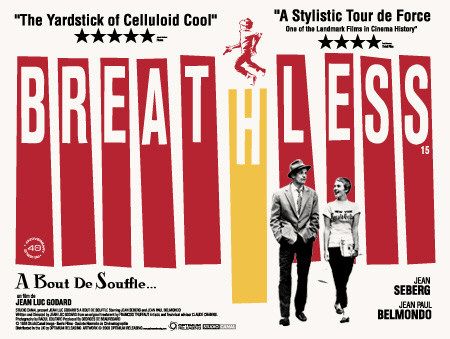
I was saddened to learn of the death of French actor Jean-Paul Belmondo earlier today. He was 88 years old and still an international icon of movie star charisma at the time of his death.
Belmondo spent the majority of his career in France, where he was one of the early faces of the New Wave and also a prominent action star, famed for doing his own very dangerous stunts. In America, he was best-known for his starring turn in Jean-Luc Godard’s Breathless. In Breathless, Belmondo was the perfect existential outlaw, living life day-by-day and obviously doomed but still so incredibly magnetic and stylish.
In tribute to Belmondo, here is a scene that I love, the final moments of Breathless.
Belfast, the latest film from Kenneth Branagh, has been getting rapturous reviews at both the Venice and Telluride Film Festivals. I’ve seen more than one critic say that it’s the first film that they’ve seen over the past few months that they could imagine winning best picture when the Oscars are handed out next year.
And really, I can see their point, even though I have yet to watch the film.
Consider the following:
It’s British.
It’s in black-and-white.
It’s directed by Kenneth Branagh, who some would say is overdue for some Oscar recognition.
It’s a personal film from one of the world’s leading Shakespeareans.
Even though it’s a personal film, it’s also a film about the troubles in Northern Ireland in the 70s and therefore, it’s a film that can probably be interpreted as commenting upon the divisions of the present.
It’s got an amazing cast.
It’s a period film.
Did I mention it’s in black-and-white?
As I said, I haven’t seen the film yet. But the trailer looks amazing so I can’t wait until I do!
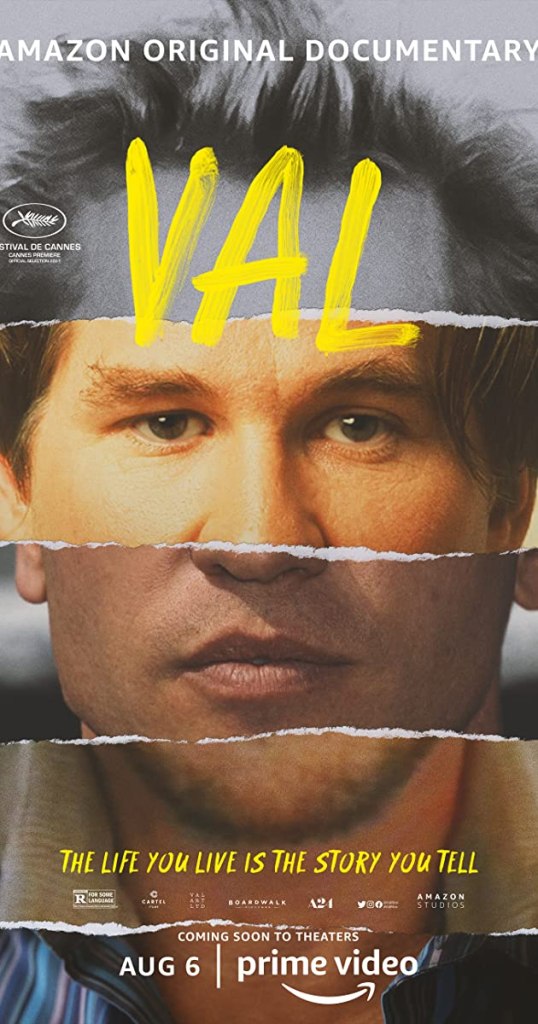
Throughout the documentary Val, modern-day Val Kilmer continually assures us that he feels better than he looks.
It’s a sad statement to hear, not just because Val Kilmer is himself admitting that he doesn’t look particularly healthy but also because it shows that Kilmer is very aware that many viewers will take one look at him and believe that his time has passed. Val Kilmer went from being a rising star in the 80s and the 90s to being a Hollywood outcast, largely due to a reputation for being eccentric and difficult to work with. While his legions of fans remembered and continued to celebrate Val Kilmer as Iceman, Jim Morrison and Doc Holliday in Tombstone, the real-life Kilmer was aging, struggling financially, and often appearing in movies that were ignored by the same public who loved his old films. Kilmer started to make a comeback by playing Mark Twain in an acclaimed one man show but a battle with throat cancer left him without his voice and the ability to feed himself. No, Kilmer doesn’t look particularly healthy in Val but, as quickly becomes apparent, his mind is as sharp as ever.
Val is really two documentaries in one. Half of the film is made up of footage of the young Val Kilmer, much of it shot by Kilmer himself. We see him hanging out with an impossible young-looking Sean Penn. We also see some behind-the-scenes footage of Tom Cruise in Top Gun and we’re left to wonder how Tom Cruise can look exactly the same in 2021 as he did in 1986. Kilmer, it turns out, was obsessive about filming his life, leaving you to wonder how much of it was about recording events and how much of it was about maintaining a wall between him and anyone who might get too close. (By filming everything, Kilmer made sure that no one stopped acting.) In the late 80s and early 90s, Kilmer went so far as to film unsolicited audition tapes for the directors with whom he wanted to work. There’s a touching earnestness to the three auditions he filmed for Stanley Kubrick while his attempts to convince Martin Scorsese to cast him in Goodfellas led to Kilmer apparently making a mini-gangster film of his own. In the footage of the young Kilmer, there’s a mix of good-natured arrogance along with an eagerness to please. Kilmer knew he was handsome and he knew he was talented but you get the feeling that what he really wanted were for his filmmaking heroes to acknowledge those things.
The other half of the film features the older Kilmer, humbled by poor health and years of personal struggles. This the Kilmer who can only speak in a rasp of a whisper. The film follows him as he goes from convention to convention, singing pictures for fans who inevitably ask him to write down catchphrases from either Top Gun or Tombstone. Kilmer says that a part of him hates having to work the circuit but, at the same time, he’s obviously and sincerely touched to have so many fans. In one of the films most powerful moments, the older Kilmer watches the younger Kilmer in Tombstone. Though the modern-day Kilmer insists that he’s doing better than he looks, it’s obvious that he’s now very much aware of his own mortality and there are parts of the film that come dangerously close to sounding like a premature eulogy. But when Kilmer watches himself as Doc Holliday, it’s obvious that Kilmer knows that, no matter what the future holds, his performances will live forever.
That said, I imagine that there are a lot of people who will watch this film just to see what Kilmer has to say about his legendary reputation for being difficult. Kilmer admits to being a perfectionist and he says that he sometimes pushed too hard. There’s a montage of various entertainment reporters, all reporting on Kilmer being “difficult” on the sets of Batman Forever and the Island of Dr. Moreau. Kilmer, himself, however doesn’t seem to view himself as being unnecessarily difficult and why should he? While other may have called him eccentric, one gets the feeling that Kilmer would simply say that he was just being himself.
Kilmer reveals a lot about himself and his career in Val. At the same time, it’s obvious that there are still certain walls that he will never completely let down. When he discusses his family and his childhood, it’s with a mix of regret and a need to believe that things really weren’t as bad as he remembers them being. He talks about how his family fell apart after the death of his brother. His father walked out on the family and, after Val became a star, cheated his son out of a fortune. One would expect Val to rail against his father but instead, Kilmer just accepts it as something that happened. Still, the amateur psychologist will be tempted to say that a lot of Val’s perfectionism came from his desire to please his father. (When Kilmer discusses Iceman in Top Gun, he says that he imagined that Iceman’s competitive nature came from having a father who was never happy with him.) Perhaps the documentary’s most revealing moment comes when we listen to audio of Val Kilmer arguing with director John Frankenheimer on the troubled set of The Island of Dr. Moreau. Kilmer says that he can’t do the scene because he’s too upset over Frankenheimer saying that he was considering walking off the picture. At that moment, one gets the feeling that the film set represented the childhood that Kilmer wanted and working with directors like Frankenheimer and Joel Schumacher threw him back into the mindset of the teen who watched his father walk away when things got too difficult.
Val is a documentary that sticks with you, a mediation of fame, aging, regret, and mortality. (Let it sound too sad to watch, rest assured that Val Kilmer does have a sense of humor and it is on display in the film.) Here’s hoping that Val Kilmer is with us and being difficult for a long time to come.
 Through the Shattered Lens