In the Line of Duty: A Cop For The Killing (1990, directed by Dick Lowry)


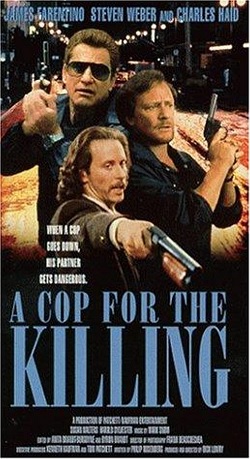
When an undercover narcotics operation goes wrong, a veteran cop (Charles Haid) is killed.  While the cop’s killer goes on trial, the members of the undercover squad struggle to deal with their feelings about what has happened.  The head of the squad (James Farentino) struggles with how much emotion he can show while still remaining a leader.  As his ex-wife puts it, he’s so busy staying strong for everyone else that he hasn’t been able to deal with his emotions.  Meanwhile, the dead cop’s partner (Steve Weber) has the opposite problem and starts to take dangerous risks on the job.  When it looks like the killer might get a plea deal from the district attorney, both Farentino and Weber are forced to come to terms with Haid’s death and their own feelings of anger and guilt.

In the early 90s, there was several “In the Line of Duty” films made for NBC.  They were all based (often loosely) on true stories and they dealt with members of the law enforcement who died while on the job.  The best known of these was probably Ambush in Waco, which went into production while the Branch Davidian siege was still ongoing.

A Cop For The Killing was the second of the In The Line of Duty films.  Unlike the later films in the series, it didn’t deal with a nationally-known case.  Instead, it just focused on one squad of cops and how the death of a member of the squad effected them.  With its ensemble of familiar television actors and Dick Lowry’s efficient but not particularly splashy direction, it feels more like a pilot than an actual movie.  Even though this film features the cops opening up about their feelings, there’s not much to distinguish it from other cop shows of the period.  If someone digitally replaced Steven Weber with Fred Dryer, it would be easy to mistake A Cop For The Killing for a two-hour episode of Hunter.  As with all of the In The Line of Duty films, there are a few scenes designed to show the comradery of the members of the squad but it again all feels too familiar to be effective.  Before Charles Haid dies, he and Steven Weber hang out at a bar and wrestle.  After Haid dies, Weber hangs out at a strip club that’s safe for prime time.  Judging from 90s television cop shows, undercover detectives were solely responsible for keeping most strip clubs profitable.

The cast is adequate.  Farentino is believable as the emotionally withdrawn commander.  Charles Haid makes the most of his limited screen time.  Tony Plana plays a smug drug lord who smiles even when he’s being booked.  It takes a while to adjust to Steven Weber playing a serious role but his courtroom meltdown is the movie’s highlight.  In The Line of Duty: A Cop For The Killing may not have led to a television series featuring Farentino and Weber taking down the bad guys but it did lead to another In The Line of Duty movie that I will take a look at tomorrow.

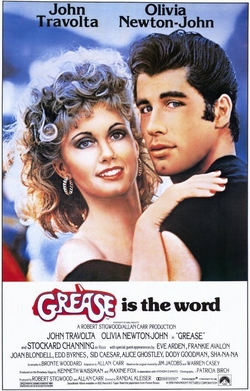
Scenes That I Love: Olivia Newton-John and John Travolta Perform You’re The One That I Want From Grease


I just read that Olivia Newton-John passed away earlier today.  She was 73 years old.

Here she is, performing You’re The One That I Want with John Travolta at the climax of 1978’s Grease.  No matter what else you may think about this film (and, to be honest, it’s not one of my favorite musicals, just because of the way that director Randal Kleiser framed most of the dance numbers), you can’t deny that both Olivia and Travolta poured their hearts into this climax.

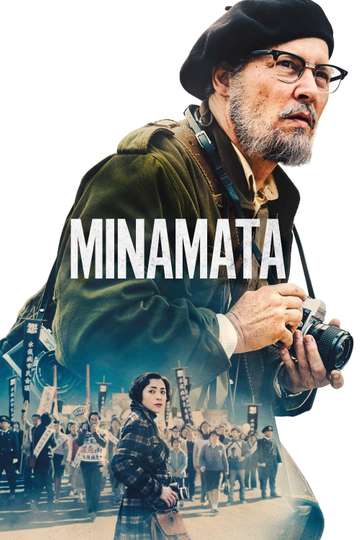
Film Review: Minamata (dir by Andrew Levitas)


In Minamata, Johnny Depp plays Eugene Smith, a real-life photographer who found fame taking pictures for Life Magazine.  Taking place in 1971, the film opens with Smith famous but burned out.  He spends most of his time in his run-down apartment or walking the streets of New York.  His camera is always with him, a tool of both his art and a symbol of his detachment.  Smith can capture the world in a photograph but he’s still not sure that he wants to be a part of it.  Smith is outspoken, eccentric, and ultimately a bit of an idealist who hides behind a cloak of cynicism.

When Smith is asked to come to the Japanese city of Minamata so that he can photograph the effects of Mercury poisoning on the citizens, he agrees to do so.  Armed with only his camera and aided only by his translator, Aileen (Minami), Smith discovers a community that has been ravaged by environmental pollution.  Smith tries to bring the story of Minamata to the world, despite the efforts of one of Japan’s largest corporations to silence him.

As far as films go, Minamata isn’t bad.  It feels a lot like a throwback to the old social problem films of the late 70s and the early 80s.  Watching the film, it was easy to draw comparisons to similar films like The China Syndrome, Silkwood, A Civil Action, Erin Brockovich, and even Promised Land.  Like the characters at the heart of those films, Eugene Smith is an unlikely crusader but when he sees a heartless corporation destroying lives, he feels that he has no choice but to act.  The film’s narrative momentum occasionally sputters and there are a few too many scenes of Smith haranguing his editor but the film’s heart is in the right place.  Johnny Depp gives a surprisingly sincere performance as Eugene Smith, playing him as someone who is a bit of a natural screw-up but who still wants to make the world a better place.  The film’s best scenes are the ones in which Smith tries to convince the camera-shy villagers to allow him to document what’s happening to them.  Minamata is at its best when it just allows Depp (as Smith) to interact with other people.

Of course, by this point, Minamata is probably best known for the drama that went on behind-the-scenes.  Minamata was filmed in 2019 and made its debut at the Berlin International Film Festival in February of 2020.  Distribution rights were eventually purchased by MGM and it was originally slated to be released in 2021.  However, after Amber Heard accused Depp of domestic abuse, MGM took the film off of its schedule.  Due to the bad publicity surrounding Depp, it appeared that the film would be buried.  Depp’s fans reacted by voting for Minamata to win the Oscars Fan Favorite contest.  Though Minamata ultimately came in third place, that’s a good showing for a film that hardly anyone had seen and which hadn’t even been distributed in the United States.  The victory of the Snyder Cut may have gotten all the attention but Minamata‘s strong showing served to remind Hollywood that, despite the accusations, Johnny Depp still had a strong fanbase.

It’s tempting to say that Minamata got its release due to the outcome of the Depp/Heard libel trial.  It was actually released on Hulu while the trial was still going on.  Though Minamata is probably destined to be mostly remembered as a footnote in Oscar history, it is a film that shows that Johnny Depp can still give a good performance when he has the right material.

Homicide: The Movie (2001, directed by Jean de Segoznac)


Before The Wire, there was Homicide: Life On The Streets.

Based on a non-fiction book by the Baltimore Sun’s David Simon, Homicide: Life on the Streets aired for seven seasons on NBC, from 1993 to 1999. For five of those seasons, Homicide was the best show on television. Produced and occasionally directed by Barry Levinson, Homicide was filmed on location in Baltimore and it followed a group of Homicide detectives as they went about their job. From the start, the show had a strong and diverse ensemble, made up of actors like Andre Braugher, Ned Beatty, Jon Polito, Melissa Leo, Kyle Secor, Clark Johnson, Richard Belzer, Daniel Baldwin, and Yaphet Kotto. When Polito’s character committed suicide at the start of the third season (in a storyline that few other shows would have had the courage to try), he was replaced in the squad by Reed Diamond.

Homicide was a show that was willing to challenge the assumptions of its audiences. The murders were not always solved. The detectives didn’t always get along.  Some of them, like Clark Johnson’s Meldrick Lewis, had such bad luck at their job that it was cause for alarm whenever they picked up the ringing phone. As played by Andre Braugher, Frank Pembleton may have been the most brilliant detective in Baltimore but his brilliance came with a price and his non-stop intensity even led to him having a stroke while interrogating a prisoner. Kyle Secor played Pembleton’s partner, Tim Bayliss.  Bayliss went from being an idealistic rookie to a mentally unstable veteran murder cop in record time, spending seven seasons obsessing on his first unsolved case. Homicide dealt with big issues and, much like its spiritual successor The Wire, it refused to offer up easy solutions.

Despite the critical acclaim and a much hyped second season appearance by Robin Williams (playing a father who was outraged to hear the detectives joking about the murder of his family), Homicide was never a ratings success. After five seasons of perennially being on the verge of cancellation, the producers of Homicide finally caved into NBC’s demands.  The storylines became more soapy and the cases went form being random and tragic to being what the detectives had previously dismissively called “stone cold whodunits.”   New detectives joined the squad and the focus shifted away from the more complex veterans. Not only did this not improve ratings but also those who had been watching the show from the start were not happy to see Pembleton and Bayliss being pushed to the side for new characters like Paul Falsone (Jon Seda) and Laura Ballard (Callie Thorne). Falsone, in particular, was so disliked that there was even an “I Hate Falsone” website. At the end of the sixth season, Andre Braugher left the show and that was the end. The seventh season limped along, with Bayliss growing increasingly unstable.  The show ended with the implication of Bayliss turning into a vigilante and resigning from the Baltimore PD. It was not a satisfying ending. Richard Belzer’s John Munch moved to New York and became a regular on Law & Order: SVU but the rest of the detectives and their fates were left in limbo.

Fortunately, on February 13th, 2000, NBC gave Homicide another chance to have a proper conclusion with Homicide: The Movie.

Homicide: The Movie opens with a montage of Baltimore at its best and its worst, a reminder that Homicide never abandoned the city that had supported it for seven years.  While other shows recreated New York or Chicago on a soundstage, Homicide was always an authentic product of Baltimore. Lt. Al Giardello (Yaphet Kotto) is now running for mayor on a platform calling for drug legalization. When Giardello is shot at a campaign stop, all of the current and former members of the Homicide Unit come together to investigate the case.   While Giardello fights for his life, Pembleton and Bayliss partner up for one final time.

Homicide: The Movie fixes the main mistake that was made by the final two seasons of the show. Though all of the detectives get their moment in the spotlight (and all true Homicide fans will be happy to see Richard Belzer and Ned Beatty acting opposite each other for one final time), the focus is firmly on Pembleton and Bayliss. It doesn’t take long for these two former detectives, both of whom left the unit for their own different reasons, to start picking up on each other’s rhythms. Soon, they’re talking, arguing, and sometimes joking as if absolutely no time has passed since they were last partnered up together. But, one thing has changed. Bayliss now has a secret and if anyone can figure it out, it will be Frank Pembleton. What will Pembleton, the moral crusader, do when he finds out that Bayliss is now a killer himself?

The movie follows the detectives as they search for clues, interview suspects, and complain about the state of the world.  However, in the best Homicide tradition, the investigation is just a launching point to investigate what it means to be right or wrong in a city as troubled as Baltimore.  In the movie’s final half, it becomes more than just a reunion movie of a show that had a small but fervent group of fans. It becomes an extended debate about guilt, morality, and what it means to take responsibility for one’s actions. The final few scenes even take on the supernatural, allowing Jon Polito and Daniel Baldwin a chance to appear in the reunion despite the previous deaths of their characters.

Despite being one the best shows in the history of television, Homicide: Life on the Streets is not currently streaming anywhere, not even on Peacock.   (Considering how many Homicide people later went on to work on both Oz and The Wire, it would seem like it should be a natural fit for HBOMax.) From what I understand, this is because of the show’s signature use of popular music would make it prohibitively expensive to pay for the streaming rights. Fortunately, every season has been released on home video.   Homicide: The Movie is on YouTube, with the music removed.  The movie’s final montage is actually more effective when viewed in complete silence.

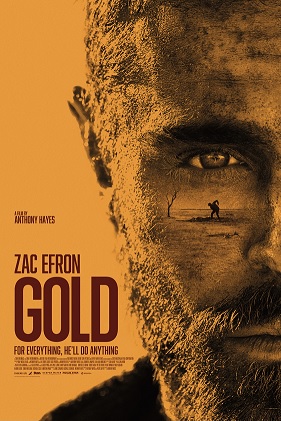
Film Review: Gold (dir by Anthony Hayes)


If you’ve ever wanted to see Zac Efron covered in flies, Gold is the film for you!

Actually, I’m being perhaps a bit more snarky than I should be.  Gold is actually a pretty good movie and Zac Efron deserves a lot of credit for trying something different.  That said, when all is said and done, I think the thing that most people will remember about this movie will be the flies.  Efron plays a character who spends several days stranded in the desert.  As we all know from watching any of the films that Clint Eastwood made with Sergio Leone, the desert is full of flies and there’s nothing they like more than to land on the blisters on someone’s sun-baked face.  So, it makes sense that Efron spends the majority of the film dealing with flies.  Of course, he also has to deal with feral desert dogs, a mysterious stranger who may or may not exist, and a freak dust storm.

Gold takes place in the near future.  Gold was filmed in Australia and, in many ways, it seems to take place in the same cinematic universe as the first Mad Max.  It’s the early days of a dystopia, when there’s still enough comforts around for people to pretend that things can still be normal.  People still watch television.  They still drive cars.  They still use telephones.  There’s still some sort of government that is supposedly in charge of things.  Society still exists but all around are clues that it is in the process of collapsing.  Things are on the verge of changing and they won’t be for the better.

Zac Efron plays Virgil, a man who wants to go to some place known as the Compound.  Keith (played by Anthony Hayes) has been hired to drive Virgil through the desert.  From the start, Keith and Virgil don’t get along.  Keith gets angry at Virgil for wasting water.  He gets even angrier when Virgil turns up the air conditioning in Keith’s truck and causes the motor to overheat.  However, when Keith and Virgil come across a giant gold nugget in the desert, they become reluctant partners.  When Keith heads to another town to get an excavator so they can dig up the gold, Virgil remains in the desert.  His job is to guard the gold, though one has to wonder who he thinks he’s guarding it from.  Virgil is literally in the middle of nowhere.

Keith leaves Virgil with a set of instructions of how to survive in the desert.  However, within hours of Keith leaving, Virgil starts to lose it.  He doesn’t have enough water.  He doesn’t have enough food.  Keith has taken the truck so it’s not like Virgil could go anywhere, even if he was willing to abandon the gold.  There are feral dogs all around.  There are flies on Virgil’s face.  And there are other scavengers in the desert as well….

There’s really not much of a story to Gold.  Virgil waits in the desert and loses his mind, all because he’s not willing to surrender that gold.  He’s a victim of his own greed, which admittedly is not the most original idea in the world.  (Consider the case of Fred C. Dobbs, for instance.)  That said, you do have to admire Efron’s willingness to allow himself to look absolutely terrible on screen.  From the flies to the dust storm to the scorching sun, the film goes out of its way to destroy Efron’s good looks but there’s a bigger meaning to it beyond Efron’s well-known desire to be taken seriously as an actor.  With each fly and speck of dust that lands on Efron’s face, Gold reminds the viewer that the desert will always win.  The desert and the animals that call it home don’t care about gold and they certainly don’t care about their prey.  In the desert, it’s all about survival.  Civilization may collapse but the desert will remain forever.

Visually, there’s a harsh beauty to Gold.  The desert is both frightening and fascinating at the same time and the scenes of Efron frame against the landscape really do drive home the film’s point.  One way or the other, the desert will always win.

What Could Have Been: George Hamilton as Travis Bickle?


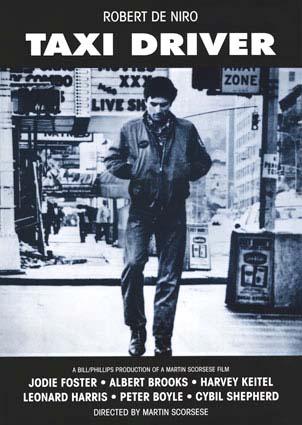
I was recently reading the IMDb trivia page for Martin Scorsese’s 1976 film, Taxi Driver. 

Taxi Driver is often held up as the being the ultimate New York horror story as well as being the quintessential Martin Scorsese/Robert De Niro collaboration.  In fact, the film is so identified with Scorsese, De Niro, and screenwriter Paul Schrader that it is easy to forget that it actually took a while for Scorsese and De Niro to become involved with the project.  Quite a few different directors showed interest in Schrader’s script before Scorsese signed on.  And, even though the role will always be associated with him, De Niro was not the only actor considered for the role of Travis Bickle.

That’s what brought me to the IMDb trivia page.  I wanted to see who else was considered for the role of Travis.  Here’s the list that I found: Jeff Bridges, Jack Nicholson, Dustin Hoffman, Warren Beatty, Burt Reynolds, Ryan O’Neal, Peter Fonda, Al Pacino, Jon Voight, Robert Blake, David Carradine, Richard Dreyfuss, Christopher Walken, Alain Delon, James Caan, Roy Scheider, Paul Newman, Marlon Brando, Martin Sheen, Elliott Gould, Alan Alda, and George Hamilton.  That’s quite a list!  And. for the most part, I don’t buy it for a second.

Don’t get me wrong.  It is known that Al Pacino was sent the script before Scorsese came on board.  And Scorsese himself has said that he offered the role to Dustin Hoffman.  (Hoffman says he turned down the role because Scorsese’s intensity freaked him out.)  Jeff Bridges was also a possibility and, if you read Schrader’s script and force yourself to forget about De Niro’s performance, you can actually imagine Bridges in the role.  I could also imagine a youngish Martin Sheen in the role.  He had just played Charlie Starkweather in Badlands so one can imagine him being considered for Travis.  Peter Fonda and Robert Blake seem possible as well.  Even David Carradine.

But some of the other names on that list …. Alain Delon?  Paul Newman?  Alan Alda?  GEORGE HAMILTON?

This George Hamilton?

Listen, I like George Hamilton.  He’s a good comedic actor.  And I know that there were a lot of directors who took a look at Paul Schrader’s script and I also know that some of Travis’s most iconic moments — like the whole “You talkin’ to me?” scene — were improvised by De Niro and were not in the original script.  Taxi Driver could have gone in a lot of different directions.  But I’m just going to say right now that there is no way that George Hamilton was ever considered for the role of Travis Bickle.  It’s totally possible that Hamilton was considered for another role in the film.  I could imagine him as the presidential candidate, Charles Palantine.  I could also imagine him in the role of Tom, Palantine’s campaign manager.  Perhaps he was offered one of those roles and someone, reading that George Hamilton had turned down Taxi Driver, got it into their head that he was considered for Travis.

Or maybe …. someone just made the whole thing up.  I enjoy the IMDb trivia pages but I’ve come across a lot of information that simply is not true.  Despite what the page for the original Halloween says, I refuse to believe that John Belushi was considered for the role of Dr. Loomis.  For that matter, I also refuse to believe that Bill Murray was a runner-up for the role of Han Solo in Star Wars.  Sorry, IMDb trivia people.  I just don’t buy it.
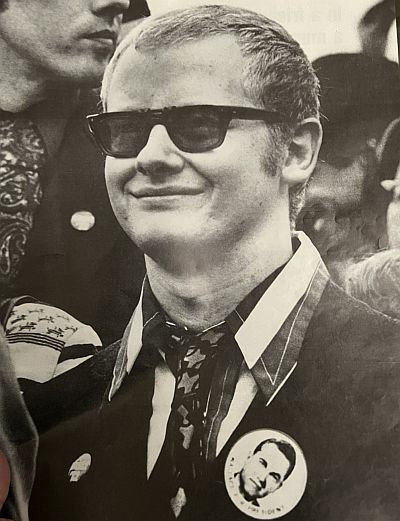
Arthur Bremer

Here’s what we do know.  Paul Schrader was originally inspired to create the character of Travis Bickle by Arthur Bremer, a non-descript 21 year-old Midwesterner who, in 1972, shot and nearly killed presidential candidate, George Wallace.  After the shooting, police turned up a diary in which Bremer wrote about his desire to be someone.  According to Bremer, he shot Wallace not as a political act but because he wanted to be famous.  Schrader later said that, while writing the script, the story became less about Bremer and more about Schrader’s own social isolation.

The script was optioned by the production team of Tony Bill and Julia and Michael Phillips.  They had just recently produced the Oscar-winning The Sting.  Originally, Tony Bill wanted to make his directorial debut with the film.  That was when the script was sent to Al Pacino.  Pacino turned down the role, reportedly because he didn’t want to work with a first-time director.  (Tony Bill, a former actor, later directed several films, most of which appeared to be taking place in a totally separate universe from Schrader’s vision of urban Hell.)

The script was eventually read by Brian De Palma, who voiced an interest in directing the film.  DePalma’s choice for the role of Travis Bickle?  Jeff Bridges.

Today, it might be hard to imagine the affable, laid-back Jeff Bridges as Travis Bickle but, if you read the script, it’s easy to see why De Palma considered him for the role.  Travis was written as being someone from the middle of the country, someone who was out-of-place in New York City.  Travis was meant to be lost in New York.  (Though Travis does say that he’s from the midwest in Scorsese’s film, Robert De Niro himself remains the prototypical New Yorker.)  At least initially, Bridges would have been a bit less obviously unstable than De Niro.  As good as Taxi Driver is, it always seems a bit strange that Betsy would agree to go out with De Niro’s Travis but it’s a bit easier to believe that she would take a chance on Jeff Bridges, with his charming smile and likable manner.  Bridges’s descent into madness would have been all the more devastating because he was such an outwardly affable presence.  I’m not saying it would have worked but I can still see what De Palma would have been going for in his version of Taxi Driver.

That said, De Palma did not make Taxi Driver.  He instead decided to do Carrie.  A young Steven Spielberg briefly showed interest in Taxi Driver (the mind boggles) before decided to do Jaws instead.  Eventually, after being introduced to Schrader by De Palma, Martin Scorsese agreed to direct the film.  After getting turned down by Dustin Hoffman, Scorsese offered the role to De Niro.
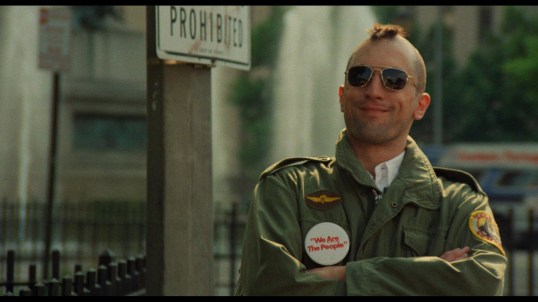
As for the rest of the cast, Rock Hudson would have been an interesting choice for the role of Sen. Palantine but he turned down the script because he was busy with a television show.  There was also some talk of casting former New York Mayor John Lindsay in the role but, in the end, the role was given to a writer named Leonard Harris.

The role of Tom was originally offered to Harvey Keitel.  Because Keitel wanted to play the pimp, Albert Brooks ended up as Tom.  Because there wasn’t much to Tom in the script, it was felt that, as a comedian, Brooks could bring some sort of life to the character.  Indeed, Brooks reportedly improvised the majority of his lines.

Despite the fact that producer Julia Phillips wanted to cast Farrah Fawcett in the role, Martin Scorsese selected Cybil Shepherd for the role of Betsy.  If you believe the IMDb, Meryl Streep was offered the role but turned it down.  (If I sound skeptical, it’s because Streep hadn’t even made her film debut at the time that Taxi Driver went into production.)  Glenn Close, Jane Seymour, and Susan Sarandon auditioned for the role.  Mia Farrow reportedly wanted the role but was turned down by Scorsese.

As everyone knows, Jodie Foster played the 13 year-old prostitute, Iris, in Taxi Driver.  A man named John Hinckley, Jr. was so obsessed with Foster’s performance that he went the same route as Travis Bickle and attempted to assassinate the president in an effort to impress her.  Foster, however, was only picked after Scorsese saw several up-and-coming actresses.  Reportedly, due to the success of The Exorcist, Linda Blair was seriously considered for the role.  Tatum O’Neal was also considered, after winning her Oscar for Paper Moon.  Scorsese came close to casting Melanie Griffith but then Tippi Hedren read the script and nixed the idea.  Among the others who supposedly read for Iris: Mariel Hemingway, Jennifer Jason Leigh, Heather Locklear, Kristy McNichol, Carrie Fisher, Ellen Barkin, Kim Basinger, Geena Davis, Michelle Pfeiffer, Brooke Shields, Debra Winger, Rosanna Arquette, Bo Derek, and Kim Cattrall.

Finally, actor George Memmoli was injured on the set of another film, which led to Scorsese playing the passenger who talks to Travis about murdering his wife.
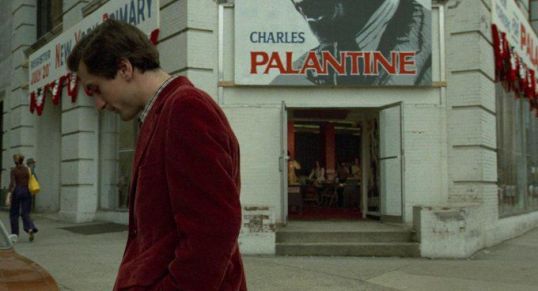
In the end, the right director and the right cast were selected and Taxi Driver became a classic of urban paranoia.  Still, it’s always fun to play What If.  On Earth-2, someone is watching Jeff Bridges, Rock Hudson, Jane Seymour, and Melanie Griffith in Brian De Palma’s Taxi Driver.  And, on Earth-3, George Hamilton is polishing his Oscars and thinking about how playing Travis Bickle changed his life.
4 Shots From 4 Films: Special Nicholas Ray Edition


4 Or More Shots From 4 Or More Films is just what it says it is, 4 shots from 4 of our favorite films. As opposed to the reviews and recaps that we usually post, 4 Shots From 4 Films lets the visuals do the talking!

Director and screenwriter Nicholas Ray was born 111 years ago today, in Galesville, Wisconsin.  He would go on to become one of the most influential American directors of all time, making independently-minded films that celebrated rebels and iconoclasts.  The directors of the French New Wave loved him and for good reason.

Today, we celebrate the life and legacy of Nicholas Ray with….

4 Shots From 4 Nicholas Ray Films

In A Lonely Place (1950, dir by Nicholas Ray, DP: Burnett Guffey)

Johnny Guitar (1954, dir by Nicholas Ray, DP: Harry Stradling)

Rebel Without A Cause (1955, dir by Nicholas Ray, DP: Ernest Haller)

Party Girl (1958, dir by Nicholas Ray, DP: Robert J. Bronner)

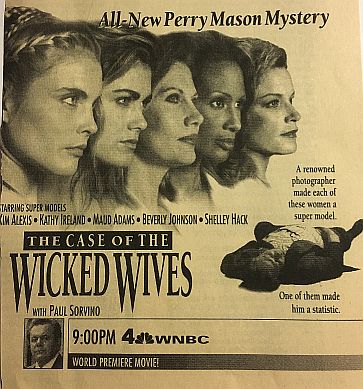
A Perry Mason Mystery: The Case Of The Wicked Wives (1993, directed by Christian Nyby II)


Famed fashion photographer David Morrison (Eric Braeden) has fallen on hard times but things are looking up.  The American Museum of Art wants to do a retrospective of his work.  He just has to get the permission of his current wife, Dee (Kathy Ireland), and his four ex-wives (Shelley Hack, Kim Alexis, Maud Adams, and Beverly Johnson).  All of them are super models who owe their careers to David but four of them hate his guts and Dee isn’t happy when she sees evidence that he has been cheating on her.  When David turns up dead, Dee is arrested.  She claims that she’s innocent but the prosecution is sure that they have an airtight case.

This sounds like a case for Perry Mason!

However, Perry’s out of town so it falls to Perry’s never previously mentioned best friend, Tony Caruso (Paul Sorvino), to solve The Case of the Wicked Wives!  With the help of Perry’s tireless associates, Della Street (Barbara Hale) and Ken Malansky (William R. Moses), Caruso works to solve the case and prove the Dee is innocent.  He also prepares many pasta dinners and frequently sings.

So, where was Perry?  As everyone knows, Raymond Burr played Perry Mason for 9 seasons in the 50s and the 60s.  20 years after the show aired its final episode, Burr returned to the role in a series of highly rated, made for television movies.  Unfortunately, Burr died in 1993 with several movies left to be filmed.  In his will, Burr specifically requested that production on the remaining films continue so that the cast and crew wouldn’t lose their jobs.  Since the role of Mason obviously could not be recast that soon after Burrs’s death, it was decided that the remaining movies would feature guest lawyers.  Enter Paul Sorvino.

The Case of the Wicked Wives was the first Perry Mason film to be made after Burr’s death.  As his replacement, Tony Caruso has much in common with Mason, including the ability to make the guilty confess in open court.  Unlike Mason, Caruso is also obsessed with cooking elaborate spaghetti dinners and singing operatic arias.  This movie came out just a year after Sorvino left Law & Order to specifically pursue his opera career.  Sorvino sings a lot in The Case of the Wicked Wives, sometimes in court.  Unfortunately, a love of singing and pasta are the only two personality traits that are really given to Caruso.  Through no fault of Paul Sorvino’s, Caruso is never as compelling a character as the coolly calculating Mason.  Mason could trick anyone into confessing through perfectly asked questions.  Caruso is more into courtroom stunts that would get most lawyer disbarred.

Because the mystery itself is a dud, the main reason to watch The Case of the Wicked Wives is for the wives.  Who wouldn’t want to keep Kathy Ireland from being wrongly convicted?  All of the wives get at least one big moment to shine and tear up the scenery.  You’ll guess who the murderer is long before anyone else in court.

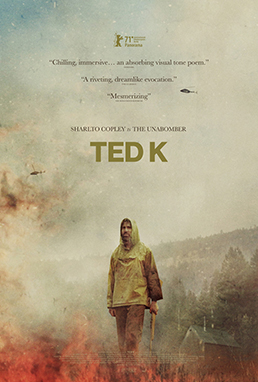
Film Review: Ted K. (dir by Tony Stone)


Ted K. is a film about a man who lives in a cabin in the Montana wilderness.  The man was a child genius who attended Harvard University when he was only 16.  He worked briefly as a professor but, in the early 70s, he started to retreat from society.  He moved into a tiny cabin, one that he had previously built with his brother.  The man’s name is Ted Kaczynski.  He would later be known as the Unabomber.  As of today, he is known as prisoner #04475-046 at a Colorado supermax prison.

When Ted K. begins, Ted (played by Sharlto Copley) has been living in the cabin for close to ten years.  He is usually unshaven and unbathed.  He loves the wilderness but he hates all evidence of technology.  He screams at jets as they fly overhead.  When a group of vacationers ride their snowmobiles across his property, Ted responds by breaking into their house and taking an axe to their snowmobiles.  Ted carries on an inner dialogue with himself, talking about how technology and progress are destroying the world.  He also talks about how he can’t handle the idea of ever having to take orders from a woman.  Ted hunts a rabbit and then thanks its spirit for giving up its life so that he could eat.  I’ve never quite understood people who do that.  Is the spirt of the rabbit supposed to be happy that its body is getting eaten just because the schmuck who shot it offered up some halfass prayer?

Sometimes, Ted goes into town and he calls his mom on an old payphone, one that regularly steals his coins.  He usually calls to demand money because Ted is incapable of holding down a job.  Ted yells at his mom, blaming her for his lack of social skills and sexual experience.  Ted swears that he will never again speak to his brother.  Later, Ted calls his brother to beg for money and swears that he will never again speak to their mother.  When he’s not in front of the payphone, he can be found buying tools at the local hardware store.  He also sometimes goes out so that he can peep through windows and point his rifle at anyone who he sees.  He gets especially upset when he sees a man and woman about to make love.  Little seems to anger Ted more than knowing that there are actually happy people in the world.

In short, Ted Kaczynski is a loser, an incel who is bitter about having never been able to get his once promising life together.  He hates everyone, with the exception of the always-sympathetic girlfriend who pops up in his fantasies.  Every loser needs someone or something to blame and Ted challenges his self-loathing and his sexual frustration into rage against modern society.  When he first appears in the film, Ted has already made his first bomb.  As the film progresses, he starts to send his bombs out.  Some, he mails.  Some, he leaves sitting in front of computer stores and university buildings.  Eventually, he becomes the most wanted man in the country but Ted has an offer to make to the authorities.  If they just let him publish his manifesto, he’ll call of his reign of terror….

Ted K tells the story of Kaczynski’s life in Montana, often using passages lifted straight from Kaczynski’s journals to illustrate his inner thoughts.  It’s an interesting film because, on the one hand, it’s clearly sympathetic to Kaczynski’s feelings about technology.  The film starts with a slow motion shot that makes the snowmobiles plowing through Montana wilderness look like an invading, faceless army.  Shots of blissful and silent nature are contrasted with shots of lumber mills, airplanes, and humming electrical wires.  On the other hand, the film never makes the mistake of trying to turn Kaczynski himself into a heroic character.  Ted is a creep from the minute that he first appears and he assures us in his own words that his main goal is to get revenge on a world that he feels has rejected him.  He’s a misogynist who alienates everyone that he meets and who tries to hide his insecurity behind a projected air of arrogance.  There are a few scenes in which Ted lowers his mask just enough to reveal his loneliness and that he’s someone who is incapable of understanding how communication works.  He desperately wants to be able to talk to people and have someone in his life but he doesn’t know how to do it.  His natural awkwardness gets in the way every time.  Ted turns his anger out on the world.  He may claim that he’s angry with what technology had done to society but the truth of the matter is that he’s angry at a world that has passed him by.  Retreating to a cabin to seek enlightenment is charming when someone is in their 20s but far less impressive when that person is nearly 40.

With a two-hour running time, Ted K runs a bit long.  The film’s final 30 minutes seem to move slowly, largely because we already know how the story is going to end.  That said, Sharlto Copley makes Ted into a compelling character without ever making the mistake of trying to make him sympathetic.  Director Tony Stone and cinematographer Nathan Corbin gives us some truly striking shots of the Montana wilderness.  (At the very least, one can see why Ted would view it as being a potential paradise.)  Blanck Mass provides a wonderfully ominous score, one that puts the viewer straight into Ted’s mind.  Ted K deserves credit for both its refusal to idealize Kaczynski and also its attempt to understand just what exactly causes him to take the actions that he did.  It makes for a valuable study of a man who has influenced terrorists on both the Left and the Far Right.

Incidentally, I once took a philosophy class where the TA was a huge Kaczynski fan.  He suggested that everyone read the Unabomber Manifesto and “judge it by what it says, not what the author did.”  I couldn’t get past the first paragraph.

4 Shots From 4 Films: Special Andy Warhol Edition


4 Or More Shots From 4 Or More Films is just what it says it is, 4 shots from 4 of our favorite films. As opposed to the reviews and recaps that we usually post, 4 Shots From 4 Films lets the visuals do the talking!

On this date, 94 years ago, Andy Warhol was born.  Today, we mark this occasion with….

4 Shots From 4 Andy Warhol Films

Empire (1965, dir by Andy Warhol)

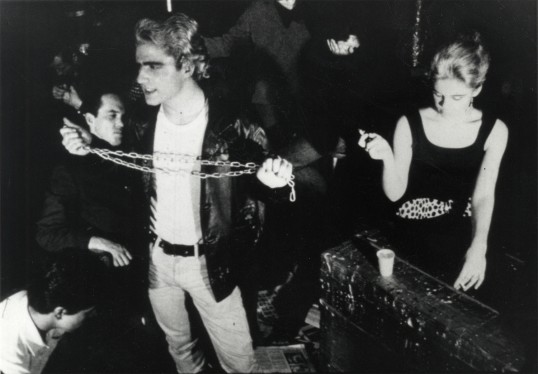
Vinyl (1965, dir by Andy Warhol)

Poor Little Rich Girl (1965, dir by Andy Warhol)

Chelsea Girls (1966, dir by Andy Warhol and Paul Morrissey)