Lisa Reviews An Oscar-Nominated Horror Film: Jaws (dir by Steven Spielberg)


JAWS_Movie_poster

There’s little that is more intimidating than trying to write a review of the 1975 best picture nominee, Jaws.

I mean, seriously, what’s left to be said about this film?  Jaws is one of those movies that everyone has seen and everyone loves.  And, even if someone somehow hasn’t seen the film, chances are that they still know all about it.  They know that it’s a movie about a giant shark that attacks Amity Island, just as the summer season is starting.  They know that the town’s mayor refuses to close the beaches, because he doesn’t want to lose the tourist dollars.  They know that the final half of the film is three men (Roy Scheider, Richard Dreyfuss, and Robert Shaw) floating around in a boat, searching for a shark.  And they certainly know that, whenever you hear John Williams’s iconic theme music, it means that someone is about to get attacked.

Jaws is such a part of our culture that probably not a single day goes by without someone saying a variation on “we’re going to need a bigger boat.”  Did you know that, on twitter, Ben Gardner’s boat has its own account?  And despite getting pretty graphically dismembered about halfway through Jaws, poor little Alex Kintner has an account as well!

What’s amazing about Jaws is that, even though everyone’s seen it and it’s been parodied a few thousand times, Jaws remains incredibly effective.  I still find myself cringing whenever the shark catches Alex Kintner and that geyser of blood explodes out of the ocean.  I still jump whenever the shark suddenly emerges from the water and scares the Hell out of Roy Scheider.  I still laugh at Richard Dreyfuss’s hyperactive performance and I instinctively cover my ears whenever I realize that Robert Shaw is about to drag his nails across that chalk board.

And then there’s that music, of course!  Even after being used, misused, and imitated in countless other films, the Jaws theme still fills me with a sort of existential dread.  The mechanical shark was notoriously fake-looking and was rarely seen onscreen as a result.  The camera and the music stand in for the shark and it works beautifully.

The one unfortunate thing about Jaws is that it’s been so critically acclaimed and so embraced by audiences that I think people tend to forget that it is primarily a horror film.  Mainstream critics tend to look down on horror as a genre so, rather than admit the obvious, they claim that Jaws is more of a thriller than a horror film.  Or they talk about how it’s actually meant to be a political allegory or an environmental allegory or an examination of male bonding.

So, let’s just make this clear.  No matter what the elitist critics or even Steven Spielberg himself may say, Jaws is primarily a horror film, with that relentless killer shark serving as a prototype for such future horror fiends as Michael Myers, Jason Voorhees, Freddy Krueger, and both of the Ghostface and Jigsaw Killers.  (Jaws even opens with a stereotypical slasher movie death, as a nude and stoned swimmer is suddenly attacked by an unseen killer.) If not for Scheider, Shaw, and Dreyfuss floating in the endless ocean, you would never have had films — like the Blair Witch Project — about people being lost and stalked in the wilderness.  And when that shark attacks and graphically rips apart its victims, how different is it from something you might find in a George Romero or Lucio Fulci zombie film?

On the basis of Jaws and Duel, I think it can be argued that, if Steven Spielberg hadn’t become America’s favorite director of crowd-pleasing, Oscar-contending blockbusters, he could have been one of our best horror directors.  Sadly, Spielberg has pretty much abandoned horror and I doubt that Jaws would be as effective if it were made today.  (I suspect that the temptation to resort to a cartoonish CGI shark would be too great.)

But that’s all speculation.

What matters is that Jaws remains one of the greatest films ever made.

And it’s a horror film!


Horror On The Lens: It! (dir by Herbert J. Leder)


For today’s Horror on the Lens, we are happy to present It!, a Hammer-style British horror film from 1966.

In It!, Roddy McDowall plays Arthur Pimm.  Arthur works as an assistant at a museum and, needless to say, he’s eager to move up in his profession.  There’s nothing unusual about that.  And I guess you could argue that, while it’s certainly not ideal, it’s not necessarily unusual that Arthur still lives with his mother.  What is unusual is that Arthur’s mother happens to be dead.

That right — Arthur is totally and completely insane.

As you can probably guess, Arthur is probably the last person who should have control of the immortal and indestructible Golem.  But that’s exactly what happens!  Soon, Arthur is using the Golem to kill his enemies and kidnap the woman that he loves.

Needless to say, things end with a bang.

Along with being a time capsule of 1966, It! is worth watching for Roddy McDowall’s memorably unhinged lead performance.

Halloween Havoc!: THE HOUSE OF SEVEN CORPSES (TCA, 1973)


gary loggins's avatarcracked rear viewer

corpses1

TCM is airing THE HOUSE OF SEVEN CORPSES late Friday/early Saturday at 1:30 AM. Do yourselves a favor. Go to sleep. Do not set the DVR. This little opus has nothing to offer. When Faith Domergue gives a film’s best performance, you know you’re in trouble.

corpses2

The movie is much ado about nothing. John Ireland plays a low-budget film director making a horror flick in the spooky old Beal mansion. Faith is his leading lady opposite hammy Charles Macauley (Blacula). John Carradine’s on hand as the house’s caretaker, so you automatically know he’s a red herring. It’s all about the actors reading lines from the Tibetan Book of the Dead, which causes strange things to happen. The only strange thing to happen in the first hour or so is Faith’s cat being found cut in half. Other than that, it’s like swimming through molasses. Seriously, nothing happens until the last ten or fifteen minutes, and when you finally get…

View original post 94 more words

The Daily Horror Grindhouse: The Manipulator (dir by Yabo Yablonsky)


Mickey Rooney is ... THE MANIPULATOR!

Mickey Rooney is … THE MANIPULATOR!

Up until recently, I firmly believed that Love and Other Drugs was the most annoying movie ever made.  But then, a few nights ago, I cracked open my Mill Creek 50 Drive In Movie Classic box set and I watched a little film from 1971.  I was just looking for a horror film to review for October.  Little did I know that I would soon be watching the most annoying movie ever made!

The name of that movie?

The Manipulator.

The star of that movie?

Mickey Freaking Rooney.

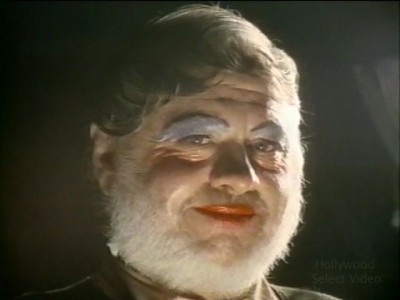
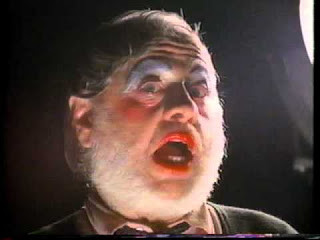
In The Manipulator, Mickey plays B.J. Lang, a former Hollywood makeup artist who has had a mental breakdown.  He now lives in a dusty warehouse, surrounded by old movie props and mannequins.  B.J. spends a lot of time talking to himself and trying on makeup.  Sometimes, he wears a fake nose and pretends that he’s Cyrano de Bergerac.  And then, at other times, he imagines all of his mannequins coming to life and taunting him.  (It’s kind of like the final scene of Maniac, except nobody’s head gets ripped off.)  Occasionally, he has weird flashbacks, which are all about giving the filmmaker an excuse to utilize the fish-eye lens and psychedelic lighting.

Eventually, we learn that BJ (and, as I watched the film, I kept wondering if his name was supposed to make viewers think about oral sex) is not alone in his warehouse.  There’s a woman (Luana Anders) who is being held prisoner.  He has her tied up in a chair and, whenever she begs to eat, he feeds her baby food.  BJ calls her Carlotta, though that’s apparently not actually her name.  The woman yells a lot.  Her first five minutes of screen time consist of her repeating, “MR. LAAAAAAAAAANG” over and over again.

BJ spends most of his time delivering monologues about how Hollywood used to be and occasionally, he demands that Carlotta help him put on a play.  At one point, BJ appears to have a heart attack and this leads to Carlotta going, “DON’T DIIIIIIIIIIIIIIIIIEEEEEE, MR. LAAAAAAAAANG” over and over again.

And then a homeless bum (Keenan Wynn) shows up and wanders about for five minutes before dying.

The problem with writing about a film like The Manipulator is that, just by describing the plot, you make it sound more interesting than it actually is.  You’re probably reading this and thinking, “Wow, this sounds really weird!  I need to see it at least once…”

No, you don’t.  It may sound weird but ultimately, it’s more emptily pretentious than anything else.  This was both director Yabo Yablonsky’s first and final film and there is not a single camera trick that he does not employ.  We get the weird angles, the random moments of slow motion, the even more random moments when the film is suddenly sped up, the extreme close-ups, the sudden blackouts, the ragged jump cuts, and, of course, lots of rack focus and zoom lens use.  Compared to The Manipulator, the direction of Getting Straight appears to be mild and conventional!  The film does feature three talented performers but none of them seem to have the slightest idea what the movie is about or who they are supposed to be playing.  In particular, both Rooney and Wynn seem to be making up their dialogue as they go along.

And really, that’s why The Manipulator is so annoying.  It should have, at the very least, been an insane misfire.  Instead, it’s just boring.

Sorry, Mickey.

Mickey Rooney Again


Icarus File No. 2: Maximum Overdrive (dir by Steven King)


mo

There is exactly one effective sequence to be found in Maximum Overdrive, a horror film from 1986 that attempts to show us what would happen if all of Earth’s machines decided to destroy humanity.

It takes place at the end of a little league game.  The coach, happy that his team has won, declares soda for everyone!  He walks over to the soft drink machine and puts in his coins and…nothing happens.  The coach stares at the machine perplexed.  His team gathers around him.

Suddenly, a can flies out of the machine and hits the coach in the groin.  Coach falls to his knees, just to get another can driven straight into his skull, leaving him with a big bloody hole in his head.  As the coach twitches, his teams starts to run away.  Suddenly, the machine is shooting cans out at them.  Some of the kids escape but quite a few don’t.

Suddenly, as the kids flee, a driverless steamroller crashes through a fence and drives across the field, graphically flattening one of the players…

It’s over-the-top, it’s kind of scary, it’s fun in a naughty sort of way, and it’s exciting to watch.  It’s totally absurd and yet it’s effective at the same time.  It’s a really brilliant scene, one that hints at what Maximum Overdrive could have been.  It hints that Maximum Overdrive‘s first-time director did have some potential and watching it, one is tempted to feel a pang of regret over the fact that he never directed another film after this one.

However, then you watch the rest of Maximum Overdrive and you realize that one effective scene was a total fluke.  To your horror, you realize that this film’s director (and screenwriter) has decided to set nearly the entire film in the ugliest and most disgusting truck stop in the world.  You realize that the director has no idea how to maintain suspense and that his idea of horror appears to be having a lot of trucks constantly circling the truck stop.  And then, worst of all, you realize that the unlikable caricatures inside the truck stop are meant to be our heroes!

And you find yourself wondering if things could possibly get any worse.  Well, believe me — they can.

First off, a guy named Camp Loman (Christopher Murney) shows up and reveals himself to be a total lech and then starts trying to sell bibles and really, what do you expect from someone named Camp Loman?  And, what’s annoying, is that the film’s director seems to think that he’s blowing our mind by presenting us with an hypocritical bible salesman.  I mean, seriously — the amount of time devoted to Camp Loman will make you nostalgic for scenes of a steamroller crushing a child.

And then Emilio Estevez shows up as our hero but he scowls through the entire movie and delivers all of his lines through gritted teeth, as if he’s pissed off about appearing in Maximum Overdrive and really, who can blame him?  That said, it doesn’t really make for an enjoyable performance.

But hey — Emilio’s not the only person in the truck stop.  There’s also Pat Hingle, playing the owner of the truck stop.  He’s overweight, wears a tie, smokes a cigar, and speaks with a vaguely Southern accent.  Hmmmmm, do you think he’s going to be a bad guy?

Oh!  And let’s not forget the waitress played by Ellen McElduff.  “WE MADE YOU!” she shouts at the machines and then she shouts it again and again and again and again and it’s almost as if the film is being directed by a guy so in love with his own dialogue that he doesn’t realize how annoying the same line gets when it’s screeched over and over again.

And I haven’t even gotten to the helium-voiced newlyweds yet…

When I recently watched Maximum Overdrive on Encore, there were a lot of things that annoyed me, such as the bad pacing, the bad acting, the bad dialogue, the bad special effects, the bad cinematography, and the bad everything else.  But what really got to me was just how inconsistent this movie was.  Some machines turned into killers but oddly, others did not.  At one point, a machine gun starts shooting at the people in the truck stop but the weapons that Pat Hingle keeps in the truck stop never turn on their human masters.  Seriously, if you’re going to make a terrible movie, at least be consistent.

So, you may be asking, why is this an Icarus File?  Well, it was directed by Stephen King, the writer who is routinely called the “master of horror.”  King may be a great writer but, judging from this movie, he was a really crappy director.  I imagine, when the film was in pre-production, the logic was that if King could write a scary book then he could definitely direct a scary movie.

Nope.

It turns out that, just as Icarus should never have gotten so close to the sun, Stephen King should never have directed a movie.

Previous Icarus Files:

  1. Cloud Atlas

Horror Film Review: The Green Inferno (dir by Eli Roth)


The_Green_Inferno_poster

AGCK!

Seriously, it’s hard for me to think of any recent film that has made me cringe as much as Eli Roth’s cannibal epic, The Green Inferno.  A film about a bunch of Occupy activists who end up getting eaten by a native tribe in the jungles of Peru, The Green Inferno does not shy away from showing us all the icky cannibal action.  Eyes are scooped out of heads.  Heads are removed from bodies.  Flesh is ripped off of a bones.  Blood flows everywhere and …. well, let’s just say that I didn’t have much of an appetite after watching The Green Inferno.

And, to be honest, I have no idea whether or not the gore effects were realistic or not.  It always amuses me when some of my fellow film bloggers say, “That’s not what the inside of a human body really looks like.”  Like we would know!  Listen, I have no idea what it’s like to cook a human body and I never will.  It may have been realistic or it may not have been.  It doesn’t matter.  All I know is that, in a very visceral and frightening way, the effects worked.  They made me look away from the screen.  They inspired me to say, “Agck!” and I imagine that’s the exact response that Roth was going for.

If The Green Inferno was a box office success, I imagine that thousands of people would leave the movie and promptly google, “Can you get cannibals high by stuffing a baggie of marijuana in a dead body?”  (The Green Inferno certainly argues that you can but it also suggests that, once a cannibal tribe gets the munchies, bad things will happen as a result.)

However, I doubt that The Green Inferno is going to be a box office success, at least not during its theatrical run.  The film was originally made in 2013 and it’s taken two years for it to finally get a theatrical release and it’s pretty much being dumped into theaters with little fanfare.  Not surprisingly, it’s currently getting slammed by most mainstream critics and it’s hard to imagine anyone who doesn’t review films online waking up and spontaneously saying, “I want to see that movie about people being eaten alive!”  (Myself, I had no great desire to see it but I felt somewhat obligated, considering that I’m a self-described grindhouse fan and horror lover.)  Jeff and I saw The Green Inferno on Tuesday, at the Cinemark 14 in Denton, Texas.  The theater was nearly deserted.

And, in many ways, it is a difficult film to recommend, though that’s exactly what I’m doing.  It’s not an easy film to watch but it does what it does well.  Back in the day, many grindhouse films were advertised as being “a film that goes all the way” and, for better or worse, The Green Inferno goes all the way.  At a time when so many horror films are either watered down or just the usual found footage rehash, The Green Inferno is a film that actually made me squirm in my seat.  It’s a film that delivered exactly what it promised and that does count for something.  The Green Inferno is being advertised as being nightmare fuel and that’s exactly what it is.

(SPOILER ALERT!  READ NO FURTHER IF YOU’RE GOING TO WHINE ABOUT SPOILERS AS A RESULT!)

There’s an interesting and unexpected political subtext to The Green Inferno and, I would argue, that political subtext is exactly why so many online critics are having such a violently negative reaction to the film.  The Americans who end up getting eaten by the cannibals are all Occupy-style political activists.  The reason that they are in Peru is to protest a company that is chopping down the rain forests.  When they do their protest, they all wear masks (which makes the Occupy comparison obvious) and they use social media to make sure that the whole world is watching.  It’s only later, once the surviving activists are all locked away in a cage and waiting to be eaten, that they learn that their leader, the arrogant Alejandro, was actually working for a rival logging company.  And now, they’re desperately waiting for that rival company to show up, tear down the rain forest, and save their lives.

And, oh my God — some reviewers (mostly the ones that write at sites like the A.V. Club)  are so upset about this!  But, honestly, those reviewers are missing the point.  The Green Inferno is not attacking the politics of the activists.  Instead, the film is attacking the shallowness of the activists themselves.  Almost all of them are caucasian, all of them come from privileged backgrounds, and all of them are so high on their own self-righteousness that they don’t even realize that they’re being manipulated by the same system they claim to be destroying.  And, just like the college students who spent a few months doing the Occupy thing and then went on to get a job on Wall Street, they ultimately expect the system to protect them even as they play revolutionary.  At the end of the film, hundreds of new white, privileged protestors are wearing t-shirts decorated (Che-style) with Alejandro’s face.  It’s a deeply cynical vision of political activism but, in many ways, it’s far more realistic than a lot of people want to admit and it makes The Green Inferno a bit more interesting than your typical gore film.

(Add to that, there are thousands of movies about heroic political activists so what’s wrong with having one film where they all get eaten in the Amazon rain forest?  Seriously, it’s not the end of the world…)

Admittedly, the film does make a huge mistake.  It features a mid-credits scene which sets up a sequel.  (And a sequel was announced way back in 2013 but has apparently been abandoned.)  That mid-credits scene — which feels more appropriate for a Marvel film — is totally unnecessary.  There’s no need for a sequel.  The Green Inferno accomplishes exactly what it set out to do.

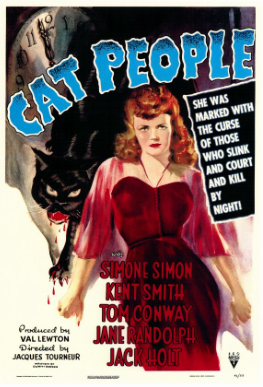
Horror Film Review: Cat People (dir by Jacques Tourneur)


Cat_People_poster

The 1942 horror classic Cat People is often described as being a horror film where, up until the last few minutes, the monsters are mostly psychological.  And there is some definite truth to that.  The title creatures remain a mystery for the majority of the film and, up until those final minutes, the audience would have every right to wonder whether or not they actually existed.  This is a film that seems to take place almost totally in the shadows, a film noir without detectives or gangsters but featuring a memorable and compelling femme fatale.

However, I would argue that there is a monster who is present on-screen long before the audience first sees the shadowy form of a cat person.  That monster is named Louis Judd and he’s the true villain of this story.  As played by Tom Conway, Louis Judd is a psychiatrist and, from the minute we first see him, we know that he’s not to be trusted.  He’s far too smooth for his own good and his soothing tones barely disguise the arrogant condescension behind his words.  If his pencil-thin mustache didn’t make him sinister enough, Dr. Judd also keeps a sword concealed inside of his walking stick.

Irena Reed (Simone Simon) is one of Dr. Judd’s patients.  A fashion designer from Serbia, Irena has recently married an engineer named Oliver Reed (Kent Smith).  Despite the fact that she loves Olivier, she cannot bring herself to be intimate with him.  As Dr. Judd discovers, Irena fears that she has been cursed and, if she ever allows herself to become aroused, she will be transformed into a panther.  Dr. Judd repeatedly tells her that her belief is just superstition and that her fears are the result of repressed trauma from her childhood.  When Irena refuses to accept his diagnosis and continues to insist that she is cursed, Dr. Judd assumes that he can prove her wrong by forcing himself on her.  (Big mistake.)

Meanwhile, Oliver loves Irena but her refusal to consummate their marriage is driving him away.  He finds himself growing more and more attracted to his co-worker, Alice (Jane Randolph).  At first, Irena is upset to discover that Oliver has been telling Alice about their problems.  But eventually Irena realizes that all she can do is watch as Oliver and Alice grow closer and closer.  Irena knows that she can’t give Oliver what he desires but the confident and outspoken Alice can.  As Irena grows more and more jealous, Alice starts to feel as if she’s being watched and followed.  She starts to hear growls in the shadows and when she’s at her most vulnerable — swimming alone at night — she is shocked when Irena suddenly appears and demands to know where Oliver is.

And really, that’s what makes Cat People such a great film.  It’s not necessarily a scary film, at least not to modern audiences.  Sadly, we have seen so much graphic real-life horror and have become so jaded by CGI that we’re no longer scared by the mere cinematic suggestion of a monster.  But the film still works because we can relate to both Irena and Alice.  When I look over my relationships, I can see times when I’ve been both the insecure Irena and the confident Alice.  For a film where the word “sex” is never uttered once, Cat People is a penetratingly honest look at relationships, love, and sexuality.

And it also features a truly memorable monster.

Seriously, that Dr. Judd is the worst!

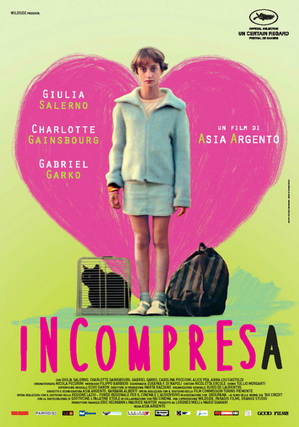
Film Review: Misunderstood (dir by Asia Argento)


Misunderstood_(2014_film)

I’ve always loved Asia Argento because, as both an actress and a public personality, she is tough, hard, and sexy all at the same time.  She’s not one of those actresses who feels the need to hide who she really is.  Watching her on-screen, you realize that she doesn’t give a fuck whether you like her or not.  Instead, she’s going to do whatever it is that she wants to do and, if you’re lucky, you might get to watch.  Some hold her responsible for the erratic output of Dario Argento’s post-Opera career but those people far too often fail to take into account that Asia, with her naturally off-center presence, has often been the most interesting thing about Dario’s later films. (Say what you will about Trauma, The Stendhal Syndrome, and Mother of Tears, they’re all better with Asia than without her.)  Asia Argento is one of those talented actresses who could never have played Ophelia because no one would ever believe that she would so easily drown.  Instead, she’d simply pull herself out of the water and then go kick Hamlet’s ass for being so indecisive.

If that paragraph sounds familiar, it’s because it’s the exact same paragraph that I used to start my review of Asia Argento’s directorial debut, Scarlet Diva.  I have no shame about recycling that paragraph for my review of Asia Argento’s third directorial effort, Misunderstood, largely because Misunderstood is, in many ways, a companion piece to Scarlet Diva.  Whereas Scarlet Diva was based on Asia Argento’s life as an international film star, Misunderstood is based on her famously dysfunctional childhood.  And, much as your enjoyment of Scarlet Diva was dependent upon how much you already knew about Asia’s life, how you feel about Misunderstood depends on whether you know that nine year-old Aria (Giulia Salerno) will eventually grow up to be Asia Argento.

Aria is the daughter of celebrities.  Her father (Gabriel Garko) is a famous actor who appears to be incapable of maintaining any sort of emotional attachment with his family.  Her mother (Charlotte Gainsbourg, made up to look like Asia’s real-life mother, the actress Daria Nicolodi) is an unstable and emotional musician who bitterly feels that she’s sacrificed her career for both her husband and her children.  She spends her time dramatically playing her piano and angrily arguing with the neighbors.

When we first meet Garko and Gainsbourg, they’re shouting at each other while eating dinner, a scene that should be painfully familiar to far too many of us.  It’s not surprising when Gainsbourg and Garko tell their three daughters that they are getting a divorce.  One of the daughters — who is obsessed with the color pink — goes to live with Garko.  Another daughter stays with Gainsbourg.  As for Aria, she finds herself constantly shuttling back and forth between her parents.  The film’s dominant image becomes one of Aria walking down a street, often between homes, while carrying a black cat with her.  (Her cat, by the way, is named Dac.  My black cat is named Doc.  That’s just one of the many things that made me relate to poor Aria.)  Aria is desperate to be loved but she’s almost too desperate.  Even her best friend eventually says that Aria is too clingy.

Misunderstood has been getting mixed reviews here in the States but anyone who has ever had to watch her parents split up will be able to relate to Misunderstood.  As I said, it helps to know that Aria will eventually grow up to be Asia Argento because, otherwise, parts of the film would be almost unbearably sad.  For those unfamiliar with Argento’s previous directorial efforts (Scarlet Diva and The Heart Is Deceitful Above All Things), it may take a while to get used to her exaggerated directorial style but, ultimately, it must be remembered that the film is not meant to be a literal representation of reality.  Instead, we are seeing things through the prism of the adult Asia’s memories of her dysfunctional childhood.  Asia Argento also proves herself to be a great director of actors and Charlotte Gainsbourg gives an amazing performance as an all-too human monster.

Reading some of the reviews of this film, all I can say is that many critics have misunderstood Misunderstood.  Is Aria always likable?  Of course not.  Does the film occasionally attempt to alienate the audience?  Yes, it does.  However, that’s always been the appeal of Asia Argento.  Largely as a result of the childhood that inspired Misunderstood, she never feels the need to pander as a filmmaker.  For those willing to give the film a chance, Misunderstood is an insightful look at what it’s like to grow up unwanted.  Asia is proving herself to be just as memorable a director as her famous father at his considerable best.

4 Shots From 4 Films: Frankenstein, Dracula, The Mummy, White Zombie


4 Shots From 4 Films is just what it says it is, 4 shots from 4 of our favorite films.  As opposed to the reviews and recaps that we usually post, 4 Shots From 4 Films is all about letting the visuals do the talking.

4 Shots From 4 Films

Frankenstein (1931, directed by James Whale)

Frankenstein (1931, directed by James Whale)

Dracula (1931, directed by Tod Browning)

Dracula (1931, directed by Tod Browning)

The Mummy (1932, directed by Karl Freund)

The Mummy (1932, directed by Karl Freund)

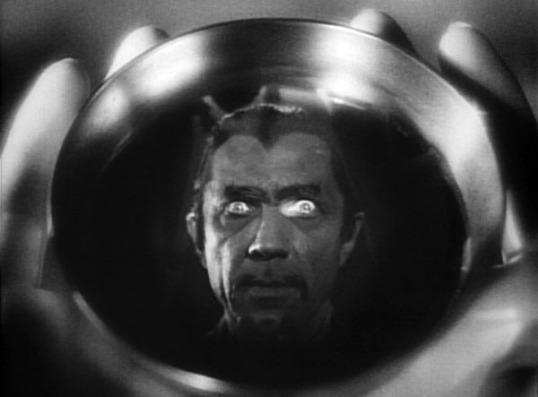
White Zombie (1932, directed by Vincent Halperin)

White Zombie (1932, directed by Victor Halperin)

Lisa’s Picks For The Twelve Best Horror Films of The Past Six Years


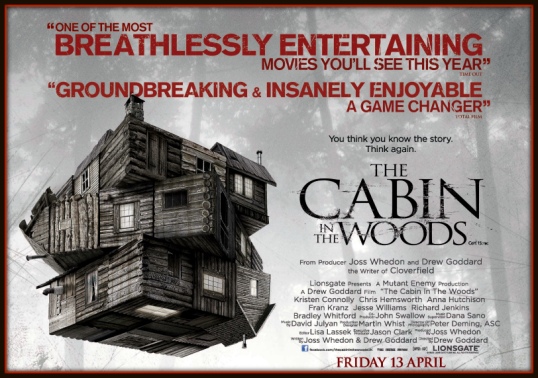
CabinInTheWoods

It’s October, which means that it’s horror month here at the Shattered Lens!  Can you believe that we’ve been doing this for six years?  I figured what better way to celebrate the start of October than by listing my picks for the ten best horror and supernatural-themed films to have been released since the founding of Through the Shattered Lens!

(Whoops!  Derrick Ferguson of the Ferguson Theater just reminded me that House of the Devil came out in 2009.  Though I haven’t reviewed House of the Devil on this site — though I did take time to praise this dance scene — it is a film that definitely belongs on this list.  So, I’m adding it and another film as well.  So now, we have a list of the 12 best horror films of the past six years!)

Check them out below!

  1. The Cabin In The Woods (2012)
  2. Warm Bodies (2013)
  3. The Conjuring (2013)
  4. A Field in England (2014)
  5. Take Shelter (2011)
  6. Sinister (2012)
  7. The House of the Devil (2009)
  8. The Babadook (2014)
  9. Devil’s Due  (2014)
  10. Insidious (2011)
  11. Only Lovers Left Alive (2014)
  12. You’re Next (2013)

Agree?  Disagree?  Let me know in the comments!

Warm Bodies