4 Shots From 4 Films: Tween Two Loves, The Poor Little Rich Girl, Through the Back Door, Secrets


Happy 125th birthday to America’s first movie star, Mary Pickford!

4 Shots From 4 Films

Tween Two Loves (1911, directed by Thomas Ince)

The Poor Little Rich Girl (1917, dir by Maurice Tourneur)

Through the Back Door (1921, dir by Alfred Green and Jack Pickford)

Secrets (1933, dir by Frank Borzage)

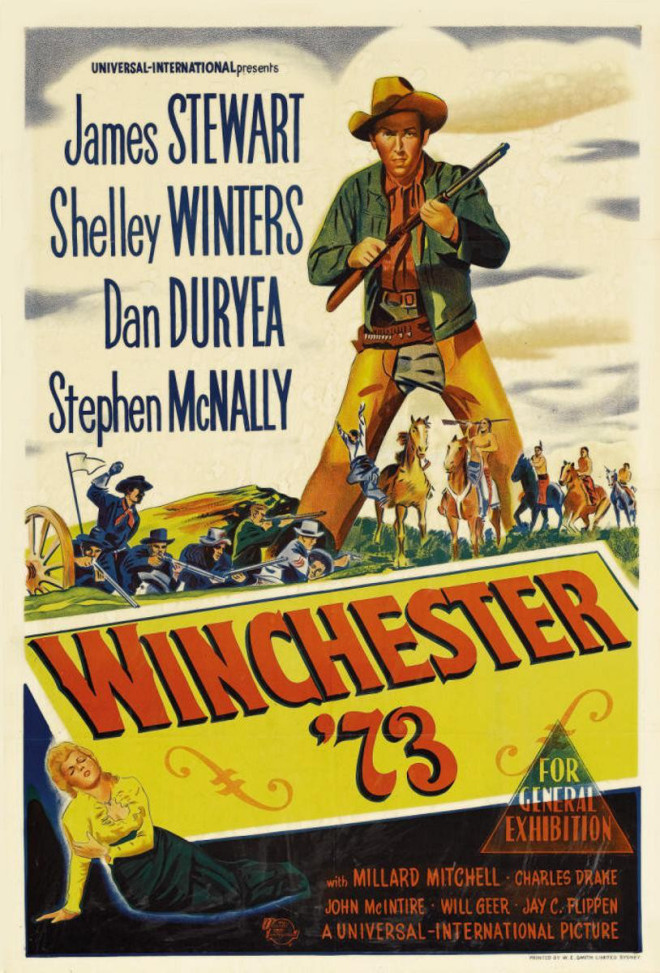
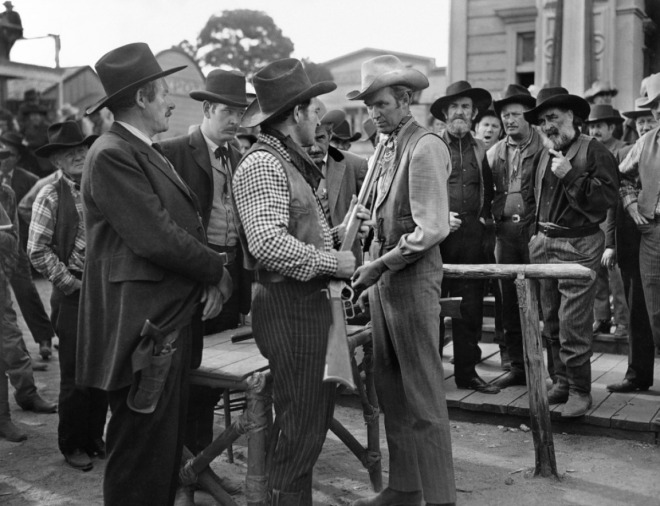
Dark Western Sky: James Stewart in WINCHESTER ’73 (Universal-International 1950)


gary loggins's avatarcracked rear viewer

James Stewart  and Anthony Mann made the first of their eight collaborations together with the Western WINCHESTER ’73, a film that helped change both their careers. Nice guy Stewart, Hollywood’s Everyman in Frank Capra movies like MR. SMITH GOES TO WASHINGTON and IT’S A WONDERFUL LIFE, took on a more mature, harder-edged persona as Lin McAdam, hunting down the man who killed his father, Dutch Henry Brown (Stephen McNally ). As for Mann, after years of grinding out B-movie noir masterpieces (T-MEN, RAW DEAL ), WINCHESTER ’73 put him on the map as one of the 1950’s top-drawer directors.

The rifle of the title is the movie’s McGuffin, a tool to hold the story together. When McAdam and his friend High Spade (the always welcome character actor Millard Mitchell) track Dutch Henry to Dodge City, the two mortal enemies engage in a shooting contest judged by none other than Wyatt Earp (Will Geer)…

View original post 465 more words

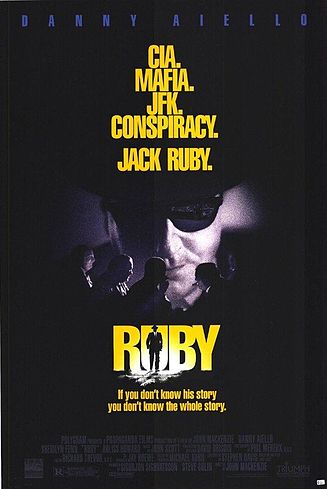
A Movie A Day #91: Ruby (1992, directed by John Mackenzie)


Of all the stars to come out of Twin Peaks, Sherilyn Fenn’s star briefly shined the brightest and sadly, she was the most misused by Hollywood.  While it is true that Fenn has worked regularly since Twin Peaks went off the air, she has rarely gotten the great roles that someone with her talent deserves.  Instead, her performances have far too often been the best thing about an otherwise mediocre film.

For example, Ruby.

In this very speculative biopic about the strip club owner who killed Lee Harvey Oswald and whose organized crime background has put him at the center of a thousand conspiracy theories, Danny Aiello plays Jack Ruby and Sherilyn Fenn plays his only friend, Sheryl Ann Dujean (or, when she’s stripping in the Carousel Club, Candy Cane).  The film portrays Jack Ruby as being a low-level mobster who is never as valuable or as important to his superiors as he thinks he is.  In this movie, Ruby is always on the outside looking in on the conspiracy and, when he kills Oswald, it is because he wants to prove that he is more than just a small time hood.  Candy, who was a composite of several Carousel Club dancers, maintains a strong platonic friendship with Jack and is always there for him to talk to, except for when she goes to Vegas to perform for and sleep with the President.

Ruby came out as the same time as JFK and it often seems like a fanfic based on Stone’s film.  Low budget and overwritten, Ruby never works as a movie but Danny Aiello is perfectly cast as the bombastic but insecure Jack Ruby.  Unfortunately, Ruby‘s screenplay often does not seem to know what it wants to say about its main character.  As Candy, Fenn is not given nearly enough to do but she still manages to show the same natural spark that made her a star on Twin Peaks.

Sherilyn Fenn is not the only Twin Peaks cast member to have a role in Ruby.  Keep an eye out for a post-Twin Peaks, pre-X-Files David Duchovny, playing the role of J.D. Tippit.

In the Beginning: Three Short Films by David Lynch


Whenever I pay one of my sporadic visits to TSL HQ, it seems there’s always something going on with these crazy kids. This month, it’s TWIN PEAKS fever, with everyone buzzing about David Lynch . Lisa and the gang just won’t stop gabbing about it, and since I can’t concentrate  on my own work, I figure if you can’t beat ’em join ’em! So let’s take a brief look at three of David Lynch’s very early works, before he became the auteur he is today.

Lynch’s first work on film was a one minute short called SIX MEN GETTING SICK (SIX TIMES), a 1966 experimental piece of animation based on a painting of his. It features the six men having their stomachs filled by red bile, which snakes it’s way up their intestines, causing them to vomit out a purplish puke, over and over, set to the sound of a wailing siren. It reminded me a bit of Terry Gilliam’s work with Monty Python’s Flying Circus, and Lynch’s first stab at filmmaking showed promise. The next short I viewed was 1968’s THE ALPHABET, a four minute piece that combines live action with animation. In this one, a woman is dreaming about children repeating the A-B-C’s in sing-song fashion, followed by some bizarre graphics involving letters, and the woman crazily reciting the alphabet. Lynch’s use of sound here (whistling wind, crying babies), and the surrealistic use of red blood in the shot-in-black-and-white film, make this an interesting attempt.

THE ALPHABET earned Lynch an AFI grant, and his next short was a bit more ambitious. 1970’s THE GRANDMOTHER is my favorite of the triumvirate, with more narrative than the previous two, but still in a tripped-out vein. Another live action/animation hybrid, THE GRANDMOTHER is the story of a boy whose parents are, quite frankly, assholes. When the boy wets his bed, abusive Dad continuously rubs his face in the piss. Drunken Mom aggressively tries to molest the youngster. Feeling alienated and unloved, the boy stumbles onto a bag of seeds, and planting one, grows a loving, benign Grandmother of his very own. (Grandma grows out of a pod a’la INVASION OF THE BODY SNATCHERS! ). The boy and his new Grandmother have a kind, affectionate relationship, and the child fantasizes about offing his parents via animation, then Grandma gets sick and dies, and the boy lives miserably ever after. This 33 minute short has a real 70’s grindhouse horror feel to it, and of the three I watched, I recommend THE GRANDMOTHER above all.

So there you have it, my contribution to the works of David Lynch is complete. Even though I’m not a big fan of his, my contractual obligation has been met. Now will you guys keeps the noise down so I can finish typing up my piece on WINCHESTER ’73?!?! Sheesh… kids these days!

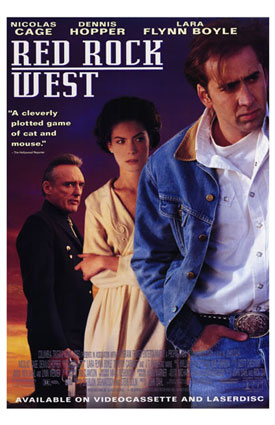
A Movie A Day #90: Red Rock West (1992, directed by John Dahl)


The place is Red Rock, a little town located in the middle of nowhere Wyoming.  When a man from Texas (played by Nicolas Cage) wanders into his bar, the owner, Wayne (J.T. Walsh), assumes that the man is Lyle From Dallas, the semi-legendary hit man who Wayne has hired to kill his wife, Suzanne (Lara Flynn Boyle).  Wayne gives the man half of his payment in advance and promises the other half after Suzanne is dead.  What Wayne doesn’t realize is that Lyle From Dallas is not actually Lyle From Dallas.  Instead, he is a drifter named Michael who has just recently lost his job.  Michael takes Wayne’s money but, when he sees Suzanne, he tells her that Wayne wants her dead.  Suzanne responds by offering to pay Michael to kill Wayne.  Michael mostly just wants to leave town but his every effort is thwarted, with him continually only managing to get a mile or two out of town just to then find circumstances forcing him to once again pass the Red Rock welcome sign.  Meanwhile, the real Lyle From Dallas (Dennis Hopper) has shown up and he is pissed.
Red Rock West is a clever and energetic neo noir that plays out like the child of a marriage between the Coen Brothers and David Lynch.  Like the Coens’ Blood Simple, Red Rock West is a violent movie that is full of twist and turns and features characters who are often confused and rarely understand what is actually going on.  From David Lynch, it borrows both Twin Peaks‘s Lara Flynn Boyle and Blue Velvet‘s Dennis Hopper.  Red Rock West was made when Nicolas Cage still gave a damn and it also shows why, during his short career, J.T. Walsh was everyone’s favorite duplicitous character actor.  Hopper is his usual crazy self and Boyle is a sultry and sexy fatale.  Red Rock West is one of the best neo noirs of the 1990s.

A Movie A Day #89: Paint It Black (1989, directed by Tim Hunter)


This month, since the site is currently reviewing every episode of Twin Peaks, each entry in Move A Day is going to have a Twin Peaks connection.  Paint In Black was directed by Tim Hunter, who directed three episodes of Twin Peaks, including the one that I reviewed earlier today.

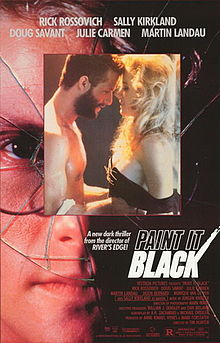
Jonathan Dunbar (Rick Rossovich) should have it all.  He is an acclaimed sculptor but he’s being cheated financially by his dealer and sometimes girlfriend, Marion Easton (Sally Kirkland).  Things start to look up for Jonathan after he has a minor traffic accident with Gina (Julie Carmen).  Not only are he and Gina immediately attracted to each other but it turns out that Gina is the daughter of Daniel Lambert (Martin Landau), who owns the most prestigious art gallery in Santa Barbara.  It appears that Jonathan is finally going to get the big show that he has always dreamed of, but only if he can escape from Marion’s management.

One night, Jonathan helps out a man who was apparently mugged outside of an art gallery.  The man, Eric (Doug Savant), says that he’s an art collector and that he is a big fan of Jonathan’s work.  When Jonathan opens up about his problems with Marion, Eric decides to return Jonathan’s favor by killing Marion and anyone else who he feels is standing in the way of Jonathan’s success.  Because of the way that Eric artistically stages the murders, the police suspect that Jonathan is the murderer.

Depending on the source, Paint It Black’s original director was either fired or walked off the project and Tim Hunter was brought in to hastily take his place.  According to Hunter, he spent the production “shooting all day and rewriting all night.”  Paint it Black is a standard late 80s, direct to video thriller but it is interesting as a tribute to Alfred Hitchcock.  Hunter taught a class on Hitchcock at the University of California at Santa Cruz and Paint it Black is full of shout outs to the master of suspense.  Marion’s murder is staged similarly to a murder in Frenzy.  There are frequent close-ups of scissors, a reference to Dial M For Murder.  Probably the most obvious homage is the character of Eric, who appears to be based on Robert Walker, Jr’s character from Strangers on a Train.

Rick Rossovich was best known for playing cops, firemen, and soldiers in movies like Top Gun, Navy SEALS, and Roxanne.  He’s not bad in Paint it Black but he is still not the most convincing artistic genius.  Doug Savant and Sally Kirkland were better cast and more enjoyable to watch.  In fact, Kirkland is killed off too early.  The movie loses a lot of its spark once she is gone.

Paint It Black may not live up to being named after one of the best songs that the Rolling Stones ever recorded but Tim Hunter took unpromising material and shaped it into something that is far more watchable than anyone might expect.


A Movie A Day #88: Where The Day Takes You (1992, directed by Marc Rocco)


This month, since the site is currently reviewing every episode of Twin Peaks, each entry in Move A Day is going to have a Twin Peaks connection.  Where The Day Takes You is a movie that has not just one but two connections to Twin Peaks.
Where The Day Takes You is an episodic film about young runaways living on the streets of Los Angeles.  Led by 22 year-old King (Dermot Mulroney), who ran away from home when he was 16, the runaways form a surrogate family.  While being constantly harassed by both the police and well-meaning social workers, some of the runaways get addicted to drugs while others turn to prostitution in order to survive.  Some find love.  Some find death.  They all go where the day takes you.  (Not sure if that was the movie’s tag line but it should have been.)

Where The Day Takes You is a gritty and often tough film, though it’s effectiveness is undercut by a predictable ending and the presence of too many familiar faces in the cast.  The runaways are made up of a who’s who of prominent young actors from the 1990s.  Balthazar Getty plays King’s second-in-command.  Sean Astin plays an obviously doomed drug addict.  Alyssa Milano and David Arquette play prostitutes.  Ricki Lake and James Le Gros play comedic relief.  Will Smith, in his film debut, plays a wheelchair-bound runaway.  Christian Slater and Laura San Giacomo show up as social workers while the police are represented by Rachel Ticotin and Adam Baldwin.  Everyone gives a good performance but the film would have worked better with unknown actors or even real runaways.  No matter how good a performance Sean Astin gives as a heroin addict, he is always going to be Sean Astin and it is always going to be difficult to look at him without saying, “I might not be able to carry the ring but I can carry you!”

The movie’s first Twin Peaks connection is that Lara Flynn Boyle, who played innocent Donna Hayward on Twin Peaks, plays innocent runaway Heather in Where The Day Takes You.  The role is cliché but Boyle shows the same charm that she showed while playing Donna.

The movie’s second Twin Peaks connection is more unexpected.  Kyle MacLachlan is effectively cast against type as Ted, the drug dealer who keeps most of the runaways hooked on heroin and who is perfectly willing to leave an overdosed junkie in a garbage bin.  Ted is about as far from Dale Cooper as you can get.

Jurassic Joke: THE LOST WORLD (20th Century Fox 1960)


gary loggins's avatarcracked rear viewer

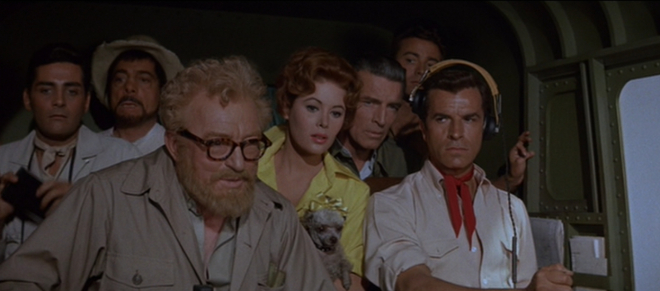
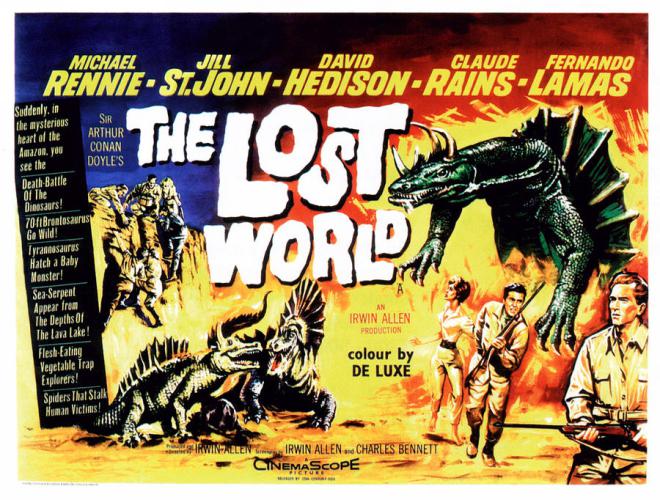
Sir Arthur Conan Doyle’s adventure novel THE LOST WORLD was first filmed in 1925 with special effects by the legendary Willis O’Brien  . O’Brien gets a technical credit in Irwin Allen’s 1960 remake, but his wizardry is nowhere to be found, replaced with dolled-up lizards and iguanas designed to frighten absolutely no one. This one’s strictly for the Saturday matinee kiddie crowd, and though it boasts a high profile cast, it’s ultimately disappointing.

Genre fans will appreciate the presence of The Invisible Man himself, Claude Rains , in the role of expedition leader Professor Challenger. The 71 year old Rains is full of ham here, playing to the balcony, and still managing to command the screen with his sheer talent. Challenger claims to have discovered “live dinosaurs” in the remote Amazon rainforest, a claim scoffed at by the scientific community, especially rival Professor Summerlee (the equally hammy Richard Hayden). The crusty Challenger…

View original post 314 more words