Playing Catch-Up: Crisscross, The Dust Factory, Gambit, In The Arms of a Killer, Overboard, Shy People


So, this year I am making a sincere effort to review every film that I see.  I know I say that every year but this time, I really mean it.

So, in an effort to catch up, here are four quick reviews of some of the movies that I watched over the past few weeks!

  • Crisscross
  • Released: 1992
  • Directed by Chris Menges
  • Starring David Arnott, Goldie Hawn, Arliss Howard, Keith Carradine, James Gammon, Steve Buscemi

An annoying kid named Chris Cross (David Arnott) tells us the story of his life.

In the year 1969, Chris and his mother, Tracy (Goldie Hawn), are living in Key West.  While the rest of the country is excitedly watching the first moon landing, Chris and Tracy are just trying to figure out how to survive day-to-day.  Tracy tries to keep her son from learning that she’s working as a stripper but, not surprisingly, he eventually finds out.  Chris comes across some drugs that are being smuggled into Florida and, wanting to help his mother, he decides to steal them and sell them himself.  Complicating matters is the fact that the members of the drug ring (one of whom is played by Steve Buscemi) don’t want the competition.  As well, Tracy is now dating Joe (Arliss Howard), who just happens to be an undercover cop.  And, finally, making things even more difficult is the fact that Chris just isn’t that smart.

There are actually a lot of good things to be said about Crisscross.  The film was directed by the renowned cinematographer, Chris Menges, so it looks great.  Both Arliss Howard and Goldie Hawn give sympathetic performances and Keith Carradine has a great cameo as Chris’s spaced out dad.  (Traumatized by his experiences in Vietnam, Chris’s Dad left his family and joined a commune.)  But, as a character, Chris is almost too stupid to be believed and his overwrought narration doesn’t do the story any good.  Directed and written with perhaps a less heavy hand, Crisscross could have been a really good movie but, as it is, it’s merely an interesting misfire.

  • The Dust Factory 
  • Released: 2004
  • Directed by Eric Small
  • Starring Armin Mueller-Stahl, Hayden Panettiere, Ryan Kelly, Kim Myers, George de la Pena, Michael Angarano, Peter Horton

Ryan (Ryan Kelly) is a teen who stopped speaking after his father died.  One day, Ryan falls off a bridge and promptly drowns.  However, he’s not quite dead yet!  Instead, he’s in The Dust Factory, which is apparently where you go when you’re on the verge of death.  It’s a very nice place to hang out while deciding whether you want to leap into the world of the dead or return to the land of the living.  Giving Ryan a tour of the Dust Factory is his grandfather (Armin Mueller-Stahl).  Suggesting that maybe Ryan should just stay in the Dust Factory forever is a girl named Melanie (Hayden Panettiere).  Showing up randomly and acting like a jerk is a character known as The Ringmaster (George De La Pena).  Will Ryan choose death or will he return with a new zest for living life?  And, even more importantly, will the fact that Ryan’s an unlikely hockey fan somehow play into the film’s climax?

The Dust Factory is the type of unabashedly sentimental and theologically confused film that just drives me crazy.  This is one of those films that so indulges every possible cliché that I was shocked to discover that it wasn’t based on some obscure YA tome.  I’m sure there’s some people who cry while watching this film but ultimately, it’s about as deep as Facebook meme.

  • Gambit
  • Released: 2012
  • Directed by Michael Hoffman
  • Starring Colin Firth, Cameron Diaz, Alan Rickman, Tom Courtenay, Stanley Tucci, Cloris Leachman, Togo Igawa

Harry Deane (Colin Firth) is beleaguered art collector who, for the sake of petty revenge (which, as we all know, is the best type of revenge), tries to trick the snobbish Lord Shabandar (Alan Rickman) into spending a lot of money on a fake Monet.  To do this, he will have to team up with both an eccentric art forger (Tom Courtenay) and a Texas rodeo star named PJ Puznowksi (Cameron Diaz).  The plan is to claim that PJ inherited the fake Monet from her grandfather who received the painting from Hermann Goering at the end of the World War II and…

Well, listen, let’s stop talking about the plot.  This is one of those elaborate heist films where everyone has a silly name and an elaborate back story.  It’s also one of those films where everything is overly complicated but not particularly clever.  The script was written by the Coen Brothers and, if they had directed it, they would have at least brought some visual flair to the proceedings.  Instead, the film was directed by Michael Hoffman and, for the most part, it falls flat.  The film is watchable because of the cast but ultimately, it’s not surprising that Gambit never received a theatrical release in the States.

On a personal note, I saw Gambit while Jeff & I were in London last month.  So, I’ll always have good memories of watching the movie.  So I guess the best way to watch Gambit is when you’re on vacation.

  • In The Arms of a Killer
  • Released: 1992
  • Directed by Robert L. Collins
  • Starring Jaclyn Smith, John Spencer, Nina Foch, Gerald S. O’Loughlin, Sandahl Bergman, Linda Dona, Kristoffer Tabori, Michael Nouri

This is the story of two homicide detectives.  Detective Vincent Cusack (John Spencer) is tough and cynical and world-weary.  Detective Maria Quinn (Jaclyn Smith) is dedicated and still naive about how messy a murder investigation can be when it involves a bunch of Manhattan socialites.  A reputed drug dealer is found dead during a party.  Apparently, someone intentionally gave him an overdose of heroin.  Detective Cusack thinks that the culprit was Dr. Brian Venible (Michael Nouri).  Detective Quinn thinks that there has to be some other solution.  Complicating things is that Quinn and Venible are … you guessed it … lovers!  Is Quinn truly allowing herself to be held in the arms of a killer or is the murderer someone else?

This sound like it should have been a fun movie but instead, it’s all a bit dull.  Nouri and Smith have next to no chemistry so you never really care whether the doctor is the killer or not.  John Spencer was one of those actors who was pretty much born to play world-weary detectives but, other than his performance, this is pretty forgettable movie.

  • Overboard
  • Released: 1987
  • Directed by Garry Marshall
  • Starring Goldie Hawn, Kurt Russell, Edward Herrmann, Katherine Helmond, Roddy McDowall, Michael G. Hagerty, Brian Price, Jared Rushton, Hector Elizondo

When a spoiled heiress named Joanne Slayton (Goldie Hawn) falls off of her luxury yacht, no one seems to care.  Even when her husband, Grant (Edward Herrmann), discovers that Joanne was rescued by a garbage boat and that she now has amnesia, he denies knowing who she is.  Instead, he takes off with the boat and proceeds to have a good time.  The servants (led by Roddy McDowall) who Joanne spent years terrorizing are happy to be away from her.  In fact, the only person who does care about Joanne is Dean Proffitt (Kurt Russell).  When Dean sees a news report about a woman suffering from amnesia, he heads over to the hospital and declares that Joanne is his wife, Annie.

Convinced that she is Annie, Joanne returns with Dean to his messy house and his four, unruly sons.  At first, Dean says that his plan is merely to have Joanne work off some money that she owes him.  (Before getting amnesia, Joanne refused to pay Dean for some work he did on her boat.)  But soon, Joanne bonds with Dean’s children and she and Dean start to fall in love.  However, as both Grant and Dean are about to learn, neither parties nor deception can go on forever…

This is one of those films that’s pretty much saved by movie star charisma.  The plot itself is extremely problematic and just about everything that Kurt Russell does in this movie would land him in prison in real life.  However, Russell and Goldie Hawn are such a likable couple that the film come close to overcoming its rather creepy premise.  Both Russell and Hawn radiate so much charm in this movie that they can make even the stalest of jokes tolerable and it’s always enjoyable to watch Roddy McDowall get snarky.  File this one under “Kurt Russell Can Get Away With Almost Anything.”

A remake of Overboard, with the genders swapped, is set to be released in early May.

  • Shy People
  • Released: 1987
  • Directed by Andrei Konchalovsky
  • Starring Jill Clayburgh, Barbara Hershey, Martha Plimpton, Merritt Butrick, John Philbin, Don Swayze, Pruitt Taylor Vince, Mare Winningham

Diana Sullivan (Jill Clayburgh) is a writer for Cosmopolitan and she’s got a problem!  It turns out that her teenager daughter, Grace (Martha Plimpton), is skipping school and snorting cocaine!  OH MY GOD!  (And, to think, I thought I was a rebel just because I used to skip Algebra so I could go down to Target and shoplift eyeliner!)  Diana knows that she has to do something but what!?

Diana’s solution is to get Grace out of New York.  It turns out that Diana has got some distant relatives living in Louisiana bayou.  After Cosmo commissions her to write a story about them, Diana grabs Grace and the head down south!

(Because if there’s anything that the readers of Cosmo are going to be interested in, it’s white trash bayou dwellers…)

The only problem is that Ruth (Barbara Hershey) doesn’t want to be interviewed and she’s not particularly happy when Diana and Grace show up.  Ruth and her four sons live in the bayous.  Three of the sons do whatever Ruth tells them to do.  The fourth son is often disobedient so he’s been locked up in a barn.  Diana, of course, cannot understand why her relatives aren’t impressed whenever she mentions that she writes for Cosmo.  Meanwhile, Grace introduces her cousins to cocaine, which causes them to go crazy.  “She’s got some strange white powder!” one of them declares.

So, this is a weird film.  On the one hand, you have an immensely talented actress like Jill Clayburgh giving one of the worst performances in cinematic history.  (In Clayburgh’s defense, Diana is such a poorly written character that I doubt any actress could have made her in any way believable.)  On the other hand, you have Barbara Hershey giving one of the best.  As played by Hershey, Ruth is a character who viewers will both fear and admire.  Ruth has both the inner strength to survive in the bayou and the type of unsentimental personality that lets you know that you don’t want to cross her.  I think we’re supposed to feel that both Diana and Ruth have much to learn from each other but Diana is such an annoying character that you spend most of the movie wishing she would just go away and leave Ruth alone.  In the thankless role of Grace, Martha Plimpton brings more depth to the role than was probably present in the script and Don Swayze has a few memorable moments as one of Ruth’s sons.  Shy People is full of flaws and never really works as a drama but I’d still recommend watching it for Hershey and Plimpton.

Pre Code Confidential #18: FIVE STAR FINAL (Warner Brothers 1931)


gary loggins's avatarcracked rear viewer

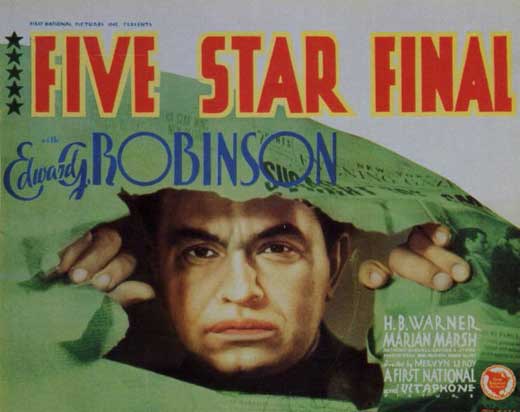
Tabloid journalism has been around far longer than the cable “news” channels of today, with their 24 hour a day barrage of nonstop sleazy scandals and “fake news”. A circulation war between publishers Joseph Pulitzer (New York World) and William Randolph Hearst (New York Journal) in the 1890’s, filled with sensationalized headlines and mucho muckraking, gave birth to the term “Yellow Journalism”, derived from Richard Outcault’s guttersnipe character The Yellow Kid in his comic strip Hogan’s Alley, which appeared in both papers. This legacy of dirt-digging and gossip-mongering continued through the decades in supermarket rags like The National Enquirer and World Weekly News, leading us to where we are today with the so-called “mainstream media” stretching credibility to the max and bogus Internet click-bait sites abounding. All of which leads me to FIVE STAR FINAL, a Pre-Code drama about headhunting for headlines starring Edward G…

View original post 608 more words

Film Review: Alien (dir. by Ridley Scott)


AlienPosterToday is 4.26, also known as “Alien Day”, and named after the planet in James Cameron’s Aliens (LV-426 / Acheron). It’s a celebration of the entire Alien Franchise, but I’m only focused on the first film as I finally saw it in the theatre in 2017.

This isn’t so much a review as it’s just my history with Ridley Scott’s Alien. You can find actual reviews all over the internet, and I know very few people who didn’t enjoy the movie. This piece assumes you’ve seen the film and are familiar with it. There are also spoilers within, though with a nearly 40 year old film, I’m not sure if it can be classified as such.

When I was little, my older brother and I shared a room in my grandmother’s house. Below our bunk beds was a open space that contained a set of boxes and each box contained a collection of our toys – board games, knick knacks, things like that. If you needed something, you went under the bed to fetch it. Only thing is, I always reached into those boxes with my eyes closed.

I have a vague memory of when my older brother received 3 toys that affected the way I looked at things. The first was a board game for the movie Alien. On it, you had a map of the Nostromo, about 3 Astronaut pieces and one for the Alien. I can’t recall the exact nature of how it was played, but I do remember it having to do with finding a way to reach the Narcissus – the escape ship – before the Alien reached your character. Each player also had their own Alien they could use to hunt the other characters before they could escape.

alien-board.jpg

The Alien Board Game. Fox marketed toys for Alien (an R rated film), possibly fearing the mistake they made with Star Wars.

The second was a movie viewer. I had to do some hunting around the net to find it, and thanks to The Toy Box, I was able to locate one. These viewers (made by Fisher Price and by Kenner) were really popular, especially after the Star Wars boom. You loaded it with a tape and it would play out a scene. For the Alien tape my brother had, it would play out the egg opening face hugger jump sequence. I rewound that too many times, and perhaps it’s the reason I’m afraid of spiders. I don’t really know for sure. The tape used below goes through most of the film’s plot, so if you haven’t watched the film by now, consider yourself spoiled.

The last toy was the reason I never went into the toy boxes. My brother owned an 18 Inch tall Alien figure, complete with a glow in the dark headpiece and a functional second set of teeth. It was one of the scariest things I’d seen as a kid.

All of this was thanks in part to Star Wars. With the mistake Fox made in giving the merchandising rights for Star Wars to Lucas and Lucasfilm, Ltd., they missed out a major chunk of revenue. So when Alien was set to launch 2 years later, they greenlit an entire toy line for the film, even though the movie was rated “R” and the toys demographic couldn’t really see the movie without parental supervision. For the time, that was a pretty amazing thing.

Back in the early 1980s, my father invited my older brother and I to his place to see Alien. I was about six or seven years old at the time, with my brother a few years older. My parents worked nights, so we pretty much lived with my grandmother. He was always into movies and he acquired a RCA Videodisc Player, along with that film and First Blood. Although I was sick, I still went and watched it. I vomited twice during the playthrough, but it was so worth it.

I’d come to find out years later from my Mom that my Dad really didn’t need to invite us. He was just too scared of the movie to watch it alone. According to family legend, Alien was a date movie for my parents, and halfway into the film, my Dad (along with most guys, I’ve heard), was using my Mom as a shield. Mind you, this was a guy who kept multiple firearms in the house and knew how to use them.

Alien was the brainchild of Dan O’Bannon and Ronald Shusett. Having worked on Dark Star for John Carpenter, O’Bannon wanted to create another space film, but with a more serious tone. They came up with the story, inspired by 1958’s B-movie classic It! The Terror From Outer Space and decided to roll with it. The feel for their story would be more like a set of space truckers hauling ore and picking up a stowaway space possum in their cargo.

And that’s Alien in a nutshell. A crew of seven astronauts heading towards Earth in their mining vessel are awakened from hyper sleep when their spaceship – The Nostromo – picks up a distress signal from a nearby planetoid. They are given orders to investigate the signal, but when one of them is incapacitated by an alien life form, it brings trouble to the rest of the crew once they all return to the ship. Can they survive?

The casting for Alien is damn near flawless. There isn’t a single person that feels out of place. The characterization for everyone is straightforward, from the wisecracking pair of Harry Dean Stanton and Yaphet Kotto to the very systematic Ian Holm as the Nostromo’s Science Division expert, it doesn’t take long for one to get to know them or at least wonder if they’ll make it through the story unscathed.  Whether it’s Veronica Cartwright’s Lambert, who is nervous and jittery mid way through the film (and with good reason) or Sigourney Weaver’s Ripley who sees the potential threat before it gets out of hand, everyone here plays their part well.

Ridley Scott was a young director brought on board to create the film. Now, normally, this is where the movie would be made and that really would be that. Scott’s visit to an art gallery in Paris would change the make up of the movie, according to the behind the scenes documentary. What set Alien aside from other space/horror fanfare were the influences of two major artists at the time, Jean Giraud and H.R. Giger.

Jean_Henri_Gaston_Moebius_Giraud_blog.kierankelly.net_mobieus_alien1

Concept Art by Jean Giraud, a.k.a. Moebius.

Having seen his work in France, Ridley Scott felt that Giger had to be brought on board. Giger agreed to use some of his designs for the film and actually helped create the entire Space Jockey set. For the late 1970s, Giger’s look – elongated bones with sexual undertones – had to be a shock to audiences. Giraud, known to many fans as Moebius, was one of the greatest illustrators to have lived. Giraud was previously brought on to work on Alejandro Jodorowsky’s adaptation of Dune, but after that fell through, he ended up working with Scott for a bit, mainly coming up with the designs for the suits in the Nostromo. Together, both their designs would be used to bring something entirely new to audiences at the time. Also on hand was Carlo Rambaldi (E.T. the Extra-Terrestrial, Dune), who helped design the Alien’s mouth and motor features. In the effects department, Dennis Ayling, Nick Allder, and even Batman’s Anton Furst had a hand in setting the atmosphere for the Nostromo and LV-426. The result is a sense of claustrophobia. The Nostromo’s hallways aren’t the immaculate ones you’d find on board the Enterprise or the roomy ones on the Millennium Falcon. They’re tight, dimly lit with an obvious function over form factor to them. It’s a space rig.

With older monster films, the creature usually is just one form. Giger’s Alien had three distinct forms used, which has always made me curious for the initial audience reactions. The first encounter is with a the Facehugger, an arachnid like creature with a tail that restricts the breathing of its potential victim. Add to this the notion that it uses molecular acid for blood. How do you even fight such a thing? Imagine thinking this is the “big bad” you’re going to see throughout the movie. Scott was particular in having the advertising reference as little as it could about the Alien itself (though the toy line kind of ruined that).

Just when you’re comfortable with the possiblity of facehuggers crawling around, the movie switches gears and introduces us to the Chestburster, a phallic snake of a creature (thanks again to Giger). . The scene was fantastic. Although the cast was told what was supposed to happen with Kane (John Hurt), they weren’t completely filled in on how it was supposed to occur. It was a two part process. The first involved trying to hold down Kane, and the second was setup with John Hurt in the table to have the “push through”. So, when Kane lets out that one big scream, everyone’s reactions are real. You can see that both Parker (Yaphet Kotto) and Dallas (Tom Skerritt) are completely stunned. Veronica Cartwright (and her character Lambert) caught the worst of all this and also had the best reaction. When the Chestburster appears, the effects blood pumps caught Cartwright full on and it was all kept on film. I’m told that the scene in its initial run had people curling in their seats, standing to move to the back of the theatre (for some distance) or walking out altogether. What I wouldn’t give for a Time Travelling DeLorean and an Opening Night movie ticket to that.

So now, there’s a snake running loose on the ship. The film spares very little time before our newborn becomes an adult. Mostly sleek and skeletal, the adult Alien is the stuff of nightmares, but thanks to Scott, and Cinematographer Derek Vanlint, we don’t see much of the Alien until the last act of the movie. Like the Batman, we only see it pounce, and that’s a testament both to the lighting used and the editing of shots. Scott’s close-ups on the Alien’s mouth and forehead doesn’t give anyone enough time to fully make out what it is entirely. Credit also goes to Bolaji Badejo, who portrayed the Alien. At 6’10”, Badejo was perfect for the creature sense of stature and movement, particularly with Harry Dean Stanton’s Brett having to stare up at him in shock.

BigAlienHead

The production wasn’t without an issue here or there. Giraud’s suits – which had a samurai feel to them – had problems with the ventilation, so some of the actors nearly experienced exhaustion while working in them. This was later remedied, of course.

Alien remains one of Jerry Goldsmith’s best scores, though it’s also a simple one. The music isn’t so much horrific as it just classical. The music in Alien isn’t really used to imply any kind of horror (save for perhaps one sequence), but perhaps that’s a good thing. The music lets the movie do the talking instead of throwing zingers. There’s very little I can say about the score outside of that.

Alien would go on to spawn seven extra films, though personally, only James Cameron’s Aliens (1986) and Ridley Scott’s Prometheus (2012) are the two worth seeing. Alien 3 (1992) is beautiful, thanks to David Fincher and Cinematographer Alex Thomson, but also kind of damaged the timeline.

So, turn out the lights, settle in with the food of your choice and enjoy Alien Day.

SpaceJockey

The Space Jockey. Much of Giger’s designs looked like bone.

* – A thank you goes out to Kevin Carr of Fat Guys At the Movies. He once featured It! The Terror From Outer Space years ago during the weekend Live Tweets he used to host. It was a treat to watch.

Film Review: Destroy All Monsters (dir by Ishirō Honda)


Long before Marvel Studios convinced everyone in Hollywood that shared cinematic universes were the way of the future, Toho gave the world Destroy All Monsters!

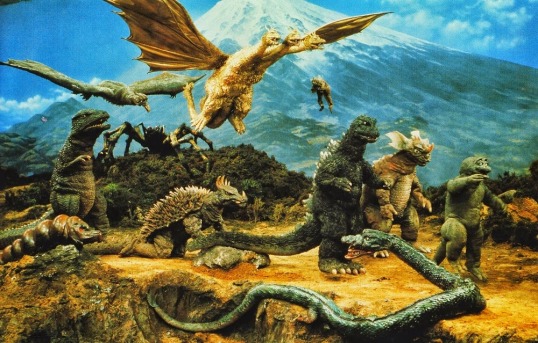
First released in 1968, Destroy All Monsters featured almost every monster that every destroyed Tokyo.  As you can see in the picture below, this was a collection like no other.  Long before the Avengers, it was all about … The Monsters!

Check out the cast of Destroy All Monsters:

Some of these monsters are more identifiable than others.  Everyone knows Godzilla and I imagine that the majority of our readers can identify both Rodan and Mothra (who spends most of Destroy All Monsters in her larval form).  And, of course, that’s everyone’s favorite three-headed dragon, King Ghidorah, hovering in the sky.

As for the rest of the cast, they may be lesser monsters but, just like Ant-Man and the Falcon, they all have a role to play.  Up at the front of the group is Minilla, who is Godzilla’s bastard son.  Walking next to Godzilla is Baragon, who was the antagonist in Frankenstein Conquers The World.  The big snake is Manda, who previously appeared in a non-Godzilla film called Atragon.  The spiky armadillo is Anguirus from Godzilla Rides Again and directly behind him is Gorosaurus, who previously appeared in King Kong Escapes.  The big spider is Kumonga, who previously appeared in Son of Godzilla and apparently no longer wants to eat Minilla.  Meanwhile, up in the air with Rodan and Ghidorah, you’ve got Varan the Unbelievable from the film of the same name.

When Destroy All Monsters opens, all of these monsters (with the exception of Ghidorah) have been trapped on Monster Island.  Somehow, despite the fact that they’ve all tried to kill each other in the past, they’re now getting along just fine.  There’s a research station located underneath the island, where scientists can both study the monsters and keep them from escaping.  It seems like a great situation for everyone!  The monsters get a home of their own and the humans don’t have to keep rebuilding their cities.

But then, one day, all communication with Monster Island is lost and the monsters themselves start to pop up all over the world.  Rodan destroys Moscow.  Mothra takes out Beijing.  Gorosaurus totally destroys Paris.  Why doesn’t America step up to save the rest of the world?  Well, they’ve got problems of their own.  Just check out who has surfaced in New York harbor…

After years of exclusively destroying Tokyo, Godzilla has finally decided to visit New York City!  Of course, Godzilla ends up wrecking the place.  He specifically takes out the United Nations and wins the hearts of libertarians everywhere.

It turns out that, once again, a bunch of aliens have invaded Earth and are using mind control signals to force the monsters to attack humanity.  (After you watch enough Godzilla movies, you come to understand that this happens pretty regularly.)  While a team of humans try to figure out how to disrupt the control signals, the monsters are busy destroying every major city that they come across.

However, as the lead human points out, the monsters instinctively know who they’re “real enemy” is and it’s only a matter of time until they turn on the aliens.  The aliens, however, have a Plan B.  And, like so many intergalactic schemes of the past, that Plan B involves summoning King Ghidorah.

The appeal of King Ghidorah is obvious.  He’s got those big wings and those three heads and he breathes fire and he just looks like the type of monster that you would want on your side.  But, at the same time, I really do have to question the wisdom of continually trying to use Ghidorah to defeat Godzilla.  Ghidorah and Godzilla fought a countless number of times and never once did Ghidorah actually win.  He often put up a fairly impressive fight and he usually managed to knock around Godzilla’s friends but, repeatedly, Ghidorah proved to be totally ineffective when it came to actually defeating or even slowing down Godzilla.

That said, Destroy All Monsters just wouldn’t be the same without King Ghidorah.  Reportedly, this was originally envisioned as being the final Godzilla film and it’s kind of nice to see Godzilla hanging out with all of the other monsters.  Ghidorah and Godzilla may not have been friends but Ghidorah is still as important a part of Godzilla’s life as Rodan and Mothra.

Like most of the Godzilla films of the late 60s and early 70s, Destroy All Monsters spends way too much time on its human characters but, even if there isn’t as much as you might want, the rubber monster mayhem is still enjoyably silly and fun to watch.  All the monsters get together and play their role in saving the world.  Call it Godzilla: Infinity Wars.

Film Review: The Mean Season (dir by Phillip Borsos)


From the very first few scenes of the 1985 film, The Mean Season, one thing is abundantly clear.  People are dying in Florida.

In itself, that’s probably not a shock.  Death is a part of life, after all.  Add to that, the majority of The Mean Season takes place in Miami, the seventh most populous area of the United States.  It makes sense that the more people you have living in one area, the more people are also going to end up dead.  That’s just the way things work.

Still, Malcolm Anderson is getting tired of all the death.  Played by a youngish and sexy Kurt Russell, Malcolm’s a journalist.  He covers the crime beat for the Miami Herald.  He spends all day reporting on death and violence and he’s finally reached the point where he’s burned out.  He and his girlfriend, a teacher named Christine (Mariel Hemingway), are even planning on moving to Colorado.  Malcolm says that he could be very happy working at a small town newspaper.  His editor (Richard Masur) doesn’t believe him and, quite frankly, neither do we.  Malcolm may say that he wants peace and quiet but it’s hard not to feel as if he’s fooling himself.

One day, Malcolm gets a phone call.  The voice on the other line (which belongs to character actor Richard Jordan) is deceptively calm.  The caller explains that he’s a fan of Malcolm’s work.  The caller also claims to be responsible for a series of murders that have recently taken place.  At first, Malcolm is skeptical.  After all, he gets calls from crazy people all the time.  That’s one reason why he wants to leave Miami, after all.  But then the caller starts to give Malcolm details about the crimes, details that haven’t been released to general public…

The killings continue and, after every murder, the caller contacts Malcolm.  Soon, Malcolm is appearing on the national news, giving carefully calculated interviews about what it’s like to be a celebrity.  Malcolm is soon on the front page of all the papers.  Malcolm’s happy.  His editor is happy.  But you know who isn’t happy?  The killer.  He didn’t go to all the trouble to kill those people just so Malcolm could get famous off of his hard work!  Soon, the killer is no longer content to just call Malcolm.  Now, he wants to meet face-to-face and maybe even get to know Christine as well…

The Mean Season is one of those movies that starts out well but then falls apart towards the end.  It’s not a spoiler to tell you that the killer eventually ends up kidnapping Christine.  You probably figured out that was going to happen as soon as I told you that Malcolm had a girlfriend.  (It doesn’t help that Christine is such an underwritten character that it feels like the only reason she was put in the film was so she could be used for one gratuitous nude scene and then get kidnapped.)   Once the killer kidnaps her, he goes from being a genuinely intriguing menace to just being a typical and overly verbose movie psycho.

That’s a shame because the first half of The Mean Season is really quite good.  The film makes excellent use of its locations, capturing the humid atmosphere of Florida in the summer.  As the killer, Richard Jordan alternates between being coldly calculating and surprisingly vulnerable without missing a beat.  (Interestingly, he appears to be personally hurt when he realizes that Malcolm doesn’t consider him to be a friend.)  Not surprisingly, Kurt Russell is likable as the conflicted Malcolm but his best moments are the ones where he suggests that Malcolm has become so addicted to fame that he’s almost hoping that the killer strikes again.  As the two homicide detectives who are assigned to keep an eye on Malcolm, both Richard Bradford and Andy Garcia are perfectly cast.  A scene where Bradford tries to comfort a child who accidentally gets in the middle of the search for the killer is the best in the film.  “We’re just looking for the bad guys,” he tell the traumatized child.  It’s small moments like this that elevates The Mean Season above the typical mid-80s serial killer film.

Seen today, The Mean Season — with its emphasis on newspapers — feels like a historical artifact.  If the film were made today, Russell would definitely work for either a 24-hour cable news channel or an online news site.  It actually would be interesting to see this story updated and retold for the age of clickbait.  Somebody needs to get on that and, while they’re at it, come up with the type of ending that an otherwise intriguing story like this deserves.

Hand-y Man: Peter Lorre in THE BEAST WITH FIVE FINGERS (Warner Brothers 1946)


gary loggins's avatarcracked rear viewer

Warner Brothers was in at the beginning of the first horror cycle with DR. X and MYSTERY OF THE WAX MUSEUM , both starring Lionel Atwill. The studio concentrated more on their gangster flicks, Busby Berkeley musicals, swashbuckling epics, and the occasional highbrow films with George Arliss and Paul Muni, but once in a while they’d throw horror buffs a bone: Karloff in 1936’s THE WALKING DEAD, ’39’s THE RETURN OF DR. X (no relation to the original, instead casting Humphrey Bogart as a pasty-faced zombie!), and a pair of scare comedies from ’41, THE SMILING GHOST and THE BODY DISAPPEARS.

Come 1946, Warners took another stab at horror with THE BEAST WITH FIVE FINGERS, a psychological thriller about a dead pianist’s crawling hand out for murderous revenge… well, sort of. The movie was assembled by a host of horror vets, directed by Robert Florey (MURDERS IN THE RUE MORGUE…

View original post 623 more words

Cleaning Out The DVR: The Star Chamber (dir by Peter Hyams)


Here’s a good example of why I need to clean out my DVR more regularly:

I recorded the 1983 legal thriller, The Star Chamber, off of Starz on March 14th.  I know what you’re saying.  “Big deal!  That wasn’t that long ago.”  Well, did I mention that it was March 14th, 2017?

That’s right!  The Star Chamber sat on my DVR for over a year before I finally got around to watching it last night.  You’d be justified in asking why it took me so long and I’m afraid that I really couldn’t give you a definite answer.  I can, however, tell you the four main reasons why I recorded it in the first place:

  1. I’m always intrigued whenever I come across a movie of which I haven’t previously heard.
  2. The movie was described as being about a conflicted judge and I just happen to love legal films.
  3. I really, really liked the title.  The Star Chamber?  Did that mean it took place in a room full of stars?
  4. Before I recorded The Star Chamber, I only had 55 films on the DVR.  Since I don’t like odd numbers, recording The Star Chamber took care of that problem.

As for the film itself, The Star Chamber is another one of those movies where a group of vigilantes end up getting pissed off because liberal California judges are letting too many murderers go free because of pesky, constitutional technicalities.  The twist here is that the vigilantes are the same judges who keep tossing out evidence and ruling that confessions are inadmissible in court.  After spending their day setting free the dregs of society, the judges all gather in a nearby house and review the evidence before voting on whether or not they believe the accused was actually guilty.  If the verdict is guilty, the judges promptly hire a hit man who proceeds to clean up the streets.

The newest member of this tribunal is Judge Steven R. Hardin (Michael Douglas).  Hardin is haunted by the technicalities that forced him to toss out a case against two accused of child murderers.  (Making things even worse, the child’s father commits suicide afterward.)  Despite his initial reservations, Judge Hardin signs off on hiring an assassin to take the two men out.  But, when it becomes apparent that the two men actually were innocent, Judge Hardin is horrified to discover that there’s no way to call off the hit…

The Star Chamber is an oddly constructed movie.  When the movie starts, it feels like a typical police procedural.  From there, the movie turns into a rather talky examination of the U.S. legal system, with Judge Hardin trying to balance his idealism with the often frustrating reality of what it takes to uphold the law.  The movie then briefly turns into a conspiracy film, featuring middle-aged men in suits holding secret meetings and debating whether or not they’re serving the greater good.  And then, towards the end of the movie, it turns into an action film, with Judge Hardin being chased by two drug dealers, a contract killer, and a suspicious police detective (Yaphet Kotto).  Judge Hardin may start the movie as a conflicted liberal but he ends at someone who can blow up the entire second floor of a drug lab.  In many ways, The Star Chamber is a deeply silly film but, as directed and co-written by Peter Hyams, it’s also just pulpy enough to be entertaining.  The dialogue may be over-the-top but so is Michael Douglas’s performance so it all evens out in the end.

It may have taken me a while to get around to watching The Star Chamber but I’m glad that I finally did.  It’s a ludicrous film and all the more entertaining as a result.

Rockin’ in the Film World #16: Herman’s Hermits in HOLD ON! (MGM 1966)


gary loggins's avatarcracked rear viewer

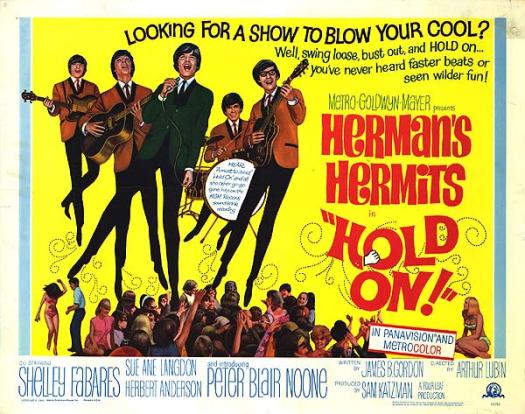
In yesterday’s  ‘One Hit Wonders’ post on the Blues Magoos, I told you Dear Readers my first concert was headlined by Herman’s Hermits, five non-threatening teens from Manchester, UK – Karl Greene, Barry Whitwam, Derek ‘Lek’ Leckenby, Keith Hopwood, and lead singer Peter Blair Denis Bernard Noone, known as Herman for his slight resemblance to cartoon character Sherman (of “Mr. Peabody and…’ fame). Their infectious, peppy pop rock and Herman’s toothy grin made the teenyboppers scream with delight, with hits like “I’m Into Something Good”, “Mrs. Brown You’ve Got a Lovely Daughter”, and “I’m Henry the VIII, I Am”. Even parents liked The Hermits, and they seemed destined to follow in the cinematic footsteps of The Beatles. MGM, who released their records stateside, concocted a ball of fluff for Herman and the lads called HOLD ON!, and any resemblance between that title and The Fab Four’s HELP! is strictly not

View original post 597 more words

Film Review: Guerrilla: The Taking of Patty Hearst (dir by Robert Stone)


“Death to the fascist insect that preys upon the life of the people!”

— Patty “Tania” Hearst

2004’s Guerrilla is not the first movie that I’ve reviewed about the kidnapping of heiress Patty Hearst.  Previously, I took a look at Abduction, a grindhouse film that was released while Hearst was still missing, and 1988’s Patty Hearst, which was based on Hearst’s own book about her ordeal.  However, Guerrilla is different from those two films in that it’s a documentary and it features interviews with people who actually knew Patty and her kidnappers.

It’s a strange and complicated story, the type that you would probably be dismissed as implausible if not for the fact that it actually happened.  In 1973, Oakland school superintendent Marcus Foster was gunned down in a parking lot.  Because Foster was the first black man to held the position of superintendent, it was originally assumed that he had been gunned down by a racist paramilitary group.  However, a neo-Marxist group known as the Symbionese Liberation Army (SLA) soon took responsibility for the murder, claiming that Foster had been tried in a people’s court and sentenced to death for his crimes.  (Foster’s “crime” was apparently trying to introduce ID cards in Oakland schools.)

Who were the SLA?  They were a small group of self-styled revolutionaries.  Though their leader was a black, escaped convict named Donald DeFreeze, the other members of the SLA were white and largely middle class.  They enjoyed sending out portentous political announcements and they went out of their way to try to portray themselves as being a highly disciplined and regimented military organization.  Donald DeFreeze changed his name to “Field Marshal Cinque.”  According to the interviews in Guerrilla, most of their fellow radicals viewed the SLA as being a joke.  (One contemporary expresses his disappointment in meeting the SLA and discovering that they were all very boring and middle class.)  No one could understand the logic behind murdering Foster, who was viewed as being a progressive educator.

If not for what happened in the months after Foster’s murder, the SLA probably would have faded into the same obscurity that has swallowed up so many activist groups.  After two members of the group were arrested, the SLA retaliated by kidnapping Patty Hearst.

At the time that she was abducted, Patty Hearst was a nineteen year-old student at Berkeley.  She was also the granddaughter of William Randolph Hearst, the publishing magnate whose life famously inspired the film Citizen Kane.  With the entire world now watching, the SLA announced that Patty would be executed unless the Hearst family arranged for every poor person in California to receive $70 worth of food.  As is portrayed in cringe-inducing detail in the documentary, the Hearst family actually attempted to meet the SLA’s demands, just to watch the food distribution program descend into chaos.  As for the SLA, they were not impressed by the Hearst family’s effort.  Even more tellingly, Patty was not impressed.  In a recording sent to the press, Patty complained that her family hadn’t made enough of an effort and assured everyone that the SLA was treating her in accordance to international law.

Shortly afterwards, the SLA released another recording.  In this recording, Patty announced that she had been given the option of either returning to her family or joining the SLA.  She had decided to join the SLA and take the new name of Tania.  Soon, Patty Hearst was robbing banks and declaring “death to the fascist insect.”

Was Patty sincere in her conversion or was she brainwashed?  That’s the question that Guerrilla explores, while leaving it to the audience to decide for themselves what was actually going on in Patty’s mind.  Though Patty is not interviewed in the film, we do get to hear the recordings that she made during her time with the SLA.  We listen as she goes from being a sacred abductee to a self-declared “urban guerrilla.”  Listening to her dull, flat voice, you get the feeling that she didn’t have much of an individual identity before she was kidnapped and she had even less of one after she converts to the SLA cause.  When she talks about how much she loves the other members of the SLA, she sounds like an actress giving a bad audition.  Before she was kidnapped, she was a Hearst.  After she was kidnapped, she was a revolutionary.  At no point do you get the feeling that she was ever just Patty.

It’s an interesting story and Guerrilla is a fascinating documentary, one that explores how idealism can sometimes be just as dangerous as cynicism.  It’s also a film that explores how the kidnapping of an heiress received more attention than the murder of a teacher.  It’s interesting to note that, while the other members of the SLA eventually ended up either dead or in prison, Patty Hearst ended up getting a full pardon from Bill Clinton.  It’s hard not to feel that the story would have been much different if the SLA had kidnapped Jane Smith instead of Patty Hearst.

Film Review: Gimme Shelter (dir by Albert and David Mayles and Charlotte Zwerin)


After you watch Woodstock, you owe it to yourself to watch another documentary from 1970.  This one is called Gimme Shelter and it deals with the infamous Altamont Free Concert.  Taking place a few months after Woodstock, Altamont was originally envisioned as being Woodstock West but, as Gimme Shelter illustrates in disturbing detail, it ultimately became something far different.

Here are a few images from both Gimme Shelter and the Altamont Free Concert:

This is Mick Jagger, the lead singer of The Rolling Stones.  The Rolling Stones were the final act to perform at the Altamont Free Concert and their performance was meant to be the conclusion of their 1969 American tour.  Gimme Shelter was originally meant to be a documentary about the final days of the tour and clips of a confident and charismatic Jagger performing in Madison Square Garden are sprinkled throughout the first 40 minutes of the film.  They provide a striking contrast to the chaos of the second half of the film, in which Jagger finds himself ineffectually trying to maintain order as fights break out in front of the stage.

This is Charlie Watts, the Rolling Stones’s drummer.  Though Gimme Shelter is usually referred to as being a documentary about the Rolling Stones, the film pretty much centers around Mick and Charlie.  Gimme Shelter‘s framing device involves Mick and Charlie watching a rough cut of the documentary itself.  While Mick always seems to maintain an air of deliberate detachment, Charlie seems to be visibly disturbed by what happened during their performance at Altamont.

(In another memorable scene, the group is shown listening to their latest recording.  While this rest of the group plays up to the filmmakers, Charlie quietly takes in the music and appears to be surprised when he notices that he’s being filmed.)

This is the Melvin Belli.  An attorney, Belli appears throughout the first half of Gimme Shelter, making the arrangements for the Altamont Free Concert and obviously having a great time showing off for the camera.  At one point, Belli makes a comment about opening for the Stones.  While Belli’s joking, it’s obvious from the tone of his voice that he’d love nothing more than to do so.  In fact, Belli is so busy being entertaining that he really doesn’t seem to notice that, even during the planning stages, the Altamont Free Concert doesn’t sound like a good idea.

This is Sonny Barger, a founding member of the Hell’s Angels.  He’s standing on the Altamont stage, watching Mick Jagger perform.  Why is Barger on stage?  He’s there because, for some reason, someone thought it would be a good idea to hire the Hell’s Angels to handle security at the concert.  (Barger is heard, in the film, saying that he was told that he could sit on the stage and drink beer and all he had to do was keep anyone else from approaching the musicians.)

What is Barger thinking as he watches Jagger perform?  This is a question that I think anyone who has ever watched Gimme Shelter has asked themselves.  Is he annoyed with or menacing Jagger or is he just doing his job and making sure that no one rushes the singer?  Perhaps it’s all of the above.

The man in green is Meredith Hunter.  This shot is the first time that Hunter appears in the film.  The second time is when he’s getting stabbed to death by a member of the Hell’s Angels security force.  Watching the documentary, Jagger asks to rewatch the scene of Hunter’s murder.  The filmmakers slow down the scene and show him both the knife being held by the Hell’s Angel and the gun being held by Hunter.

Even before Hunter’s death, Gimme Shelter has already shown us enough to convince us that the counter culture dream of Woodstock was the exception as opposed to the rule.  The final hour of Gimme Shelter takes place at the Altamont Free Concert and almost every scene feels like an angry rebuke to the positivity of Woodstock.  The crowds were angrier.  The scenery was far less aesthetically pleasing.  (Woodstock took place on a farm.  Altamont took place on a cement race track.)  Whereas Woodstock famously featured warnings about the “brown acid,” Gimme Shelter features one of the concert promoters reacting to concerns about the bad acid circulating in the crowd by saying, “Tough shit.”  Even the naked people at Altamont were far less attractive than the naked people at Woodstock.  Jefferson Airplane played at both festivals.  At Woodstock, they apparently had sound issues but otherwise, there were no problems.  At Altamont, as the cameras rolled, lead singer Marty Balin was knocked unconscious by a Hell’s Angel with a pool cue.

(“I’d like to mention that the Hell’s Angels just smashed Marty Balin in the face and knocked him out for a bit. I’d like to thank you for that,” one of the members of the band announced.)

A few more images from Altamont:

Before the concert starts, this man cheerfully yelled “LSD!  Mescaline!” at everyone walking by.  I’m not sure if that was his dog or not.  But speaking of dogs…

…this dog casually wandered across the stage during the Rolling Stones’s performance.  It’s never clear where he came from or where he went after he left the stage.

Even with the Hell’s Angels beating up everyone in sight, a few people still enjoyed the concert.  This is who I relate to in the film because she was determined to enjoy herself no matter how weird things got.

But then there’s this guy, who was standing only a few feet away from Jagger when he started to freak out:

If Woodstock is ultimately all about peace and life, Gimme Shelter is a film that is suffused with conflict and death.  If you’re going to watch one, you owe it to yourself to watch the other.  In the end, the two documentaries together provide us with a view of a counterculture that had so much potential but which couldn’t escape the darkness that hid behind the light.

(Interestingly enough, future director George Lucas was one of the cameramen at Altamont that day.  Just as how Altamont was often cited as the end of the 60s, the blockbuster success of Lucas’s Star Wars would often be cited as the beginning of the 80s.)

I’ll end this review with a quote from Grace Slick, one that is still relevant today.  As she said as she watched Altamont descend into chaos: “You don’t hassle with anybody in particular. You gotta keep your bodies off each other unless you intend love. People get weird, and you need people like the Angels to keep people in line. But the Angels also – you know, you don’t bust people in the head – for nothing. So both sides are fucking up temporarily; let’s not keep FUCKING UP!”