Horror on the Lens: Dr. Jekyll and Mr. Hyde (dir by John S. Robertson)


394px-Dr_Jekyll_and_Mr_Hyde_1920_poster

Ever since the birth of film, Robert Louis Stevenson’s Dr. Jekyll and Mr. Hyde has been a popular subject for adaptation.  Not only does the classic story of a good doctor who unleashes his evil instinct via potion serve as a potent metaphor for everything from sexual repression to drug addiction, but the dual role of Dr. Jekyll and Mr. Hyde has provides an excellent opportunity for an actor to show off.

The first film adaptation of Dr. Jekyll and Mr. Hyde is believed to have been made in 1908.  Two more version followed in 1912 and 1913 and then, suddenly, 1920 saw three different film versions.

The best known of the 1920 version is our film for today.  This version is best remembered for John Barrymore’s powerful performance in the title role but it also holds up remarkably well as a work of cinematic horror.

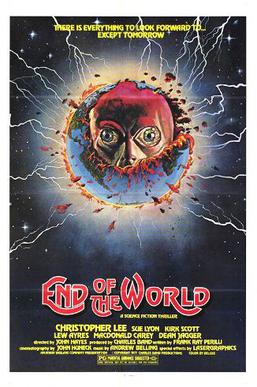
The TSL’s Horror Grindhouse: End of the World (dir by Charles Band)


The 1977 film End of the World has got a great opening scene.  An obviously distraught priest (played by none other than Christopher Lee!) steps into an isolated diner.  He tells the counterman that he needs to use the phone.  The counterman says, “Sure, father.”  And then suddenly, everything in the dinner starts blowing up.  The phone, the coffee, the pinball machine, everything explodes.  The counterman ends up trying to unsuccessfully throw himself through a window.  The priest, looking rather confused, steps outside of the diner and he runs into …. his exact double!  Christopher Lee meets Christopher Lee!

Again, that’s a great opening and it’s really not a surprise that the rest of the film can’t live up to it.  Once the two Christopher Lees disappear into the darkness, the focus of the story shifts to a scientist named Andrew (Kirk Scott) and his wife, Sylvia (Sue Lyon, who years previously played Lolita).  Andrew spends a lot of time sitting in front of a boxy computer and staring at the screen.  He’s picking up strange transmissions from space and he’s trying to translate them.  Andrew goes home.  He and his wife got a party.  Andrew sits in front of the computer a while longer.  Andrew goes home.  Andrew goes to work.  Andrew keeps staring at the computer….

“Wait,” you’re saying at this point, “isn’t this is a Christopher Lee movie?”

Yes, it is.  Christopher Lee is indeed top-billed and he’s hardly in the movie at all.  I’d like to think that, when asked why by an intrepid reporter why he agreed to star in End of the World, Lee laughed and replied, “For the money, of course.”  But, according to Lee’s autobiography, he did the film because he was told that he would be appearing with a cast of distinguished actors like Jose Ferrer, Dean Jagger, and John Carradine.  Now, Dean Jagger does have a small cameo in the film but Ferrer and Carradine are nowhere to be seen.  Either they left the production or someone lied to Sir Christopher!

Anyway, back to the plot.  Eventually, Andrew figures out that the space transmissions are predicting natural disasters.  We don’t actually see any of these disasters because, after all, this is the end of the world on a very low budget.  But we are assured that the disasters are happening.  Andrew and Sylvia discover that the transmissions are coming from a convent in the middle of the desert.  Andrew and Sylvia go to investigate and they discover that the nuns are….

ALIENS!

Now, this is actually a pretty good twist and there are some vaguely humorous scenes of the the nuns working in a space lab.  It turns out that the nuns (and one of the Christopher Lees) are stranded on this planet because their spaceship broke down.  They don’t really like Earth, considering it to be an ugly and polluted place.  They’re planning on ending the world but they need to leave before the whole place blows up.  They demand that Andrew help them fix their transporter and they’re going to hold Sylvia hostage until he does so….

It’s all a bit silly but, as you’re watching the film, you can’t help but wish that it had been even sillier.  I mean, alien nuns and Father Christopher Lee?  That sounds like the makings of a certain type of classic!  But, unfortunately, the film never fully embraces the full potential of its absurdity.  It takes forever for Andrew and Sylvia to actually reach that convent and even the alien nuns become rather passé after a few minutes.  Christopher Lee is fun to watch as always and his character’s irritation with being stuck on Earth was obviously mirrored by Lee’s irritation with being in the film.  And, despite all else, let’s give credit where credit it is due — the title lives up to its promise.  The world may end in a pile of stock footage but an end is an end.

Anyway, this one is pretty much for Christopher Lee completists only.  Watch the opening and then fast forward to the end.

Robotic Vengeance: Steel and Lace (1991, directed by Ernest Farino)


On trial for raping concert pianist Gally Morton (Clare Wren), evil businessman Daniel Emerson (Michael Cerveris) gets four of his sleazy buddies to provide a fake alibi for him.  After Emerson is acquitted, Gally goes to the roof of the courthouse and leaps to her death.

Five years later, Daniel and his four friends have made a fortune by illegally foreclosing on people’s houses.  They may think that they’ve gotten away with their crimes but what they don’t know is that Gally’s brother, Albert (Bruce Davison), has been building a robot version of his sister.  Soon, Robot Gally is killing off all of Emerson’s friends while a courtroom sketch artist named Alison (Stacy Haiduk) and a detective named Dunn (David Naughton) attempt to figure out what’s going on.

A mix of The Terminator and I Spit On Your Grave, Steel and Lace is a classic of its kind.  While the deaths are inventive and, considering who Robot Gally is killing, deserved, what really sets the film apart is the strong cast and the inventive direction.  Director Ernest Farino wastes no time getting down to business and he inventively opens the film by cutting back and forth between Emerson assaulting Gally and the jury acquitting him of the crime that we just saw him commit.  Davison is not in the film as much as you might expect but he still makes an impression as the fanatical Albert and Naughton and Haiduk are likable even if their scenes sometimes feel like padding.  Best of all is Clare Wren, an actress who deserved to be a bigger star and who is convincing both as the fragile Gally and as the vengeance-driven robot.  Robot Gally eventually comes to question whether justice is truly be served by all of the killings and Wren sells it.  Also be sure to keep an eye out for David L. Lander, playing the prerequisite eccentric coronor.  (Has there ever been a movie coroner who wasn’t an eccentric?)  Finally, Brian Backer — who will be forever known for playing nice guy Mark Ratner in Fast Times At Ridgemont High — is effectively cast against type as one of Emerson’s stooges.

Steel and Lace is one of the best low-budget films to come out of the early 90s, a deeply satisfying tale of robotics and vengeance.

International Horror Film Review: House (dir by Nobuhiko Obayashi)


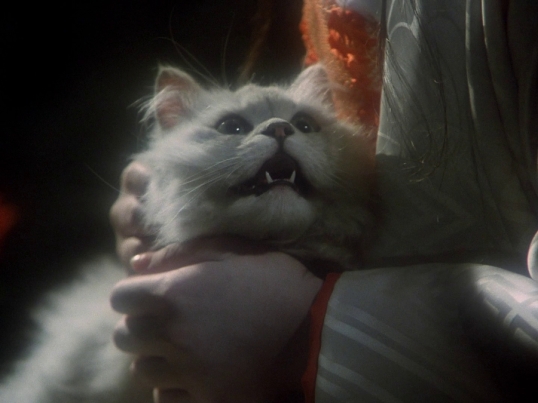
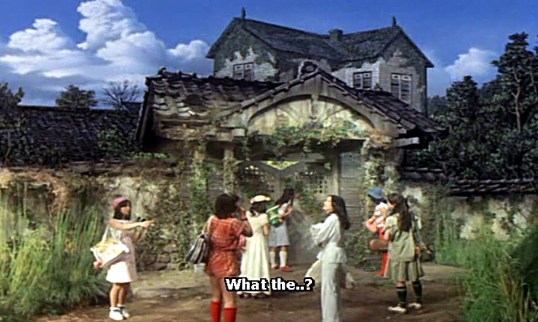
The 1977 Japanese horror film, House, opens with a teenage girl named Gorgeous (Kimiko Ikegami) who is excited about the start of summer.  Her father has finally returned home from Italy, where he was scoring a film for Sergio Leone.  (Supposedly, Leone said that her father was even more talented than Ennio Morricone!)  However, Gorgeous is upset to discover that her father has remarried and she has a new stepmother!  No longer wanting to be around her father, Gorgeous writes to her aunt and asks if she can spend the summer with her.  Gorgeous’s aunt (Yōko Minamida) agrees and invites Gorgeous to visit the country house where she lives with a white cat.

However, Gorgeous will not be traveling on her own.  She’s bringing six of her school friends with her!  Like Gorgeous, all of them have trait-appropriate names.

For instance, Kung Fu (Miki Jinbo) is athletic and good at kung fu.

Prof (Ali Matsubara) is intelligent and wears glasses.

Fantasy (Kumiko Oba) is a daydreamer.

Mac (Mieko Sato) enjoys eating.

Melody (Eriko Tanaka) plays music.

Sweet (Masayo Miyako) is …. well, sweet.

They’re all fun, cheerful, optimistic, and good-natured.  (They also all have a crush on their teacher, Mr. Togo (Kiyohiko Ozaki),  goofy fellow with sideburns and an old car.)  As soon as the girls arrive at Auntie’s house, they present her with a watermelon and then take a tour of the old house.  They all take the time to notice Auntie’s white cat, who is adorable but seems to have a little bit of an attitude.  Everyone’s happy and perky and it truly appears that this is going to be the greatest summer of their lives….

Of course, not everything’s perfect.  There are a few complications.  For instance, Gorgeous is still upset about her father remarrying and chooses to go off on her own. Mac goes out to the well and then doesn’t return.  However, her head is later seen floating around the house and biting the other girls.  One girl gets eaten by a clock.  Another loses her hands while playing the piano.  The piano then proceeds to eat the girl while Mac’s disembodied head giggles and says, “Naughty!”  Soon, there are body parts flying around all over the house and the downstairs is flooded with blood.  The cat, it must be said, appears to be rather amused….

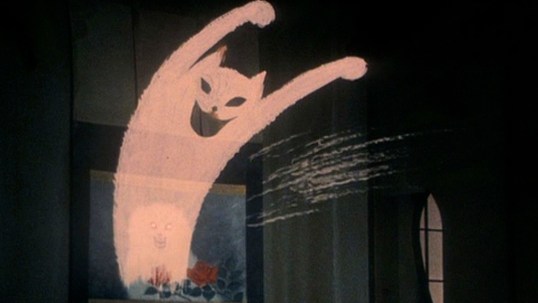
I don’t know if words alone can convey what a strange movie House is.  This really is one of those movies that has to be seen to believed.  In many ways, it feels like a children’s film made by someone who really dislikes children.  Everything starts out very happily, with bright colors, frantic camera work, corny humor, and cheerful music playing in the background.  There’s even several incidences of deliberately crude, pop art-style animation sprinkled throughout the film.  Then the girls reach the house and suddenly, everyone’s screaming and there’s blood spurting everywhere and disembodies heads and other limbs flying around and yet, the tone of the film doesn’t change.  The music remains cheerful.  The humor remains corny, especially in the scenes involving hapless Mr. Togo and his attempts to rescue the girls, and the film’s special effects remains deliberately crude.  At the same time, there’s an interesting subtext to the film.  Gorgeous’s aunt is bitter over the death of her lover, who never returned from World War II.  When Gorgeous meets her new stepmother, the sky glows with an almost atomic intensity and one unfortunate character is literally vaporized into nothing.  The old house is literally eating the young, perhaps to punish them for being the first generation to be born after the end of the war and to have no firsthand experience with the twin traumas of the destruction of Hiroshima and Nagasaki.

As I said, it’s a weird, weird movie.  It’s also an incredibly watchable one, one that comes very close to capturing the feel of a filmed dream.  It’s not for everyone, this oddly cheerful bloodbath.  But I’d still recommend watching it at least once.

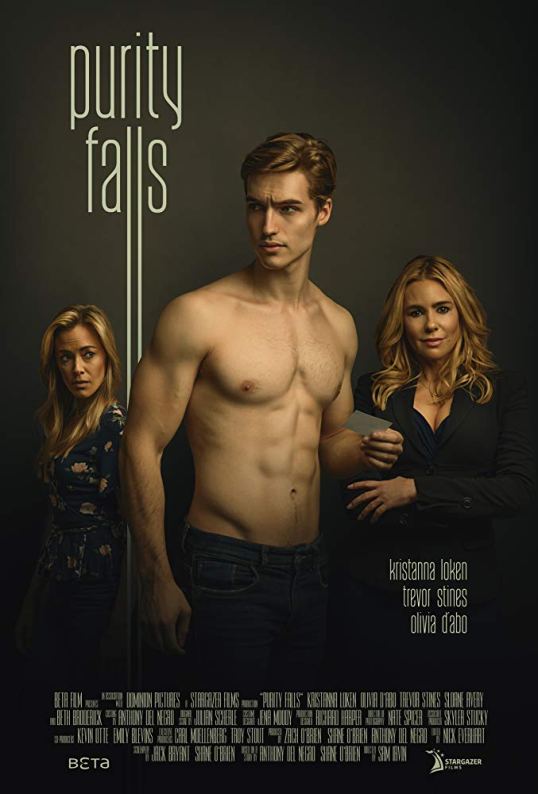
Lifetime Film Review: The Madam of Purity Falls (dir by Sam Irvin)


One of the first rules of moving to a new place, avoid any location that has a potentially ironic name.

Seriously, don’t live near a virgin spring.  Don’t move into the house at the end of Charity Drive.  Avoid Peaceful Meadows at all costs.  Happy Street?  Don’t even think about it.  And Purity Falls?

Listen, there’s no way that moving to a town called Purity Falls is a good idea.

Still, that’s what Nicole and her children do in the Lifetime film, The Madam of Purity Falls.  The recently widowed Nicole (Kristanna Loken) even gets a job as the guidance counselor at Purity Falls High School!  Since the family is still struggling to come to terms with the death of Nicole’s husband and the children’s father, the hope is that a new home can help them move on.  Younger sister Justine (Sloane Avery) is willing to give it a try.  But older brother Jason (Trevor Stines) is resistant from the beginning.  Even meeting and befriending Chad (Jonathan Bouvier) doesn’t seem to help with Jason’s angst.  Of course, Chad is soon found floating in a swimming pool, dead.  Can you believe such a thing could happen in Purity Falls?

Trying to adjust to a new school, Jason joins the wrestling team and even meets a girl who seems to like him.  But how can Jason go on a date when he doesn’t have a car!?  And how can he get a car if he doesn’t have any money!?  Hey, wait a minute.  Didn’t his new neighbor, Courtney (Olivia d’Abo), mention that she had some odd jobs that she needed done around the house and that she would be willing to pay him to do them?  At first, Jason is reluctant to work for Courtney but one of his fellow wrestling teammates assures him that working for Courtney will be the greatest experience of his life.

Courtney has a nice big house and a lucrative job selling organic cosmetics.  Everyone in Purity Falls seems to know her.  She puts Jason right to work, paying him for landscaping and sex.  Realizing that there’s a lot of money to be made from being a suburban prostitute, Jason agrees to become one of Courtney’s “boys.”  Soon, he’s sleeping with almost every frustrated housewife in Purity Falls, making all sorts of money, and getting into all sorts of danger!

Of course, Nicole is curious as to why her son keeps sneaking out of the house and then staying out for so long.  And some of Jason’s clients are into some things that make Jason uneasy.  And, of course, there’s the fact that people are dying.  Hmmmm …. being a suburban prostitute might not be as easy as it looks!  But is Jason already in too deep to escape his new life?

The Madam of Purity Falls is an enjoyably over-the-top in execution as it is in its name.  This is one of those films where everyone lives in a nice, big house and they’ve all got nice, big secrets to hide.  Don’t take the film too seriously.  Just enjoy it for the melodrama and the sex and for Olivia d’Abo’s enjoyably villainous turn as the Madam of Purity Falls.

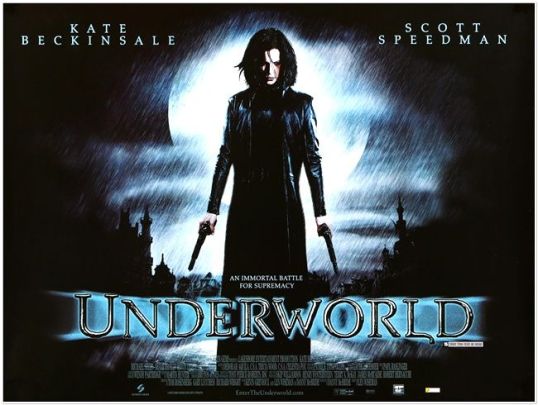
Horror Film Review: Underworld (dir by Len Wiseman)


Underworld is one hell of a confusing movie.

I saw Underworld when it was first released in theaters, way back in 2003.  And I’ve rewatched more than a handful of times since then, mostly because of my huge girl crush on Kate Beckinsale.  And every time that I watch this movie, I find myself wondering what the Hell’s going on.

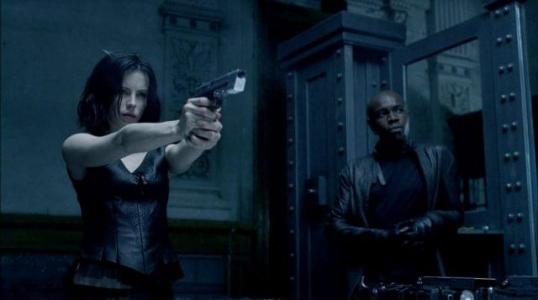
I mean, I get it.  There’s a centuries-old war between vampires and Lycans and the Lycans are basically werewolves but they’re called “Lycan” because Lycan sounds better than werewolf.  The Death Dealers are vampires who go around and shoot Lycans on dark rainy nights.  And apparently, the vampires think that the Lycan threat has been neutralized because the leader of the Lycans, Lucian, is dead but maybe he’s not because Lucian’s body was never found.  And meanwhile, there’s three vampire rulers and two of the rulers get to sleep while the other one reigns and they switch out every few centuries.

Oh!  And the vampires and the Lycans are not really supernatural creatures.  Instead, they’re people who have been infected by a virus that causes them to live a really long time and have a craving for blood or something like that.  So, that explains why none of the vampires turn into a bat or anything like that during the movie.  Instead, everyone just runs around and does parkour and shoots guns at one another.

Also, the vampires don’t have to prey on human beings because they’ve learned how to clone blood because cloning is the solution for everything.

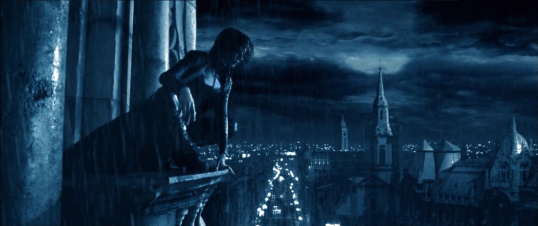
And also, everything happens at night while it’s raining because the vampires and the Lycans are secretly living in the same world with humans, they’re just living underground.  They’re living in an underworld, if you will.

Also ….

Well, listen, there’s a lot of plot in this movie.  Underworld lasts for 121 minutes and there’s really not a slow spot in the entire film.  In fact, that’s probably one of the film’s greatest strengths.  The nonstop action keeps you from thinking about how the plot of the film just seems to be something that the filmmakers made up as they went along.  Instead of wondering how everything fits together, you’re too busy watching as the movie flies from violent set piece to another.

Underworld‘s other great strength is that it stars Kate Beckinsale.  Nowadays, the action girl who kicks ass and defeats evil while looking good has become such a cliche that it’s easy to forget just how exciting it was when we first saw Kate Beckinsale, clad in leather and effortlessly dodging bullets and ruthlessly killing Lycans.  Though its impact may have subsequently been diluted by too many sequels and imitations, watching Underworld for the first time was a very empowering experience.  Watching Underworld for the first time, I wanted to be Kate Beckinsale. If Kate could defeat both vampires and Lycans without breaking a sweat then I knew that I could defeat my own insecurities.   Of course, unlike Kate, I didn’t have the advantage of movie magic to help me down a backflip off of a wall and I ended up spraining my ankle but still, Kate Beckinsale in Underworld was the perfect antidote to years of previously watching women in horror and action films be treated like either disposable victims or damsels in need of rescue.

In Underworld, Kate Beckinsale played Selene, a Death Dealer who tries to figure out why the Lycans are all after a human named Michael (Scott Speedman).  Selene also falls in love with Michael, which leads to some complications after Michael gets bitten by Lucian (Michael Sheen), the Lycan leader who wasn’t really dead after all.  Meanwhile, Kraven (Shane Brolly) wants to take over the vampires and a vampire elder named Viktor (Bill Nighy) is woken up early and then ages backwards through the film, which is actually a pretty clever idea.

And, as I said before, it never really makes much sense.  But, as incoherent as Underworld may be, it’s still an undeniably addictive viewing experience.  The movie is pure style.  It takes place in a world where it’s always night and it’s always raining and where everyone is beautiful and deadly at the same time.  Whether they’re a vampire or a Lycan, People in Underworld movies don’t merely enter a room.  Instead, they throw the doors open and allows blue light to flood in as they make a grand entrance.  At times, the film’s style is so kinetic and overwhelming that it threatened to get a little bit silly but, again, that’s a part of the film’s appeal.  While Kate Beckinsale thrills you with her empowering performance, the visuals grab you and say, “We’re going on a trip and don’t worry about whether it makes any sense!”

That’s why I’ve watched Underworld several times.  It doesn’t have to make sense.  It just has to kick ass.


Horror on the Lens: The Last Man on Earth (dir. by Ubaldo Ragona and Sidney Salkow)


Hi there and Happy October 4th!  For today’s treat from the ranks of horror films that have fallen into the public domain, I present to you one of the most important films in horror history.  Though it wasn’t appreciated when it was first  released back in 1964, The Last Man On Earth was not only the 1st Italian horror film but George Romero has also acknowledged it as an influence on his own Night of the Living Dead.

It’s easy to be a little bit dismissive of The Last Man On Earth.  After all, the low-budget is obvious in every scene, the dubbing is off even by the standards of Italian horror, and just the name “Vincent Price” in the credits leads one to suspect that this will be another campy, B-movie.  Perhaps that’s why I’m always surprised to rediscover that, taking all things into consideration, this is actually a pretty effective film.  Price does have a few over-the-top moments but, for the most part, he gives one of his better performances here and the black-and-white images have an isolated, desolate starkness to them that go a long way towards making this film’s apocalypse a convincing one.  The mass cremation scene always leaves me feeling rather uneasy.

The film is based on Richard Matheson’s I Am Legend and no, it’s nowhere as good as the book.  However, it’s a lot better than the Will Smith version.

If you have 87 minutes to kill, please enjoy The Last Man On The Earth.

The TSL’s Horror Grindhouse: Guru, The Mad Monk (dir by Andy Milligan)


The 1970 film Guru, the Mad Monk opens with a woman being dragged, by two men, down a New York sidewalk.  In the background, you can clearly hear the sounds of Manhattan morning traffic as people head to work or school, presumably barely noticing that a movie is being made one block over.

Now, normally, that might not be a problem.  In fact, it’s the kind of things that you tend to expect from an independent film made in the early 70s.  Cinema verite was all the rage back then and many films from that period would incorporate documentary techniques, shooting on location and making use of actual bystanders and the sound of actual traffic.  However, Guru, the Mad Monk is supposed to be taking place on the isolated (and fictional) prison island of Mortavia.  Even more importantly, it’s supposed to be taking place in 1480.  Now, obviously, all historical films require a certain suspension of disbelief.  I mean, we know that no cinematic version of the 15th Century is going to be a 100% accurate and we really should be happy about that because the the 1400s were a pretty disgusting time to be alive.  I mean, we don’t need to see people tossing a chamber pot out of their bedroom window in order to accept that a film is taking place in a certain time period.  However, what we do need is for there not to be two scenes that feature the sounds of cars driving by the film’s set.  One half expects some random person to wander into the shot and hail a taxi.

Guru, the Mad Monk was directed by Andy Milligan, who is a legendary name as far as grindhouse filmmaking is concerned.  Milligan was an off-off broadway playwright-turned-exploitation filmmaker who didn’t let a lack of money and/or discernible talent prevent him from directing an estimated 29 films.  Milligan’s films are distinguished by angry (if usually incoherent) storylines, flamboyant performances from a stock company made up of local Staten Island actors, cheap gore effects, and poor sound quality.  One reason why you especially notice the sound quality is because a typical Milligan film is surprisingly talky.  It makes sense when you consider that Milligan developed his artistic vision while working in theater but, as a director, Milligan never seemed to figure out how to break free from the inherent stageyness of his scripts.

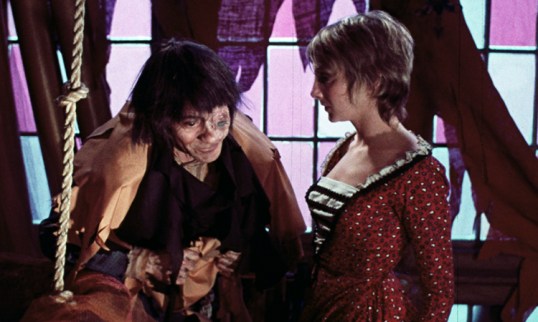
And yet, there’s also an odd and, at times, rather dream-like intensity to most of Milligan’s films.  Some of that is undoubtedly due to the fact that a typical Milligan film lacks any sort of intentional humor.  For instance, Guru features a supporting character named, believe it or not, Igor.  And yes, Igor (played by Jack Spencer)) is a hunchback.  And typically, you would think any filmmaker including a hunchback named Igor in a horror film made after 1940 would have to be having a little bit of fun with the cliches of the genre.  But no, Guru, The Mad Monk was obviously meant to be a very serious film and very much a reflection of the negative worldview that seemed to permeate all of Milligan’s films.  Guru, The Mad Monk is a dark film where almost everyone is corrupt and guilty of something and, watching the film, you get the feeling that its darkness is coming straight for Milligan’s heart.

Notice the white scooter in the background as these 15 century clergymen hold a meeting in Guru, The Mad Monk.

As for what the film’s about …. well, that’s hard to say.  The plot is rather difficult to follow.  Father Guru (played, in flamboyantly evil style, by Neil Flanagan) is the governor of the prison island of Mortavia.  (St. Peter’s, an Episcopal Church in Manhattan, stands in for the prison.)  Guru is usually quick to execute his prisoners so that his mistress, Lady Olga (Jacqueline Webb), can drink their blood.  It’s hard to say whether Lady Olga is supposed to be a real vampire or not.  When we first meet her, she just comes across as being a Lady Bathory-type but then there’s another scene where she appear to be wearing fake fangs and declares herself to be the “Soul of Darkness” so who knows for sure?

In between all of the eye gougings and beheadings that one would typically expect to find in a Milligan film, there’s also a love story as jailer Carl (Paul Lieber) falls in love with the latest prisoner, Nadja (Susan Israel).  Nadja is due to be executed but Guru agrees to spare her life if Carl will dig up some bodies and sell them to a nearby university.  Carl agrees but it soon turns out that he made a mistake trusting Father Guru.  It all leads to the expected bloodbath, along with Guru raving about the joys of living a life where “I preach one thing but continue to believe another!”

Clocking in at just 57 minutes, it’s a weird film.  Typically, I tend to defend films like this because, regardless of their flaws, they at least represent the director’s unique vision of the world.  That’s always been my defense when it’s come to Ed Wood, for instance.  But, when it comes to Milligan …. eh.  I mean, from a historical perspective, anyone who is interested in classic grindhouse and independent filmmaking has to see at least one Andy Milligan film.  And it can be said that you’ll never mistake an Andy Milligan film for anyone else’s.  But, at the same time, I have to admit that watching Guru was the longest 57 minutes of my life.

So, no …. unless you’re on some sort of Andy Milligan kick, I don’t really recommend Guru, The Mad Monk.

Sorry, Igor.
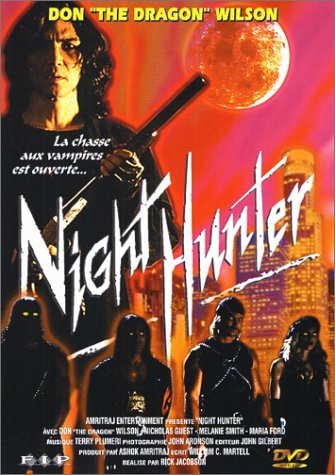
Everything You Know About Vampires Is Wrong: Night Hunter (1996, directed by Rick Jacobson)


Forget everything you know about vampires!
Did you think that vampires could only go out at night?  Wrong.  They can run around in broad daylight.

Did you think that you needed a cross or a stake to kill a vampire?  Wrong.  You can break their necks or use a shotgun.

Did you think that we get new vampires by vampires biting their victims late at night?  Wrong.  Vampires can only breed during a solar eclipse.

Did you think that there’s thousands of vampires hiding out across the world?  Wrong.  There’s only seven left.

That’s the idea behind Night Hunter, which stars Don “The Dragon” Wilson as Jack Cutter.  Cutter’s grandparents were vampire hunters.  His parents were vampire hunters.  Cutter was destined to be a vampire hunter.  And now that he’s the only member of his family left alive, he is determined to wipe out the last few remaining vampires.  Jack has two problems.  The first is that the police don’t believe in vampires so they just think that Jack is going around Los Angeles and killing random people.  The second is that a solar eclipse is rapidly approaching and, if the vampires breed, all of Jack’s work will be for nothing.  Accompanied by a plucky tabloid reporter named Raimy (Melanie Smith), Jack searches for the king of the vampires.  Not coincidentally, Raimy looks just like the woman that the king once loved over a hundred years ago.

For a direct-to-video vampire film, Night Hunter’s not bad.  Wilson may not have been a great actor but he was one of the best kick boxers in the world and this brings a verisimilitude to Night Hunter‘s action scenes that most direct-to-video action films couldn’t hope to duplicate.  Rick Jacobson directed the majority of Wilson’s films and, in Night Hunter, he keeps things moving along at a steady pace.  Night Hunter doesn’t waste any time getting to the vampire action and it never pretends to be anything more than what it is.  Best of all, the film’s got Maria Ford as a French vampire named Tourneur who says things like, “I will not await vengeance, the hunter will die!”

When I first watched Night Hunter, I thought that it was a rip-off of Blade but Blade actually came out two years after Night Hunter.  Unless Don “The Dragon” Wilson (who co-produced) was a fan of Tomb of Dracula, the similarities between the two films are probably coincidental.  While Night Hunter may not be Blade, it’s still pretty damn cool.

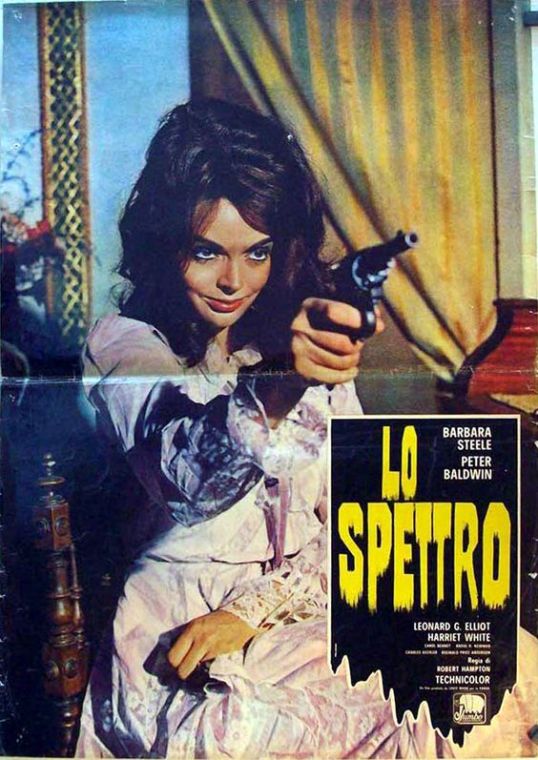
International Horror Film Review: The Ghost (dir by Ricarrdo Freda)


The 1963 Italian film The Ghost takes place in 1910 at an isolated Scottish estate.  It’s the type of estate where the mornings are always foggy, the nights are always full of lightning, and shadows always seem to be creeping around every corner.  The film opens with a darkened seance, one in which the estate’s housekeeper, Catherine (Harriet Medin), serves as a medium.  It’s an appropriate opening because, as we soon discover, everyone at this estate is obsessed with death.

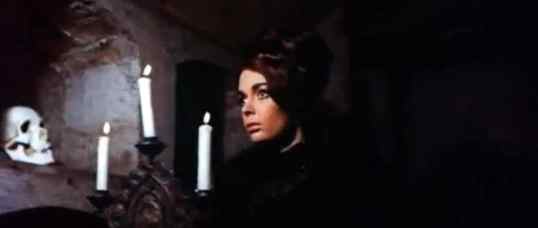
The estate’s owner, the appropriately-named Dr. Hichcock (Elio Jotta), is sickly and obviously doesn’t have much time left.  He speaks constantly of the end while his wife, Margaret (Barbara Steele) and his doctor, Charles Livingstone (Peter Baldwin), continually try to keep him for committing suicide.

Of course, just because Margaret and Charles seem to be committed to keeping Dr. Hichcock from killing himself that doesn’t mean that they aren’t willing to do the job themselves.  Margaret and Charles are lovers and are eagerly looking forward to getting their hands on Hichock’s fortune once he actually does die.  When Margaret suggests that maybe Charles could help the process out while still making Hichcock’s death look natural, Charles is, at first, a bit hesitant.  But, he finally goes through with it.

So, now, Dr. Hichcock’s dead!  They have a moodily-photographed funeral and everything!  However, Margaret and Charles are shocked when the doctor’s assets are revealed to amount to very little money.  Figuring out that he must have hidden his fortune somewhere in the estate, Margaret and Charles start to search but find themselves wondering how much they can trust each other.

Making things even more complicated is that it appears that Dr. Hichcock might not be done with either one of them.  Soon, both Margaret and Charles are hearing the dead doctor’s voice echoing throughout the house and other strange things start to happen.  Even the housekeeper gets possessed and starts telling Margaret not to trust Charles.  Is Dr. Hichcock haunting them from the grave or is Margaret being driven mad by her own greed and guilt?  Or is there another solution?

The Ghost is a moody and enjoyable gothic mystery story, one that is dripping with atmosphere and which features a typically fierce and compelling performance from the greatest femme fatale of Euroshock cinema, Barbara Steele.  Take the murder at the center of the plot and then add in the creepy housekeeper and you have a film that feels almost like a cross between Rebecca and Double Indemnity.  It’s not a perfect film, of course.  Especially when compared to other Italian horror-thrillers of the era, the pace is a bit slow and you’ll probably figure out the story’s big twist before anyone in the film does.  But no matter.  Once you get used to it, the slow pace actually adds to the film’s creepy atmosphere and, if the plot is familiar, it’s familiar in the way that the best fairy tales and other cautionary legends are familiar.  It’s an enjoyably creepy film and a perfect example of why Barbara Steele remains one of the most revered icons of Italian horror.