The Things You Find On Netflix: The Laundromat (dir by Steven Soderbergh)


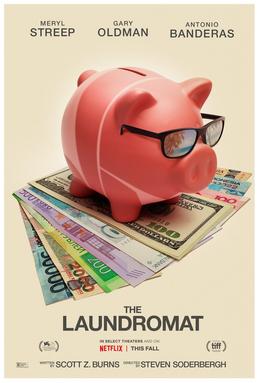
To say that Meryl Streep gives a bad performance in The Laundromat actually does a disservice to your average, run-of-the-mill bad performance.

Meryl Streep instead gives an absolutely terrible performance in The Laundromat, playing not one, not two, but three characters.  One of the characters is Ellen Martin, a middle-class widow from Michigan whose attempts to collect a fair settlement after the death of her husband provides a portal in the world of shady con men and corrupt financial institutions.  One of the characters is a secret, which means that Meryl wears a lot of make-up and frumpy clothes.  That said, from the minute the character appeared on screen, I went, “Oh, there’s Meryl again.”  Then, in her third role, Meryl plays herself, demanding campaign finance reform and striking a Statue of Liberty pose while holding a hairbrush instead of a torch.

Really, it’s the type of horrendous performance that could only be delivered by a truly great actress.  (If Meryl Streep is the modern Norma Shearer, this is her Romeo and Juliet.)  Watching Meryl Streep play the role of Ellen, It occurred to me that Meryl is one of those actresses who is incapable of being authentic but who can certainly act the Hell out of pretending to be authentic.  You never forget that Meryl Streep is acting and that’s one reason why her best performances are usually the ones where she’s playing theatrical characters, whether they’re politicians like Margaret Thatcher, celebrities like Julia Child, or the Witch in Into the Woods.  But when you cast Meryl as someone who is basically supposed to be a member of the “common people,” it just doesn’t work.  Laura Dern, Laurie Metcalf, Allison Janney, even Annette Bening probably could have done a decent job playing Ellen Martin but Meryl is just too Meryl.  As for her other two performances in The Laundromat, they don’t work because one is meant to be a joke on the audience and the other is just a retread of her standard “I’m just a middle class woman from New Jersey and I love the little people” awards show speech.

Of course, The Laundromat itself is a remarkably bad film.  Again, it takes a lot of talent to make a film this bad.  Watching the film, I found myself wondering why, at this point in his celebrated career, Steven Soderbergh would decide to become a second-rate Adam McKay, especially when McKay himself is just a third-rate Jean-Luc Godard?  The film is structured so that, while Ellen is obsessing on why she’s getting screwed over by the insurance companies, we’re also treated to scenes of Gary Oldman and Antonio Banderas talking directly to the camera and explaining to use why the poor are always going to get screwed over by the rich.  That’s probably true but the film gets so heavy-handed in its execution that the resulting migraine is going to be due less to outrage and more due to the sledgehammer that Soderbergh takes to your head.

Along with Ellen’s story, we also get to see several other stories featuring people and their money.  Jeffrey Wright is a crooked accountant who has two families.  And then there’s an African businessman who bribes his wife and daughter with shares in a non-existent company and then we take a trip to China, where we learn about cyanide and organ harvesting. And yes, I get it.  It shows how a crime committed in China is ultimately felt by a widow living in Michigan.  But one can’t help but wish that Soderbergh had just focuses on one story, instead of trying to imitate the worst moments of The Big Short.

Gary Oldman and Antonio Banderas are technically playing the film’s villains but they’re both so charming that The Laundromat at times seems like more of a recruiting film for aspiring money launderers than anything else.  (To continue the Adam McKay comparison, it’s a bit like how Vice actually left audiences feeling sympathy for Dick Cheney as opposed to writing petitions to send to The Hague.)  It desperately wants to leave us outraged but Soderbegh gets so caught up in his own cutesy storytelling techniques that it just leaves us feeling somewhat annoyed.  Watching the film, one gets the feeling that the perfect directors for The Laundromat would have been the Coen Brothers, who are capable of outrage but whose detached style would have kept them from bludgeoning the audience with it.  Soderbergh is too angry to be effective.

As I said, there’s a lot of talented people involved in The Laundromat.  It’s full of people who have done great work in the past and who will do great work in the future.  As for The Laundromat, it’s a legitimate contender for the biggest disappointment of the year.

Horror on the Lens: The Terror (dir by Roger Corman)


Have you ever woken up and thought to yourself, “I’d love to see a movie where a youngish Jack Nicholson played a French soldier who, while searching for a mysterious woman, comes across a castle that’s inhabited by both Dick Miller and Boris Karloff?”

Of course you have!  Who hasn’t?

Well, fortunately, it’s YouTube to the rescue.  In Roger Corman’s 1963 film The Terror, Jack Nicholson is the least believable 19th century French soldier ever.  However, it’s still interesting to watch him before he became a cinematic icon.  (Judging from his performance here and in Cry Baby Killer, Jack was not a natural-born actor.)  Boris Karloff is, as usual, great and familiar Corman actor Dick Miller gets a much larger role than usual.  Pay attention to the actress playing the mysterious woman.  That’s Sandra Knight who, at the time of filming, was married to Jack Nicholson.

Reportedly, The Terror was one of those films that Corman made because he still had the sets from his much more acclaimed film version of The Raven.  The script was never finished, the story was made up as filming moved alone, and no less than five directors shot different parts of this 81 minute movie.  Among the directors: Roger Corman, Jack Hill, Monte Hellman, Francis Ford Coppola, and even Jack Nicholson himself!  Perhaps not surprisingly, the final film is a total mess but it does have some historical value.

(In typical Corman fashion, scenes from The Terror were later used in the 1968 film, Targets.)

Check out The Terror below!

The TSL’s Horror Grindhouse: The Children (dir by Tom Shankland)


Poor Casey (Hannah Tointon)!

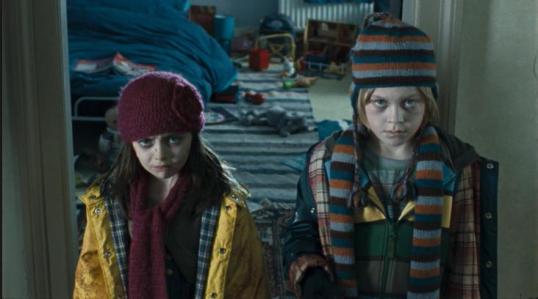
As 2008’s The Children opens, all she wants to do is celebrate New Year’s with her friends.  Instead, her mom and her stepfather are dragging her off to some stupid house in the middle of nowhere, where she’ll have to hang out with her aunt and her dorky uncle and she’ll also be expected to look after not only her two much younger cousins but her two half-siblings as well!  Even worse, once they arrive at the house, all of the young children start to complain about feeling sick.  One of them even throws up.  Everyone assumes it’s just car sickness but could it be something worse?

(Of course.  There’s always something worse!)

In fact, perhaps the only positive thing about the holiday is that it’s snowed!  All of the snow sure does look pretty and it’s a lot of fun to play in.  Once the kids get over being sick, they can’t wait to go outside and have some fun!  One of the adults accompanies them.  While he’s sledding, the kids use a garden rake to kill him.  They even disguise it to look like an accident…

Yep, there’s definitely something going on with the children.  At first, Casey is the only one who understands that the children have turned evil.  (Of course, her first clue comes when they attack her in the woods.)  All the adults are either in shock or denial.  At first, they refuse to even consider that their children are trying to kill them.  Of course, once the children lay siege to the house, the adults are in for a rude awakening…

This is actually the second film called The Children that I’ve reviewed for this site.  The first one was a film from the early 80s that featured a school bus driving through a toxic cloud with the end result being a bunch of homicidal, radioactively-charged children.  In the second version, it’s left a bit more ambiguous as to why the children have suddenly turned homicidal.  While it’s established that that they’re suffering from a virus, the film never tells us where the virus came from or even how it was contracted in the first place.  In fact, until the film’s last few minutes, the audience is never quite sure just how far the infection has spread.  That ambiguity is what gives this film its power.  There’s nothing scarier than not being sure what’s going on.

The Children is a grim and disturbing horror film, one the features very little humor and which ends on an ominous note.  It’s a film that exploits something that we all know but rarely want to admit, which is that children can be incredibly creepy.  We tend to idealize children, which is exactly what the children in this movie use to their advantage.

The Children is also a very well-acted horror film.  Hannah Tointon is sympathetic in the lead role while all of the killer children are played with a proper combination of savagery and innocence.  This may very well be the best killer children film ever made.

Oedipus Mess: Rivals (1972, directed by Krishna Shah)


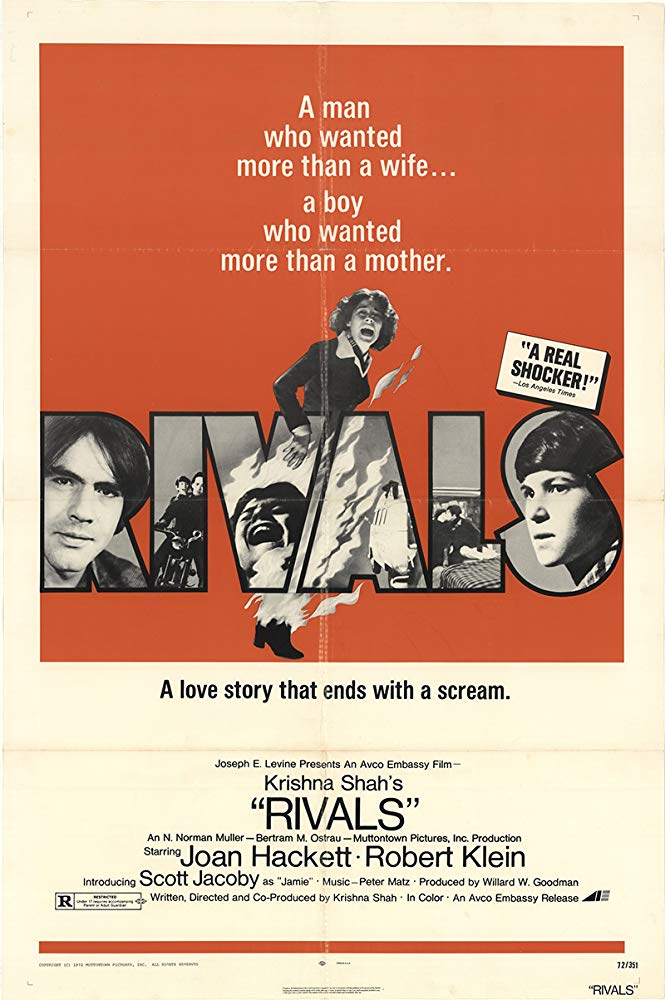
Christine (Joan Hackett) is a young single mother and widow who lives in New York City.  She has a son, Jamie (Scott Colomby, playing a ten year-old even though he’s obviously a teenager).  Jamie is an aspiring director who make a film of his classmates running around the playground while wearing Richard Nixon masks.  Jamie, who is described as having a genius IQ, is also unhealthily obsessed with his mother, which the film, via flashback, links to her taking a shower in front of him while he was still potty training.

Jamie is not happy when Christine meets Peter (Robert Klein), a loudmouth who gives tours of the city to New York residents only.  If you’re from out-of-town, don’t even try to get in Peter’s microbus.  Peter and Christine start to date and then, eventually, they get married.  Despite the fact that his older babysitter wants to have an affair with him, Jamie remains obsessed with his mother and refuses to accept Peter as his stepfather.  Peter knows that Jamie doesn’t like him and eventually gives up on trying to win him over.  What Peter doesn’t know is that Jamie has come up with an elaborate scheme to murder him.

Rivals is the type of strange and messy film that could only have been made in 1972.  I guess it would be considered to be a mix of a horror movie and a psychological thriller but the tone of Rivals is all over the place so it’s hard to know what the film is trying to say about Jamie or his mother.  Throughout the film, there are sudden montages that seem to have little to do with the plot.  For instance, the film comes to a halt so we can spend several minutes watching as Peter attempts to harangue people into getting in his bus.  Peter is supposed to be likable but he comes across as being so obnoxious that it is easy to see why Jamie would not want him for a stepfather.  As for Jamie, he’s supposed to be ten but looks like he should be starting middle school so his obsession with sex is never as shocking as it should be.  The ludicrous subplot about his babysitter goes nowhere and just seems to disappear.  The one bright spot in the film is Joan Hackett as Christine.  Hackett does the best she can with her inconsistent role and she’s the one person in Rivals who you will actually care about.

Rivals is a mess, perhaps worth seeing only for the location footage of New York in the early 70s.  Otherwise, this is a forgotten film that does not need to be remembered.

Horror Film Review: The Possession of Hannah Grace (dir by Diederik van Rooijen)


2018’s The Possession of Hannah Grace is a real idiot film.

As in, “Hey, idiot, there’s a dead woman behind you!”

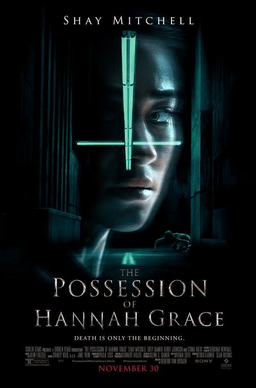
The dead woman in question of Hannah Grace (Kirby Johnson), who was once alive and had brown eyes but then she was possessed by demons and her eyes turned blue.  An attempted exorcism didn’t go well, with the older priest ended up getting impaled on a conveniently placed hook and the younger priest being one of those young bearded types who had obviously never done an exorcism before.  Finally, Hannah’s father, Grainger (Louis Herthum), was like, “Ah, screw it,” so he just smothered her to death,

Unfortunately, the demon is still inside of Hannah’s body and, three moths later, that means trouble when it shows up at the morgue.  Megan (Shay Mitchell), who is working the night shift, is an ex-cop with drug and alcohol problems and she’s not sure if Hannah is really wandering around or if she’s just hallucinating things.  The film probably would have been more interesting if we had been as uncertain as Megan as to whether or not she was really seeing Hannah wandering around the morgue.  Unfortunately, though, the film starts with the unsuccessful exorcism and, as a result, we already know that it’s Hannah and we’re just kinda like, “We get it.  You’ve got issues.  Who cares?”

Anyway, even though the morgue is a restricted area, people keep coming down there and getting killed.  What’s interesting is that everyone who dies is on duty at the hospital yet hardly anyone seems to notice or care that they’re suddenly absent.  We do see one security guard wandering why his partner hasn’t returned but that’s pretty much it.

And it should be scary because this is one of those films that seems to exclusively take place in dark rooms and unlit hallways but it never really is, largely because we know everything that Hannah’s going to do before Hannah does it.  And everyone is so stupid that there’s not really any suspense as to whether or not Hannah’s going to be able to rip them up into little pieces of naive medical personnel.  This all, of course, leads to Megan declaring that she’s now a stronger person and will be able to face the the future with renewed confidence so I guess all of those people dying for no good reason was worth it.

Anyway, I usually like to make sure that my reviews usually run at least 500 words but I kind of feel like that would be a waste of effort where The Possession of Hannah Grace is concerned.  I’ll be happy with 440.

Horror On The Lens: Night Tide (dir by Curtis Harrington)


Night Tide

First released in 1961 and directed by Curtis Harrington, Night Tide stars a young Dennis Hopper as Johnny, an awkward sailor.  Johnny meets Mora (Linda Lawson), who works as a “mermaid” on the pier.  For Johnny, it’s love at first sight.  However, the more that Johnny pursues her, the more he learns about both her mysterious past and the dark fate of her previous boyfriends.

Night Tide is low-key and atmospheric gem of a movie, one that serve as an inspiration for low-budget filmmakers every where.  Lawson is perfectly cast as the enigmatic Mora but the film really belongs to Dennis Hopper.  Hopper’s naturally off-key presence made him perfect for the role of Johnny.

Night Tide is one of those low-budget movies that, because it’s in the public domain,  has been released on DVD (often in inferior form) by dozens of different companies.  Often times, films like this turn out to be fairly forgettable.  Night Tide, however, is an exception.

The Story of the Hills: The UFO Incident (1975, directed by Richard A. Colla)


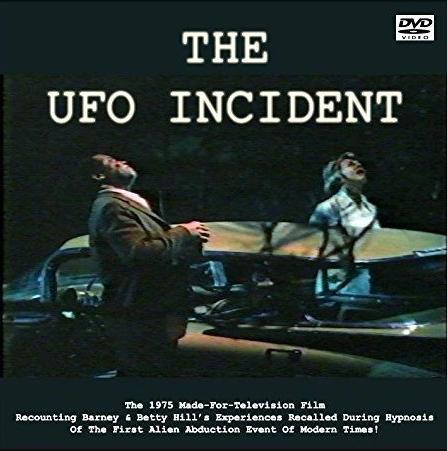
Betty and Barney Hill (played by Estelle Parsons and James Earl Jones) are a happily married couple living in New Hampshire in the mid-60s.  They are both haunted by something that happened two years previously, while they were on vacation.  They both remember something appearing in the sky over their car but they can’t remember anything that happened afterwards.  They are both haunted by nightmares and a strong feeling that something terrible most have happened to them.  Finally, they meet with Dr. Benjamin Simon (Barnard Hughes), who places them both under hypnosis.  Only then does a clear picture start to emerge of what Betty and Barney believe happened as they both describe being abducted and experimented upon by aliens.

The UFO Incident is a very sober and serious account of the Hills’s abduction.  It never takes a clear side as to whether Betty and Barney are remembering something that actually happened or if they’re just remembering elaborate dreams.  That works to the film’s advantage, though it might disappoint those looking for a more dramatic take on the subject.  This is a made-for-TV movie so don’t expect much from the special effects and the alien costumes look disappointingly cheap.  The important thing, though, is that the film treat the Hills and their story with respect and James Earl Jones gives one of his best and most relatable performances as Barney.  The film is as much about how even a good marriage can be threatened by stressful times as it is about the UFOs.

The UFO Incident is based on the non-fiction book, The Interrupted Journey by John G. Fuller, which purported to tell the story of the Hills and their abduction.  The Hills were two of the first people to come forward with a story about being abducted by aliens.  Much of the common elements that can be found in stories about alien abductions, like the little grey men, the medical experimentation, and the amnesia afterwards, began with the Hills’s account of what they believed happened to them in 1961.  The Hills, who were active and highly respected in their community, were considered to be unusually credible witnesses, though Dr. Simon ultimately decided that Barney’s recollections of being on the UFO were probably influenced by Betty’s descriptions of her nightmares.  Barney, himself, died in 1969, three years after the book was published.  Betty remained active in the UFO community until her death in 2004.

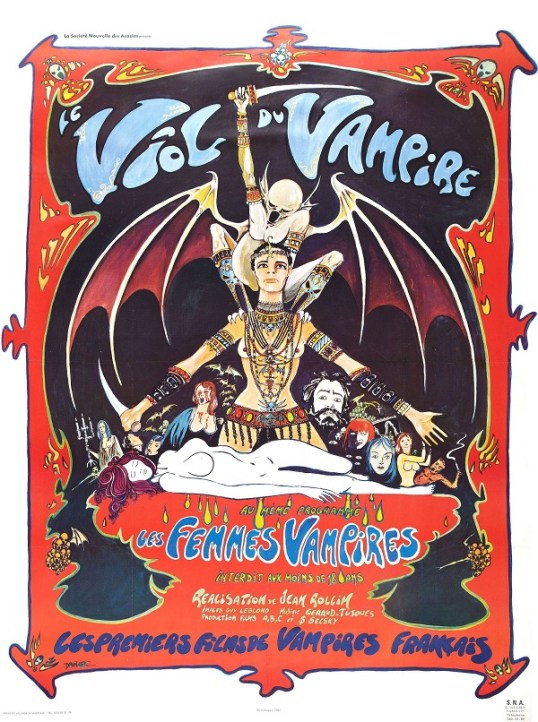
Critique Cinématographique: Le Viol du Vampire (dirigé par Jean Rollin)


Don’t worry, I’m not going to review this film in French.

I wish I could because this was the feature film debut of Jean Rollin, who made horror films that were uniquely French in both their vision and their execution.  A decade ago, I probably could have written an at least 300-word review in vaguely passable French but, unfortunately, my language skills have gotten a bit rusty as of late.  “But Lisa, what about Google translate?”  Uhmmm ….. yeah, that’s not a good idea.  The comprehension powers of Google translate are a bit overstated.

Anyway, on to the film!

I absolutely love the wonderfully surreal films of Jean Rollin.  At his best, Rollin was responsible for some of the most visually impressive and narratively incoherent films ever made.  Believe it or not, I don’t mean incoherent in a bad way.  A Rollin film creates its own unique world, one in which things don’t necessarily have to make much sense.  A Jean Rollin movie is like a filmed dream, one in which the stories continually seem to loop back to the same group of obsessions.  There’s always an emphasis on memory and the importance of the past.  The countryside is always beautiful but also always full of menace.  There’s always a scene or two at the beach.  It’s not unusual for a Rollin film to end with the water washing away the evil, like some sort of fairy tale.  There’s usually a house in the country and Rollin’s camera loved old French architecture just as much as it loved images of people making love.  Rollin’s films often very sincerely celebrated female friendship while, at the same time, continually returning to the theme of lesbian vampires.  In fact, I think it can be argued that the best way to appreciate Rollin’s films is to sit down and watch all of them, one after another.  So many theme reoccur from film to film that ultimately, they all become a part of giant and very strange tapestry of lust, secrets, and the paranormal in France.

Le Viol du Vampire (which translates to The Rape of the Vampire in English) was Rollin’s feature directing debut.  It started out as a 30-minute short film, one that more or less made sense.  A producer then offered Rollin some money to expand the short into a feature film.  The end result was a deeply strange but visually stunning film, one in which characters who clearly died in the original short film mysteriously came back to life so that they could take part in the second part of the film.

During the first 30 minutes of the film, three Parisians are called out to a country château (because it’s not a Rollin film without a château) to investigate four sisters who believe that they’re vampires.  (One of the sisters is blind and says she became a vampire after being raped by the local peasants, hence the film’s title.)  The Parisians believe that the sisters are being manipulated by an evil old man.  The sisters believe that they are all vampires.  It turns out that they’re all right!

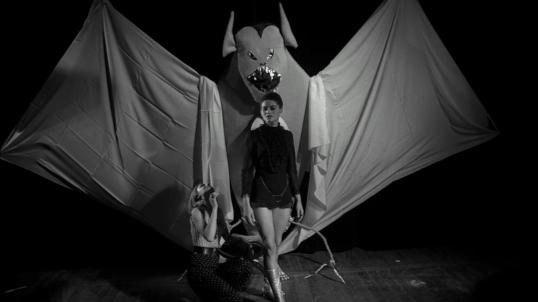
As I said, that part of the film makes sense.  But then suddenly, a vampire queen appears and suddenly there’s all these other vampires running around and some of them are dressed like court jesters and there’s a doctor working at a clinic who thinks that he can cure vampirism and then there’s a revolution against the queen and there’s a car chase and you’re never really sure who is who or what it is that they’re doing or why they’re doing it.  Rollin was a noted fan of the old serials and that’s how directs the final 60 minutes of Le Viol du Vampire.  Cliffhanger after cliffhanger follows twist after twist and, again, you find yourself wondering if even Rollin was able to keep up with it all.

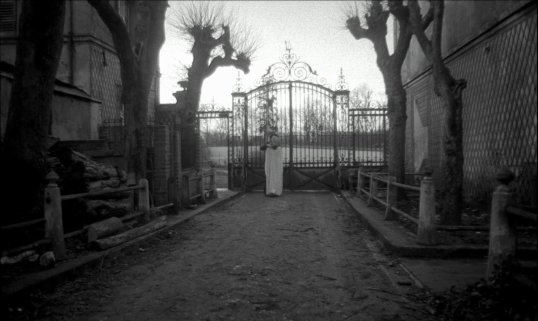
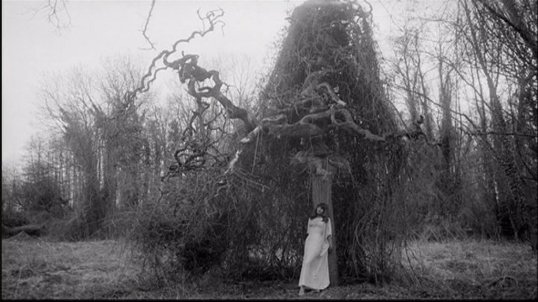
And yet, it remains a compelling film because Rollin was such a gifted visual artist and the black-and-white cinematography is so atmospheric that it’s very easy to ignore the plot and instead just enjoy looking at the film.  I would actually suggest waiting to watch this film until you’ve seen some of Rollin’s other films.  Once you’ve experienced Rollin’s unique aesthetic vision, it’s easy to watch Le Viol du Vampire and say, “There’s the beach!  There’s the clowns!  There’s the lesbian vampires!  There’s everything that we’ve come to expect from Jean Rollin!”

Le Viol du Vampire was released in 1968.  It was released at a time when political turmoil had brought much of the French film industry to a halt.  As a result, Le Viol du Vampire was the only film playing several theaters.  If you were in France during the summer of 1968 and you wanted to go to the movies, Le Viol du Vampire was often the only option available.  As a result, a huge number of people went to this movie.  Audiences were reportedly so angered by the film’s intentional incoherence that they rioted and threw things at the screen.  It was quite a scandal but it also made Rollin a bit of a star.

Seen today, the film is still incoherent but it’s also a chance to see where one of the most interesting horror directors of the 20th Century got his start.

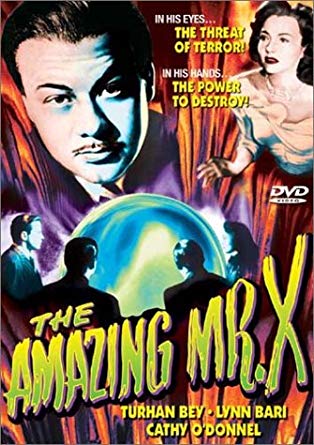
Horror Film Review: The Amazing Mr. X (dir by Bernard Vorhaus)


A woman named Christine (Lyn Bari) walks along the beach when she thinks that she hears the voice of her husband calling out her name.  The only problem is that her husband has been dead for two years.  Christine’s sister, Janet (Cathy O’Donnell), says that Christine is just hearing things and that she needs to move on from mourning.  After all, her boyfriend, Martin (Richard Carlson), is on the verge of asking Christine to marry him….

And yet, Christine can’t escape the feeling that her husband is trying to contact her from beyond the grave.  During another walk along the beach, she runs into a handsome man who introduces himself as being Alexis (Turhan Bey).  Alexis says that he’s a medium and that he has the power to speak to the dead.  Furthermore, he tells Christine that he can speak to her dead husband for her.

Despite the fact that Alexis owns a really impressive crystal ball, Martin is skeptical of his claims.  Martin even goes so far as to hire a private investigator (Harry Mendoza) to investigate Alexis’s past.  Meanwhile, though she has her suspicions, Janet finds herself falling in love with the charming Alexis….

Released in 1948, The Amazing Mr. X is an unjustly obscure little mystery film.  Though I guess it’s open to debate whether it should be considered a horror film or just a noirish thriller, The Amazing Mr. X is full of creepy atmosphere and eerie moments.  Employing expressionistic camera angles and dark lighting, director Bernard Vorhaus turns The Amazing Mr. X into a dream of dark and forbidden things.  Some of the black-and-white shots are simply stunning and the seance sequence is brilliantly done.

The film is also well-acted by a cast of actors who deserve to be better remembered.  Lynn Bari is perfectly fragile and sympathetic as the haunted Christine while Cathy O’Donnell turns the potentially boring Janet into a compelling character.  The film even makes good use of Richard Carlson’s reliable dullness by casting him as the one character who is meant to be a force of stability in Christine’s otherwise neurotic life.

That said, the entire film is stolen by Turhan Bey.  Born in Austria and of Turkish descent, Turhan Bey was nicknamed the “Turkish Delight” during his film career and, watching The Amazing Mr. X, you can see why.  Bey is so charming and so handsome that you can understand why even those who should know better would want to believe that Alexis could talk to the dead.  The Amazing Mr. X was one of the last films that Bey filmed in the United States.  He retired a few years later and returned to his native Austria, where he ran a cafe.  (40 years later, the now elderly Bey did come out of retirement and made a few appearance of television before passing away, at the age of 90, in 2012.)

Like all good mysteries, The Amazing Mr. X has a third act twist that you probably won’t see coming and it ends with the proper combination of tragedy and redemption.  The Amazing Mr. X is currently in the public domain and can be viewed on YouTube so check it out!  You won’t be sorry!

Horror On The Lens: The House On Haunted Hill (dir by William Castle)


The original The House on Haunted Hill is a classic and one that we make it a point to share every Halloween.  And since October is nearly halfway over, now seems like the perfect time to do so!

Be sure to check out Gary’s review by clicking here!

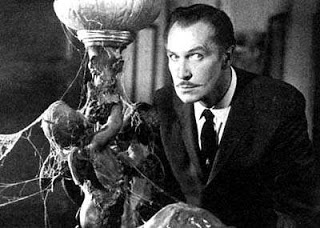
Enjoy Vincent Price at his best!