Save The Goat!: Curse III: Blood Sacrifice (1991, directed by Sean Barton)


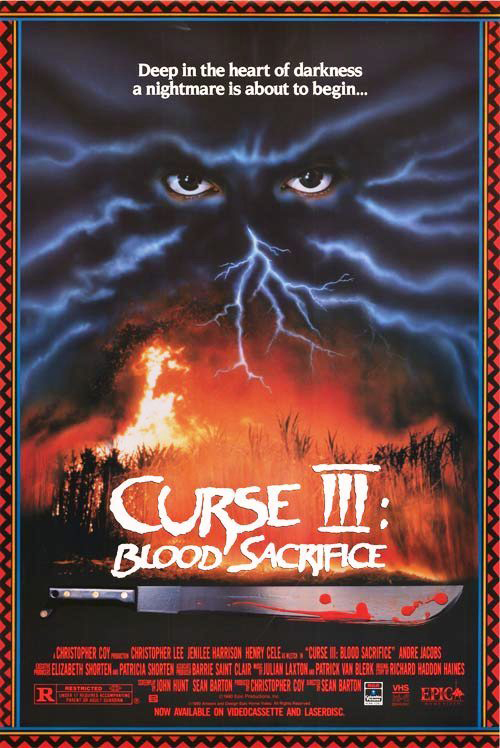
Having absolutely nothing to do with either of the Curse films that preceded it, Curse III: Blood Sacrifice takes place in South Africa during the 1950s.  American Elizabeth (Jenilee Harrison) has just married plantation owner Geoff Armstong (Andre Jacobs) and is still struggling to adjust to living in Africa.  When her sister, Cindy (Jennifer Steyn), comes over for a visit, she and Elizabeth stumble across what appears to be a native ceremony.  When they realize that the local witch doctor is about to sacrifice a goat, Cindy steps on and grabs the goat.  Not happy at being interrupted and needing to make a sacriice to atone for an earlier murder, the witch doctor places a curse on Elizabeth and her entire family.  Later, a rubbery fishman stalks the plantation, using a machete to kill every colonialist it comes across.

Curse III is the best of the Curse films, though that may not be saying much.  The film is largely a standard slasher with a super natural twist, right down to the first victims being horny teens.  However, both the setting and the 1950s time period make the film slightly more interesting than the usual 90s, direct-to-video horror fare, with the curse being the result of a cultural misunderstanding and many of the victims too blinded by their own prejudices to realize how much trouble they are in.  Making what would turn out to be both his first and last film as a director, acclaimed editor Sean Barton showed that he knows how to put together an effective “stalking” scene, wringing out all the atmosphere that he could from that plantation.  Best known for co-starring in the later seasons of Three’s Company, Jenilee Harrison is adequate if not particularly memorable in the lead role but the film is, not surprisingly, stolen by Christopher Lee,  who plays a local doctor and who lends Curse III whatever gravitas it may have.

Horror on the Lens: Curse of the Swamp Creature (dir by Larry Buchanan)


Today’s horror on the lens is 1966’s Curse of the Swamp Creature!

Probably the best thing about Curse of the Swamp Creature is that it was filmed in the town of Uncertain, Texas, which is right near the Texas/Louisiana border.  Uncertain, which sits on the shores of Caddo Lake, was incorporated in 1961.  Reportedly, when filling out the paperwork, the town’s founders wrote “Uncertain” in the blank for the name because they genuinely hadn’t come up with a name.  And …. well, you know what happens when you try to make a joke on an official document.

Anyway, this film was directed by Larry Buchanan and that’s really all you need to know about it.  Buchanan specialized in making low-budget remakes of other films, though he always claimed that Curse of the Swamp Creature was a totally original idea on his part.  The film is about a mad scientist who lives in the swamp and is trying to reverse evolution.  Things don’t always work out the way that they should and occasionally, the mad scientist has to feed his alligators.  John Agar’s in the movie, of course.

Enjoy!

The TSL’s Horror Grindhouse: The Flesh and Blood Show (dir by Pete Walker)


I had a few reasons for watching the 1972 slasher film, The Flesh and Blood Show.

First off, the film was directed by Pete Walker.  Though Pete Walker may not be as well-known as some of his contemporaries and his overall cinematic output is dreadfully uneven, he was still responsible for enough memorable films that I will always give him a chance.

Secondly, it’s a British film and the British were responsible for some of the best horror films of the late 60s and early 70s.

Third, speaking as a horror fan, that title is just irresistible.  The Flesh and Blood Show?  Well, there’s nothing subtle about that!  Looking at that title, you find yourself wondering, “How much flesh and how much blood is actually in this film?”

Well, having watched the film, I can tell you that there’s very little blood and a good deal of flesh.  The Flesh and Blood Show was Walker’s first horror film.  Before moving into the horror genre, Walker specialized in making sexploitation movies and it’s kind of obvious that, when he directed this film, he was still more comfortable asking people to undress than asking them to play dead.  As opposed to other slasher films, the majority of the young cast survives and the almost all of the murders occur off-screen.  Every couple of minutes or so, someone else is getting undressed.  The constant nudity actually starts to get pretty funny after a while.  One could very easily use The Flesh and Blood Show to construct a drinking game.

As for the film’s plot, it deals with a group of actors who receive invitations to an abandoned theater.  An unseen producer apparently wants them all to perform an infamous play, perhaps the same play that is rumored to have led to tragedy back in 1945.  If it seems rather odd that the film’s characters would willingly go to an abandoned theater in the middle of nowhere and perform a possibly cursed play, no one is ever going to accuse anyone in this film of being smart.  Why ask why when there’s so much dancing and undressing to do?

There’s also an elderly major (Patrick Barr) hanging out around the theater.  He was actually one of my favorite characters in the movie because he approached everything with this very British, very stiff upper lip attitude.  Of course, the major himself has a secret.  That said, the secret isn’t that surprising.  I figured it out as soon as he showed up.

Naturally, all the murders at the theater are linked back to a tragedy in the past.  The final 15 minutes of the movie are made up of an extensive flashback to that tragedy and I will say this: it’s the best part of the film.  The flashback was originally filmed in 3-D and Walker uses this as an excuse to indulge in some surreal flourishes.

There are a few positive things to be said about The Flesh and Blood Show.  Pete Walker was a talented director and that talent comes through in even his weaker films.  There are a few scenes where Walker manages to maintain a properly ominous atmosphere and the movie’s score is so melodramatic and over the top that it’s kind of hard not to love it.

But, for the most part, The Flesh and Blood Show is a rather forgettable film.  If you want to see a good Pete Walker film, track down Frightmare.

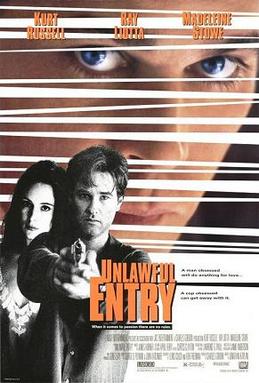
Who Watches The Watchmen: Unlawful Entry (1992, directed by Jonathan Kaplan)


The upscale and complacent life of Michael and Karen Carr (Kurt Russell and Madeleine Stowe) is interrupted one night when a burglar breaks into their home via their skylight.  The intruder briefly holds a knife to Karen’s throat before taking off.  Shaken by the encounter, the Carrs are very happy when a seemingly friendly cop, Officer Pete Davis (Ray Liotta). offers to help them cut through all the red tape and get a security system installed in their house.

At first glance, Pete seems like the perfect cop but actually, he’s a mentally unstable fascist who quickly becomes obsessed with Karen.  When Pete offers Michael his nightstick so that Michael can use it on the man who earlier broke into his house, Michael refuses.  That’s all that Pete needs to see to decide that Michael’s not a real man and that Karen would be better off with him.  Even after Michael orders Pete to stay away from his home, Pete continues to drop by so that he can spy on the couple.  When Michael complains, Pete frames him by planting cocaine at his house.  When Michael says that he’s innocent, no one believes him.  Why would they?  Pete’s a decorated cop who is keeping the streets safe.  Michael is just a homeowner.  While Michael sits in jail, the increasingly violent and unhinged Pete makes plans to make Karen his own.

“Who watches the watchmen?” as the old saying goes.  Unlawful Entry is an efficient and no-nonsense thriller that was ahead of its time as far as its portrayal of a policeman abusing his authority is concerned.  Jonathan Kaplan was trained in the Roger Corman school of filmmaking so he doesn’t waste any time getting to the story and he even finds a role for Dick Miller.  Ray Liotta, fresh off of his performance in Goodfellas, is perfectly cast as the manipulative and misogynistic Pete while Kurt Russell is once again the ideal everyman.  Madeleine Stowe, who was one of the best actresses of the 90s, does not get to do much beyond be menaced but she does it well.  Whatever happened to Madeleine Stowe?  Kurt Russell’s career is still going strong and Ray Liotta still appears regularly in gangster movies and Chantix commercials.  Isn’t it about time for a Madeleine Stowe comeback?

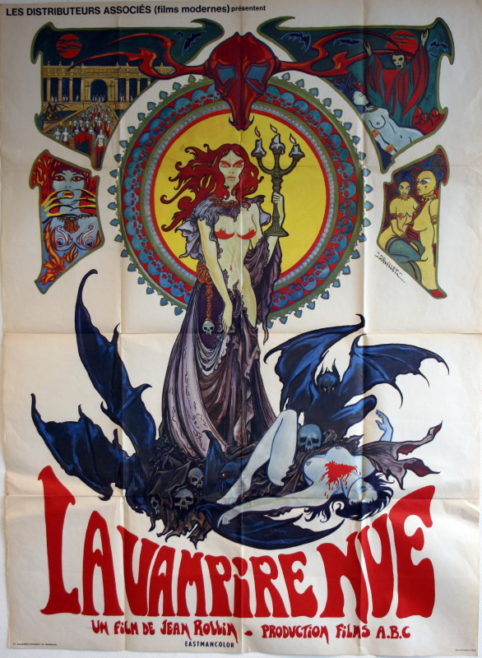
International Horror Film Review: The Nude Vampire (dir by Jean Rollin)


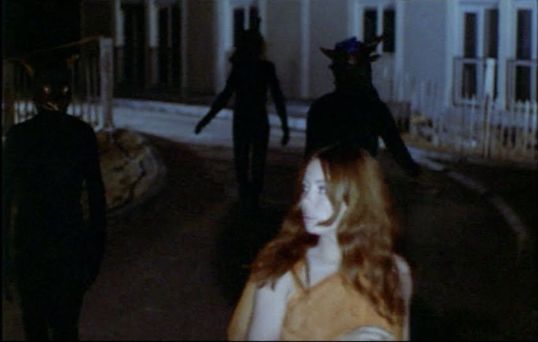
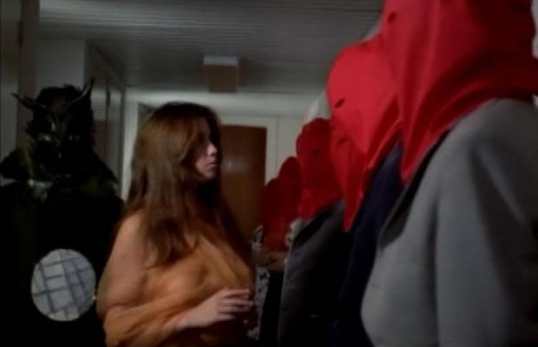
In the middle of the night, a woman (Christine François), wearing an orange nightgown walks down a dark, Paris street.

She is followed by three men, all of whom are wearing strange, bird-like masks.

The woman turns a corner and runs into Pierre (Olivier Rollin).  Pierre and the woman stare at each other, without saying a word.  Though it may be their first time to meet each other, both their attraction and their bond is instantaneous.

Both Pierre and the woman run down the street.  The men in the marks follow them.

Finally, in a deserted alley, the men corner the woman and Pierre.  Though Pierre escapes, the woman is shot by one of the men and promptly collapses.

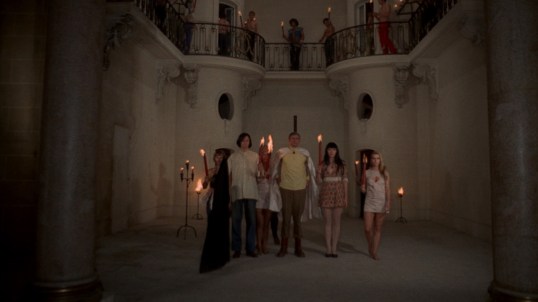
The men pick up the woman’s body and carry her to a nearby, gated building.  A bearded doorman lets them through.  Several other people, all wearing tuxedos and fancy gowns, come to the gate and, after showing the doorman their invitation, are allowed to pass through.  Pierre tries to follow but is told that he cannot enter because he has not been invited.

And so begins Jean Rollin’s 1970 film, The Nude Vampire.  This was Rollin’s second film, following the controversial Le Viol du VampireThe Nude Vampire, while once again featuring all of Rollin’s pet obsessions, is still a far more assured piece of filmmaking than Rollin’s first film.  It’s interesting to watch The Nude Vampire directly after Le Viol du Vampire because you can can truly see Rollin developing as a director.  Once again, Rollin is telling an odd story about a frequently disrobed vampire and once again, all of the action leads to the beach.  However, the plot is far easier to follow in The Nude Vampire than in Le Viol du Vampire.  If the first film often seemed to be too indulgent for its own good, The Nude Vampire is just indulgent enough to work.  Of course, as with any Rollin film, your mileage may vary.  What seems rather coherent and almost tame to a Rollin fan may seem like the exact opposite to someone who has never seen a Rollin film before.

As for Pierre, he is determined to figure out what happened to the woman, even though his own father says that it is sometimes best to just leave well enough alone.  After punching out a partygoer and stealing his invitation, Pierre gets into the building and discovers that, despite having been shot in front of him, the woman in the orange nightgown is not dead.  In fact, she doesn’t even appear to be injured.  Instead, she drinks the blood of a party guest who has just committed suicide.  It turns out that the party is actually a cult and they worship the woman.

As if that’s not shocking enough, Pierre discovers that his own father is in charge of the cult!  His father explains that the woman is actually a vampire but that there might be a cure for her condition.  But, in order to cure her, she must be kept safe from the vampires who are trying to capture her….

And that’s not all!  But I won’t share any more of the plot.  I only have limited space here, after all.  The film plays out like a serial, with twists and turns and a lot of scenes involving people being chased from one location to another.  As I mentioned before, it all leads to the beach because this is a Rollin film and Rollin’s vampiric visions always ended with the beach.

As one should always expect from a Jean Rollin film, The Nude Vampire plays out at its own deliberate, dream-like pace.  As a director, Rollin was such a strong visualist that somehow even his film’s lapses in coherence seemed to make a strange sort of sense.  If every movie is a dream then who are we to complain when they employ dream logic?  As with any Rollin film, The Nude Vampire is not for everyone but fans of Rollin’s unique aesthetic will definitely find much to enjoy.

Horror Film Review: The Hunger (dir by Tony Scott)


“Bela Lugosi’s dead….” Peter Murphy sings at the start of 1983’s The Hunger and, in the case of this film, it’s as much of a challenge as a tribute.

Bela Lugosi and Dracula are gone, the film announces, and so is the old-fashioned vampire movie.  Here’s a new look at an old favorite….

Of course, seen today, The Hunger doesn’t seem new.  Since The Hunger‘s release, there’s been  a countless number of films in which vampires have been decadent and chic aristocrats, hanging out in dark nightclubs and looking at the world with ennui-stricken eyes.  By today’s standards, the stylish decadence of The Hunger can seem almost quaint.  Much like Paul Schrader’s remake of Cat People, The Hunger is such a film of the 80s that you half-expect someone to offer you a line coke while you’re watching it.  Also, like Cat People, it’s such a glorious tribute to excess that there’s no way you can’t watch it once it starts.  It’s hypnotic in its excess.

In The Hunger, our vampires are Miriam Blaylock (Catherine Deneuve) and her lover, John (David Bowie).  Miriam has been a vampire since at least the time of the ancient Egyptians.  Rather than sinking her fangs into the necks of her victims, Miriam uses an Ankh pendant to slit their throats.  John was once a cellist in 18th century France.  Now, they live in an expensive New York townhouse, where they teach classical music and occasionally murder anyone that they can convince to come up to see them.

When they first met, Miriam promised John that he would have eternal life but she didn’t promise him eternal youth.  Unfortunately, it takes 200 years for John to notice.  When he starts to rapidly age, he seeks out aging expert Dr. Sarah Roberts (Susan Sarandon) for help.  Though Dr. Roberts is originally dismissive of his claims, she is shocked to see John age several years in just an hour.

When an angry and desperate John kills the music student (Beth Ehlers) that Miriam was hoping to transform into her next lover, Miriam is forced to search elsewhere.  When Sarah shows up, searching for the man who aged years in an hour, Miriam feels that her search may be over.

As one might expect from a film directed by Tony Scott, The Hunger is an extremely stylish film, to the extent that the film’s story is often secondary to the way that Scott chooses to tell it.  The set design is so ornate and every scene is so precisely lit and shot and that, at times, the movie feels a bit like a commercial for vampirism.  It’s easy to imagine Britney Spears singing “Work Bitch” in the background of some of the scenes.  (“You want a hot body?  You want a Bugatti?  You Want a Maserati?  You better work vamp.”)  Throughout the film, New York glows like a neon wonderland while John and Miriam coolly look out over the world like 18th century French aristocrats who have no idea that they have a future date with the guillotine.  At times, it’s a film that becomes almost ludicrous in its celebration of grandeur and style.  One could imagine Jean Rollin telling the same story just as effectively while spending a lot less money.

And yet, it’s that very embrace of the over-the-top ludicrousness of it all that makes The Hunger a memorable film.  The film’s a tribute to excess, with an ending that falters precisely because it attempts to reject precisely what it’s spent the past hour and a half celebrating.  The Hunger doesn’t add up too much but its hypnotically stylish and well-acted by a cast who does their best to keep up with Tony Scott’s camera.


Horror on the Lens: The Lodger (dir by Alfred Hitchcock)


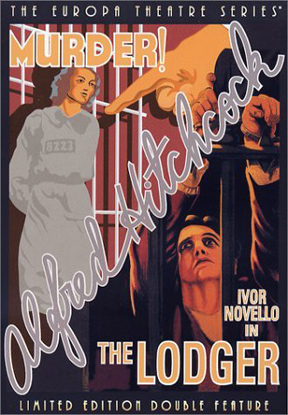
A serial killer known as “The Avenger” is murdering blonde women in London (which, once again, proves that its better to be a redhead).  And while nobody knows the identity of the Avenger, they do know that the enigmatic stranger  (Ivor Novello), who has just recently rented a room at boarding house, happens to fit his description.  They also know that the lodger’s landlord’s daughter happens to be a blonde…

Released in 1927, the silent The Lodger was Alfred Hitchcock’s third film but, according to the director, this was the first true “Hitchcock film.”  Certainly it shows that even at the start of his career, Hitchcock’s famous obsessions were already present — the stranger accused of a crime, the blonde victims, and the link between sex and violence.

Also of note, the credited assistant director — Alma Reville — would become Alma Hitchcock shortly before The Lodger was released.

The TSL’s Horror Grindhouse: The Banana Splits Movie (dir by Danishka Esterhazy)


The Banana Splits Movie takes viewers behind the scenes of a children’s television show and shows us the sordid world that nobody knows about.

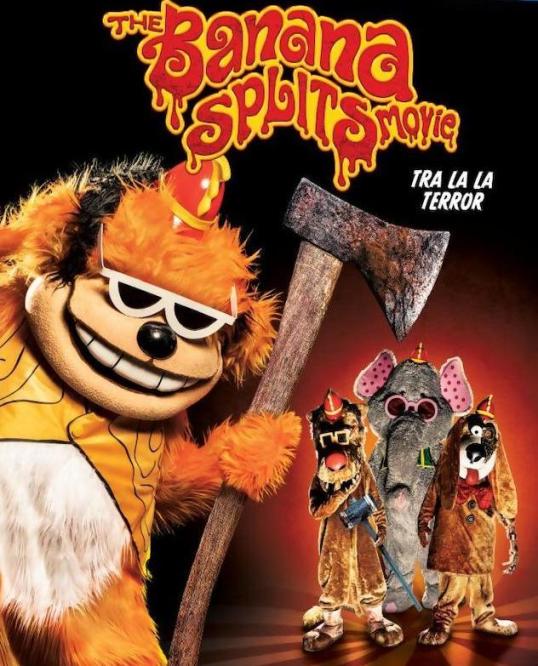
The stage manager is overworked.  The new head of the network is a jerk.  The star of the show is a drunk.  The lovable Banana Splits, who play silly games and all play music instruments, are all actually robots who are looked down upon by their human coworkers.  When Stevie (Richard White), the star of the show, learns that the show is being canceled, he makes the mistake of telling the robots and, before you know it, all Hell is breaking lose.  People are getting stabbed to death with lollipops.  Network executives are getting dismembered.  One unfortunate person gets slammed in the head with a giant hammer.  You gotta be careful who you piss off, folks.  Robots are ruthless.

To me, the most shocking thing about The Banana Splits Movie was the discovery that it was based on an actual show.  Apparently, the Banana Splits were real and they had their own show in the late 60s and early 70s.  I’m going to guess that the Banana Splits were played by people in costumes as opposed to just being big robots.  At least, I hope that’s the case because, after watching The Banana Splits Movie, I’m kind of over wanting anything to do with robots.

I will say this.  If I imagine the characters from this movie not killing people, I can kinda understand why they would have their own TV show.  I mean, they’re all really cute, except for when they’re covered in blood and brain matter.  My personal favorite was Snorky, who was a big elephant and was a bit less murderous than the other three members of the Banana Splits.  In fact, I have to admit that the film kind of left me feeling a little bit depressed because all of the robots are so cute that you really don’t want to see them murder people or get damaged themselves.  The film actually does a pretty good job of contrasting the adorableness of the Banana Splits with the pain and carnage that they caused.

And make no doubt about it.  There’s a lot of blood spilled in this movie.  The Banana Splits are ruthless murderers and they don’t care how nice you are or if you paid money to see the show or if you’re just trying to make your daughter into a big star.  If they see you, they’ll kill you.  In fact, I have to admit that it sometimes got to be a bit too much for me.  I got a little bit tired of all the violence but, at the same time, I also appreciated the film’s satiric intent.  In a world gone mad, why wouldn’t the stars of a children’s TV show turn out to be a bunch of killer robots?  When you think about all of the once beloved celebrities that have fallen from grace over the past 10 years, it makes an odd sort of sense.

Anyway, The Banana Splits Movie is well made splatter film with a satiric vein running through all blood and guts.  It was a bit much for me but I respected it for sticking to its subversive premise and I do think it will be appreciated by a lot of other horror fans and pop culture fanatics.

I’m just hoping that the sequel features more Snorky.

It’s No Westworld: Futureworld (1976, directed by Richard T. Heffron)


Two years after the Westworld “incident,” (in which a group of robots malfunctioned and murdered hundreds of humans), Delos Amusement Park has reopened and is accepting guests.  Westworld has been permanently shut down but guests can still go to Romanworld and Medeivalworld (despite the fact that it was in Medievalworld that the whole robot rebellion started in the first place).  Delos has added two new worlds: Spaworld and Futureworld.  Spaworld is a spa for people who want to think young and Futureworld is the world of the future, which looks much like 1976, the year that this film was made.

Two reporters, Chuck Browning (Peter Fonda) and Tracy Ballard (Blythe Danner), have been invited to cover the grand reopening of Delos and to hopefully generate some good publicity.  Chuck, however, has reason to believe that there’s something sinister happening at Delos.  While Tracy is busy fantasizing about Yul Brynner, Chuck discovers that Delos is using Futureworld to clone diplomats.

At the end of Futureworld, Peter Fonda gives everyone the finger and that’s really cool but otherwise, this is a forgettable sequel to Westworld.  The whole point of the original Westworld was that the robots didn’t know they were robots but, in Futureworld, the robots not only know what they are but they’re also superfluous to the plot.  There’s no robot revolution in Futureworld nor is there any of Crichton’s concerns about technology run amok.  Instead, it’s all about clones and a predictable political conspiracy.

The main issue facing the makers of this film was how could they do a sequel to Michael Crichton’s unexpected hit when Westworld‘s main attraction, Yul Brynner’s robot gunslinger, was thoroughly destroyed at the end of the first film.  It would not make any sense for anyone to have reactivated the robot.  Their solution was to bring Brynner in for a cameo in which he appeared in one of Tracy’s dreams.  Sadly, why they thought it was a good idea to have Tracy develop an erotic fixation on a killer robot and then, just as abruptly, abandon the idea is not for us to know.  They would have been better off leaving Brynner out of the film entirely because his presence just reminds us that Futureworld is no Westworld.

International Horror Film Review: The Iron Rose (dir by Jean Rollin)


“Let’s go to the cemetery.”

That line is actually from another Jean Rollin film, Requiem for Vampire, but it also perfectly sums up the plot of his 1973 masterpiece, The Iron Rose.

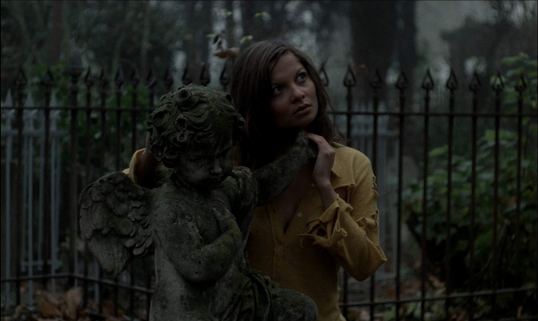
A man (Hugues Quester) meets a woman (Francoise Pascal) at a wedding party.  They agree to go on a date, one which includes a railway station, a picnic, bicycling, and finally a walk that leads to a seemingly deserted cemetery.  On what seems to be a whim, the two of them enter the cemetery.  The woman seems to be fascinated with the place.  The man is dismissive, saying that funerals are an expensive, waste of time.  The woman believes that there is something after death.  The man is cynical, saying that once you’re dead, you’re dead.  As any couple would do after having a theological conversation, the two of them enter a crypt and make love.

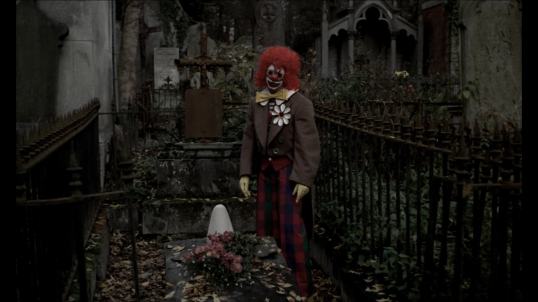
While they’re busy making love, we discover that there actually are others in the cemetery.  There’s a clown that places flowers on a grave.  There’s a mysterious man who has been watching the couple as they walk among the graves.  (In the credits the man is called “Le vampire,” though he never actually does anything in the film that would indicate that he’s a bloodsucker.)  And then there’s the old woman who, as night falls, promptly closes the cemetery gates.

When the man and the woman emerge from the crypt, they discover that they are trapped.  There’s no way to open the gate and there’s no way to get out of the cemetery.  The two of them start to walk around, searching for either an exit or, at the very least, some sort of shelter for the night.  As they walk, strange things start to happen and we’re forced to reconsider our previous assumptions about not only the man and the woman but also the cemetery itself.  Did they enter the cemetery on a whim or did one of them specifically lead in the other?  As the night progresses, the feeling of impending doom only grows.  It all leads to a rather macabre fate for one of our lovers and a dance among the tombstones for another.

The Iron Rose is one of Jean Rollin’s best films and, sadly, it’s also one of his most unjustly obscure.  Even by the standards of Rollin’s early vampire films, The Iron Rose is a surreal film, one that is far more interested in creating a haunting atmosphere than in telling a traditional story.  What is the real reason that leads to the man and the woman entering the cemetery?  The Iron Rose is full of hints but, for most part, it’s left to the audience to answer that question for themselves.  The film’s haunting final scenes force us to reconsider everything that we previously assumed by the characters and their actions.  Are they obsessed with love or are they just in love with death?  There are no easy answers.

Obviously, a 90-minute film about two people walking around a cemetery is going to have some slow spots but, in this case, those occasional moments just add to the film’s ennui-drenched atmosphere.  As filmed by Rollin, the cemetery becomes as important a character as both the man and the woman and a reminder that the present is always going to be tied to the past.  The Iron Rose is Rollin at his dream-like best.