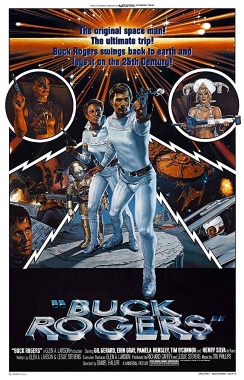
Buck Rogers in the 25th Century (1979, directed by Daniel Haller)


In the year 1987, NASA launches it’s final manned mission.  Captain Buck Rogers (Gil Gerard) is sent into space but, while he’s orbiting the Earth, he and his spacecraft fall victim to a strange space anomaly which leaves him in suspended animation.  On Earth, Buck Rogers is believed to be lost.  500 years pass.  Buck’s ship continues to orbit the Earth while, down below, mankind nearly destroys itself in a nuclear war.  Eventually, Earth is reduced to radioactive rubble and what remains of human civilization lives in the city of New Chicago.  (Old Chicago, meanwhile, has been taken over by mutants.)

Finally, in the 25th century, Buck and his ship are discovered by Draconia, a spaceship that belongs to the intergalactic Draconian Empire.  Buck is brought out of suspended animation and meets the beautiful Draconian Princess Ardala (Pamela Hensely) and her second-in-command, an Earthling named Kane (Henry Silva).  Ardala would obviously like to make Buck her prince but, after being in suspended animation for 500 years, Buck just wants to return to Earth.  The Draconians allow Buck to return home.

Upon landing in New Chicago, Buck discovers that the world is much different now.  Everyone wears skintight uniforms and a little robot named Twiki (voice by Mel Blanc) is the only person willing to be Buck’s friend.  Commander Wilma Deering (Erin Gray) is in charge of defending what’s left of human civilization and she’s immediately suspicious of Buck and his story.  When it turns out that Ardala and Kane implanted Buck with a tracking device, Deering want to execute him.  Can Buck prove his loyalty and also thwart Ardala and Kane’s plot to conquer humanity?

Buck Rogers In The 25th Century was originally a pilot for a Glen Larson-produced televisions series.  (Larson was also responsible for the original Battlestar Galactica, another sci-fi show whose pilot was given a theatrical release.)  Hoping to appeal to the same audiences who made Star Wars a monster hit, Universal spent a little extra money to upgrade the special effects, added a few suggestive scenes to prevent the pilot from getting the dreaded G-rating, and then released it in theaters a few months before the TV show premiered.  That was a good idea because the movie did become a minor hit and the TV series went on to run for two seasons.

As the movie itself, it never feels like anything more than an extended episode of a television series.  Gil Gerard is bland in the lead role and most serious sci-fi fans will probably lose interest as soon as the child-friendly robot shows up.  Buck Rogers may have been made to capitalize on the success of Star Wars but it doesn’t have any of the attention to detail or the careful world-building that went into George Lucas’s original space opera.  On the plus side, though, the Dads who took their kids to matinee showings of this film were probably happy to see Erin Gray and Pamela Hensley prominently featured in the film and Henry Silva is a great villain as always.  As with a lot of the sci-fi films that were released in the immediate wake of Star Wars, Buck Rogers In The 25th Century does have a definite camp appeal.  It’s bad but some people will enjoy it on a nostalgic level.

Probably the most memorable thing about Buck Rogers In the 25th Century was its James Bond-inspired title sequence.  Here it is, in all of its glory:

An Offer You Can’t Refuse #16: Love Me or Leave Me (dir by Charles Vidor)


The 1955 film, Love Me or Leave Me, is a biopic about singer Ruth Etting.

Don’t know who Ruth Etting is?  Well, don’t feel too bad.  I didn’t know who she was either, at least not until I watched this movie.  Judging from the trailer that I’ve embedded at the top of this review, she was apparently well-known enough in the 50s for a biopic about her to be a big deal.  Having now watched Love Me or Leave Me and having done some independent research, I know that Ruth Etting was a popular singer in the 20 and 30s and that she was, for a while, married to a gangster named Marty Snyder (played, in the film, by James Cagney).  I also know that, after her marriage to Snyder ended, she married a composer named Johnny Alderman (played by Cameron Mitchell).

I still couldn’t tell you just how closely Love Me or Leave Me actually sticks to the facts of Etting’s life.  I imagine that there was a quite a bit of liberty taken with the truth, if just because the film was made in 1955 and it’s one of those big, glossy productions where all of the sets are ornate and all of the clothes are to die for and all of the dialogue has an edge that’s somehow both tough and sentimental.  It feels less like real life and more like the way that you would imagine life to be.

The film begins in the roaring 20s, with Marty Snyder intervening when Ruth nearly gets fired for kicking an obnoxious admirer.  For Marty, it’s obsession at first sight and, even after Ruth refuses to spend a weekend in Miami with him, Marty continues to help her out in her career.  Marty uses his considerable clout (and the fact that everyone is scared to death of him and his temper) to get Ruth on the radio and then eventually a job with the Ziegfeld Follies.  Despite the fact that Ruth is in love with Johnny and Johnny is in love with her, she ends up marrying Marty because she feels that she owes her entire career to him.  Even after they get married, Marty continues to be obsessively jealous.  It all eventually leads to a shooting, an arrest, and a final song from Doris Day.

It’s very much a film of the 50s.  I imagine that audiences in 1955 thought it made perfect sense that Ruth would feel that she owed it to Marty to marry him despite the fact that she never really asked him to do anything for her.  Seen today, though, Marty comes across as being a stalker and you really want someone to sit Ruth down and have a conversation with her about it and maybe explain concepts like gaslighting and restraining orders to her.

My advise, though, would be to not think too much about it because seriously, the film’s sets are beautiful, the musical numbers are entertainingly excessive, and Doris Day gives a really good performance.  For those who only know her from the romantic comedies that she did with Rock Hudson, Love Me or Leave Me is a revelation.  She’s likable and she’s tough and she sings as if the world depended upon it and watching her in Love Me Or Leave Me, you not only understand why Ruth Etting became a star but also why Doris Day did as well.  James Cagney also gives a good performance as Marty Snyder, bringing all of his swaggering charisma to the role.  As a fan of exploitation films, the most interesting thing about Love Me or Leave Me to me was getting to see Cameron Mitchell play a nice guy for a change.  Mitchell does an okay job with the role, though Johnny is never as interesting a character as Marty.  In the end, it’s an entertaining film, an ornate visual feast that works as long as you don’t think about it too much.

Love Me or Leave Me is an offer that you can’t refuse.

Previous Offers You Can’t (or Can) Refuse:

  1. The Public Enemy
  2. Scarface
  3. The Purple Gang
  4. The Gang That Could’t Shoot Straight
  5. The Happening
  6. King of the Roaring Twenties: The Story of Arnold Rothstein 
  7. The Roaring Twenties
  8. Force of Evil
  9. Rob the Mob
  10. Gambling House
  11. Race Street
  12. Racket Girls
  13. Hoffa
  14. Contraband
  15. Bugsy Malone

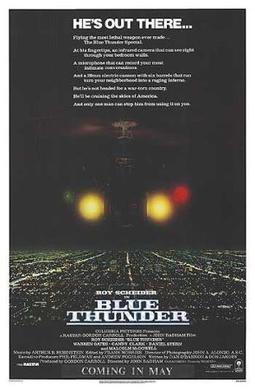
Blue Thunder (1983, directed by John Badham)


Frank Murphy (Roy Scheider) is a Vietnam vet-turned-cop who pilots a police helicopter for the LAPD.  Every night, he and his partner, Richard Lymangood (Daniel Stern) fly over Los Angeles, helping to keep the peace and peeping on anyone undressing in a high-rise apartment.

Murphy is selected to serve as the test pilot for what is described as being the world’s most advanced military helicopter, Blue Thunder.  Blue Thunder is so advanced that the pilot can control the gun turrets just by turning his head and it’s also been supplied with the latest state of the art surveillance equipment.  The pilot of a Blue Thunder can literally spy on anyone while listening to and recording their conversations.  With the Olympics coming up, the city of Los Angeles wants to test out the Blue Thunder as a way to control the crowds and prevent crime during the Games.

Murphy may be impressed by the helicopter but he has his reservations about the program.  He immediately sees that Blue Thunder could be a dangerous tool in the wrong hands.  Those wrong hands would belong to Col. Cochrane (Malcolm McDowell), who was Blue Thunder’s first pilot and also Murphy’s commanding officer during Vietnam.  Murphy is still haunted by the atrocities that he saw committed by Cochrane during the war.

When it turns out that Murphy was right to be suspicious of Cochrane’s intentions, the movie turns into an exciting aerial chase above Los Angeles, with Murphy in Blue Thunder, trying to outrun F-16s, heat-seeking missiles, and eventually Cochrane, who enters the chase in a Blue Thunder of his own.

I’m always surprised that Blue Thunder doesn’t have a bigger following than it does.  It’s an action classic, with a gritty performance from Roy Scheider, a villainous performance from Malcolm McDowell, and comedic relief from the always reliable Daniel Stern.  Even Warren Oates is in the movie, playing Murphy’s LAPD commander!  The script actually does have something relevant to say about the militarization of America’s police forces (and it feels downright prophetic today) and the chase scenes are all the more exciting because they were filmed in the era before CGI and have an authenticity to them that is missing from most modern action films.

Blue Thunder is a perfect example of the “don’t do this really cool thing” style of action film.  The Blue Thunder helicopter is described as being a danger to everyone in the country and the movie even ends with a note saying that real-life Blue Thunders are currently being designed.  But I don’t think anyone who has ever watched this film has thought, “I hope they stopped making those helicopters.”  Instead, this movie makes you want to have a Blue Thunder of your very own.  They’re so cool, who wouldn’t want to fly one of those things?

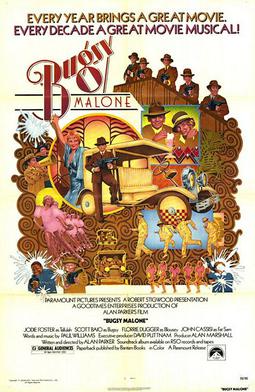
An Offer You Can’t Refuse #15: Bugsy Malone (dir by Alan Parker)


Remember how, a few weeks ago, I said I was going to spend the month of June reviewing 30 gangster movies?  Well, I was doing pretty well but then I got distracted with some things and I ended up falling behind and now, it’s the last day of June and I’ve only reviewed 14 of the 30 films that I was planning on taking a look at.  It’s frustrating but, as any movie blogger can tell you, it happens.  Still, I’m not one to give up so easily!  I promised to review 30 gangster movies and I’m going to keep my word.  Or, at the very least, I’m going to try to…. like, definitely maybe try to….

Anyway, let’s get back to it with 1976’s Bugsy Malone!

Bugsy Malone is an homage to the old gangster movies of the 1920s and 30s.  It’s also a musical, featuring a lot of songs about wanting to make a lot of money, fall in love, and go away to Hollywood.  On top of all that, it’s also a children’s film.  Though they may be playing gangsters and going to war over who will control the rackets, the cast is entirely made up of children.  Though the film does feature a lot of guns, none of the guns fire bullets.  Instead, they shoot custard pies.  Once you get cornered by a rival gangster and you get “splurged,” your career in the rackets is over.  You’re humiliated.  You’re nothing.  You’re just another two-bit hood who couldn’t make it in the big leagues.  You’re just….

Well, you get the idea.

Basically, the plot of the film is that Dandy Dan (Martin Lev) and Fat Sam (John Cassissi) are two rival gangsters who want to take over the Lower East Side.  Fat Sam owns a speakeasy, which means that there’s always a lot of dancing and singing going on in the background.  Bugsy Malone (Scott Baio) is a tough boxer who wants Fat Sam to give a job to Blousey Brown (Florrie Dugger), who dreams of going to Hollywood and becoming a big star.  Tallulah (Jodie Foster) is Fat Sam’s gun moll but she used to go out with Bugsy and she still wants him back.  Bugsy get caught up in the middle of the war between Dandy Dan and Fat Sam and it all eventually leads to a big pie fight and a lot of children covered in custard.  “You give a little love,” the children sing as they realize that their lives don’t have to be defined by gang wars, “and it all comes back to you….”

So, I have to admit that I was absolutely dreading watching Bugsy Malone.  I mean, singing children and custard pie guns?  It all sound just unbearably cutesy.  But, to my surprise, Bugsy Malone actually turned out to be a fun and clever little movie, one that was full of smart dialogue, catchy songs, excellent dancing, and wonderfully non-cutesy performances from its cast.  Even though the film may be about a bunch of children dressing up as gangsters, all of the child actors take their characters seriously and director Alan Parker directs the film as if it were an actual gangster film as opposed to just a children’s musical.  The end result is a film that’s cute but never cutesy.  Believe me, there is a huge difference between the two.

To my shock, Bugsy Malone turned out to be an offer that you can’t refuse.

Previous Offers You Can’t (or Can) Refuse:

  1. The Public Enemy
  2. Scarface
  3. The Purple Gang
  4. The Gang That Could’t Shoot Straight
  5. The Happening
  6. King of the Roaring Twenties: The Story of Arnold Rothstein 
  7. The Roaring Twenties
  8. Force of Evil
  9. Rob the Mob
  10. Gambling House
  11. Race Street
  12. Racket Girls
  13. Hoffa
  14. Contraband

The Stratton Story (1949, dir. by Sam Wood)


Monty Stratton was one of the greats.

He was a Texas farmboy who knew how to throw a baseball.  Recruited by the Chicago White Sox, he spent five years in the majors.  From 1934 through 1938, he compiled a 36–23 record with 196 strikeouts and a 3.71 ERA in 487.1 innings.  In 1937, he won 15 games with a 2.40 ERA and five shout-outs.  The next season, he won another 15 games and completed 17 of his 22 starts.  For those of you who might not speak baseball, that all means that he was a really good right-handed pitcher.

When Stratton wasn’t playing baseball, you could find him down on his farm in Greenville, Texas.  He lived there with his wife, Ethel.  On November 27th, 1938, Monty Stratton was hunting rabbits when he accidentally shot himself in his right leg.  While Stratton survived the shooting, his leg was amputated, bringing Stratton’s major league career to an end.

No longer able to play in the majors, Monty Stratton spent the next few years as a pitching coach and helping to start a semi-pro team in Greenville.  With the help and encouragement of his wife, he continued to practice his pitching and he eventually trained himself to the point where he could transfer his weight effectively onto his artificial leg so that he could effectively throw a baseball.  In 1947, Monty Stratton made a comeback, pitching in the minors and ending the season with an 18–8 record and a 4.17 earned run average.  Stratton spent the next six years pitching in the minors before retiring from the game.  He went on to start the Greenville Little League program.  If you go to Greenville, you can still find Monty Stratton Field near Greenville High School.

The Stratton Story was made in 1949, shortly after Stratton’s comeback and while he was still playing in the minors.  James Stewart plays Monty Stratton while June Allyson plays his wife.  The movie follows Stratton from his early days on the farm through his major league career, his accident, and his eventual comeback.  Though the real Monty Stratton served as a technical advisor to the film, I don’t know how historically accurate it was.  The movie, for instance, seemed to condense the timeline so that it seemed like Stratton went straight from losing his leg to practicing for his comeback when it actually took ten years for Stratton to eventually get signed to a minor league team.  Even if it does take some liberties from the facts, The Stratton Story is still a good movie.  The baseball scenes are great and Jimmy Stewart is convincing when he’s throwing the baseball.  He’s also convincing in the scenes where Stratton sinks into a dark depression after losing his leg.  Stewart was so good in the role that, when Stratton finally started to practice his pitching again, I wanted to jump up and cheer.

I liked The Stratton Story.  It probably helps that I love baseball but it’s also a good movie about an inspiring story.

Faster (2010, directed by George Tilllman, Jr.)


A man known as the Driver (played by Dwayne Johnson) is released from prison, having served time for taking part in a bank robbery.  As soon as he gets his freedom, the Driver is jumping in a fast car, driving across Nevada and California, and killing everyone who he believes set him up and murdered his half-brother.  The Driver has even made out list of the people on whom he needs to get revenge.  Among those on the Driver’s list are a nightclub bouncer, a snuff film producer, an traveling evangelist, and one name that the Driver has not bothered to write down.

As the Driver conducts his killing spree, he is pursued by two other men who each have their own reason for wanting to find him.  The Cop (Billy Bob Thornton) is close to retirement and has a heroin addiction.  The Killer (Oliver Jackson-Cohen) is a hit man who views murder as a personal challenge and who plans to marry his girlfriend (Maggie Grace) as soon as he takes care of the Driver.

Today, we take Dwayne Johnson’s superstardom for granted so it’s interesting to go back and watch a movie like Faster, which was made when Johnson was still best known as a wrestler and there were still doubts about whether or not he had the screen presence to carry an entire film on his own.  Though Johnson’s character is the main character and it’s his single-minded quest for revenge that propels the plot, the film spends as much time with the Cop and the Killer as it does with the Driver.  The Driver doesn’t get much dialogue.  Instead, the majority of the Driver’s scenes emphasize Johnson’s physical presence, casting him as the unstoppable hand of fate.  Johnson doesn’t really get to show what he can do as an actor until nearly halfway through the film, when the Driver has an emotional meeting with his mother.  Johnson acquits himself well in the scene but it’s still obvious that the film was made before people realized that Dwayne Johnson really could act.

Seen today, Faster is a relentless and exciting B-movie.  It’s fast-paced and, even if it doesn’t give Johnson a chance to say much, it’s smart enough to surround him with memorable character actors like Billy Bob Thornton, Tom Berenger, Adewale Akinnuoye-Agbaje, and Carla Gugino.  Even without a lot of dialogue, Dwayne Johnson is such an imposing figure and has so much screen presence that he dominates the film in a way that it’s hard to believe that there were ever any doubts about whether or not he could be a film star.  Faster holds up well, as both an action movie and star-making vehicle for Dwayne Johnson.

Major League (1989, dir. by David S. Ward) and Major League II (1994, dir. by David S. Ward)


I’m so excited that baseball’s back!

The 2020 regular season of Major League Baseball is going to start on July 22nd and it’s going to last until September 27th.  The teams will play 60 games and the World Series will be held in October.  It’s an abbreviated season but there was no way to avoid that.  I’m just happy that there will at least be some games played this year.

Of course, as excited and happy as I am, I can’t deny that baseball almost always breaks my heart.  Just a few years ago, I was so excited when a Texas team finally won the World Series.  Later, we all found out that the Astros won because they cheated, which will forever taint both the legacy of the team and the MLB.  It breaks my heart to say it but, as far as I’m concerned, no Texas team has yet to legitimately win the World Series.

And then there’s the Rangers.  I’m a Rangers fan.  I love the Rangers.  I was so excited the two times that they made it to the World Series and I’ve never gotten over their loss to the Cardinals.  (Their loss to the Giants I can accept because the Giants were a great team and they earned their wins.  The Cardinals, on the other hand…)  Ever since 2012, though, the Rangers have always broken my heart.  It’s been a while since we’ve had a great Rangers season.  At the start of every season, though, I say, “This is our season!”  And no matter how badly things end, I always say, “Next season, we’re going all the way!”

I guess that’s why I love Major League.

Major League is the ultimate underdog baseball movie.  It’s a film about a fictional version of the Cleveland Indians.  Rachel Phelps (Margaret Whitton), the new owner of the Indians, wants to move the team to Miami but to do that, she’s going to need to have the worst season ever, one where the team plays so badly and breaks so many hearts that even the most loyal fans stop coming to the games.  It shouldn’t be too hard since the Indians have’t even won a pennant in over 30 years.  But to make sure that it happens and that the team only wins 15 games over the entire season, Phelps recruits the worst players she can find.

The team that she puts together is made up of has-beens and never-weres.  Some of them have raw talent but none of them know how to play as a team.  Ex-con Ricky Vaughn (Charlie Sheen) has a killer fastball but is so near-sighted that he’s a danger whenever he steps on the mound.  Catcher Jake Taylor (Tom Berenger) is a veteran team leader but his knees are so bad that he can barely walk.  Willie Mays Hayes (Wesley Snipes) is fast but can’t hit worth a damn.  Pedro Cerrano (Dennis Haysbert) can hit home runs but only if the pitcher throws him a fastball.  Just as Rachel expected, the team struggles at first.  Even when they start to show signs of improvement, she cut back on their budget and sells their equipment, all to try to make winning impossible.  It’s only when their manager, ex-drywall salesman Lou Brown (James Gammon), tells them that Rachel wants them to lose that the team comes together and starts to win.

Everything that’s great about baseball can be found in Major League.  I love all the scenes with the fans slowly coming around to believing that maybe the Indians actually could win it all.  I’ve been through that so many times with the Rangers that I know exactly how they all felt.  I love the interactions between all the players on the team, from the new players eager to win to the veterans who just want to survive another season.  I love the scenes with the play-by-play announcer (Bob Uecker) trying to put a good spin on the way the team plays.  (All together: “Just a bit outside!”)  And mostly, I love that the film treats the game and its players with the respect that they deserve.  So many other films would have turned a character like born-again pitcher Eddie Harris (Chelcie Ross) into a punchline.  Instead, in Major League, he gets a standing ovation after he pitches his last game.  The best thing about Major League is that it loves baseball, both the games and the players.

Since Major League was a success at the box office, it was eventually followed by a sequel, Major League II.

Major League II picks up the season after the first movie ended and it tells the exact same story as the first film, just not as well.  Almost everyone from the first film is back (though Omar Epps takes over the role of Willie Mays Hayes from Wesley Snipes) but the charm and the chemistry from the first movie just aren’t there.  The players have to set aside their egos and learn how to play like a team all over again.  The main difference between the two movies is that it takes a lot longer for the Indians to start winning in the sequel than in the first film.  Plus, the sequel just isn’t as funny.

Even if the sequel is a let down, the first Major League is still one of the best baseball movies ever made.  If the Indians could win the pennant in Major League, maybe there’s hope for my Rangers yet!

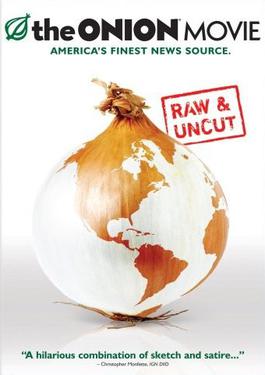
The Onion Movie (2008, directed by James Kleiner)


From some of the funniest people on Earth comes one of the least funny films ever made.

That was, at least, my initial reaction to watching The Onion Movie.  Written by two of the founders of the world’s premiere satirical news sight, The Onion Movie is a collection of skits that are almost all based on Onion headlines.  Some of the skits are amusing.  Most of them aren’t.  When it comes to the Onion, the headlines are often funnier than the details.  A headline about a murder mystery party switching over to a rape investigation party might be funny but having to sit through a lengthy skit about it is considerably less amusing.

Len Cariou plays an anchorman at the Onion News Network, who introduces each satirical story and who gets upset when his employers keep using his newscast to promote a new Stephen Seagal movie called Cock Puncher.  (Seagal, who appears as himself, punches people in the groin.  The joke would have been funnier if the fake movie had starred Dolph Lundgren.)  In between introducing absurd stories, Cariou yells at the network executives, who don’t care about the integrity of the news.  Len Cariou is the best thing in the film because he plays his role straight, never once smiling or winking at the camera.

The Onion Movie was written by two of the Onion’s founders and was originally filmed in 2003.  It sat on the shelf for five years before being released, without much fanfare, direct-to-video.  By the time it was released, The Onion itself had all but disowned the movie, announcing that they were no longer involved beyond the use of the site’s name.  (Something similar happened in the 80s when MAD Magazine briefly tried to branch out into films.)  Watching the film, it’s easy to see why The Onion distanced themselves from the final product.  It’s not just that, for the most part, it’s not very funny.  It’s also that the majority of the humor is shockingly racist and sexist.  (Halfway through the film, a black civil rights leader announces that he’s going to lead a walk-out to protest the way that blacks have been portrayed in the film.  It’s played as a joke but the man has a point.)  The Onion Movie wants credit for being politically incorrect but instead, most of the humor just feels lazy.  The Onion Movie is type of movie that, if it were released today, The A.V. Club would demand that it be banned.  Schadenfreude is nothing to brag about and I’m not proud that I felt some of that as I watched The Onion Movie.  If the people who created one of the funniest sites on Earth could create something this bad, I thought, that makes me feel better about every mistake I’ve ever made over the course of my entire life.

By the way, the film’s best joke is borrowed from Caddyshack but at least they got Rodney Dangerfield to come back and deliver it.  Dangerfield was always good, even in something like The Onion Movie.


Cinemax Friday: The Last Hour (1991, directed by William Sachs)


Because Eric (William Sachs) is a wealthy stockbroker who has just stolen five million dollars from the mafia, mob boss Lombardi (Bobby Di Cicco) sends a group of his enforcers to get both Eric and the moeny.  However, when they arrive at Eric’s home, they discover that he’s not there but his wife, Susan (Shannon Tweed), is!  After they kidnap Susan, they take her to an abandoned skyscraper and they wait for Eric to show up with the money.  However, Susan’s ex-husband, Jeff (Michael Pare), is a tough cop who is not going to let anyone get away with holding his ex-wife hostage.  After reluctantly teaming up with Eric, Jeff infiltrates the skyscraper and takes on the kidnappers, one-by-one.

What do we have with this movie?  We’ve got an abandoned skyscraper.  We’ve got a group of flamboyant hostage takers.  We’ve got a beautiful woman being held prisoner.  We’ve got a hero who is a tough cop and who loses his shirt early in the movie.  You probably think this is a Die Hard rip-off but consider this!  In Die Hard, the main bad guy was a European terrorist.  In The Last Hour, he’s an American mafioso.  Otherwise, this is totally a Die Hard rip-off.  It’s Die Hard with a much lower budget and with a wooden Michael Pare serving as an unconvincing stand-in for Bruce Willis.

However, The Last Hour does have two things that Die Hard could have used.  First off, it’s got Danny Trejo as one of the hostage takers.  Any movie with Danny Trejo is going to automatically be cooler than any movie without Danny Trejo.  Of course, this movie asks us to pretend that Michael Pare vs Danny Trejo would be a fair fight but we all know that, in the real world, Danny would totally win that battle.  The other thing that this movie has that Die Hard doesn’t is Shannon Tweed.  Shannon doesn’t get to do a lot.  If you want to see a Die Hard rip-off where Shannon really gets to show what she can do, watch No Contest.  Still, just as with Danny Trejo, any film with Shannon Tweed is automatically better than any film without her.

The Last Hour is no Die Hard, no matter how much it tries.  But if brings together Danny Trejo and Shannon Tweed and for that, late night Cinemax viewers everywhere give thanks.

Quiet Killer (1992, directed by Sheldon Larry)


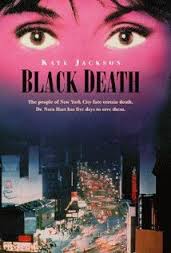
When wealthy teenager Sarah Dobbs (Kathleen Robertson) vomits up blood and then drops dead in the middle of New York City, the coroner’s office is baffled as to what killed her.  As far as anyone knows, Sarah has just been suffering from the flu, which she apparently contracted when she was recently overseas.  However, there is one doctor in New York who thinks that she knows what’s happening.  Dr. Nora Hart (Kate Jackson) takes one look at Sarah’s case and decides that the Black Death — the same plague that wiped out half of the world’s population in 54 AD — has come to New York!

Nora wants to shut down the city immediately but Mayor Carmichael (Al Waxman) says that would not only lead to mass panic but it would also an economic disaster.  Working with a team of other doctors (including Jerry Orbach, who is always a welcome presence in New York films), Dr. Hart tries to track down everyone who Sarah came into contact with and quarantine them before both a panic and a pandemic breaks out.  Unfortunately, one congressman (Howard Hesseman!) doesn’t want to go into quarantine because that would mean admitting that he was in Manhattan to visit his mistress.  Despite everyone’s best efforts, mass panic follows.

Quiet Killer (which is also known as Black Death) is a made-for-TV movie that used to show up on late night television throughout the 90s.  It’s a typically overwrought disaster film and it’s easy to laugh at some of the dialogue and some of the acting.  (Kate Jackson is particularly wooden in the lead role.)  The first time I saw it, I thought the most interesting thing about it was that it featured Howard Hesseman as a congressman.  For those who know Hesseman best for playing characters like Dr. Johnny Fever on WKRP, it’s strange to see him playing a member of the establishment.  Hesseman isn’t bad in the role but it never makes sense that he wouldn’t be able to think of a way to explain away his presence in Manhattan.  You would think a politician would be better at coming up with an alibi or that he could have pulled some strings to keep it from being revealed that he had been quarantined.  Instead, he decides to just run off and potentially infect the entire nation.  That’s not what I pay my tax dollars for.

Quiet Killer is a good example of how real-life events can shape how we view a film.  Up until just a few months ago, this would have seemed like just another cheesy disaster movie.  Watch it today and it feels prophetic.  Hopefully, by this time next year, it will be back to just being cheesy.