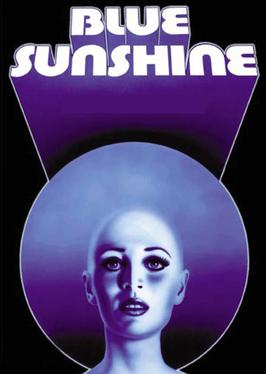
Today’s scene that I love comes from Jeff Lieberman’s 1978 film, Blue Sunshine.
If you haven’t seen the film, Blue Sunshine is the nickname for the acid that a group of characters dropped while in college during the 60s. Unfortunately, ten years later, all of them are losing their hair, suffering from extreme migraines, and turning into psycho killers. It’s the worst acid flashback of all time!
This is a pretty good film, one that uses the horror genre as a way to explore the contrast between the idealism of college and the realities of the real world. It’s also, as you can see in the scene below, quite suspenseful and more than a little frightening.
That can be a dangerous thing to admit nowadays. Clint is not a popular man on social media. The older critics have yet to forgive him for endorsing Mitt Romney over Barack Obama in 2012, despite the fact that Eastwood’s empty chair speech was quite a bit tamer than some of the other criticisms and insults that were being lobbed at both Obama and Romney at the time. The younger critics are still angry that he made Richard Jewell, a film that was seen as criticizing the press at a time when Trump was doing the same thing, this despite the fact that Eastwood never endorsed Trump in 2016 or 2020. (Beyond having a strong individualistic streak, Eastwood’s films are usually apolitical.)
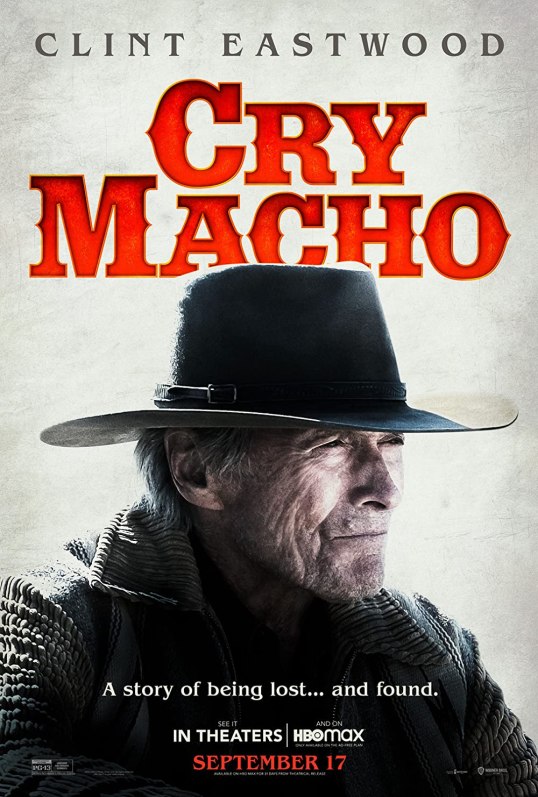
He’s one of those cultural figures that drives Twitter crazy. No one can deny that he’s a film icon and that he’s directed several good and a handful of great films. But, because he doesn’t seem to care what the online crowd thinks and probably isn’t even totally sure what Twitter is, there’s this need to try to tear him down. As such, I wasn’t surprised when his latest film, Cry Macho, received mixed reviews. At this point in the game, any film that Eastwood makes is going to be criticized.
Don’t get me wrong, of course. Sometimes, the criticism is correct, even if it is more motivated by personal animus than anything else. Some of his recent films have been a bit weaker than his earlier ones. I wasn’t a fan of Jersey Boys but I figured that Eastwood was in his 80s and he probably had always wanted to do a musical and, if anyone has earned the right to cross a few things off of his bucket list, it’s Clint Eastwood. Having the three men at the center of The 15:17 to Paris play themselves is something that worked better as an idea than in the actual execution. J. Edgar was a mess and so was Hereafter.
And yet, for every weak Eastwood film, there’s also a recent film that reminds us that he’s still a good director and that he’s still far more willing to explore new territory than some of his contemporaries. The Mule is a film that, like Cry Macho, received mixed reviews but which looks better with each subsequent viewing. Sully was a moving tribute to professionalism and grace under pressure and featured one of Tom Hanks’s best performances. American Sniper was far more nuanced that most critics were willing to admit. All of these films received mixed reviews, even the Oscar-nominated American Sniper. All of them have benefitted from reevaluation.
Will Cry Macho be another Eastwood film that will be embraced in later years? It’s too early to say but I think it will be. Now, again, don’t get me wrong. Some of the criticism that the film has received is justified. In Cry Macho, Clint plays a rodeo rider who, a year after being forced to retire due to a back injury, is hired to go down to Mexico and track down Rafo (Eduardo Minett), the teenage son of a wealthy businessman (Dwight Yoakam). Clint Eastwood is 91 years old and, let’s just be honest, he looks like he’s 91 years old as well. Thirty or even twenty years ago, Clint would have been perfect for the role of Mike Milo. Today, Clint is a bit too old for the role and it’s hard not to notice that, whenever Mike does throw a punch in the film, the scene is edited so that we see the fist and we see the results of the hit but we don’t actually see the punch itself. Clint is old in this film and, even more importantly, he comes across as being old.
But you know what? It almost doesn’t matter. He may be old but he’s still Clint Eastwood. He’s a pop cultural icon. He’s a legend. He epitomizes an era that Cry Macho acknowledges is coming to an end. It’s a bit of a meandering film. Though Rafo’s mother refuses to allow him to leave with Mike, Rafo still sneaks into Mike’s truck and travels with him to the border. Along the way, some men working for Rafo’s mother try to stop them from leaving Mexico. There are a few small action scenes but they’re not what the movie is about and it’s significant that this is a rare Eastwood film in which no one, not even the main bad guy, dies. Instead, the movie is about Mike and Rafo bonding on the road and discussing what it truly means to be macho. Mike is someone who has spent his entire life being “macho” but now he’s old and he’s broken down and he’s realizing that there’s more to life than just trying to live up to some sort of idealized version of manhood. Rafo is young and Mike is very old but, over the course of the movie, they both learn the same lesson. It’s okay to just be yourself. That may be a simple lesson but it’s one worth hearing.
As a director, Eastwood leaves room for the story to wander a bit but he still keeps the action moving at a steady pace. He gets good performances out of his cast. Despite being miscast, he still manages to gets a good performance from himself, though you may cringe a little at his insistence of still trying to present himself as being a romantic lead. (This was played for laughs in The Mule.) The film’s cinematography, courtesy of Ben Davis, is breathtaking. Even while helping Rafo leave the country, Mike falls in love with Mexico and, looking at the beautiful landscapes in this film, you can’t blame him. All in all, it’s a good film. If it had been made a few decades earlier, it would have been a great film but still, this is Eastwood at his most gentle and self-reflective. Future reviewers, free from the need to appease the online mob, will appreciate this film more than the modern ones.
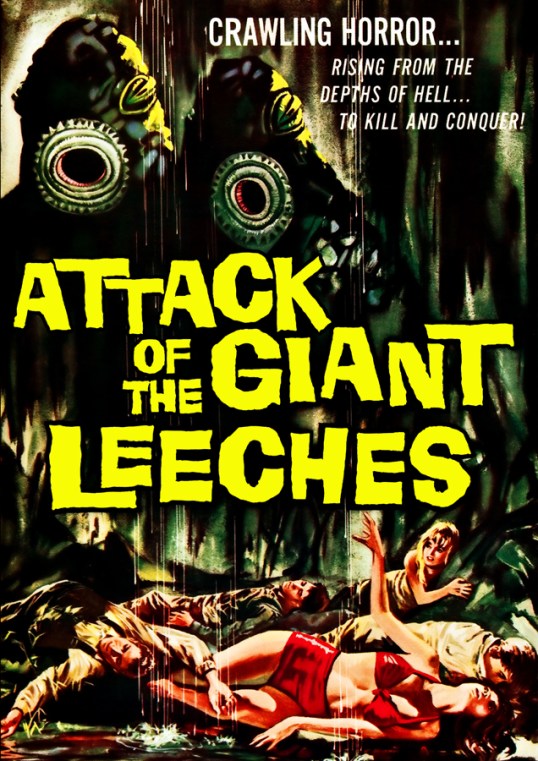
For today’s public domain horror film, I present to you 1959’s Attack of the Giant Leeches. This 60-minute film is a classic Drive-in film. While it has its slow spots, it also features an iconic performance from Yvette Vickers, who is like one of my favorites of the strong, confident, unapologetically sexy women who dominated the old B-movies. (Plus, she was only 5’3 and it’s not easy being brave when you’re having to look up at everyone. Trust me, I know.) This short little film is steamier than Louisiana in August and is full of bayou atmosphere.
I have to admit that I’m kinda freaked out by the scenes of people floating underwater in this film. And leeches … agck! Don’t even get me started on leeches. Especially giant leeches…
In the 2013 film, Dead in Tombstone, Danny Trejo plays Guerrero De La Cruz, an old west outlaw who is loyal to his family, who has no problem robbing banks, but who also is not a fan of unnecessary bloodshed. Even though the film opens with Guerrero and his gang gunning down a posse of men, that’s just because they were saving the life of Red (Anthony Michael Hall), who just happens to be Guerrero’s half-brother. No sooner than you can say, “In what world could Danny Trejo and Anthony Michael Hall possibly be related?,” Red is asking Guerrero to help him pull off a daring robbery.
Guerrero helps Red because Guerrero is all about family. Unfortunately, Red is all about money and, not wanting to share the loot after the robbery, he promptly guns Guerrero down. Not only does Red shoot Guerrero but he insists that each member of the gang shoot him as well, implicating all of them in the crime.
Guerrero dies and promptly goes to Hell, where he’s met by Lucifer (Mickey Rourke). Guerrero doesn’t want to go to to Hell. He wants to get revenge. He offers to send a lot more souls down to Hell if Lucifer gives him a chance to return to the world of the living so that he can kill Red and the former members of his gang. Amused, Lucifer agrees but with a condition: Guerrero only has 24 hours to kill all six of his killers and Guerrero has to do all of the killing himself. He can’t hire someone else to do it or ask anyone for help. Guerrero agrees.
Unfortunately, as Guerrero soon discovers, he’s not the only one who wants Red dead. He’s going to have to move quickly if he’s going to kill all the members of the gang before Calathea (Dina Meyer), the wife of a sheriff killed by Red, gets a chance to do it herself!
Dead In Tombstone is one of those films that sounds a lot more interesting than it is. The concept behind the film is actually a pretty neat one and I like the idea of Guerrero actually having competition. This isn’t one of those westerns where everyone patiently waits their turn to go after the bad guys. The entire world wants these guys dead! Plus, who wouldn’t be excited about the idea of watching Danny Trejo and Mickey Rouke act opposite each other? With his weathered features and stoic demeanor, Danny Trejo is the perfect choice to play an outlaw and, for that matter, Rourke’s gravelly whisper and permanent smirk are put to good use in the role of the Devil. And while Anthony Michael Hall might seem like an odd choice to play Danny Trejo’s half-brother, he’s still properly villainous and loathsome in the role of Red.
And yet, the overall film itself is a bit uneven. The film looks good (especially for a straight-to-video project) but it never really seems to develop any sort of narrative momentum and there’s more than a few slow spots. At times, the film seems to be unsure of just how seiously it wants to take itself and, as a result, the story exists in a kind of limbo between being a straight western with supernatural elements and send-up of the whole genre. The end result is pretty uneven but the dream combination of Rourke and Trejo still makes it worth watching.
What do you get when a producer like Roger Corman notices that Jurassic Park was the most financially successful film of 1993?
Dinosaur Island!
Directed by not just Fred Olen Ray but also Jim Wynorski (and if that combination isn’t enough to spark your interest, I don’t know what is), Dinosaur Island is about what happens when a cargo plane transporting three AWOL soldiers back to the United States crashes near an uncharted island. Led by no-nonsense Capt. Briggs (Ross Hagen), the soldiers make it to the island.
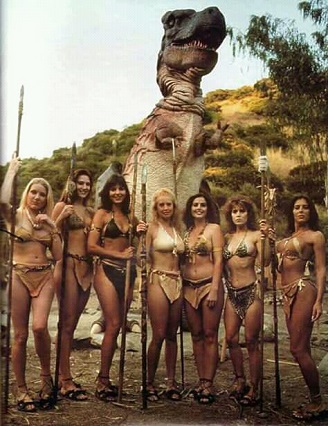
They discover that the island is full of beautiful cavewomen who spend much of their time topless. For the film’s intended audience of teenage boys, that’s good.
They discover that the women are ruled by a queen (Toni Naples) who hates men. That’s bad.
When the women notice that one of the men has a smiley face tattoo, they decide that he is the chosen one who has been prophesized about in the ancient scrolls. That’s good, I guess.
Chosen or not, the men still have to battle the Tyrannosaurs Rex that rules the island. That’s bad. Or is it good? I don’t know anymore.
To save money, Roger and the gang reused the dinosaur who appeared in Corman’s previous Jurassic hit, Carnosaur. They also reused a lot of stock footage from that film. The Carnosaur footage often doesn’t match with the footage that was shot for Dinosaur Island but I don’t know that anyone would expect anything less from Corman-produced rip-off of Jurassic Park. There are some films where the cheapness of it all become a selling point and this is one of them. The special effects are less important than marveling at how the movie got a dinosaur without spending any money.
Dinosaur Island is a bad movie with less than convincing special effects and a lot of overacting but it seems to be aware of its limitations so it’s hard not to like it. It’s obvious that Ray and Wynorski both understood that there was no way that they were gong to be able to make a serious film with the resources that they had available so instead, they shot a flat-out comedy that made fun of its own cheapness. It was the right approach to take, even though the film’s jokes are as often groan-worthy as they are funny. Among the cast, Ross Hagen seemed to have the best understanding of what was needed because he deadpans his way through the entire film, delivering his weird lines with a straight face and giving a performance that wouldn’t be out of place in Airplane! or one of the other ZAZ films.
Not surprisingly, this was a popular film on late night cable back on the day. It’s combination of boobs, jokes, and dinosaurs made it a Cinemax mainstay. Rewatching it, I knew how stupid it was but I couldn’t help but laugh at a few parts. I enjoyed viewing it again. Nostalgia is more powerful than any dinosaur.
All bad action films tend to feature it. (Actually, it shows up in some good action films as well.) Whenever a group of soldiers step on a mine and slowly flip through the air as a result of the subsequent explosion, that’s the Slo Mo of Doom. Whenever an important supporting character is shot and the film suddenly slows down so that each frame of their collapse is their highlighted, that’s the Slo Mo of Doom. Sometimes, it’s a way of saying, “Hey, you should care more about this violent death than you care about all of the other violent deaths in this movie.” Sometimes, it’s a way of showing off the fact that the producers could afford stunt people, even if they couldn’t afford anything else. Other times, it’s just a way to pad out the running time so that a movie can at least reach the 90 minute mark before the end credits roll. Regardless of the reason why it’s deployed, Slo Mo of Doom is usually a good sign that you’re watching a cheesy action film.
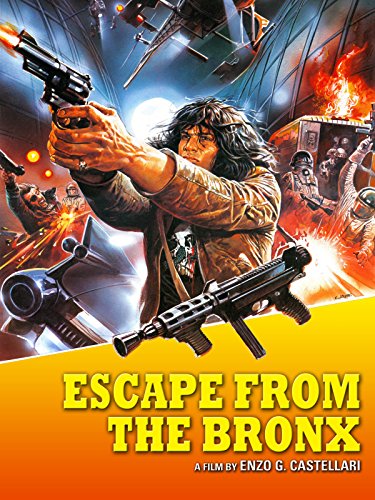
Last night, when I watched the 1983 Italian film, Escape from the Bronx, with a group of friends, we counted at least six instances of the Slo Mo of Doom. There may have been even more, it’s hard to say. Along with frequent slow motion, Escape from the Bronx features a lot of flame throwers, several corporate bad guys, and an abundance of graffiti. It also featured Henry Silva as a villain named Floyd Wangler and Antonio Sabato, Sr. as a flamboyant rebel leader who dressed like he was appearing in an Off Broadway adaptation of The Fantasticks. In short, it was a classic of its kind.
Escape From The Bronx takes place in, what was then, the future. (To be specific, the story is said to take place in the year 2000.) The Bronx has become such an eyesore that an evil corporation wants to blow up all the buildings and rebuild. Unfortunately, the residents of the Bronx know how difficult it is to find an apartment in New York City and they don’t want to move. In order to change their minds, Floyd Wangler and his army of jackbooted, flame thrower-wielding bad guys invade the Bronx. “Leave the Bronx!” they announce. “It is time to leave the Bronx.” And, to be honest, the Bronx looks like a terrible place to live so maybe they have a point.
A motorcycle-riding bad boy named Trash (played by Mark Gregory) doesn’t want to leave the Bronx so he goes underground. While the buildings are being blown up and people are being set on fire, Trash teams up with Doblon (Antonio Sabato, Sr.) and his gang of flashy rebels. Working with a mercenary named Strike (Giancarlo Prete) and journalist named Moon Gray (Valeria D’Obici), Trash plots to kidnap the president of the corporation. Of course, by doing so, Trash might be doing exactly what Floyd wants him to do.
Both John Carpenter’s Escape from New York and George Miller’s Mad Max films were very popular in Europe and Escape From The Bronx was one of the many Italian films to imagine New York (or, in this case, one unfortunate borough of New York) as being some sort of a post-apocalyptic wasteland. (In fact, Escape From The Bronx was a sequel to another film called The Bronx Warriors. The adventures of Trash could not be contained to just one film.) One could argue that Escape From The Bronx was an early warning against the horrors of gentrification, with the poor being set on fire so that the rich can blow up their homes and make even more money. Personally, I thought the film was much more about the struggle of the Italian film industry to come to terms with the legacy of Mussolini. Floyd Wangler may have had a silly name but, as played by Henry Silva, he was the chilling epitome of the authoritarian impulse come to life. With his black uniform and his steely gaze, it was easy to imagine Floyd as one of the fascists who marched on Rome in 1922. There’s a definite political subtext to Escape from the Bronx, one that can easily get overshadowed by the prominent use of the Slo Mo of Doom.
That’s not to say that Escape from the Bronx is a particularly good film, of course. There’s a few decent action scenes but the middle part of the film drags and Mark Gregory doesn’t have much screen presence. Henry Silva is better-cast as the bad guy but it’s hard to take a villain named Floyd seriously. That said, Escape from the Bronx is an entertaining film to watch with a group of friends. This is a film that invites you to talk back to the screen and, with all of its costumed rebels, it’s actually a good film for October. Whatever its flaws, I defy anyone to watch this film without getting “Leave the Bronx” stuck in their head.
And, if nothing else, you can always have fun counting all of the Slo Mo of Doom.
What’s an Insomnia File? You know how some times you just can’t get any sleep and, at about three in the morning, you’ll find yourself watching whatever you can find on cable or Netflix? This feature is all about those insomnia-inspired discoveries!
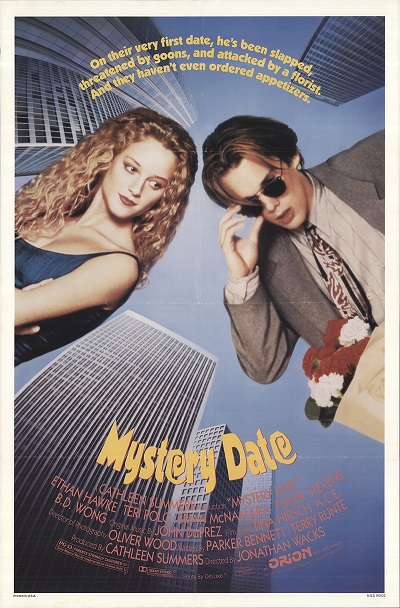
If you were having trouble getting to sleep last night, around one in the morning, you could have turned over to the HBO Family channel and watched the 1991 comedy, Mystery Date!
A young and extremely adorable Ethan Hawke plays Tom McHugh, a college student who is in love with Geena (Teri Polo), the housesitter next door. The only problem is that Tom is extremely shy and can’t even work up the nerve to ask Genna out. It sure would help if he was rich and charming like his older brother, Craig (Brian McNamara). Eventually, Craig helps his brother out. He gives Tom his credit card and his car so that Tom can take Geena out on a date. What an nice brother! Soon, Tom and Geena are hitting the town and having a great time. They even see Gwar perform which …. well, okay. That probably would not be my ideal first date but whatever.
Unfortunately, it turns out that Craig has gotten involved with some pretty bad things and, as a result, there are two dead bodies in the trunk of the car! Uh-oh, that could be awkward. Plus, the Chinese mafia (led by B.D. Wong) are determined to kill Tom because they think that he’s Craig. And finally, to top it all off, Tom has got a crazed flower delivery guy (played by Fisher Stevens) following him all over the city. Can Tom possibly survive the night and still get a second date!?
Mystery Date starts out nicely. Ethan Hawke is cute in a non-threatening sort of way. Teri Polo is likable. They seem like they would make a cute couple. You want things to work out for them. Unfortunately, once the date actually starts, the film gets frantic without getting any funnier. It becomes a case of the film just trying too hard and you feel as if the film is demanding that you laugh as opposed to offering up a reason to laugh. You watch the film and you don’t so much think about what you’re watching as you think about films like Risky Business and Better Off Dead, both of which told similar stories with a lot more energy and imagination. You have to kind of imagine that whenever Ethan Hawke gives one of his interviews where he talks about why he’s not interested in doing typical mainstream films, this is probably the type of movie that he was talking about. Among the many other things for which we have to thank Richard Linklater, he ensured that Ethan Hawke would never have to star in Mystery Date 2.
Was I the only one who was relieved that William Shatner didn’t die this week?
Seriously, when I heard that the 90 year-old Shatner was going to be taking a trip on one of the Amazon rockets, I was really worried. First off, you’re taking a 90 year-old into space. Secondly, you’re doing it with a rocket that people don’t really know that much about. And third, that 90 year-old is a cultural icon and one who probably played no small role in causing people like Jeff Bezos and Elon Musk to become obsessed with conquering space in the first place. With the exception of George Takei, everyone loves William Shatner. (And, at this point, Takei’s constant sniping about Shatner is coming across as being just a little bit petty. Move on, George! People love you, too.)
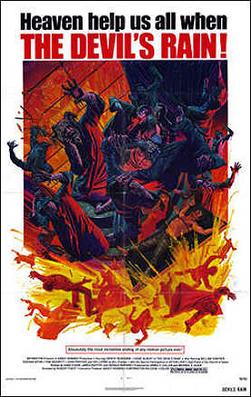
As I watched Shatner land back on Earth, I found myself thinking about The Devil’s Rain, a film from 1975 that starred William Shatner as a man whose exploration of the unknown led to a far less triumphant result.
In this film, Shatner plays Mark Preston, a youngish man who lives on ranch with his father (George Sawaya) and his mother (Ida Lupino). For some reason, the Preston family owns a book that is full of evil magic. Satanic high priest Jonathan Corbis (Ernest Borgnine) wants the book and when the Prestons refuse to hand it over, he makes it his mission to destroy them. He gets things started by turning Mark’s father into a weird, waxy zombie who melts in the rain. Not wanting the same fate to befall the rest of the family, Mark grabs the book and heads to a desert ghost town that has been taken over by Corbis and his followers. Mark never returns.
Mark’s older brother, Tom (Tom Skerritt) then shows up in town, searching for Mark. Accompanying him are his wife (Joan Prather) and a paranormal researcher (Eddie Albert). Tom discovers that Corbis is transforming his followers into zombies who have no memories and who exist only to …. well, I’m not sure what the point of it all is but I guess it basically comes down to Corbis needing something evil to do. Not only has Mark become one of his Corbis’s followers but, if you keep an eye out, you might spot a very young John Travolta in the background. This was Travolta’s film debut. According to the end credits, the character he plays is named Danny. Danny Zuko, perhaps? That would serve him right for making Sandy doubt herself.
The Devil’s Rain is one of the many low-budget movies that William Shatner did between the end of the Star Trek TV show and the start of the Star Trek movies. It’s a bit of an disjointed film, as I think any film starring William Shatner and Tom Skerritt as brothers would have to be. Skerritt gives a very laconic performance, playing his character as if he was the star of a Western. Shatner, meanwhile, does that thing where he randomly emphasizes his words and gets the full drama out of every sentence and facial expression. But, as much as Shatner overacts, you can’t help but enjoy his performance because he’s William Shatner and that’s what he does. The same is true of Ernest Borgnine, who overacts in his role just as much as you would expect Ernest Borgnine to overact when cast as an evil cult leader. For that matter, Eddie Albert isn’t exactly subtle as the paranormal researcher. Don’t even get me started on Keenan Wynn, playing yet another small town sheriff. Let’s just say that, with the exception of Tom Skerritt, the cast of The Devil’s Rain is not necessarily full of actors noted for their restraint. That said, there’s something rather charming about everyone’s attempts to steal every scene in which they appear.
The Devil’s Rain is a deeply silly film but that doesn’t make any sense but it’s hard not to get caught up in it. Even if the fact that this film is perhaps your only opportunity to see John Travolta melt on screen isn’t enough to make you watch, Shatner vs. Borgnine with Skerritt approaching in the distance is just too entertaining to resist! Thankfully, Shatner survived appearing in this film and revitalized his career through a combination of Star Trek movies and Canadian tax shelter flicks. He’s a survivor. In fact, I guess I shouldn’t have been surprised that, even at the age of 90, Shatner has no trouble going into space. William Shatner’s going to be around forever.
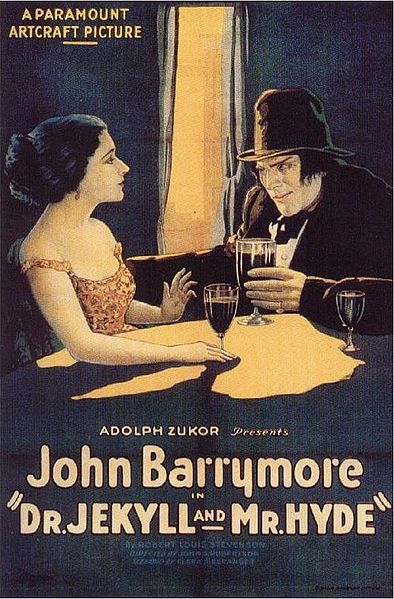
Ever since the birth of film, Robert Louis Stevenson’s Dr. Jekyll and Mr. Hyde has been a popular subject for adaptation. Not only does the classic story of a good doctor who unleashes his evil instinct via potion serve as a potent metaphor for everything from sexual repression to drug addiction, but the dual role of Dr. Jekyll and Mr. Hyde has provides an excellent opportunity for an actor to show off.
The first film adaptation of Dr. Jekyll and Mr. Hyde is believed to have been made in 1908. Two more version followed in 1912 and 1913 and then, suddenly, 1920 saw three different film versions.
The best known of the 1920 version is our film for today. This version is best remembered for John Barrymore’s powerful performance in the title role but it also holds up remarkably well as a work of cinematic horror.
Daddy’s Girl is a forgotten film today but I swear that there was a two-month period in 1997 when it showed up every weekend on late night Cinemax and Showtime. Like many former late night cable mainstays, Daddy’s Girl never developed enough of a cult following to justify getting a DVD release so, if you want to see it, you either have to have a working VCR or the ability to search YouTube.
I’m surprised this film doesn’t have a following because it features two thing that were every popular on cable in the 90s, William Katt and an evil child. This time, William Katt plays Don, a toy designer who can’t get anyone to buy his creations. Because he’s struggling, his wife (Michele Greene) is having to support the family. Despite the fact that they’re not in great financial shape, they still decided to adopt 11 year-old Jodi (Gabrielle Boni). Jodi loves Don and he spoils her every chance that he gets. Jodi hates everyone else and tries to kill all of them.
What sets Daddy’s Girl apart from other crazy kid movies is just how far Jodi will go to kill anyone who might get between her and her adopted father. Don’t even think about recommending that Jodi go to a special school because Jodi will knock you off a ladder and then push over a bookcase so that it lands on top you! Don’t try to investigate her past because Jodi knows how to use a meat tenderizer as a deadly weapon! Even if you’re at the hospital as a result of Jodi’s actions, she’ll just go down there and pull the plug herself! And Jodie won’t just kill you. She’ll make a joke about it after she does it! Jodi is full of one liners. Is this kid a comedian or a killer? You’ll die laughing!
It’s hard to believe that no one would catch on to what Jodi is doing and I think the movie overestimates the physical strength of a typical 11 year-old girl but Daddy’s Girl isn’t bad. William Katt was one of the better actors to regularly appear in direct-to-video thrillers like this one and Gabrielle Boni is a trip as the clingy and crazy Jodi. Direct-to-video mainstays Mimi Craven and Whip Hubley also make welcome appearances. Daddy’s Girl is an enjoyable take on The Bad Seed.


 Through the Shattered Lens