Which Way Forward For The “Batman” Movie Franchise? Take Two : Building A Better Gotham


If there’s one area (and actually I think there are several, but that’s rather beside the point and I promised to remain focused like a laser beam on each individual subtopic in this “Batman reboot” series of posts) where I think Tim Burton’s Bat-flicks had it all all over Christopher Nolan’s it’s in their depiction of Gotham City. Not only did Burton’s Gotham have a fantastic Metropolis-gone-gothic look thanks to the late Anton Furst, but it felt like an intrinsically different sort of place than a real city, a place where you could sort of actually believe guys might run around in bat costumes and Joker facepaint , while Nolan’s Gotham was just, essentially, New York only a little grimier (even if his first two films were shot in Chicago).

I understand the reasoning behind making Gotham less fantastic, of course, and those reasons do make sense — Nolan’s Batman was supposed to be a more “realistic” character, to the extent that a billionaire who dresses up like a bat can ever be called “realistic,” and Joel Schumacher’s CGI Gotham was such an over-the-top visual disaster that a back-to-basics approach to Bruce Wayne’s hometown was a predictable enough move to make.

Still, I think something was lost, and that Batman works a bit better with at least some level of the fantastic still involved in its primary geographic setting. To that end, I think  there are basically three things any self-respecting Gotham of the potential “soft reboot” of the Bat-franchise we were talking about should have —

1. It should look at least a little bit different than a garden-variety major US city. You needn’t construct anything as elaborate as Furst’s amazing two-city-block long set, but a city that has some fairly spectacular architecture in the form of bridges, tall buildings, etc. that you can focus in on would be a definite plus, especially if they’re all a bit past their prime and have seen better days, since Gotham pretty has to be a grimy place by definition. Some constructed set pieces that could stand in as fictitious local landmarks would be a plus, as well, so to that end it would be helpful if the filming location for future Batman flicks had something of an emptied-out urban core where you could build an Arkham Asylum, or a neat-looking miniature version of Wayne tower, etc. I’m thinking an ideal sort of look would combine elements of New York as depicted in Zack Snyder’s Watchmen combined with a toned-down Gothic feel at least somewhat reminiscent of furst’s Gotham, albeit scaled way the hell back.

2. There should be some ritzy neighborhoods or suburbs where you can find adequate exterior footage for Wayne Manor and its grounds. I don’t think the next Bruce Wayne needs to live in a fucking castle like Bale’s version, but certainly a “stately manor” that exudes old-school wealth and prestige and hearkens back to the city’s more prosperous days before it became Crime Capitol, USA (which Gotham pretty much always  is).

3. As alluded to in the first two points, the majority of the city should be run down, and obviously well past its prime — a city in desperate need of a champion.

Finally, for reasons that will be made more clear as I get into the nuts and bolts of the plot outline I have in mind for this whole “soft reboot” thing, I think it would be essential for the city-to-stand-in-for-Gotham to be close to some wooded and even mountainous areas, since while the focus of this flick is most assuredly not going to be on the minutiae of the Batman’s origins per se, I still think some “flashback”-style sequences that show rugged wilderness survival-type training are going to be in order.

I suppose this is all rather just moot speculation since they’ll probably just film the next flick in Vancouver and it’ll look just fine because it pretty much always does no matter what, but just for the sake of fun speculation, I have something else in mind here — a locale that combines everything we’re looking for in terms of a run-down urban core; some truly spectacular architecture of its own; essentially empty areas that might as well hang a sign up saying “will build to suit;” palatial, ultra-wealthy, “old money” suburban areas; and fairly reasonable access to densely-wooded, geographically rugged forest. Batman Begins was filmed in Iceland, the UK, and Chicago, respectively, in order to capture all these various aspects, but you can do all this in exactly one place here in the good ol’ USA, and the state government is eevn actively engaged in rolling out the red carpet to film production in recent years, seeing the economic boom it’s brought to its northerly neighbor in Toronto.

Yes, folks, I think the next principal filming location for Gotham City — the ideal place to set the geographic tone for a re-launched, re-loaded (even if it’s done “softly”) Bat-franchise — should be (drumroll please) : Detroit!

I assure you, friends, I’m not kidding. Given the kind of place I think would work best for this “sot reboot,” as outlined in my (admittedly makeshift) criteria above, I think the much-maligned Motor City would be absolutely ideal, and bringing the production there would have the added bonus of generating great publicity for the film due to the positive economic impact it would have on an area that sure could use it. A multi-million-dollar Hollywood production setting up shop in Detroit? You can bet the city fathers (and mothers) would positively roll out the red carpet for Warner Brothers, and everything you would need is  literally right there at your fingertips. Honestly, this idea’s almost too damn good. But maybe you’ve got a better one, in which case, please chime in before I move on to step three, which will concentrate on the overall tone of the film itself (now that we’ve — okay, I’ve — established a great location) tomorrow!

Which Way Forward For The “Batman” Movie Franchise? Take One


Bear with me, folks, ‘cuz this is gonna be a looonnnnng one. Not this post in and of itself, mind you — in fact I’m going to do my very best to keep things brief in this and subsequent installments (whoops! I just gave away what’s going on here, didn’t I?) and try, perhaps even desperately, to confine all postings in this series (and if I didn’t give it away before I sure did now!) to one particular aspect of what we’ll be discussing here each time so as not to throw too much out there at once before receiving input from you, dear readers, as to your own thoughts on what I’m talking about before plowing ahead to the next part. I know, I know — all bloggers say they genuinely want the input of their readership on what they’re posting, but in this case I really do mean it with all sincerity. I want this to be an interactive discussion about what we, as fans/movie geeks, want to see happen next with one of the most successful properties, arguably perhaps even the most successful property,  in cinematic history.

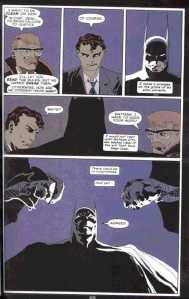
I’m speaking, of course, of the Batman. With Christopher Nolan’s beyond-blockbuster trilogy having just wrapped up, speculation is already rife as to what DC Entertainment and its parent company, Warner Brothers, will do next when it comes to the adventures on the Dark Knight Detective on the silver screen. For an initial hint about were I’d take things, please refer to the famous page above from the Jeph Loeb/Tim Sale comic Batman : The Long Halloween. For reasons that will be made clear over this course of this series of postings, however long it may drag on, that scene — the famous “rooftop meeting” between Batman, Commissioner Gordon, and District Attorney Harvey Dent — is at the very heart of where I think the Bat-franchise would go next.

But let’s not get too far ahead of ourselves just yet. First, let’s take stock of where we are now and the three, as I see them anyway, options DC/Warner has going forward. As of this moment, The Dark Knight Rises has taken in just a hair under $420 million dollars at the domestic box office, and just a hair under $1 billion worldwide. It’s a pretty solid bet that it will end up taking in $500 million domestically and will AvatarTitanicThe Avengers, and The Dark Knight in the over-a-bliion-dollars-in-worldwide-ticket-sales club. That means that of the five highest-grossing films in the world in history, two will be Batman flicks. Clearly, Warner isn’t going to let this property stagnate for too long.

But they need to play their cards exactly right going forward, because this is one golden goose they absolutely need to keep laying eggs. Which brings me back those three options they have going forward, each of which carries some risk, as well as potential rewards. Let’s look at each potential path  forward individually, shall we? Glad you agree.

Option #1 — The direct sequel. Nolan certainly left this possibility wide open with Robin/John Blake’s “inheritance” of the Batcave, and in many ways it’s the easiest and most painless way to go. Blake’s the new Batman (or Robin, or Nightwing, or whoever), some ambitious director would be more than willing to take on carrying things forward from where Nolan left them, and audiences are already primed and ready to accept Joseph Gordon-Levitt as the new man beneath the cowl.

But are they really? Let’s face it — Bruce Wayne is central to the Batman myth. You could argue that DC themselves are working on making him less central to it with the publication of such books as Batman, Incorporated and several storylines in recent years that have seen the likes of Dick Grayson, among others, assuming the Batman role for varying periods of time. Maybe they’re trying to test the waters with this whole someone-else-as-Batman idea on the printed page before going for it on the big screen? It’s possible, but sooner or later they always seem to come back to Bruce Wayne, and it’s easy to see why —

Frankly, it just never really works with anyone else as anything other than a temporary gimmick to boost sales for a few months. Sooner or later, the fans always want to see the “real” Batman back in action. A new guy might be interesting for a movie or two, but the speculation as to if and when Bruce Wayne — and, by extension, Christian Bale and maybe even Chris Nolan — would be back would be a Sword of Damocles hanging over the head of any “direct sequel” flick, no matter how good it was. And that just ain’t gonna happen. Bale’s done. Nolan’s done. These guys have made the studio a fortune. Let them get on with their lives in peace.

Option #2 — The “hard reboot.” This has been done, successfully, with the Bat-franchise before, obviously. Batman Begins is as “hard” a reboot of a character and his origins as you’re going to find. We’re used to seeing Batman reinvented every so often, and it’s never been a dealbreaker before. Every generation flat-out deserves its own iconic take on the character, right? Why go in any other way now? It would free up the next director, producers, and cast from having to do things the “Nolan way,” that’s for sure, and sometimes the best way forward is by taking a few steps back.

And yet — that might necessitate Batman sitting on the shelf longer than Warner wants him to be. The Amazing Spider-Man isn’t that bad a superhero movie by any stretch of the imagination, but even its most fervent partisans would, when pressed, admit that two Spidey origins within a decade is a bit much. And besides, it’s not like Batman Begins is going to appear especially dated within the next five or ten years, nor is it likely to be surpassed in terms of quality as a Batman origin story for the silver screen. Any “hard reboot” story is going to inevitably be compared to it, and any other cinematic origin story is going to come up short, more than likely. Unless, of course, it’s a work of such singular awesomeness that it just comes along and completely blind-sides all of us. But ya know what? Even then, I bet it’s still gonna piss plenty of people off. Plus, there’s the open question of just how necessary a “start-from-scratch”-type story even is. More or less everyone knows at least the basic details of the Batman myth — do we need to see them play out before us yet again to understand and appreciate a new cinematic interpretation of the character?

Which brings us, finally, to Option # 3 — the so-called “soft reboot” option. Admittedly, this hasn’t worked out so well for secondary comic-book-related properties like The Punisher and the Hulk, but they were both coming off first installments that were pretty iffy to begin with, to put things kindly. That”s not the case here by any stretch of the imagination. Even if Nolan’s Batman films weren’t your cup of tea, there’s no denying they’ve been tremendously successful at the box office and generally quite well-regarded by hard-core fans, critics, and more casual audiences alike. Maybe there’s no need to reinvent the wheel here, even if we’re going to go back into Batman’s career chronologically, the cast is going to be entirely different, there will be a new director and screeenwriter(s), etc.

Not that this option isn’t without some risk, too. It would essentially assume at least a rudimentary knowledge of the character on the part of the audience (anyone not know anything about the guy? Bueller? Bueller?), and it would subject the new film,series to more direct comparison with the Nolan flicks than, perhaps, option #2 (although that’s debatable, and flat-out inevitable in any case, anyway), and — well, that’s probably about it.

So — from where I’m sitting right now, that looks like the best bet to me. Let’s have a new take on the Batman franchise with new actors, a new director, a new writer or writers, new everything — but let’s not feel compelled to tell his origin over from the start. Let’s concern ourselves with concentrating on the various elements that have made Batman so appealing and enduring as a cultural icon over the years, tell a story that incorporates and elaborates upon all of those, and maybe throws a few new wrinkles of its own into the mix, and not feel like the wheel needs to be reinvented here. The Nolan films are going to be the standard against which all future films are going to be judged, anyway, so rather than run as far away from them as possible, why not keep what worked about them, and maybe present them in a new way?

If all this sounds just a little bit too abstract for you at this point, I wouldn’t blame you, but stick with me here — at least until you get bored. I hope that as things progress, what I have specifically in mind will become more and more clear. And keep that image from The Long Halloween in mind as we go along, because it’s central to where I’m going — even though I don’t think the comic itself was anything other than a somewhat-above-average Batman story (and yes, I’m hoping that sentence will make a bit more sense to you in the coming days/weeks, as well).

So that’s it for part one of this thinking-it-out as-I-go-along project. I hope to pick things up again tomorrow with some some thoughts on Gotham City — how it’s been presented in the past, how and why it’s central to the Batman mythos, particularly in film, and a really weirdly appealing (in my own twisted mind, at any rate) idea I’ve got as to exactly which major American city would make a great movie Gotham for the future. Until then, please — tear my opinion to shreds! Or agree with it! Or somewhere in between! But let’s see where we agree or disagree and find out where you think I’m right and wrong and why!

It’s Time For The Annual Self-Important Post About The Year In Film So Far


For the entire past week, something has been nagging at me.  I knew that there was something that I needed to do but I couldn’t remember what it was.  Earlier today, however, I was reading the latest critical blathering about the state of cinema over at AwardsDaily.  As usual, that site’s editors were whining about the fact that the Social Network didn’t win best picture and also the fact that my generation is apparently the “WORST.  GENERATION.  EVER” and blah blah blah. 

Fortunately, however, reading that  post reminded me of what I had forgotten: We are now at the halfway mark as far as 2012 is concerned.  This is the time of year that self-important film critics (both online and elsewhere) tell their readers what type of year it’s been so far. 

So, without further ado — what type of year has 2012 been so far?

(By the way, you can also check out my thoughts from July of 2011 and July 2010 as well.)

(Also, please understand that the act of me posting this in no way guarantees that I won’t change my mind several times within the next hour.)

Best Film Of The Year (So Far): Cabin In The Woods. Compared to both 2010 and 2011, this has been a pretty slow year so far.  There really hasn’t been a Hanna or an Exit Through The Gift Shop type of film so far.  Instead, there’s been a handful of nice surprises, quite a few pleasant but somewhat forgettable films, and then quite a few films that i wish were forgettable.  Cabin In The Woods, however, was a nice little valentine to horror fans like me and it’s a film that actually gets even better with repeat viewings.  Runners up include Bernie, Damsels in Distress, Brave, The Hunger Games, Safety Not Guaranteed, Moonrise Kingdom, For Greater Glory, Jeff, Who Lives At Home, and the Avengers.

Best Male Performance Of The Year (So Far): Jack Black in Bernie.  Runners up include Andrew Garfield in The Amazing Spider-Man and Jason Segal in Jeff, Who Lives At Home.

Best Female Performance of the Year (So Far): Jennifer Lawrence in The Hunger Games.  Seriously, just try to imagine that film with someone else in the lead role.  Runners up include Susan Sarandon in Jeff, Who Lives At Home, Aubrey Plaza in Safety Not Guaranteed, and Greta Gerwig in Damsels in Distress.

Best Voice-Over Performance Of The Year (So Far): Kelly MacDonald in Brave.

Best Ending Of The Year (So Far): A 3-way tie between The Cabin In The Woods, Safety Not Guaranteed, and Jeff, Who Lives At Home.

Best Horror Film Of The Year (So Far): The Cabin In The Woods

Most Underrated Film Of The Year (So Far): The Five-Year Engagement, a sweet and funny movie that was just a tad bit too long.

Best Bad Film of the Year: Battleship.  Yes, the movie represented some of the worst impulses of big-budget filmmaking but I had a lot of fun watching it and Alexander Skarsgard was to die for in that white Navy uniform.

Worst Film Of The Year (So Far): The Wicker Tree.  I could make an argument for both Rock of Ages and The Devil Inside here but no…just no.  As the Trash Film Guru put it, “BURN THE WICKER TREE!”

Biggest Example Of A Missed Opportunity For This Year (So Far): Seeking a Friend For The End of the World.  A great performance from Steve Carrel can’t save a film that has no idea what it wants to be.

The Get Over It Already Award For The First Half of 2012: The Devil Inside, for being the most tedious example of a “found footage” horror film yet.  Coming in second: Rock of Ages, for reminding me that my parents had terrible taste in music.

The Trailer That Has Most Outgrown Its Welcome: The Perks of Being a Wall Flower.  “Be aggressive…passive aggressive…” Okay, shut up, already.

The Cameron/Fincher Bandwagon Trophy (Awarded To The Upcoming Film That, Regardless Of Quality, Will Probably Be So Violently Embraced By People Online That You’ll Be Putting Your Life In Danger If You Dare Offer Up The Slightest Amount Of Criticism): The Dark Knight Rises

The Ebert Award (Awarded to the upcoming film that will probably get  positive reviews based on the film’s political context as opposed to the film itself): Zero Dark Thirty

The Sasha Award (Awarded To The Film That I Am Predicting Will Be The Most Overrated Of The Year): Lincoln.

The Roland Emmerich/Rod Lurie Award For The Film That I’m Predicting Will Be The Worst Of 2012: Honestly, it’s really hard to imagine a worse film than The Wicker Tree (though, to be honest, Rock of Ages comes pretty close). 

Films I’m Looking Forward To Seeing In The Future (An incomplete list): On The Road, Lawless, The Dark Knight Rises, Cosmopolis, Django Unchained, The Hobbit, The Great Gatsby, and especially The Master and Joe Wright’s Anna Karenina.

And there you have it.  2012 hasn’t been a great year so far but there’s still a lot of time left.

Unless, of course, the Mayans were correct.

The Magic of Duels of the Planeswalkers


A couple of years back I was bored one afternoon and browsing the XBox Live Marketplace. I didn’t have any real expectation of finding a game that would get me through the afternoon, let alone something that would have real staying power for me, and I would revisit time and again. When I saw that there was a Magic the Gathering game, it was suspicions that became aroused, not interest. Out of a kind of morbid curiosity I selected the game and read a little more into it, saw that a couple of my friends had played it, and that it seemed to be a self-contained engine of a game, and not simply another attempt to sell me Magic the Gathering Online in a repackaged form (don’t get me wrong, I don’t have anything against MTG:O. In fact, it’s a clever idea to reach people who either don’t have an active local Magic scene, or hate their local Magic scene, but if I had money to waste on Magic, I personally would do it at my local comic store).

But, oddly, the complaint that I keep hearing from people about Duels of the Planeswalkers (aside from some more quantitative complaints, which I’ll get into) is that it’s a self-contained thing, not a beautifully rendered amalgamation of all Magic ever.

…Well, duh.

You may bring whatever expectations you wish into your gaming experiences, but I find it’s better to try and keep things a little bit in perspective. For a $10 XBox Live Arcade title – a game that by definition is not a full retail game – you are expecting a full pool of Type II cards, a fully operational deck builder, and carte blanche to build as many decks as you like and play them against other humans? How much money does that privilege cost in real life? If some quickly-researched netdecking can be believed, a couple hundred bucks will buy you a top end deck in the current meta (and someone bought those cards at $4 for each randomized pack or whatever at retail, let’s not forget). Let’s say each ranked DCI event costs another $7 as an entry fee. So for one singular deck, you must expend hundreds of dollars, and much of that income reaches Wizards of the Coast. Then, if you wish to change decks, you’re likely to need more cards. Wizards will release new expansions, and you will need still more cards. All of this generates revenue for the company that is printing the game (and all of the creative people behind its design, etc.) and you honestly approach Duels of the Planeswalkers with the expectation that it’s going to just replace the CCG model forever?

Come on.

So now that that soap box moment is out of the way, let’s talk about the game. 2013 is the latest upgrade to the now-yearly franchise. Much like regular Magic’s Type II environment, DotP can be seen as a sealed ‘block’ of decks of cards, and it evolves year by year. The game-play improvements in 2013, then, are very slight, since the game of Magic hasn’t changed much. The most meaningful one is the long-awaited ability to manually select your own lands to tap for Mana instead of letting the CPU select them for you (the CPU attempts to do this intelligently, but unfortunately, the CPU has no idea what it’s doing). The main difference is, therefore, the entirely new pool of decks that players can customize and compete with. The game launched with 10 available decks which come with a basic pool of 35 cards (plus the necessary land to make the deck function of course) and an additional 30 unlockable cards. The cards are unlocked – unfortunately – one by one, by winning duels, or if you’re lucky enough to be playing the console versions, by the purchase of Deck Keys (those cost about $1 of your real money each) which completely unlock the deck in question. This represents a large increase in possible customization over the selection offered by 2012.

The decks themselves are primarily monochrome, which is a shame. I understand that Wizards probably sees DotP as a tool to draw people into the world of Magic: The Gathering either on or off line, hoping to gain more lifetime players who are eager to experience the full game. However, many players do want to enjoy DotP as a game in its own right, and while monochrome decks are easier to play and make a decent introduction, the truth is that the Magic decks you’re going to see even at a local Friday Night Magic tournament are going to include a lot of paired colours for a simple reason – each colour is deliberately designed with shortcomings. Black has access to many easy fire-and-forget creature destruction spells and no enchantment removal at all. White has only a tiny splash of creature removal (and each of their ‘removal’ cards has a drawback printed on the card!) but many good cards for destroying enchantments or artifacts. If you combine the two, you can have both of those strengths, and cover for the weaknesses, at the expense of a deck that can be less reliable (since you must now possess two different colour resources) and harder to play. The trade-off is almost always worth it.

Hopefully DLC (it’s already in the works, of course!) will expand a little bit on this, and throw in some more two-colour decks (and a few fewer absolutely atrocious 3-colour decks. Please?).

As for the Planechase mode, I haven’t got much to say. I’ve never liked Planechase because it can really take a long time to play a single game of it, so I’ve avoided testing it extensively. I can say that it works just like I remember it working in real life, and it can definitely be fun if you have the patience to stick with it. The unpredictable and powerful effects of the different twisting Planes can really throw a traditional match-up on its head. Combined with the inevitable chaos of FFA multiplayer, and you definitely have a format with legs – no two games of Planechase will ever be exactly the same.

I suggest that you think of Duels as a Magic format much like Captains or, frankly, Type II… and enjoy it for what it is; a closed Magic experience that doesn’t cost you a lot of cash out of pocket to play. The added levels of customization (regrettably, still not the ability to pick how many lands your deck has in it. Grrr!) make the environment more varied than ever (mind you, I did not suggest the environment was balanced. It’s much too early to speak on that) so it’s definitely a game that’s got some depth if you’re willing to take the time to learn the format and delve into its own quirks and strategies.

The game reportedly suffers from numerous bugs. I have not encountered any that are more severe than the ‘mild annoyance’ variety, but I suspect there are uglier ones to be found in those innumerable lines of code somewhere. I wish I could say this was uncommon for releases in 2012, but I try to remain honest when I write these columns.

So there it is. I find Duels to be a fantastic addition to my summer, and I’m more excited than ever to waste countless hours trying to determine the best combination of 60 cards in the fixed pool that makes up my blue deck that will best let me control the decks I’ve seen people playing this week. Oh, and if you pick it up, do try it out with a friend in Two-Headed Giant at least once. It’s riotously fun.

1500 and Counting…


It’s hard to believe it but the little entertainment site that begun one quiet morning the day before Christmas 2009 has reached another milestone.

1500 articles posted is no small feat considering that this was originally a site dedicated to just it’s creator’s random thoughts on entertainment with little or no focus. As the months went by more people joined wanting to contribute and each and every one contributed in their own way. Many have begun to follow the thoughts, opinions and ramblings of the crew that made up the this chaotic ship called Through the Shattered Lens.

Once again I say thanks to those who have become my blog nakama and who continue to stay on board this ship to destinations unknown. My biggest thanks has to go to the one I consider this site’s heart and soul and one who continues to make running this little piece of the entertainment blogosphere quite an adventurous and unpredictable experience: Lisa Marie Bowman.

Fair winds and following seas to the crew of Through the Shattered Lens both new and old!

The Academy Was Wrong: 20 Times That The Wrong Film Won Best Picture


Hi everyone! It’s Oscar Sunday which, as we all know, is a national holiday. 

And, like many holidays, things occasionally don’t go the way they should.  Often times, the day starts with such promise and ends with such bitterness as the Academy announces that the best film of the year is a film that we all know didn’t deserve the title.

Below, you’ll find a list of 10 instances when the Academy got it wrong.  Please note that these are just my own personal picks.  You may disagree and you are welcome to do so (as long as you understand that, ultimately, I’m always right.)

Also, please note that I have limited myself to only considering films that were actually nominated for best picture.  You could make a great argument for films like Psycho, 2001, The Dark Knight, and others.  However, none of those films were even nominated for best picture and therefore, I have not considered them for this list.

(Also, if this list seems to be dominated by more recent Oscar picks, that’s because it’s more likely that I’ve been able to see a film that was released in 2007 as opposed to film from 1927.)

Anyway, here’s my chronological list of 20+ nominees that should have won:

1941 — Citizen Kane (lost to How Green Way My Valley)

1952 — A Place In The Sun (lost to An American In Paris)

1967 — The Graduate (lost to In The Heart of The Night)

1973 — The Exorcist or American Graffiti (lost to The Sting)

1976 — All The President’s Men (lost to Rocky)

1986 — Hannah and Her Sisters or A Room With A View (lost to Platoon)

1990 — Goodfellas (lost to Dances With Wolves)

1994 — Pulp Fiction (lost to Forrest Gump)

1995 — Sense and Sensibility or Babe (lost to Braveheart)

1996 — Fargo (lost to The English Patient)

1999 — The Sixth Sense (lost to American Beauty)

2000 — Crouching Tiger, Hidden Dragon (lost to Gladiator)

2001 — In The Bedroom (lost to A Beautiful Mind)

2002 — Lord of the Rings: The Two Towers (lost to Chicago)

2003 — Lost in Translation (lost to Lord of the Rings: The Return of the King)

2004 — The Aviator (lost to Million Dollar Baby)

2005 — Capote or Brokeback Mountain (lost to Crash)

2006 — Babel (lost to The Departed)

2009 — An Education (lost to The Hurt Locker)

2010 — Black Swan (lost to The King’s Speech)

6 Trailers Delayed


This weekend, because of both the Oscars and some personal matters I have to take care of, I will not be posting my usual Lisa Marie’s Favorite Grindhouse and Exploitation Trailers post.  I sincerely apologize but I promise that the feature will return in two weeks time, on March 10th.

Let me take this time to ask a question of my fellow grindhouse and exploitation film enthusiasts.  Are there any trailers that I have yet to feature that you personally think I should?  In other words, what are your favorite trailers?  If you’re feeling too shy (or not shy enough) to use the comments box below, feel free to e-mail me at LisaMarieBowman@live.com.

Again, the feature will be back in two weeks.  Until then, here’s a picture of a racoon holding a kitty.


No Guts, No Glory, Part II: Lisa Marie Goes Down Into The Oscar Pool And Gets Wet


Since every other film blogger and wannabe Awards diva is doing so, I figured I might as well post my predictions as to who and what will actually win when the Oscars are handed out on Sunday.  Please remember, these are not the films and performers that I personally would choose to honor.  (Indeed, I’ve never disagreed with the Oscar nominations more than I have this year.)  These are just my predictions and random guesses at what will be honored on Sunday.

Best Picture: The Descendants

Best Director: Michel Hazanavicius for The Artist

Best Actor: George Clooney in The Descendants

Best Actress: Viola Davis in The Help

Best Supporting Actor: Christopher Plummer in Beginners

Best Supporting Actress: Octavia Spencer in The Help

Best Original Screenplay: Woody Allen for Midnight in Paris

Best Adapted Screenplay: The Descendants

Best Animated Feature Film: Rango

Best Foreign Language Film: In Darkness (Poland)

Best Documentary Feature: Paradise Lost 3: Purgatory

Best Original Score: War Horse

Best Original Song: “Man or Muppet” from The Muppets

Best Sound Editing: Hugo

Best Sound Mixing: Hugo

Best Art Direction: The Artist

Best Cinematography: The Tree Of Life

Best Makeup: Albert Nobbs

Best Costume Design: The Artist

Best Film Editing: The Descendants

Best Visual Effects: Hugo

Agree?  Disagree?  Confused as to what just the Hell I was thinking when I made some of these predictions?  Please let me know in the comments section below.

R.I.P. Whitney Houston


Some sad news has hit the music industry and it’s fans as one of the iconic singers of the 1980’s and 90’s passed away today at the age of 48.

Whitney Houston was one of the major voices of the music scene from the time she came into it with her self-titled debut album in 1985. Her sound was a combination of the R&B, soul and Gospel sound which Motown had popularized during it’s hey day during the 60’s and 70’s, but she also injected a major dose of pop to her singing which allowed her to cross genre boundaries to become a mainstream pop star.

Her success with the mainstream scene would cause her some problems with those who were R&B fans first and foremost. This personal struggle to both acknowledge her R&B roots and also maintain her foot within the mainstream would plague Whitney Houston throughout her career.

In the end, one doesn’t need to be in the camp of either side to acknowledge her vocal talent of which it was staggering. She dominated the Billboard during her reign as pop music’s female answer to Michael Jackson during the 80’s and early 90’s. Sadly, a contentious marriage to another pop star in Bobby Brown during the early 90’s would lead to drug use and subsequently a degradation of the very voice which brought her fame and success.

For me, two songs which would forever cement her star in the constellation of greatest singers of any era would be her cover of the song “The Greatest Love of All” and her powerful rendition of the national anthem, “Star-Spangled Banner”, during Super Bowl XXV. These two songs proves that she was a talent that arrived on the music scene once a generation and who would influence uncounted singers following in her footsteps.

Source: Associated Press


Arleigh’s 13 Favorite Films of 2011


2011 was a year that wasn’t spectacular by any stretch of the imagination. From January right up to December there were not many films which I would consider event films. This is surprising considering all the superhero blockbusters which arrived during the summer and the final film in the Harry Potter film franchise. Even the prestige films which came out during the holidays never truly captured everyone’s imagination (though one film was very close to achieving it due to one Michael Fassbender).

What 2011 did have was a solid slate of titles which ranged from the pulpy to the cerebral. We even got films which were able to combine the two to come up with something very special. Not every film resonated with everyone and some even split audiences down the extreme middle with half hating it and the other half loving it.

The list below catalogs the films which I consider my favorites of 2011. Some titles on this list I consider some of the best of 2011 while some didn’t make that particular list but were entertaining enough for me to make this favorite list. Once again, the list is not ranked from top to bottom, but only numbered to keep things organized….

  1. Shame (dir. by Steve McQueen) – This character-driven film starring Michael Fassbender and Cary Mulligan was one of those film which got close to becoming the one film everyone ended up talking about as the year wound down. It’s an exercise in minimalist filmmaking as Steve McQueen doesn’t allow too much dialogue to get in the way of telling the visual story of sex-addict Brandon and his downward spiral from addiction to self-hate. Much have been said of how much Fassbender’s penis in full display was a reason why people flocked to see this little existential film, but I rather thought that was probably just a bonus for some and instead it was Fassbender’s uncompromising performance in the role of Brandon which made Shame one of my favorites for 2011.
  2. Rise of the Planet of the Apes (dir. by Rupert Wyatt) – this film was one which didn’t garner too much high-anticipation from genre fans leading up to it’s release. People had been burned by Tim Burton’s reboot of the franchise and saw this second attempt to reboot the series as a failure in the making. So, it was to o everyone’s surprise that Rupert Wyatt’s film managed to not just bring new life to a stagnating franchise but do so in such a way that it became one of the best films of 2011. Sure, there was some flaws in how the human character were written, but in the end it was the performance-capture work by Andy Serkis and the digital wizardry of WETA Digital which made Rise of the Planet of the Apes not just a wonderful and fun film this past summer, but also one which laid the groundwork for more stories in what is a franchise reborn with fresh blood and life.
  3. I Saw the Devil (dir. by Kim Ji-woon) – this little revenge thriller from South Korea was one which I happened to catch just before it left the theaters this part spring. It had played in one of the few arthouse theaters in the Bay Area that hadn’t closed down. I was glad to have seen this film on the big screen instead of on Netflix Instant the way most have seen it. It’s a brutal cat-and-mouse story of a South Korean secret agent who stalks and hunts the serial killer (played by Oldboy‘s Choi Min-sik) who kidnapped and brutally murdered his fiancee. The film is not for the timid and weak of stomach as we see through the eyes of not just Agent Soo-hyun (played by Lee Byung-hun) but that of serial killer Kyung-chul the dark corners of South Korea where hunter has become prey and vice versa.  South Korea has always been good for one great film that I feel personally attached to and for 2011 it was this film.
  4. Cave of the Forgotten Dreams (dir. by Werner Herzog) – I don’t think I could ever make a year’s favorite list of any year that had a Herzog release and not have it as a favorite of mine for the year. It happens that Herzog had two films come out in 2011 and both of them excellent documentaries. It would be his earlier documentary for 2011 that became a favorite of mine. It also happened to be his first (and according to him the only time) foray into 3D-filmmaking. Herzog makes great use of 3D filmmaking’s added epth of field to make the cave paintings in the Chauvet Cave come to life. If this was going to be Herzog’s only film shot in 3D then he made one for the ages and it’s a travesty that those who vote for documentaries to be nominated for the Academy Awards failed to even list this film.
  5. Attack the Block (dir. by Joe Cornish) – this scifi-action film from the UK became the darling for genre fans everywhere. It had everything which bigger-budgeted films of the same stripe failed to accomplish. It was fun, thrilling and, most important of all, had characters which the audience would get to know and care for. John Boyega as the gang leader and, ultimately, the reluctant savior of the block which has become under siege by an alien force is just one of the highlights of the film which boasts one of the best screenplays of 2011. Joe Cornish joins the likes of Neill Blomkamp as a filmmaker whose first feature-length film hits on all cylinders.
  6. Captain America: The First Avenger (dir. by Joe Johnston) – this film was to be the last leg of the Marvel Films before 2012’s highly-anticipated The Avengers film. It introduced the film’s title character and his origins for those not familiar with the name Captain America. This film could easily have been a throwaway one. A film to set-up this year’s The Avengers. Instead what we got was one of the most fun blockbusters in the summer of 2011. Joe Johnston goes back to his Rocketeer days and creates an action film that’s full of genuine nostalgia but not burdened by it. Any doubts fans might have had of Chris Evans in the role as Captain America had them wiped clean with his pitch-perfect performance as the title character. The film also had one of the most romantic relationships on-screen in quite awhile with Evan’s Steve Rogers and Hayley Atwell’s Peggy Carter.
  7. Drive (dir. by Nicolas Winding Refn) – In my opinion, Refn’s existential take on the pulp genre with Drive is also one of the best films of 2011, if not the best of them all. Refn, with Ryan Gosling in the role of  the Driver, has created a film that mashes up so many different genres and does it so well that it’s hard to be sympathetic to those who felt they were misled by the fim’s trailer that it would be a nonstop action film similar to Fast Five. The film is not an action film, but a film which just happens to have some action in it. Action that comes sudden and brutal and none of the whiz-bangs other action films rely heavily on. It’s another film where Refn explores duality of the male persona. It helps Refn’s film that Gosling is so great as the Driver that the film never slows down too much before things revs up once more. The rest of the ensemble cast also does stand-out work with Albert Brooks as an aging, cynical Hollywood gangster leading the pack.
  8. Fast Five (dir. by Justin Lin) – Speaking of Fast Five…this was a film that surprised me in so many ways. It’s the fifth installment in a series that seemed to have evolved from being an action series whose main goal was to highlight the street-racing community and the ridiculous lengths people in it would go to in order to trick out their cars. This latest installment in the franchise has put the street-racing aspect of the series on the back burner and instead has remade the franchise into an action-heist series that just happens to have fast cars in it. This film was loud, fast and fun and despite some major leaps in logic in the storyline it never stopped being entertaining. It also brought back Dwayne “The Rock” Johnson in an action film role that he had stopped doing these past five or so years.
  9. Hanna (dir. by Tom Hooper) – If someone had come to me and said that little Saoirse Ronan (The Lovely Bones, Atonement) would turn out to be kickass action-hero directed by a British filmmaker not known for action films then I would dismiss such a thing as crazy talk. But crazy talk it wasn’t and all that came to pass with Tom Hopper’s excellent modern fairy tale in Hanna. Ronan as the title character was asuch a find in a role that didn’t just need for her to act like the little lost babe in the woods, but to also turn on a dime and kick ass with the best of action heroes past. It helped that everyone else around her were up to the task of supporting her performance whether it was Eric Bana in the role father (huntsman in fable lore) to Cate Blanchett as the cold-hearted CIA chief (evil queen) whose connection to Hanna drives the film’s narrative from beginning to end.
  10. Kung Fu Panda 2 (dir. by Jennifer Yuh Nelson) – in a year where Pixar had one of it’s rare misses (Cars 2 really was awful and such a blatant cash grab for the studio) it was there for the taking for top animated film of the year for everyone else to fight over. There was Rango and there was The Adventures of TinTin, but my favorite animated film of 2011 has to be Kung Fu Panda 2. It continues to adventures of the Dragon Warrior and panda kung master Po and his compatriots, the Furious Five. With the first film having done with him becoming the Dragon Warrior, this sequel was free to explore more aspects of Po’s life and personality such as his true origins and the tragic circumstances which led him to be adopted by his noddle-making goose of a father. The film is much darker than the previous one with it’s storyline exploring such themes as genocide and the destructive march of technology over nature’s harmony. It also had one of the best villains to come out in 2011 with Gary Oldman as the evil peacock, Lord Shen. Plus, it had scenes of Po as a baby Panda…A BABY PANDA.
  11. Tinker, Tailor, Soldier, Spy (dir. by Tomas Alfredson) – a feature-length film remake of the BBC miniseries of the same name (adapted from a John LeCarre novel), this spy thriller/procedural was Tomas Alfredson’s follow-up to his coming-of-age vampire film, Let the Right One In. Once again he has taken a well-worn genre and infused it with his own unique style of storytelling which valued characters and how they all interacted with each other over action and thrilling sequences. With a cast that’s a who’s who of British cinema the film was able to condense many hours of the miniseries into just a couple and still not lose the complex and layered plot involving political intrigue and betrayal. This film also had one of the best performances by any male actor for 2011 with Gary Oldman in the role of George Smiley. With Fassbender being passed over and not nominated for Best Actor for the upcoming Academy Awards I would be very perturbed if anyone else other than Oldman took home the statue.
  12. Kill List (dir. by Ben Wheatley) – I’m not well-versed on the work by Ben Wheatley so I saw this film on the recommendation of many whose opinions I trust when it comes to genre films. To say that I was thoroughly surprised by just how well this filmed turned out would be an understatement. Kill List is one of those films which turns so many horror and thriller conventions right on its head, but do so to serve the film’s narrative instead of a filmmaker trying to show his/her audience just how clever they can be. The film moves at a gradual pace that leads to a surprising ending that has split audiences down the middle. Some have loved the ending and other have hated it. I, for one, thought the ending was the only way the film could end. This was a film that was able to balance the different aspects of what makes a thriller and what makes a horror film. The moment when the film transitions from the former to the latter was so seamless that it takes several viewings to find just where it occurred. The best horror film of 2011, bar none.
  13. 13 Assassins (dir. by Miike Takashi) – many will be saying that I’m cheating with this final entry since the film was released in 2010. I would agree with them, but then again this film wasn’t released in the US until early 2011 so in my own honest opinion it qualifies as a 2011 film. This latest from Japan’s eclectic and prolific filmmaker, Miike Takashi, is his own take on the Japanese jidaigeki and a remake of the 1963 film of the same name. If there was ever a best action film of 2011 then this film would be it. Miike would pull back from his more over-the-top visuals (though he still manages to insert some very disturbing imagery early on in the film) for a much more linear and traditional action filmmaking. It’s a men-on-a-mission film that pits the 13 assassins of the title against 200 or more bodyguards of a sadistic lord who must be killed for the sake of the country. The first 45 minutes or so of the film shows the film gathering the assassins and planning their ambush. It’s that final hour or so of the film with it’s nonstop action which qualified this film not just one of my favorite for 2011, but that year’s best action film. No other film could even get to it’s level.

Honorable Mentions: Warrior, Super 8, Batman: Year One, Green Lantern: Emerald Knights, Sucker Punch, A Dangerous Method, The Adventures of TinTin, The Skin I Live In, Bunraku, The Guard, We Need to Talk About Kevin, Hugo, Tyrannosaur, Thor, The Interrupters, X-Men: First Class, Contagion, Battle: Los Angeles, Project Nim