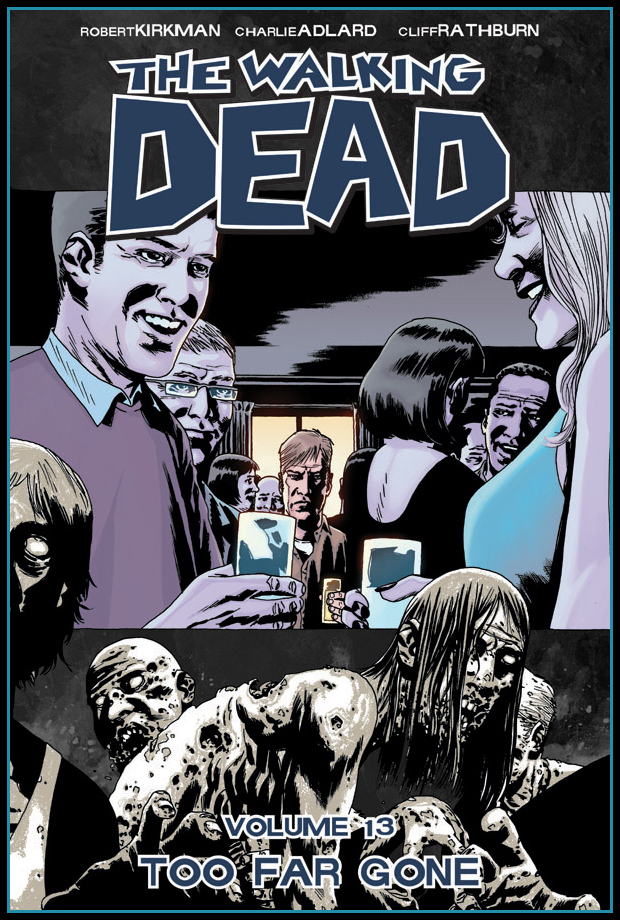
Review: The Walking Dead Volume 4 (by Robert Kirkman)


[Some Spoilers Within]

I’ve loved and obsessed over Kirkman’s The Walking Dead series and the previous three collected volumes have not disappointed at any level. This fourth volume collects issues 19 through 24 and is appropriately titled The Heart’s Desire. We pick up from the cliffhanger that ended the third volume (Safety Behind Bars) as Dexter gives Rick and his group a choice that bodes nothing but death either way he chooses: stay and be shot or leave and take their chances with the zombies outside the fences.

The book starts things off with a bang as Rick realizes that Dexter’s success in getting guns of his own has let loose a bigger set of problems as zombies from a locked wing of the prison was accidentally let out. What happens next as Rick’s group and Dexter’s group fight to stay alive shows a new side to Rick that surprised me alot. It puts a new wrinkle on Rick’s rule of “you kill, you die” and will have long-reaching ramifications deeper in the story. It is also in this heart-pounding sequence that a new face is added to the mix in the form of a female survivor whose mode of survival, to say the very least, is interesting.

The rest of the book really deals less with the zombies but the emotional consequences of many of the characters’ actions from the very start of the series all the way to point of this volume. I can fully understand the disappoint many fans have with the direction the series took with all the drama and sopa opera kind of twists nd turns of the heart, but I think people fail to realize that Kirkman is writing about the human condition rather than just about zombies. Sure I got abit impatient with all the emotional crisis and the meltdowns by almost everyone involved, but I can also understand why they’ve been acting the way they have. I think if Kirkman had written abit more of zombies and death in this part of the series people wouldn’t be complaining much.

Kirkman himself has already admitted that zombies wasn’t what the story was all about, but just a part of it. With the group in relatively safety within the secured fences of the prison and some sort of artificial normalcy starting to come back to the group he needed a way to continue the conflicts that make for good drama. What else but let the pent-up emotional baggage everyone has been carrying since issue 1 to finally come to boil. Part of me didn’t fully enjoy this new arc in the series, but not enough to be disappointed with the end result. Hell, even with all the drama Kirkman still came up with one of the best fight scenes in the series a la Carpenter’s They Live and South Park’s “Cripple Fight” episode.

The Heart’s Desire was not as great as the previous three collected volumes in the series, but it still told a good story though with a bit more drama than most fans of the book were willing to take. I myself enjoyed the book enough that it wasn’t a waste and I was a bit surprised and shocked at the observation Rick finally made and shared with everyone at the end of the volume. I know that after all the emotional trials and tribulations everyone in the series went through in The Heart’s Desire and how the arc ended there’s nothing left but up for the series.

Review: The Walking Dead Volume 3 (by Robert Kirkman)


[Some Spoilers Within]

Safety Behind Bars is the third collected volume of Robert Kirkman’s excellent The Walking Dead comic book series from Image Comics. This volume collects issues 13 through 18 and it continues that journey and travails of surviving in a world overrun by the undead. As the tagline of the books proclaim, in a world ruled by the dead we are forced to finally start living. This is so true in Safety Behind Bars as Kirkman and returning artist Charlie Adlard tell the story of Rick Grimes and his band of survivors as they come across what they think will be their salvation from the threat of the hungry dead: an abandoned prison complex.

The last we saw Rick, Tyrese, Lori and their ragtag band of survivors they had just been forced off the the presumably safety of the Herschel farm after the tragic events which transpired within its fences. But Safety Behind Bars starts off with the group discovering an abandoned prison complex that may just solve their shelter, safety and food problems. Once again, Kirkman’s writing is tight and to the point. The characters of Rick and the rest of the survivors continue to evolve as the days and months pass by in the journey to survive. What they find in the abandoned prison is both safety and danger, but not in the way of most people thought it would come in. Sure there are still zombies both inside and outside of the prison’s security fences, but as the enormity of the crisis finally crashes on everyone — that there won’t be a rescue — the survivors reach the threshold of their breaking points to the detriment of everyone involved. It’s especially tragic for Tyrese as a tragedy pushes him to act on his base instincts in an act of vengeance that is both understandable and horrifying.

More people are introduced to the group in the form of surviving group of inmates left behind by fleeing prison guards. This new group acts to change the group dynamics and even add more conflict to what Rick and his group thought was going to be safety from the dead. Instead, human nature — as Kirkman sees it — causes more problems and danger than the dead represent. The events of The Walking Dead has really changed everyone involved and we lose more people to both living and the dead.

The volume ends in an even bigger cliffhanger than the previous two collected volumes. Like the best drama series on TV, The Walking Dead hooks you in with great writing, well-drawn characters and a great hook that pulls the reader in and doesn’t let go. Whether the upcoming AMC and Darabont-produced tv adaptation of this series follows this particular story-arc is still up in the air. To deviate from the prison would definitely involve a new story-arc that surpasses what Kirkman has written in these 6-issues and that would be quite a tall order.

Review: The Walking Dead Volume 2 (by Robert Kirkman)


[Some Spoilers Within]

Robert Kirkman’s The Walking Dead Vol.2 – Miles Behind Us puts together issues 7 through 12 into one collection. The first six issues introduce the reader to the main character of Rick Grimes and his discovery of a world turned upside-down and inside-out as the legions of undead walk and prowl the streets, fields and by-ways. The rest of that first volume reunites Rick with his wife and son and a ragtag bunch of other survivors just looking for a safe place to stay. I loved how Kirkman used the backdrop on a world of the undead to tell a story of survival and how extreme situations can have surprising and lasting effects on those left behind.

In Miles Behind Us, Robert Kirkman’s story has a new artist in Charlie Adlard. Adlard’s style has a different look to that of previous artist Tony Moore. Where Moore’s pages and panels had a smoother and more cinematic feel to them, Adlard’s rougher, sketchy style actually fits the mood and feel of the story Kirkman is writing. I love Moore’s work and the gory detail he put in the first issues, but Adlard’s just seems to resonate a bit more with the subject matter of survival and doing what it takes to survive. There’s certain scenes in Miles Behind Us where its hard to tell the difference between the survivors and the zombies. I like this technique in how it shows that the zombies and the survivors may have alot more in common after all in relation to the title of the story.

Kirkman introduces in this volume quite a bit of new characters to the group Rick is leading as they leave the campground at the outskirts of Atlanta. They’ve lost three of their numbers in the previous volume. Two of them to the predations of the undead who stumbled into their campground and another to the stress and jealousy that weighed on the mind of one of their own.

Miles Behind Us brings in two groups of survivors. One is a father, his daughter and the girl’s boyfriend. Tyrese is an interesting character right from the get-go and hints of problems with the daughter and boyfriend are gradually doled out to help bring in new conflicts to the group dynamic. The other group is a farmer and his children and some neighbors from down the road. The introduction of Herschel and his family helps in showing how not everyone reacted the same way to the undead crisis. To say that Herschel’s reaction and temporary solution to how to handle the undead crisis was a bad idea all-around was an understatement. Hershel’s actions helps lead to the biggest sequence event in this volume and how far-reaching its ramifications are. While new characters are introduced some of the people in Rick’s group fall by the wayside as their search for a safe place to stay in becomes more and more dangerous and people are lost and/or nearly lost along the way.

I agree with the assertion that The Walking Dead is really not all about the zombies and the gore (it helps that it has them in abundance), but that its about the effects of extreme events and situations on the personality, psyche and behavior of those left behind trying to survive. From the Dale (the oldest) all the way down to Carl (one of the youngest), the survivors are affected right down to their bones with all that has happened to them. Sometimes the result makes each individual stronger and at times it just leads to conflicts and brings out the baser nature of man as an individual.

Miles Behind Us continued to impress me in how well Kirkman has taken the zombie apocalypse theme and ran with it. It’s a testament to his storytelling and imagination that I consider The Walking Dead series as equal to anything Romero has done. I think from fans of zombie and apocalyptic stories that’s high praise indeed.

Review: The Walking Dead Volume 1 (by Robert Kirkman)


One of the geek properties that had been building a major hype and buzz at this year’s San Diego Comic-Con was Image Comics and Robert Kirkman’s long-running and critically-acclaimed zombie series, The Walking Dead.  It’s time at the Con didn’t just push the title to a new batch of fans, but also made a major showing at it’s very own panel with the cast and crew of AMC’s tv series adaptation of the comic book. It would be an understatement to say that by the  time The Con was over the series (both comic book and the upcoming tv series) walked away a clear winner and put the property into hype/buzz overdrive.

With the series set to premiere on AMC this coming October 2010 I thought it was high-time that I went back to my reviews of the collected trade paperbacks of the series. Each trade paperback collection were 6-issues long and usually started a current story-arc or finished an on-going one. This comic book series is one of the few in the market currently running which could was able to keep releasing its trades in 6-issue collected formats and not lose any impact that particular arc had when read as single-issues. It was by finding the first trade that I was initially introduced to Kirkman’s zombie opus.

It was 2005 and I was what one might call a lapsed comic book fan. I had burned myself out on the neverending flood of superhero titles even as independent ones quickly got cancelled, died out or just outright didn’t end but left its readers hanging. But it took a passing glance of The Walking Dead‘s first trade volume to get my interest in comic books rekindled. Kirkman’s foray into creating the zombie film that never ends made comic books fun for me again. The fact that Kirkman didn’t jump onto the fast-zombie bandwagon that became the rage of the mid-2000’s was a major plus in my eyes.

Using the same slow, shambling zombies that George A. Romero first made popular with Night of the Living Dead and its subsequent sequels, Kirkman continued the zombie story where Romero usually ended his films. All those times people have wondered what happened to those who survived in zombie films need not imagine anymore. Kirkman has created a believable world where the dead have risen to feast on the living, but has concentrated more on the human dynamic of survival in the face of approaching extinction.

I won’t say that the story-arc collected in this first volume has little or no zombies seen, but they’ve taken on more as an apocalyptic prop. One can almost substitute some other type of doom in place of zombies and still get a similar effect (as was done in Brian K Vaughn’s equally great series, Y: The Last Man). What Kirkman has done was show how humanity’s last survivors were now constantly, desperately trying to adapt to a familiar world through unfamiliar circumstances. Characters from the start make the sort of mistakes regular people would make when they don’t know exactly everything that was happening around them. Instead of chiding these people as one reads their story, we sympathize and hope for their continued survival.

The artwork by Tony Moore is another reason why people should check out this first volume. While it is only in this volume (the first 6-issues of the series which is now deep into the 70’s) Tony Moore’s art puts the horrific in the story Kirkman has written. His zombies and their look were quite detailed and for fans of the series his departure after issue 6 and staying to just make the covers to each single-issue has rubbed them the wrong way. While I subscribe to the opposite viewpoint that Moore’s work was a nice bonus to bring in the readers in the end his artwork was gravy to what was already a fulfilling story that would’ve been as effective if the artwork was mediocre at best. It’s a good thing that follow-up and series regular artist Charlie Adlard more than holds his own in drawing the rest of the series.

This first volume was a great beginning which should automatically pull in the hardcore zombie fans (pretty much any of those types should’ve been reading the books for years now) while giving newbie fans to the zombie genre a reason not to dismiss it as just another gorefest lacking in drama and great storytelling. Already Kirkman has done more to realizing the universe Romero created than a lot of the hack filmmakers who have taken Romero’s idea and cannibalized it for their own profit. I consider The Walking Dead as a must-read for anyone looking to find something different from all the costumed superhero titles. It is also a great starting point for those awaiting the start of the tv series, but have never read the original comic book source.

Inception: A Grant Morrison Level Mind Frack (spoiler free)


I don’t want to ruin the Inception experience for anyone so I will mention elements that were present in the trailer.

Reality vs Dream: The audience is presented with a scenarios where Oneiroinauts (like astronauts of the dream plane) are unable to differentiate between the waking world (reality) and dreams.  This caused me to recall Spike Spiegel’s samurai ideal (considering oneself as dead and the idea of death being an awakening from a dream) as well as Morrison’s discussion on reality, space and time) and its nature.

Viral Idea: Inception introduced the concept of infectious pathogen-like ideas that have the potential to enhance or corrupt the host.  This brought to mind a Grant Morrison creation: Weapon XII, a biological weapon with a viral consciousness that mentally degraded its victim and reshaped their minds into an extension of its own.

Limbo: Limbo is a netherworld spawned from the dreamer’s unconscious mind that an Onieroinaut could become trapped in. This was similar to the limbo featured in Final Crisis: Superman Beyond, a hell formed from the collective unconscious mind of comic book readers.

Grant Morrison speaking about reality, space/time and our perception of the three.

Images are courtesy of IGN.com and the videos are courtesy of Google Videos and YouTube.

Shamanism: A Recurring Theme in Warren Ellis Fiction


A shaman is defined as a person who acts as intermediary between the natural and supernatural worlds, using magic to cure illness, foretell the future, control spiritual forces, etc.Mr. Ellis created/redesigned characters that functioned as shaman in his books (like Nate Grey in the Counter X series, the Doctor from Stormwatch/Authority, and Century Babies in Planetary).
Nate Grey functioned as intermediary between the 616 reality and parallel as lower and upper realities, and maintained a multiversal balance. Upper realities were virtual utopias like the Deva Realm from the 6 desire realms in Buddhism. The lower realities were hellish planes like the Preta and Naraku realms.
The Doctor (all iterations) and the Century Babies functioned as mediums for humanity and Gaia (the Earth itself) and maintained harmonic balance.

He also introduced ideas like:

“Down there are people called ayahuasqueros. Tribal doctors, mystics, medicine men. They take this stuff called ayahuasca, this awful mush they brew up out of vines and stuff. It’s a psychedelic. They hallucinate all over the place — but it’s their belief that the visions are actually another dimension. When you ask them why they take it, they say it’s for working with the ancestors. They’re necronauts. They travel in the place of the dead. And what they bring back are messages from the afterlife.”
– Sam Wilson (in Ultimate Nightmare)


“You are aware through esoteric scientific research conducted by many people over the Twentieth Century. that souls do not die. Souls are some form of electromagnetic field that continue to inhabit the body after death. Bones, crackling with strange and imperceptible energetic activity. And we buried them. Are they still aware? Can the dead still perceive we don’t yet know. Is that happens? We lay in the dirt, still somehow aware of being in there? And gravity draws us into the earth. And plants grow. Ayahuasca. Peyote. Psylocibin. Stropharia Cubensis. The drugs. Yes, historically, we consider them shamanic drugs, and they were overlaid with ritual and religion and the other crap of archaic societies. But all societies had their speakers to the dead and their oracles who looked into other places. In legend, the Oracle at Delphi stood at a pool and inhaled its vapor, the pneuma, to oraculate. It was recently found that a vent beneath the pool expressed ethylene, a hydrocarbon gas that creates an euphoric derangement, into the water. Ethylene, the pneuma, is a plant hormone. The dead lay in the ground, their souls oiling out from their bones, into the earth, into roots… that effervesced into the clouds that the oracle inhaled to see new worlds. Into the plants that our speakers to the dead ingested to do their business.
– Melanctha (in Planetary)

“You’re a machine. I’m a machine. Our parts are made out of water and meat and minerals, but we’re walking pieces of engineering. Everything’s a machine. Plants, everything. When we eat a plant, we disassemble it, junk what we don’t want and plug the parts we need into our machine. What if these jungle drugs are machines we can ride?”
– Sam Wilson (in Ultimate Nightmare)

His ideas lead me to look at shamanism, the soul, death and planes of existence, from a different angle. I would love to read an Ellis book where he jumps head first into this theme and runs wild with it in a similar manner to his Crooked Little Vein novel.

Images courtesy of Ben Templesmith and Freak Angels.Warren Ellis’ images courtesy of Warren Ellis’ Official Livejournal.

The Walking Dead – Motion Comic (AMC)


With Comic-Con over the hype surrounding the tv adaptation of Robert Kirkman’s zombie apocalypse comic book series has reached stratosphere status. The 6-episode first season was already one of the most anticipated new shows of the upcoming fall season from just the fans and geek community talking about it nonstop in the internet, but with it’s unveiling at this year’s San Diego Comic-Con the mainstream press has latched itself onto the series. The common reaction to the series at the panel in Hall H seemed to be a unanimous positive one.

Character photos, Drew Struzan posters and new trailers have added to the hype. The comic book series has hit it’s milestone 75th issue. Sales of the comic and it’s collected softcover and hardback graphic novels have seen a spike in sales. AMC has added to the series’ website a taste of the the comics for people to get an idea of what to expect from the series. This motion comic of the first issue of The Walking Dead really captures the horror and hopelessness of the world Kirkman has created and Daabont plans to show up on the TV screen.

Source: The Walking Dead on AMC

Web Comic: The Zombie Hunters


The Zombie Hunters

I think everyone who has been visiting and reading this blog might have figured out that I am a huge fan of the zombie genre. If some haven’t come to that conclusion let me just get it out of the way and say that I do indeed love the zombie genre and everything associated with it. Sometimes the heart wants what the heart wants.

For the past couple months I have had the pleasure of reading one the best web comics still running on the web. I am talking about Jenny Romanchuk’s very own on-line zombie comic book series, The Zombie Hunters. The series began in around mid-November of 2006 and has gained quite the loyal fanbase as word-of-mouth about this particular zombie webcomic spread like the undead infection that is its subject.

I came across the webcomic while I was bored and going through the usual surfing of my favorite zombie-related websites. One site had a poll asking people which zombie webcomic was their favorite and listed all that met criteria. Ms. Romanchuk’s webcomic was one of them and being bored I clicked the link and to say I was impressed and instantly hooked would be quite the understatement. The storytelling is quite good with some scenes quite emotional and others knee-slapping funny. The artwork is very good with clean lines, not much clutter to distract the eyes and very good coloring done. Since The Zombie Hunters is about a zombie apocalypse the comic is also quite violent and gory as it should be.

With Apple’s iPad now being seen as the start of a new era in digital distribution of comics both in print and those just on-line I truly hope that Ms. Romanchuk finds a way to sell her series through that medium if just to expand her fanbase and really make some money off of an excellent comic book series. Sometimes the little guys need to be rewarded for a job well done and one that is still being done well.

Official Site: The Zombie Hunters

10 Favorite Comic Books of the Past Decade


The first decade of the new millenium found me in a weird place when it came to one of my big hobbies after high school. From 1989 all the way through the 90’s I was a major comic book reader and collector. I would say that I wouldn’t deny the charge that I might have helped the so-called “comic book speculator era” rise to the forefront of the hobby. Artists like Jim Lee, Whilce Portacio, Todd McFarlane were like rock stars in that era and their titles would fly off the shelves the moment they came out. I and others would buy multiple copies, carefully board and bagged them (but also read them) and wait for their price to go up.

Some titles did go up in price and were sold for a profit thus feeding the notion that I could make a lot of money off of these comic books. I was one of the early adopters of the independent titles which really fed the speculator market. First there was buying up all the early Evil Ernie issues before most of the public got wind of just how awesome (and limited their printing were) then doing the same for William Tucci’s Shi title which I must say really defined a speculator’s dream title. It had buzz to it due to the bad girl art, the story was not bad and had an exotic taste to it and, best of all, the printing on the title character’s first appearance was practically non-existent.

By the time the speculator’s market finally burst it’s bubble and dragged the comic book industry down with it I was pretty much burnt-out on comic books. I still read them and bought the titles whcih caught my eye, but the days of buying every issue of most every title from Marvel/DC/Image were done with. I even stopped buying and reading them in the beginning of the 2000’s. The industry was in a creative rut in the early years of the new decade. While superhero titles were floundering and publishers (small and medium ones) were declaring bankruptcy and selling off properties to the highest bidder a curious thing happened. I got back into comic books and it wasn’t the hero titles which drew me back in but the mature, independent titles from Vertigo, Dark Horse, Image and small-indie publishers.

This was a very good thing since I missed having the books in my hands. I wasn’t buying them now to collect but to read. I still handled them with kid gloves but I wasn’t worried about whether they would turn me a profit anymore. So, for most of the decade I was an indie-fool who pretty much avoided most the titles from Marvel/DC. While I still read some titles from the two main comic book houses it wasn’t on the same level pre-2000’s.

Below is the list of the 10 titles that were my favorite of the decade. Some were considered the best of the decade and some just my favorite because they spoke to me as a reader. This time they will be in order of importance unlike my previous Best/Fave lists.

10. Hellboy by Mike Mignola (Dark Horse Comics)

9. Daredevil by Brian Michael Bendis/Ed Brubaker (Marvel Comics)

8. Y: The Last Man by Brian K. Vaughn (Vertigo)

7. All-Star Superman by Grant Morrison (DC Comics)

6. The Goon by Eric Powell (Dark Horse Comics)

5. Fables by Bill Willingham (Vertigo)

4. The League of Extraordinary Gentlemen by Alan Moore (America’s Best Comics)

3. Transmetropolitan by Warren Ellis (Vertigo)

2. The Walking Dead by Robert Kirkman (Image Comics)

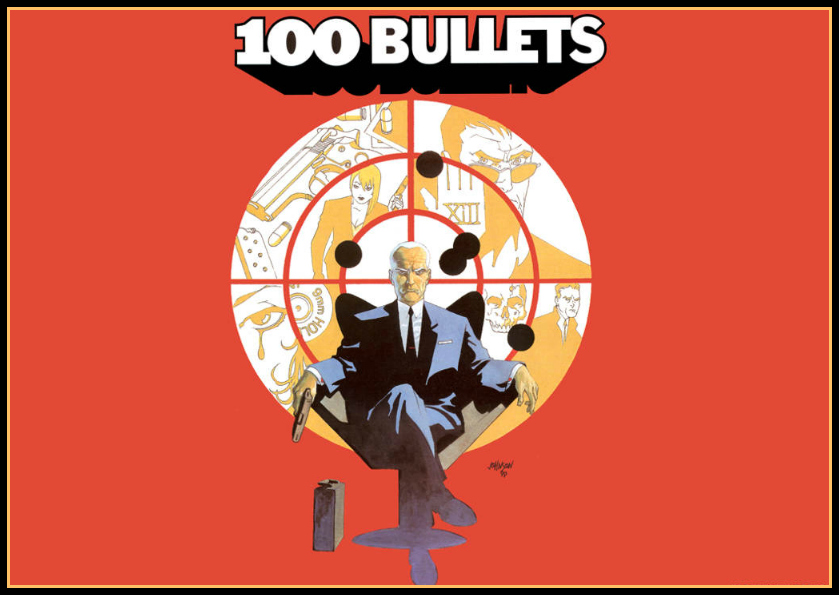
1. 100 Bullets by Brian Azzarello (Vertigo)