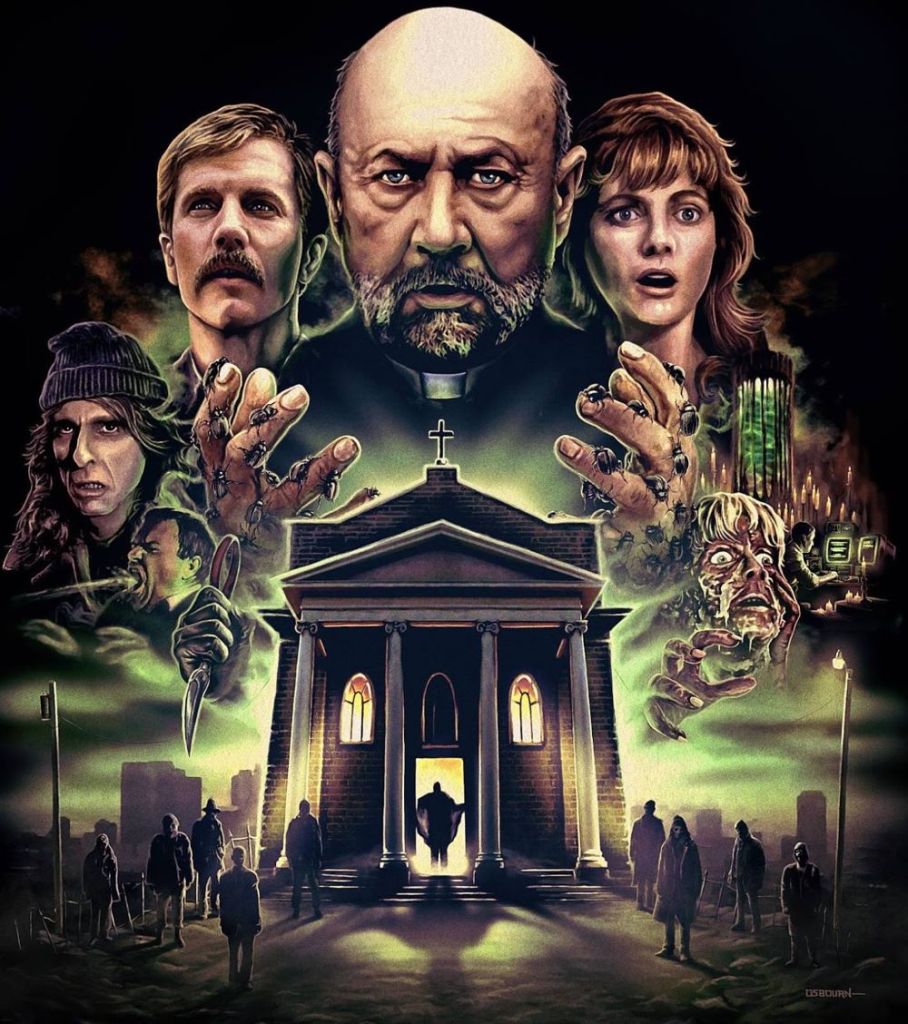
Horror Review: Prince of Darkness (dir. by John Carpenter)


“Say goodbye to classical reality, because our logic collapses on the subatomic level… into ghosts and shadows.”

John Carpenter’s Prince of Darkness is a criminally underrated entry in his canon—a blend of philosophical, apocalyptic horror and supernatural mystery that’s as unsettling as it is deliberately strange. Released in 1987, the film often gets eclipsed by Carpenter classics like The Thing and In the Mouth of Madness. Even so, it stands out as a unique organic link between science-driven paranoia and cosmic horror—the sort of film that grows on you as you unravel its layers.

The setup is simple but immediately offbeat: In a derelict Los Angeles church, Father Loomis (Donald Pleasence, always at his nervous best) stumbles on a swirling green cylinder hidden away in the basement. Loneliness and age hang over Loomis as he realizes this is no mere relic but possibly the essence of absolute evil—the literal embodiment of Satan. Sensing he’s in over his head, the priest reaches out to Professor Birack (Victor Wong), a physicist whose rational mindset is quickly tested by the uncanny. Birack arrives with a diverse team of grad students and lab techs, each bringing curiosity, skepticism, and just enough personality to keep things lively.

What starts as an academic investigation quickly goes off the rails. Strange, shared dreams trouble the researchers—fragmented transmissions from the future, warning of disaster in unsettling, VHS-glitch style. Meanwhile, the area outside the church transforms into a kind of urban wasteland: homeless people, gripped by an unseen force, stumble with zombie-like intent, trapping the group inside. Inside, members fall prey to unsettling phenomena, from unexplained possession to increasingly grotesque violence. There’s a sense that the evil in the cylinder isn’t content to simply stay put—and the combination of supernatural implication and scientific uncertainty gives everything a persistent, gnawing tension.

Carpenter directs the film with measured, stifling precision. His color palette—rotting yellows, bruised greens, washed-out sunlight—creates a perpetually uneasy mood. He uses slow tracking shots and carefully composed frames to ratchet up suspense, and the score (co-composed with Alan Howarth) pulses with ominous synths that buzz beneath all the dialogue, making even the film’s quieter moments feel restless and charged with threat. Compared to the gooey spectacle of The Thing, the terror in Prince of Darkness is more metaphysical—less visible monsters, more eroding reality.

Sound and image work together to keep the audience on edge: moments of unsettling silence are punctuated by visual oddities, like swarms of bugs or the warped geometry of the church’s shadows. The group’s scientific attempts to decode the evil—a jumble of quantum theory, apocalyptic Christian lore, and unsettling mathematics—do more to ramp up anxiety than offer answers. Carpenter seems to delight in ambiguity; the revelations never clarify so much as deepen the void, giving shape to a primordial kind of fear.

The film’s most iconic device is its recurring nightmare sequence, where the group—cut off from the world—witnesses a cryptic, shadowy figure emerging from the church, broadcast as a tachyon transmission from the future. It’s classic Carpenter: deeply unsettling, oddly hypnotic, and open to any number of interpretations. The blending of science fiction and theological horror feels fresh and ambitious, and it’s fair to say these sequences alone have ironically kept the film alive in horror culture discussions and remixes.

The cast, featuring Pleasence and Wong, manages the film’s shifts in tone—moving from banter about theoretical physics to genuine terror with surprising ease. The grad students are likable enough for you to root for, especially Lisa Blount and Jameson Parker, who carry the emotional brunt as things collapse. Alice Cooper’s cameo as a silent, menacing street dweller further anchors the film’s reputation for “unexpected creepy” in the best way possible.

While there are flashes of gore—possessions, injuries, even some memorable stabbings—Carpenter resists making violence the centerpiece. The real horror here is psychological: paranoia, loss of agency, and the collapse of foundational beliefs. Where The Thing was about trusting (or not trusting) your friends, Prince of Darkness is about grappling with a world where even faith and science seem powerless and interchangeable in the face of the unknown.

Thematically, this is Carpenter at his most cerebral and bleak. The notion that neither faith nor science can adequately tackle the unfathomable echoes Lovecraft, yet Carpenter grounds it all in urban decay and deadpan dialogue rather than Gothic flourish. The questions get bigger—what good is faith if truth is poisonous, and what does science matter against a force older than logic? Dialogue about quantum uncertainty and theological paradoxes isn’t there to solve anything, but to make everything less secure.

If the film has a flaw, it’s that its pacing feels deliberately patient—some might say slow. Tension accumulates gradually, and you’re invited to sit in the discomfort as the group loses sleep, loses one another, and loses touch with reality. As the stakes escalate, the line between dream and waking life shreds, leading to an ending that’s haunting, ambiguous, and deeply open-ended. There’s no neat wrap-up or cathartic victory—only trauma, unsolved terror, and a lingering sense that evil never really left, just waited.

It’s this refusal to explain or comfort that gives Prince of Darkness its lasting cult appeal. Carpenter puts cosmic pessimism front and center: knowledge itself stands as a kind of curse, and both faith and reason bend beneath the weight of mystery. Rather than offer solutions, the movie warns about the dangers of peeling back reality’s surface—a theme that’s only grown more unsettling in the years since it was made.

Watching Prince of Darkness now, the film may not fit everyone’s idea of a fun Friday-night scarefest. But if you want horror that’s slow, dense, and sticks with you, this is essential viewing. Carpenter delivers a bleak, hypnotic nightmare about what happens when explanations fail—when the universe itself seems ready to swallow us whole. Whether you’re a die-hard genre fan or someone looking for something different, Prince of Darkness is cult horror at its most unshakable—proof that the scariest stories are often those that leave their deepest secrets unexplained.

Song of the Day: Theoden Rides Forth (by Howard Shore)


For my chosen song from Howard Shore’s orchestral film score for Peter Jackson’s The Lord of the Rings: The Two Towers I picked the tune which starts off my favorite scene in from that film. This will be the latest song for “Song of the Day”.

“Theoden Rides Forth” begins with the scene of Theoden, Aragorn, Legolas and what remains of the Rohan cavalry riding out for one last time out of the Keep at Helm’s Deep into the thick of the Uruk-Hai forces. The song takes the “Rohan theme” first heard in the early part of the film, but with a heroic flair that transitions to full brass blaring the theme to great effect. The song then segues into a brief appearance of the “Fellowship theme” as Gandalf, Eomer and the Rohirrim appear to save their king and companions. From there the song brings in the “Shadowfax theme” with child soprano Ben Del Maestro providing the solo chorus as the charge comes down the steep incline and into the ranks of Uruk-Hai waiting below. But the song doesn’t end there as it moves into the follow-up scene using the “Nature theme” to show Treebeard and the Ents make their final march to war against Isengard.

This track from the score finishes off the two parallel story lines of Helm’s Deep and Isengard. The transitions in the song from one story line to the other were flawless. The fact that Shore was able to incorporate and combine so many different themes not just from this film but from the previous one shows an artist who is definitely a master of his craft. There’s no denying why “Theoden Rides Forth” became the best tune from the The Two Towers film score and why so many fans of the film and the score wholeheartedly agree.

Scenes I Love: The Lord of the Rings: The Two Towers


Yesterday, I had chosen my favorite scene from Peter Jackson’s The Lord of the Rings: The Fellowship of the Ring. Today, I just finished re-watching the sequel to that film (though I think of it more as the second act of a 12-hour film), The Two Towers. From this second act I chose the one of the three climactic sequences in the film: Gandalf the White’s arrival and subsequent charge of the Rohirrim to break the siege of Helm’s Deep.

This second act had so many excellent scenes. From the last march of the Ents as they go to war against Isengard, to Gandalf’s descent and fight against the Balrog right up to the hour-long battle for Helm’s Deep. In the end, it was the charge by Gandalf, Eomer and the Rohirrim which sealed the deal for me. It wasn’t just the dramatic entrance of these characters to save their friends, but Howard Shore’s score which really added to the scene.

I love how just as the Rohirrim charge was about to smash into the front ranks of the Uruk-Hai spearmen the sun behind the charge peaked above the top of the incline and blinded the defenders at the bottom. For someone who has studied military tactics and maneuvers in battle this was a textbook use of the sun at a charging forces back to blind and confuse the enemy. Many who saw this film probably just saw it as just part of the scene, but not I. This is the major reason why this scene was my favorite in The Lord of the Rings: The Two Towers.

Song of the Day: The Breaking of the Fellowship (by Howard Shore)


With my favorite scene from The Fellowship of the Ring chosen and posted it’s now time to pick my favorite piece of music from that film’s orchestral soundtrack. This was a soundtrack that I consider just one-third of a massive 12-hour symphony. The song I’ve chosen is actually a re-edited version of this film’s “Complete Recordings” release: “The Breaking of the Fellowship”.

Howard Shore’s work as composer for Peter Jackson’s monumental and epic (if there was ever a subject deserving of that overused word it would be Jackson’s fantasy trilogy) has been hailed by critics and fans alike as one of the best, if not the best, film score of the new millennium. Shore doesn’t go for the typical overly bombastic score that’s become the go-to style for epic films of any stripe. His work on this first third of the total Lord of the Rings score even manages to outdo John Williams’ own compositions for the other major fantasy series to come out the same year in Harry Potter and The Sorcerer Stone.

Where Williams’ had begun to partially cannibalize his own past film scores for his recent ones, Shore was able to look at what Jackson was creating and decided to base the entire score for The Fellowship of the Ring on three motifs which were airy, subtle with the loud and expressive brass section only appearing in one of these three. “The Breaking of the Fellowship” ends the film on a mixture of triumph and sadness as the track’s title describes. Shore takes the peaceful “hobbit theme” from the beginning of the film and combines it with the more rousing “Fellowship theme” then topped with as bonus with sections from the “Rivendell theme”. These three themes combine to highlight not just the breaking of the fellowship in the end of the film, but some sense of loss of innocence of the hobbits in the group as heard by a more somber and pensive rendition of the “hobbit theme”.

Of all the musical cues in The Fellowship of the Ring it’s the one which makes up “The Breaking of the Fellowship” that fully expresses the overall thematic and narrative themes of the film. It’s a song that tells the audience that the peaceful nature of the hobbits have now been tempered by their complete understanding of the exact nature of their fellowship’s quest. It also underscores how even in triumph the fellowship will encounter heartbreak and tragedy. These two themes will continue to be explore in the next two films and their respective score, but it’s in this first one that it truly shines.

Scenes I Love: The Lord of the Rings: The Fellowship of the Ring


“I would have would have followed you, my brother… my captain… my king.” – Boromir, Captain and High Warden of the White Tower

It’s been five days since the season finale of the first season of Game of Thrones and the withdrawal symptoms are definitely starting to kick in. Season two of this fabolous series won’t be back for at least ten months. To help alleviate some of the withdrawal symptoms I decided to go on The Lord of the Rings Trilogy marathon all weekend. Tonight will be The Fellowship of the Ring (Extended Edition). It’s from this first leg of the trilogy that I choose today’s scene that I love.

The scene I have chosen is very close to the end of the film and it’s a scene between Viggo Mortensen’s Aragorn and Sean Bean’s Boromir. It’s soon after the attack of Saruman’s Uruk-Hai on the group. Boromir valiantly tries to protect and save Merry and Pippin from the Lurtz and his band of Uruk-Hai. It’s the scene which arrives after that really hits home for me just how great Peter Jackson’s adaptation of the first part of Tolkien’s massive tome.

This quiet and heartbreaking scene between Aragorn and Boromir cements Viggo’s performance as the reluctant hero moving towards embracing his legacy and destiny while at the same adding complexities to Sean Bean’s performance as Boromir being a flawed and tragic hero in his own right. It is a scene that will cause more than just a few tears to be shed.

Trailer: Captain America: The First Avenger (Theatrical)


The summer of 2011 has been called the Summer of Superhero Films. In early May we had Marvel Studios’ Thor film premiere to good reviews and it has had a certain level of success (though not the level of The Dark Knight success rabid fanboys and jaded film bloggers think every comic book-based film should be doing). Then next up was the fourth X-Men film from Twentieth Century Fox by Matthew Vaughn that seem to reboot the franchise from it’s downward spiral begun by the third film and the Wolverine origins film. This film garnered even higher praise than Thor and many saw it as equaling or surpassing the X2. While it’s box-office success has been good it didn’t make the sort of money previous films in the franchise have made in years past. Then we come to the recently released Green Lantern from Warner Brothers and DC Entertainment.

This film was to be the next crown jewel to join DC’s successful Batman film franchise and iconic Superman series which seems to be the only DC properties to have had a successful live-action adaptation. While the film did very good in it’s first weekend the reviews of the film range from “ok and fun” at best to “downright awful” at its worst. All three films have huge budgets and, most likely, all three will be a profit for their studios, but not runaway hits.

Maybe the public has begun to tire of superhero films as a cause for the less than cosmic box-office returns. One other reason could be that too many people have been blinded by the massive box-office success of Christopher Nolan’s The Dark Knight that every superhero film must now be compared to that one fair or not. This makes the job much harder for Marvel Studios’ second film of the summer, Captain America: The First Avenger, as that film looks to cement the foundation for next summer’s major blockbuster ensemble superhero film, The Avengers.

I don’t see Captain America doing TDK level money, but early screenings of the film has earned it some major positive buzz that had been missing from Thor. That early positive buzz and this latest trailer which really showcases the action of this period piece of a superhero film should help push Captain America to be a success no matter if it makes 200million dollars domestic or more.

One thing I’m sure of is that this latest trailer should be more people excited for Captain America: The First Avenger when it comes out on July 22, 2011.

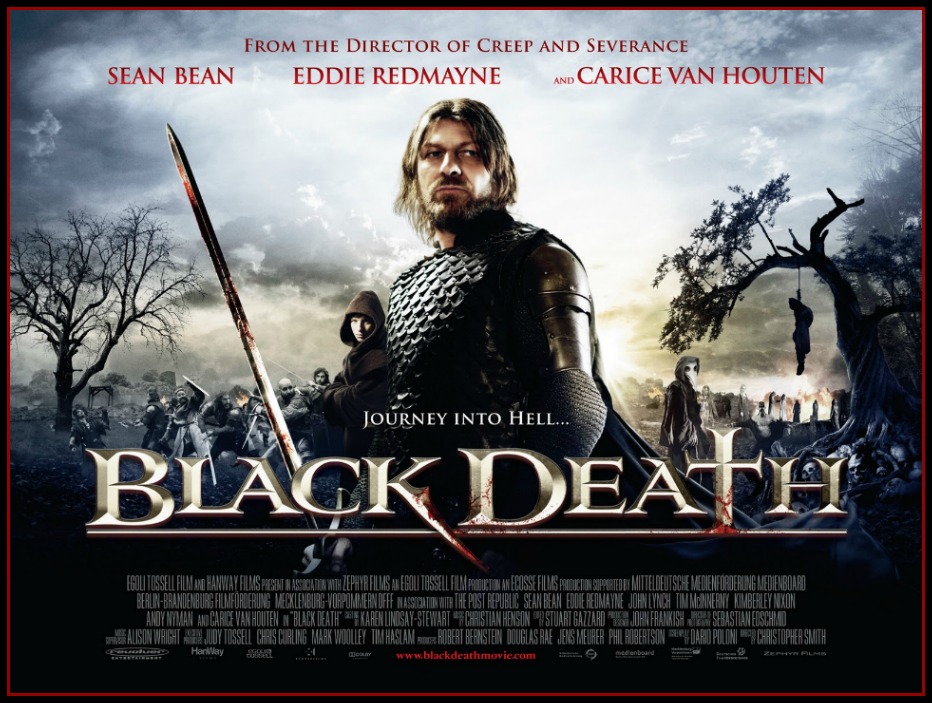
Quickie Review: Black Death (dir. by Christopher Smith)


British filmmaker Christopher Smith has been flying under the radar of most of the film-going public. He’s already a filmmaker with five films to his credit of varying quality, but each showing his growth as a director with each successive release. In 2010, Christopher Smith released his sixth film in the UK with some film festival showings in the US soon thereafter. Black Death continues Smith’s work in the horror genre with this latest film a historical horror piece which tries to take a look at the subject matter of the Black Death of medieval Europe in a realistic, gritty light.

The film is set during in 1348 plague-ravaged England where a Osmund, a young monk, has a crisis of faith as he agonizes over his celibate vows to God and his love for Avrill, a young woman in town who also has feelings for Osmund. Avrill gives Osmund a week to find the answer to his dilemma and will wait for him at the marshes in that alloted time. Osmund finds his answer as templar knight Ulric (played by Sean Bean) and a group of his soldiers arrive at the monastery on a mission to find a village said to be untouched by the plague and one which might be providing a safe haven for a necromancer who has brought the dead back to life. Osmund seizes on this chance to leave the monastery and lead Ulric and his men through the marshes and to this village.

During their travel the group loses a couple men to bandit attacks and to the plague itself. They also come across a band of villagers about to burn a young woman for witchcraft. At first, Ulric seems to take pity and show compassion to this young woman, but instead kills her himself for the crime she is accused of. Ulric reminds Osmund and his men that they have no time for such distractions as they a much more important task ahead of them. A task which soon brings them to the very village which seem to be free from the plague many attribute to God punishing the sinners and other’s as the Devil tormenting the faithful.

It’s this ambiguous theme of how the Black Death was seen by villagers, soldiers and faithful which becomes an overriding theme in the film. Smith, using Dario Poloni’s screenplay, goes about exploring how those in power on both sides of the question — of whether God or the Devil was responsible for the plague — hold such a major influence on the minds of the uneducated populace. Ulric, Osmund and the group do find their necromancer, but it’s not all what they’ve expected and, for Osmund, this mission becomes a tragic one which tests his faith in God, his church and all that he’d been taught (indoctrinated some would call it) to believe. Osmund becomes the spiritual battleground from which Ulric and the necromancer fight over his eternal soul and the effect this has on the young monk turns out a surprising fashion which brings to mind Michael Reeves own historical piece and one of the greatest horror films of all-time in Witchfinder General.

Christopher Smith’s direction continues to improve and shows in Black Death as he’s able to make not just the subject of this horrific era in Europe’s medieval past, but at the same time use a deft hand to explore themes of faith, spirituality, role of religion as control and how fundamentalism doesn’t just affect those with religious conviction but also those who follow the secular path. It helps that Smith had a capable ensemble cast led by Sean Bean’s usual strong performance. Eddie Redmayne as Osmund seemed to be a one-note cipher through the first-half of the film, but once he arrives in the village his character begins to open up in complex ways that we’re never sure if he’ll fall on the side of the angels or the demons even right up to the end and even then it’s left ambiguous.

Black Death marks the latest in Christopher Smith’s tour of the horror genre and it’s many varying subjects to hone his growing craft as a filmmaker. The film ended up being entertaining despite having such an oppressive atmosphere and tone to not just the story, but to the very setting. There’s enough blood and gore spilled (using practical effects and not a sign of CGI to be seen) during scenes of fighting and torture to satisfy gorehounds who might come across the film. It also should work the mind of those also looking not just for the grue but also something to stimulate the mind. It’ll be interesting to see what Christopher Smith has next to follow-up this well-done and executed historical horror film.

AMV of the Day: Devil’s Game


madokamagica

The latest “AMV of the Day” is another one which is based on the mahou shoujo series, Puella Magi Madoka Magica. It’s become one of my favorite anime series of late and with each repeat viewing just increases my love for it. This latest anime music video takes that “magical girl” anime series and combines it with a symphonic rock song to create an AMV titled, “Devil’s Game”.

“Devil’s Game” is not just my latest pick for “AMV of the Day” but also the latest from AMV creator-extraordinaire Chiikaboom whose anime music video creations have always become instant favorites of mine. This latest really highlights the darkness that permeates throughout the anime series. For a mahou shoujo series, Puella Magi Madoka Magica get pretty dark and the subgenre as a whole uses themes of darkness to balance out the cute magical girl art design.

Within Temptation’s “A Demon’s Fate” is quite an appropriate song to use for this video. The series is all about Magi (magically-enhanced teen girls) fighting evil Witches to save the innocent people and the world. The series also includes Kyubey whose extremely cute appearance hides a secret that the song’s lyrics and title really meshes well with.

Chiikaboom’s editing of the video was not as extensive as some past ones which really comes and goes in rapid-fire fashion. For this video the editing and scene transitions matches very well with the bass drum sections in the song that it’s not noticeable at first glance, but really shows after repeat viewings. And it’s well-made AMV’s like this using scenes from this series that really should help sell Puella Magi Madoka Magica to the uninitiated whose experience with anime is from Adult Swim showings on Cartoon Network.

“Devil’s Game” is the best Puella Magi Madoka Magica AMV I’ve seen, so far, hand’s down.

Anime: Puella Magi Madoka Magica

Song:  “A Demon’s Fate” by Within Temptation

Creator: Chiikaboom

Trailer: A Dangerous Method (dir. by David Cronenberg)


To say that I am a huge fan of Canadian auteur and all-around genius filmmaker David Cronenberg would be the understatement of the decade. I count him as one of the greatest filmmakers of the last 30 years. Seen his style go from grindhouse video nasties type of horror to the sublime. He’s one filmmaker who has never had to compromise his filmmaking style to suit the audience. You either accept what he has crafted or not.

The last 5-6 years has seen his stock rise amongst the film community as films like A History of Violence and Eastern Promises has gotten him recognition from the Academy voters, Film Circles and others in the film elite community. At the same time these films have been widely regarded by film fans as some of the best of the past decade. It helps that he seems to have found a partner-in-crime in another auteur with actor Viggo Mortensen who played lead in both those films.

Now for 2011 the two partner up again for the third time for Cronenberg’s film adaptation of the stage play “The Talking Cure” which itself was adapted from the non-fiction book, A Most Dangerous Method. The film is called A Dangerous Method and stars Viggo Mortensen as Sigmund Freud, Michael Fassbender as Carl Jung and Keira Knightley as Sabina Spielrein. These three become the focal point of a sort of relationship triangle as the friendship between Freud and his younger apprentice in Jung becomes even more complicated when young Sabina get’s between the two men who would give rise to the study of psychoanalysis.

That brief synopsis doesn’t make this film very interesting at first glance, but this is Cronenberg who never picks projects and stories to tell unless it appealed to him. I wouldn’t be surprised if the film wasn’t just a story about three individuals and their relationships towards each other, but something even more abstract as Cronenberg’s bound to explore the early days of psychoanalysis itself.

Here’s to hoping A Dangerous Method delivers on everything fans of Cronenberg have come to expect from him…or not expect as the man has a tendency to surprise with each new film.

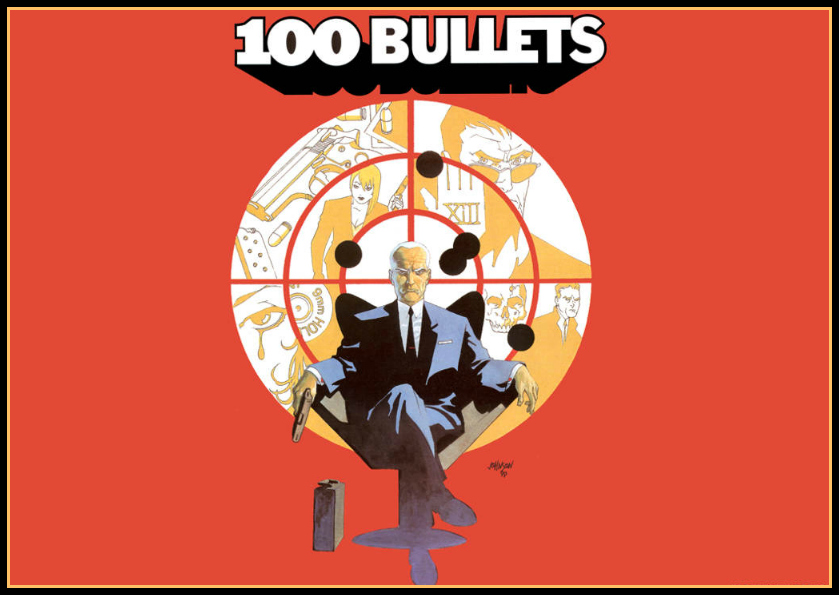
100 Bullets To Be Developed For Showtime


One of my favorite comic book titles ever ended up not being a superhero title, but an inventive take on the pulp noir stories which has it’s basis on the stories of such luminaries as Dashiell Hammett, Mickey Spillane, Jim Thompson and Raymond Chandler. 100 Bullets by DC Comics’ Vertigo imprint is that very title and it’s creative team of Brian Azzarello (writer) and Eduardo Risso (artist) were able to fit a complex, morally ambiguous tale of betrayal, conspiracies and bloodshed.

In years past there had been talk of adapting the 100-issue maxi-series into an HBO series, but those plans went for naught. With DC now hellbent on adapting much of their comic book properties to the big and small screen it was a nice surprise to read from Slashfilm.com that 100 Bullets is in development for premium cable channel Showtime with David Goyer executive producing the show. Whether this news ultimately reaches it’s logical conclusion and Showtime picks up the show is still up in the air.

The fact that there’s a good chance the series will finally have it’s live-action realization has made this news a happy one for me. I have always thought that Azzarello and Risso created something that was tailor-made for premium cable. Even the way Risso drew the scenes on the pages of the comic was done so as if through a film camera recording every detail. The series also has quite a cast of characters that makes it easy for an audience to latch onto and invest themselves emotionally for their well-being.

Here’s to hoping that Goyer is able to set aside his ego and find quality writers to help him adapt the series. Of all the details about this news it’s his name that worries me the most. Showtime definitely needs a new series to counter the runaway hit HBO has in it’s hands with it’s Game of Thrones series. I believe that 100 Bullets could be Showtime’s counter to HBO’s new show if they decide to pick it up.

Source: /Film