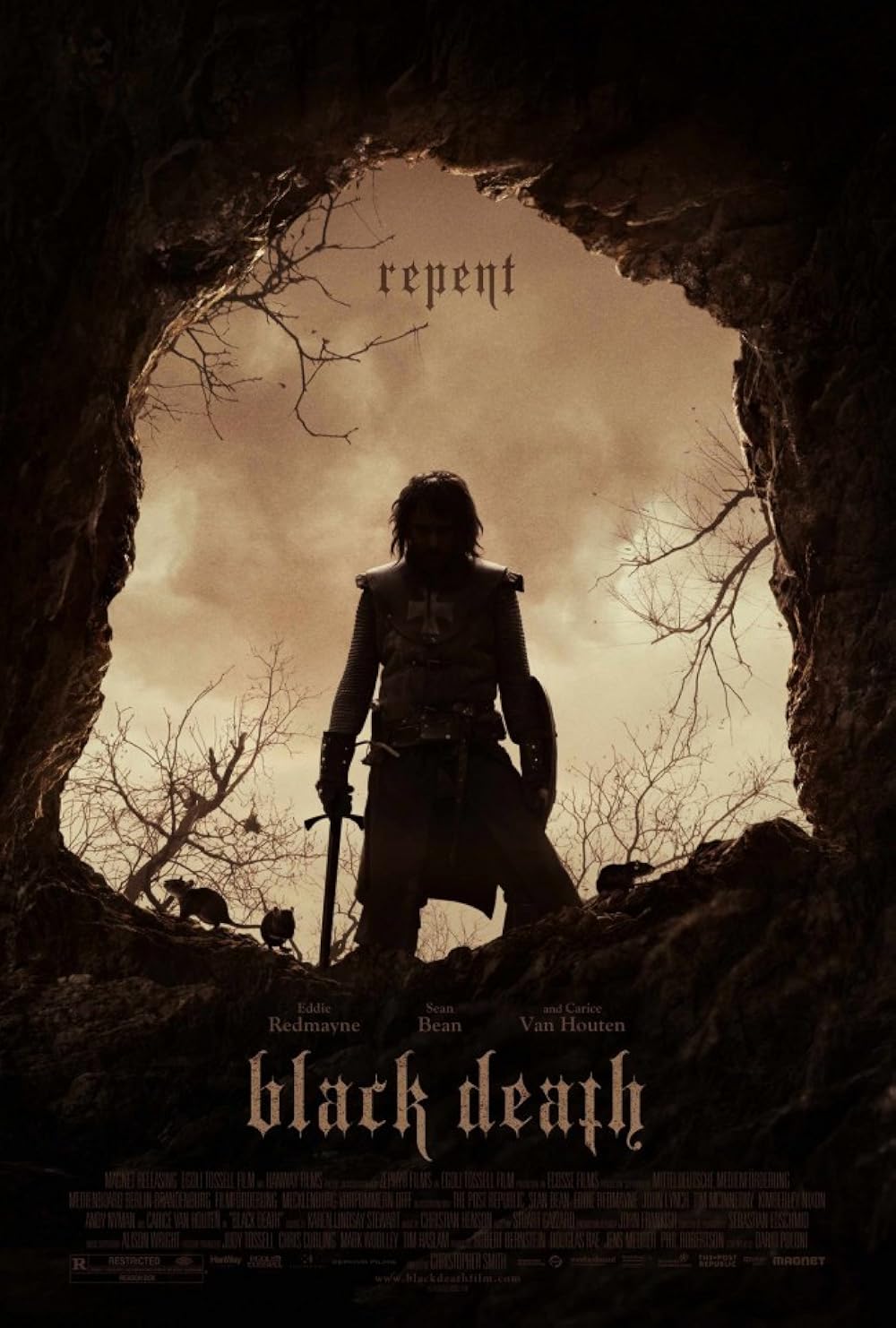
Review: Black Death (dir. by Christopher Smith)


“I believe hunting necromancers and demons serves men more than it serves God.” — Osmund

British filmmaker Christopher Smith has always been something of an under-the-radar presence, steadily putting out films that show flashes of talent without quite breaking into the mainstream. By the time Black Death arrived in 2011 (after its 2010 UK debut), Smith had already built a modest body of work that hinted at a filmmaker sharpening his voice. Looking back now, though, Black Death feels less like a stepping stone and more like a high-water mark—arguably the point where his growth as a director peaked before his later efforts settled into something more pedestrian or simply passable.

Set in 1348 England during the height of the plague, the film follows Osmund, a young monk caught between his religious vows and his love for a woman named Avrill. It’s a familiar internal conflict, but one that Black Death treats with a surprising amount of weight. Osmund’s indecision isn’t just romantic hesitation—it’s a crisis of identity, faith, and fear in a world that feels like it’s actively collapsing. When Avrill gives him a week to choose, that ticking clock hangs over everything that follows, even as the narrative shifts into something darker.

Enter Ulric (Sean Bean), a hardened knight tasked with investigating a remote village rumored to be untouched by the plague—and possibly harboring a necromancer. Osmund volunteers to guide Ulric and his men through the marshes, seeing the journey as both an escape and a test. What follows is less a traditional quest and more a gradual stripping away of certainty, as each step toward the village drags the characters deeper into moral ambiguity.

The journey itself is marked by violence, disease, and small but telling moments of cruelty. One of the film’s most effective scenes involves a woman accused of witchcraft. Ulric appears, at first, to intervene with compassion, only to execute her himself in the name of expediency. It’s a cold, efficient act that encapsulates the film’s worldview—belief, in any form, can justify brutality when it’s held too tightly.

Once the group reaches the village, Black Death shifts gears into something more unsettling. The horror here isn’t loud or overt; it’s quiet, controlled, and deeply psychological. The village’s apparent immunity to the plague raises more questions than it answers, and Smith resists the urge to provide easy explanations. Instead, the film leans into ambiguity, letting tension build through implication rather than spectacle.

At its core, the film is less about the plague itself and more about how people interpret it. Is it divine punishment? A test of faith? Or something else entirely? Smith, working from Dario Poloni’s script, explores how both religious and secular authorities manipulate these interpretations to maintain control. The result is a world where truth becomes secondary to belief—and where belief itself becomes a weapon.

Osmund stands at the center of this conflict, pulled between Ulric’s rigid, punitive worldview and the village’s more enigmatic philosophy. Eddie Redmayne plays him with a quiet restraint that borders on opacity in the first half, but that pays off once the story reaches its turning point. As Osmund begins to unravel, Redmayne lets more complexity seep in, turning what initially feels like a passive character into something far more unstable and unpredictable.

Sean Bean, as expected, delivers a commanding performance. His Ulric is not a cartoonish zealot, but a man whose certainty makes him dangerous. He believes completely in what he’s doing, and that conviction gives his actions a disturbing legitimacy. It’s one of those performances where the lack of doubt is what makes the character so unsettling.

Visually, Black Death commits fully to its bleakness. The mud-soaked landscapes, the gray skies, the ever-present sense of decay—it all reinforces the film’s oppressive tone. Smith’s direction here is notably controlled, favoring atmosphere and tension over flashy technique. The violence, rendered with practical effects, is harsh and immediate without feeling gratuitous, adding to the film’s grounded realism.

There’s an unmistakable echo of Witchfinder General in how the film approaches its themes, particularly in its refusal to draw clean moral lines. Like that earlier classic, Black Death presents a world where righteousness and cruelty often occupy the same space, and where faith can be both a source of strength and a tool of destruction.

What makes Black Death stand out within Smith’s filmography—especially in hindsight—is how confidently it balances all of these elements. The thematic ambition, the performances, the atmosphere, the restraint in its storytelling—it all comes together in a way that his later films haven’t quite matched. Where Black Death feels deliberate and probing, much of his subsequent work has leaned more toward the functional, lacking the same sense of purpose or depth.

That’s not to say Smith lost his technical ability, but the edge—the sense that he was really digging into something uncomfortable and meaningful—feels dulled in comparison. Black Death captures a moment where everything aligned: a strong script, a committed cast, and a director pushing himself beyond straightforward genre conventions.

The result is a film that works on multiple levels. It’s a grim historical horror piece, a character study, and a meditation on faith and control, all wrapped in a stark, unforgiving atmosphere. More importantly, it stands as a reminder of what Christopher Smith was capable of at his peak—even if that peak, in retrospect, came earlier than expected.
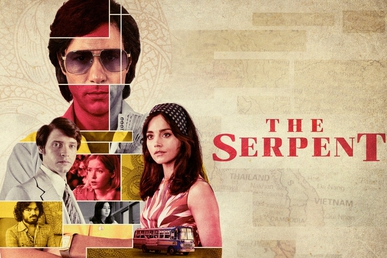
The Things You Find on Netflix: The Serpent (dir by Tom Shankland and Hans Herbots)


Some shows require a bit of patience on the part of the viewer and that’s certainly the case with The Serpent, an uneven but ultimately rewarding 8-episode British miniseries that can currently be viewed on Netflix.

The Serpent tells the true story of Charles Sobhraj (played by Tahar Rahim), a career criminal who spent the 70s smuggling diamonds and killing hippies. Living in Bangkok, Sobhraj and his two associates — his French-Canadian lover, Marie-Andree LeClerc (Jenna Coleman) and his henchman, Ajay (Amesh Edireweera) — preyed on travelers who had come to Asia in search of adventure and sometimes enlightenment. Using the name Alain, Sobhraj would befriend his victims and then drug them. When they were violently ill, he would nurse them back to health. He would also steal their money, use their passports, and he ultimately killed a huge number of them. Sobhraj was a serial killer but, unlike other serial killers, he didn’t kill for pleasure as much as he just killed because it was a part of his business. Sobhraj was also frequently described as being charming and witty, a sort of real-life Bond villain. When he was captured, he would inevitably find a way to escape. When he had finished serving his sentences, he would go to the media and give self-promoting interviews. Indeed, his need for notoriety would ultimately be his downfall.

It’s an interesting tale but it’s also not an easy one to break down into a collection of easy story beats. Sobhraj committed so many crimes and victimized so many different people in so many different countries that it’s hard to know where to ever start with him. The Serpent focuses on the time Sobhraj spent in Bangkok and the efforts of a Dutch diplomat named Herman (Billy Howle) and his wife, Angela (Ellie Bamber), to prove Sobhraj’s guilt and to bring some justice to his countless victims. Working with Herman and Angela are a cynical Belgian named Paul Seimons (Tim McInnerny) and, ultimately, Sorbhaj’s French neighbors, Nadine (Mathilde Warnier) and Remi (Grégoire Isvarine). Throughout the film, we get to know not only Sobhraj’s gang and the people investigating him but also Sobhraj’s victims, the majority of whom were just happy to see a seemingly helpful and friendly face in an unknown land.

As I said, The Serpent requires some patience. The show makes heavy use of flashbacks, continually going back and forth from Sobhraj first meeting his associates and his victims and Herman and Angela investigating his crimes months later. Especially during the first two episodes, it’s difficult to keep track of what’s happening in the past and what’s happening in the show’s present. As the series progresses it becomes easier to follow the plot and the show’s flashback structure actually starts to pay off. You find yourself watching the same scene a second or a third (or even a fourth time) but this time, you have new information and what once seemed odd or obscure suddenly makes terrifying sense. The show’s third episode — which deals with a French tourist (Fabien Frankel, giving a harrowing performance) who finds himself practically a prisoner of Sobhraj and his associates — is especially powerful and suspenseful. It’s the type of thing that will make you wonder about every time a stranger has ever offered to help you out. At its best, The Serpent is a hell of a paranoia generator.

The show divides it’s attention between Sobhraj and Herman. That Herman becomes obsessed with capturing Sobhraj and understanding his crimes is not surprising. That often happens to amateur sleuths. (Michelle McNamara’s self-destructive obsession with the Golden State Killer comes to mind.) Unfortunately, as played by Billy Howle, Herman comes across as being slightly unhinged before he even starts investigating the murders and, as such, we’re kind of left wondering whether it’s his obsession that’s destroying his career or just his own self-righteous personality. As for Tahar Rahim, it took me a few episodes to really appreciate his performance. At first, Rahim’s performance seemed almost too restrained for a character who was charismatic enough to fool an untold number of victims into trusting him. But, as the series progressed, I came to see that Rahim was essentially playing Sobhraj as being an empty but attractive vessel, someone upon whom his eventual victims could project their desires. For those who wanted a lover, Sobhraj projected charm and sensuality. For those who wanted a friend, Sobhraj projected compassion. But, ultimately, it was all projection because there was nothing going on underneath the surface. Sobhraj knew how to manipulate humans but he didn’t know to actually be one.

For me, the series was pretty much stolen by Jenna Coleman, Ellie Bamber, and Mathilde Warnier. Coleman, especially, does a good job of playing Marie-Andree. It’s easy to just say that Marie-Andree was brainwashed by Sobhraj but Coleman suggests that Marie-Andree knew exactly who and what Sobhraj was but chose to pretend otherwise because the glamorous fantasy of their life was preferable to the drab reality of her life back in Quebec. Mathilde Warnier is the story’s often unacknowledged hero, as she repeatedly puts her life in danger to find and photograph evidence of Sobhraj’s crimes. She’s at the center of the majority of The Serpent‘s most suspenseful moments. Ellie Bamber, meanwhile, brings Angela to likable life despite the fact that the script often seems to be trying to sabotage her by giving her some of the show’s worst lines. (In real life, Angela played as active a role in investigating Sobhraj as her husband. In the show, though, Angela is often just portrayed as being wearily supportive even as she worries about Herman’s growing obsession.)

That said, the heart of the show is with Sobhraj’s victims, all of whom are portrayed with more compassion and respect than one typically expects from a true crime series. All of them, from the American girl looking for one night of fun before becoming a nun to the Danish tourists who make the mistake of trusting Sobhraj and Marie-Andree, are portrayed with compassion. Your heart breaks for them and also for what their deaths represent. All of them are too trusting. All of them are, in the beginning, too naïve. All of them are looking for something more than what they had in the boring safety of their old lives. In the end, their murders represent the death of innocence.

As I said, The Serpent requires some patience but it’s ultimately more than worth watching.

Black Death: Trailer


There’s a film called Black Death that came out sometime around 2010 that seems to have fallen below the radar of most everyone. It’s a British historical horror film from upcoming genre filmmaker Christopher Smith. The film stars Sean Bean in the role of a knight during the Black Death era of Europe.

From what I’ve seen of the trailer and read about the film it seems to be a horror film that looks at the Black Death era of history with a slightly supernatural bent to it. Even the trailer gives gives the film a certain Wicker Man vibe to it. Holy warriors of the Christian faith coming into a village untouched by the Black Death. A village whose inhabitants might be dabbling with powers from a much older and earthy religion to keep the village safe. It definitely sounds like this film might have been influenced by that classic horror film starring Edward Woodward.

I like the look of the film as seen through the trailer. It almost looks black and white with splashes of vibrant colors here and there. Black Death hasn’t been announced as having a North American theatrical release date so this film looks like it will be a blu-ray release for me to finally see it.