Movie Review: Texas Chainsaw 3D (dir. by John Luessenhop)


TexasChainsaw3D11012012-thumb-550x382-104468

I like to use 2010’s Nightmare on Elm Street as the basis for horror remakes I’m not fond of. So when Texas Chainsaw 3D was announced, I automatically wrote it off as being something you could put on the shelf right next to this one. I have to admit I was actually surprised. Yeah, it’s a bad movie, but I didn’t find myself scoffing nearly as much as I did Nightmare, which really didn’t work for me at all. I just don’t see myself running back to see this one. I believe part of this has to do with the way the film opens.

Having gone into the film blind, I expected a remake of the remake. Essentially the same story we had with The Texas Chainsaw Massacre: The Beginning. The shock was that the film starts with the events of the original Tobe Hooper film, rendered in 3D (which was very cool, I might add). It then moves to the afternoon after the last victim ran away. This gives anyone who may be unfamiliar with the original a bit of a bridge, and personally having never liked any of the original sequels, I liked the aftermath that takes place.

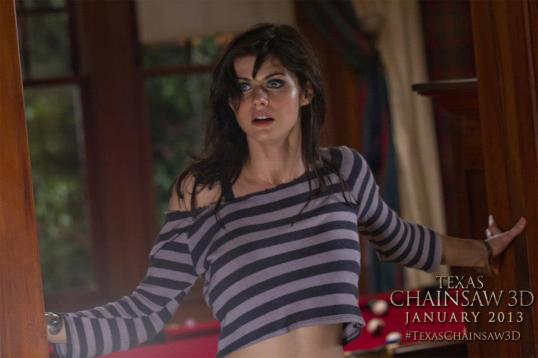
Essentially, Texas Chainsaw 3d is the story of Heather Miller (played by Percy Jackson’s Alexandra Daddario), who receives word from her lawyer that she’s inherited a home in Dallas, Texas. What she doesn’t realize is that this inheritance comes with a few problems. She decides to hop in a van and head down there, accompanied by her friend Nikki (Tania Raymonde), Nikki’s date Kenny (Keram Malicki-Sanchez), and her boyfriend (Tremaine “Trey Songz” Neverson, who the girls in my audience gave the same whoops and catcalls normally reserved for Pattinson/Lautner in a Twilight Showing).

Basically, the movie becomes the cliché “draw this person into isolation and Bam!” that every horror film has, but I’ll admit that I watched a lot of those scenes with my eyes averted, so in that aspect, it got the job done. The visual makeup effects were done by Robert Kurtzman, the “K” in the KNB Effects group (The Walking Dead’s Gregory Nictotero and Howard Berger are the others), and there’s no shortage of blood in this film. While it’s not quite on the level on what the upcoming Evil Dead looks like – that appears to be on the epic Dead Alive levels – Chainsaw does have limbs lost, blood spurting and Leatherface’s signature weapon used to fullest extent. Those moments of isolation come of as very intense, and the direction isn’t bad.

The 3D in the film was nice, though used sparingly. To be honest, the best use of the effects was in what it added to the pieces of the original film that were used. I really enjoyed the outcome there and there are a few key “weapon in the camera” shots that may make you flinch.

Horror films have their eye candy. Sex sells, let’s face it. In Chainsaw, both Raymonde and Daddario had the guys captivated, and Scott Eastwood (Clint’s Son) works for the ladies. While there’s no nudity in the film, good considering how many kids were at my showing, there’s enough skin to appreciate.

What I didn’t like about the film was that in this day and age where you have smart heroes in horror stories – one need only look at Cabin in the Woods here – Chainsaw resorts to the classic “two step, drop” method, meaning that characters meaning to escape will only make it a few steps before stumbling over their feet. I don’t know if that works anymore for audiences. The times that it happened at my showing brought about more laughter than it did horror. Granted, I can’t say I’d be the best of runners with someone wielding a noisy chainsaw behind me, but you’d be damn sure I’d be up or kicking from the floor if I had to. Additionally, the heroes make a few stupid mistakes, which they have to I suppose. Still, I would have liked a few more smart moves. One other thing is that Leatherface himself, while menacing, doesn’t have the same effect that the Brynarski one in Marcus Nispel’s film with Jessica Biel. The Leatherface in that film was a hulking behemoth of a dude that ran with football player like speeds. Chainsaw 3D’s Leatherface is more like your grandpa that caught you stomping around his rose garden and chased after you with garden shears. It’s the equivalent of seeing Dawn of the Dead running zombies and going back to shuffling walkers.

Overall, Texas Chainsaw 3D isn’t anything fantastic and new. You can wait for it on 3D Blu-Ray. If you are an absolute fan of the series, it’s worth a look for both the connections to the original and a cool Gunnar Hansen cameo. Or you can watch it just for Daddario. Just make sure someone else buys you the ticket.

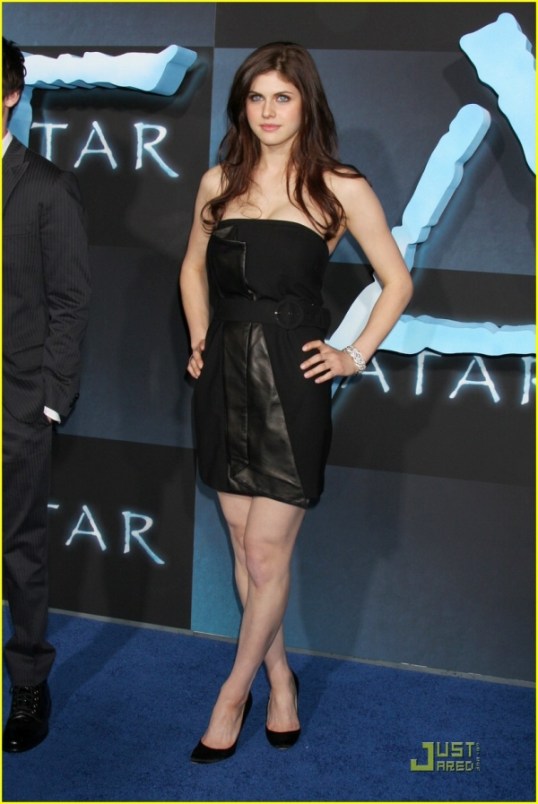
Hottie of the Day: Alexandra Daddario


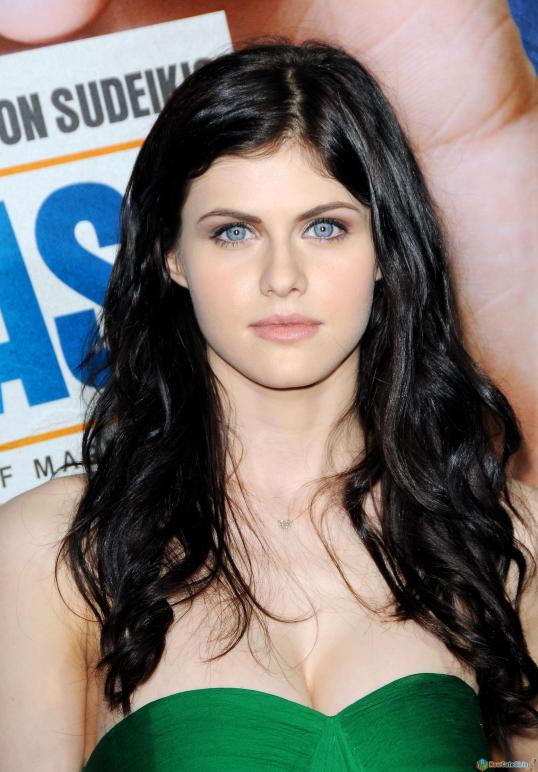
My pick for Hottie of the Day for January 5, 2013 is Alexandra Daddario.

While Texas Chainsaw 3D will probably a blip in the January 2013 movie set, I doubt anyone seeing the film will forget it’s heroine, Heather Miller, played by Alexandra Daddario. Audiences may know her from Parenthood or Blue Collar, but she’s perhaps best known as Annabeth Chase, daughter of Athena in Chris Columbus’ Percy Jackson and the Olympians: The Lightning Thief. With a pair of brilliant blue eyes, this Italian / Czechoslovakian beauty will also grace audiences with Percy Jackson and the Olympians: The Sea of Monsters later this year and hopefully, more in the future.

alexandra daddario under flash

600full-alexandra-daddario

alexandra daddario tcs3d

alexandra%20daddario%20bikini

264909_416462018422923_358535722_n

Alexandra-Daddario-percy-jackson-and-the-olympians

AlexandraDaddario159791

alexandra-daddario


PAST HOTTIES

Quick Review: Zero Dark Thirty (dir. by Kathryn Bigelow)


zero-dark-thirty-releases-a-uk-poster-121641-00-1000-100I’m hoping this won’t be the only review for Zero Dark Thirty. I just happened to view it earlier, and these are my thoughts. As other reviews come in, they will more than likely be in depth.

On May 1st, 2011, news spread around the United States as President Barack Obama announced that a successful operation was completed that resulted in Osama Bin Laden’s death. Academy Award Winning Director Kathryn Bigelow’s Zero Dark Thirty is the story of the events leading up to that operation. This is by far one of the trickiest reviews I’ve ever had to write, considering this isn’t a fictional tale, but one based on actual events. Additionally, in trying to tell you about this, even though you know what happens, I’m leaving out tons of details so that the audience can be surprised. In short, Zero Dark Thirty is easily my front runner for Best Picture and Director this year (and this is coming from someone who enjoyed Lincoln and Silver Linings Playbook this year). I enjoyed it so much that right after seeing it today, I went back in for a 2nd showing.

Zero Dark Thirty doesn’t apologize for anything that occurs in the film. There are actions that may have viewers wincing or possibly questioning the motives behind them. At the same time, it doesn’t really try to glorify anyone either. There are no congratulatory celebrations like you’d find in a Michael Bay film. There’s no one approving of nor condemning in this. There’s just a target, and the people are who are – by whatever means they can – trying to eliminate that target, no sugar coating required. I like to think it takes a bit of courage to throw that up there for audiences. I’m not really certain there’s any other way they could have told it without causing some kind of upset. Unlike Act of Valor, which favored the Military Forces presented on screen, Zero Dark Thirty kind of showcases Seal Team 6 as just a group of guys that need to go in and do a job. It may be considered the safe road in having the distance there, but I felt it worked over all.

Jessica Chastain carries the film as Maya, a CIA Operative who makes it her mission to get UBL. I’ve never seen Chastain’s other films, but she comes across with such ferocity in this movie as it process as it’s hard to ignore her and I’ll probably keep an eye out for her other work. Jason Clarke (Brotherhood) also plays an operative who works with her. Zero Dark Thirty has a great ensemble cast that includes Mark Strong (Green Lantern), James Gandolfini (The Sopranos), Chris Pratt (Wanted), Jennifer Ehle (Contagion), Edgar Ramirez (The Bourne Ultimatum), among others. It didn’t feel like anyone missed a beat on this.

The movie moves at an even pace. It felt long the first time I watched it, but considerably shorter the second time. Mark Boal’s script is pretty lean, moving from scene to scene with ease, which may actually be more to Bigelow’s credit. The first audience I saw the film with gave it tons of applause at the climax of the film – the actual raid done in a mixture of night time shots and night vision camera shots –  and at the end credits. The second group only clapped at the end credits. I imagine there’s going to be mixed responses all around.

Zero Dark Thirty is getting some serious praise from Hollywood and condemnation from political officials, from what I’m seeing online. Yes, the movie does contain scenes of torture, but perhaps my having seen too many horror films, I didn’t quite feel that what was displayed was really that bad.  As I saw the film without knowing any of the historical background of the actual events, the movie worked for me as a tense drama. It’s altogether possible that others may feel differently when viewing it, and that’s okay.

Overall, if you’re able to find a theatre that’s playing the film during this preview period, it’s worth seeing. The movie will open in wide release on January 11.

James Bond Review: Quantum of Solace (dir. by Marc Foster)


So, here we are at the end of all things.

About 22 days ago, The Shattered Lens started a project to cover all of the Bond Films in order leading up to the release of the 23rd film, Skyfall. Spearheaded by Lisa Marie and Arleigh, It’s been a fun ride seeing everyone’s thoughts on James Bond over the movies and it’s cool to know that after 50 years, they still (well, most of them) hold their own. Today, we cover the second Daniel Craig film, Quantum of Solace.

Quantum of Solace reunites the same writing team from Casino Royale – Neal Purvis, Robert Wade and Paul Haggis (Academy Award Winner for 2006’s Crash), and brings on Monster’s Ball director Marc Foster for filming duties. As far as I can tell, it seems to be the first 007 film to start not far from the previous film ended. Literally, there could be a 20 minute difference between the end events of Casino Royale and the opening sequence here. The movie veers away from the classic gun barrel sequence and gets the audience right into the action with Bond avoiding villains in his Aston Martin DBS. The chase leads into a quarry, where he manages to get rid of his opponents. It’s only when he arrives in an unknown location within Siena, Italy that we find he’s had Mr. White in the trunk of his car the entire time. Mr. White was the individual that Bond wounded and introduced himself at the end of Casino Royale.

We basically find James Bond dealing with the loss of Vesper Lynd (Eva Green), and though she never makes any kind of appearance in the film, her presence (or lack thereof) is certainly felt. While Quantum of Solace has some remarkable scenes, for me it suffered from at least one major problem early on. Near the beginning of the film, after the credits, there is a chase between Bond and a villian, as always. At the same time, we’re given shots of a bullfight that’s occurring. While I understand that we’re supposed to see the similarities between both actions, I felt as if I was being pulled away from the story at hand. Foster does this a number of times, including one in the middle of an opera scene. That seemed really strange to me, though others may appreciate it.

Bond is told by M (Dame Judi Dench), after securing Mr. White that she has a lead on Vesper’s boyfriend, but also believes that he’s not quite dead. She asks Bond to leave it alone, but being someone who sees things through, he takes a copy of his photograph. It’s revealed that Mr. White is part of a larger group called Quantum, similar to SPECTRE in some respects. Although Bond loses Mr. White, he gets a clue that leads him to Haiti.

The Haiti sequences were done prior to the earthquake that happened there, and it makes Quantum of Solace one of the last films to show how that area looked before the devastation. 007 is able to find his suspect, but in the course of fighting, he kills him. This becomes something of a thread in Quantum of Solace. Just about anyone that Bond encounters is either killed by him or because of him and at some point, restraint needs to be made. At some point, it goes so far that it becomes something of a “Bond Goes Rogue” tale in the vein of License to Kill. There’s a slight reference to The Spy Who Loved Me with a rooftop fall that’s interesting, as well as a great one for the movie Goldfinger. The Craig Bond stories seem to want to make sure they remind us of all the films before it, though it’s hardly the first 007 story to do so.

The Bond Girls in Quantum of Solace are Olga Kurlyenko and Gemma Arterton. Kurlyenko’s Camille has a mission of her own, as she’s trying to avenge the death of her mother. Arterton’s character, Miss Fields (who’s first name I believe may be Strawberry, but don’t quote me on that) is send in by MI6 to bring Bond back in for debriefing (as he’s been avoiding M’s requests). The actual villain of the movie is played by Mathieu Amalric (Munich), who is more of a hands-off baddie with tons of henchmen at his side.

The problem I had with Quantum of Solace is that it seemed like the Vesper angle was a side note. Yes, we know Quantum is out there, and we learn there’s a plot to control the water of a small area, but outside of all that, it didn’t seem like much of a revenge story. This is unless, of course, it wasn’t meant to be. I’m not a big fan of Quantum of Solace overall. It’s not as bad as Die Another Day (which a number of people consider to be one of the worst) by a longshot, but after what we were given in Casino Royale, it almost seems like it builds on things in the wrong direction.

This weekend, Skyfall is out, and by the time the weekend is up, we’ll have a review for it. We leave you the theme song to Quantum of Solace, “Another Way to Die” by Jack White and Alicia Keys. The Instrumental version of this song is actually really good, though the actual song itself was just a little off.

James Bond Review: Goldeneye (dir. by Martin Campbell)


After License to Kill, there was darkness.

The Bond Franchise would hit the longest lull in the series history, a break of about 6 years before Goldeneye came into fruition. I remember seeing the poster for Goldeneye in a subway station and the shock of both finding out there was finally a Bond film and that they managed to pick one of my favorite Bond choices at the time in Pierce Brosnan.

Albert “Cubby” Broccoli was upset with the response of License to Kill after its release. In the process, he decided to try something new and perhaps go with a different writer / director pairing. John Glen did a number of the Bond films leading up to this, and like a change in coaching, Broccoli may have felt it wasn’t going where it should. MGM, who was in the process of dying (and let’s face it, MGM was like that for some time), were in a deal that would allow the new owners to publish the Bond movies on TV without any consent or control from EON Productions. It was basically a fight to hold on to the ownership of the entire Bond Library, from what I’m finding. I could be wrong there, but it’s how I read into it.

Additionally, Dalton was supposed to do a third Bond film, but the issues between MGM and EON lasted so long that he eventually decided to bow out. Brosnan was approached to play Bond right after Moore finished A View to A Kill, but was unable to do so due to the success of Remington Steele. It was only after License to Kill (and Dalton’s departure) that the offer came back again and this time he jumped right on it.

One of the challenges for Goldeneye was to come up with a story for Bond. With the Cold War ending around the beginning of the decade, they couldn’t use General Gogol and the other angles that worked well in previous 007 files. The story that was made was seemingly tailored to work around that. Goldeneye deals with a joint mission with James and Alex Trevelyan (Sean Bean), who is also 006. During the mission, 006 is believed killed and Bond is able to both complete the job and escape. Bond later discovers that Trevelyan is alive and is behind a plot to fire an orbital EMP that would let him rob all of the banks in London via an electronic transfer. The film concentrates on how Bond doesn’t exactly fit in, considering that so much has changed around him.

One thing that Goldeneye really failed at was the music. Instead of the traditional Orchestra like tones from John Barry, they went with The Professional’s Eric Serra. The music was a mixture of electronic sounds and beats, a major departure from everything that Bond fans up until that point knew. For a number of Bond fans, the music just didn’t work for the film in any way (or only marginally made sense). This would be later rectified in Tomorrow Never Dies and a composer change. Here’s a bit of trivia: The end song of Goldeneye, “The Experience of Love” is actually a song made for The Professional, and an instrumental version of that song can be heard in that film’s soundtrack. Not the first time that’s happened musically – A James Horner track for James Cameron’s Aliens can be heard in the movie Die Hard – but it is a first for a Bond film, as far as I can tell.

Martin Campbell took over the directing for Goldeneye. While he doesn’t have a perfect track record (see Green Lantern and The Legend of Zorro), he was able to pull an action film together. He did so well with Goldeneye that he was actually brought on to film Casino Royale, possibly because both films were different kinds of reboots.

Another notable difference in Goldeneye is the introduction of Dame Judi Dench as “M”. It marks the first time that M is played by a woman. Her candor towards James is that he is “a relic of the Cold War” and a “misogynist dinosaur”. The chemistry between Brosnan and Dench is a bit rough when compared to her work with Daniel Craig, but the change also lends to an interesting dynamic. For someone who is considered a ladies man, here 007 is having to answer to a woman. Not terrible by any means, but it’s a shake up in the scheme of things. A younger Moneypenny (Samantha Bond) is also introduced, whose attitude is similar to M’s, but not as venomous. Desmond Llewelyn returns as Q, providing Bond with a BMW, outfitted with all of the regular gear. Although an Aston Martin DB5 was used in the beginning of the movie, it’s not the same car that Bond uses for the rest of the film. Where Moore was a Lotus driver and Dalton an Aston Martin one, Brosnan would be found behind BMW’s for the span of his 007 career.

For the Bond girls, two are better than one, and for Goldeneye we were given Izabella Scorupco as Natalia Simonova, a programmer with knowledge of how to stop the Goldeneye and a witness to the attack and theft of the device. The other is Xenia Onatopp, a former Soviet helicopter pilot and assassin, played by X-Men’s Famke Janssen. Jansen’s character is a bit cliche in that she kills with her thighs, but one has to wonder if that was just a carry over from what EON had to work with in previous films.

I thought Sean Bean was a great choice for a Bond Villain. At the time, he was young and dynamic, so  his character was able to hold his own with Bond in the fighting scenes and had a great plan with what he wanted to do with Goldeneye. I wouldn’t mind seeing more Bond guys be of the actual fighting type, rather than ones who let their henchmen do it for them. Speaking of henchmen, Alan Cumming’s hacker was more funny than fearsome to me, providing a comic relief to the film. Robbie Coltrane also adds a bit of humor as a contact of Bond’s that leads him to Trevelyan.

Goldeneye is also the first Bond movie to have it’s very own console based video game, and the impact of that game as a first person console shooter was huge at the time. We leave you with Tina Turner’s theme to the movie, with the assistance of Bono and the Edge. Tomorrow, we take on Tomorrow Never Dies.

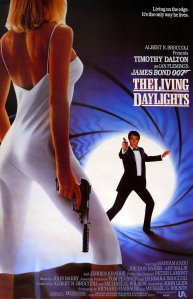
James Bond Review: The Living Daylights (dir. by John Glen)


Addendum: It was brought to my attention that Maryam and Olivia d’Abo are actually cousins, rather than sisters.  This was corrected.  

The Shattered Lens continues it’s coverage of all things Bond with 1987’s The Living Daylights. Timothy Dalton was once approached to play 007 after Connery left the franchise the first time, but being only 22 at the time, he considered himself a bit too young for the role. It was only after Roger Moore’s final role in A View to a Kill that he reconsidered and brought on as Britain’s superspy. What I liked about Dalton as Bond was that he was very cold and direct. There was nothing stylish about him, nor did he really try to be (aside for the usual Bond quip). For me, there was sense of darkness to the character. Dalton’s Bond felt like someone just a second away from doing damage to someone, but not exactly caring about how smoothly it was done. This may be partially why I’ve liked Craig so far in his films.

Below is the trailer for The Living Daylights. It makes chuckle how the word “Dangerous” gets thrown on screen every now and then.

The Living Daylights deals with a Russian plot to kill spies. General Gogol in the Roger Moore films was replaced with General Pushkin (John Rhys-Davies, Sallah from the Indy Films and Gimli from Lord of the Rings), and MI6 believes they are behind the recent deaths of agents during a training mission. Bond is asked to help eliminate a sniper for a defecting Soviet named Koskov (Jeroen Krabbe), but upon realizing that the sniper is a woman, he deliberately misses, shooting the frame of the gun and catching the sniper off guard. Bond manages to get Koskov out of Russia via a tube system, but Koskov is later kidnapped again.

We come to find that Koskov’s defection was a fake and that he’s working with an arms dealer (played by Joe Don Baker, who would later return to the Bond Franchise in Goldeneye as a different character), smuggling Opium and arms. Bond locates the sniper, who turns out to be Koskov’s girlfriend Kara (Maryam d’Abo) and poses a friend to Koskov to get closer to him. Granted, this ends up with Kara falling in love with James and we all know where that goes. d’Abo wasn’t bad as a Bond girl, but arguably her cousin, Olivia was more popular at the time.

Q Branch supplies Bond with a few fun gadgets. Back in the 80s, one fad were these keychain finders that would beep when you whistled or made a sound. 007 receives one of these with both an explosive and a smoke gas pellet inside. It’s pretty much the same setup that Connery had in From Russia With Love, placed in a more “modern day” casing (well, as modern as 25 years ago). Bond is also given an Aston Martin V8 Volante, and after all the Lotus editions in the Moore films – perhaps with the exception of the one that doubled as a sub, that one was awesome – it’s really wonderful to see the franchise return to it’s automotive roots. The car is outfitted with missiles, lasers in the hubcabs, on board skis and the all important self destruct system. As with all of Bond’s toys, he doesn’t manage to return this to Q.

From an action point of view, there isn’t a great deal in The Living Daylights. That’s a fantastic snow chase early on, and a fight on an airplane so popular that it was mimicked in the videogame Uncharted 3: Drake’s Deception. Neither of these try to be too over the top and work to great effect, but there are also a number of slow pacing moments that frankly had me wanting to fast forward through the film. I thought the sequence with the desert was drawn out just a little too much, lending to my notion that whenever a James Bond film uses the desert as a filming location, the movie just isn’t as strong in my eyes. Others, of course, may disagree. What the film does do well is establish Dalton as the new Bond. It doesn’t make fun of who he is compared to who came before in the way Her Majesty’s Secret Service did and just gives you an action sequence that says “Take it or leave it, this is who we’re running with”. I like to think it worked well. One could say it becomes the template for all of the “new 007” films

The Living Daylights notes a few changes in the Bond style. It would be the last film ever scored by long time Bond musician John Barry. The Dalton film after this, License to Kill was actually done by the late Michael Kamen (Robin Hood, Die Hard), and everything after that was either done by Eric Serra (The Professional, Goldeneye) or David Arnold (Stargate and Independence Day). A new, younger Moneypenny is introduced after Lois Maxwell’s departure, but I kind of hoped there would have been more time to see the chemistry grow there.

Overall, for a film that had to introduce a new James Bond to audiences, The Living Daylights does so with the 007 style we all know and love. It’s does downshift during the film to concentrate on the love story, but I felt Timothy Dalton’s dark and cold approach to the signature character adds a lot to the story overall.

The theme song to the film is a stand out by the band A-ha (who was popular with their song, Take On Me), and it’s orchestrated version is used heavily in the film. Tomorrow, we’ll visit License to Kill, where Bond goes rogue.

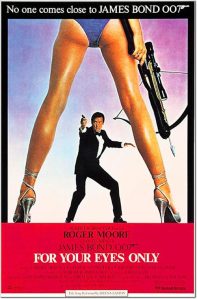
James Bond Review: For Your Eyes Only (dir. by John Glen)


For Your Eyes Only marks a few changes in the way EON Productions wanted to go with James Bond.  With Moonraker being so over the top, the producers decided to go a little more low key and practical. After working on the 2nd unit for Moonraker and a few other Bond Films, John Glen would step up to the plate as the director for this and every 007 film leading up to Goldeneye. Instead of John Barry working on the music, Bill Conti would take over here, which ended up being a very different kind of sound for the film, one fitting of the early 80s.

For Your Eyes Only opens with an interesting start, having Bond visit the grave of his wife, Tracy, who was killed during the events in Her Majesty’s Secret Service. Bond is informed that his helicopter is ready, but when he climbs inside, he finds that it’s under the control of someone with a serious grudge, and though we can’t see his face, we’re to assume he could be Ernst Starvo Blofeld. Supposedly, the scene, which ends with Bond reclaiming control of the helicopter and dropping the would be Blofeld into a chimney pipe, was a jab at writer Kevin McClory. Over the years, the Thunderball lawsuit caused some rifts between McClory and EON Productions. The statement made with For Your Eyes Only was that EON could come up with plenty of great stories without having to use a signature villain like Blofeld. They’d been successful with two movies back to back using Richard Kiel as the henchman Jaws, and probably felt they were doing pretty well. In reponse, McClory would give the Thunderball another try in the bond film Never Say Never Again (which isn’t part of the EON produced Bond films, and won’t be found in any of their Bond Blu-Ray / DVD compilations.

Similar to Tomorrow Never Dies, the story starts with a boat being attacked and sunk. Bond is asked to retrieve a targeting system from the ship and return it to Britain before the Russians do the same. One of the great things about the time period is that since it was pretty much the Cold War, everything was a black ops -sneak in, sneak out – scenario to avoid World War III and nukes being fired by both sides.

The Bond Girl for this film is Melina Havelock (Carole Bouquet), who I really liked here. After her parents are gunned down on their boat, she picks up a bow and arrow to take revenge. As a result, she manages to run into Bond on a number of occasions and had a real sense of calm to her (or as calm as one could be when facing a giant fellow in a scuba suit). The villain of the story, Kristatos was played by Julian Glover, who I enjoyed in Indiana Jones and the Last Crusade and currently on Game of Thrones. I didn’t care much for him in Harry Potter and the Chamber of Secrets as Hagrid’s pet spider, Aragog. One thing to note about Glover is that at one point, he was approached to actually play Bond after Connery left. An interesting casting choice if you notice him is Charles Dance as one of the henchmen and Fiddler On the Roof’s Topol, who played a former business partner of Kristatos’. I found that kind of fun, that you could see these actors here in 1981 that people are familiar with to some degree. The year this came out, Liam Neeson was in Excalibur, for example.

The story features a number of good moments, particularly a great snow skiing chase, a mountain climb as well as a fight between Bond and some hockey players. There’s even a well filmed underwater sequence. Of the Roger Moore Bond films, I always thought of this one and The Spy Who Loved Me as two of his best. With the mission being as small as it is, there wasn’t a lot of room for anything as wild as Moonraker. It’s a pretty tight, practical film that doesn’t rely too much on the gadgetry of the other films. It should also be pointed out that like The Spy Who Loved Me, the signature car for Moore’s Bond is still a Lotus, as I don’t believe the Aston Martins made an appearance until The Living Daylights. That was a little of a letdown for me, but otherwise, the film is beautiful.

Tomorrow, The Shattered Lens takes on Octopussy, a film that showcases just how deadly the circus can be when James Bond is involved. We’ll leave you with the theme song to For Your Eyes Only, sung by Sheena Easton.

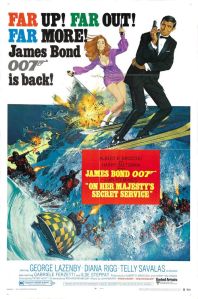
James Bond Review: On Her Majesty’s Secret Service (dir. by Peter Hunt)


By the time Sean Connery was done with You Only Live Twice, he grew tired of being Bond. After all, he’d played the role since 1962 and the ‘70s were on their way. Five movies would do that to you. After that film was done (or near the end of filming it), Connery made it known that he was done with the character and wouldn’t be returning for another installment. Imagine the impact of that. That’s like Daniel Radcliffe having said “You know what? Potter is a tosser and I’ve had it.”, Leaving right after the Order of the Phoenix. That’s not an easy role to fill.

This was the challenge that Albert Broccoli and Harry Saltzman faced in getting On Her Majesty’s Secret Service made. Before watching the movie, I watched one of the documentaries on the casting. It turns out that among the individuals that they wanted to play Bond, Timothy Dalton was offered the role. However, since he was only about 22 at the time, he felt he was too young to play the suave secret agent. The producers eventually went with George Lazenby, who was famous in Australia for commercials, but had the look they were shooting for.

To help push the changes, the marketing team concentrated on everything being “different” and “new”. The idea was that you were still getting James Bond and everything within his universe, but that the kind of Bond you were getting was something awesome. This is evidenced in the trailer and many of the promotion materials.

Broccoli and Saltzman did a search for a leading lady that would be able to support Lazenby. To this end, they recruited The Avengers star Diana Rigg. Her role as Emma Peel (which was later played by Uma Thurman in the box office adaptation) was well-known, and was used as the basis of her ability to work on an action / drama piece like Bond 6. Her character, Countess Teresa di Vicenzo remains one of the best Bond Girls on film (to me, anyway), because of how cold she is from the start of the film. he same could be said of Pussy Galore in Goldfinger, but then again, Lazenby’s Bond is somewhat different from Connery’s. Additionally, Savalas’ Blofeld came across as very dynamic, and between the two, they help to keep the story exciting when Lazenby’s talking lulls others (like the women at his dinner table) to sleep. I don’t think it’s Lazenby’s fault too much. All of the other Bonds either starred in films, like Daniel Craig or television shows, like Moore and Brosnan. For someone who just came off of commercials, Lazenby did a better than expected job, but after 5 Connery films, it’s a hell of a feat to try to take that place in people’s minds.

On Her Majesty’s Secret Service is the story of how James Bond sought out Ernst Starvo Blofeld  and managed to fall so head over heels in love that he got married. That’s basically it. In between, there’s beautiful snow in Switzerland, but OHMSS is at it’s heart very much a love story. It should also be noted that as this is the first film without Connery, there’s a lot of references to Connery’s tenure as Bond and some of these are smile inducing. Right from the start, when Lazenby’s Bond tries to save the countess from drowning herself, he gets caught up in a fight. By the time he’s able to defeat the thugs, she’s run off. No running into his arms, no “Oh..James!” embrace. All of this leads him to look at the camera and exclaim that this type of thing “never happened to the other fellow”. I liked that, I have to admit. There’s also an interesting scene where Bond decides to resign from MI6 and packs his suitcase. The items that he takes out of this drawer are ones from the first 3 films, complete with the musical cues to match them. Much of the first half of the movie works on paying homage to what was done before while trying to get everyone situated with Lazenby.

The movie moves from the beach to where he finds the Countess. After a little 60s coercion (“Talk!” *smack*), She reveals who she is and spends the evening with him, but by the next morning, she’s run off. That morning, on leaving the hotel, he’s kidnapped and is taken to the Countess’ father. The father explains to Bond that like Merida in Pixar’s Brave, Teresa is a bit spirited and that she should be wed. He even goes so far to offer Bond a million dollars, but Bond states that he enjoys the Bachelor’s taste of freedom, but does decide to follow through if the father can provide information on the whereabouts of Blofeld. This leads Bond to an office and an elaborate safe cracking sequence, the results of which give him information on genealogy. Impersonating the person who’s office he was in, he manages to sneak into an establishment in Switzerland that studies about allergies and how to cure them (but may be doing more nefarious deeds).

One cute part about the genealogy is that we’re shown the Bond Family Crest, which comes complete with the family motto “Orbis Non-Suffici”, which translates into “The World is Not Enough” This would later become the title of a future Brosnan film.

We come to find that what Blofeld really is doing is that he’s brainwashing the women he has at the center for use in planting biological weapons around the world. After an escape on skis and a snowy car chase, Bond is eventually able to stop Blofeld and his henchwoman (or at least wound him, anyway). This all leads up to one of the best endings ever devised for a Bond film, because it catches you completely off guard. If there’s any reason to keep this film on your shelf to watch, it’s because it was daring enough to avoid giving the audience the Bond ending you always see, with him heading off with the girl for one that’s ultimately more emotional and/or meaningful. To date, I feel that only Craig’s Casino Royale (which in essence owes a lot to OHMSS) comes close to actually providing something similar. It only falters in that Royale has Bond’s loss focusing him on the notion that he can’t have anyone in his life out of a lack of trust. On Her Majesty’s Secret Service gives the better reason that Bond simply has too many enemies in his life to warrant the connections others have, which makes him almost a sad character in a way.

Lazenby’s performance as Bond is a mix of hit and miss. From an action point of view, I thought he was pretty good. From an acting point of view, he played it a little too much by the book for me, which made me think that he wasn’t really the most exciting Bond there was. He didn’t have Timothy Dalton’s sense of darkness, Roger Moore’s wit, Brosnan’s narcissism or Craig’s coldness. He was just a guy who knew a lot and could punch you in the face if the need arose. Where Lazenby excelled were his interactions with Rigg. As a love story, OHMSS works just fine. As a Bond film, it’s like drinking coffee without any milk in it. You’re still given the same flavor, but it doesn’t quite taste the same. Perhaps this is why he didn’t stick around for Diamonds are Forever, which the producers did have him in mind for.

Musically, John Barry was back on board, and having to come up with something that defined the “New Bond”, he came up with an entirely new theme song. The music for On Her Majesty’s Secret Service is actually pretty damn good, and actually serves to became as much of an Official Theme as “007”, used in From Russia With Love – which actually happens to be my 2nd favorite Bond theme next to “A View to a Kill”.

Tomorrow, the Shattered Lens tackles Connery’s return to form in Diamonds are Forever. Below is the vocal theme for On Her Majesty’s Secret Service, “All the time in the World” by Louis Armstrong. Enjoy.

James Bond Review: Thunderball (dir. by Terence Young)


The Shattered Lens is taking on all of the Bond Films, one a day until the U.S. Release of Skyfall on November 9th. Today, we approach the fourth Bond Picture, Thunderball. Before I start, I should note that this film actually has a bit of controversy behind it. Thunderball had the potential to become one of the first Bond films, but a law suit in 1961 stating that Ian Fleming’s novel for the story was based on the screenplay for the film. Producer Kevin McClory was able to win the lawsuit and hold on to the rights. This would later result in 1983’s Never Say Never Again, with Sean Connery returning to play the same role in the same story as he did in 1965. In the meantime, Dr. No, From Russia With Love and Goldfinger were released with great success.

Before watching the movie, I watched a 1965 documentary from NBC called “The Incredible World of James Bond”, which talked about Ian Fleming, James Bond, and the overall popularity of the character. By the time Goldfinger came out, you’d find lines around theatres all around the world. People were buying colognes and watches – if it had 007 written on it, it was an easy sale. Both the books and the movies were doing extremely well. So with Thunderball being the latest release, it was similar to having perhaps the next Harry Potter or Twilight film on the way. I also learned that Q (Desmond Llewelyn) actually has a name, Major Boothroyd. That was cool to discover.

I wish I could say that I enjoyed Thunderball.  It’s the only Bond film I’ve never seen and the production values for the film were some of the most elaborate around at the time of it’s release. They went out of their way to create submersible machines and other equipment, but the fact that so much of the film took place underwater really caused me to lose interest in what was going on. Granted, it may be fun for many people, but I really wanted to them to give me a few more locales under than the major underwater harpoon fight that occurs near the film’s action climax. Both Tom Jones’ theme song (which describes Bond’s approach to things) and John Barry’s score help to set the mood of the story.

Thunderball continues the SPECTRE story started with Dr. No. Originally, this was supposed to be SMERSH, but that was a real group, much like the KGB or CIA. For movie purposes, SMERSH became SPECTRE to avoid giving any of the Bond stories an anti-nation slant. This would also be done with Quantum of Solace, the organization being something private rather than being any kind of counter intelligence group. This time around, the story opens with Bond attending the funeral of one of the SPECTRE members, and on seeing his wife getting into a car on her own (something I didn’t see as wrong), he follows her to her home to confront her. It’s revealed that the widow is actually the SPECTRE agent (I wasn’t expecting the punch that revealed it), and in the fight Bond ends up killing him. He makes a quick exit and uses a jet pack to get out of the building, where his Aston Martin is waiting for him. It was kind of interesting to see that there was that kind of technology in the 60s.

SPECTRE agent Emilio Largo (Adolfo Celi) is given the task to acquire two Nuclear weapons and decides he’s going to blow up Miami if he doesn’t get his way. Bond is assigned to stop him, and along the way he meets Domino (Claudine Auger), who assists him on this.

At the time of it’s release, Thunderball was a major hit and even won an Academy Award. It managed to come out at the height of Connery’s career as the secret agent. It does suffer from one or two flaws. As most of the story takes place on or near a beach, there are tons of underwater sequences, including a full out battle. Even Finding Nemo took some time to stay on the surface once in a while. This doesn’t make Thunderball a terrible film at all, it simply focuses the story on one element. I would have liked a little more variety.

Q’s gadgets for Bond this time around included a Geiger Counter, a rebreather, an underwater camera, and a personal flare gun, all for the life aquatic.

Overall, Thunderball’s a good film to watch if you’re doing what we’re doing here and are watching the films in a series. You may find yourself a little bothered by the amount of underwater scenes, but the movie still manages to keep some of the spy vibe of the earlier films. Below is Tom Jones’ theme to the film. Tomorrow, the Shattered Lens will take on the David Niven / Peter Sellers version of Casino Royale.

James Bond Review – Goldfinger (dir. by Guy Hamilton)


The Shattered Lens continues the Bond Marathon leading up to the release of Skyfall with 1964’s Goldfinger. Normally, one would figure that the third film in a series is the one with the most danger of ruining everything. You’ve already had two successful stories and you’re asking audiences to come back for yet another round. Yet Goldfinger manages to be considered a favorite by many, and even managed to be the first 007 film to win an Academy Award (for Sound Effects). It does this by expanding on what was already done.

Building on the format that From Russia With Love started, Goldfinger opens with the gun barrel animation and Bond already on a mission. As he reaches what looks like an oil field under the cover of night, he manages to sabotage it (with a little help from C4 or possibly C3, given the time) and arrive back in a neighboring town before it explodes. Heading to his hotel room, he finds a young lady waiting for him who tries to capture his attentions before he catches sight of a thug in the reflection of her eyes. In the fight that ensues, Bond’s quick thinking and a bathtub full of water makes all of the difference. This prologue will become commonplace in all of the EON Production Bond films save for Dr. No (of course) and Quantum of Solace, which gives you the gun barrel at the end of that film.

Sean Connery reprises his role as MI6’s best agent, finding himself in Miami, where he interrupts the card game of one Auric Goldfinger (Gert Frobe), cheating with the help of Jill Masterson (Shirley Eaton). When Bond is caught off guard and knocked out, he wakes up to find Jill dead in her bed, covered in gold paint. The scene actually sparked a number of rumors that Eaton had died in the process of filming it, and as it was mentioned in the film, without leaving a free space near the base of the spine, the actress suffered “skin asphyxiation”. This was later tested on the Discovery Channel’s Mythbusters, and while skin doesn’t “breathe” the way Fleming wrote, your sweat can’t get out of clogged pores. You end up dying of heat stroke. Guess my science teachers were right there, to a degree. The image is so popular, it was even referenced by Quantum of Solace, though Oil was the substance of choice used there.

Bond is given the mission to track Goldfinger and figure out what he’s up, but not without a quick visit to Q Branch. It’s here where we find James’ new car, the Aston Martin DB5, and are introduced to one of longest professional relationships between an automotive company and a production one. Aston Martin would go on to cover nearly every Bond film save for a few (Goldeneye quickly comes to mind), but I’ll profile that relationship in a separate article. The car is outfitted with machine guns, oil slicks, smoke screens and even an ejector seat, believe it or not. Among the gadgets he’s given are two trackers (one large and one small). In terms of the overall series, this is the point where 007 seemingly becomes more of a gadget hound than relying on his actual abilities. I always felt that the ones in From Russia With Love supported him just when he needed it. In Goldfinger, they come across as utility belt like items, though functional all the same.

One of the other standouts in the film is Goldfinger’s henchman, OddJob (Harold Sakata). With a bowler hat that served as a razor disc, he’s one of the most iconic villains in the series, perhaps second only to Richard Kiel’s Jaws. Tomorrow Never Dies and even Goldeneye went on to use henchmen (or henchwomen in Famke Jassen’s case) to great effect.

In going after Goldfinger, Bond runs into Tilly Masterson (Tania Mallet), who mistakenly tries to kill him. They’re eventually caught an in classic 007 Fashion, Bond is placed in a situation that causes one to ask why no one has ever tried to kill him outright. The laser scene that has Bond tied to a table features one of the most famous lines in Goldfinger. When Bond asks Auric if he expects him to talk because of the laser that’s due to cut him in two, Goldfinger stops, turns to face him and exclaims, “No, Mister Bond! I expect you to die!” Needless to say, Goldfinger changes his mind after Bond mentions “Operation Grand Slam”, a plot to seemingly rob Fort Knox. It’s only later that we find that Goldfinger isn’t out to rob the reserve, he’s planning on detonating a nuclear weapon in it that would make all of the nation’s gold radioactive (and all of his gold worth billions, as a result). This is all showcased in a grand sequence involving Pussy Galore’s flight team and some knockout gas. As a kid, I loved it.

Finally, what Bond film would be complete without a Bond Girl? For Goldfinger, we have Honor Blackman’s Pussy Galore. In doing some research on this, I found that according to an article in Empire Magazine, in order to get the name by the American censors, the movie producers took them out to dinner. They decided to not interfere with the name, but it was never exactly listed in any of the US marketing promos. I’d always wondered about that, myself.

As a Bond Girl, Pussy was great in that she handled herself well with both weapons and hand to hand combat. Honor Blackman was well versed in Judo, so her action scenes with Sean Connery were easy to make. Cold and to the point, Pussy Galore wasn’t the “crying over a broken nail” type, but this being the 60’s, they still had the character succumb to Bond’s advances. Personally, I’m not exactly cool with that, but understand that given the time period and possibly the audience, it had to be written as such. Future Bond Girls would make up for it. At least it was good to see that there was a Bond Girl who could stand toe to toe with Bond.

Regarding the casting, one thing that’s also interesting to note that Gert Frobe, who played Goldfinger had a heavy German accent, so heavy in fact that his lines had to be dubbed by someone else. All of the Bond regulars from previous films make a return – Desmond Llewelyn as Q, Lois Maxwell as Miss Moneypenny, in particular. Felix Leiter would be played by a different actor (my favorite being David Hedison from License to Kill).

The impact of Goldfinger has been huge over the years. It’s one of the films everyone usually recalls, and even famed Video Game creator Hideo Kojima pays homage to the film by way of the theme song used in it’s game “Metal Gear Solid 3: Snake Eater”, as the game takes place in the same time period as Goldfinger.

Overall, Goldfinger remains one of the strongest parts of the 007 saga. Tomorrow, the Shattered Lens takes on Thunderball, the Fourth Connery film and the controversy surrounding it. I’ll leave you with Shirley Bassey’s iconic theme to the film.