97 years ago, on this date, Lenny Montana was born in Brooklyn, New York.
Montana started out as a boxer and a wrestler. He eventually ended up working as a bouncer and a bodyguard for the leadership of the Colombo Crime Family. However, Montana achieved his immortality as a result of veteran tough guy actor Timothy Carey turning down the role of Luca Brasi in The Godfather. Brasi was the Corleone Family’s most feared enforcer and Carey, who had made a career out of playing psychos, was one of the most feared men in Hollywood, one who was rumored to have pulled a gun on more than a few directors. (For the record, Stanley Kubrick loved him.) When Carey turned down the role in favor of doing a television series, Francis Ford Coppola offered the role to Lenny Montana. Montana may not have had Carey’s screen acting experience but he brought real-life authenticity to the role. When Michael says that Luca Brasi is a “very scary man,” one look at Lenny Montana confirms it. Unfailingly loyal to the family and willing to do anything for the Don, Luca Brasi represents the Family’s strength. When Luca Brasi is killed, you know that the old era of the Corleones is ending as well. Without Luca, the Corleones are in deep trouble.
My favorite Luca Brasi scene comes at the beginning of the film. Surprised to be invited to Connie’s wedding, Luca wants to thank the Don personally. Nervous about acting opposite Marlon Brando, Montana flubbed his lines. The scene, with the flub, was kept in the film and it served to humanize both Luca and Don Corleone. (The Don’s smile was due to the fact that Marlon Brando was having trouble not laughing.) It’s a nice little scene, one that reminds us that even gangsters are human.
In today’s music video of the day, Britney Spears gets to live every film lover’s dream!
Before I selected this video for today’s music video of the day, it had been a while since I had watched it and I have to admit that I had forgotten that this song was actually written for The Smurfs. When the video started, I thought Britney and her children were watching a deliberately cheesy send-up of Harry Potter and I was like, “Well, that’s clever!”
But then Britney got transported into the movie and that’s when I saw all of the little blue people around her feet. Imagine how different this video would have been if Britney had accidentally stepped on the Smurfs and left a trail of blue gore in her wake. Some in the audience would have cheered but I imagine others would have been traumatized. Myself, I don’t know how I would have reacted as I find the Smurfs to be kind of creepy but, at the same time, I wouldn’t want Britney to have a Smurf massacre on her conscience. In the end, we should just be happy that things worked out for the best.
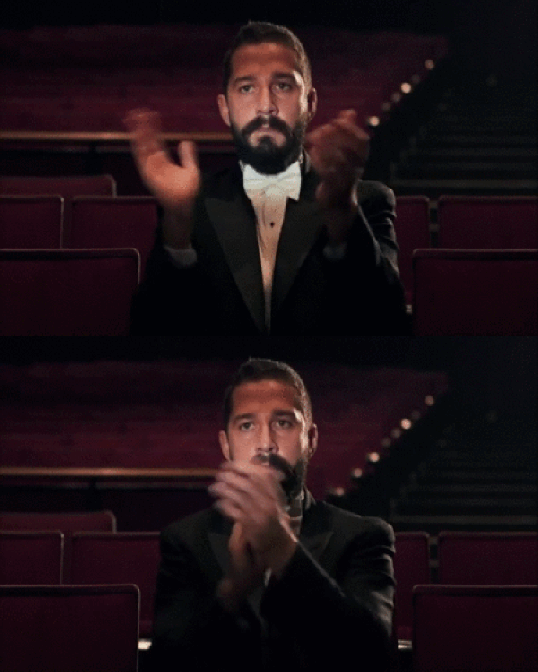
That’s it! That’s a wrap! All that is left to do is to cue up all of our applause GIFs:
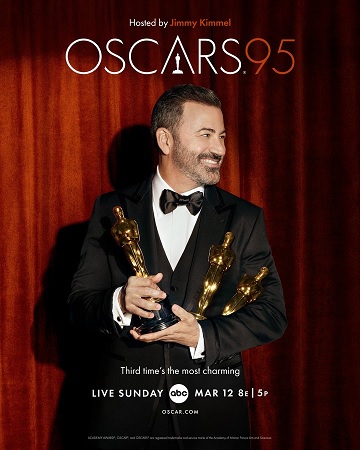
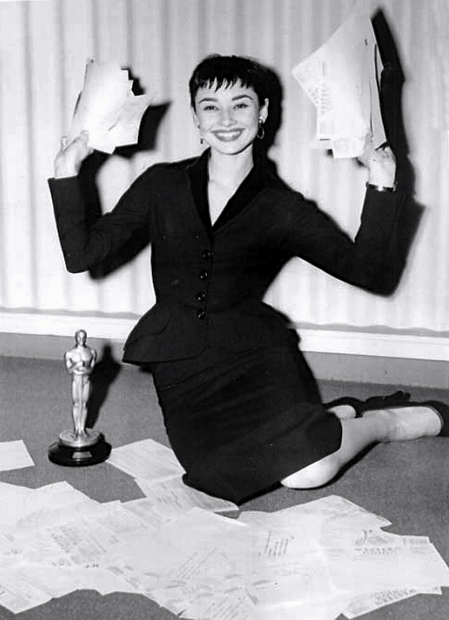
We hope everyone has enjoyed Oscar Sunday!
Now that the Oscars are over with, it’s time to start a new year of entertainment! Thank you everyone for reading us over the course of 2022 and the first three months of 2023!
Now, let’s make 2023 the best year ever as we continue to celebrate the 13th year of the Shattered Lens!
This year’s Oscar ceremony was all about the Slap.
Don’t get me wrong. No one got slapped during the ceremony. No one got yelled at. There wasn’t any major controversy at all, beyond the question of whether Everything Everywhere All At Once actually deserved all of those Oscars. Most of the awards speeches were nice. Ke Huy Quan was a highlight, calling his story “an American dream.” Much as when Gary Oldman praised America upon winning his Oscar for Best Actor, you could tell the audience at the ceremony wasn’t sure how to react to unironic praise of America but I can promise you that his speech touched the hearts of almost everyone watching. Compared to previous ceremonies, there wasn’t a lot of political blathering and the orchestra did its job and kept people from rambling on for too long. Obviously, the Academy learned its lesson from the Soderbergh Oscars and that guy who wouldn’t shut up about his octopus.
That said, from the start, it was obvious that The Slap and preventing another incident was on everyone’s mind. As opposed to last year’s Oscars, the entire ceremony felt tightly controlled. Jimmy Kimmel kept his jokes light and only poked fun at people who didn’t show for the ceremony, like James Cameron and Tom Cruise. Amongst the presenters, there was a definite lack of comedians or, really, anyone who might threaten to go off script and say something controversial. The show was carefully constructed to keep anything shocking from happening and, as a result, it was a bit dull. For all the drama and controversy that surrounded the Slap, it was probably one of the few truly spontaneous moments that we’ve seen on the Oscars. Certainly, more people talked about the Slap last year than are going to be talking the ceremony this year.
This year was safe and boring, though it was never as downright dull as the Soderbergh Oscars. Most of the victories felt inevitable. I guess the biggest upset was Jamie Lee Curtis winning Best Supporting Actress over Angela Bassett. (Though I appreciated that Curtis epitomized everything that normal people hate about the IRS, I was rooting for Kerry Condon.) There was a brief moment of excitement when it seemed like All Quiet On The Western Front might upset Everything Everywhere All At Once but that ended up as soon as All Quiet lost the Adapted Screenplay Oscar to Women Talking.
As far as the speeches go, Ke Huy Quan won the evening by giving a genuine, heartfelt acceptance speech. The Daniels got to give three acceptance speeches and they both seemed to get just a little bit more impressed with themselves with each speech. (A lot of people are going to have their knives out when the Daniels get around to making their third film.) EEAAO‘s editor went on for a bit too long, which is actually kind of a funny thing for an editor to do. Michelle Yeoh’s speech was classy and should be used as a guide who ever wonders what to say when accepting an award.
I was kind of dreading the prospect of Jimmy Kimmel hosting but I thought he did a good job. Other than throwing in a few heavy-handed political jabs towards the end, Kimmel struck the right tone for the show. Jimmy certainly seemed to have a better handle on things than Amy Schumer, Wanda Sykes, and Regina Hall did last year. Of course, unlike those three, Kimmel didn’t have to deal with any nominees walking on stage and striking a presenter.
As far as the musical performances go, the performance of RRR‘s nominated song was a lot of fun and I also thought Lady Gaga did a wonderful job with her song. The other performances didn’t do much for me, though none of them were particularly bad. They were just kind of safe. The fact that EEAAO got a nomination for that song should have been everyone’s first clue that the Academy was going to love the movie.
The ceremony this year was controlled and boring and, most importantly, it’s now over. Now, we can start talking about what’s going to win in 2024!
Like all good Italian crime films, 1972’s Long Arm of the Godfather opens with an absurdly over-the-top act of violence. In this case, a young gangster names Vincenzo (Peter Lee Lawrence) masterminds the hijacking of a delivery of Italian army weapons. It’s gangsters versus soldiers as a ludicrous amount of bullets are fired and even a few grenades are tossed through the air. The violence goes on for so long that actually starts to feel as if the film has become self-aware and is parodying the expectations of the audience. The film seems to be saying, “You want violence? Take this!”
That said, Vincenzo eventually does get away with a truck of weapons. He’s suppose to deliver the truck to Don Carmelo (Adolfo Celi, who is probably best-known for playing James Bond’s nemesis in Thunderball) but Vincenzo has other ideas. After running Carmelo off the road, Vincenzo drives off on his own. His plan is to sell the weapons and use the money to start a new life with prostitute girlfriend, Sabina (Erika Blanc). Unfortunately, because Vincenzo doesn’t have any money, he can’t pay anyone to help him unload the truck. Eventually, he deals with that problem by stealing and selling Sabina’s jewelry. Understandably, Sabina is not happy about this but Vincenzo has an even bigger problem to deal with.
It turns out that Don Carmelo is still alive. Even when Vincenzo and Sabina leave Italy for North Africa and attempt to make a deal to sell the weapons to a group of terrorists, Don Carmelo and his men are following close behind. It all leads to even more violence and an appropriately fatalistic ending. The film’s ultimate message is that there is no escape from a life of crime. There is no way to avoid the long of arm of the godfather.
Perhaps the most interesting thing about the film is that all of the characters pretty much hate each other even before the inevitable betrayals begin. Don Carmelo appears to dislike all of his men and most of his men appear to dislike him to. Even the people who help Vincenzo make little secret of the fact that they can’t stand to be around him. The main exception to all of this mutual dislike is Vincenzo himself. Vincenzo appears to sincerely like (if not quite love) Sabina. Sabina, on the other hand, spends the majority of the film talking about how everything is Vincenzo’s fault. She knows that Vincenzo is in over his head but, at the same time, she also knows that there’s a chance Vincenzo could make a lot of money so she sticks with him. As for Vincenzo, he’s an eternal optimist, trying to find hope even when its clear that there’s none left. Vincenzo may be clever but he’s not particularly smart and that is destined to be his eventual downfall.
Long Arm of the Godfather is an unapologetically pulpy thriller, one in which both the violence and the melodrama are frequently over the top. It’s a film that will be appreciated by fans of hard-boiled crime fiction and Italian exploitation films. Celi is properly intimidating as Don Carmelo while Peter Lee Lawrence gives a charismatic performance as Vincenzo. Tragically, Lawrence would die two years after starring in Long Arm of the Godfather, a victim of a brain tumor that went undetected until it was too late. He was 30 years old and, had he lived, he undoubtedly would have been a big star in European cinema. Fortuntely, one can still watch him in a film like this and see hints of what could have been.
In the 1977 film, Mr. Mean, Fred Williamson plays the title role.
He’s a former employee of the Cosa Nostra who now works as a sort of private investigator. He’s cool. He’s hip. He’s sexy. He’s Fred Williamson! But the best thing about him is that his name actually is Mr. Mean. Everyone in the film literally calls him “Mr. Mean.” He introduces himself as being “Mr. Mean.” The people who are closest to him occasionally leave out the “Mister” and just call him “Mean.”
The film begins with a woman approaching Fred Williamson on a basketball court and saying to him, “Hey, is your name Mr. Mean?”
Later, when he calls his office to check his messages, he tells his secretary, “This is Mr. Mean.”
When he goes to his favorite bar, he’s approached by two members of Ohio Players, the band behind Fire and Love Rollercoaster. They tell him that they are such big fans of him and his reputation that they’ve actually written a song about him. The song is called “Mr. Mean.” They proceed to play the song over the opening credits. For his part, Mr. Mean does not appear to be impressed. That said, I imagine the Ohio Players were probably happier to be playing for Mr. Mean and than for the Brady Bunch.
Mr. Mean is summoned to Italy by a mob boss who wants Mr. Mean to do one last job. He wants Mr. Mean to assassinate a rival gangster, Huberto (Lou Castel). Mr. Mean explains that he may be a fighter and lover but he’s not a killer. However, Mr. Mean then learns that Huberto has been running a scam charity, stealing money that people are donating to help fight hunger in Africa. Mr. Mean takes on the contract. However, Huberto knows that Mr. Mean is in Italy to take him out so Huberto hires an assassin named Rommell (Raimund Harmstorf) to take out Mr. Mean first.
Judging from the endless shots of Mr. Mean casually walking through Rome, it doesn’t appear that either man is in much of a hurry to get the job done. Mr. Mean even takes time to pursue a romance with the mysterious Rene (Crippy Yocard). What little action there is comes to a complete halt so the film can give us a lengthy scene of Mr. Mean and Rene walking along the beach. Eventually, it turns out that Rene has a secret of her own and, for a few minutes, it seems like Mr. Mean might become yet another Fred Williamson film to feature a sudden downbeat finale. But no worries! Mr. Mean may be mean but he’s also clever!
(Actually, Mr. Mean turns out to be a surprisingly nice guy so I’m not really sure how he got that nickname.)
The film’s plot is next to impossible to really summarize because the plot doesn’t make any sense. The story feels like it was made up on the spot, probably because it was. Reportedly, Fred Williamson shot this film while he was in Italy to make Inglorious Bastards. He would spend the week working on Bastards and then, on the weekend, he would borrow the film’s equipment and crew and secretly work on Mr. Mean. He wrote the script while filming. The result is a film that meanders without adding up to much. The main theme of Mr. Mean appears to be that Fred Williamson was Fred Williamson’s biggest fan.
Mr. Mean is one of Fred Williamson’s lesser films. Though he didn’t necessarily have a wide range as an actor, Fred Williamson had charisma and a lot of style and confidence. All of that is on display in Mr. Mean but the film itself is impossible to follow and ultimately just feels like an extended home movie. Mr. Mean just isn’t mean enough to be memorable.
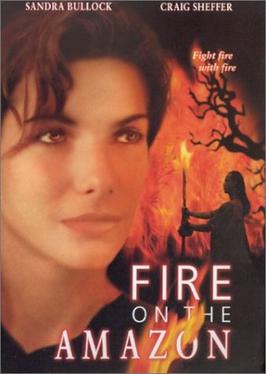
Released in 1993 and produced by none other than Roger Corman, Fire on the Amazon takes place in Bolivia. Despite the protests of the indigenous population and the environmental activists who have flown down to support them, the Rain Forest is being destroyed by corporations, cattle ranchers, and military units. After an activist named Rafael Santos (Eduardo Cesti) is assassinated, photojournalist R.J. O’Brien (Craig Sheffer) comes down to document the accused assassin’s trial.
R.J. tries to remain detached from the injustices that he sees around him. Much like Robert Forster in Medium Cool, R.J. claims to be an observer and not a participant. But then he meets an environmentalist named Alyssa Rothman (a pre-stardom Sandra Bullock) and he comes to realize that the Bolivian government is covering up the details of Santos’s death. R.J. and Alyssa go deep into the Rain Forest, searching for evidence that can prove that the military was behind the assassination. The military, of course, is determined to keep them from doing that.
Fire on the Amazon is a Roger Corman films with a social conscience. It features several speeches about the importance of the Rain Forest and it ends with a title card informing viewers of how much of the Rain Forest was destroyed on a daily basis in 1993. Whatever else one might have to say about the films that Corman has either produced or directed, he has always seemed very sincere when it comes to his messages. That said, Corman has also always been very sincere in his belief that movies should make money and Fire on the Amazon doesn’t allow its environmental message to get in the way of the sex and violence that most of the film’s viewers were probably looking for. The film actually feels a bit like a companion piece to The Forbidden Dance. Yes, saving the Rain Forest is importance but so is doing the Lambada.
Today, if Fire on the Amazon is known for anything, it’s probably for the rather random sex scene featuring Sandra Bullock and Craig Sheffer. To be honest, while the scene is graphic and lengthy, the only thing that sets it apart from other low-budget sex scenes is the fact that it features a future Oscar winner. A huge problem with the scene is that there are next to no romantic sparks between Bullock and Craig Sheffer. Indeed, Sheffer gives such a lifeless performance that, at one point, it appears that he’s actually fallen asleep during the big sex scene. Fortunately, Sheffer sticks out his tongue long enough to let us know that he’s still alive.
Make no mistake about it, while Sandra Bullock may be the name that’s highlighted whenever this film shows up on a streaming site, Craig Sheffer is the star of the film. The majority of the film focuses on him as he wanders around Bolivia and whines about having to do his job. Though he’s certainly not helped by the film’s script, Sheffer gives a performance that alternates between sleep-walking and histrionic shouting. The problem is that the only time Sheffer shows any emotion is when his character has been inconvenienced. He can watch the police beat up a man without barely lifting an eyebrow but, as soon as he’s arrested and put in a cell, the audience is subjected to over a minute of Sheffer shrilly screaming, “Call the embassy!”
It would be nice to say that Sandra Bullock gives a performance that transcends the material but, unfortunately, she’s miscast as a somber activist and, worst of all, she gets stuck with the film’s worst line when she tells Sheffer to write about what “you feel and not what you see.” It seems like better advice would be to do both but what do I know? I mean, as of right now, it seems like people focusing on what they feel as opposed to what they see has led to a lot of problems but maybe the 90s were a simpler time.
Just a year after this film was released, Sandra Bullock would star in Speedand become a star. This meant that Bullock would no longer be filming sex scenes in Roger Corman-produced eco-thrillers. It also meant that Fire on the Amazon would forever be promoted on DVD and Blu-ray as being a “Sandra Bullock film” while Craig Sheffer would often go unmentioned. (In Sheffer’s defense, he’s still acting and has given many performances that are a hundred times better than his work in Fire on the Amazon.) If you want to see a good film about Sandra Bullock in the jungle, check out The Lost City. If you want to see an entertaining environmentally-themed thriller from director Luis Llosa, check out Anaconda. Worthy intentions aside, Fire on the Amazon is best avoided.







 Through the Shattered Lens