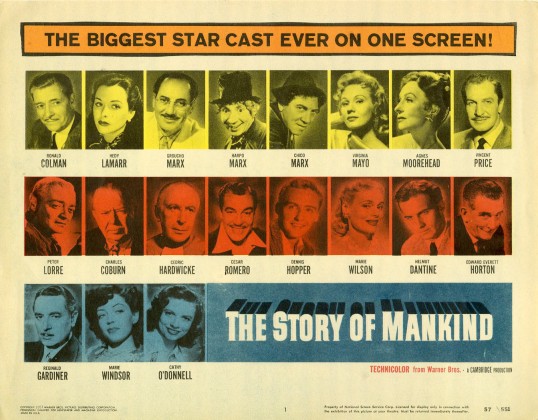
Insomnia File #1: The Story of Mankind (dir by Irwin Allen)


Story of Mankind

What’s an Insomnia File?  You know how some times you just can’t get any sleep and, at about three in the morning, you’ll find yourself watching whatever you can find on cable?  This feature is all about those insomnia-inspired discoveries!

If, last night, you were suffering from insomnia at 3 in the morning, you could have turned on TCM and watched the 1957 faux epic, The Story of Mankind.

I call The Story of Mankind a faux epic because it’s an outwardly big film that turns out to be remarkably small on closer inspection.  First off, it claims to the tell the story of Mankind but it only has a running time of 100 minutes so, as you can imagine, a lot of the story gets left out.  (I was annoyed that neither my favorite social reformer, Victoria C. Woodhull, nor my favorite president, Rutherford B. Hayes, made an appearance.)  It’s a film that follow Vincent Price and Ronald Colman as they stroll through history but it turns out that “history” is largely made up of stock footage taken from other movies.  The film’s cast is full of actors who will be familiar to lovers of classic cinema and yet, few of them really have more than a few minutes of screen time.  In fact, it only takes a little bit of research on the imdb to discover that most of the film’s cast was made up of performers who were on the verge of ending their careers.

The Story of Mankind opens with two angels noticing that mankind has apparently invented the “Super H-Bomb,” ten years ahead of schedule.  It appears that mankind is on the verge of destroying itself and soon, both Heaven and Hell will be full of new arrivals.  One of the angels exclaims that there’s already a housing shortage!

A celestial court, overseen by a stern judge (Cedric Hardwicke) is convened in outer space.  The court must decide whether to intervene and prevent mankind from destroying itself.  Speaking on behalf on humanity is the Spirit of Man.  The Spirit of Man is played by Ronald Colman.  This was Colman’s final film.  In his heyday, he was such a popular star that he was Margaret Mitchell’s first choice to play Rhett Butler in Gone With The Wind.  However, in The Story of Mankind, Colman comes across as being a bit bored with it all and you start to get worried that he might not be the best attorney that mankind could have hired.

Even more worrisome, as  far as the future of mankind is concerned, is that the prosecutor, Mr. Scratch, is being played by Vincent Price.  Making his case with his trademark theatrics and delivering every snaky line with a self-satisfied yet likable smirk on his face, Vincent Price is so much fun to watch that it was impossible not to agree with him.  Destroy mankind, Mr. Scratch?  Sure, why not?  Mankind had a good run, after all…

In order to make their cases, Mr. Scratch and the Spirit of Man take a tour through history.  Mr. Scratch reminds us of villains like the Egyptian pharaoh Khufu (John Carradine) and the Roman Emperor Nero (Peter Lorre, of course).  He shows how Joan of Arc (Hedy Lamarr) was burned at the stake.  The Spirit of Man argues that, despite all of that, man is still capable of doing good things, like inventing the printing press.

And really, the whole point of the film is to see who is playing which historical figure.  The film features a huge cast of classic film actors.  If you watch TCM on a semi-regular basis, you’ll recognize a good deal of the cast.  The fun comes from seeing who tried to give a memorable performance and who just showed up to collect a paycheck.  For instance, a very young Dennis Hopper gives a bizarre method interpretation of Napoleon and it’s one of those things that simply has to be seen.

And then the Marx Brothers show up!

They don’t share any scenes together, unfortunately.  But three of them are present!  (No, Zeppo does not make an appearance but I imagine that’s just because Jim Ameche was already cast in the role of Alexander Graham Bell.)  Chico is a monk who tells Christopher Columbus not to waste his time looking for a quicker way to reach India.  Harpo Marx is Sir Isaac Newton, who plays a harp and discovers gravity when a hundred apples smash down on his head.  And Groucho Marx plays Peter Miniut, tricking a Native American chief into selling Manhattan Island while leering at the chief’s daughter.

And the good thing about the Marx Brothers is that their presence makes a strong argument that humanity deserves another chance.  A world that produced the Marx Brothers can’t be all bad, right?

Anyway, Story of Mankind is one of those films that seems like it would be a good cure for insomnia but then you start watching it and it’s just such a weird movie that you simply have to watch it all the way to the end.  It’s not a good movie but it is flamboyantly bad and, as a result, everyone should see it at least once.


The Daily Grindhouse: Death Has Blue Eyes (dir by Nico Mastorakis)


Death Has Blue Eyes

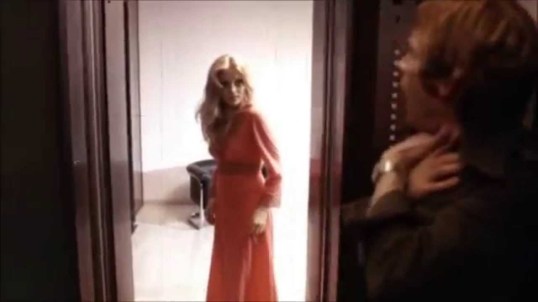
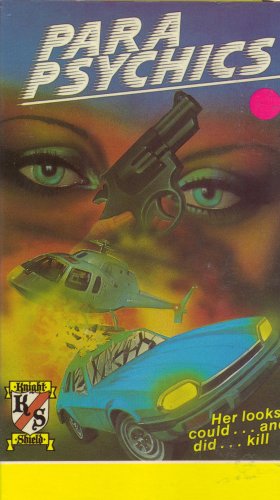
Just in case you needed proof that I will literally watch and review anything, here’s a few thoughts on an extremely obscure Greek thriller, which was first released in 1976.  As often happened with exploitation films in the 70s, this movie was released under several different names.  It’s original Greek title was To koritsi vomva.  Apparently, in England, it was known as The Para Psychics, which is truly a hideous title.  I prefer the American title, Death Has Blue Eyes.

So, maybe you’re wondering how exactly it was that I ended up watching a totally unknown (and unsung) Greek thriller that was filmed long before I was even born.  The trailer for Death Has Blue Eyes was included on the first volume of 42nd Street Forever, an amazingly fun and entertaining compilation of grindhouse movie trailers.  (I imagine that I’m not alone in counting 42nd Street Forever as my introduction to the anything goes aesthetic of the grindhouse.)

Check out the trailer below!

I have to admit that this trailer became something of an obsession of mine.  Some of it, of course, was the music.  And some of it was because every second of the trailer screamed out “low-budget 1970s.”  But, beyond that, I loved this trailer because it contained so many scenes and yet it still told me absolutely nothing about the film.  Seeing as how there were very little information about Death Has Blue Eyes online, I would watch the trailer and I would try to figure out how all of the random scenes fit together.

I could tell, of course, that the film was an action movie.  It was also obvious that the film featured a woman with psychic powers and that she could apparently blow up tents and kill men in bowling alley.  Just as obviously, the two men — one dark-haired and one blonde — were trying to protect her from an evil organization.

But, beyond that, I found myself obsessing on the odd scenes of the two men and the woman on the beach.  Why, I asked myself, were they on that beach?  And why, in a few shots, did both the woman and the blonde guy have such dark circles under their eyes?  Why was their skin so much more pasty and white on the beach than it was in the rest of the trailer?  Why was the blonde guy laughing like a maniac as the tide came in?  Why did the dark-haired guy appear to look so shocked when he saw the blonde guy and the woman dancing?  Why were they dancing on the beach in the first place?  And why, while the mysterious woman looked on with a mournful expression, were the two men fighting in the ocean?

Could it be, I wondered, that the three of them were dead?  And maybe the beach was purgatory?  Perhaps that explained why the blonde guy was laughing.  Maybe he had been killed after opening that briefcase full of money.  Maybe he was laughing at the fact that, as soon as he became rich, he lost his life and found himself on Purgatory Beach.  All that trouble to get all the money and here was betrayed, dead, and in purgatory.  No wonder he couldn’t stop laughing.

And what about that briefcase full of money?  Obviously, this was a heist film.  The two men must have been friends until they both fell in love with the same psychic woman.  And then, after the heist and the fireworks show, the two men turned against each other.  They fought.  They died.  And they ended up in purgatory.

Yes, I thought to myself, that had to be it!

And, as soon as I figured that out, I knew that I had to see Death Has Blue Eyes.  I mean, how often do you get to see a film that so perfectly combines film noir with Catholic theology as the trailer for Death Has Blue Eyes?  Death Has Blue Eyes was obviously a forgotten classic, waiting for one brave red-headed film blogger to defend it!  And if that film blogger has mismatched eyes and loved to dance, all the better!

Unfortunately, it was not easy to see Death Has Blue Eyes.  There’s a few old (and expensive) VHS copies floating around but the film has never been released on DVD or Blu-Ray.  (I am lucky enough to have an old VHS player, as all good lovers of film and history should!)  However, a year ago, someone was good enough to upload Death Has Blue Eyes to YouTube and I finally got to see it!

51NAQXY0RvL

And all I can say is that my version is sooooo much better.

I was right about the film being an action film that featured two guys protecting a blonde with psychic powers.  But I was totally wrong about purgatory.  In fact, when I saw how the beach scenes were actually used in he film, I got angry because my version was so much better!

(Because the film contains a lot of nudity and some violence and I don’t want our little site to get in trouble, I’m not going to embed the video here.  But if you want to watch the film on YouTube, click here!)

Anyway, as for the film, it tells the story of Bob (Peter Winter) and Ches (Hristos Nomikos), who are two con artists who make a living by seducing older women and pretending to be guests at expensive hotels.  After Ches’s latest cougar victim kicks them out of her home, they find themselves homeless.  But then, they’re hired to serve as bodyguards for Christine (Maria Aliferi).  Christine is a powerful psychic who witnessed a political assassination.  Because she can read minds, she knows both who the assassin was and who he was working for!

The rest of the film is basically a nonstop collection of car chases, exploding tents, and random assassins.  (What’s odd is that Christine can blow people up by merely looking at them and yet, she still needs bodyguards.)  It doesn’t make a bit of sense and the two “heroes” are incredibly unlikable but, because it’s such a product of its time, the film is oddly watchable.  It’s terrible and there’s no purgatory but it’s still probably the only film ever made about two gigolos hired to protect a blonde with ESP from a bunch of motorcycle-riding assassins.

That said, I still think my version of the film is better!

Check out some footage below, along with listening to a bit of the film’s score.  As I said, it’s all very 70s.

Trailer: Let Me Make You A Martyr


Here’s the trailer for Let Me Make You A Martyr, an upcoming crime film that has been getting a lot of attention because it features Marilyn Manson as a hit man.

I’m not sure how I feel about this trailer.  I like the visual atmosphere and it’s look like the film uses Manson to good effect.  At the same time, that droning voice over gets on my nerves.

I’ll be looking forward to discovering whether Let Me Make You A Martyr is another Cold In July or another Paperboy.

The Third Annual Academy Awards: 1916


Over on Through the Shattered Lens Presidents the Oscars, Jedadiah Leland and I have been reimagining Oscar history, one year at a time! Today, we take a look at 1916, the year of Thomas H. Ince, Civilization, and Intolerance!

Lisa Marie Bowman's avatarThrough the Shattered Lens Presents The Oscars

Thomas H. Ince, the 2nd President of AMPAS Thomas H. Ince, the 2nd President of AMPAS

In the long history of the Academy of Motion Picture Arts and Sciences, 1916 was dominated by one man: Thomas H. Ince.

Today, Ince is a largely forgotten figure and his many accomplishments have been overshadowed by the mysterious and potentially sordid circumstances of his death in 1924.  However, in 1916, Ince was one of the most popular figures working in the film industry.  He was the first producer to build his own studio in California and, with D.W. Griffith and Academy President Mack Sennett, founded the Triangle Motion Picture Company.  When, following the 2nd Academy Awards ceremony, Sennett announced the he would not be running for a second term as president of the AMPAS, Ince was the obvious choice to replace him.

As President, Ince immediately launched a recruiting drive to bring more industry professionals into the organization…

View original post 1,487 more words

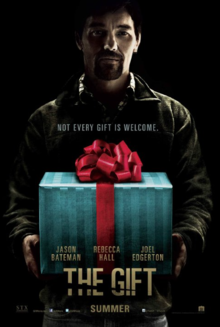
Film Review: The Gift (dir by Joel Edgerton)


The_Gift_2015_Film_Poster1

Because of the nature of The Gift, this post is going to contain minor spoilers.  There’s no way to talk about what makes the film work so brilliantly without giving away a few plot points.  Such is the nature of the beast and all that.  So, if you don’t want to deal with spoilers, allow me just to say this: Go see The Gift.  See it tonight.  See it tomorrow.  See it this weekend.  But, definitely — go see it!

(And if anyone tells you that The Gift is not worth seeing than that person is not really your friend and you need to start hanging out with a better class of people.)

Ryan has already reviewed The Gift and, having watched the film earlier today, I agree with everything that he had to say.  That’s why I am happy to add my voice to his and encourage you to see The Gift.  With this week pretty much dominated by ruminations on the colossal failure of The Fantastic Four and the upcoming weekend guaranteed to be dominated by the release of both Straight Outta Compton and The Man From UNCLE, there’s a definite risk that The Gift is going to get lost in the shuffle.

And that’s unfortunate.  Much like the thematically similar Unfriended, The Gift comes disguised as a conventional thriller but, once you start to unwrap it, you discover that there are layers and layers of subtext and The Gift is actually one of the best and most thought-provoking films of the year.

Like many great Lifetime films, The Gift opens with a married couple living a deceptively wonderful life.  Simon (Jason Bateman) is friendly and charming and appears to be on the verge of getting a big promotion at work.  He and his wife, Robyn (Rebecca Hall), appears to be happy and in love.  They have also got a friendly dog named Mr. Bojangles and they’ve just moved into a beautiful new house.  After spending the last few years in Chicago, they’ve relocated to Simon’s home state of California.  They’re looking forward to starting a family.  Everything’s perfect.

And then, while out shopping for furniture, they run into Gordo (Joel Edgerton).  Gordo explains that he went to high school with Simon.  (At first, Simon swears to his wife that he doesn’t even remember Gordo but that soon proves to be false.)  The socially awkward Gordo starts to send Simon and Robyn progressively more and more extravagant gifts.  After Simon tells Robyn that Gordon was known as Weirdo in high school, Robyn starts to feel sorry for Gordo and insists that Simon try to be friendly towards him.  Simon, however, remains weary of Gordo and his intentions.  At first, it seems like Simon is just being cautious but, as the film unfolds, we discover that Simon has his own reasons for wanting to avoid his old classmate.

The more Gordo tries to insert himself into Simon and Robyn’s life, the more we start to see the cracks behind their “perfect” marriage.  Robyn, it turns out, had previously suffered a miscarriage and has a history of abusing prescription medicine.  Meanwhile, it’s revealed that, behind Simon’s fast smile, there lies a condescending control freak.  (Gordo mentions that Simon ran for senior class president on a “Simon says” platform.)

There’s more to Simon and Gordo’s relationship than either one of them is initially willing to admit.  In high school, Simon was a bully and Gordo was his number one victim.  That Gordo wants revenge on Simon should not be surprising.  That’s obvious from the trailer.  No, the genius of the film is to be found in the way that it subtly reveals that, as an adult, Simon is still as much of a jerk and a bully as he was in high school.  He’s just gotten a lot better at hiding it. The same traits that made Simon a bully in high school have helped him to find material success in the real world.   When Gordo reeneters his life, Simon can no longer hide who he really is.  Gordo is not just his former victim.  Gordo is proof of what lies underneath Simon’s perfect facade.  When Robyn finally convinces Simon to apologize to Gordo, Simon cannot do so convincingly because he’s not so much sorry as he’s just inconvenienced.  When Gordo refuses to accept the apology, Simon’s mask falls away and he reveals his true nature, setting up the film’s devastating conclusion.

(I’m not going to spoil how the film ends but I will tell you that it left me breathless and stunned.  It’s not a happy ending but it is absolutely the right ending for the story that’s being told.  As both the film’s director and writer, Joel Edgerton deserves a lot of credit for staying true to the movie’s theme.)

Rebecca Hall is well-cast as Robyn but, ultimately, the film is dominated by the performances of Jason Bateman and Joel Edgerton.  (Interestingly enough, both Bateman and Edgerton are made up so that they superficially resemble each other, allowing Gordo to literally become the personification of Simon’s ugly side.)  Edgerton transforms Gordo into a character who is both scary and pathetic at the same time.  Meanwhile, Jason Bateman — oh, where to begin?  For the longest time, it’s been impossible for me to look at Bateman without flashing back to that scene in Juno where he hit on Ellen Page.  Now, however, I don’t think I’ll ever be able to look at Jason Bateman without hearing him yell, “Accept my apology!”  Jason Bateman has played a lot of less-than-sympathetic characters but Simon … well, Simon may be the worst.  As an actor, Jason Bateman deserves a lot of credit for not shying away from revealing the truth about Simon.  It takes courage to play such an unlikable character and talent to make that character compelling even when the viewer can’t stand him.

The Gift is an excellent and thought-provoking thriller, the type of film that will both make you jump with fright (I screamed during a certain shower scene and that’s all I’ll say about that) and leave you with much to think about after the end credits roll.

It’s a film that you need to see now.

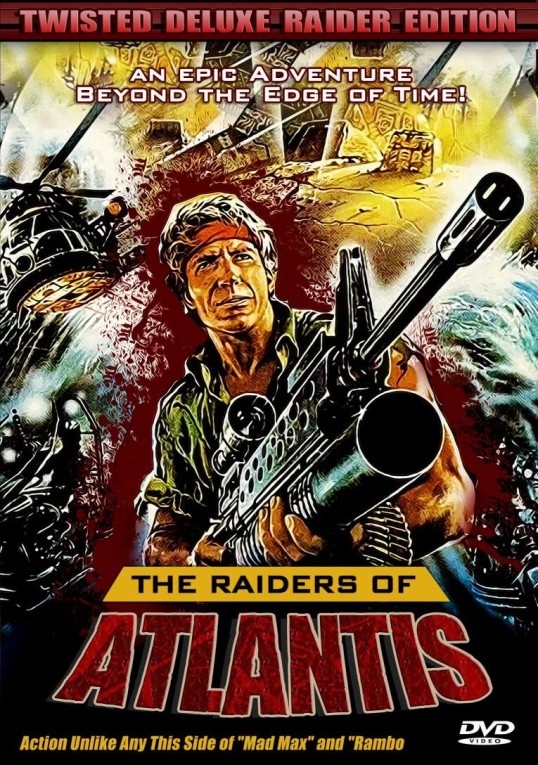
The Daily Grindhouse: The Raiders of Atlantis (dir by Ruggero Deodato)


ROA

It’s been a while since I’ve done an entry in the Daily Grindhouse here at the Shattered Lens.  (And please, no snarky comments about the definition of the word “daily.”  I’ve been doing such a good job of controlling my temper lately…)  So, I figured I’d correct that oversight by taking a few moments to tell you about The Raiders of Atlantis, an Italian film from 1983.

(If you’re a regular reader, you know how much I love Italian exploitation films.)

On many a Saturday night, I have gotten together with my fellow members of the Late Night Movie Crew (including TSL’s own Patrick Smith) and we’ve watched movies with titles like Samson Vs. The Vampire Women, Cruel Jaws, and Space Raiders.  Whenever it’s my night to pick the movie, I’ve always been tempted to select The Raiders of Atlantis.  In many ways, it’s the perfect film to watch with a group of snarky and outspoken friends.  The film is action packed, it features a lot of over-the-top melodrama, the pace is relentless, and the film is so defiant in its refusal to follow any narrative logic that you can’t help but respect its defiant soul.

(If Raiders of Atlantis could talk, it would say, “I do what I want!” before giving the finger to anyone complaining about not being able to follow the plot.)

I’ve come very close to picking it on a few occasions but then I always remember just how violent this film can be.  By the standards of Italian exploitation, The Raiders of Atlantis is actually rather tame but it still features a lot of people dying in a lot of disturbingly graphic ways.  People are set on fire.  People are graphically shot in the face.  One unfortunate woman gets a dart fired into her neck.  Heads roll, literally.

The Raiders of Atlantis tells the story of what happens when a bunch of scientists on an oil rig accidentally cause the lost continent of Atlantis to rise up out of the ocean.  A Caribbean island is conquered by an army of heavily made up, motorcycle-riding, mohawk-sporting “interceptors,” who claim to be the descendants of the original inhabitants of Atlantis.  Led by the evil Crystal Skull (Bruce Baron), the Interceptors are determined to kill everyone who does not possess Atlantean blood.  When they’re not randomly killing, they’re searching for an artifact that will … well, to be honest, I’m not sure why they wanted that artifact but they certainly were determined to find it.

Who can stop the Interceptors?  Well, how about Mike (Christopher Connelly) and Washington (Tony King)?  They’re two mercenaries who just happened to be nearby when the continent of Atlantis rose out of the ocean.  Along with a group of scientists, an escaped convict, and a random bald guy in tuxedo, it’s up to Mike and Washington to save the world!

(Washington, incidentally, has just converted to Islam and spends most of the movie demanding that Mike call him by his new name, Mohammad.  I imagine this is one of those subplots that would be abandoned if the film were remade today.)*

So, as I said before, The Raiders of Atlantis makes absolutely no sense but that’s actually a huge part of the film’s charm.  This is one of those relentless action films that truly does seem to be making it up as it goes along.  There’s something very enjoyable about seeing how many movies The Raiders of Atlantis can rip-off in just 98 minutes and you soon find yourself thankful that the film didn’t waste any time trying to justify itself.  The film may not be traditionally “good” but it is flamboyantly bad and, in many ways, that’s even better.  Maybe you have to be a fan of Italian exploitation cinema to truly understand.

Speaking of which, if you have any experience at all with Italian exploitation, you will immediately recognize half the cast of The Raiders of Atlantis.  You may not know they’re names, because these actors frequently changed their Americanized screen names from film to film.  But you’ll definitely recognize the faces and one of the more enjoyable aspects of The Raiders of Atlantis is that you get to see all of these familiar faces together in one movie.

For instance, Christopher Connelly is best known for starring in Lucio Fulci’s ill-fated Manhattan Baby.  Tony King gave memorable performances in both The Last Hunter and Cannibal Apocalypse.  The cast also features giallo and spaghetti western mainstays George Hilton and Ivan Rassimov, along with Filipino Z-movie veteran Mike Monty.  Stefano Mingardo, who appeared in a handful of violent actions films, shows up as an escaped convict and livens up every scene in which he appears.  Even Michele Soavi, years before he would direct the brilliant Dellamorte Dellamore, appears in a small role.  Unfortunately, George Eastman is nowhere to be found but still, The Raiders of Atlantis is worth seeing for the cast alone.

The Raiders of Atlantis was directed by Ruggero Deodato, who is best known for directing such controversial films as Cannibal Holocaust and The House At The Edge of the Park.  Raiders of Atlantis is nowhere close to being as extreme as either one of those films.  If anything, it feels like a more violent than usual SyFy movie.

The Raiders of Atlantis has apparently slipped into the public domain and, as of this writing, it’s been uploaded to YouTube.  You can watch the trailer below.  This trailer not only captures the feel of the film but it also features the film’s enjoyably vapid theme music.

—–

*And why not remake it!?  Chris Pratt and Tyrese Gibson could play Mike and Washington.

Trailer: Goodnight Mommy


So, what does everyone think of the trailer for Goodnight, Mommy?  For the past few months, people have been hyping this movie as one of the scariest movies ever made.  The trailer certainly has its moments, nicely mixing obvious scares with moments of deep unease and ominous atmosphere.  This is one movie that I will definitely be seeing as soon as it opens in theaters.

4 Shots From 4 Films: Lisa Loves Giallo Edition


4 Shots From 4 Films is just what it says it is, 4 shots from 4 of our favorite films.  As opposed to the reviews and recaps that we usually post, 4 Shots From 4 Films is all about letting the visuals do the talking.

4 Shots From 4 Films

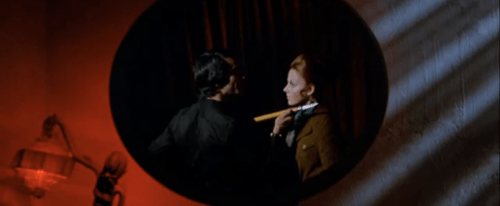
Forbidden Photos Of A Lady Above Suspicion (1970, directed by Luciano Ercoli)

Forbidden Photos Of A Lady Above Suspicion (1970, directed by Luciano Ercoli)

Torso (1973, directed by Sergio Martino)

Torso (1973, directed by Sergio Martino)

Spasmo (1974, directed by Umberto Lenzi)

Spasmo (1974, directed by Umberto Lenzi)

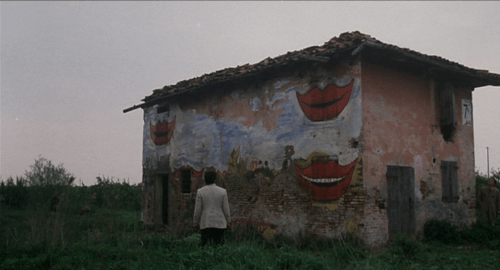
The House With Laughing Windows (1976, directed by Pupi Avati)

The House With Laughing Windows (1976, directed by Pupi Avati)

A Quickie With Lisa Marie: Killer Mermaid (dir by Milan Todorovic)


91BKhDN7ssL._SL1500_

Killer Mermaid!

That’s a great title, isn’t it?  Originally, the title of this 2014 film from Serbia was Nymph.  However, by the time it reached Netflix, it had become Killer Mermaid.  And really, everything you need to know about this movie is right there in that title.  It’s a movie about a mermaid that kills people.  If you have a strong desire to see a movie about a mermaid that kills people, Killer Mermaid is for you.  If you don’t have that desire, then you’re probably not going to be reading this review.

Killer Mermaid takes place in Montenegro.  Two American tourists — Kelly (Kristina Klebe) and Lucy (Natalie Burn) — are visiting their old friend Alex (Slobodan Stefanovic) and his girlfriend Yasmin (Sofija Rajovic).  (Just in case we forget that Kelly and Lucy are Americans, Lucy wears American flag shorts.)  At first, they do typical Americans-in-Europe things.  Kelly attempts to confront some past childhood trauma.  Lucy sleeps with Alex and then worries about Yasmin finding out.  They meet and flirt with Bobban (Dragan Micanovic), a local who looks a lot like Lost‘s Henry Ian Cusick.

And then they make plans to spend a day on a nearby island and exploring an abandoned old military fortress.  They do this despite a local fisherman, Niko (Franco Nero!), telling them that it’s a terrible idea because the fortress was built by evil Nazis and anyone who explores it is destined to die a terrible death.

“Ha!”  the tourists say, “We’re too young and American to die in Montenegro!  Now, let’s go to the remote island with some guy that we’ve only known for 12 hours…”

Ignoring Niko, they go out to the island and … well, you can probably guess what happens.  There’s a mysterious caretaker (Miodrag Krstovic) wandering around the fortress.  He’s protecting something very important to him and, if that means he has to kill some tourists, so be it.

What is the caretaker protecting?  Well, you can probably guess from the title of the film.  There’s a mermaid (Zorana Kostic Obradovic, who has a fantastically evil smirk) living in the waters around the island and she’s a killer.  Whenever she sings, Alex, Bobban, and the caretaker all go into a state of zombiefication.  As women, Kelly, Lucy, and Yasmin are all immune to the mermaid’s song but it really doesn’t matter because, even with that advantage, no one is anywhere close to being smart enough to survive a horror movie.  Just the fact that they ended up on that island in the first place should tell you all you need to know about the intelligence of the characters in Killer Mermaid…

But that’s okay because, with the exception of Niko and maybe Bobban (depending on whether or not you had a crush on Lost‘s Desmond Hume), you really don’t care enough about any of these characters to get upset over their impending doom.  This film is all about the killer mermaid.  It takes her a while to show up and she doesn’t get any lines but she still dominates the entire film.  Say what you will about the script and some of the performances, the filmmakers went to the trouble to give us a believable and viscous mermaid.

Killer Mermaid works far better than it should.  Yes, it’s pretty much your standard killer monster movie but the film looks good and the mermaid is an impressive monster.  While it may never make sense for everyone to have headed off for that island in the first place, the film still makes good use of the atmospheric location.  Add to that, Killer Mermaid delivers exactly what it promises.

And, of course, you’ve got Franco Nero as Niko!  Now, I have to admit that I didn’t recognize Franco when he first showed up.  He’s made up to look as weather-beaten as possible and Nero downplays his trademark charisma, playing Niko as a haunted and emotionally withdrawn man.  To be honest, it’s a far better performance than you would probably ever expect to see in a film called Killer Mermaid but, then again, that’s always been the case with Nero.  He’s always good, no matter how bad some of his movies may occasionally be.  As I’ve said in the past, any movie can be saved by a random Franco Nero appearance and that’s certainly the case with this one.

(That said, it’s hard to imagine that any film will ever top the exhilarating oddness of Franco Nero’s cameo as Jesus in The Visitor.)

That’s Killer Mermaid for you.  It’s exactly what you think it is but, with that in mind, it’s entertaining enough.

And it’s currently available on Netflix!

The First Annual Academy Awards: 1914


Hi there! The blogger known as Jedadiah Leland and I have launched a TSL side project. We are taking Oscar history, re-imagining it, and turning it into something much better, one year at a time! I, of course, will be handling the even years while he handles the odd years. (Why? Because Lisa doesn’t do odd numbers, that’s why!) Here’s our report on the First Annual Academy Awards, honoring the best of 1914.

(You read that right…)

Lisa Marie Bowman's avatarThrough the Shattered Lens Presents The Oscars

Mack Sennett, the 1st President of the Academy Of Motion Picture Arts and Sciences Mack Sennett, the 1st President of the Academy Of Motion Picture Arts and Sciences

Ironically, considering its current prominence in American culture, the origins of the Academy of Motion Picture Arts and Sciences are shrouded in mystery.

Reportedly, in February of 1914, a meeting was held in New York City that led to the founding of the Academy.  While all exact records appear to be lost, it is generally agreed that the meeting was attended by Mack Sennett,Thomas H. Ince, William Randolph Hearst, Charles O. Baumann, John R. Freuler, Samuel S. Hutchinson, Jesse Lasky, William Fox, Adolph Zukor,D.W. Griffith, Cecil B. DeMille, William Kennedy Dickson, Mary Pickford,J. Stuart Blackton, Albert E. Smith, Carl Laemmle, and L. Frank Baum.  By the end of the meeting, not only had the Academy of Motion Picture Arts and Sciences…

View original post 584 more words