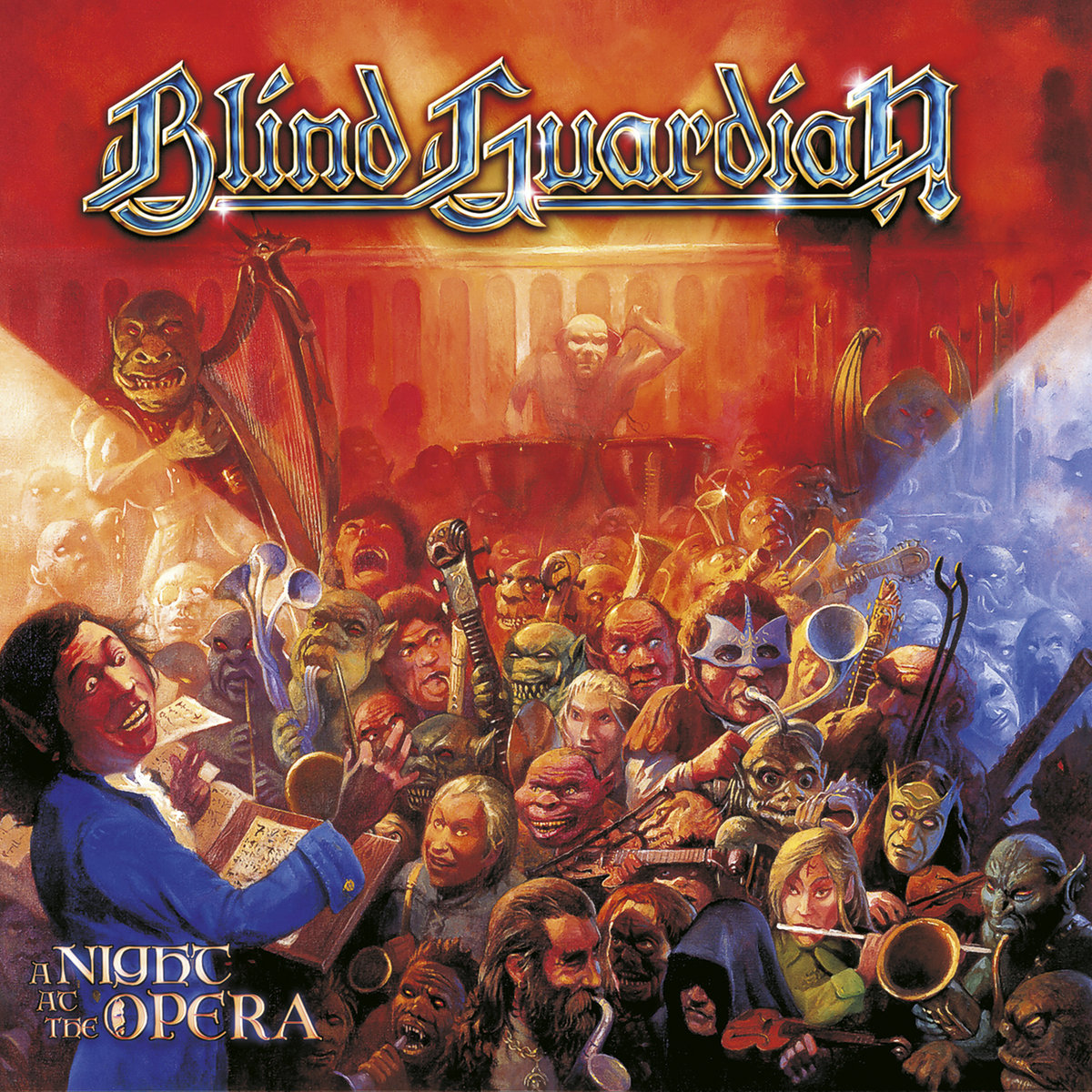
Retro Music Review: A Night at the Opera (by Blind Guardian)


Before getting into it, a little context: this album was my first introduction to Blind Guardian, courtesy of TSL writer necromoonyeti — the same person responsible for putting Boris on my radar. So if this review reads like someone who came in completely cold and got their face melted off, that’s because that’s exactly what happened.

Let’s get one thing straight right away: A Night at the Opera is not a casual listen. It’s not something you throw on while you’re folding laundry or zoning out on the commute home. This is the kind of album that demands you sit down, maybe pour yourself something nice, and just let it completely steamroll you for about an hour. And honestly? That’s exactly the kind of album Blind Guardian needed to make at that point in their career.

Released in 2002, A Night at the Opera is the German power metal legends’ seventh studio album, and it arrived after the already-enormous Somewhere Far Beyond and Imaginations from the Other Side had already cemented the band as giants of the genre. So naturally, Hansi Kürsch and company decided to throw the rulebook entirely out the window. The result is one of the most ambitious, over-the-top, maximalist records in the history of metal — and it rules, even when it’s utterly overwhelming.

The album opens with Precious Jerusalem, and within about thirty seconds you understand exactly what kind of ride you’ve signed up for. The layered vocals, the orchestral bombast, the sheer density of the production — it all comes crashing in like a wall of sound that somehow never feels muddy. Hansi’s voice is front and center, soaring over a choir that sounds like it’s made up of about four hundred people, and it sets the tone perfectly. This isn’t metal with some orchestral elements sprinkled on top. This is something else entirely — something almost operatic in the truest sense of the word.

From there, Battlefield kicks in with a bit more aggression and momentum, which is a welcome shift. André Olbrich and Marcus Siepen’s guitar work throughout the record is phenomenal, but Battlefield is one of the spots where the riffs really get a chance to breathe and cut through the orchestral layering. It’s not quite the straightforward power metal banger you might want it to be, but it’s driving and epic in all the right ways.

Then there’s Under the Ice, which slows things down into something that almost feels mournful. It’s one of the quieter moments on the record, but it’s deceptively powerful. Hansi’s vocal performance here is genuinely moving, and the restraint the band shows — relative to literally everything else on this album — makes it stand out in a really effective way.

If there’s a centerpiece that most people point to when discussing A Night at the Opera, it’s almost certainly And Then There Was Silence. Clocking in at nearly fifteen minutes, it is an absolute monster of a track — a prog-metal epic that tells the story of the fall of Troy through the eyes of Cassandra. Yes, really. And somehow it doesn’t feel self-indulgent. Well, okay, it does feel self-indulgent, but in the best possible way. The track builds and shifts and spirals through so many phases that by the time it reaches its climactic final stretch, you’ve completely forgotten where it started. It’s one of the most impressive things Blind Guardian have ever put to tape, and that’s saying something.

The Maiden and the Minstrel Knight is probably the most accessible thing on the record — a more traditional Blind Guardian ballad that sits comfortably alongside tracks from their earlier work. It’s a bit of a breather in the middle of all the chaos, and it’s genuinely gorgeous. The vocal harmonies are lush and warm, and it’s one of those songs that reminds you how good Hansi Kürsch is at pure melody when he wants to be.

Sadly Sings Destiny and Wait for an Answer keep the epic atmosphere rolling in the back half of the album, though they can start to feel a little dense if you’re not fully locked in. That’s perhaps the one honest criticism of A Night at the Opera— it’s a lot. The production, helmed by Charlie Bauerfeind and the band themselves, is incredibly thick. There are reportedly hundreds of vocal overdubs on some tracks, and while that creates an incredible sound, it can also make the album feel like it’s working very hard to impress you, all the time, without pause. By the time you hit the later tracks, the sheer weight of everything can start to feel a little exhausting if you’re not in the right headspace.

But then The Soulforged comes along and reminds you why you’re here. Inspired by the Dragonlance fantasy series — classic Blind Guardian territory — it’s one of the most energetic tracks on the album, and the chorus is an absolute earworm. It’s big, it’s bright, and it shows that even buried under all the orchestral grandeur, the band still knows how to write a hook that sticks with you for days.

Closing things out, Age of False Innocence and Punishment Divine bring the album home in suitably dramatic fashion. By this point, you’ve been through the full experience, and the record ends feeling genuinely complete — like a proper album with a beginning, middle, and end, rather than just a collection of songs.

So where does A Night at the Opera land in the Blind Guardian catalog? Honestly, it’s one of those records that rewards the people willing to meet it on its own terms. If you go in expecting Somewhere Far Beyond or Imaginations from the Other Side, you might come out a little shell-shocked. But if you give it the time and attention it demands, you’ll find one of the most unique and daring records in power metal history — a band swinging for the absolute fences and largely connecting. It’s not always easy listening, but it’s always worth it.
Song of the Day: And Then There Was Silence… (by Blind Guardian)


The latest pick for Song of the Day is one that is, quite literally, worshipped by some people I know. For them, this is the greatest song ever committed to record — or, if not the absolute pinnacle, something so close to it that the distinction barely matters. Today’s selection is Blind Guardian’s “And Then There Was Silence,” and if you’ve never heard it, you are about to understand what the word “epic” actually means.

The song runs a staggering fourteen minutes long and comes from this German power metal band’s 2001 album, A Night at the Opera. The lyrical foundation draws from two of the greatest works in the Western literary canon: Homer’s The Iliad and Virgil’s Aeneid. Let that sink in for a moment. A heavy metal song rooted in ancient Greek and Roman epic poetry. Specifically, “And Then There Was Silence” chronicles the final days of Troy — the fall of a city, the collapse of a civilization, and the human cost of a decade-long war — all rendered in the language of power metal. The ambition alone is enough to demand respect.

There is a persistent and deeply unfair misconception about metal as a genre — the idea that it is nothing more than formless noise, guttural bellowing, and musicians who wouldn’t recognize a melody if it knocked them flat. “And Then There Was Silence” will dismantle that notion within its first minute. Blind Guardian frontman Hansi Kürsch doesn’t merely carry a tune; he commands the music with a vocal range and precision that rivals the most accomplished operatic tenors and sopranos working today. His voice soars through passages of genuine beauty, then plunges into something more urgent and desperate, perfectly mirroring the emotional arc of the story being told. This is singing in the most demanding and traditional sense of the word.

This is also the song that finally pulled me headlong into the world of power metal — a subgenre I have affectionately and unapologetically taken to calling “nerd metal.” The label is meant as the highest of compliments. Power metal draws its lyrical DNA from fantasy novels, mythology, folklore, medieval history, science fiction, and the great legends of human civilization. It is music made by and for people who stayed up past midnight reading Tolkien, who know the difference between the Trojan War and the Peloponnesian War, and who see no contradiction between loving heavy guitars and loving great literature. Blind Guardian, in particular, have built an entire career on this premise, and “And Then There Was Silence” represents the form at its absolute peak.

What makes the song especially remarkable is its narrative perspective. Rather than presenting the fall of Troy from a broad, panoramic viewpoint, Blind Guardian tells the story through the eyes of Cassandra — the Trojan princess cursed by Apollo to speak true prophecies that no one would ever believe. She saw every catastrophe coming and was powerless to prevent any of it. It is one of the most haunting figures in all of classical literature, and the choice to center the song on her experience gives the music a quality of grief and inevitability that the straightforward historical account could never achieve.

The structure of the song itself echoes that of an ancient epic poem. It builds, recedes, transforms, and builds again. I have compared its finale to the ending of Peter Jackson’s The Return of the King — the one famously criticized for having too many endings. Just when you feel certain the song has reached its emotional peak and is preparing to close, another movement begins, and rather than feeling excessive, each new section deepens and enriches everything that came before it. The song earns every one of its fourteen minutes.

Here is the honest truth: even people who are entirely indifferent to metal — who would not voluntarily put on a heavy guitar record under any ordinary circumstances — tend to find something in this song that reaches them. Something in the melody, the storytelling, the sheer scale of it connects across the usual genre boundaries. It asks only fourteen minutes of your time and, in exchange, offers something genuinely unlike almost anything else in popular music. That seems like a reasonable trade.

And Then There Was Silence

Turn your head and see the fields of flames

He carries along
From a distant place
He’s on his way
He’ll bring decay
(don’t move along cause things they will go wrong
the end is getting closer day by day)
in shades of grey
We’re doomed to face the night
Light’s out of sight

Since we’ve reached the point of no return
We pray for starlight
We wait for the moon
The sky is empty
Alone in the unknown
We’re getting nowhere

We have been betrayed
By the wind and the rain
The sacred halls empty and cold
The sacrifice made should not be done in vain
Revenge will be taken by Rome

We live a lie
Under the dying moon
Pale faced laughs doom
Indulges in delight

It’s getting out of hand
The final curtain will fall
Hear my voice
There is no choice
There’s no way out
You’ll find out

We don’t regret it
So many man have failed
But now he’s gone
Go out and get it
The madman’s head it shall be thine
We don’t regret it
That someone else dies hidden in disguise
Go out and get it
Orion’s hound shines bright

Don’t you think it’s time to stop the chase
Around the ring
Just stop running, running
Round the ring
Don’t you know that fate has been decided
By the gods
Feel the distance, distance
Out of reach

Welcome to the end…
Watch your step, Cassandra
You may fall
As I’ve stumbled on the field
Sister mine
Death’s a certain thing
Find myself in darkest places
Find myself drifting away
And the otherworld
The otherworld appears

Find myself, she dies in vain
I cannot be freed
I’m falling down
As time runs faster
Moves towards disaster
The ferryman will wait for you
My dear

And then there was silence
Just a voice from the otherworld
Like a leaf in an icy world
Memories will fade

Misty tales and poems lost
All the bliss and beauty will be gone
May my weary soul find release for a while
At the moment of death I will smile
It’s the triumph of shame and disease
In the end
Iliad

Raise my hands and praise the day
Brake the spell, show me the way
In decay
The flame of Troy will shine bright

The newborn child would carry ruin to the hall
The newborn’s death will be a blessing to us all

Good choice?
Bad choice?
Out of three
You’ve choosen misery
Power and wisdom
You deny
Bad choice

War is the only answer
When love will conquer fear
So the judgment’s been made
To the fairest
The graceful says
Badly he fails

Warning
Fear the heat of passion, father king
Don’t let him in
Don’t let her in
Desire, lust, obssession
Death they’ll bring
We can’t get out
Once they are in

She’s like the sunrise
Outshines the moon at night
Precious like starlight
She’ll bring in a murderous price

In darkness grows the seed of man’s defeat
Jealousy
I can clearly see the end now

The thread of life in spun
The coin’s been placed below my tongue
Never give up
Never give in
Be on our side
So we can win
Never give up
Never give in
Be on our side

Old moon’s time is soon to come

Nowhere to run
Nowhere to hide
Nothing to lose
Like one we’ll stand
We’ll face the storm
Created by man

Troy, Troy, Troy, Troy

And as the lion
Slaughters man
I am the wolf
And you’re the lamb

Hallowed Troy shall fall
Round the walls
Faith is shattered, bodies fall

Nowhere to run
Nowhere to hide
Nothing to lose
Like one we’ll stand
It’s all for one and one for all
All we live for will be wiped out

I feel that something’s wrong
Surprise, surprise they’re gone
Full moon your time goes by
And new moon’s still kept out of sight

We live
We die

Misty tales and poems lost
All the bliss and beauty will be gone
May my weary soul find release for a while
At the moment of death I will smile
It’s the triumph of shame and disease
In the end
Iliad

Raise my hands and praise the day
Brake the spell, show me the way
In decay
The flame of Troy will shine bright

Roam in darkness
Spread the vision
We will be lost if you truly believe
Troy in darkness
There’s a cold emptiness in our hearts
That they’ve gone away
And won’t come back

They’ll tear down the wall to bring it in
They’ll truly believe in the lie
With blossoms they’ll welcome the old foe

The vision’s so clear
When day and dream unite
The end is near
You’d better be prepared

The nightmare shall be over now
There’s nothing more to fear
Come join in our singing
And dance with us now
The nightmare shall be over now
There’s nothing more to fear
The war it is over, forevermore

No hope
The blind leads the blind
Carry on
Though future’s denied
Mare or stallion
There’s far more inside
We are in at the kill
We’ll cheerfully die

Misty tales and poems lost
All the bliss and beauty will be gone
May my weary soul find release for a while
At the moment of death I will smile
It’s the triumph of shame and disease
In the end
Iliad

Raise my hands and praise the day
Brake the spell, show me the way
In decay
The flame of Troy will shine bright

Its holy light shines on
So the judgement’s been made
We’re condemned though the trial’s far ahead
The crack of doom
Father
Your handsome son is heading home

Heading home

Still the wind blows
Calm and silent
Carries news from a distant shore

Out of mind
Can’t get it
Can’t get it out of my head

Sorrow and defeat
Sorrow and defeat

Continue reading

Song of the Day: Harvest of Sorrow (by Blind Guardian)


Who would’ve thought that a German power metal band will end up penning and composing one of the best ballad’s dedicated to a story from J.R.R. Tolkien’s classic novel, Silmarillion. Power metal bands has always been quite adept at using fantasy-related subject matter as inspiration for songs and entire albums. The band Blind Guardian have pretty much made a career out of using J.R.R. Tolkien’s stories and tales as inspiration. They’ve even dedicated an entire full-length album to Middle-Earth: Nightfall in Middle-Earth.

One of the bonus tracks from Nightfall on Middle-Earth is our “Song of the Day.” It is a song based on Tolkien’s tragic tale of  Túrin Turambar as he mourns the loss of his sister Nienor. One would expect Harvest of Sorrow to be full of metal riffs and overdubbed vocals common in metal power ballads, but this is not the case in this Blind Guardian ballad. The band has instead gone renaissance folk-rock in their composition. I will say that their stylistic choice fits the song well. The song has been so popular that there are nine versions of the song. There are the seven recording variants in addition to two live versions. There are two English versions, two versions in Spanish, one in French and another in Italian with another a mix of all versions minus the English acoustic.

So, those who think that metal is all about sturm und drang with screaming and guttural noises will be in for a surprise to know that they can also be quite subtle in the music they make. Harvest of Sorrow is a fine example and quite easy to sing-along to. Just pull up a chair at the table, grab a stein of ale or a horn full of mead and sing-along using the lyrics provided.

Harvest of sorrow

She is gone leaves are falling down
The tear maiden will not return
The seal of oblivion is broken
And a pure love’s been turned into sin

At the dawn of our living time
Hope may cover all cries
Truth lurks hidden in the shadows
Dreams might be filled with lies
Soon there will be night
Pain remains inside

Suddenly (oh) it seemed so clear
All the blindness was taken away
She closed her eyes and she called out my name
She was never ever never ever seen again

Harvest of sorrow, your seed is grown
In a frozen world full of cries

When the ray of light shrinks
Shall cold winter nights begin

She is gone and I fall from grace
No healing charm covers my wounds
Fooled’s the dawn and so I am
Fooled by life and a bitter doom
To bring you the end of the day

At the dawn of our living time
Hope it soon will pass by
Facing a darkness
I stand (alone)

Harvest of sorrow, your seed is grown
In a frozen world full of cries
When the ray of light shrinks
Shall cold winter nights begin